While in Dublin Sheridan attends the English Grammar School in Grafton Street. The family moves permanently to England in 1758 where he is a pupil at Harrow School from 1762 to 1768. After his period in Harrow School, his father employs a private tutor to directs his studies.
In 1775, Sheridan’s first play, The Rivals, is produced at London’s Covent Garden Theatre. It is a failure on its first night. He casts a more capable actor in the lead for its second performance, and it is a smash which immediately establishes the young playwright’s reputation and the favour of fashionable London. It has gone on to become a standard of English literature.
Shortly after the success of The Rivals, Sheridan and his father-in-law, Thomas Linley the Elder, a successful composer, produce the opera, The Duenna. This piece is accorded such a warm reception that it plays for seventy-five performances.
The following year, Sheridan, his father-in-law, and one other partner purchase a half-interest in the Drury Lane theatre and, two years later, buy out the other half. Sheridan is the manager of the theatre for many years and later becomes sole owner with no managerial role.
His most famous play, The School for Scandal (Drury Lane, May 8, 1777), is considered one of the greatest comedies of manners in English. It is followed by The Critic (1779), an updating of the satirical Restoration comedyThe Rehearsal. He has a rivalry with his fellow playwright Richard Cumberland and includes a parody of Cumberland in The Critic. In 1778, Sheridan writes The Camp, which comments on the ongoing threat of a French invasion of Britain.
In 1780, Sheridan enters Parliament as the ally of Charles James Fox on the side of the American Colonials in the political debate of that year. He remains in Parliament for 32 years.
On February 24, 1809, despite the much-vaunted fire safety precautions of 1794, the theatre burns down. On being encountered drinking a glass of wine in the street while watching the fire, Sheridan is famously reported to have said, “A man may surely be allowed to take a glass of wine by his own fireside.”
When he fails to be re-elected to Parliament in 1812, his creditors close in on him and his last years are harassed by debt and disappointment. On hearing of his debts, the United States Congress offers Sheridan £20,000 in recognition of his efforts to prevent the American Revolutionary War. The offer is refused.
In December 1815 Sheridan becomes ill and is largely confined to bed. He dies in poverty on July 7, 1816, and is buried in the Poets’ Corner of Westminster Abbey. His funeral is attended by dukes, earls, lords, viscounts, the Lord Mayor of London, and other notables.
Fenians propose a “New Departure,” an alliance with the Parnellites, on October 27, 1878. The term New Departure is used to describe several initiatives in the late 19th century by which Irish republicans, who are committed to independence from Britain by physical force, attempt to find a common ground for co-operation with groups committed to Irish Home Rule by constitutional means. The term refers to the fact that Fenians are to some extent departing from their orthodox doctrine of noninvolvement with constitutional politics, especially the British parliament.
John O’Connor and Dr. Mark Ryan, both members of the IRB’s Supreme Council, believe O’Connor Power has some hand in the new departure. John O’Connor suspects that Michael Davitt of the IRB has been influenced by O’Connor Power, and that the new departure proposals conceal some sinister scheme of Power’s devising, assumptions that Davitt hotly rejects. The precedent for constitutional agitation set by Power is not lost on orthodox Fenians such as Dr. Ryan, who sees behind the new departure the nefarious influence of the member for Mayo.
In late 1878 Michael Davitt makes a fund-raising political lecture tour of the United States, promoted by William Carroll and John Devoy of Clan na Gael. On October 13 in Brooklyn, New York, Davitt first presents, in a lecture titled “Ireland in parliament from a nationalist’s point of view,” a doctrine that Irish republicans cannot prevent Irishmen voting or being elected to the British parliament, but they can influence who is sent to that parliament. He states that the Home Rule League, especially Isaac Butt and John O’Connor Power, are failing to prevent Ireland from being “imperialised” or “West Britainised.” Davitt however believes that Parnell and Joseph Biggar are acceptable Irish MPs, and Irish republicans should ensure that more such strong nationalists are voted in. John Devoy follows and points out that if Irish republicans are to gain the support of Britain’s potential enemies, such as Russia, they need to provide far stronger opposition to Britain both inside and outside parliament. He points out that Russia has not yet seen the Irish as providing any such meaningful opposition, in fact to Russia they appear loyal to Britain. Hence it is necessary to replace representatives in all Irish public bodies with suitable committed nationalists. Both Davitt and Devoy at this meeting stress that resolution of the Irish land question by transfer of ownership to the farmers themselves is integral to Irish demands on Britain.
On October 27, 1878, Devoy, without first consulting Davitt, summarises these ideas in what he terms a “new departure” in the New York Herald, and it is reported in Ireland on November 11. He also states that Irish participation in the British parliament is to be temporary, and that at a suitable time Irish nationalist MPs will withdraw to Dublin and form an independent Irish legislature. Davitt is at first worried that perceived connections to the Fenians will threaten Parnell in parliament, but Devoy convinces him that Parnell will not be affected. IRB leaders John O’Leary and Charles Kickham reject the overture to constitutionalists and Parnell gives no comment. He does however adopt the militant rhetoric of land ownership to be transferred to the Irish farmers themselves in various public speeches in Ireland. Hence the stage is set for the successful collaboration in 1879 over the Land War.
Threatened by lung trouble in 1879, Plunkett goes to the United States and spends ten years as a cattle rancher in the Bighorn Mountains of Wyoming. He returns to Ireland in 1889 and devotes himself to the agricultural cooperative movement, first organizing creameries and then, in 1894, the Irish Agricultural Organisation Society, a forerunner of similar societies in England, Wales, and Scotland. A moderate Unionist member of Parliament for South County Dublin from 1892 to 1900, he becomes vice president (1899–1907) of the new Department of Agriculture and Technical Instruction for Ireland, which he has been instrumental in creating.
Plunkett’s later experience convinces him of the need for the independence of an Ireland without partition inside the Commonwealth, and he fights strongly for this goal, as chairman of the Irish Convention (1917–18) and, in 1919, as founder of the Irish Dominion League and of the Plunkett Foundation for Cooperative Studies, an agricultural research and information centre. He is appointed to the first Senate of the Irish Free State (1922–23). His house in Dublin is bombed and burned during in the Irish Civil War and he lives in England thereafter. In 1924 the Plunkett Foundation also moves to England. In 1924 he presides over a conference in London on agricultural co-operation in the British Commonwealth and in 1925 he visits South Africa to help the movement there.
The Garda Special Branch informs the Minister for JusticeMicheál Ó Móráin and TaoiseachJack Lynch that a plot to import arms exists and includes government members, however Lynch takes no action until the Special Branch makes opposition leader Liam Cosgrave aware of the plot. Cosgrave tells Lynch he is aware of the plot and will announce it in the Dáil the next day if he does not act. Lynch subsequently requests that Haughey and Blaney resign from the Cabinet. Both men refuse, saying they had done nothing illegal. Lynch then asks PresidentÉamon de Valera to terminate their appointments as members of the government, a request that de Valera is required to grant by convention. Haughey and Blaney are subsequently tried in court along with Captain James Kelly, a former intelligence captain in the Irish Army, and Albert Luykx, a former Flemish Nationalist and businessman, who allegedly used his contacts to buy the arms.
The verdict, reached by jury after two hours and 10 minutes of deliberation, leads to political repercussions for the Government of Taoiseach Jack Lynch. Lynch had dismissed the Haughey from his Cabinet post the previous May on the allegation of illegal gunrunning.
Witnesses declare during the 14‐day trial that the arms, imported from the Continental Europe, were ultimately destined for the Roman Catholic minority in Northern Ireland. However, the defense contends that the arms had been brought in with the knowledge and approval of the current Minister for Agriculture, Jim Gibbons, who was serving as Minister for Defence at the time.
The jury rules that the prosecution had failed to prove its case. Haughey is carried from the High Court after the acquittal, as are the three other defendants.
Although cleared of wrongdoing, it appears as if Haughey’s political career is finished. Blaney eventually resigns from Fianna Fáil but Haughey remains. He spends his years on the backbenches building support within the grassroots of the party. During this time, he remains loyal to the party and serves the leader but after the debacle of the Arms Crisis neither man trusts the other.
(Pictured: Charles Haughey with Neil Blaney at the 1970 at the Arms Trial)
Ponsonby is born on March 29, 1713, the second son of Brabazon Ponsonby, 1st Earl of Bessborough. In 1739, he enters the Irish House of Commons for Newtownards, becoming its speaker in 1756. He also serves as First Commissioner of the Revenue and he becomes a member of the Privy Council of Ireland in 1746. In 1761, he is elected for Kilkenny County and Armagh Borough, and sits for the first. In 1768, he stands also for Gowran and Newtownards, and in 1776 for Carlow Borough, but chooses each time Kilkenny County, which he represents until 1783. Subsequently Ponsonby is again returned for Newtownards and sits for this constituency until his death in 1787.
Belonging to one of the great families which at this time monopolizes the government of Ireland, Ponsonby is one of the principal “undertakers,” men who control the whole of the king’s business in Ireland, and he retains the chief authority until George Townshend, 1st Marquess Townshend, becomes lord-lieutenant in 1767. A struggle for supremacy follows between the Ponsonby faction and the party dependent on Townshend, one result of this being that Ponsonby resigns the speakership in 1771.
O’Duffy does an apprenticeship as an engineer in Wexford before working as an engineer and architect in Monaghan. In 1919 he becomes an auctioneer. He is a leading member of the Gaelic Athletic Association in Ulster in the 1910s. In 1912 he is appointed secretary of the Ulster provincial council. He is also a member of Harps’ Gaelic Football Club.
Professionally, O’Duffy becomes the second Commissioner of the Garda Síochána, the police force of the new Irish Free State, after the Civic Guard Mutiny and the subsequent resignation of Michael Staines. He holds this post until 1933, when he is dismissed by Éamon de Valera. In his political life O’Duffy is an early member of Sinn Féin, founded by Arthur Griffith. He is elected as a Teachta Dála (TD) for his home county of Monaghan during the 1921 election.
After a split in 1923 he becomes associated with Cumann na nGaedheal and becomes head of a veteran’s group then known as the Army Comrades Association. O’Duffy changes its name to “National Guard” and begins to stage fascist-style rallies and adopts a fascist salute. Its members begin to wear blue uniform shirts and become known as the Blueshirts. When government opposition groups form Fine Gael in September 1933, he becomes its first president, reaching the apex of his political power.
Subsequently, the government bans O’Duffy’s National Guard, as well as the group he creates to replace it, the Young Ireland Association, which he in turn replaces with the League of Youth, but their blue shirts indicate its continued fascist ideology. Fine Gael’s other leaders soon tire of his inflammatory rhetoric and the frequent violent behavior of the Blueshirts but are still surprised when their opposition causes him to resign his party leadership in September 1934. He is then ousted as leader of the Blueshirts as well but does retain a small loyal following.
Eoin O’Duffy takes no further part in Irish politics and dies in Dublin on November 30, 1944. In spite of his later politics, he is given a state funeral for his earlier contributions to the Irish government. He is buried in Dublin’s Glasnevin Cemetery.
The League is the main base of support for the Irish Parliamentary Party (IPP), and under Parnell’s leadership, it grows quickly to over 1,000 branches throughout the island. In 1884, the League secures the support of the Roman Catholic Church in Ireland. Its secretary is Timothy Harrington who organises the Plan of Campaign in 1886. The Irish League is effectively controlled by the Parliamentary Party, which in turn is controlled by Parnell, who chairs a small group of MPs who vet and impose candidates on constituencies.
In December 1890 both the INL and the IPP split on the issues of Parnell’s long standing family relationship with Katharine O’Shea, the earlier separated wife of a fellow MP, Captain William O’Shea, and their subsequent divorce proceedings. The majority of the League, which opposes Parnell, breaks away to form the “Anti-Parnellite” Irish National Federation (INF) under John Dillon. John Redmond assumes the leadership of the minority Pro-Parnellite (INL) group who remains faithful to Parnell. Despite the split, in the 1892 general election the combined factions still retain the Irish nationalist pro-Home Rule vote and their 81 seats.
Early in 1900 the Irish National League (INL) finally merges with the United Irish League and the Irish National Federation (INF) to form a reunited Irish Parliamentary Party under Redmond’s leadership returning 77 seats in the September 1900 general election, together with 5 Independent Nationalists, or Healyites, in all 82 pro-Home Rule seats.
(Pictured: A hostile Punch cartoon, from 1885, depicting the Irish National League as the “Irish Vampire”, with Parnell’s head)
Michael Collins, soldier and politician who was a leading figure in the struggle for, and achievement of Irish independence in the early 20th century, is born near Clonakilty, County Cork, on October 16, 1890.
Michael Collins is born to a successful farmer, Michael John Collins, and Mary Anne O’Brien. When the couple marries, she is twenty-three years old, and he is sixty. The couple have eight children, with Michael being the youngest.
Raised in a beautiful but remote part of southwest Ireland, Collins is educated at local primary schools. At the Lisavair National School, Collins is inspired by his teacher, Denis Lyons, a member of a secret organization, the Irish Republican Brotherhood (IRB), whose aim is to gain Ireland’s independence from Great Britain. Collins is also influenced by the stories of local men who had taken part in the Irish Rebellion of 1798, a conflict that sparks a feud between the Irish Protestants and Catholics. From these stories Collins learns of Irish pride, rebellion, executions, and the general harsh treatment imposed on his country by the British.
In 1906 Collins goes to London to enter the civil service as a postal clerk. For ten years Collins lives in London, where he becomes active in various Irish organizations, including the Gaelic League, a society that promotes the use of the Irish language. Also, during this time, Collins is influenced by the writings of Arthur Griffith, an Irish nationalist who founded the Irish political party Sinn Féin. In 1909 Collins himself becomes a member of the IRB, and later becomes the IRB treasurer for the South of England.
Collins returns to Ireland in 1916 to take part in the Easter Rising, a rebellion against British rule. After the rebellion is crushed, Collins is interned in North Wales along with most of the other rebels from the IRB. When the internees are released in December 1916, he goes to Dublin, where his sharp intelligence and dynamic energy soon secure him a leadership position in the reviving revolutionary movement.
Collins plays the most important role in this struggle. As director of intelligence of the IRA, he cripples the British intelligence system in Ireland and replaces it with an effective Irish network. At the same time, he performs other important military functions, heads the IRB, and, as minister of finance in the Republican government, successfully raises and hands out large sums of money on behalf of the rebel cause. Despite constant efforts, the British are unable to capture Collins or stop his work. The “Big Fellow” becomes an idolized and near-legendary figure in Ireland, and he wins a reputation in Britain and abroad for ruthlessness, resourcefulness, and daring.
After the truce of July 1921, Collins reluctantly agrees to Irish president Éamon de Valera‘s request to serve on the peace-making talks headed by Arthur Griffith. During the autumn negotiations in London, the British government firmly rejects any settlement that involves recognition of the republic. Instead, its representatives offer Dominion status for Ireland with the right of exclusion for loyalistNorthern Ireland. Collins decides to accept these terms, in the belief that rejection would mean renewal of the war and quick defeat for Ireland, and that the proposed treaty will soon lead to unity and complete freedom for his country. Using these arguments, he and Griffith persuade their side to sign the treaty on December 6, 1921, and Dáil Éireann to approve it on January 7, 1922.
De Valera and many Republicans refuse to accept the agreement, however, believing that it means a betrayal of the republic and a continued domination by Britain. As the British evacuate southern Ireland, Collins and Griffith do their best to maintain order and enforce the treaty signed with the British. They find their efforts frustrated by the opposition of an armed Republican minority. Collins seeks desperately to satisfy the forces that oppose the treaty without abandoning the treaty altogether, but he finds it impossible to make a workable compromise.
In late June 1922, after the population had supported the settlement in an election, Collins agrees to use force against the opposition. This action sparks a civil war, a bitter conflict in which the forces of the infant Irish Free State eventually overcome the extreme Republicans in May 1923. However, Collins does not live to see the end of the war. He is killed in an ambush in West Cork on August 22, 1922, just ten days after the death of Arthur Griffith.
Much of Collins’s success as a revolutionary leader is due mainly to his realism and extraordinary efficiency. He also possesses an amazing vision and humanity in his character, however, which appeals to friend and foe alike. The treaty that costs him his life does not end the argument, as he had hoped, but it does make possible the peaceful gaining of full political freedom for most of Ireland.
Davis is the son of a Welsh father, a surgeon in the Royal Artillery, and an Irish mother. Through his mother he is descended from the Gaelic noble family of O’Sullivan Beare. His father dies one month after his birth and his mother moves to Warrington Place near Mount Street bridge in Dublin. In 1830, they move to 67 Lower Baggot Street. He attends school in Lower Mount Street before studying at Trinity College, Dublin. He graduates in Law and receives an arts degree in 1836, before being called to the Irish Bar in 1838.
Davis gives a voice to the 19th-century foundational culture of modern Irish nationalism. Formerly it is based on the republicans of the 1790s and on the Catholic emancipation movement of Daniel O’Connell in the 1820s-30s, which has little in common with each other except for independence from Britain. Davis aims to create a common and more inclusive base for the future. He establishes The Nation newspaper with Charles Gavan Duffy and John Blake Dillon.
He writes some stirring nationalistic ballads, originally contributed to The Nation and afterwards republished as Spirit of the Nation, as well as a memoir of Curran, the Irish lawyer and orator, prefixed to an edition of his speeches, and a history of King James II‘s parliament of 1689. He has formed many literary plans which are unfinished at the time of his early death.
Davis supports O’Connell’s Repeal Association from 1840, hoping to recreate the old Parliament of Ireland. They split during a debate on the proposed new Queen’s University of Ireland, when Davis is reduced to tears by O’Connell’s superior debating skill. Davis is in favour of a university that would inclusively educate all Irish students. O’Connell and the Catholic hierarchy prefer a separate system for Catholic students within Ireland that would remain under church control.
O’Connell generally refers to his inexperienced allies as “Young Ireland,” initially as a dismissive term, that from the 1870s becomes the accepted term for nationalists inspired by Davis. He also prefers a federal arrangement with Britain in the 1840s while Davis seeks a greater degree of autonomy. Both agree that a gradual and non-violent process is the best way forward. Despite their differences, O’Connell is distraught at Davis’s early death.
Davis is a Protestant but preaches unity between Catholics and Protestants. To him, it is not blood that makes a person Irish, but the willingness to be part of the Irish nation. He is to the fore of Irish nationalist thinking and it has been noted by later nationalist notables, such as Patrick Pearse, that while Theobald Wolfe Tone laid out the basic premise that Ireland as a nation must be free, Davis is the one who built this idea up promoting the Irish identity.
The stadtholder dies suddenly, however, and the States are now embarrassed by Cromwell taking the idea too seriously. The English propose the joint conquest of all remaining Spanish and Portuguese possessions. England would take America and the Dutch would take Africa and Asia. But the Dutch have just ended their war with Spain and already taken over most Portuguese colonies in Asia, so they see little advantage in this grandiose scheme and propose a free trade agreement as an alternative to a full political union. This again is unacceptable to the British, who would be unable to compete on such a level playing field, and is seen by them as a deliberate affront.
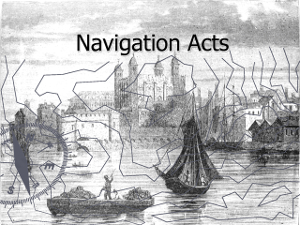
The Act bans foreign ships from transporting goods from outside Europe to England or its colonies, and bans third-party countries’ ships from transporting goods from a country elsewhere in Europe to England. These rules specifically target the Dutch, who control much of Europe’s international trade and even much of England’s coastal shipping. It excludes the Dutch from essentially all trade with England, as the Dutch economy is competitive with, not complementary to the English, and the two countries therefore exchange few commodities. This Anglo-Dutch trade, however, constitutes only a small fraction of total Dutch trade flows.
The Act is often mentioned as a major cause of the First Anglo-Dutch War, though it is only part of a larger British policy to engage in war after the negotiations have failed. The English naval victories in 1653 (the Battle of Portland, the Battle of the Gabbard and the Battle of Scheveningen) show the supremacy of the Commonwealth navy in home waters. However, farther afield the Dutch predominate and are able to close down English commerce in the Baltic and the Mediterranean. Both countries hold each other in a stifling embrace.
The Treaty of Westminster (1654) ends the impasse. The Dutch fail to have the Act repealed or amended, but it seems to have had relatively little influence on their trade. The Act offers England only limited solace. It cannot limit the deterioration of England’s overseas trading position, except in the cases where England herself is the principal consumer, such as the Canary Islands wine trade and the trade in Puglian olive oil. In the trade with the West Indies, the Dutch keep up a flourishing “smuggling” trade, thanks to the preference of English planters for Dutch import goods and the better deal the Dutch offer in the sugar trade. The Dutch colony of New Netherland offers a loophole through intercolonial trade wide enough to drive a shipload of Virginia tobacco through.
The 1651 Act, like other laws of the Commonwealth period, is declared void on the Restoration of Charles II of England, having been passed by “usurping powers.” Parliament therefore passes new legislation. This is generally referred to as the “Navigation Acts,” and, with some amendments, remains in force for nearly two centuries.






 The
The 
