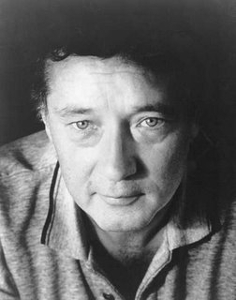
Caffrey is also well regarded for his role as a transvestite in the film Night Train, and for his role as an unlikely protagonist in I Went Down. He is also known for playing the role of the judge in the Irish comedy Father Ted on the episode A Song For Europe and for voicing a popular Christmas radio advertisement for Barry’s Tea in 1994.
Caffrey is born in Dublin on April 18, 1949. He studies at a seminary for two years before switching to an English degree. He works for a year as a primary school teacher, before becoming involved with Dublin’s Project Theatre. He appears in nearly thirty television and film roles, and also has a solid theatre career in both Dublin and London. After moving to London in 1983 he becomes a familiar face on UK television, with minor roles in Casualty, The Bill and Peak Practice. His success in Ballykissangel comes after overcoming oral cancer for which he is diagnosed in 1990, and, despite suffering a stroke in 2000 which leaves him paralysed on the right side, he manages to play a similarly afflicted character in the unreleased film Sweet Dancer in 2005.
Caffrey never fully recovers from the stroke and dies at the age of 58 on January 1, 2008, in Shrewsbury. His body is returned to Ireland for cremation in Mount Jerome Cemetery and Crematorium, Dublin, on January 8, 2008. Caffrey is survived by three sisters, Linda, Carol, and Sheila. His brother David pre-deceases him in July 2007.
Caffrey marries Brenda Banks in 1980 but the marriage ends in divorce in 1990.
O’Sullivan Beare conceals 300 of the women, children and aged of his community in a stronghold on Dursey Island, but this position is attacked, and the defenders hanged. In what is later termed the Dursey Massacre, Philip O’Sullivan Beare, nephew of O’Sullivan Beare, writes that the women and children of the Dursey stronghold are massacred by the English, who tie them back-to-back, throw them from the cliffs, and shoot at them with muskets.
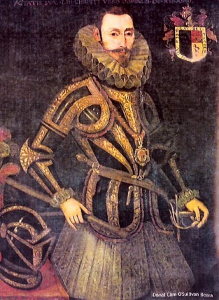
After the fall of Dursey and Dunboy, O’Sullivan Beare, Lord of Beara and Bantry, gathers his remaining followers and sets off northwards on December 31, 1602, on a 500-kilometre march with 1,000 of his remaining people. He hopes to meet Hugh O’Neill on the shores of Lough Neagh.
O’Sullivan Beare fights a long rearguard action northwards through Ireland, through Munster, Connacht and Ulster, during which the much larger English force and their Irish allies fight him all the way. The march is marked by the suffering of the fleeing and starving O’Sullivans as they seek food from an already decimated Irish countryside in winter. They face equally desperate people in this, often resulting in hostility, such as from the Mac Egans at Redwood Castle in County Tipperary and at Donohill in O’Dwyer’s country, where they raid the Earl of Ormonde‘s foodstore.
O’Sullivan Beare marches through Aughrim, where he raids villages for food and meets local resistance. He is barred entrance to Glinsk Castle and leads his refugees further north. On their arrival at Brian Oge O’Rourke‘s castle in Leitrim on January 4, 1603, after a fortnight’s hard marching and fighting, only 35 of the original 1,000 remain. Many had died in battles or from exposure and hunger, and others had taken shelter or fled along the route. O’Sullivan Beare had marched over 500 kilometres, crossed the River Shannon in the dark of a midwinter night, having taken just two days to make a boat of skin and hazel rods to carry 28 at a time the half-kilometre across the river, fought battles and constant skirmishes, and lost almost all of his people during the hardships of the journey.
In Leitrim, O’Sullivan Beare seeks to join with other northern chiefs to fight the English, and organises a force to this end, but resistance ends when Hugh O’Neill, 2nd Earl of Tyrone signs the Treaty of Mellifont. O’Sullivan Beare, like other members of the Gaelic nobility of Ireland who flees and seeks exile, making his escape to Spain by ship. O’Sullivan Beare settles in Spain and continues to plead with the Spanish government to send another invasion force to Ireland. King Phillip III gives him a knighthood, pension, and the title Earl of Bearhaven, but never that which he desires most, another chance to free his homeland.
Many generations of O’Sullivan Beare’s family later achieve prominence in Spain. In 1618, Donal Cam O’Sullivan Beare is killed in Madrid by John Bathe, an Anglo-Irishman, but the legend of “O’Sullivan’s March” lives on.
The Beara-Breifne Way long-distance walking trail follows closely the line of the historical march.
Wright attracts considerable media attention at the Drumcree standoff, where he supports the Orange Order‘s desire to march its traditional route through the Catholic/Irish nationalist area of Portadown. In 1994, the UVF and other paramilitary groups call ceasefires. However, in July 1996, Wright’s unit breaks the ceasefire and carries out a number of attacks, including a sectarian killing. For this, Wright and his Portadown unit of the Mid-Ulster Brigade are stood down by the UVF leadership. He is expelled from the UVF and threatened with execution if he does not leave Northern Ireland. Wright ignores the threats and, along with many of his followers, defiantly forms the breakaway Loyalist Volunteer Force (LVF).
In March 1997 Wright is sent to the HM Maze Prison for having threatened the life of a woman. While imprisoned, Wright continues to direct the LVF’s activities. On December 27 of that year, he is assassinated at the prison by Irish National Liberation Army (INLA) prisoners as he is led out to a van for a visit with his girlfriend. The LVF carries out a wave of sectarian attacks in retaliation.
Owing to his uncompromising stance as an upholder of Ulster loyalism and opposition to the Northern Ireland peace process, Wright is regarded as a cult hero, cultural icon, and martyr figure by hardline loyalists. His image adorns murals in loyalist housing estates and many of his devotees have tattoos bearing his likeness.
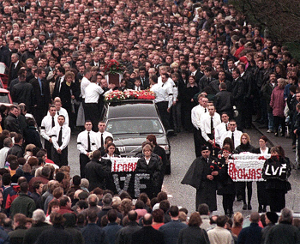
Wright’s funeral procession moves at a snail’s pace on a grey and windy day. Groups of mourners take turns carrying the coffin. Women carry a wreath that simply says “Billy.” Twenty men with tight haircuts and white shirts with black armbands flank the cortège. There is heavy security. Troops stand guard on bridges and Royal Ulster Constabulary (RUC) Land Rovers prowl the housing estates. A spotter plane flies overhead. A lone piper plays “Abide with Me” before a banner bearing the letters “LVF.”
Wright is buried at Seagoe Cemetery, Portadown, Northern Ireland.
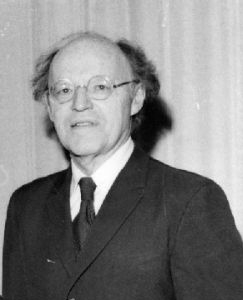
Pakenham is the elder son of Thomas Pakenham, 5th Earl of Longford and Mary, Countess of Longford, née Child-Villiers. He is the only one of the Pakenham children on whom his mother dotes, apparently because he is to succeed to the earldom on his father’s death and because he is always in delicate health.
As a pupil at Eton College, where he twice received the Wilder Divinity Prize, Pakenham succeeds to the earldom when his father is killed in action at the Battle of Gallipoli on August 21, 1915. He is an Irish Nationalist since his days at Eton, taking inspiration from the Easter Rising in 1916 and the Russian Revolution of 1917. He learned Irish and adopted the name Eamon de Longphort.
Pakenham becomes an undergraduate at Christ Church, Oxford and meets his future wife, Christine Patti Trew, an Oxford “undergraduette.” They are married on July 18, 1925. His political views make him unpopular at both Eton and Christ Church, where he is famously put in “Mercury,” the pond containing a statue of Mercury in Tom Quad.
Pakenham also has several volumes of poetry published, some at the expense of his mother when he is still at Eton, but he is not considered to have been a very good poet.
Pakenham often collaborates with his wife with whom he is also responsible for redecorating Pakenham Hall, now Tullynally Castle, in Chinese style. Pakenham Hall is often the scene of gatherings of Oxford-educated intellectuals such as John Betjeman, Evelyn Waugh, and Maurice Bowra.
Edward Pakenham dies without issue on February 4, 1961, and is succeeded by his younger brother Frank. He is buried at Mount Jerome Cemetery in Dublin.
Markievicz, who inherits the title of “countess” from her noble Polish husband, and 45 other MPs are in jail when the first meeting takes place on January 21, 1919. They are described in Gaelic as being “imprisoned by the foreign enemy” when their names are read out during roll call at the Mansion House.
The 27 MPs who attend the Dáil’s first session ratify the Proclamation of the Irish Republic of Easter 1916, which had not been adopted by an elected body but merely by the Easter rebels claiming to act in the name of the Irish people. They also claim there is an “existing state of war, between Ireland and England” in a Message to the Free Nations of the World.
When Markievicz is released in April 1919, she becomes Minister for Labour. Having also been part of the suffragette movement, her deep political convictions contrast deeply with Nancy Astor, Viscountess Astor, the first woman to sit in the House of Commons. She believes Astor, a Tory who is elected in a 1919 Plymouth by-election after her husband is forced to give up the seat when he becomes a peer, is “out of touch.”
Her political views are also influenced by Irish poet William Butler Yeats, who is a regular visitor to the family home, Lissadell House in County Sligo. She becomes involved in the women’s suffrage movement after studying art in London, where she meets and marries Count Casimir Markievicz. In 1903, the couple, who has one son, settles in Dublin, where she becomes involved in nationalist politics. She joins both Sinn Féin and Inghinidhe na hÉireann.
Like Astor, Markievicz has an irrepressible personality and is in no mood to play coy and simply blend in. She comes to her first Sinn Féin meeting wearing a satin ball-gown and a diamond tiara after attending a function at Dublin Castle, the seat of British rule in Ireland.
Markievicz spends a year in the Dáil before walking out along with Éamon de Valera, the future dominant figure in Irish politics, after opposing the Anglo-Irish Treaty. The document, which grants southern Ireland independence but keeps the north as part of the UK, splits Sinn Féin and triggers the Irish War of Independence.
Following the conflict, which the Pro-Treaty forces win, Markievicz is elected again to the Dáil, but does not take her seat in protest. In 1927, she is elected for a third time as part of de Valera’s new party Fianna Fáil, which pledges to return to the Irish parliament. But before she can take her seat, she dies at age 59 on July 15, 1927, of complications related to appendicitis.
Arthur Murphy, Irish writer also known by the pseudonym Charles Ranger, is born at Cloonyquin, County Roscommon, on December 27, 1727, the son of Richard Murphy and Jane French.
Murphy studies at Saint-Omer in France, and is a gifted student of the Latin and Greek classics. He works as an actor in the theatre, becomes a barrister, a journalist and finally a playwright. He edits Gray’s Inn Journal between 1752 and 1754. As Henry Thrale‘s oldest and dearest friend, he introduces Samuel Johnson to the Thrales in January 1765. He is appointed Commissioner of Bankruptcy in 1803.
An example of Murphy’s theatrical writings is The Citizen, a farce, first produced at Drury Lane in 1761. Philpot, a wealthy skinflint, has bargained with Sir Jasper Wilding for his son Young Philpot to marry Maria Wilding, and for his daughter Sally to marry Wilding’s son, for settlements and twenty thousand pounds paid to Sir Jasper. Young Philpot has lost a fortune, but borrows money from his father and embarks on an insurance fraud involving shipwrecked goods. Maria plans to marry Beaufort, who loves her. As Young Philpot tries to propose, she convinces him she is half-witted, and he spurns her. In the second act, Philpot senior is visiting Corinna, a lady of loose virtue, but hides under the table when his son calls upon her. He overhears as Young Philpot tells her how he has cajoled the money out of his father. Maria’s brother surprises them, and old Philpot is also discovered, to their mutual shame. In the final scene Sir Jasper with a lawyer obtains Philpot’s signature to the agreements, but meanwhile Maria, an educated girl, shows her strong character to Young Philpot and he again refuses to propose. Having signed away his rights old Philpot offers to marry her, but the lawyer reveals himself as Beaufort, and explains that he has swapped the deeds, so that Philpot has unwittingly signed his agreement for Maria to marry Beaufort.
Murphy is thought to have coined the legal term “wilful misconstruction” whilst representing the Donaldson v. Becket appeal to the House of Lords in 1774 against the perpetual possession of copyright.
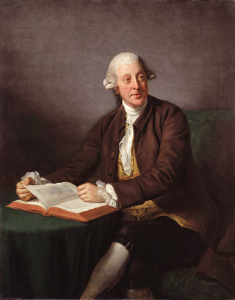
Arthur Murphy dies at Knightsbridge, London, on June 18, 1805, and is buried at Hammersmith, London. A biography is written in 1811 by Dr. Jesse Foot. Nathaniel Dance-Holland paints Murphy’s portrait which is thought to now be in the Irish National Portrait Collection.
(Pictured: 1777 portrait of Arthur Murphy by Nathaniel Dance-Holland)
The Continental Army has previously suffered several defeats in New York and has been forced to retreat through New Jersey to Pennsylvania. Morale in the army is low. To end the year on a positive note, George Washington, Commander-in-Chief of the Continental Army, devises a plan to cross the Delaware River on the night of December 25–26 and surround the Hessian garrison.
Because the river is icy and the weather severe, the crossing proves dangerous. Two detachments are unable to cross the river, leaving Washington with only 2,400 men under his command in the assault, 3,000 less than planned.
Washington’s army marches 9 miles south to Trenton. One division commanded by John Sullivan, the third son of Irish settlers from the Beara Peninsula in County Cork, secures the important bridge over the Assunpink Creek to the south of the town. This prevents escape and ensures the high number of Hessian prisoners captured.
The Hessians have lowered their guard, thinking they are safe from the American army, and have no long-distance outposts or patrols. Washington’s forces catch them off guard and, after a short but fierce resistance, most of the Hessians surrender, with negligible losses to the Americans. Almost two thirds of the 1,500-man garrison are captured, and only a few troops escaped across Assunpink Creek.
Despite the battle’s small numbers, the American victory inspires rebels in the colonies. With the success of the revolution in doubt a week earlier, the army had seemed on the verge of collapse. The dramatic victory inspires soldiers to serve longer and attracted new recruits to the ranks.
On December 25, 1715, Joshua Dawson, Irish public servant, land developer and politician, sells the Mansion House with its gardens and park to Dublin Corporation for £3,500 plus 40 shillings per annum and a “loaf of double refined sugar of six pounds weight” which is to be paid to the Dawsons every Christmas.
Dawson is born in 1660 at the family seat, which becomes Castledawson, County Londonderry, the son of Thomas Dawson, Commissary of the Musters of the Army in Ireland. He resides in County Londonderry and Dublin. His ancestral family had owned land and lived in the area where, in 1710, he founds Dawson’s Bridge, named after the bridge over the River Moyola, which becomes present-day Castledawson. In his estate he builds Moyola House in 1713.
Dawson develops an area of Dublin in 1705-1710 which includes the setting out and construction of the streets of Dawson Street, Anne Street, Grafton Street and Harry Street. These streets are named after, respectively, himself, Queen Anne (widow of William III), and Henry FitzRoy, 1st Duke of Grafton, the son of Charles II and cousin of Queen Anne. This development includes the construction of the Mansion House in Dawson Street in 1710 which is purchased in 1715 to be the official residence of the Lord Mayor of Dublin, which it has remained for 300 years.
(Pictured: Mansion House, official residence of the Lord Mayor of Dublin)
Brodrick is the second son of Sir St. John Brodrick of Ballyannan, near Midleton in County Cork, by his wife Alice, daughter of Laurence Clayton of Mallow, County Cork. His father receives large land grants during The Protectorate, and thus the family has much to lose if the land issue in Ireland is settled to the satisfaction of dispossessed Roman Catholics. He is educated at Magdalen College, Oxford and the Middle Temple, being called to the English bar in 1678. He and his relatives flee Ireland during the Glorious Revolution. They are attainted under the rule of King James II in Ireland. In exile in England, Brodrick argues for a speedy reconquest.
In 1690 Brodrick returns to Dublin and is given the legal office of Third Serjeant. He also becomes Recorder of Cork. He is dismissed as Serjeant in 1692, apparently on the ground that there is no work for him to do. While complaining bitterly about his dismissal, he admits privately that his post has been a superfluous one.
As a prominent Whig supporter of the outcome of the Glorious Revolution he is not always in agreement with court policies in Ireland, which he considers too lenient on the Jacobites. The dismissal of the First Serjeant, John Osborne, at the same time as Brodrick is due to his even stronger opposition to Court policy. Despite this he often holds Irish government offices and aspires to manage the Irish Parliament for English ministers. He represents Cork City in the Irish Parliament, which meets in 1692 and holds this seat until 1710. He is a vocal opponent of court policies, until the new Whig Lord Deputy of Ireland, Lord Henry Capell, decides to appoint him Solicitor-General for Ireland in 1695. He promotes penal laws against Catholics, whilst also supporting greater powers for the Irish Parliament.
Brodrick is Speaker of the Irish House of Commons from September 21, 1703. After promoting resolutions critical of the Lord Lieutenant of Ireland he loses his post as Solicitor-General in 1704. From 1707 until 1709 he is Attorney-General for Ireland. He becomes Chief Justice of Ireland in 1710 and is replaced as Speaker on May 19, 1710, but again holds the office in the next Parliament (November 25, 1713 – August 1, 1714), where he also represents County Cork. He is appointed Lord Chancellor of Ireland in 1714 and is ennobled in the Peerage of Ireland in 1715, as the 1st Baron Brodrick. He is advanced to the rank of 1st Viscount Midleton in 1717.
Brodrick feuds with his successor as Speaker William Conolly, as they are rivals to be the leading figure in Irish politics. Despite intrigues in England, he loses out and resigns as Lord Chancellor in 1725. He leaves behind him a legacy of bitterness and ill-will for which he is not really responsible as the Irish peers choose to blame him for the loss of their powers under the Sixth of George I, rather than their own misjudgment in imprisoning the Barons of the Exchequer.
Purcell is the son of auctioneer Pierce Purcell and his second wife Catherine (née Hoban) of 4 Ashbrook Terrace, South Circular Road, Dublin. He is baptised six days after his birth at St. Kevin’s Church, Harrington Street. Within a few months, the Purcell family moves to 12 Mercer Street Lower. He is educated at Synge Street CBS. He loses the tip of his right index finger while making cigarette vending machines and also loses his entire left index finger due to an accident while he is an apprentice carpenter, a feature which he exploits for dramatic effect in the film Mutiny on the Bounty (1962).
Purcell begins his show business career at the age of 12 in Dublin’s Gaiety Theatre. Later, he tours Ireland in a vaudeville act with Jimmy O’Dea. Stage-trained in the classics in Dublin, he moves into films in 1934. He appears in Captain Boycott (1947) and as the elderly sailor whose death maroons the lovers-to-be in the first sound film version of The Blue Lagoon (1949). He plays a member of Captain Ahab‘s crew in Moby Dick (1956), Dan O’Flaherty in episode one, The Majesty of the Law, of The Rising of the Moon (1957), a gamekeeper in The List of Adrian Messenger (1963), and a barman in The Mackintosh Man (1973). The last two films are directed by John Huston.
Purcell is the subject of This Is Your Life in 1958 when he is surprised by Eamonn Andrews at the BBC Television Theatre. He also gains some recognition as a singer. Shortly after World War II, songwriter Leo Maguire composes “The Dublin Saunter” for him. He performs the song live for many years and later records it for the Glenside label, but the recording is not a hit. However, over time it becomes one of the most favourite songs about Dublin, receiving countless airplays on radio programmes.




 seamus dubhghaill