seamus dubhghaill

Promoting Irish Culture and History from Little Rock, Arkansas, USA


1 Comment

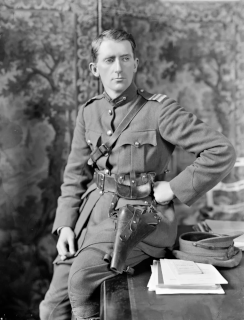
Death of Richard Mulcahy, Fine Gael Politician & Army General

Richard James Mulcahy, Irish Fine Gael politician and army general, dies from natural causes in Dublin on December 16, 1971.

Mulcahy is born in Manor Street, Waterford, County Waterford, on May 10, 1886, the son of post office clerk Patrick Mulcahy and Elizabeth Slattery. He is educated at Mount Sion Christian Brothers School and later in Thurles, County Tipperary, where his father is the postmaster.

Mulcahy joins the Royal Mail (Post Office Engineering Dept.) in 1902, and works in Thurles, Bantry, Wexford and Dublin. He is a member of the Gaelic League and joins the Irish Volunteers at the time of their formation in 1913. He is also a member of the Irish Republican Brotherhood.

Mulcahy is second-in-command to Thomas Ashe in an encounter with the armed Royal Irish Constabulary (RIC) at Ashbourne, County Meath, during the 1916 Easter Rising, one of the few stand-out victories won by republicans in that week and generally credited to Mulcahy’s grasp of tactics. In his book on the Rising, Charles Townshend principally credits Mulcahy with the defeat of the RIC at Ashbourne, for conceiving and leading a flanking movement on the RIC column that had engaged with the Irish Volunteers. Arrested after the Rising, he is interned at Knutsford and at the Frongoch internment camp in Wales until his release on December 24, 1916.

On his release, Mulcahy immediately rejoins the republican movement and becomes commandant of the Dublin Brigade of the Irish Volunteers. He is elected to the First Dáil in the 1918 Irish general election for Dublin Clontarf. He is then named Minister for Defence in the new government and later Assistant Minister for Defence. In March 1918, he becomes Irish Republican Army (IRA) chief of staff, a position he holds until January 1922.

Mulcahy and Michael Collins are largely responsible for directing the military campaign against the British during the Irish War of Independence. During this period of upheaval in 1919, he marries Mary Josephine (Min) Ryan, sister of Kate and Phyllis Ryan, the successive wives of Seán T. O’Kelly. Her brother is James Ryan. O’Kelly and Ryan both later serve in Fianna Fáil governments.

Mulcahy supports the Anglo-Irish Treaty of December 1921. Archive film shows that Mulcahy, as Minister of Defence, is the Irish officer who raises the Irish tricolour at the first hand-over of a British barracks to the National Army in January 1922. He is defence minister in the Provisional Government on its creation and succeeds Collins, after the latter’s assassination, as Commander-in-Chief of the Provisional Government’s forces during the subsequent Irish Civil War.

Mulcahy earns notoriety through his order that anti-Treaty activists captured carrying arms are liable for execution. A total of 77 anti-Treaty prisoners are executed by the Provisional Government. He serves as Minister for Defence in the new Free State government from January 1924 until March 1924, but resigns in protest because of the sacking of the Army Council after criticism by the Executive Council over the handling of the “Army Mutiny,” when some National Army War of Independence officers almost revolt after he demobilises many of them at the end of the Irish Civil War. He re-enters the cabinet as Minister for Local Government and Public Health in 1927.

During Mulcahy’s period on the backbenches of Dáil Éireann his electoral record fluctuates. He is elected as TD for Dublin North-West at the 1921 and 1922 Irish general elections. He moves to Dublin City North for the election the following year and is re-elected there in four further elections: June 1927, September 1927, 1932, and 1933.

Dublin City North is abolished for the 1937 Irish general election, at which Mulcahy is defeated in the new constituency of Dublin North-East. However, he secures election to Seanad Éireann as a Senator, the upper house of the Oireachtas, representing the Administrative Panel. The 2nd Seanad sits for less than two months, and at the 1938 Irish general election he is elected to the 10th Dáil as a TD for Dublin North-East. Defeated again in the 1943 Irish general election, he secures election to the 4th Seanad by the Labour Panel.

After the resignation of W. T. Cosgrave as Leader of Fine Gael in 1944, Mulcahy becomes party leader while still a member of the Seanad. Thomas F. O’Higgins is parliamentary leader of the party in the Dáil at the time and Leader of the Opposition. Facing his first general election as party leader, Mulcahy draws up a list of 13 young candidates to contest seats for Fine Gael. Of the eight who run, four are elected. He is returned again to the 12th Dáil as a TD for Tipperary at the 1944 Irish general election. While Fine Gael’s decline had been slowed, its future is still in doubt.

Following the 1948 Irish general election Mulcahy is elected for Tipperary South, but the dominant Fianna Fáil party finishes six seats short of a majority. However, it is 37 seats ahead of Fine Gael, and conventional wisdom suggests that Fianna Fáil is the only party that can possibly form a government. Just as negotiations get underway, however, Mulcahy realises that if Fine Gael, the Labour Party, the National Labour Party, Clann na Poblachta and Clann na Talmhan band together, they would have only one seat fewer than Fianna Fáil and, if they can get support from seven independents, they will be able to form a government. He plays a leading role in persuading the other parties to put aside their differences and join forces to consign the then Taoiseach and Fianna Fáil leader Éamon de Valera, to the opposition benches.

Mulcahy initially seems set to become Taoiseach in a coalition government. However, he is not acceptable to Clann na Poblachta’s leader, Seán MacBride. Many Irish republicans had never forgiven him for his role in the Irish Civil War executions carried out under the Cosgrave government in the 1920s. Consequently, MacBride lets it be known that he and his party will not serve under Mulcahy. Without Clann na Poblachta, the other parties would have 57 seats between them — 17 seats short of a majority in the 147-seat Dáil. According to Mulcahy, the suggestion that another person serve as Taoiseach comes from Labour leader William Norton. He steps aside and encourages his party colleague John A. Costello, a former Attorney General of Ireland, to become the parliamentary leader of Fine Gael and the coalition’s candidate for Taoiseach. For the next decade, Costello serves as the party’s parliamentary leader while Mulcahy remained the nominal leader of the party.

Mulcahy goes on to serve as Minister for Education under Costello from 1948 until 1951. Another coalition government comes to power at the 1954 Irish general election, with Mulcahy once again stepping aside to become Minister for Education in the Second Inter-Party Government. The government falls in 1957, but he remains as Fine Gael leader until October 1959. In October the following year, he tells his Tipperary constituents that he does not intend to contest the next election.

Mulcahy dies from natural causes at the age of 85 in Dublin on December 16, 1971. He is buried in Littleton, County Tipperary.


Leave a comment

Birth of George Colley, Fianna Fáil Politician

George Colley, an Irish Fianna Fáil politician, is born in the Dublin suburb of Fairview on October 18, 1925.

Colley is the son of Harry and Christina Colley. His father is a veteran of the 1916 Easter Rising and a former adjutant in the Irish Republican Army (IRA), who is elected to Dáil Éireann in 1944, as a Fianna Fáil candidate. He is educated at St. Joseph’s Secondary C.B.S. in Fairview, where one of his classmates and closest friends is Charles Haughey, who later becomes his political archrival. He studies law at University College Dublin (UCD) and qualifies as a solicitor in the mid-1940s. He remains friends with Haughey after leaving school and, ironically, encourages him to become a member of Fianna Fáil in 1951. Haughey is elected to Dáil Éireann in the 1957 Irish general election, ousting Colley’s father in the process. This puts some strain on the relationship between the two young men.

Colley is elected to the Dáil at the 1961 Irish general election, reclaiming his father’s old seat in the Dublin North-East constituency. Furthermore, he is elected in the same constituency as Haughey, thereby accentuating the rivalry. Thereafter, he progresses rapidly through the ranks of Fianna Fáil. He becomes a member of the Dáil at a time when a change from the older to the younger generation is taking place, a change facilitated by Taoiseach Seán Lemass.

Colley is active in the Oireachtas as chairman of some of the Joint Labour Committees, which are set up under the Labour Court, to fix legally enforceable wages for groups of workers who have not been effectively organised in trade unions. He is also leader of the Irish parliamentary delegation to the Consultative Assembly of the Council of Europe. His work as a backbencher is rewarded by his appointment as Parliamentary Secretary to the Minister for Lands in October 1964.

Following the return of Lemass’s government at the 1965 Irish general election, Colley joins the cabinet as Minister for Education. He introduces a plan to establish comprehensive schools, set up an advisory council on post-primary school accommodation in Dublin, and introduces a school psychological service.

Colley is promoted as Minister for Industry and Commerce in a cabinet reshuffle in July 1966, and he continues the government policy of economic expansion that had prevailed since the late 1950s.

In November 1966, Seán Lemass resigns suddenly as party leader. Colley contests the subsequent leadership election. He is the favoured candidate of party elders such as Seán MacEntee and Frank Aiken, the latter managing Colley’s campaign. Charles Haughey and Neil Blaney also declare their interest in the leadership; however, both withdraw when the Minister for Finance, Jack Lynch, announces his candidacy. Colley does not back down, and the leadership issue goes to a vote for the first time in the history of the Fianna Fáil party. The leadership election takes place on November 9, 1966, and Lynch beats Colley by 59 votes to 19. When the new Taoiseach announces his cabinet, Colley retains the Industry and Commerce portfolio.

In the wake of the Arms Crisis in 1970, a major reshuffle of the cabinet takes place, with four Ministers either removed, or resigned, or simply retired from the government due to the scandal. Colley remains loyal to the party leader and is rewarded by his appointment as Minister for Finance, the second most important position in government.

In 1973, Fianna Fáil are ousted after sixteen years in government when the national coalition of Fine Gael and the Labour Party come to power. Colley is appointed opposition Spokesman on Finance, in the new Fianna Fáil front bench. As the 1977 Irish general election approaches, Colley and Martin O’Donoghue are the main architects of Fianna Fáil’s election manifesto.

Fianna Fáil sweeps to power at the 1977 Irish general election, with a 20-seat Dáil majority, contrary to opinion polls and political commentators. Colley is re-appointed as Minister for Finance and Minister for the Public Service, and is also appointed as Tánaiste, establishing him firmly as the heir apparent to Taoiseach Jack Lynch.

In December 1979, Jack Lynch resigns unexpectedly as Taoiseach and as Fianna Fáil leader. Colley and Charles Haughey seek the leadership position and are evenly matched. A secret ballot is taken on December 7, 1979. The Minister for Foreign Affairs, Michael O’Kennedy, announces his support for Haughey on the eve of the election. This apparently swings the vote, and Haughey beats Colley by 44 votes to 38. Colley remains as Tánaiste but demands and receives a veto on Haughey’s ministerial appointments to the departments of Justice and Defence.

Fianna Fáil loses power at the 1981 Irish general election. Haughey delays naming a new opposition front bench, but Colley remains a key member of the Fianna Fáil hierarchy. The party regains office at the February 1982 Irish general election. He demands the same veto as before on Haughey’s Defence and Justice appointments but is refused. When it is revealed that Ray MacSharry is to be appointed Tánaiste in his stead, he declines another ministerial position. This effectively brings his front bench political career to an end, but he remains a vocal critic of the party leadership from the backbenches.

When the Fianna Fáil government collapses and are replaced by another coalition government after the November 1982 Irish general election, a number of TDs and Senators express lack of confidence in Haughey’s leadership once again. Several unsuccessful leadership challenges take place in late 1982 and early 1983, with Colley now supporting Desmond O’Malley and the Gang of 22 who oppose Haughey.

Colley dies suddenly on September 17, 1983, aged 57, while receiving treatment for a heart condition at Guy’s Hospital, Southwark, London. He is survived by his wife, three sons, and four daughters, one of whom, Anne Colley, becomes a TD as a member of the Progressive Democrats party.


Leave a comment

Death of Seán MacBride, Politician & Chief of Staff of the IRA

Seán MacBride, Irish government minister, prominent international politician, and a former Chief of Staff of the Irish Republican Army (IRA), dies in Dublin at the age of 83 on January 15, 1988.

MacBride is born in Paris on January 26, 1904. He is the son of Major John MacBride and Maud Gonne. After his father’s execution for his participation in the Easter Rising of 1916, MacBride is sent to school at Mount St. Benedict’s, Gorey, County Wexford in Ireland. In 1919, at the age of 15, he joins the Irish Volunteers, which fights as part of the Irish Republican Army, and takes part in the Irish War of Independence. He is imprisoned by the Irish Free State but is released in 1924 and resumes his IRA activities. He returns to Dublin in 1927 and becomes the Director of Intelligence of the IRA.

Toward the end of the 1920s, after many supporters have left the IRA to join Fianna Fáil, some members start pushing for a more left-wing agenda. After the IRA Army Council votes down the idea, MacBride launches a new movement, Saor Éire (“Free Ireland”), in 1931. Although it is a non-military organisation, Saor Éire is declared unlawful along with the IRA, Cumann na mBan, and nine other organizations.

In 1936, MacBride becomes Chief of Staff of the IRA after Moss Twomey is sent to prison for three years. At the time, the movement is in a state of disarray, with conflicts between several factions and personalities. In 1937, he is called to the bar and then resigns from the IRA when the Constitution of Ireland is enacted later that year. As a barrister, he frequently defends IRA political prisoners, but is not unsuccessful in stopping the execution of Charlie Kerins in 1944 who is convicted of killing Garda Detective Dennis O’Brien in 1942. In 1946, during the inquest into the death of Seán McCaughey, he embarrasses the authorities by forcing them to admit that the conditions in Portlaoise Prison are inhumane.

In 1946, MacBride founds the republican/socialist party Clann na Poblachta, hoping it would replace Fianna Fáil as Ireland’s major political party. In October 1947, he wins a seat in Dáil Éireann at a by-election in the Dublin County constituency. However, at the 1948 Irish general election Clann na Poblachta wins only ten seats.

MacBride is serving as Minister of External Affairs when the Council of Europe drafts the European Convention on Human Rights. He serves as President of the Committee of Ministers of the Council of Europe from 1949 to 1950 and is credited with being a key force in securing the acceptance of this convention, which is finally signed in Rome on November 4, 1950. He is instrumental in the implementation of the repeal of the External Relations Act and the passing of the Republic of Ireland Act 1948 which comes into force in 1949.

Clann na Poblachta is reduced to only two seats after the 1951 Irish general election. MacBride keeps his seat and is re-elected again at the 1954 Irish general election. Opposing the internment of IRA suspects during the Border Campaign (1956–62), he contests both the 1957 and 1961 Irish general elections but fails to be elected both times. He then retires from politics but continues practicing as a barrister. He expresses interest in running as an independent candidate in the 1983 Irish presidential election, but does not receive sufficient backing and ultimately does not enter the contest.

Throughout the 1950s, 1960s, and 1970s, MacBride works tirelessly for human rights worldwide. He is a founding member of Amnesty International and serves as its International chairman from 1961 until 1975. During the 1980s, he initiates the Appeal by Lawyers against Nuclear War which is jointly sponsored by the International Peace Bureau and the International Progress Organization.

MacBride is awarded the Nobel Peace Prize in 1974 as a man who “mobilised the conscience of the world in the fight against injustice.” He later receives the Lenin Peace Prize (1975–76) and the UNESCO Silver Medal for Service (1980).

In his later years, MacBride lives in his mother’s home, Roebuck House, that served as a meeting place for many years for Irish nationalists, as well as in the Parisian arrondissement where he grew up with his mother, and enjoyed strolling along boyhood paths. In 1978, he receives the Golden Plate Award of the American Academy of Achievement.

MacBride dies in Dublin on January 15, 1988, just eleven days shy of his 84th birthday. He is buried in a simple grave in Glasnevin Cemetery, Dublin, with his mother, and wife who died in 1976.


Leave a comment

Birth of Tomás Mac Giolla, Irish Workers’ Party Politician

tomas-mac-giolla

Tomás Mac Giolla, Workers’ Party of Ireland politician who serves as Lord Mayor of Dublin from 1993 to 1994, leader of the Workers’ Party from 1962 to 1988 and leader of Sinn Féin from 1962 to 1970, is born Thomas Gill in Nenagh, County Tipperary on January 25, 1924. He serves as a Teachta Dála (TD) for the Dublin West constituency from 1982 to 1992.

Mac Giolla’s uncle T. P. Gill is a Member of Parliament (MP) and member of the Irish Parliamentary Party (IPP) of Charles Stewart Parnell. His father, Robert Paul Gill, an engineer and architect, also stands unsuccessfully for election on a number of occasions. His mother is Mary Hourigan.

Mac Giolla is educated at the local national school in Nenagh before completing his secondary education at St. Flannan’s College in Ennis, County Clare. It is while at St. Flannan’s that he changes to using the Irish language version of his name. He wins a scholarship to University College Dublin where he qualifies with a Bachelor of Arts degree, followed by a degree in Commerce.

A qualified accountant, Mac Giolla is employed by the Irish Electricity Supply Board (ESB) from 1947 until he goes into full-time politics in 1977.

In his early life Mac Giolla is an active republican. He joins Sinn Féin and the Irish Republican Army (IRA) around 1950. He is interned by the Government of Ireland during the 1956–1962 IRA border campaign. He also serves a number of prison sentences in Mountjoy Prison in Dublin.

At the 1961 Irish general election, Mac Giolla unsuccessfully contests the Tipperary North constituency for Sinn Féin. In 1962, he becomes President of Sinn Féin and is one of the people who moves the party to the left during the 1960s. In 1969, Sinn Féin splits, and he remains leader of Official Sinn Féin. It is also in 1962 that he marries May McLoughlin who is also an active member of Sinn Féin as well as Cumann na mBan, the women’s section of the IRA. In 1977, the party changes its name to Sinn Féin the Workers Party and in 1982 it becomes simply the Workers’ Party.

Mac Giolla is elected to Dublin City Council representing the Ballyfermot local electoral area in 1979 and at every subsequent local election until he retires from the council in 1997. In the November 1982 Irish general election, he is elected to Dáil Éireann for his party. In 1988, he steps down as party leader and is succeeded by Proinsias De Rossa. He serves as Lord Mayor of Dublin from 1993 to 1994 and remains a member of Dublin Corporation until 1998.

While president Mac Giolla is regarded as a mediator between the Marxist-Leninist wing headed by Sean Garland and the social democratic wing of Prionsias De Rossa. At the 1992 special Ardfheis he votes for the motion to abandon democratic centralism and to re-constitute the party much as the Italian Communist Party became the Democratic Party of the Left. However, the motion fails to reach the required two-thirds majority. Following the departure of six Workers’ Party TDs led by De Rossa to form the new Democratic Left party in 1992, Mac Giolla is the sole member of the Workers’ Party in the Dáil. He loses his Dáil seat at the 1992 Irish general election by a margin of just 59 votes to Liam Lawlor of Fianna Fáil.

In 1999, Mac Giolla writes to the chairman of the Flood Tribunal calling for an investigation into revelations that former Dublin Assistant City and County Manager George Redmond had been the official supervisor at the election count in Dublin West and was a close associate of Liam Lawlor. In 2003, Redmond is convicted of corruption by a Dublin court but subsequently has his conviction quashed due to conflicting evidence.

In his eighties Mac Giolla continues to be active and is a member of the group which campaigns to prevent the demolition of No. 16 Moore Street in Dublin city centre, where the surrender after the Easter Rising was completed. He also serves on the Dublin ’98 committee to commemorate the 200th anniversary of the Irish Rebellion of 1798.

Tomás Mac Giolla dies in Beaumont Hospital in Beaumont, Dublin on February 4, 2010, after a long illness.