Before entering politics, Cannon is a planning official for Galway City Council and Dublin City Council, as well as CEO and secretary of the Irish Pilgrimage Trust. In 2002, he is honoured as one of the Galway People of the Year.
Cannon is elected as Leader of the Progressive Democrats in April 2008. He is the first leader of the party to sit as a Senator while serving as leader. At his first press conference as party leader, he states that he believes “there was passion, commitment, talent and knowledge within the PDs’ ranks to stage a big comeback.”
However, after speculation increases that Noel Grealish, one of the two Progressive Democrat TDs, intends to leave the party, Cannon announces in September 2008 that a party conference will be held on November 8, 2008, at which he will recommend that the party disband. The delegates present at the conference vote 201–161 to agree with this recommendation.
On March 24, 2009, Cannon announces his decision to resign the leadership of the Progressive Democrats and joins Fine Gael the same day. At the 2011 Irish general election, he is one of two Fine Gael TDs elected in Galway East.
In 2019, in recognition of his work in education, Cannon is appointed as a UNICEF global champion for education. He is one of seven Generation Unlimited Champions who advocates worldwide for the development of UNICEF’s Gen U programme.
At the 2020 Irish general election, Cannon is elected to the second seat in Galway East. He continues to serve as a minister of state until the formation of a new government on June 27, 2020.
On March 19, 2024, Cannon announces that he will not contest the next general election, blaming a “toxicity in politics.”
Cannon is a musician and songwriter, and recently collaborated with Irish folk singer Seán Keane and others on songwriting projects. One of his co-compositions, “Nature’s Little Symphony,” is performed in Dublin by the RTÉ Concert Orchestra as part of the national Cruinniú celebrations on Easter Monday 2017. Both “Nature’s Little Symphony” and another of his compositions, “Gratitude,” are featured on the album Gratitude recorded by Keane and the RTÉ Concert Orchestra in 2018. On the August 10, 2018, Cannon plays piano with Keane and the RTÉ Concert Orchestra as part of a sold-out performance at the National Concert Hall. In 2019, he composes “An Túr,” a short piano instrumental to celebrate the birthday of W. B. Yeats.
In 2021 Cannon is commissioned to compose the soundtrack to a poem by Emily Cullen as part of the national commemoration of the signing of the Anglo-Irish Treaty in 1921.
In March 2024, Cannon begins presenting The Grey Lake Cafe, a radio show on Loughrea Community Radio featuring his own musical choices, and interviews with public figures who have a passion for music.
Cannon is also an avid cyclist and cycling safety advocate. He specialises in endurance cycling challenges and on June 19, 2021, he cycles Ireland end to end, a distance of 575 km, in 23 hours and 23 minutes, to raise money for charity.
On July 2, 2021, Cannon is involved in a road traffic collision and suffers serious injuries. On July 2, 2022 he marks the first anniversary of the incident by cycling 500 km around the border of County Galway. Marking the same date in 2023, he cycles 935 km (581 mi) in 56 hours, covering all 32 counties of the island of Ireland while fundraising for Hand In Hand, a charity that supports families challenged by childhood cancer.
McDonald is born into a middle-class family in south Dublin. Her father Patrick McDonald, a builder and surveyor, and her mother Joan, separate when she is nine years old, and she stays with her mother in Rathgar. She has three siblings, one older and two younger. Her great-uncle, James O’Connor, was a member of the Anti-Treaty IRA and was executed at the Curragh Camp during the Irish Civil War.
She works as a researcher for the Institute of European Affairs, a consultant for the Irish Productivity Centre, a human resources consultancy that is jointly operated by Ibec and Irish Congress of Trade Unions (ICTU), and a trainer in the Partnership Unit of the Educational and Training Services Trust.
McDonald starts her political career by first joining Fianna Fáil in 1998 but leaves the party after a year due to core policy differences, particularly in relation to Northern Ireland and social justice. She quickly realises that Sinn Féin is a more appropriate party for her Republican views after meeting Sinn Féin members through the Irish National Congress.
She first runs for office at the 2002 Irish general election when she unsuccessfully contests the Dublin West constituency for Sinn Féin, polling 8.02% of first preference votes.
In 2004, McDonald becomes Sinn Féin’s first Member of the European Parliament (MEP) in Ireland, when she is elected at the 2004 European Parliament election in Ireland for the Dublin constituency, receiving over 60,000 first preference votes. She serves until 2009 and is a prominent member of the Employment and Social Affairs committee and Civil Liberties committee.
McDonald contests the Dublin Central constituency again at the 2011 Irish general election, this time picking up 13.1% of first preference votes. She is successful in taking the last seat in the constituency. Following the election, she becomes Sinn Féin’s Spokesperson for Public Expenditure and Reform and is a member of the Public Accounts Committee from then until 2017.
After her re-election to the Dáil at the 2016 Irish general election, in which she tops the poll in Dublin Central, she becomes Sinn Féin’s All-Ireland Spokesperson for Mental Health and Suicide Prevention, which she holds until being elected president of Sinn Féin in 2018.
At a Sinn Féin party conference on November 18, 2017, Gerry Adams is re-elected party leader but announces that he will ask party leadership to call for a special Ard Fheis to be held within three months to choose a new president, and that he will not stand for re-election as TD for the Louth constituency in the next election.
At the close of nominations to succeed Adams on January 20, 2018, McDonald is announced as the president-elect of Sinn Féin, as she is the sole nominee to enter the race. She is confirmed as president at a special Ard Fheis on February 10, 2018, in Dublin.
McDonald is nominated as Taoiseach on February 20, 2020, but is defeated 45 to 84. On June 26, 2020, Fianna Fáil, Fine Gael, and the Green Party form a coalition government, leaving Sinn Féin as the largest opposition party, and McDonald as Leader of the Opposition. She dismisses the coalition agreement as a “marriage of convenience,” and accuses Fianna Fáil and Fine Gael of conspiring to exclude Sinn Féin from government.
At the 2024 Irish general election, McDonald is re-elected to the Dáil topping the poll in Dublin Central with Sinn Féin increasing their seat share by two seats, remaining the second largest party by representation in the Dáil and attaining 19% of the first preference votes, a fall of 5.5% from 2020 and fall behind Fianna Fáil by 2.9% and Fine Gael by 1.8%.
McDonald is again nominated as Taoiseach on December 18, 2024, but is defeated 44 to 110.
McDonald’s husband, Martin Lanigan, works as a gas control superintendent for the emergency dispatch division of Gas Networks Ireland, a state infrastructure provider. They have two children and live in Cabra, Dublin.
He is elected in 1985 as a Workers’ Party member of Dublin City Council for Crumlin–Kimmage area, and is re-elected at subsequent local elections until 2011, when he is forced to resign his seat due to dual mandate. He is finally elected at the 1989 Irish general election. He joins with Workers’ Party members who form Democratic Left in 1992. He unexpectedly loses his seat at the 1992 Irish general election. Labour’s Pat Upton is unexpectedly returned on the first count, with Byrne finally losing the last seat to Fianna Fáil‘s Ben Briscoe by five votes after a marathon 10-day count.
He loses his seat again at the 1997 Irish general election. Although the Labour Party and the Democratic Left merge in 1999, he is not selected to contest the Dublin South-Central by-election which follows Pat Upton‘s death later that year. Upton’s sister Mary is elected for the Labour Party.
Byrne contests the 2002 Irish general election on the Labour Party ticket as Mary Upton’s running-mate but is unsuccessful. Along with Upton, he contests the Dublin South-Central constituency at the 2007 Irish general election advocating a Labour Party/Fine Gael government but misses the final seat by 69 votes. He is nominated by the Labour Party to contest the Seanad election in the Labour panel but is not elected. In 2009, he is re-elected to Dublin City Council. At the 2011 Irish general election he is re-elected to the Dáil, after a fourteen-year absence.
In January 2015, Byrne becomes involved in an altercation with Sinn Féin TD, Jonathan O’Brien. During ministers’ questions, O’Brien criticises TánaisteJoan Burton over homelessness in Ireland, citing the experiences of his brother, a recovering heroin addict. Byrne asks of O’Brien, “Why doesn’t his good family give him a home?” This infuriates O’Brien. The Irish TimesjournalistMiriam Lord criticizes Byrne, remarking that “You sense the relief rising in the chamber. They don’t like it when the real world intrudes. These sort of things don’t really happen to TDs.”
Coppinger is a member of Fingal County Council for the Mulhuddart local electoral area from 2003 to 2014. She is co-opted to the council in 2003, replacing Joe Higgins, and is elected in 2004 and re-elected in 2009. She is an unsuccessful candidate for the Socialist Party at the 2011 Dublin West by-election.
Following victory in the 2014 Dublin West by-election, Coppinger joins her party colleague Joe Higgins in the Dáil. After being elected, she calls for a mass campaign of opposition to water charges being implemented by the Fine Gael–Labour Partycoalition.
In November 2014, Coppinger calls for the gradual nationalisation of U.S. multinationals to prevent job losses. In response, Fianna Fáil’s jobs spokesperson Dara Calleary calls the idea “reckless and ludicrous,” as it would “place a massive burden on taxpayers and the public finances.”
In September 2015, Coppinger joins homeless families from Blanchardstown, in occupying a NAMA-controlled property as part of a campaign to raise awareness of the housing crisis. In October 2015, she joins families in their occupation of a show house in her constituency, to protest the lack of availability of affordable social housing. She also supports the tenants of Tyrrelstown, who are made homeless when a Goldman Sachsvulture fund sells their houses.
Coppinger is re-elected to the Dáil at the 2016 Irish general election, this time under the Anti-Austerity Alliance–People Before Profit banner. On March 10. 2016, at the first sitting of the 32nd Dáil, she nominates Richard Boyd Barrett for the office of Taoiseach, quoting James Connolly from a hundred years previously when she says, “The day has passed for patching up the capitalist system. It must go,” and declaring, “We will not vote for the identical twin candidates” of Fine Gael and Fianna Fáil after they “imposed austerity.” On April 6, 2016, following the failure of the Dáil to elect a Taoiseach at that first sitting, she is nominated for the role of Taoiseach, becoming the first female nominee in the history of the state.
In 2018 Coppinger praises the MeToo movement for exposing patterns of abuse and systemic inequality. However, she also notes the limitations of achieving justice through traditional channels and calls for a stronger focus on combating intimate partner violence and societal tolerance of such abuse.
In April 2018, in the lead-up to the repeal of the Eighth Amendment, Coppinger, along with her colleague Paul Murphy, holds up a Repeal sign during leader’s questions and is reprimanded by the Ceann Comhairle. She is an advocate for abortion rights in Ireland, and is a founding member of ROSA, a movement for reproductive justice in Ireland. Earlier, in 2016, she tables the private members’ motion to repeal the Eighth Amendment.
In November 2018, Coppinger protests in the Dáil against the conduct of a rape trial in Ireland. During the trial, the defence team, as part of their argument that the sex had been consensual, states that the 17-year-old victim had worn a thong with a lace front. The defendant is subsequently found not guilty. During a sitting of the Dáil, Coppinger holds up a similar pair of underwear and admonishes the conduct of the trial, suggesting victim blaming tactics had been used and suggests this is a routine occurrence in Irish courts. She calls on Taoiseach Leo Varadkar to support her party’s bill that would increase sex education in Irish schools and provide additional training to the Irish judiciary and jurors on how to handle cases of rape. Varadkar responds that victims should not be blamed for what happens to them, irrespective of how they are dressed, where they are or if they have consumed alcohol.
In 2019 Coppinger sponsors a private member’s bill – the Domestic Violence (No-contact order) (Amendment) Bill 2019. The bill lapses with the dissolution of the Dáil and Seanad.
In June 2024, Coppinger is elected to Fingal County Council for the Castleknock local electoral area on the 7th Count. At the 2024 Irish general election, she is re-elected to the Dáil.
Coppinger is an advocate of secularism and believes in abolishing both the Angelus and the Dáil prayer, viewing them as relics of an outdated intertwining of religion and governance. She supports the separation of Church and State, criticising the Catholic Church‘s historical influence in education and health, as well as its financial privileges, including exemptions from accountability under regulations like SIPO. She has called for the requisitioning of Church lands and property, citing the Church’s failure to meet commitments to abuse victims and the necessity of addressing historical injustices.
On drug policy, Coppinger supports decriminalisation and endorses the Portuguese model, which treats addiction as a health issue rather than a criminal matter. She emphasises the hypocrisy of criminalising drug use while overlooking the societal harm caused by alcohol and advocates for expanding access to medicinal cannabis, criticising the political inertia in addressing this need.
In 2013, during referendum to abolish the Irish senate, Coppinger campaigns for a yes vote, calling the institution elitist and undemocratic. However, in 2020, following the loss of her Dáil seat, she runs unsuccessfully for a seat in the Senate. Challenged by the Irish Examiner on this, she states that so long as the Senate continues to exist, it should be used to further progressive causes.
Coppinger lives in Mulhuddart and is a secondary school teacher. Her eldest brother, Eugene Coppinger, serves on Fingal County Council from 2011 to 2019.
On December 5, 2011, Pringle delivers a televised address to the nation, representing the technical group of TDs in Dáil Éireann. He does so in response to TaoiseachEnda Kenny‘s address to the nation of the previous evening. Later that month, he calls on people for support in a campaign not to pay a new household charge brought in as part of the latest austerity budget and announces that he will not register for the tax or pay it.
In February 2012, Pringle publishes his expenses online. He is elected leader of the technical group in Dáil Éireann in March 2012.
In May 2012, Pringle brings an unsuccessful High Court challenge over the 2012 European Fiscal Compact referendum and the European Stability Mechanism (ESM) Treaty which is appealed to the Supreme Court in July 2012. In July 2012, the Irish Supreme Court decides to refer three questions to the Court of Justice of the European Union (CJEU) arising out of his challenge of the European Stability Mechanism Treaty and doubts about the ESM’s legality under the Treaties of the European Union. The CJEU holds an oral hearing on the referral on October 23, 2012. It is the first time that the full court sits to hear a reference from a member state of the Union. The 27 judges hear oral arguments from the counsel for Pringle, Ireland, nine other member states, the Commission, the Council, and the European Parliament. On November 27, 2012, the EU Court of Justice dismisses Pringle’s arguments and rules that the ESM is in accordance with the Treaties.
In the 2016 Irish general election, after a re-drawing of constituency boundaries, Pringle campaigns in the new five-seater Donegal constituency. He is re-elected to the final seat by a margin of just 184 votes over Sinn Féin’s Pádraig Mac Lochlainn. During negotiations to form a government, Pringle says he is glad not to have signed up to the Independent Alliance, after that group enters talks with Taoiseach Enda Kenny. He says that unless Kenny or Fianna Fáil leader Micheál Martin sign up to Right2Change, he will not support either as Taoiseach.
As of April 2016, Pringle had become a member of the Independents 4 Change technical group in the Dáil.
In May 2016, Pringle introduces legislation designed to retain water in public ownership and avoid further privatisation.
Pringle puts forward a bill calling on the government to end public spending from fossil fuels, which passes, making Ireland the first country to fully divest public money from fossil fuels. In June 2022, he puts forward a bill proposing a referendum on lowering the voting age to sixteen.
Born into a political family in Wexford, Howlin is the son of John and Molly Howlin (née Dunbar), and named after Brendan Corish, the local Labour TD and later leader of the Labour Party. His father is a trade union official who serves as secretary of the Irish Transport and General Workers’ Union (ITGWU) in Wexford for 40 years. He also secures election as a Labour member of Wexford Corporation, where he serves for eighteen years, and is also election agent to Brendan Corish. His mother is also strongly involved in local Labour politics. His brother Ted is a former member of Wexford County Council and Lord Mayor of Wexford. He is raised on William Street in Wexford with his three siblings.
Howlin grows up in Wexford town and is educated locally in the Faythe and at Wexford CBS. He later attends St. Patrick’s College, Dublin, and qualifies as a primary school teacher. During his career as a teacher, he is active in the Irish National Teachers’ Organisation (INTO), before embarking on a career in full-time politics.
Howlin credits his introduction to politics to his involvement in the Irish anti-nuclear movement. The chair of Nuclear Opposition Wexford (NOW), he is involved in the organisation of a protest against the building of a nuclear power plant in Carnsore Point, which draws 40,000 protestors. In 1979, he is asked to run for Wexford Corporation and is selected in his absence but declines to run in order to continue as chair of NOW.
Howlin contests his first general election at the November 1982 Irish general election. He runs as a Labour candidate in the Wexford constituency, but despite the existence of a large left-wing vote in the area, he is not elected. In spite of this setback, a Fine Gael-Labour Party coalition government comes to power, and he is nominated by the Taoiseach, Garret FitzGerald, to serve in Seanad Éireann as a Senator. He secures election to Wexford County Council in 1985 and serves as Mayor of Wexford in 1986.
In 1987, the Labour Party withdraws from the coalition government and a general election is called. Howlin once again contests a seat in Wexford and is elected to Dáil Éireann. Labour are out of office as a Fianna Fáil government takes office. In spite of his recent entry to the Dáil, he is subsequently named Chief Whip of the Labour Party, a position he holds until 1993.
The 1992 Irish general election results in a hung Dáil once again. However, the Labour Party enjoys their best result to date at the time. After negotiations, a Fianna Fáil-Labour Party coalition government comes to office. Howlin joins the cabinet of Taoiseach Albert Reynolds as Minister for Health. During his tenure the development of a four-year health strategy, the identifying of HIV/AIDS prevention as a priority and the securing of a £35 million investment in childcare are advanced. He, however, is also targeted by anti-abortion groups after introducing an act which would allow information regarding abortion.
In 1994, the Labour Party withdraws from government after a disagreement over the appointment of Attorney GeneralHarry Whelehan as a Judge of the High Court and President of the High Court. However, no general election is called and, while it is hoped that the coalition could be revived under the new Fianna Fáil leader Bertie Ahern, the arithmetic of the Dáil now allows the Labour Party to open discussions with other opposition parties. After negotiations a Rainbow Coalition comes to power involving Fine Gael, Labour and Democratic Left. In John Bruton‘s cabinet, he becomes Minister for the Environment.
Following the 1997 Irish general election, a Fianna Fáil-Progressive Democrats coalition government comes to power and the Labour Party returns to the opposition benches. In the announcement of the party’s new front bench, Howlin retains responsibility for the Environment.
In late 1997, Dick Spring resigns as leader of the Labour Party and Howlin immediately throws his hat into the ring in the subsequent leadership election. In a choice between Howlin and Ruairi Quinn, the former gains some early support; however, the leadership eventually goes to Quinn by a significant majority. As a show of unity, Howlin is later named deputy leader of the party and retains his brief as Spokesperson for the Environment and Local Government.
In 2002, following Quinn’s resignation as party leader after Labour’s relatively unsuccessful 2002 Irish general election campaign, Howlin again stands for the party leadership. For the second time in five years, he is defeated for the leadership of the party, this time by Pat Rabbitte, who is formerly a leading figure in Democratic Left. He is succeeded as deputy leader by Liz McManus.
While having been publicly supportive of Rabbitte’s leadership, Howlin is perceived as being the leader of the wing of the party which is sceptical of Rabbitte’s policy with regard to future coalition with Fianna Fáil. Rabbitte explicitly rules out any future coalition with Fianna Fáil, instead forming a formal alliance with Fine Gael in the run-up to the 2007 Irish general election (the so-called Mullingar Accord).
On June 26, 2007, Howlin is appointed the Leas-Cheann Comhairle (deputy chairperson) of Dáil Éireann.
After the 2011 Irish general election, Fine Gael and the Labour Party form a government, and Howlin is appointed to the new office of Minister for Public Expenditure and Reform. In May 2011, he says that over the next 20 years the number of people in Ireland over 65 is set to increase by almost half a million, a situation that could see the annual health budget soar – rising by €12.5 billion in the next decade alone. While reform is a major part of government attempts “to regain full sovereignty over economic policy,” he tells a meeting of the Association of Chief Executives of State Agencies they will in any event face key “imperatives” in coming years. He says a new public spending review, on which he has briefed the cabinet in recent days, will not be a simple assessment of where to make cuts, but will also consider the way public sector services are delivered. He reiterates the government’s commitment not to cut public sector pay, “if the Croke Park Agreement works.” “These are just some of the challenges that our society is facing in the coming decade – crisis or no crisis. In the good times, tackling them was going to be difficult. Today, in these difficult times, tackling them is going to be imperative.” He says Ireland is facing a profound and complex economic crisis “where we are fighting a battle on three fronts – mass unemployment, a major failure in banking, and a fiscal crisis.”
Howlin retains his seat in the Dáil following the 2016 Irish general election, though only six of his Labour colleagues do likewise and the party returns to the opposition benches. Following the resignation of Joan Burton, he contests the 2016 Labour Party leadership election unopposed and is elected Leader of the Labour Party on May 20, 2016.
In March 2018, Howlin criticises Taoiseach Leo Varadkar for failing to personally invite him to accompany him as he meets ambulance crews in Howlin’s constituency of Wexford. Varadkar replies that he has been far too busy dealing with the recent weather crisis and Brexit “to organise invitations to Deputies personally in order that they felt included.” It is separately said of Howlin’s complaint, “It appears that the Taoiseach, the chief executive of the State, needs the imprimatur of local politicians when he enters their bailiwick, and needs to be accompanied and monitored by those same politicians while he is in their realm.”
Alan Kelly challenges Howlin for the party leadership in 2018, stating that he has failed to “turn the ship around.” He states that Kelly’s comments are a disappointing and unnecessary distraction. He also says that there is not a single parliamentary party member that supports the challenge, and that Kelly has the backing of a minority of councillors.
In September 2018, Howlin states that winning 14 seats in the 33rd Dáil is a realistic goal. During the campaign in 2020, he states his wish to end the United States‘s use of Shannon Airport for military related activities. In the 2020 Irish general election, party first preference vote drops to 4.4% of first preference votes and returns 6 seats – a record low. Howlin announces his intention to step down as leader on February 12, 2020. He also says that the Labour Party should not formally enter government, a view that is backed by the parliamentary party. He also states that he will not back any candidate in the following contest. On February 15, 2020, he rules himself out as a candidate for Ceann Comhairle of the 33rd Dáil, with the polling day to elect his successor set for April 3, 2020.
In 2020, Howlin’s legislation (Harassment, Harmful Communications and Related Offences Bill) is passed and signed into law by Michael D. Higgins. This bill makes the distribution of intimate images or “revenge porn” a criminal offense and makes other forms of cyberbullying and harassment punishable.
Howlin is a single man. He has spoken publicly of receiving hate mail relating to his private life and questioning his sexual orientation. In an interview with The Star during the 2002 Labour Party leadership contest, in response to repeated speculation, he announces he is “not gay.”
Wallace is born into a family of twelve children. He graduates from University College Dublin (UCD) with a teaching qualification. He marries Mary Murphy from Duncormick, County Wexford, in 1979. The couple has two sons, but the marriage ends when the children are young. He has two more children from another relationship in the 1990s.
Prior to entering politics, Wallace owns a property development and construction company completing developments such as the Italian Quarter in the Ormond Quay area of the Dublin quays. The company later collapses into liquidation, with him finally being declared bankrupt on December 19, 2016.
On December 15, 2011, Wallace helps to launch a nationwide campaign against the household charge which is introduced as part of the 2012 Budget.
Wallace is the listed officer of the Independents 4 Change, which is registered to stand for elections in March 2014 and, along with Clare Daly, is one of two MEPs which represent the party in the European parliament. During their time in the Dáil, Wallace and Daly, the Dublin North TD, become friends and political allies, and work together on many campaigns, including opposition to austerity and highlighting revelations of alleged Garda malpractices, including harassment, improper cancellation of penalty points and involvement of officers in the drug trade. They are partially active in protesting the Garda whistleblower scandal, which eventually leads to the resignation of Minister for JusticeFrances Fitzgerald, although she is later cleared of wrongdoing by the Charleton Tribunal.
In July 2014, Wallace and Daly are arrested at Shannon Airport while trying to board a U.S. military aircraft. He says the airport is being used as a U.S. military base and that the government should be searching the planes to ensure that they are not involved in military operations or that there are no weapons on board. He is fined €2,000 for being in an airside area without permission and chooses not to pay. He is sentenced to 30 days in prison in default, and in December 2015 is arrested for non-payment of the fine.
In December 2015, Wallace and independent TDs Clare Daly and Maureen O’Sullivan each put forward offers of a €5,000 surety for a man charged with membership of an unlawful organisation and with possession of a component part of an improvised explosive device.
At the 2016 Irish general election, Wallace stands as an Independents 4 Change candidate and is re-elected, finishing third on the first-preference count with 7,917 votes.
In 2017, Wallace calls on Ireland to join the Boycott, Divestment and Sanctions movement against Israel and “condemn the illegal expansion of Israeli settlements on Palestinian lands as well as the ongoing human rights abuses against Palestinians.”
Wallace is criticised for supporting Venezuela, Ecuador, China, Russia, Belarus and Syria during his period as an MEP. In November 2020, he refers to Belarusian opposition presidential candidate Svetlana Tikhanovskaya as a “pawn of western neoliberalism.” In February 2021, he is reprimanded for using a swear word during a session of the European Parliament. He has referred to Venezuelan opposition leader Juan Guaidó as being an “unelected gobshite.”
In April 2021, Wallace and Daly are called “embarrassments to Ireland” by Fianna Fáil‘s Malcolm Byrne after the two MEPs had travelled to Iraq and visited the headquarters of the Popular Mobilization Forces, an Iraqi militia supported by Iran.
Wallace questions the director general of the Organisation for the Prohibition of Chemical Weapons (OPCW), Fernando Arias, in the European Parliament in April 2021. He accuses the OPCW of falsely blaming the government of Bashar al-Assad for the 2018 Douma chemical attack. He says that, while he does not know what had happened in Douma, the White Helmets were “paid for by the U.S. and UK to carry out regime change in Syria.” Fianna Fáil’s Barry Andrews calls his accusation against the White Helmets a conspiracy theory and disinformation. French MEP Nathalie Loiseau describes his comments as “fake news” and apologises on his behalf to NGO groups in Syria.
In June 2021, Wallace and Daly are among the MEPs censured by the European Parliament’s Democracy Support and Election Coordination Group for acting as unofficial election-monitors in the December 2020 Venezuelan parliamentary election and April 2021 Ecuadorian general election without a mandate or permission from the EU. They are barred from making any election missions until the end of 2021. They are warned that any further such action may result in their ejection from the European parliament under the end of their terms in 2024.
Wallace has stated his opposition to vaccination certificates. He says, “I’m not anti-vax but we’re going down a dangerous path with COVID pass” and expresses concerns about civil liberties. Both Wallace and Daly have refused to present vaccination certs upon entering the European Parliament, resulting in them being reprimanded by the European Parliament.
In April 2022, Wallace and Daly initiate defamation proceedings against RTÉ.
In November 2022, Wallace criticises protests in Iran following the death of Mahsa Amini, accusing some protestors of violence and destruction and saying it “would not be tolerated anywhere.”
In February 2023, Wallace claims on social media that he has “three wine bars in Dublin.” This arouses alarm from his European parliamentary group, as no such assets were listed on his mandatory declaration of financial interests. After the chair of his parliamentary group calls any omission from the declaration “unacceptable” and not “worthy of our political group,” he amends his declaration to state that he is an “advisor” to the three wine bars and receives up to €500 a month in income for this role.
Kenny holds a meeting with U.S. PresidentBarack Obama. This is President Obama’s last Saint Patrick’s Day in the White House and, pending government formation negotiations, it may also be Kenny’s last as Taoiseach. Obama criticises the vicious nature of the current U.S. political cycle and pledges to continue to push for immigration reform while he is still in office. He is speaking as he attends several engagements with Kenny to mark Saint Patrick’s Day.
Earlier in the day at a breakfast reception at Number One Observatory Circle, the official residence of the vice president of the United States, Kenny tells Vice President Joe Biden that Ireland will be able to put together a stable government during the next “short period ahead.” The recent General Election is mentioned several times during speeches from both men. Biden says that he is surprised at the outcome saying, “he did a hell of a job, is still the most popular guy, and he lost.” Biden says Kenny had assured him that it was “going to work out.”
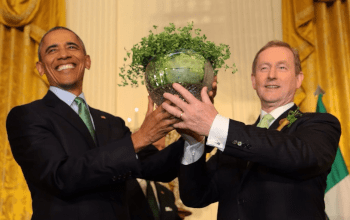
In the evening, Kenny presents the traditional bowl of shamrock to Obama at a reception at the White House. The bowl is mouth-blown and hand-cut at the House of Waterford Crystal factory in Ireland. The piece is designed by Tom Cooke and inspired by the General Post Office (GPO) in Dublin. It features the five themes of the Irish 2016 Centenary Programme – Remembering, Reconciling, Presenting, Imagining and Celebrating – which are inscribed on the piece.
Kenny also presents Obama with a pair of cufflinks modeled on the buttons of the coat Michael Collins was wearing when he was killed, and a limited-edition, fine-press collection of poetry and art, to celebrate the centenary of the 1916 Easter Rising, published by Stoney Road Press, in association with An Post and Poetry Ireland. First LadyMichelle Obama receives a ring designed by Paul Kelly, inspired by the Ring of Kerry, and a hamper of Irish food items. Daughters Malia and Sasha Obama are given two Newbridge Silverware compact mirrors.
Speaking to reporters after visiting the Oval Office, Kenny says Fine Gael is talking to like-minded parties and individuals on government formation and is working on drawing-up a set of priorities. “We’re actually determining our set of priorities that will be important in the discussions that Fine Gael will have in putting together a government. Some of that comes from our own programme, some of it comes from the parties and the alliances that we’ve been talking to. And some of it clearly comes from the concerns raised by people during the course of the election, like housing and homelessness, health issues and so on.”
Kenny adds, “We expect to have that finalised next week and that gives us really the basis for negotiations and for discussions about putting a government together.”
The following day, Kenny returns to Ireland for a short time before traveling to Brussels for a European Council meeting on Saint Patrick’s Day.
(From: “Kenny meets Obama and Biden in Washington,” RTÉ News, http://www.rte.ie, March 15, 2016)
Healy’s brother, Paddy Healy, serves as president of the Teachers’ Union of Ireland and runs unsuccessfully in the Seanad elections in 2007 and 2011 on the NUI panel, and in the 1980s runs in the Dublin North–East constituency as an Anti H-Block candidate.
Healy is re-elected to South Tipperary County Council at the 2009 Irish local elections. He wins back Tipperary South seat at the 2011 Irish general election with 21.3% of the first preference vote. On December 15, 2011, he helps launch a nationwide campaign against the household charge being brought in as part of the 2012 Irish budget.
Healy stands for re-election to the new Tipperary constituency as a non-party candidate in the 2016 Irish general election, and is elected on the seventh count. However, he is entered into the register of the 32nd Dáil as a Workers and Unemployed Action TD once again. He votes for both Gerry Adams and Richard Boyd Barrett for Taoiseach when the 32nd Dáil first convenes on March 10, 2016.
O’Sullivan is educated locally at Mount Carmel school. After completing a BA at University College Dublin (UCD), she then goes on to work as an English and History teacher and guidance counsellor in a secondary school in Baldoyle, a position she holds for thirty years.
O’Sullivan is a member of Tony Gregory‘s local political organisation in the 1970s, first canvassing for him and later serving as his election agent. She is co-opted onto Dublin City Council for the North Inner City local electoral area from September 2008 to June 2009, after the retirement of Mick Rafferty. After the death of Tony Gregory, she wins the resulting by-election which is held on the same day as the local elections where she also wins a seat on Dublin City Council, for the North Inner City local electoral area. Marie Metcalfe is co-opted to take the seat due to the dual mandate rule. Subsequently Anna Quigley replaces Metcalfe on Dublin City Council, who is in turn replaced by Mel MacGiobúin in March 2014. MacGiobúin fails to be elected at the local elections held in May.
O’Sullivan is re-elected to the Dáil at the 2011 Irish general election. She joins the Dáil technical group which gives independents and minor parties more speaking time in Dáil debates. She describes a proposal for political gender quota legislation as “tokenistic” and that women are able to get themselves nominated for election.
In December 2015, O’Sullivan and fellow independent TDs Clare Daly and Mick Wallace each put forward offers of a €5,000 surety for a 23-year-old man being prosecuted under terrorism legislation in the Special Criminal Court in Dublin charged with membership of an illegal dissident republican terrorist organisation.
After the 2016 Irish general election O’Sullivan unsuccessfully stands for election as Ceann Comhairle. She joins a technical group aligned with Independents 4 Change, while remaining outside the Independents 4 Change party. She is criticised by the brother of late TD Tony Gregory, over an allegedly false claim made in her election literature.
On January 16, 2020, O’Sullivan announces she will not be standing in the 2020 Irish general election in February.