seamus dubhghaill

Promoting Irish Culture and History from Little Rock, Arkansas, USA


Leave a comment

Birth of Kathleen Behan, Irish Republican & Folk Singer

Kathleen Behan (née Kearney), Irish republican and folk singer, and mother of Irish authors BrendanBrian and Dominic, is born on September 18, 1889, at 49 Capel StreetDublin.

She is the fifth child and youngest daughter of pork butcher and grocer, John Kearney (1854–97), and his wife Kathleen Kearney (née McGuinness) (1860–1907). She has four brothers and two sisters. Her father is from Rosybrook, County Louth and her mother is from Rathmaiden, Slane, County Meath, both coming from prosperous farming families. Her father has a business on Lower Dorset Street, with a grocery, pub and a row of houses. Owing to his own poor management, by the time she is born he has a smaller business on Dolphin’s Barn Lane. Following his death in 1897, she and her sisters are placed in the Goldenbridge orphanage at Inchicore by their mother. She is there from 1898 to 1904 where she becomes an avid reader. When she leaves, she rejoins her family in a one-room tenement flat on Gloucester Street.

Her oldest sibling, Peadar Kearney, is an ardent republican who writes the lyrics to the song that becomes the Irish national anthem, ”Amhrán na bhFiann”(English: “The Soldier’s Song”). It is through him that she meets a printer’s compositor and member of the Irish Volunteers, Jack Furlong. They marry in 1916. She is an active member of Cumann na mBan, and serves as a courier to the General Post Office, Dublin and other outposts during the 1916 Easter Rising. At the same time, Furlong fights in the Jacob’s factory garrison. The couple has two sons: Roger Casement (Rory) Furlong (1917–87) and Sean Furlong (born March 1919). Sean is born six month’s after she is widowed when Furlong dies in the Spanish flu epidemic of 1918. She lives with her mother-in-law, who is also a republican and seamstress who makes Irish Volunteer uniforms. She is arrested for running an Irish Republican Army (IRA) safe house. She works for a short time for Maud Gonne as a housekeeper, where she meets W. B. Yeats and Sarah Purser. A study painted of her by Purser (above) is now in the National Gallery of Ireland entitled The Sad Girl. From 1918 to 1922 she works as a clerk in the Dublin Corporation, while also a caretaker in the Harcourt Street branch of the Irish White Cross republican aid association.

In 1922 she marries Stephen Behan, house painter, trade unionist and fellow republican. The couple has four sons and one daughter: Brendan (b. 1923), Seamus (b. 1925), Brian (b. 1926), Dominic (b. 1928), and Carmel (b. 1932). Brendan is born while his father is imprisoned during the Irish Civil War, and Behan claims that Michael Collins gives her money while she is pregnant. Stephen’s mother owns three slum tenements, so the Behans live rent-free in a one-room basement flat at 14 Russell Street. Owing to her disdain at gossiping on the house steps, she is nicknamed “Lady Behan” by her neighbours. When Stephen’s mother dies in 1936, the Behans moved to a newly built council house in Crumlin, living at 70 Kildare Road. The family finds the new house far from work and school, and the local area devoid of community.

The family experiences extreme poverty frequently, owing to Stephen’s unemployment and during the nine month long building strike of 1936. Behan attempts to claim a pension as her first husband had served in 1916, but her application is rejected. She had said the exposure to flour had effected Furlong’s lungs negatively. It is declined as she had remarried before the enactment of the Army Pensions Act 1923. Despite their circumstances, the house attracts conversation, music, books and politics. The Behan’s republican, socialist, labour activist and anti-clericalism have a strong effect on their sons, particularly Brendan and Dominic. Such is the volume of radical meetings that take place at the Behan home, it is dubbed “the Kremlin” by their neighbours, and a “madhouse” by Stephen. During The Emergency of 1939 to 1945 she fights against local shopkeepers who ignore price controls, and is labelled as “red” for her anti-Franco and pro-Stalin sympathies. Her reply to the branding of her as such is “I’m not red, I’m scarlet.”

From the 1950s onwards, Behan shares international fame with her sons Dominic and Brendan. She often travels to London to see their plays, eventually appearing on British and Irish television and cultivating her own following. She is badly injured when she is struck by a motorcycle, a day before Stephen’s death in 1967. Owing to the effect of these injuries, she moves in 1970 to the Sacred Heart Residence of the Little Sisters of the Poor, Sybil Hill, Raheny.

In 1981, she records an album When All the World Was Young. Taped conversations of her reminiscences are made into an autobiographic book, Mother of all the Behans, by her son Brian in 1984. A one-woman stage adaptation of the book by Peter Sheridan and starring Rosaleen Linehan is acclaimed in Ireland, Britain and North America.

Behan dies in the nursing home in Raheny on April 26, 1984, and is buried in Dean’s Grange Cemetery.

(Pictured: Portrait of Kathleen Behan by Sarah Purser, National Gallery of Ireland)

Leave a comment

Ceremony Marks the Centennial of First Easter Rising Executions

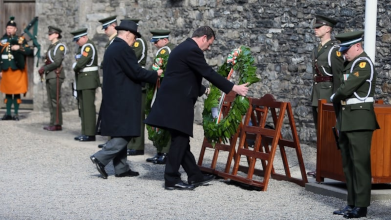
On Tuesday, May 3, 2016, ceremonies to mark the 100th anniversary of the executions of Tom Clarke, Patrick Pearse and Thomas MacDonagh are held in the Stonebreakers’ Yard in Kilmainham Gaol, the first executions of the leaders of the Easter Rising. Pearse, Clarke and MacDonagh are remembered in similar but distinct commemorations which take place on the spot where they died on May 3, 1916.

The transcripts of the short courts-martial are read aloud. In the case of Tom Clarke, who offered no defence and made no statement prior to his execution, the proceedings take only a few minutes to recount.

The presence of Capuchin friars from Church Street lends a sense of continuity to proceedings. Their predecessors had been there for the men in their final hours and their testimony is read aloud by their contemporaries.

The Government is represented by Minister for the Environment Alan Kelly, Minister for Foreign Affairs Charles Flanagan and Minister of State at the Department of Heritage Joe McHugh. Kelly speaks of living up to the ideals of the Proclamation of the Irish Republic, namely a nation that “cherishes all of the children equally.” He says Pearse was well aware of the effect on his family of his pending execution and had written his poem “The Mother” foreseeing his death.

Capuchin friar Adrian Kearns recalls the testimony of Fr. Columbus Murphy, who ministered to Pearse in his final hours. He did not “quail before the possibility of death . . . but faced his last moments with dignity and with grace.” Fr. Murphy remembered Pearse being a “sad, forlorn figure weighed down by the sense of responsibility” who lamented the loss of life and hoped it would not be in vain.

A wreath is laid on behalf of the Pearse family by his namesake Patrick Pearse, a great grandnephew.

Brother Peter Rogers recalls that Clarke was defiant rather than melancholic in his last hours. Fr. Murphy visited him as well. Clarke, the friar recalls, was “relieved that he was to be executed. His one dread was that he would be sent to prison again.” There is no member of Clarke’s family present to represent him at the commemorations, so a wreath is laid on behalf of the family by the staff of Kilmainham Gaol.

Several of MacDonagh’s surviving grandchildren are present. His granddaughter, Barbara Cashin, lays a wreath on behalf of the family. Her father Donagh and her aunt Barbara are left orphans a year after the Easter Rising when MacDonagh’s wife Muriel drowns off the coast of Skerries in July 1917. Cashin says her father had mixed feelings about the Rising, given the double tragedy that befell him and his sister a short time afterwards. “He had a horrendous childhood. He had a strange upbringing and hated to talk about it,” she says. “He had a split mind about it. I remember asking him as a child about it and saying he must be proud. Weren’t they wonderful. He said, ‘they may have been fools as well.’”

The ceremony takes place with full military honours. The “Last Post” and “Reveille” are played, and the service concludes with the national anthem of Ireland, “Amhrán na bhFiann.”

The commemorations are repeated the following day for the next four to have been executed: Joseph Plunkett, Edward Daly, Michael O’Hanrahan and Willie Pearse. Similar events are scheduled through May 12 to mark the exact centenary of the executions of the remaining eight men killed by a British Army firing squad at the Stonebreakers’ Yard.

Meanwhile, President Michael D. Higgins formally renames the East-Link Toll Bridge in Dublin the Tom Clarke Bridge.

(From: “Executed Rising rebels honoured at Kilmainham Gaol” by Ronan McGreevy, The Irish Times, http://www.irishtimes.com, May 3, 2016)


Leave a comment

Death of James McNeill, Second Governor-General of the Irish Free State

James McNeill, Irish politician and diplomat who serves as first High Commissioner to London and second Governor-General of the Irish Free State, dies on December 12, 1938.

One of five children born to Archibald McNeill, a Roman Catholic working class “baker, sailor and merchant,” and his wife, Rosetta (née McAuley) McNeill, McNeill is the brother of nationalist leader Eoin MacNeill. He serves as a high-ranking member of the Indian Civil Service in Calcutta.

Although unconnected with the Easter Rising in 1916, McNeill is arrested and jailed by the British Dublin Castle administration. On release, he is elected to Dublin County Council, becoming its chairman. He serves as a member of the committee under Michael Collins, the chairman of the Provisional Government, that drafts the Constitution of the Irish Free State. He is subsequently appointed as High Commissioner from Ireland to the United Kingdom.

When the first Governor-General of the Irish Free State, Tim Healy, retires in December 1927, McNeill is proposed as his replacement by the Irish government of W. T. Cosgrave and duly appointed by King George V as Governor-General of the Irish Free State.

In office, McNeill clashes with the King’s Private Secretary when he insists on following the constitutional advice of his Irish ministers, rather than that of the Palace, in procedures relating to the receipt of Letters of Credence accrediting ambassadors to the King in Ireland. He also refuses to attend ceremonies in Trinity College, Dublin, when some elements in the college try to ensure that the old British national anthem God Save the King is played, rather than the new Irish anthem, Amhrán na bhFiann.

When Éamon de Valera is nominated as President of the Executive Council of the Irish Free State in 1932, McNeill opts to travel to Leinster House, the parliament buildings, to appoint de Valera, rather than to require that he go to the Viceregal Lodge, the Governor-General’s residence and the former seat of British Lords Lieutenant, to avoid embarrassing de Valera, who is a republican.

However, McNeill’s tact is not reciprocated by de Valera’s government, and some of its ministers seek to humiliate him as the King’s representative by withdrawing the Irish Army‘s band from playing at functions he attends and demanding he withdraw invitations to visitors to meet him. In one notorious incident in April, two ministers, Seán T. O’Kelly (a future President of Ireland) and Frank Aiken, publicly walk out of a diplomatic function when McNeill, there as the guest of the French ambassador, arrives. In a fury, McNeill writes to de Valera demanding an apology for this treatment. When none is forthcoming, apart from an ambiguous message from de Valera that could be interpreted as partially blaming McNeill for attending functions at which ministers would be present, he publishes his correspondence with de Valera, even though de Valera had formally advised him not to do so. De Valera then demands that George V dismiss him.

The King engineers a compromise, whereby de Valera withdraws his dismissal request and McNeill, who is due to retire at the end of 1932, will push forward his retirement date by a month or so. McNeill, at the King’s request, resigns on November 1, 1932.

In June 1932 John Charles McQuaid, President of Blackrock College hosts an extravagant garden party to welcome Papal Legate Lorenzo Lauri, who had arrived in Ireland to represent Pope Pius XI at the 31st International Eucharistic Congress. While de Valera maintains a very high profile at the event, McQuaid, at de Valera’s request, goes to great lengths to avoid MacNeill to the extent possible.

McNeill dies on December 12, 1938, at the age of 69 in London. His widow Josephine is appointed Minister to the Hague by Seán MacBride, Minister for External Affairs in the coalition government of 1948.


Leave a comment

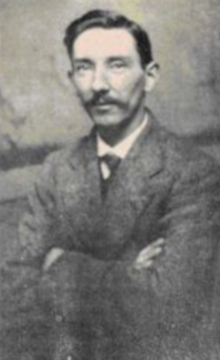
Death of Peadar Kearney, Composer & Irish Republican

peadar-kearney

Peadar Kearney, Irish republican and composer of numerous rebel songs, dies in Inchicore, Dublin on November 24, 1942. In 1907 he writes the lyrics to “The Soldier’s Song” (“Amhrán na bhFiann“), now the Irish national anthem. He is the uncle of Irish writers Brendan Behan, Brian Behan, and Dominic Behan.

Kearney was born on December 12, 1883, at 68 Lower Dorset Street, Dublin, above one of the two grocer’s shops owned by his father, John Kearney, originally from Funshog, Collon, County Louth. His mother, Katie (née McGuinness), is from Rathmaiden, Slane, County Meath. He is educated at the Model School, Schoolhouse Lane and St. Joseph’s Secondary C.B.S. in Fairview. He hears Willie Rooney give nationalist lectures on history in the Mechanics’ Institute. For a short time, he attends Belvedere College. Following the death of his father, he is left to support his mother and five younger siblings. He has various menial jobs for three years before being apprenticed to a house painter.

In 1901, the death of Willie Rooney prompts Kearney to join the Willie Rooney Branch of the Gaelic League. He joins the Irish Republican Brotherhood in 1903. He teaches night classes in Irish and numbers Seán O’Casey among his pupils. He finds work with the National Theatre Society and in 1904 is one of the first to inspect the derelict building that becomes the Abbey Theatre. He assists with props and performs occasional walk-on parts at the Abbey until 1916.

Kearney is a co-founder of the Irish Volunteers in 1913 and takes part in the Howth and Kilcoole gun runnings in 1914. In the Easter Rising of 1916 he fights at Jacob’s biscuit factory under Thomas MacDonagh, abandoning an Abbey Theatre tour in England to take part in the Rising. He escapes before the garrison is taken into custody.

Kearney is also active in the Irish War of Independence. On November 25, 1920, he is captured at his home in Summerhill, Dublin and is interned first in Collinstown Camp in Dublin and later in Ballykinler Camp in County Down.

A personal friend of Michael Collins, Kearney at first takes the Free State side in the Irish Civil War but loses faith in the Free State after Collins’s death. He takes no further part in politics, returning to his original trade of house painting.

Kearney’s songs are highly popular with the Irish Volunteers (which later becomes the Irish Republican Army) in the 1913–1922 period. Most popular is “The Soldier’s Song.” He pens the original English lyrics in 1907 and his friend and musical collaborator Patrick Heeney composes the music. The lyrics are published in 1912 and the music in 1916. After 1916 it replaces “God Save Ireland” as the anthem of Irish nationalists. The Irish Free State is established in 1922 and formally adopts the anthem in 1926.

Other well-known songs by Kearney include “Down by the Glenside,” “The Tri-coloured Ribbon,” “Down by the Liffey Side,” “Knockcroghery” (about the village of Knockcroghery) and “Erin Go Bragh” (Erin Go Bragh is the text on the Irish national flag before the adoption of the tricolour).

Peadar Kearney dies in relative poverty in Inchicore on November 24, 1942. He is buried in Glasnevin Cemetery in Dublin.


Leave a comment

Free State Government Purchases Copyright to “The Soldiers Song”

amhran-na-bhfiann

The Irish Free State government purchases the copyright of Peadar Kearney‘s The Soldiers Song on October 20, 1933, which becomes the Irish national anthem Amhrán na bhFiann. The song has three verses, but only the choral refrain is officially designated the national anthem.

A Soldiers’ Song is composed in 1907, with words by Peadar Kearney and music by Kearney and Patrick Heeney. The text is first published in Irish Freedom by Bulmer Hobson in 1912. It is used as a marching song by the Irish Volunteers and is sung by rebels in the General Post Office (GPO) during the Easter Rising of 1916. Its popularity increases among rebels held in Frongoch internment camp after the Rising, and the Irish Republican Army (IRA) in the Irish War of Independence (1919–21). After the establishment of the Irish Free State in 1922, a large proportion of the IRA’s men and apparatus become the National Army. The Soldiers’ Song remains popular as an Army tune and is played at many military functions.

The Free State does not initially adopt any official anthem. The delicate political state in the aftermath of the Irish Civil War provokes a desire to avoid controversy. Ex-Unionists continue to regard God Save the King as the national anthem, as it has been for the rest of the British Empire. W. T. Cosgrave, President of the Executive Council of the Irish Free State expresses opposition to replacing The Soldiers’ Song, which is provisionally used within the State.

There is concern that the lack of an official anthem is giving Unionists an opportunity to persist with God Save the King. The Soldiers’ Song is widely if unofficially sung by nationalists. On July 12, 1926, the Executive Council of the Irish Free State decides to adopt it as the National Anthem, with Cosgrave the driving force in the decision. However, this decision is not publicised.

In 1928, the Army band establishes the practice of playing only the chorus of the song as the Anthem, because the longer version is discouraging audiences from singing along.

The anthem is played by Radio Éireann at close down from its inception in 1926. Cinemas and theatres do so from 1932 until 1972. Peadar Kearney, who has received royalties from publishers of the text and music, issues legal proceedings for royalties from those now performing the anthem. He is joined by Michael Heeney, brother of Patrick Heeney, who had died in 1911. In 1934, the Department of Finance acquires the copyright of the song for the sum of £1,200. Copyright law changes in 1959, such that the government has to reacquire copyright in 1965, for £2,500. As per copyright law, the copyright expires in December 2012, following the 70th anniversary of Kearney’s death. In 2016, three Fianna Fáil senators introduce a private member’s bill intended to restore the state’s copyright in the anthem.