seamus dubhghaill

Promoting Irish Culture and History from Little Rock, Arkansas, USA


Leave a comment

Death of Donal McCann, Stage, Film & Television Actor

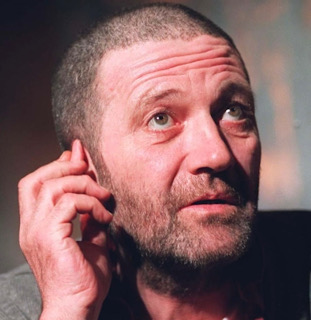
Donal McCann, Irish stage, film, and television actor, dies from pancreatic cancer in Dublin on July 17, 1999. He is best known for his roles in the works of Brian Friel and for his lead role in John Huston‘s last film, The Dead (1987). In 2020, he is listed as number 45 on The Irish Times list of Ireland’s greatest film actors.

McCann is born on May 7, 1943, in Terenure, Dublin. His father is John J. McCann, a playwright and politician who serves twice as Lord Mayor of Dublin. Although he acts in a production of his father’s Give Me a Bed of Roses at Terenure College in 1962, he briefly studies architecture before taking a job as a trainee sub-editor at the Evening Press which allows him to pursue part-time acting classes at the Abbey School of Acting at the same time. He joins the Abbey Players in the late 1960s.

Among his most important early roles are Cú Chulainn in W. B. Yeats‘s On Baile Strand (1966), and as Estragon in a seminal production of Samuel Beckett‘s Waiting for Godot, partnering with Peter O’Toole as Vladimir (1969).

McCann’s career includes parts in many plays from the Irish literary canon, including Tarry FlynnThe Shaughran, and the Gate Theatre‘s highly acclaimed production of Seán O’Casey‘s classic Juno and the Paycock in the 1980s (McCann plays the “Paycock” (Captain Boyle) opposite Geraldine Plunkett as Juno and John Kavanagh as Joxer Daly) as well as a subsequent production of O’Casey’s The Plough and the Stars.

McCann develops a particularly fruitful relationship with the playwright Brian Friel. He plays the role of Gar O’Donnell, the public figure, in a film adaptation of Philadelphia, Here I Come! in 1970 and, despite popular belief, he never plays either public or private Gar on stage. He gives a landmark performance as Frank Hardy, the title character, in Faith Healer in 1980 (a role he reprised in 1994), continuing his relationship with Friel through productions of Translations (1988) and Wonderful Tennessee (1993).

Friel says that McCann’s work “contains extraordinary characteristics that go beyond acting … it is deeply spiritual.” Perhaps McCann’s most renowned role is as Thomas Dunne in Sebastian Barry‘s The Steward of Christendom. He wins the London Critics’ Circle Theatre Award (Drama Theatre) as best actor for this role in 1995. He reprises this role in a 1996 production at the Gate Theatre, Dublin and, following a twelve-week run at the Brooklyn Academy of Music in 1997, his “performance of unarguable greatness” (The New York Observer) had Newsweek hailing him as “a world-class star,” and The New York Times referring to this “astonishing Irish actor…widely regarded as the finest of them all.”

On the London stage, McCann plays in Prayer for My Daughter opposite Antony Sher (1978), and is Jean to Dame Helen Mirren‘s Julie in Miss Julie (1971). This is filmed for the BBC, and he much later plays Judge Brack with Fiona Shaw in the title role of Henrik Ibsen‘s Hedda Gabler, a production filmed for the BBC in 1993.

McCann begins his film career early, in 1966, in Walt Disney Pictures’s The Fighting Prince of Donegal (this later becomes a TV series). More significant roles include the title character’s father Shamie in Cal and one of the feuding brothers in Thaddeus O’Sullivan‘s December Bride (1990). He works a number of times with Neil Jordan (in AngelThe Miracle and High Spirits).

His best-known film role is as Gabriel Conroy in The Dead (1987), starring opposite Anjelica Huston and directed by her father, John Huston. Significant late roles include Bernardo Bertolucci‘s Stealing Beauty (1996) and in John Turturro‘s Illuminata (released in 1999, after McCann’s death).

McCann’s television work includes the featured role of Phineas Finn in the BBC’s serialised adaptation of Anthony Trollope‘s The Pallisers, Willie Burke in RTÉ‘s Prix Italia drama entry The Burke Enigma (1979) and Barney Mulhall in RTÉ’s Strumpet City (1980), as well as many one-off parts.

McCann plays in Bob Quinn‘s Irish language film Poitín (1979) and in Quinn’s somewhat experimental The Bishop’s Story (1995). After hearing that McCann is ill, Tom Collins asks Quinn to make a TV documentary about McCann for RTÉ called It Must Be Done Right (1999), after a remark by McCann on his craft. The film airs on RTÉ a week before McCann’s death.

In his private life, McCann is a quiet and unassuming man, but he battles both depression and alcoholism all his life. He has many friends in Irish theatre and artistic circles but also across all strata of life. His hobbies include sketching and he is passionate about horse racing.

Remembering McCann on the 25th anniversary of his death, Gerald Smyth writes, “In the melancholy of that life-worn voice could be heard the cadences of a lyric heart.”
2 Comments

Death of Arthur Armstrong, Northern Irish Painter

Arthur Armstrong, painter who often works in a Cubist style and produces landscape and still life works, dies in Dublin on January 13, 1996.

Armstrong is born on January 12, 1924, at Carrickfergus, County Antrim, Northern Ireland, one of three sons among six children of James Charlton Armstrong, housepainter and decorator, and his wife Margaret (née Howard). Soon after his birth the family moves to Belfast. He attends Strandtown Primary School. He attends Queen’s University Belfast (QUB) in the early 1940s, where he initially studies political science and later architecture. Having an interest in art, which had been fostered by his father, he takes classes for a short time in the early 1940s at the Belfast School of Art. It is there he meets Gerard Dillon, who introduces him to George Campbell and Daniel O’Neill. He is largely self-taught as an artist. It is his close association with Dillon and Campbell, both some years his senior, that proves to be the most important factor in his development. In Belfast in the early 1940s they associate with the Russian artist Daniel Nietzche, who emphasises to them the importance of personal expression.

After leaving university Armstrong works at the Belfast Gas Office. At this point he is the main support for his widowed mother. Having saved some money, he leaves his job in 1946 to attempt to fulfil his ambition to paint full-time, producing a set of etchings with George Campbell, which are published by Walsh Studios. The following year he takes work as a designer for Ulster Laces in Portadown, County Armagh. In 1957, he leaves for London in the hopes of finding greater opportunities as an artist. His friends Campbell and Dillon are already living there, and he takes lodgings with Dillon’s sister at Abbey Road, north London. Though he continues to paint, he is unable to earn a living and so again has to take other work, this time in a Labour Exchange office. However, he is beginning to gain recognition. In 1957, he is awarded a traveling scholarship by the Council for the Encouragement of Music and the Arts (CEMA), which enables him to travel to Spain. He continues to visit Spain throughout the 1960s, often to see Campbell, who spends much time there.

In 1961 he has his first solo exhibition at the CEMA gallery in Belfast. He comes to live in Dublin in 1962, his work having already been exhibited there at the Irish Exhibition of Living Art in 1957 and 1958. He continues to exhibit there annually from 1961 to 1965. During the 1960s and early 1970s his work is regularly included in the Oireachtas exhibition, at which he is awarded the Douglas Hyde Gold Medal in 1968. He also shows his work with the Ritchie Hendriks Gallery and the Tom Caldwell Gallery in Dublin. Ultimately, he is to have over seventy solo exhibitions throughout his career. By 1969, when he is elected an associate member of the Royal Hibernian Academy (RHA), he has established himself as one of the leading landscape painters in Ireland. In 1972 he becomes a full member of the RHA. He exhibits there regularly until 1977.

It is during this period that some of Armstrong’s best work is produced. While landscape is his predominant theme, he never sees himself as a painter of particular views, rather he responds to the abstract qualities of a scene. He sees elements such as the sea, rocks or sky as a series of interlocking textures to be rendered expressively in oil paint. The western coastline of Ireland is a vital source of inspiration for him. Roundstone, County Galway, is a favoured base for painting trips in the company of Dillon and Campbell, who by this time are also living in Dublin.

In 1981, a retrospective exhibition of Armstrong’s work is organised by the Arts Council of Northern Ireland. He is represented in many major public and corporate collections in Ireland. From 1971 he lives at 28 Chelmsford Avenue, Ranelagh, Dublin, in a house he shares with Gerard Dillon.

Armstrong dies unmarried on January 13, 1996, in Dublin. The contents of his studio are sold on February 3, 1998.

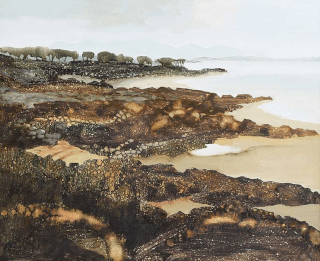
(From: “Armstrong, Arthur” by Rebecca Minch, Dictionary of Irish Biography, http://www.dib.ie, October 2009, revised November 2013 | Pictured: “Near Ballyhubbock,” oil on board by Arthur Armstrong RHA)


Leave a comment

Death of John Arden, English Playwright

John Arden, English playwright, dies on March 28, 2012, in Galway, County Galway. At the time of his death, he is lauded as “one of the most significant British playwrights of the late 1950s and early 60s.”

Arden is born in Barnsley, South Yorkshire, England, on October 26, 1930. He is the son of the manager of a glass factory. He is educated at Sedbergh School in Cumbria, King’s College, Cambridge and the Edinburgh College of Art, where he studies architecture. He first gains critical attention for the radio play The Life of Man in 1956 shortly after finishing his studies.

Arden is initially associated with the English Stage Company at the Royal Court Theatre in London. His 1959 play, Serjeant Musgrave’s Dance, in which four army deserters arrive in a northern mining town to exact retribution for an act of colonial violence, is considered to be his best. His work is influenced by Bertolt Brecht and epic theatre as in Left-Handed Liberty (1965, on the anniversary of Magna Carta). Other plays include Live Like Pigs, The Workhouse Donkey, and Armstrong’s Last Goodnight, the last of which is performed at the 1963 Chichester Festival by the Royal National Theatre after it was rejected by the Royal Court.

Arden’s 1978 radio play Pearl is considered in a Guardian survey to be one of the best plays in that medium. He also writes several novels, including Silence Among the Weapons, which is shortlisted for the Booker Prize in 1982, and Books of Bale, about the Protestant apologist John Bale. He is a member of the Royal Society of Literature.

With his wife and co-writer Margaretta D’Arcy, Arden pickets the Royal Shakespeare Company (RSC) premiere of his Arthurian play The Island of the Mighty, because they believe the production to be pro-imperialist. They write several plays together which are highly critical of British presence in Ireland, where he and D’Arcy live from 1971 onward.

In 1961, Arden is a founder member of the anti-nuclear Committee of 100, and he also chairs the pacifist weekly Peace News. In Ireland, he is for a while a member of Official Sinn Féin. He is an advocate of civil liberties, and opposes anti-terror legislation, as demonstrated in his 2007 radio play The Scam.

Arden is elected to Aosdána in 2011 before dying in Galway on March 28, 2012. He is waked in a wicker casket.

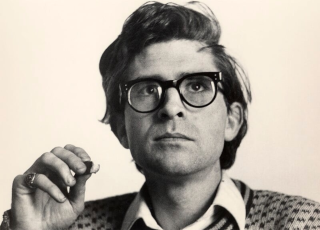
(Pictured: Photograph of John Arden, 1960 bromide print on card mount, credit to Roger Mayne, National Portrait Gallery, London)


Leave a comment

Death of Edmund Pery, 1st Viscount Pery

Edmund Sexton Pery, 1st Viscount Pery, Irish politician who serves as Speaker of the Irish House of Commons between 1771 and 1785, dies on February 24, 1806, at his home at Park Street, London.

Pery is born in Limerick, County Limerick on April 8, 1719, into one of Limerick’s most politically influential families, the elder son of the Rev. Stackpole Pery and Jane Twigge. His maternal grandfather is William Twigge, Archdeacon of Limerick.

A trained barrister, Pery becomes a member of the Irish House of Commons for the Wicklow Borough constituency in 1751. On the dissolution of the house following the death of George II, he is elected for the constituency of Limerick City and serves from 1761 until 1785, becoming Speaker of the House in 1771. In 1783, he stands also for Dungannon, however chooses to sit for Limerick City. He is considered one of the most powerful politicians in Ireland in his time, leading a faction which includes his nephew, the future Earl of Limerick, and his relatives by marriage, the Hartstonges. Following his resignation, he is created Viscount Pery, of Newtown Pery, near the City of Limerick, in the Peerage of Ireland, entitling him to a seat in the Irish House of Lords. As he has no male heirs, his title becomes extinct on his death in 1806.

Pery is also noted for his part in the history of the architecture of Limerick. In 1765, he commissions the engineer Davis Ducart to design a town plan for land that he owns on the southern edge of the existing city, which leads to the construction of the Georgian area of the city later known as Newtown Pery. He is also commemorated in the naming of Pery Square.

Pery marries Patricia (Patty) Martin of Dublin in 1756, who dies a year later, and secondly Elizabeth Vesey, daughter of John Vesey, 1st Baron Knapton, and Elizabeth Brownlow. He and Elizabeth have two daughters:

Pery dies on February 24, 1806, at his home at Park Street, London, and is buried at Furnam, Pelham, Hertfordshire, England.

Pery’s younger brother, William, is a leading figure in the Church of Ireland, becoming Bishop of Killala and Achonry and subsequently Bishop of Limerick, Ardfert and Aghadoe, and also ennobled as Baron Glentworth. William’s son, Edmund, is made Earl of Limerick in 1803 as a result of his support for the Act of Union. Pery’s younger sister is Lucy Hartstonge, the founder of what is now St. John’s Hospital, Limerick.

(Pictured: “Portrait of Edmund Sexton, later 1st Viscount Pery” by Gilbert Stuart, oil on canvas, circa 1790, National Gallery of Ireland)


Leave a comment

Birth of Edmund Pery, 1st Viscount Pery

Edmund Sexton Pery, 1st Viscount Pery, Irish politician who served as Speaker of the Irish House of Commons between 1771 and 1785, is born in Limerick, County Limerick on April 8, 1719.

Pery is born into one of Limerick’s most politically influential families, elder son of the Rev. Stackpole Pery and Jane Twigge. His maternal grandfather is William Twigg, Archdeacon of Limerick.

A trained barrister, Pery becomes a member of the Irish House of Commons for the Wicklow Borough constituency in 1751. On the dissolution of the house following the death of George II, he is elected for the constituency of Limerick City and serves from 1761 until 1785, becoming Speaker of the House in 1771. In 1783, he stands also for Dungannon, however chooses to sit for Limerick City. He is considered one of the most powerful politicians in Ireland in his time, leading a faction which includes his nephew, the future Earl of Limerick, and his relatives by marriage, the Hartstonges. Following his resignation, he is created Viscount Pery, of Newtown Pery, near the City of Limerick, in the Peerage of Ireland, entitling him to a seat in the Irish House of Lords. As he has no male heirs, his title becomes extinct on his death on February 24, 1806.

Pery is also noted for his part in the history of the architecture of Limerick. In 1765, he commissions the engineer Davis Ducart to design a town plan for land that he owns on the southern edge of the existing city, which leads to the construction of the Georgian area of the city later known as Newtown Pery. He is also commemorated in the naming of Pery Square.

Pery marries Patricia (Patty) Martin of Dublin in 1756, who dies a year later, and secondly Elizabeth Vesey, daughter of John Vesey, 1st Baron Knapton, and Elizabeth Brownlow. He and Elizabeth have two daughters:

Pery’s younger brother, William, is a leading figure in the Church of Ireland, becoming Bishop of Killala and Achonry and subsequently Bishop of Limerick, Ardfert and Aghadoe, and also ennobled as Baron Glentworth. William’s son, Edmund, is made Earl of Limerick in 1803 as a result of his support for the Act of Union. Pery’s younger sister is Lucy Hartstonge, the founder of what is now St. John’s Hospital, Limerick.

(Pictured: “Portrait of Edmund Sexton, later 1st Viscount Pery” by Gilbert Stuart, oil on canvas, circa 1790, National Gallery of Ireland)


Leave a comment

Birth of Arthur Armstrong, Landscape & Still Life Painter

Arthur Armstrong, landscape and still life painter who often works in a Cubist style, is born in Carrickfergus, County Antrim, Northern Ireland, on January 12, 1924. A prolific painter, completing up to 300 paintings a year, in oils, watercolour and mixed media, he regards himself first and foremost as an abstract artist.

Armstrong is the son of a house painter and attends Strandtown Primary School. Later he studies architecture at Queen’s University Belfast, but after two years he moves to study art at Belfast School of Art. The influence of Cubism and the School of Paris can be clearly seen in his work, which takes him to England, France and Spain. He also travels and paints in the west of Ireland and Connemara inspires some of his best work. In 1950 his work is exhibited in the Grafton Gallery in Dublin, and subsequent exhibitions take place in England, Spain and the United States, as well as in Belfast and Dublin. In 1957 he is awarded a travelling scholarship from the Council for the Encouragement of Music and the Arts (CEMA), a forerunner of the Arts Council of Great Britain, and goes to Spain. He eventually settles in Dublin in 1962 and begins showing work at the Royal Hibernian Academy.

In 1968 Armstrong is awarded the Douglas Hyde Gold Medal at the Oireachtas Exhibition. In 1969 he designs sets, with George Campbell and Gerard Dillon, for the Seán O’Casey play, Juno and the Paycock, at the Abbey Theatre in Dublin. He becomes a member of the Royal Hibernian Academy in 1972 and in 1973 he is awarded the Art in Context prize from the Arts Council of Northern Ireland. He becomes a member of Aosdána in 1981, the same year that a retrospective exhibition of his work from 1950 to 1980 is held by the Arts Council of Northern Ireland.

From 1971 Armstrong lives at 28 Chelmsford Avenue, Ranelagh, Dublin, in a house he shares with Gerard Dillon. A bachelor, Armstrong dies in a Dublin hospital on January 13, 1996. The contents of his studio are sold February 3, 1998.

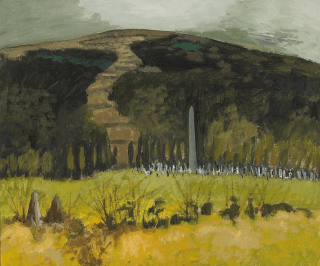
(Pictured: “Glendalough” by Arthur Armstrong, oil on board)


Leave a comment

Birth of English Playwright John Arden

John Arden, English playwright, is born in Barnsley, South Yorkshire, England, on October 26, 1930. At the time of his death he is lauded as “one of the most significant British playwrights of the late 1950s and early 60s.”

Arden is the son of the manager of a glass factory. He is educated at Sedbergh School in Cumbria, King’s College, Cambridge and the Edinburgh College of Art, where he studies architecture. He first gains critical attention for the radio play The Life of Man in 1956 shortly after finishing his studies.

Arden is initially associated with the English Stage Company at the Royal Court Theatre in London. His 1959 play, Serjeant Musgrave’s Dance, in which four army deserters arrive in a northern mining town to exact retribution for an act of colonial violence, is considered to be his best. His work is influenced by Bertolt Brecht and epic theatre as in Left-Handed Liberty (1965, on the anniversary of Magna Carta). Other plays include Live Like Pigs, The Workhouse Donkey, and Armstrong’s Last Goodnight, the last of which is performed at the 1963 Chichester Festival by the Royal National Theatre after it was rejected by the Royal Court.

Arden’s 1978 radio play Pearl is considered in a Guardian survey to be one of the best plays in that medium. He also writes several novels, including Silence Among the Weapons, which is shortlisted for the Booker Prize in 1982, and Books of Bale, about the Protestant apologist John Bale. He is a member of the Royal Society of Literature.

With his wife and co-writer Margaretta D’Arcy, Arden pickets the Royal Shakespeare Company (RSC) premiere of his Arthurian play The Island of the Mighty, because they believe the production to be pro-imperialist. They write several plays together which are highly critical of British presence in Ireland, where he and D’Arcy live from 1971 onward.

In 1961, Arden is a founder member of the anti-nuclear Committee of 100, and he also chairs the pacifist weekly Peace News. In Ireland, he is for a while a member of Official Sinn Féin. He is an advocate of civil liberties, and opposes anti-terror legislation, as demonstrated in his 2007 radio play The Scam.

Arden is elected to Aosdána in 2011 before dying in Galway, County Galway on March 28, 2012. He is waked in a wicker casket.

(Pictured: Photograph of John Arden in 1966, credit to Sam Falk/The New York Times)


Leave a comment

Death of Sculptor Alexandra Wejchert

Alexandra Wejchert, Polish-Irish sculptor known for her use of perspex (plexiglass), stainless steel, bronze and neon colours, dies in Dún Laoghaire, County Dublin, on October 24, 1995.

Wejchert was born in Kraków, Poland on October 16, 1921. Her father is Tedeusz Wejchert, who ran a shipping business out of Gdańsk. She enters University of Warsaw to study architecture in 1939, and while there witnesses the German invasion of Poland during World War II. Having graduated in 1949, she works as a town planner and architect in Warsaw, where she graduates from the Academy of Fine Arts in 1956 with a degree before moving to Italy.

Wejchert holds her first solo show in 1959 in the Galeria dell’ Obelisco, Rome. She then returns to Warsaw where she is featured in the National Museum “Fifteen years of Polish art” exhibition in 1961. At this time she is still working as an architect, but does not support the social realism of Soviet architecture, which leads her to decide to concentrate solely on art from 1963. She leaves communist Poland in 1964, when she accompanies her younger brother, the architect Andrej Wejchert, when he and his wife Danuta moved to Dublin.

She holds her first solo show in Dublin in November 1966 with an exhibition of 30 paintings at The Molesworth Gallery. In 1967 she shows Blue relief at the Irish Exhibition of Living Art, which is a wall relief of “sculpted paintings” which are precursors to her later free-standing sculpture. She wins the Carroll Open award of £300 at the 1968 Irish Exhibition of Living Art for Frequency No. 5. Also in 1968 she holds a solo exhibition in the Galerie Lamert, Paris, becoming a regular exhibitor there. During this period her work is used as a setting for an electronic music concert with the critic Dorothy Walker noting her designs have a rhythmic quality.

From the 1970s, Wejchert wins commissions for public art, starting with the 1971 wood and acrylic wall relief in the arts building at University College Dublin. In the same year, the Bank of Ireland purchases Blue form 1971 and then Flowing relief in 1972. Her 1971 triptych, Life, is commissioned for the Irish Life headquarters in Abbey Street. The Lombard and Ulster Bank in Dublin commissions untitled in 1980, and Allied Irish Banks (AIB) purchases Freedom in 1985 for their branch in Ballsbridge. Her entry wins a competition in 1975 for a stamp marking International Women’s Year, and features an image of hands reaching for a dove with an olive branch.

Wejchert becomes an Irish citizen in 1979, a member of Aosdána in 1981, and a member of the Royal Hibernian Academy (RHA) in 1995. She is recognised internationally when she is the only Irish sculptor included in Louis Redstone’s new directions (1981). She is shown at the Solomon gallery from 1989 numerous times, including a solo show in 1992. A number of her most important pieces are for Irish universities, such as Geometric form at the University of Limerick and Flame at the University College Cork in 1995, her last work.

Wejchert dies suddenly at her home on Tivoli Road, Dún Laoghaire on October 24, 1995. She has one son, Jacob. The RHA holds a posthumous exhibition of her work in 1995. She is said to have influenced the younger generation of Irish sculptors, including Vivienne Roche, Eilis O’Connell, and Michael Warren. Flame is selected to be a part of the Irish Artists’ Century exhibition at the RHA in 2000.

(Pictured: “Flame,” 1995, brass and granite, University College Cork. This sculpture commemorates the people who bequested their bodies to the UCC Anatomical Gift Programme for the purpose of science and learning. It represents the flame of knowledge which leads to the light of understanding.)