seamus dubhghaill

Promoting Irish Culture and History from Little Rock, Arkansas, USA


Leave a comment

Death of Irish Artist Sarah Henrietta Purser

sarah-purser-by-john-butler-yeats

Sarah Henrietta Purser, Irish artist mainly noted for her work with stained glass, dies in Dublin on August 7, 1943.

The Purser family had come to Ireland from Gloucestershire in the eighteenth century. Purser is born in Kingstown (now Dún Laoghaire) in County Dublin on March 22, 1848. She is raised in Dungarvan, County Waterford, one of the numerous children of Benjamin Purser, a prosperous flour miller and brewer, and his wife Anne Mallet. She is related to Sir Frederic William Burton, RHA (1816-1900), who is a son of Hannah Mallet. Two of her brothers, John and Louis, become professors at Trinity College Dublin. Her niece Olive Purser, daughter of her brother Alfred, is the first woman scholar at Trinity.

At thirteen Purser attends the Moravian school, Institution Evangélique de Montmirail, Switzerland where she learns to speak fluent French and begins painting. In 1873 her father’s business fails and she decides to become a full-time painter. She attends classes at the Dublin Metropolitan School of Art and joins the Dublin Sketching Club, where she is later appointed an honorary member. In 1874 she distinguishes herself in the National Competition. In 1878 she again contributes to the Royal Hibernian Academy (RHA), and for the next fifty years becomes a regular exhibitor, mainly portraits, and shows an average of three works per show.

In 1878-1879, Purser studies at the Académie Julian in Paris where she meets the German painter Louise Catherine Breslau, with whom she becomes a lifelong friend.

Purser becomes wealthy through astute investments, particularly in Guinness, for which several of her male relatives have worked over the years. She is very active in the art world in Dublin and is involved in the setting up of the Municipal Gallery of Modern Art, persuading the Irish government to provide Charlemont House in Parnell Square to house the gallery.

Purser works mostly as a portraitist. Through her talent and energy and owing to her friendship with the Gore-Booths, she is very successful in obtaining commissions. When the Lord Lieutenant of Ireland commissions her to portray his children in 1888, his choice reflects her position as the country’s foremost portraitist. Various portraits painted by Purser are held in the National Gallery of Ireland.

Purser finances An Túr Gloine (The Tower of Glass), a stained-glass cooperative, at 24 Upper Pembroke and runs it from its inauguration in 1903 until her retirement in 1940. Michael Healy is the first of a number of distinguished recruits, such as Catherine O’Brien, Evie Hone, Wilhelmina Geddes, Beatrice Elvery and Ethel Rhind. She is determined the stained-glass workshop should adhere to true Arts and Crafts philosophy. An Túr Gloine archive is held in the Centre for the Study of Irish Art, National Gallery of Ireland.

Purser does not produce many items of stained glass herself. Most of the stained-glass works are painted by other members of the co-operative, presumably under her direction. Two early works are St. Ita (1904) for St. Brendan’s Cathedral, Loughrea and The Good Shepard (1904) for St. Columba’s College, Dublin. Her last stained-glass work is believed to be The Good Shepard and the Good Samaritan (1926) for the Church of Ireland at Killucan, County Westmeath.

Until her death Purser lives for many years in Mespil House, a Georgian mansion with beautiful plaster ceilings on Mespil Road, on the banks of the Grand Canal. Here she is “at home” every Tuesday afternoon to Dublin’s writers and artists. Her afternoon parties are a fixture of Dublin literary life.

Purser dies in Dublin on August 7, 1943, and is buried in Mount Jerome Cemetery beside her brothers John and Louis. Mespil House is demolished after her death and developed into apartments.

Purser is the second woman to sit on the Board of Governors and Guardians, National Gallery of Ireland, 1914-1943. She is made an Honorary Member of the Royal Hibernian Academy in 1890, becoming the first female Associate Member in 1923 and the first female Member in 1924. Also, in 1924 she initiates the movement for the launching of the Friends of the National Collection of Ireland. Archives relating to Sarah Purser are housed in the Centre for the Study of Irish Art, National Gallery of Ireland.

(Pictured: Portrait of Sarah Purser by John Butler Yeats, c. 1880–1885)


Leave a comment

Death of Artist Margretta “Gretta” Bowen

greta-bowen-children-in-the-park

Margretta Bowen, self-taught Irish artist best known as Gretta Bowen, dies in Belfast, Northern Ireland on April 8 1981. She starts painting late in life, around 1950, after her sons Arthur and George Campbell are already established as artists.

Born in Dublin in January 1880, Bowen lives most of her life in Belfast. She is married to Matthew Campbell, a veteran of the Second Boer War. They have three sons, Arthur, George and Stanley, who all go on to be highly talented artists, with George becoming particularly successful. After her husband death in 1925 she runs a laundrette and takes in lodgers to make ends meet.

Bowen comes to art late in her life. A few weeks before her seventieth birthday she finds paints left behind by her son Arthur and begins to experiment, apparently inspired to some extent by her sons. She uses her maiden name to apparently avoid any obvious connection with them.

Bowen clearly attracts notice early on despite her late start. In 1959, just five years after she takes up painting, she is given a solo exhibition by the Council for Encouragement of Music and the Arts, which continues to support her work when it subsequently becomes the Arts Council of Great Britain. An extensive and admiring review appears in The Times.

Bowen’s work is shown at the Royal Hibernian Academy (RHA), the Irish Exhibition of Living Art and the Oireachtas. She also holds one-person exhibitions at the Hendriks Gallery, the Bell Gallery and the Tom Caldwell Gallery. In 1979, at the age of 99, her works gain international fame. She exhibits at the first International Exhibition of Naïve Art in London.

Bowen dies at the age of 101 in Belfast on April 8, 1981.


Leave a comment

Pope John Paul II Meets Jubilee 2000 Delegation

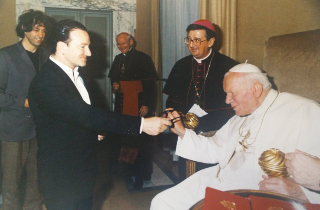
geldof-bono-pope-john-paul-ii

Bob Geldof, Bono, Quincy Jones and other members of an international lobby group meet with Pope John Paul II in Rome on September 23, 1999 to discuss the cancellation of third world debt repayments.

In an extraordinary meeting, marking 100 days to the millennium, Pope John Paul II makes a strong appeal to world to leaders to take urgent and decisive action towards resolving the debt crisis that afflicts the world’s poorest countries.

Speaking during a meeting with an international Jubilee 2000 delegation of economists, artists and campaigners, the Pope questions why progress in resolving the debt problem is so slow, and expresses impatience with the protracted negotiations. He warns that it “is the poor that pay the cost of indecision and delay.”

The Pope says “the Catholic Church looks at the situation with great concern. Not because she has any concrete technical model of development to offer, but because she has a moral vision of what the good of individuals and of the human family demands. She has consistently taught that there is a ‘social mortgage‘ on all private property, a concept which today must also be applied to ‘intellectual property‘ and to ‘knowledge.’ The law of profit alone cannot be applied to that which is essential for the fight against hunger, disease and poverty.”

Addressing the Pope on behalf of the delegation, Ann Pettifor, director and co-founder of Jubilee 2000, appeals to the Vatican to prevail upon the world’s leaders to meet again before the New Year, to cancel debts that result in the deaths of 20,000 children every day. She says, “This is a day that will go down in history. The Pope has given his endorsement and blessing to the passion and commitment of millions of Jubilee 2000 campaigners around the world. It is now up to the world’s leaders to rise to the Pope’s call and moral leadership.”

Following the meeting Bob Geldof says, “Were the spirit of this frail old man mirrored in a practical way by our political leaders, then the final push of political will to eradicate this unnecessary tragedy, would be easily achieved…and I liked his shoes!”

Professor Jeffrey Sachs adds, “With 100 days left to the millennium, we are halfway up the summit. But much more is needed. For hundreds of millions of the world’s poorest people, the Pope’s message today is crucial: the time is urgent for rich and poor to take the full and bold measure of debt cancellation that is so vitally needed.”

Bono summed it up saying, “His everyday courage amazes me. As aged as he is and as infirm as he has been, he will, you know, hang out with a bunch of pop stars…who could turn this man down?”

(Source: “Pope meets Bobo and calls for debt relief,” The Guardian, September 23, 1999)


Leave a comment

Death of Poet & Barrister Samuel Ferguson

sir-samuel-ferguson

Sir Samuel Ferguson, Irish poet, barrister, antiquarian, artist, and public servant, dies in Howth, County Dublin on August 9, 1886. Ferguson is perhaps the most important Irish poet of the 19th century. Due to his interest in Irish mythology and early Irish history he is seen as a forerunner of William Butler Yeats and the other poets of the Irish Literary Revival.

Ferguson is born in Belfast on March 10, 1810. He lives at a number of addresses, including Glenwhirry, where he acquires the love of nature that informs his later work. He is educated at the Belfast Academy and the Belfast Academical Institution and then moves to Dublin to study law at Trinity College, obtaining his bachelor’s degree in 1826 and his master’s degree in 1832.

Because his father has exhausted the family property, Ferguson is forced to support himself through his student years. He turns to writing and is a regular contributor to Blackwood’s Magazine by the age of 22. He is called to the bar in 1838, but continues to write and publish, both in Blackwood’s and in the newly established Dublin University Magazine.

Ferguson settles in Dublin, where he practises law. In 1848, he marries Mary Guinness, a great-great-niece of Arthur Guinness and the eldest daughter of Robert Rundell Guinness, founder of Guinness Mahon bank. At the time he is defending the Young Irelander poet Richard Dalton Williams.

In addition to his poetry, Ferguson contributes a number of articles on topics of Irish interest to antiquarian journals. In 1863, he travels in Brittany, Ireland, Wales, England, and Scotland to study megaliths and other archaeological sites. These studies are important to his major antiquarian work, Ogham Inscriptions in Ireland, Wales and Scotland, which is edited after his death by his widow and published in 1887.

His collected poems, Lays of the Western Gael is published in 1865, resulting in the award of a degree LL.D. honoris causa from Trinity College. He writes many of his poems in both Irish and English translations. In 1867, Ferguson retires from the bar to take up the newly created post of Deputy Keeper of the Public Records in Ireland. As reward for his services, he receives a knighthood in 1878.

Ferguson’s major work, the long poem Congal is published in 1872 and a third volume, Poems, in 1880. In 1882, he is elected President of the Royal Irish Academy, an organisation dedicated to the advancement of science, literature, and antiquarian studies. His house in North Great George’s St., Dublin, is open to everyone interested in art, literature or music.

Ferguson dies on August 9, 1886, in Howth, just outside Dublin city, and is buried in Donegore near Templepatrick, County Antrim.