seamus dubhghaill

Promoting Irish Culture and History from Little Rock, Arkansas, USA


Leave a comment

Birth of Nora Twomey, Animator, Director & Screenwriter

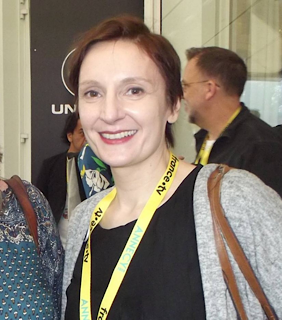
Nora Twomey, Irish animator, director, screenwriter, producer and voice actress, is born on October 31, 1971, in Cork, County Cork. She is best known as the co-founder of Cartoon Saloon, alongside Tomm Moore and Paul Young, an animation studio and production company, based in Kilkenny, County Kilkenny.

Twomey is educated at St. Mary’s Secondary School in Midleton, County Cork but leaves before completing the Leaving Certificate at the age of fifteen. She does manual labor at a local factory but continues to draw and briefly studies fine art before she is admitted to Ballyfermot Senior College in Dublin to their School of Animation program on the basis of her portfolio. In the factory she operates a conveyor belt for up to twelve hours on end during the night shift. She credits this period of her life to much of her success, as she wears headphones to drown out the loud noise of machinery, the silence combined with the monotony of the task she performs allows her to ponder concepts and generate ideas, many of which are put to film later in her life.

After graduating from Ballyfermot Senior College in 1995, Twomey begins to work for Brown Bags Film, an animation studio in Dublin. In 1999, she helps found Cartoon Saloon, along with Tomm Moore, Paul Young and Ross Murray. In 2002, she directs the award-winning short animated film From Darkness. The short film has no dialogue and is based on an Inuit folk tale where a man helps a woman with only a skeleton for a body to regenerate. She also works on the successful animated TV series Skunk Fu!.

Twomey goes on to write and direct the animated short Cúilín Dualach (Backwards Boy), released in 2004. Based on a story by Jackie Mac Donacha, a boy with his head on backwards finds only love and acceptance in his mother and has to work to gain that from the rest of his community but most of all his father.

Twomey co-directs, with Tomm Moore, The Secret of Kells, an animated feature film as well as doing additional voice acting for the film. The film is set in 9th century Ireland, at the time when the Book of Kells is written. In it, a 12-year-old orphan boy living at a monastery has the task of finishing a book with the art of illumination. The film premieres at the Berlin International Film Festival in February 2009. The Secret of Kells is nominated in the category of Best Animated Feature Film at the 82nd Academy Awards.

Twomey continues to work on feature films with Cartoon Saloon with 2014’s Song of the Sea directed by Tomm Moore. She works as the film’s head of story and voice director.

Twomey next directs the animated film The Breadwinner, released in 2017. Based on the best-selling young adult novel by Deborah Ellis, an 11-year-old girl named Parvana must dress as a boy and become the titular breadwinner for her family when her father is wrongfully arrested by the Taliban. It premieres at the Toronto International Film Festival in September 2017 with a wide release in November 2017. It is the first feature-length film she has sole director credit on. She works on the project with actress Angelina Jolie, who helps fund the project and works as an executive producer. The project is a huge success for Twomey, as she is recognized as a solo female filmmaker, and given accolades as well as being lauded by many as a source of female empowerment, all while battling cancer during production. During the development of The Breadwinner, she is named in Variety‘s “2017 10 Animators to Watch.”

Twomey is a member of the Academy of Motion Picture Arts and Sciences.

Twomey becomes the seventh graduate of Ballyfermot Senior College to be nominated for an Academy Award with her work on The Breadwinner when it is nominated for Best Animated Feature at the 90th Academy Awards. She is also nominated for an award at the Golden Globe Awards.

The Breadwinner earns ten nominations at the 45th Annie Awards, including Outstanding Achievement for Directing in an Animated Feature Production for Twomey. It wins the award for best animated feature for an independent film. This marks the first time a sole female director directs the film that wins the award. It also wins the Cinema for Peace award for Justice in 2018.

Twomey’s work also has a heavy presence at the Emile Awards, an annual event held by the European Animation Awards Association that honors European creators of animation. During the awards of 2018, which are hosted in Lile, France, her film The Breadwinner wins awards in five categories: Best Direction, Best Storyboarding, Best Character Animation, Best Background, and Best Character Design.

Twomey has won several awards according to the Screen Directors Guild of Ireland (SDGI). These awards include the best New Irish Short Animation at the Galway Film Fleadh (2002), Best Short at the Boston Irish Film Festival (2003), Best Animation at the Kerry Film Festival (2003), and the Silver Award at the Kalamazoo Animation Festival International (2003) for her film From Darkness. Her film Cúilín Dualach (Backwards Boy) also wins the Best Animated Short from the Irish Film & Television Academy (2005), Best Short Film at Cartoons on the Bay (2005), Best Animation for Children at Animadrid (2005) and the Best Animation at the Celtic Film Festival (2005). Among other awards, the 2018 Cinema for Peace Award for Justice for her movie The Breadwinner can be included.

Cartoon Saloon, the studio Twomey co-founds with contemporaries Paul Young and Tom Moore in Kilkenny, has been nominated for five Academy Awards, a British Academy of Film and Television Arts (BAFTA) award and several Emmy Awards.
Leave a comment

Birth of Graham Linehan, Comedy Writer & Activist

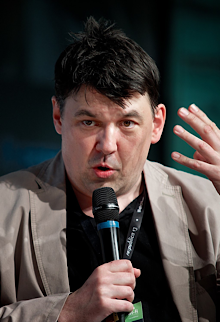
Graham George Linehan, Irish comedy writer and anti-transgender activist, is born in Dublin on May 22, 1968. He created or co-created the sitcoms Father Ted (1995–1998), Black Books (2000–2004), and The IT Crowd (2006–2013), and he has written for shows including Count Arthur StrongBrass Eye and The Fast Show. Early in his career, he partners with the writer Arthur Mathews. He has won five BAFTA awards, including Best Writer, Comedy, for The IT Crowd in 2014.

After an episode of The IT Crowd is criticised as transphobic, Linehan becomes involved in anti-transgender activism. He argues that transgender activism endangers women, and likens the use of puberty blockers to Nazi eugenics. He says his views have lost him work and ended his marriage.

Linehan attends Catholic University School, a Roman Catholic secondary school for boys. In the 1980s, he joins the staff of the Dublin politics and music magazine Hot Press, where he meets his future writing partner, Arthur Mathews. In their early collaborations, they create segments in sketch shows including Alas Smith and JonesHarry Enfield & ChumsThe All New Alexei Sayle ShowThe Day Today and the Ted and Ralph characters in The Fast Show. They continue their collaboration with Paris (one series, 1994), Father Ted (three series, 1995–1998), and the first series of the sketch show Big Train. They also write the “Dearth of a Salesman” episode for the series Coogan’s Run, which features the character Gareth Cheeseman. In late 2003, he and Mathews are named one of the 50 funniest acts to work in television by The Observer. Father Ted wins BAFTA awards for Best Comedy in 1996 and 1999.

Linehan writes for the satirical series Brass Eye (1997), Blue Jam (1997–1999) and Jam (2000). With the actor Dylan Moran, he creates the sitcom Black Books (2000–2004). He writes and directs the 2006 Channel 4 sitcom The IT Crowd, in which he seeks to move away from the British trend towards mockumentary comedies. Unlike many series of the time, it is recorded before a studio audience. In November 2008, he is awarded an International Emmy for The IT Crowd. In 2013, he writes and directs the sitcom The Walshes. He co-writes the first series of the BBC sitcom Motherland and directs its pilot episode. In 2014, he wins his fifth BAFTA, for Best Writer, Comedy, for his work on The IT Crowd. He is also nominated for Count Arthur Strong.

In 2018, Linehan and Mathews announce plans for a Father Ted musical. Lineham says it will finish the series as they had planned it before the death of the lead actor, Dermot Morgan. The musical is cancelled by producers following the controversy over Linehan’s views on transgender rights. In December 2024, he announces plans to move to Arizona to work on a sitcom and create a production company with the comedians Rob Schneider and Andrew Doyle.


Leave a comment

Birth of John Cole, Northern Irish Journalist & BBC Broadcaster

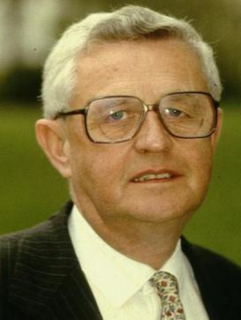
John Morrison Cole, Northern Irish journalist and broadcaster best known for his work with the BBC, is born in Belfast, Northern Ireland, on November 23, 1927. He serves as deputy editor of The Guardian and The Observer and, from 1981 to 1992, is the BBC’s political editor. Donald Macintyre, in an obituary in The Independent, describes him as “the most recognisable and respected broadcast political journalist since World War II.”

Cole is the son of George Cole, an electrical engineer, and his wife Alice. The family is Ulster Protestant, and he identifies himself as British. He receives his formal education at the Belfast Royal Academy.

Cole starts his career in print journalism in 1945, joining the Belfast Telegraph as a reporter and industrial correspondent. He subsequently works as a political reporter for the paper. He gains a scoop when he interviews the then Prime Minister, Clement Attlee, who is holidaying in Ireland.

Cole joins The Guardian, then The Manchester Guardian, in 1956, reporting on industrial issues. He transfers to the London office in 1957 as the paper’s labour correspondent. Appointed news editor in 1963, succeeding Nesta Roberts, he takes on the task of reorganising the paper’s “amateurish” system for gathering news. He heads opposition to a proposed merger with The Times in the mid-1960s, and later serves as deputy editor under Alastair Hetherington. When Hetherington leaves in 1975, Cole is in the running for the editorship, but fails to secure the post, for reasons which may include his commitment to the cause of unionism in Northern Ireland, as well as what is seen by some as inflexibility and a lack of flair. Unwilling to continue at The Guardian, he then joins The Observer as deputy editor under Donald Trelford, remaining there for six years.

After Tiny Rowland takes over as proprietor of The Observer in 1981, Cole gives evidence against him at the Monopolies Commission. The following day he receives a call from the BBC offering him the job of political editor, succeeding John Simpson. He has little previous television experience but proves a “natural broadcaster.” Reporting through most of the premiership of Margaret Thatcher, he becomes a familiar figure on television and radio.

Cole’s health is put under strain by the workload, and he suffers a heart attack in February 1984. Returning to report on that year’s conference season, he covers the Brighton hotel bombing, getting a “memorable” interview with Thatcher on the pavement in its immediate aftermath, in which she declares that the Tory conference will take place as normal. An astute observer of the political scene, he is one of the earliest to forecast Thatcher’s resignation as Prime Minister in 1990, in what colleague David McKie refers to as “perhaps his greatest exclusive.”

Cole establishes a strong reputation for his “gentle but probing” interviewing style, for his political assessments, and for presenting analysis rather than “bland reporting.” Held in enormous affection by viewers, he is trusted by both politicians and the public. He is known for speaking in the language used by ordinary people rather than so-called Westminster experts. His distinctive Northern Irish accent leads the way for BBC broadcasters with regional accents.

Cole retires as political editor in 1992 at the age of 65, compulsory at the time, but continues to appear on television, including making programmes on golf and travel. He also continues to appear on the BBC programme Westminster Live for several years after he retired as political editor.

In addition to his journalistic writing, Cole authors several books. The earliest are The Poor of the Earth, on developing countries, and The Thatcher Years (1987). After his retirement as BBC political editor, he spends more time writing. His political memoir, As It Seemed to Me, appears in 1995 and becomes a best-seller. He also publishes a novel, A Clouded Peace (2001), set in his birthplace of Belfast in 1977.

In 2007, Cole writes an article for the British Journalism Review, blaming both politicians and the media for the fact that parliamentarians are held in such low esteem, being particularly scathing of Alastair Campbell‘s influence during Tony Blair‘s premiership.

In 1966, the Eisenhower Fellowships selects Cole to represent Great Britain. He receives the Royal Television Society‘s Journalist of the Year award in 1991. After his retirement in 1992, he is awarded an honorary degree from the Open University as Doctor of the University and receives the Richard Dimbleby Award from BAFTA in 1993. He turns down a CBE in 1993, citing the former The Guardian newspaper rule that journalists can only accept gifts which can be consumed within 24 hours.

In his private life Cole is a supporter of the Labour Party and is a believer in the trades union movement. He considers that the combating of unemployment is one of the most important political issues. He is a British Republican and a committed Christian, associating in the latter part of his life with the United Reformed Church at Kingston upon Thames.

Cole suffers health problems in retirement including heart problems and two minor strokes. In 2009, he is diagnosed with cancer. He subsequently develops aphasia. He dies at his home at Claygate in the county of Surrey on November 7, 2013.

Tributes are paid by journalists, broadcasters and politicians across the political spectrum. Prime Minister David Cameron calls Cole a “titan at the BBC” and an “extraordinary broadcaster.” Labour Party leader Ed Miliband says that “my generation grew up watching John Cole. He conveyed the drama and importance of politics.” The Scottish First Minister Alex Salmond says that Cole is “an extremely able journalist but also extraordinarily helpful and generous to a young politician.” The BBC’s political editor at the time, Nick Robinson, writes that Cole “shaped the way all in my trade do our jobs.”


Leave a comment

Birth of John Lynch, Actor & Novelist

john-lynch

John Lynch, actor and novelist, is born in Corrinshego, County Armagh, Northern Ireland on December 26, 1961. He wins the AFI (AACTA) Award for Best Actor in a Leading Role for the 1995 film Angel Baby. His other film appearances include Cal (1984), The Secret Garden (1993), In the Name of the Father (1993) and Sliding Doors (1998).

Lynch is the eldest of five children of an Irish father and an Italian mother from Trivento in the Province of Campobasso. His younger sister Susan and his nephew Thomas Finnegan are also actors. He attends St. Colman’s College, Newry and begins acting in Irish language-medium plays at school during the early years of the conflict in Northern Ireland.

Lynch has appeared in numerous films related to Northern Ireland’s problems such as Cal (1984) with Helen Mirren, In the Name of the Father (1993) with Daniel Day-Lewis, The Railway Station Man (1992) with Julie Christie and Donald Sutherland, Nothing Personal (1995) and Some Mother’s Son (1996), also with Mirren, as well as the Irish-themed film Evelyn (2002).

Lynch stars as a supporting actor in Derek Jarman‘s Edward II (1991), as Lord Craven in Agnieska Holland‘s film of The Secret Garden (1993), as Tadhg in The Secret of Roan Inish (1994), and as Gerry in Sliding Doors (1998).

Lynch plays the part of football legend George Best in the 2000 film Best. He plays the lead in the Australian feature Angel Baby, winning the Australian Film Institute award for best leading actor and the Australian Film Critics Association award for best actor of 1995. He is nominated for a Satellite Film Award for the film Moll Flanders in 1996. He works with acclaimed Belgian director Marion Hänsel on her adaptation of Booker-nominated author Damon Galgut‘s novel, The Quarry (1998), which wins Best Film at the Montreal World Film Festival. He wins Best Actor for the lead role in Best at the Fort Lauderdale Film Festival in 2000.

Lynch is nominated for a British Academy of Film and Television Arts (BAFTA) for Cal, as well as for an Irish Film and Television Award for his role in The Baby War. He stars in Five Day Shelter as Stephen, which wins a European Film Award and is in competition at the Rome Film Festival. He plays the lead in Craig Vivieros’ first feature film, the prison drama Ghosted. He plays the role of Wollfstan in Black Death and appears in the 2012 film version of Michael Morpurgo‘s novel, Private Peaceful.

Lynch is also a novelist. His first novel, Torn Water, is published in November 2005 by the 4th Estate, a literary imprint of HarperCollins Publishers LLC, and his second, Falling Out of Heaven, is published on May 13, 2010, by the same publisher.


Leave a comment

Birth of Kenneth Branagh, Actor, Director & Producer

kenneth-branagh

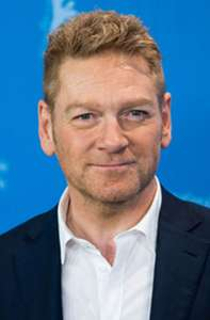
Sir Kenneth Charles Branagh, British actor, director, producer, and screenwriter, is born in Belfast on December 10, 1960.

Branagh is the middle of three children of working-class Protestant parents Frances (née Harper) and William Branagh, a plumber and joiner who runs a company that specialises in fitting partitions and suspended ceilings. He lives in the Tiger’s Bay area of the city and is educated at Grove Primary School.

At the age of nine, Branagh moves with his family to Reading, Berkshire, England, to escape the Troubles. He is educated at Whiteknights Primary School, then Meadway School, Tilehurst, where he appears in school productions such as Toad of Toad Hall and Oh, What a Lovely War!. He attends the amateur Reading Cine & Video Society (now called Reading Film & Video Makers) as a member and is a keen member of Progress Theatre for whom he is now the patron. He goes on to train at the Royal Academy of Dramatic Art in London and in 2015 succeeds Richard Attenborough as its president.

Branagh has both directed and starred in several film adaptations of William Shakespeare‘s plays, including Henry V (1989) (for which he was nominated for the Academy Award for Best Actor and Academy Award for Best Director), Much Ado About Nothing (1993), Othello (1995), Hamlet (1996) (for which he was nominated for the Academy Award for Best Adapted Screenplay), Love’s Labour’s Lost (2000), and As You Like It (2006).

Branagh stars in numerous other films and television series including Fortunes of War (1987), Woody Allen‘s Celebrity (1998), Wild Wild West (1999), The Road to El Dorado (2000), Conspiracy (2001), Harry Potter and the Chamber of Secrets (2002), Warm Springs (2005), as Major General Henning von Tresckow in Valkyrie (2008), The Boat That Rocked (2009), Wallander (2008–2016), My Week with Marilyn (2011) as Sir Laurence Olivier (nominated for Academy Award for Best Supporting Actor), and as Royal Navy Commander Bolton in the action-thriller Dunkirk (2017). He directs such films as Dead Again (1991), in which he also stars, Swan Song (1992) (nominated for Academy Award for Best Live Action Short Film), Mary Shelley’s Frankenstein (1994) in which he also stars, The Magic Flute (2006), Sleuth (2007), the blockbuster superhero film Thor (2011), the action thriller Jack Ryan: Shadow Recruit (2014) in which he also co-stars, the live-action film Cinderella (2015), and the mystery drama adaptation of Agatha Christie‘s Murder on the Orient Express (2017), in which he also stars as Hercule Poirot.

Branagh narrates the series Cold War (1998), the BBC documentary miniseries Walking with Dinosaurs (1999), Walking with Beasts (2001) and Walking with Monsters (2005). He has been nominated for five Academy Awards, five Golden Globe Awards, and has won three BAFTAs, and an Emmy Award. He is appointed a Knight Bachelor in the 2012 Birthday Honours and is knighted on November 9, 2012. He is awarded the Freedom of the City of his native city of Belfast in January 2018.


1 Comment

Birth of Irish Folk Singer Moya Brennan

moya-brennan

Moya Brennan, born Máire Ní Bhraonáin, Irish folk singer, songwriter, harpist, and philanthropist, is born in Dublin on August 4, 1952.

After leaving secondary school, Brennan spends a few years at the Royal Irish Academy of Music in Dublin studying the harp, the piano, and singing. She has also taught music at Holy Cross College in Falcarragh, County Donegal.

In 1970 Brennan joins her two brothers, Pól and Ciarán, and their mother’s twin brothers, Noel and Pádraig Ó Dúgáin, and form the band Clannad. They are identified and introduced to television by Tony MacMahon. After enjoying a decade of being among the world’s foremost Irish musical groups, Clannad graduates to chart success in 1982 with the album Magical Ring. Brennan is at the forefront of the group’s success and her voice suddenly becomes synonymous with Celtic music and Irish music at the time. Brennan records 17 albums with Clannad and wins a Grammy Award, a BAFTA, and an Ivor Novello award with the quintet. Her sister, Eithne Ní Bhraonáin, who spends some time with Clannad, continues to pursue a very successful solo career under the name Enya.

Brennan releases her first solo album in 1992, Máire, on Atlantic Records. Misty Eyed Adventures on BGM follows three years later. In 1998, Brennan signs with Word Records and releases Perfect Time, and Whisper to the Wild Water a year later. The album is nominated for the Grammy Award for Best New Age Album in 2001.

Brennan’s autobiography, The Other Side of the Rainbow, is published in 2000 and she performs her song Perfect Time live at World Youth Day in Rome in front of crowds of pilgrims and Pope John Paul II. There are 2.1 million people present, making it the largest crowd ever gathered in the Northern Hemisphere.

In film, Brennan is a featured vocalist on King Arthur (2004), co-writing the title theme Tell Me Now (What You See) with Hans Zimmer. She also writes an additional music score for To End All Wars (2001). In 1995, she duets with Shane MacGowan on You’re the One for the movie Circle of Friends. Brennan has collaborated with many other musicians, including Chicane, Alan Parsons, Bono, Robert Plant, Van Morrison, Michael McDonald from the Doobie Brothers, Bruce Hornsby, Joe Elliott, The Chieftains, Paul Young, Paul Brady, Michael Crawford, Joe Jackson, and Ronan Keating.

In total Brennan has recorded 25 albums, and has sold 20 million records. Brennan and Clannad are credited with the creation of contemporary Celtic music and are held in high esteem for their vast contribution to bringing new life to old Irish songs. They have been compared to Seán Ó Riada, in that they brought the Irish language into popular culture through their music. One critic said, “Clannad’s music offers a terrific fusion between traditional and modern influences.” U2 front man Bono says of her voice, “I think Máire has one of the greatest voices the human ear has ever experienced.”