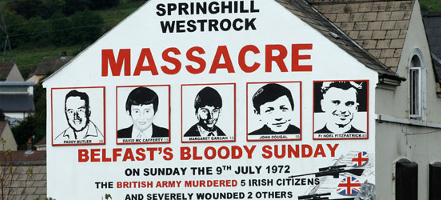
The Springhill Massacre, a shooting incident which claims five lives in the Springhill estate in west Belfast, takes place on July 9, 1972. Three civilians, including a Catholic priest, and two members of Fianna Éireann are shot dead by British Army snipers firing from a timber yard.
The Northern IrelandTroubles have been raging for three years and hundreds have already been killed by the two warring factions in Northern Ireland, unionists, including Ulster loyalists and the British Army, and Irish republicans wanting unification with the Republic of Ireland. Violence has been taking place all day and the five dead are part of ten people killed on that day.
According to a Provisional Irish Republican Army (IRA) statement on July 10, British Army snipers take up sniping positions in Corry’s timber yard and reinforced them with sandbags. Two cars pull into Springhill and the snipers fire two shots at them. One of the cars flees while the other drives a short distance and stops. The occupants get out and the snipers open fire again, seriously wounding one with a shot in the back of the head. A resident rushes to help the injured man but is immediately shot in the arm. This man’s brother and a friend run to the downed occupant, but both are shot by the snipers. At some point during this time a 13-year-old girl is fatally shot by the snipers. The parish priest, waving a white cloth, and a passer-by rush to her but a sniper kills both with a single bullet that passes through both their heads. All of the victims are unarmed.
The British Army disputes the IRA’s version of events and claims its troops were fired on first by the IRA, ending a temporary IRA ceasefire. A British Army spokesman states, “There has been a heavy exchange of fire between the IRA and troops. Some of the dead and wounded were undoubtedly caught in the crossfire.” On July 10, the British Army claims that it has killed terrorists. An open verdict is recorded at the inquest into the events.
No British soldier has been held accountable for these murders.
At the start of the 20th century, the IRB is a stagnating organisation, concerned more with Dublin municipal politics than the establishment of a republic. A younger generation of Ulster republicans aim to change this and, in 1905, Denis McCullough and Bulmer Hobson found the Dungannon Clubs, whose purpose is to discourage enlistment into the British Army and encourage enlistment into the IRB.
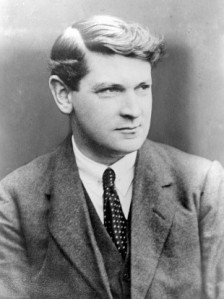
In 1909, Michael Collins is introduced to the brotherhood by Sam Maguire. By 1914, the Supreme Council is largely purged of its older, tired leadership, and is dominated by enthusiastic men such as Hobson, McCullough, Patrick McCartan, John MacBride, Seán Mac Diarmada, and Tom Clarke. The latter two are to become the primary instigators of the Easter Rising in 1916.
Following the Rising some republicans, notably Éamon de Valera and Cathal Brugha, leave the organization as they view it as no longer necessary since the Irish Volunteers now perform its function. The IRB, during the War of Independence (1919-1921), is under the control of Michael Collins, who initially is secretary and subsequently, on June 28, 1919, is made president of the Supreme Council.
When the Anglo-Irish Treaty is signed on December 6, 1921, it is debated by the Supreme Council, which votes to accept it by an 11-4 vote. Those who oppose the Treaty include former leader Harry Boland, Austin Stack, and Liam Lynch. Anti-Treaty republicans like Ernie O’Malley, who fought during the Civil War against the Treaty, see the IRB as being used to undermine the Irish Republic.
The IRB becomes quiescent during the Irish Civil War, which ends in May 1923, but it emerges again later that year as a faction within the National Army. It supports Minister for Defence Richard Mulcahy against the “Old IRA,” which fights against the recruitment of ex-British Army personnel and the demobilization of old IRA men. This comes to a head with the Army Mutiny of 1924, in the wake of which Mulcahy resigns and other IRB members of the army are dismissed by acting President of the Executive Council Kevin O’Higgins. The IRB subsequently dissolves itself, although it is not known whether a formal decision is made, or it simply ceases to function.
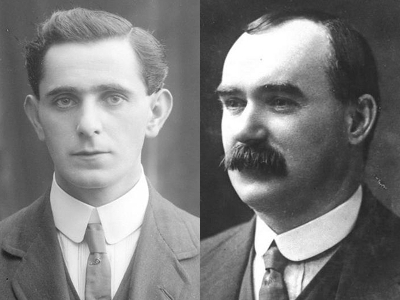
Seán MacDiarmada is born in 1884 in Leitrim. He emigrates to Glasgow in 1900 and from there to Belfast in 1902. A member of the Gaelic League, he is acquainted with Bulmer Hobson. He joins the Irish Republican Brotherhood (IRB) in 1906 while still in Belfast, transferring to Dublin in 1908 where he assumes managerial responsibility for the IRB newspaper Irish Freedom in 1910. Although MacDiarmada is afflicted with polio in 1912, he is appointed as a member of the provisional committee of Irish Volunteers from 1913 and is subsequently drafted onto the military committee of the IRB in 1915. During the Rising, MacDiarmada serves in the General Post Office (GPO). Following the surrender, MacDiarmada nearly escapes execution by blending in with the large body of prisoners. He is eventually recognised by Daniel Hoey of G Division and faces a court-martial on May 9.
James Connolly is born in Edinburgh in 1868. Connolly is first introduced to Ireland as a member of the British Army. Despite returning to Scotland, the strong Irish presence in Edinburgh stimulates Connolly’s growing interest in Irish politics in the mid-1890s, leading to his emigration to Dublin in 1896 where he founds the Irish Socialist Republican Party. He spends much of the first decade of the twentieth century in America. He then returns to Ireland to campaign for worker’s rights with James Larkin. A firm believer in the perils of sectarian division, Connolly campaigns tirelessly against religious bigotry. In 1913, Connolly is one of the founders of the Irish Citizen Army. During the Easter Rising he is appointed Commandant-General of the Dublin forces, leading the group that occupies the General Post Office.
The treatment accorded to Connolly is particularly despicable. Crippled by an infected wound in the ankle, he is carried to Kilmainham Gaol, tied to a chair, and shot. As the men are loading their rifles, Connolly forgives the men of the army firing squad for their actions. Shaken by their distasteful task, a ragged volley of shots resounds from their rifles. He is the last of the leaders to be executed.
The Easter Rising, also known as the Easter Rebellion, begins in Dublin on April 24, 1916, and lasts for six days. The Rising, organised by seven members of the Military Council of the Irish Republican Brotherhood, is launched to end British rule in Ireland and establish an independent Irish Republic while the United Kingdom is heavily engaged in World War I. It is the most significant uprising in Ireland since the Irish Rebellion of 1798, and the first armed action of the Irish revolutionary period.
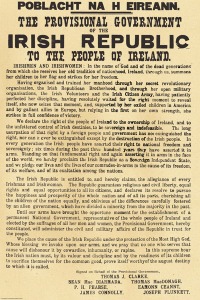
Shortly before midday, members of the Irish Volunteers, led by schoolmaster and Irish language activist Patrick Pearse and joined by the smaller Irish Citizen Army of James Connolly and 200 women of Cumann na mBan, seize key locations in Dublin and proclaim an Irish Republic. The rebels’ plan is to hold Dublin city centre, a large, oval-shaped area bounded by the Grand Canal to the south and the Royal Canal to the north, with the River Liffey running through the middle.
The British Army brings in thousands of reinforcements as well as artillery and a gunboat. There is fierce street fighting on the routes into the city centre, where the rebels put up stiff resistance, slowing the British advance and inflicting heavy casualties. Elsewhere in Dublin, the fighting mainly consists of sniping and long-range gun battles. The main rebel positions are gradually surrounded and bombarded with artillery.
With much greater numbers and heavier weapons, the British Army suppresses the Rising, and Pearse agrees to an unconditional surrender on Saturday, April 29. Almost 500 people are killed during Easter Week. About 54% are civilians, 30% are British military and police, and 16% are Irish rebels. More than 2,600 are wounded. Many of the civilians are killed as a result of the British using artillery and heavy machine guns, or mistaking civilians for rebels. Others are caught in the crossfire in a crowded city. The shelling and the fires leave parts of inner-city Dublin in ruins.
After the surrender the country remains under martial law. About 3,500 people are taken prisoner by the British, many of whom have played no part in the Rising, with 1,800 of them being sent to internment camps or prisons in Britain. Most of the leaders of the Rising are executed following courts-martial. The Rising brings physical force republicanism back to the forefront of Irish politics, which for nearly 50 years has been dominated by constitutional nationalism. It, and the British reaction to it, leads to increased popular support for Irish independence. In December 1918, republicans, represented by the reconstituted Sinn Féin party, win a landslide victory in the general election to the British Parliament. They do not take their seats but instead convene the First Dáil and declare the independence of the Irish Republic, which ultimately leads to the Irish War of Independence.
Cumann na mBan, an Irish republican women’s paramilitary organisation, is formed in Dublin on April 2, 1914.
In 1913, a number of women decide to hold a meeting in Wynn’s Hotel, Dublin, for the purpose of discussing the possibility of forming an organisation for women who would work in conjunction with the recently formed Irish Volunteers. A meeting led by Kathleen Lane-O’Kelly on April 2, 1914, marks the foundation of Cumann na mBan. Branches, which pledge to the Constitution of the organisation, are formed throughout the country and are directed by the Provisional Committee.
The primary aims of Cumann na mBan, as stated in its constitution, are to “advance the cause of Irish liberty and to organize Irishwomen in the furtherance of this object,” to “assist in arming and equipping a body of Irish men for the defence of Ireland” and to “form a fund for these purposes, to be called ‘The Defence of Ireland Fund.'”
Recruits come from diverse backgrounds, mainly white-collar workers and professional women, but with a significant proportion also from the working class. In September 1914, the Irish Volunteers split over John Redmond‘s appeal for its members to enlist in the British Army. The majority of Cumann na mBan members support the 10,000 to 14,000 volunteers who rejected this call and who retain the original name, the Irish Volunteers.
On April 23, 1916, when the Military Council of the Irish Republican Brotherhood finalises arrangements for the Easter Rising, it integrates Cumann na mBan, along with the Irish Volunteers and Irish Citizen Army, into the “Army of the Irish Republic.”
On the day of the Rising, Cumann na mBan members arrive armed with both a Webley revolver and a typewriter, entering the General Post Office (GPO) on O’Connell Street in Dublin with their male counterparts. By nightfall, women insurgents are established in all the major rebel strongholds throughout the city. The majority of the women work as Red Cross workers, are couriers, or procure rations for the men. Members also gather intelligence on scouting expeditions, carry despatches, and transfer arms from dumps across the city to insurgent strongholds. A number of Cumann na mBan members die during the Rising.
At the Four Courts, they help to organise the evacuation of buildings at the time of surrender and destroy incriminating papers. On April 29, the leaders at the GPO decide to negotiate surrender. Patrick Pearse, the overall Commandant-General, asks Cumann na mBan member Elizabeth O’Farrell to act as a go-between. Under British military supervision she brings Pearse’s surrender order to the rebel units still fighting in Dublin. Over 70 women, including many of the leading figures in Cumann na mBan, are arrested after the insurrection, and many of the women who are captured fighting are imprisoned in Kilmainham Gaol. All but twelve are released by May 8, 1916.
Revitalized after the Rising and led by Countess Markievicz, Cumann na mBan takes a leading role in popularising the memory of the 1916 leaders, organising prisoner relief agencies, opposing conscription, and canvassing for Sinn Féin in the 1918 general election, in which Markievicz is elected Teachta Dála.
Cumann na mBan supports the Provisional wing in the 1969-1970 split in the Irish Republican Army (IRA) and Sinn Féin. In Northern Ireland, Cumann na mBan is integrated into the mainstream IRA during the conflict, although they continue to exist as a separate organisation in the Republic of Ireland. In 1986, Cumann na mBan opposes the decision by the IRA and Sinn Féin to drop the policy of abstentionism and aligns itself with Republican Sinn Féin and the Continuity IRA.
In 2014, Cumann na mBan celebrates the Centenary of its foundation in Wynn’s Hotel, Dublin, the site of their founding in 1914. The U.K. Home Office in March 2015 lists Cumann na mBan as a group linked to Northern Ireland related terrorism. However, it is not so listed in 2008 by the U.S. State Department.
In early 1912, the Liberal British government of H. H. Asquith introduces the Third Home Rule Bill for Ireland, which proposes the creation of an autonomous Irish Parliament in Dublin. Unionists have objected to being under the jurisdiction of the proposed Dublin Parliament. Ulster Unionists found the Ulster Volunteers (UVF) paramilitary group in 1912, aided by a number of senior retired British officers, to fight against the British government and/or against a future Irish Home Rule government proposed by the Bill.
In September 1913, with Irish Home Rule due to become law in 1914, the Chief of the Imperial General Staff (CIGS) Sir John French expresses his concerns to the government and to the King that the British Army, if ordered to act against the UVF, might split. The British Cabinet contemplates some kind of military action against the Ulster Volunteers who threaten to rebel against Home Rule. Many officers, especially those with Irish Protestant connections, of whom the most prominent is Hubert Gough, threaten to resign rather than obey, privately encouraged from London by senior officers including Major-General Henry Hughes Wilson.
Although the Cabinet issues a document claiming that the issue has been a misunderstanding, the Secretary of State for WarJ.E.B. Seely and French are forced to resign after amending it to promise that the British Army will not be used against the Ulster loyalists.
The event contributes both to unionist confidence and to the growing Irish separatist movement, convincing Irish nationalists that they cannot expect support from the British army in Ireland. In turn, this increases renewed nationalist support for paramilitary forces. The Home Rule Bill is passed but postponed, and the growing fear of civil war in Ireland leads on to the British government considering some form of partition of Ireland instead, which eventually takes place.
The event is also notable in being one of the few incidents since the English Civil War in which elements of the British military openly intervene, as it turns out successfully, in politics.
The first recorded parade honoring the Catholic feast day of St. Patrick, the patron saint of Ireland, is held in New York City on March 17, 1762 – fourteen years before the signing of the Declaration of Independence. The parade is comprised of a band of homesick, Irish ex-patriots and Irish military members serving with the British Army stationed in the colonies in New York. They march to an inn of one John Marshall located near the present-day intersection of Barclay and Church streets in lower Manhattan.
Early Irish settlers to the American colonies, many of whom are indentured servants, bring the Irish tradition of celebrating St. Patrick’s feast day to America. This is at a time when the wearing of green is a sign of Irish pride but is banned in Ireland. In the 1762 parade, participants revel in the freedom to speak Irish, wear green, sing Irish songs, and play the pipes to Irish tunes that are meaningful to the Irish immigrants of the time.
With the dramatic increase of Irish immigrants to the United States in the mid-19th century, the March 17th celebration becomes widespread. Today, across the United States, millions of Americans of Irish ancestry celebrate their cultural identity and history by enjoying Saint Patrick’s Day parades and engaging in general revelry.
Saint Patrick, born in the late 4th century, is one of the most successful Christian missionaries in history. Born in Britain to a Christian family of Roman citizenship, he is taken prisoner at the age of sixteen by a group of Irish raiders during an attack on his family’s estate. They transport him to Ireland where he spends six years in captivity before escaping back to Britain. Believing he has been called by God to Christianize Ireland, he joins the Catholic Church and studies for 15 years before being consecrated as the church’s second missionary to Ireland. Patrick begins his mission to Ireland in 432 and the island is almost entirely Christian at the time of his death in 461.
In 1910, he becomes manager of the radical newspaper Irish Freedom, which he founds along with Bulmer Hobson and Denis McCullough. He also becomes a national organiser for the IRB and is taken under the wing of veteran Fenian Tom Clarke and the two become nearly inseparable. Shortly afterward, Mac Diarmada is stricken with polio and is forced to walk with a cane.
In November 1913, Mac Diarmada is one of the original members of the Irish Volunteers and continues to work to bring the organisation under IRB control. Mac Diarmada is arrested in Tuam, County Galway, in May 1915 under the Defense of the Realm Act 1914 for giving a speech against enlisting into the British Army.
Following his release in September 1915, Mac Diarmada joins the secret Military Committee of the IRB, which is responsible for planning the rising.
Due to his disability, Mac Diarmada has little participation in the fighting of Easter week but is stationed at the headquarters in the General Post Office (GPO), as one of the Provisional Republican Government. Following the surrender on April 29, 1916, he nearly escapes execution by blending in with the large body of prisoners but is eventually identified by Daniel Hoey of G Division. Following a May 9 court-martial, Mac Diarmada, at the age of 33, is executed by firing squad in Kilmainham Gaol. Before his execution, Mac Diarmada writes, “I feel happiness the like of which I have never experienced. I die that the Irish nation might live!”
In September 1919, Hoey is shot dead by Michael Collins‘s Squad. Likewise, the British Officer who ordered Mac Diarmada to be shot rather than imprisoned, is also killed in Cork on Collins’s order during the Irish War of Independence.
Mac Diarmada will be portrayed by actor Colin Morgan in the 2016 Irish historical biopic drama film, The Rising, written by Kevin McCann and Colin Broderick.



 seamus dubhghaill