seamus dubhghaill

Promoting Irish Culture and History from Little Rock, Arkansas, USA


Leave a comment

Birth of Margaret Anna Cusack, Founder of Poor Clares Convent

margaret-anne-cusack

Margaret Anna Cusack, founder of the first Poor Clares convent in the west of Ireland and a talented writer who publishes on the issues of social injustice, is born to an aristocratic family of English origin in Coolock, County Dublin on May 6, 1829. Her writings and actions focus on advocacy of women’s rights including equal pay, equal opportunity for education, and legal reform to give women control of their own property.

Cusack is raised in the Anglican church tradition until her conversion to Catholicism in 1858. She enters the Irish Poor Clare Sisters and is among the first group of Sisters sent to found the convent at Kenmare, County Kerry.

During the next 21 years, Cusack, now known as Sister Francis Clare, dedicates herself to writing. Her writings include a wide range of concerns including lives of the saints, local histories, biographies, books and pamphlets on social issues and letters to the press. As the “Nun of Kenmare” she writes on behalf of the liberation of women and children who are victims of oppression. Income from her books and from her famine relief fund is distributed throughout Ireland. While doing all she can to feed the hungry, at the same time she campaigns vigorously against the abuse of absentee landlords, lack of education for the poor and against a whole system of laws which degrade and oppress a section of society.

To broaden the scope of her work Cusack moves to Knock, County Mayo in 1881 with the idea of expanding the ministry of the Poor Clares. She starts an industrial school for young women and evening classes for daytime land-workers. Several women are attracted by this work and in 1884 she decides to found her own community, The Sisters of St. Joseph of Peace.

Continued conflict in Knock with Church leaders leads Cusack to seek support in England. Under Cardinal Henry Edward Manning and Bishop Edward Bagshawe, she receives approbation for the new religious order from Pope Leo XIII and the Congregation of the Sisters of St. Joseph of Peace is founded in January 1884, in the Diocese of Nottingham, England.

Later, Cusack travels to the United States to continue her work with immigrant Irish women but is immediately rebuked by Archbishop Michael Corrigan of New York. Just at that time, New Jersey stretches out a hand of welcome and encouragement as Bishop Winand Wigger of the Archdiocese of Newark invites her to establish homes for young Irish working women there. Within a few years, however, she claims that because of Archbishop Corrigan’s criticism of her among bishops throughout the United States, the work of her new community cannot continue as long as she remains with them.

Physically exhausted, sick and disillusioned with a patriarchal Church, Cusack withdraws from the Sisters of St. Joseph of Peace and leaves behind the sisters she so dearly loved. She eventually returns to her friends in the Church of England. In later years, she keeps in contact with the Sisters and expresses a loving concern for them. She dies on June 5, 1899, and is buried in the cemetery reserved for the Church of England at Leamington Spa, Warwickshire, England.

Cusack passes into obscurity for a long time until, as a result of the Second Vatican Council, religious orders are encouraged to review their roots and the intent of their founders. Since then, there have been a number a studies on Cusack, such as Philomena McCarthy’s The Nun of Kenmare: The True Facts. With the rediscovery of the life and times of Cusack, she has been hailed as a feminist and a social reformer ahead of her time.


Leave a comment

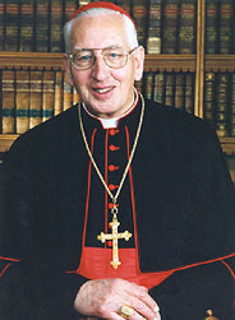
Desmond Connell Created Cardinal-Priest by John Paul II

desmond-connell

Desmond Connell is created Cardinal-Priest by Pope John Paul II at the Consistory in Rome on February 21, 2001. He becomes the first Archbishop of Dublin in over 100 years to be installed as a Cardinal. A large Irish contingent from Church and State, along with family and friends of the Cardinal, attend the installation which for the first time takes place at the front of the entrance to St. Peter’s Basilica.

Connell is born in Dublin on March 24, 1926. He is educated at St. Peter’s National School, Phibsborough and the Jesuit Fathers’ second level school, Belvedere College, and studies for the priesthood at Holy Cross College. He later studies Arts at University College Dublin (UCD) and graduates with a BA in 1946 and is awarded an MA the following year. Between 1947 and 1951, he studies theology at St. Patrick’s College, Maynooth for a Bachelor of Divinity.

Connell is ordained priest by Archbishop John Charles McQuaid on May 19, 1951. He takes up a teaching post at the Department of Metaphysics at the University College Dublin. He is appointed Professor of General Metaphysics in 1972 and in 1983 becomes the Dean of the Faculty of Philosophy and Sociology. The College’s Department of Metaphysics is abolished after his departure.

Connell is appointed Archbishop of Dublin by the Holy See in early 1988. He is consecrated at St. Mary’s Pro-Cathedral, Dublin on March 6, 1988. He is created Cardinal-Priest by Pope John Paul II at the Consistory in Rome on February 21, 2001, with the Titulus S. Silvestri in Capite. Archbishops of Armagh, who hold the higher title of Primate of All Ireland, are more frequently appointed Cardinal than Archbishops of Dublin. The last Archbishop of Dublin to have been a cardinal is Cardinal Edward MacCabe, who was appointed in 1882.

On April 26, 2004, Connell retires as archbishop, handing the diocese to the coadjutor bishop, Diarmuid Martin. All bishops submit their resignation to the Pope on their 75th birthday. Connell’s is accepted shortly after his 78th birthday.

Connell is one of the cardinal electors who participates in the 2005 papal conclave that selects Pope Benedict XVI. Connell is considered quite close to Pope Benedict, both theologically and personally, both having served together on a number of congregations. He attends the 50th International Eucharistic Congress in Dublin in June 2012 and concelebrates at the Statio Orbis Mass in Croke Park.

It is Connell’s failure, when Archbishop of Dublin in 1988–2004, to address adequately the abuse scandals in Dublin that lead the Vatican to assign Archbishop Martin as his replacement in the country’s largest diocese. The Murphy Report finds that Connell had handled the affair “badly” as he was “slow to recognise the seriousness of the situation.” It does praise him for making the archdiocesan records available to the authorities in 2002 and for his 1995 actions in giving the authorities the names of 17 priests who had been accused of abuse, although it says the list is incomplete as complaints were made against at least 28 priests in the archdiocese.

From 1988 Connell also continues to insure his archdiocese against liability from complainants, while claiming to the Murphy Commission that the archdiocese is “on a learning curve” in regard to child abuse. He arranges for compensation payments to be made from a “Stewardship Trust” that is kept secret from the archdiocese’s parishioners until 2003. In 1996 he refuses to help a victim of Paul McGennis and does not pass on what he knows about McGennis to her, or to the police. He apologises for this in 2002.

Desmond Connell dies in Dublin at the age of 90 on February 21, 2017, exactly sixteen years after his creation as Cardinal.


Leave a comment

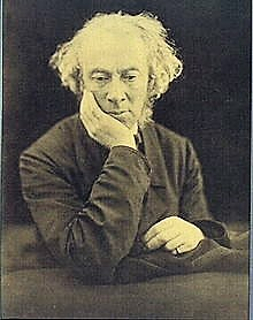
Birth of Aubrey Thomas de Vere, Critic & Poet

aubrey-de-vere

Aubrey Thomas de Vere, a critic and poet who adapts early Gaelic tales, is born on January 10, 1814, at Curraghchase House, now in ruins at Curraghchase, Kilcornan, County Limerick.

Hunt de Vere is the third son of Sir Aubrey de Vere, 2nd Baronet and his wife Mary Spring Rice, daughter of Stephen Edward Rice and Catherine Spring, of Mount Trenchard, County Limerick. He is a nephew of Thomas Spring Rice, 1st Baron Monteagle of Brandon and a younger brother of Sir Stephen de Vere, 4th Baronet. His sister Ellen marries Robert O’Brien, the brother of William Smith O’Brien. In 1832, his father drops the original surname “Hunt” by royal licence, assuming the surname “de Vere.”

de Vere is strongly influenced by his friendship with the astronomer Sir William Rowan Hamilton through whom he comes to a knowledge and reverent admiration for William Wordsworth and Samuel Taylor Coleridge. He is educated privately at home and in 1832 enters Trinity College, Dublin, where he reads Immanuel Kant and Coleridge. Later he visits Oxford, Cambridge, and Rome, and comes under the potent influence of John Henry Newman. He is also a close friend of Henry Taylor.

The characteristics of de Vere’s poetry are high seriousness and a fine religious enthusiasm. His research in questions of faith leads him to the Roman Catholic Church where in 1851 he is received into the Church by Cardinal Henry Edward Manning in Avignon. In many of his poems, notably in the volume of sonnets called St. Peters Chains (1888), he makes rich additions to devotional verse. For a few years he holds a professorship, under Newman, in the Catholic University in Dublin.

In A Book of Irish VerseW. B. Yeats describes de Vere’s poetry as having “less architecture than the poetry of Ferguson and Allingham, and more meditation. Indeed, his few but ever memorable successes are enchanted islands in gray seas of stately impersonal reverie and description, which drift by and leave no definite recollection. One needs, perhaps, to perfectly enjoy him, a Dominican habit, a cloister, and a breviary.”

de Vere also visits the Lake Country of England, and stays under Wordsworth’s roof, which he calls the greatest honour of his life. His veneration for Wordsworth is singularly shown in later life, when he never omits a yearly pilgrimage to the grave of the poet until advanced age makes the journey impossible.

de Vere is of tall and slender physique, thoughtful and grave in character, of exceeding dignity and grace of manner, and retains his vigorous mental powers to a great age. According to Helen Grace Smith, he is one of the most profoundly intellectual poets of his time. His census return for 1901 lists his profession as “Author.”

Aubrey de Vere dies at Curraghchase on January 20, 1902, at the age of eighty-eight. As he never married, the name of de Vere at his death becomes extinct for the second time and is assumed by his nephew.


Leave a comment

Mikhail Gorbachev Receives Freedom of the City of Dublin

mulcahy-and-gorbachev

Mikhail Gorbachev, the former president of the Soviet Union, becomes the 71st person to receive the Freedom of the City of Dublin at a special meeting in the City Hall on January 9, 2002, following in the footsteps of Pope John Paul II, Nelson Mandela, and members of U2.

“You helped change and enhance the lives of hundreds of millions of people,” the Lord Mayor of Dublin, Cllr. Michael Mulcahy says as he presents the award. “There are few people in the history of the world of whom that can be stated.”

City councillors in their robes assemble for the occasion and the guests include Cardinal Desmond Connell, the Papal Nuncio, Archbishop Giuseppe Lazzarotto, and other members of the diplomatic corps. Gorbachev is also presented with a dove of peace in Waterford Crystal.

In his acceptance speech, the former Communist leader says there have been many events in his life, big and small, joyful and sad. “The event that is happening today in this wonderful hall is very special.”

He says Ireland has taken the right road in emphasising knowledge, education and high technology. He quips that President Mary McAleese had said to him over lunch, “We don’t have any natural resources other than the rain.”

Gorbachev notes that as a Freeman of the City of Dublin he is entitled to graze sheep anywhere in Dublin. He assures his audience he will “buy a flock” to exercise that right. “I have seen some very, very nice places in the Park, near the President’s palace.”

At a news conference in the Mansion House earlier in the day, Gorbachev comes in for sharp questioning from Eoin Ó Murchú, a journalist, who asks “ex-Comrade Gorbachev” if he felt any sense of remorse or guilt when he “stood passively aside” while the Soviet Union was destroyed and ordinary people were reduced to poverty and prostitution. He also queries Gorbachev about his decision to take part in a television commercial for a chain of pizza restaurants.

Ignoring the suggestion that he has demeaned himself by appearing in the television advertisement, Gorbachev replies equally sharply, “My advice to you as a comrade – you used the word ‘comrade’ – is that you too should probably get rid of this kind of ideological straitjacket.”

Gorbachev denies having stood idly by while the USSR was dismantled. Commenting on the Northern Ireland situation he says, “This is one of those processes where people have to make difficult choices. You will see politicians who have a ready-made recipe for everything, in many cases to use force and bombs.”

It was good that, instead of bombing, there was a peace process. Bombing was not a solution and he welcomes the peace efforts being made and the fact that parties are acting “both prudently and responsibly.”

(From The Irish Times, January 10, 2002 | Pictured: Lord Mayor Michael Mulcahy and Mikhail Gorbachev, Doheny & Nesbitt’s Public House, January 8, 2002)


Leave a comment

Birth of Father Leonard Eugene Boyle

leonard-eugene-boyle

Leonard Eugene Boyle, Irish and Canadian scholar in medieval studies and palaeography, is born in Ballintra, County Donegal on November 13, 1923. He is the first Irish and North American Prefect of the Vatican Library in Rome from 1984 to 1997.

Boyle spends some years in Tralee, County Kerry, following the July 1940 death of his older brother John, who is a member of Garda Síochána and drowns while on holiday in Ballybunion, County Kerry. He is educated in the Irish language and enters the Dominican Order in 1943. He is ordained a priest in 1949 having received his doctorate in Oxford.

Boyle frequently visits Tralee, where a number of his family still reside, and is involved in many projects in the town. His immense knowledge and expertise in historical and archaeological issues is freely given in order to enhance the town. Of particular concern is his hope that the site of the original Dominican Priory at the centre of the town be conserved for future archaeological excavation.

After moving to Toronto, Boyle teaches at the Pontifical Institute of Mediaeval Studies and at the Centre for Medieval Studies at the University of Toronto from 1961 to 1984. He also serves as Professor of Latin Palaeography and History of Medieval Theology at the Pontifical University of St. Thomas Aquinas in Rome from 1956 to 1961.

In 1984 Boyle is appointed Prefect of the Vatican Library by Pope John Paul II. This appointment takes him by surprise but appears to be a recognition of his immense scholarship, expertise in antiquity and renowned interest in learning as a whole. In an effort to modernise the Vatican Library, he sets about the digitisation of the library’s many thousands of manuscripts that date from hundreds of years BC, which leads to their greater availability to scholars around the world. He also extends the opening hours of the library and employs women for the first time as part of the library’s staff. In 1987, he is made an Officer of the Order of Canada. In 1997, he is ousted as Prefect after his dealings with some American fund-raising associates result in lawsuits involving the Vatican.

Known for his wit and independence of mind and spirit, Boyle is once asked of his interest in being a Cardinal given the fact that all of his predecessors have gone on to be Cardinals. His reply is in the negative saying “nothing but the papacy” would do him.

Father Boyle dies on October 25, 1999. He is buried in his beloved Basilica di San Clemente, in 2000, a year after his death, following official desire to give him the honour of interment in the vaults of San Clemente — one of Rome’s holiest and most historical shrines.


Leave a comment

Birth of Cardinal Tomás Séamus Ó Fiaich

Tomás Séamus Ó Fiaich, Irish prelate of the Roman Catholic Church, is born in Cullyhanna, County Armagh, on November 3, 1923. He serves as the Catholic Primate of All Ireland and Archbishop of Armagh from 1977 until his death. He is created a Cardinal in 1979.

Ó Fiaich is ordained a priest on July 6, 1948. He spends his first year of ordination as assistant priest in Clonfeacle parish. He undertakes post-graduate studies at University College, Dublin, (1948–50), receiving a Master of Arts (MA) in early and medieval Irish history. He also studies at the Catholic University of Leuven in Belgium, (1950–52), receiving a licentiate in historical sciences.

In 1952 Ó Fiaich returns to Clonfeacle where he remains as assistant priest until the following summer and his appointment to the faculty of St. Patrick’s College, Maynooth. He is an academic and noted Irish language scholar, folklorist and historian in the Pontifical University in St. Patrick’s College, Maynooth, the National Seminary of Ireland. From 1959 to 1974 he is Professor of Modern Irish History at the college. In this capacity he suggests to Nollaig Ó Muraíle that he begin research on Dubhaltach Mac Fhirbhisigh and his works. He “was an inspired lecturer, an open and endearing man, who was loved by his students… Tomas O’Fiaich was my Good Samaritan.”

Ó Fiaich serves as vice president of the college from 1970 to 1974 and is then appointed college president, a post that traditionally precedes appointment to an episcopal position in the Irish Church. He holds this position until 1977.

Following the relatively early death from cancer of Cardinal William Conway in April 1977, Monsignor Ó Fiaich is appointed Archbishop of Armagh by Pope Paul VI on August 18, 1977. He is consecrated bishop on October 2, 1977. The principal consecrator is the papal nuncio Archbishop Gaetano Alibrandi. The principal co-consecrators are Bishop Francis Lenny, the auxiliary Bishop of Armagh, and Bishop William Philbin, the Bishop of Down and Connor. Pope John Paul II raises Ó Fiaich to the cardinalate on June 30, 1979, and he is appointed Cardinal-Priest of S. Patrizio that same day.

Ó Fiaich dies of a heart attack on the evening of May 8, 1990, while leading the annual pilgrimage by the Archdiocese of Armagh to the Marian shrine of Lourdes in France. He arrives in France the day before and complains of feeling ill shortly after saying Mass at the grotto in the French town. He is rushed by helicopter to a hospital in Toulouse, 125 miles away, where he dies. He lies in state at the cathedral in Armagh, where thousands of people lined up to pay their respects.

Ó Fiaich is succeeded as archbishop and cardinal by a man six years his senior, Cahal Daly, then the Bishop of Down and Connor.


Leave a comment

Poisoning of James Butler, 9th Earl of Ormond

James Butler, 9th Earl of Ormond, is poisoned in London on October 28, 1546. He is the son of Piers Butler, 8th Earl of Ormond, and Margaret Fitzgerald, Countess of Ormond. In 1535 he is created Viscount Thurles, and is confirmed by Act of Parliament on November 6, 1541, in the Earldom of Ormond, as 9th Earl with the pre-eminence of the original earls.

About 1520 Butler joins the household of Cardinal Thomas Wolsey, who praises him as a young gentleman “both wise and discreet.” In early 1522, it is proposed by King Henry VIII that he marry his cousin Anne Boleyn, who is the great-granddaughter of Thomas Butler, 7th Earl of Ormond. This is to resolve a dispute her father Thomas Boleyn, 1st Earl of Wiltshire has with James’ father over the Ormond inheritance and title. Wolsey himself supports the proposal. The marriage negotiation, comes to a halt for unknown reasons. Butler subsequently marries Lady Joan Fitzgerald in December 1532. Lady Joan is the daughter and heiress of the other great Munster landholder, the James FitzGerald, 10th Earl of Desmond and his wife Amy O’Brien. Their marriage produces seven sons.

During the early 1540s Butler gradually restores the Butler dynasty to their former position of influence, leading to antagonism from the quarrelsome Lord Deputy of Ireland, Sir Anthony St. Leger. St. Leger gives Butler command of the Irish forces in the Anglo-Scottish War of 1544. On the face of it this is an honour, but allies of Butler accuse St. Leger of deliberately sending him into danger. Butler himself demands an inquiry into claims that St. Leger had planned his murder, and the matter is thought to merit a Privy Council investigation. The Council finds in favour of St. Leger and he and Butler are ordered to work together amicably. Key Government allies of Butler like John Alan and Walter Cowley are removed from office, and Butler is struggling to maintain his standing when he is poisoned.

On October 17, 1546, James goes to London with many of his household. They are invited to dine at Ely Place in Holborn. He is poisoned along with his steward, James Whyte, and sixteen of his household. He dies nine days later, on October 28, leaving Joan a widow in her thirties.

It is surprising, in view of Butler’s high social standing, that no proper investigation into his death is carried out. Who is behind the poisoning remains a mystery. His host at the dinner, John Dudley, 1st Duke of Northumberland, though he could be notably ruthless, seems to have no motive for the crime, as he is not known to have had any quarrel with Butler. A recent historian remarks that it would be an extraordinary coincidence if St. Leger had no part in the sudden and convenient removal of his main Irish opponent.


2 Comments

Birth of Cardinal Patrick Joseph O’Donnell

patrick-joseph-odonnell

Patrick Joseph O’Donnell, Cardinal of the Roman Catholic Church, is born in Glenties, County Donegal, on November 28, 1856. He serves as Archbishop of Armagh from 1924 until his death and is elevated to the cardinalate in 1925.

O’Donnell, son of Daniel O’Donnell, a farmer, and his wife, Mary (née Breslin), is one of nine children in a family that claim descent from the O’Donnells of Tyrconnell. He is educated in the High School, Letterkenny, the Catholic University, Dublin, and St. Patrick’s Pontifical University, Maynooth. He is ordained to the priesthood on June 29, 1880. In that same year he is appointed to the staff of St. Patrick’s College, Maynooth, holding the chairs of Dogmatic and Moral Theology. In 1884 he becomes dean of the revived post-graduate Dunboyne Institute and in 1885 is awarded his STD. From his desk in Maynooth he pours out a continuous stream of articles on moral theology and canon law.

O’Donnell becomes Bishop of Raphoe on February 26, 1888, and is consecrated by Cardinal Michael Logue on April 3 in Letterkenny. With superior qualities of mind and body, he is a benign figure who is yet gifted with sharp political acumen. He has the most distinguished episcopate, locally and nationally. He undertakes and completes prodigious building projects including a superbly sited neo-gothic cathedral, St. Eunan’s Diocesan College, and the Presentation Monastery and Loreto schools and an extension to Loreto Convent, all in Letterkenny.

He is appointed coadjutor Archbishop of Armagh on January 14, 1922, and succeeds Cardinal Logue on November 19, 1924. On December 14, 1925, Pope Pius XI makes O’Donnell a Cardinal.

O’Donnell takes an active part in the social, political, and economic life of Ireland. A staunch activist for social justice, as Bishop of Raphoe, he is a member of the first Committee of the Irish Agricultural Organisation Society, founded by Sir Horace Plunkett. In 1918, when representing the nationalist’s side at the Irish Convention, he opposes John Redmond‘s amendment intended to bring about unanimity on All-Ireland Home Rule.

Cardinal O’Donnell dies on October 22, 1927, in Carlingford, County Louth. The St. Connell’s Museum in his hometown of Glenties has a display about his life.


Leave a comment

Founding of the Pontifical Irish College in Rome

pontifical-irish-college

The Pontifical Irish College, a Roman Catholic seminary for the training and education of priests, is founded in Rome, Italy, on November 6, 1628.

Towards the close of the sixteenth century, Pope Gregory XIII sanctions the foundation of an Irish college in Rome and assigns a large sum of money as the nucleus of an endowment. However, the pressing needs of the Irish chieftains make him think that, under the circumstances, the money might as well be used for religion by supplying the Irish Catholics with the sinews of war in Ireland as by founding a college for them at Rome.

The project is revived in 1625 by the Irish bishops, in an address to Pope Urban VIII. Cardinal Ludovico Ludovisi, who is Cardinal Protector of Ireland, resolves to realize at his own expense the desire expressed to the pope by the Irish bishops. A house is rented opposite Sant’Isodoro a Capo le Case, and six students go into residence January 1, 1628. Eugene Callanan, Archdeacon of Cashel, is the first rector, Father Luke Wadding, OFM being a sort of supervisor. Cardinal Ludovisi dies in 1632 and as he is of a princely family with a large patrimony, he makes provision in his will for the college. It is to have an income of one thousand crowns a year, a house is to be purchased for it, and he leaves a vineyard as Castel Gandolfo where the students might pass their villeggiatura. The cardinal’s will directs that the college should be placed under the charge of the Jesuits. Both the heirs and Wadding suspect that provision and disputed it. A protracted lawsuit is finally decided in 1635 in favour of the Jesuits.

On February 8, 1635, the Jesuits take charge of the college and govern it until financial difficulties force them to give up control in September 1772. An Italian priest, Abbate Luigi Cuccagni, is made rector. The rectorate of Cuccagni comes to an end in 1798, when the college is closed by order of Napoleon.

Dr. Michael Blake, Bishop of Dromore, who is the last student to leave the college at its dissolution in 1798, returns a quarter of a century later to arrange for its revival, which is affected by a brief of Pope Leo XII, dated February 18, 1826. He becomes the first rector of the restored college, and among the first students who seek admission is Francis Sylvester Mahony of Cork, known to the literary world as Father Prout. Having set the college well to work, Blake returns to Ireland and is succeeded by Dr. Boylan, of Maynooth, who soon resigns and dies in 1830. He is succeeded by a young priest, later Cardinal Paul Cullen.

Dr. Cullen is succeeded by Dr. Tobias Kirby, known for his holiness of life. He governs the college for more than forty years. His successor is Michael Kelly, later coadjutor to the Archbishop of Sydney.

In 2011, under orders from Pope Benedict XVI, Cardinal Timothy Dolan, Archbishop of New York, leads a root and branch review of all structures and processes at the college. He is assisted in the visitation report by then Archbishop of Baltimore and now Cardinal Edwin O’Brien and Msgr. Francis Kelly of the Northern American College in Rome. The report is highly critical of the college and, as a result of which, three Irish members of the staff are sent home and a fourth resigns.

In 2012, four Irish archbishops, Cardinal Seán Brady, Archbishop of Armagh, Dr. Diarmuid Martin, Archbishop of Dublin, Dr. Michael Neary, Archbishop of Tuam, and Dr. Dermot Clifford, Archbishop of Cashel, are sent a copy of the visitation report by the Vatican. A response prepared for them says “a deep prejudice appears to have coloured the visitation and from the outset and it led to the hostile tone and content of the report.”

Today the Pontifical Irish College serves as a residence for clerical students from all over the world. Every year over 250 Irish couples choose the college chapel as a means to marry in Rome. It organises events for the Irish and wider international community who are currently residing in Rome and has over the years become an unofficial centre for Irish visitors to Rome seeking advice and information.


Leave a comment

Opening of the Catholic University of Ireland

The Catholic University of Ireland in Dublin is opened, and lectures commence on November 3, 1854, with the registration of seventeen students, the first being Daniel O’Connell, grandson of the notable Catholic politician Daniel O’Connell.

The university is founded in 1851 following the Synod of Thurles in 1850, and in response to the Queen’s University of Ireland and its associated colleges which are non-denominational. Cardinal Paul Cullen has previously forbidden Catholics from attending these “godless colleges.” On May 18, 1854, the university is formally established with five faculties of law, letters, medicine, philosophy, and theology with John Henry Newman as the Rector.

In 1861, Dr. Bartholomew Woodlock, the rector from 1860–1879, tries to secure land for a building near Holy Cross College Clonliffe, the establishment to be known as St. Patrick’s University. Plans are drawn up by architect J.J. McCarthy and a foundation stone laid. Cardinal Cullen is against the idea of educating lay and clerical students on the same premises. However, this plan is shelved because of the expansion of the railway line. A church and monastery are eventually built on the site. Under the name St. Patrick’s University night classes are advertised by the University under Dr. Woodlock’s name.

Some feeder secondary schools are established for the Catholic University of Ireland. The nearby Catholic University School is joined by St. Flannan’s College in County Clare and Catholic University High School in Waterford.

The Catholic University is neither a recognised university so far as the civil authorities are concerned, nor an institution offering recognised degrees. Newman has little success in establishing the new university, though over £250,000 has been raised from the laity to fund it. Though they hold the foundation money as trustees, the hierarchy in 1859 spends most of it to support an Irish Brigade led by Myles O’Reilly to help defend Rome in the Second Italian War of Independence. Newman leaves the university in 1857.

Subsequently the school goes into a serious decline, with only three students registered in 1879. The situation changes in 1880 when the recognised Royal University of Ireland comes into being and students at the Catholic University are entitled to sit the Royal University examinations and receive its degrees.

In 1909 the Catholic University essentially comes to an end with the creation of the National University of Ireland, with University College Dublin as a constituent, however the Catholic University of Ireland remains a legal entity until 1911.

(Pictured: J. J. McCarthy’s design for the Catholic University of Ireland)