
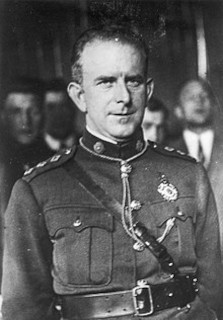
Eoin O’Duffy, Irish nationalist political activist, soldier and police commissioner, dies in Dublin on November 30, 1944.
O’Duffy is born near Castleblayney, County Monaghan on January 28, 1890. Trained initially as an engineer, he later becomes an auctioneer. He becomes interested in Irish politics and joins Sinn Féin, later becoming a member of the Irish Republican Army (IRA).
During the Irish War of Independence, O’Duffy commands the Monaghan Brigade and in February 1920 he successfully captures the Royal Irish Constabulary (RIC) barracks at Ballytrain taking from it weapons and explosives. Also present at this victory is Ernie O’ Malley, who goes on to organize flying columns, and the socialist guerrilla fighter Peadar O’Donnell.
In the 1921 Irish elections, O’Duffy becomes TD for Monaghan. By 1922, he has been promoted to Chief of Staff of the IRA and is one of Michael Collins foremost supporters when he accepts the Anglo-Irish Treaty and fights in the Irish Civil War as a general of the Free State Army.
As commander of the 2nd Northern Division of the IRA, O’Duffy sees action in Belfast when defending Catholic ghettoes from attacks by Protestant pogromists. He also leads the Free State forces into Limerick city.
In September 1922, following the mutiny in Kildare by Civic Guard recruits, O’Duffy replaces Michael Staines as commissioner. Under him the police force is renamed the Garda Síochána, disarmed and is later merged with the Criminal Investigation Department (CID) and the Dublin Metropolitan Police (DMP). His fervent Catholicism is greatly reflected in the ethos of the Garda Síochána.
In 1933, O’Duffy becomes associated with Cumann na nGaedheal by taking on the leadership of their security organization the Army Comrades Association, later to be known colloquially as the Blueshirts. This organization is to become a participant in many street brawls with anti-treaty sympathizers who try to break up pro-treaty political meetings. When the pro-treaty parties merge in 1933 to become Fine Gael, he is the party President for a short period of time.
It is believed that O’Duffy unsuccessfully encourages W. T. Cosgrave to consider a coup-de’etat in the event of Fianna Fáil winning the 1932 Irish general election. Cosgrave, in the event, puts his trust in a democracy when Fianna Fáil does, in fact, form a government, led by Éamon de Valera, with the help of the Labour Party.
After the 1933 Irish general election, which again sees de Valera in power, O’Duffy is dismissed from his post as Garda Commissioner on the grounds that due to his past political affiliations, he will be unable to carry out his duties without bias.
In Europe, the new phenomenon of fascism is gaining ground and O’Duffy, like many of his pro-treaty colleagues, is drawn to it. His Army Comrades Association is renamed the National Guard, and they begin to take on many of the symbols of fascism such as the outstretched arm salute and the blue uniforms.
When O’Duffy plans a massed march for August 1933 in Dublin to commemorate the deaths of Arthur Griffith and Michael Collins, de Valera, fearing a coup, has it banned. Possibly de Valera is also testing the loyalty of the army and the Garda Síochána. In September the National Guard itself is banned although it reforms under the title The League of Youth.
In 1934 O’Duffy suddenly and inexplicably resigns as president of Fine Gael although it is known that many of its members are growing worried by his actions and statements. The Blueshirt movement begins to unravel at the seams. That same year he forms his own fascist movement, the National Corporate Party.
In 1936, supported by the Catholic Church in Ireland, O’Duffy leads 700 of his followers to Spain to help General Francisco Franco in the Spanish Civil War against the republican government. They form part of the XV Bandera Irlandesa del Terico, a part of the Spanish Legion. The Bandera sees little or no action and are returned to Ireland in 1937.
Although O’Duffy has some low-level dalliance with the Nazis he never does regain any of his political influence. His health is on the decline, and he dies on November 30, 1944. De Valera grants him a state funeral and he is interred in Glasnevin Cemetery in Dublin.

 seamus dubhghaill