Gray is the second son of Sir John Gray and his wife, Anna Dwyer. He has three brothers and two sisters. After receiving his education, he joins his father in managing the Freeman’s Journal, the oldest nationalist newspaper in Ireland. When his father dies in 1875, he takes over proprietorship of the Journal, and his family’s other newspaper properties such as the Belfast Morning News and the Dublin Evening Telegraph.
In 1868, Gray saves five people from drowning in a wrecked schooner at Killiney Bay, an action for which he receives the Tayleur Fund Gold Medal for bravery from the Royal Humane Society. By coincidence, the rescue is witnessed by his future wife, Caroline Agnes Gray, whom he meets shortly afterwards. Agnes is the daughter of Caroline Chisholm, an English humanitarian renowned for her work in female immigrant welfare in Australia, and although Gray is descended from a Protestant family, he converts to Catholicism to marry her. The wedding in London on July 17, 1869, is conducted by the Bishop of Northampton, Francis Amherst. The couple has one son, Edmund Dwyer-Gray, who eventually takes over from his father as proprietor of his newspapers and goes on to become Premier of Tasmania.
From 1875 to 1883, Gray serves as a member of the Dublin Corporation, and in 1880 serves a term as Lord Mayor of Dublin. Unusual for an Irish nationalist politician, he is very much focused on urban rather than rural affairs, and like his father is heavily involved in public health and water provision for Dublin. He also promotes reform in the municipal health system.
Gray is imprisoned for six weeks in 1882 for remarks made in the Freeman’s Journal with regard to the composition of the jury in the case of a murder trial. He is actually Sheriff of Dublin City at the time of his imprisonment and, because of the conflict of office, is taken into custody by the city coroner. The defendant in the case in question is later hanged.
A heavy drinker and asthma sufferer, Gray dies at his home, Pembroke House, Upper Mount Street, Dublin, on March 27, 1888, at the age of 42 following a short illness. He is buried at Glasnevin Cemetery in Dublin.
The Great Chicago Fire, a conflagration that destroys roughly 3.3 square miles of Chicago, Illinois, including over 17,000 structures, kills approximately 300 people and leaves more than 100,000 residents homeless, starts at about 8:30 p.m. on October 8, 1871, in or around a small barn belonging to the Irish immigrant O’Leary family that borders the alley behind 137 W. DeKoven Street.
The shed next to the barn is the first building to be consumed by the fire. City officials never determine the cause of the blaze, but the rapid spread of the fire due to a long drought in that year’s summer, strong winds from the southwest, and the rapid destruction of the water pumping system, explain the extensive damage of the mainly wooden city structures. There has been much speculation over the years on a single start to the fire. The most popular tale blames Catherine O’Leary‘s cow, who allegedly knocked over a lantern; others state that a group of men were gambling inside the barn and knocked over a lantern. Still other speculation suggests that the blaze was related to other fires in the Midwest that day.
The fire’s spread is aided by the city’s use of wood as the predominant building material in a style called balloon framing. More than two-thirds of the structures in Chicago at the time of the fire are made entirely of wood, with most of the houses and buildings being topped with highly combustible tar or shingle roofs. All of the city’s sidewalks and many roads are also made of wood. Compounding this problem, Chicago receives only 1 inch of rain from July 4 to October 9, causing severe drought conditions before the fire, while strong southwest winds help to carry flying embers toward the heart of the city.
In 1871, the Chicago Fire Department has 185 firefighters with just 17 horse-drawn steam pumpers to protect the entire city. The initial response by the fire department is timely, but due to an error by the watchman, Matthias Schaffer, the firefighters are initially sent to the wrong place, allowing the fire to grow unchecked. An alarm sent from the area near the fire also fails to register at the courthouse where the fire watchmen are, while the firefighters are tired from having fought numerous small fires and one large fire in the week before. These factors combined to turn a small barn fire into a conflagration.
When firefighters finally arrive at DeKoven Street, the fire has grown and spread to neighboring buildings and is progressing toward the central business district. Firefighters hope that the South Branch of the Chicago River and an area that had previously thoroughly burned would act as a natural firebreak. All along the river, however, are lumber yards, warehouses, and coal yards, and barges and numerous bridges across the river. As the fire grows, the southwest wind intensifies and becomes superheated, causing structures to catch fire from the heat and from burning debris blown by the wind. Around midnight, flaming debris blows across the river and lands on roofs and the South Side Gas Works.
With the fire across the river and moving rapidly toward the heart of the city, panic sets in. About this time, Mayor Roswell B. Mason sends messages to nearby towns asking for help. When the courthouse catches fire, he orders the building to be evacuated, and the prisoners jailed in the basement to be released. At 2:30 a.m. on October 9, the cupola of the courthouse collapses, sending the great bell crashing down. Some witnesses report hearing the sound from a mile away.
As more buildings succumbed to the flames, a major contributing factor to the fire’s spread is a meteorological phenomenon known as a fire whirl. As overheated air rises, it comes into contact with cooler air and begins to spin, creating a tornado-like effect. These fire whirls are likely what drives flaming debris so high and so far. Such debris is blown across the main branch of the Chicago River to a railroad car carrying kerosene. The fire has jumped the river a second time and is now raging across the city’s north side.
Despite the fire spreading and growing rapidly, the city’s firefighters continue to battle the blaze. A short time after the fire jumps the river, a burning piece of timber lodges on the roof of the city’s waterworks. Within minutes, the interior of the building is engulfed in flames and the building is destroyed. With it, the city’s water mains go dry and the city is helpless. The fire burns unchecked from building to building, block to block.
Finally, late into the evening of October 9, it starts to rain, but the fire has already started to burn itself out. The fire had spread to the sparsely populated areas of the north side, having thoroughly consumed the densely populated areas.
Once the fire has ended, the smoldering remains are still too hot for a survey of the damage to be completed for many days. Eventually, the city determines that the fire destroyed an area about 4 miles long and averaging 3⁄4 mile wide, encompassing an area of more than 2,000 acres. Destroyed are more than 73 miles of roads, 120 miles of sidewalk, 2,000 lampposts, 17,500 buildings, and $222 million in property, which is about a third of the city’s valuation in 1871.
On October 11, 1871, General Philip H. Sheridan comes quickly to the aid of the city and is placed in charge by a proclamation, given by mayor Roswell B. Mason.
To protect the city from looting and violence, the city is put under martial law for two weeks under Gen. Sheridan’s command structure with a mix of regular troops, militia units, police, and a specially organized civilian group “First Regiment of Chicago Volunteers.”
For two weeks Sheridan’s men patrol the streets, guard the relief warehouses, and enforce other regulations. On October 24, the troops are relieved of their duties and the volunteers are mustered out of service.
Of the approximately 324,000 inhabitants of Chicago in 1871, 90,000 residents (about 28% of the population) are left homeless. One hundred twenty bodies are recovered, but the death toll is believed to possibly exceed 300. The county coroner speculates that an accurate count is impossible, as some victims may have drowned or been incinerated, leaving no remains.
In the days and weeks following the fire, monetary donations flow into Chicago from around the country and abroad, along with donations of food, clothing, and other goods. These donations come from individuals, corporations, and cities.
Almost from the moment the fire breaks out, various theories about its cause begin to circulate. The most popular and enduring legend maintains that the fire began in the O’Leary barn as Mrs. O’Leary is milking her cow. The cow kicks over a lantern (or an oil lamp in some versions), setting fire to the barn. The O’Leary family denies this, stating that they were in bed before the fire started, but stories of the cow begin to spread across the city. Catherine O’Leary seems the perfect scapegoat: she is a poor, Irish Catholic immigrant. During the latter half of the 19th century, anti-Irish sentiment is strong in Chicago and throughout the United States. This is intensified as a result of the growing political power of the city’s Irish population.
Furthermore, the United States has been distrustful of Catholics since its beginning, carrying over attitudes in England in the 17th century. As an Irish Catholic, Mrs. O’Leary is a target of both anti-Catholic and anti-Irish sentiment. This story is circulating in Chicago even before the flames die out and is noted in the Chicago Tribune‘s first post-fire issue. In 1893, the reporter Michael Ahern retracts the “cow-and-lantern” story, admitting it is fabricated, but even his confession is unable to put the legend to rest. Catherine O’Leary turns into a recluse after the fire and dies in 1895. Although the O’Learys are never officially charged with starting the fire, the story becomes so engrained in local lore that Chicago’s city council officially exonerates them — and the cow — in 1997.
(Pictured: A Currier & Ives lithograph showing people fleeing across the Randolph Street Bridge)
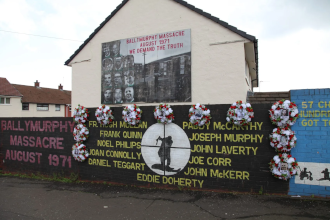
On the morning of Monday, August 9, 1971, the security forces launch Operation Demetrius, the main focus of which is to arrest and intern suspected members of the Provisional Irish Republican Army (IRA). The Parachute Regiment is selected to carry out the operation. The operation is chaotic and informed by poor intelligence, resulting in a number of innocent people being interned. By focusing solely on republicans, it excludes violence carried out by loyalistparamilitaries. Some nationalist neighbourhoods attempt to disrupt the army with barricades, petrol bombs and gunfire. In the Catholic district of Ballymurphy, ten civilians are shot and killed between the evening of August 9 and the morning of August 11, while another dies of heart failure.
Members of the Parachute Regiment state that they were shot at by republicans as they entered the Ballymurphy area and returned fire. The press officer for the British Army stationed in Belfast, Mike Jackson, later to become head of the British Army, includes a disputed account of the shootings in his autobiography, stating that those killed in the shootings were republican gunmen. This claim is strongly denied by the families of those killed in the shootings, including in interviews conducted during the documentary film The Ballymurphy Precedent. The claim is found to be without basis by a later coroner’s inquest, which establishes that those killed were “entirely innocent.”
The six civilians killed on August 9 are Francis Quinn (19), shot while going to the aid of a wounded man, Father Hugh Mullan (38), a Catholic priest, shot while going to the aid of a wounded man, reputedly while waving a white cloth to indicate his intentions, Joan Connolly (44), shot by three soldiers as she stands opposite the army base, Daniel Teggart (44), shot fourteen times mostly in the back as he lay injured on the ground, Noel Phillips (20) and Joseph Murphy (41), shot as they stand opposite the army base. Murphy is subsequently taken into army custody and after his release, as he is dying in hospital, he claims that he had been beaten and shot again while in custody. When his body is exhumed in October 2015, a second bullet is discovered in his body, which activists say corroborates his claim.
Edward Doherty (28), is shot and killed on August 10 while walking along Whiterock Road.
Another three civilians are shot on 11 August: John Laverty (20) and Joseph Corr (43) are shot at separate points at the top of the Whiterock Road. Laverty is shot twice, once in the back and once in the back of the leg. Corr is shot several times and dies of his injuries on August 27. John McKerr (49), is shot in the head by an unknown sniper while standing outside a Catholic church and dies of his injuries on August 20. While a number of eyewitnesses state that soldiers were seen shooting toward the area, the 2021 inquest cannot establish who had killed him. The coroner notes that a more specific finding is not possible, in large part, due to an “abject failing by the authorities to properly inquire into the death of [McKerr at the time].”
Paddy McCarthy (44), an eleventh civilian, dies on August 11 following an altercation with a group of soldiers. His family allege that an empty gun is put in his mouth and the trigger pulled, he suffers a heart attack and dies shortly after the alleged confrontation.
In February 2015, the conviction of Terry Laverty, younger brother of John Laverty, one of those killed, is quashed by the Criminal Cases Review Commission. He had been convicted of riotous behaviour and sentenced to six months on the eyewitness evidence of a private in the Parachute Regiment. The case is referred to court because the sole witness retracts his evidence.
In 2016, Sir Declan Morgan, the Lord Chief Justice of Northern Ireland, recommends an inquest into the killings as one of a series of “legacy inquests” covering 56 cases related to the Troubles. These inquests are delayed, as funding has not been approved by the Northern Ireland Executive. The Stormont first minister, Arlene Foster of the Democratic Unionist Party (DUP), defers a bid for extra funding for inquests into historic killings in Northern Ireland, a decision condemned by the human rights group Amnesty International. Foster confirms she has used her influence in the devolved power-sharing executive to hold back finance for a backlog of inquests connected to the conflict. The High Court says her decision to refuse to put a funding paper on the Executive basis is “unlawful and procedurally flawed.”
In January 2018, the coroner’s office announces that the inquest will begin in September 2018. On May 11, 2021, this coroner’s inquest finds that the ten civilians killed were innocent and that the use of lethal force by the British Army was “not justified.” The circumstances of the 11th death are not part of the inquest since Paddy McCarthy died from a heart attack, allegedly after being threatened by a soldier. Following the inquest verdict, Boris Johnson, the British prime minister, apologises for the deaths at Ballymurphy in a phone call to Foster and deputy First MinisterMichelle O’Neill. The lack of public apology is criticised by some relatives of the victims and Northern Irish politicians.
In May 2021, families of those shot dead by British soldiers in Ballymurphy urge the Irish government to oppose any attempt to prevent the prosecution of British soldiers alleged to have committed crimes during the Troubles.
The killings are the subject of the August 2018 documentaryThe Ballymurphy Precedent, directed by Callum Macrae and made in association with Channel 4.
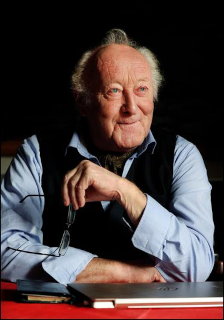
Rynne’s father is Stephen Rynne, a writer, broadcaster, author and wit, while his mother, Alice Curtayne, is a writer, hagiographer, lecturer, linguist and scholar. He attends Prosperous National School from 1947 to 1951 and Ring College Waterford from 1951 do 1952. From 1961 to 1968, he attends the Royal College of Surgeons in Ireland. After graduation, he emigrates to Canada with an internship with Hamilton Civic Hospital.
Rynne starts his general practise in Mitchell, Ontario, from 1968 to 1973, where he is introduced to vasectomy. In 1970, he is appointed as the coroner for Perth County, Ontario. In January 1974, he returns to Ireland and establishes a general practise in Clane, County Kildare.
In 1975, Rynne joins Irish Family Planning Association and starts doing vasectomies for them. In 1984, he sells condoms as an act of civil disobedience and gets fined £500. In the following year, he becomes the Chairman of IFPA. In the same year, he founds Clane General Hospital with the opposition from the Catholic Church and the local supporters.
In 1990, Rynne is shot by a man on whom he had carried out a vasectomy eight years previously. According to Rynne, the gunman fires six or seven times with a .22 Long Rifle and shoots him in the right hip. The incident is the subject of a short film The Vasectomy Doctor by Paul Webster.
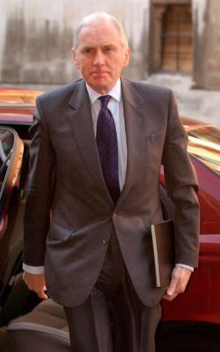
Hutton becomes a Queen’s Counsel in 1970. From 1979 to 1989, as Sir Brian Hutton, he is a High Court judge. In 1989, he becomes Lord Chief Justice of Northern Ireland, becoming a member of the Privy Council of Northern Ireland, before moving to England to become a Lord of Appeal in Ordinary on January 6, 1997. He is consequently granted a life peerage as Baron Hutton, of Bresagh in the County of Down.
On March 30, 1994, as Lord Chief Justice of Northern Ireland, Hutton dismisses Private Lee Clegg‘s appeal against his controversial murder conviction. On March 21, 2002 he is one of four Law Lords to reject David Shayler‘s application to use a “public interest” defence as defined in section 1 of the Official Secrets Act 1989 at his trial.
Hutton represents the Ministry of Defence at the inquest into the killing of civil rights marchers on “Bloody Sunday.” Later, he publicly reprimands Major Hubert O’Neil, the coroner presiding over the inquest, when the coroner accuses the British Army of murder, as this contradicts the findings of the Widgery Tribunal.
Hutton also comes to public attention in 1999 during the extradition proceedings of former Chilean dictator General Augusto Pinochet. Pinochet had been arrested in London on torture allegations by request of a Spanish judge. Five Law Lords, the UK’s highest court, decide by a 3-2 majority that Pinochet is to be extradited to Spain. The verdict is then overturned by a panel of seven Law Lords, including Hutton, on the grounds that Lord Lennie Hoffmann, one of the five Law Lords, has links to human rights group Amnesty International which had campaigned for Pinochet’s extradition.
In 1978, Hutton defends the UK at the European Court of Human Rights in the case of Ireland v United Kingdom, when the court decides that the interrogation techniques used were “inhuman and degrading” and breached the European Convention on Human Rights, but do not amount to “torture.” The court also finds that the practice of internment in Northern Ireland had not breached the Convention. He sentences ten men to 1,001 years in prison on the word of “supergrass” informer Robert Quigley, who is granted immunity in 1984.
Hutton is appointed by Tony Blair‘s government to chair the inquiry on the circumstances surrounding the death of scientist David Kelly. The inquiry commences on August 11, 2003. Many observers are surprised when he delivers his report on January 28, 2004 and clears the British Government in large part. His criticism of the BBC is regarded by some as unduly harsh with one critic commenting that Hutton had given the “benefit of judgement to virtually everyone in the government and no-one in the BBC.” In response to the verdict, the front page of The Independent newspaper consists of one word, “Whitewash?”
Peter Oborne writes in The Spectator in January 2004: “Legal opinion in Northern Ireland, where Lord Hutton practised for most of his career, emphasises the caution of his judgments. He is said to have been habitually chary of making precedents. But few people seriously doubt Hutton’s fairness or independence. Though [he is] a dour Presbyterian, there were spectacular acquittals of some very grisly IRA terrorist suspects when he was a judge in the Diplock era.”
Hutton retires as a Law Lord on January 11, 2004. He remains a member of the House of Lords until retiring under the House of Lords Reform Act 2014 on April 23, 2018.
On January 31, 1972, the day after Bloody Sunday, British Home SecretaryReginald Maudling announces a tribunal of inquiry “into the circumstances of the march and the incidents leading up to the casualties which resulted.”
The official British Army position, backed by Maudling in the House of Commons, is that the paratroopers reacted to gun and nail bomb attacks from suspected Irish Republican Army (IRA) members. Apart from the soldiers, all eyewitnesses — including marchers, local residents, and British and Irish journalists present — maintain that soldiers fired into an unarmed crowd or were aiming at fleeing people and those tending the wounded, whereas the soldiers themselves were not fired upon. No British soldier is wounded by gunfire or reports any injuries, nor are any bullets or nail bombs recovered to back up their claims.
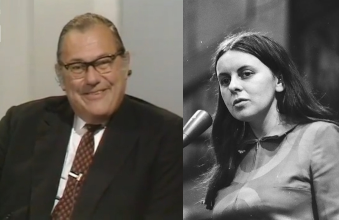
In the days following Bloody Sunday, Bernadette Devlin, the independent Irish nationalistMember of Parliament (MP) for Mid Ulster, expresses anger at what she perceives as British government attempts to stifle accounts being reported about the shootings. Having witnessed the events firsthand, she is infuriated that the Speaker of the House of Commons, Selwyn Lloyd, consistently denies her the chance to speak in Parliament about the shootings, although parliamentary convention decrees that any MP witnessing an incident under discussion will be granted an opportunity to speak about it in Parliament. Devlin slaps Reginald Maudling and calls him a “murdering hypocrite” when he makes a statement to Parliament that the British Army had fired only in self-defence. She is temporarily suspended from Parliament as a result.
An inquest into the deaths is held in August 1973. The city’s coroner, Hubert O’Neill, a retired British Army major, issues a statement at the completion of the inquest. He declares:
“This Sunday became known as Bloody Sunday and bloody it was. It was quite unnecessary. It strikes me that the Army ran amok that day and shot without thinking what they were doing. They were shooting innocent people. These people may have been taking part in a march that was banned but that does not justify the troops coming in and firing live rounds indiscriminately. I would say without hesitation that it was sheer, unadulterated murder. It was murder.”
(Pictured: Home Secretary Reginald Maudling (left) and Member of Parliament for Mid Ulster Bernadette Devlin)
Bridget Cleary is burned to death on March 15, 1895, by her husband who believes her spirit has been taken by bad faeries and replaced with a changeling.
Cleary is born Bridget Boland around 1869 in Ballyvadlea, County Tipperary. Bridget meets Michael Cleary in Clonmel in August 1887, where he works as a cooper and she serves as a dressmaker’s apprentice, and they marry a short time later.
After the marriage, she returns to her townland of Ballyvadlea to live with her parents while Michael continues to work as a cooper in Clonmel. During this period of living apart, Bridget’s independence grows and she begins keeping her own flock of chickens and selling the eggs to neighbours. She is also a professional woman which is somewhat unusual for the era and area. She obtains a Singersewing machine, which is state-of-the-art at the time, and is variously described as a dressmaker and a milliner.
Despite their eight years of marriage, the couple has no children by the time of Bridget’s death. Following the death of Bridget’s mother, the Clearys find themselves responsible for Bridget’s elderly father, Patrick Boland. His residence with the couple enables them to secure a house reserved for labourers. Neither Bridget nor Michael is entitled to this cottage, but as Patrick had been a labourer in his youth, they are able to acquire the best house in the village. However, there is no widespread interest in the house as it is built on the site of a supposed fairy ringfort.
In early March 1895, Bridget becomes ill although her specific diagnosis is unknown. On March 13, more than a week into her illness, a physician visits her home. Her condition is considered sufficiently grave that a priest soon follows to administer last rites. Several friends and family members attend her over the next two days and a number of home remedies are administered including one ritual that anticipates her later demise. Her father and her husband accuse her of being a fairy sent to take Bridget’s place. Urine is thrown on her and she is carried before the fireplace to cast the fairy out. By March 16, rumours begin to circulate that Bridget is missing and the local police begin searching for her. Michael is quoted as claiming that his wife has been taken by fairies. Witness statements are gathered over the ensuing week and, by the time Bridget’s burned corpse is found in a shallow grave on March 22, nine people have been charged in her disappearance, including her husband. A coroner‘s inquest the next day returns a verdict of death by burning.
Legal hearings take place from April 1 to April 6, 1895. The court session begins on July 3. Evidence indicates that Michael attempted to force-feed his wife, throwing her down on the ground before the kitchen fireplace. Bridget’s chemise catches fire and Michael then throws lamp oil on Bridget. Witnesses are unclear as to whether she is already dead by this point. Michael keeps the others away from her body as it burns, insisting that she is a changeling and has been for a week. Michael believes that this will allow him to get his wife back from the fairies.
Michael Cleary is found guilty of manslaughter and spends 15 years in prison.



 seamus dubhghaill