The policy of Irish neutrality during World War II is adopted by the Oireachtas at the instigation of De Valera upon the outbreak of World War II in Europe. It is maintained throughout the conflict, in spite of several Germanairstrikes by aircraft that miss their intended British targets and attacks on Ireland’s shipping fleet by Allies and Axis alike. De Valera refrains from joining either the Allies or Axis powers. While the possibilities of not only a German but also a British invasion are discussed in Dáil Éireann, and either eventuality is prepared for, with the most detailed preparations being done in tandem with the Allies under Plan W, De Valera’s ruling party, Fianna Fáil, supports his neutral policy for the duration of the war.
This period is known in the Republic of Ireland as “The Emergency“, owing to the wording of the constitutional article employed to suspend normal government of the country.
Pursuing a policy of neutrality requires attaining a balance between the strict observance of non-alignment and the taking of practical steps to repel or discourage an invasion from either of the two concerned parties.
Ireland maintains a public stance of neutrality to the end, although this policy leads to a considerable delay in Ireland’s membership of the United Nations (UN). Ireland’s applications for membership are vetoed by the Soviet Union, a permanent member of the United Nations Security Council, from 1946 to December 1955. Seán MacBride considers that the UN boycott of Ireland had been originally agreed upon at the 1945 Yalta Conference by Winston Churchill and Joseph Stalin. Ireland’s acceptance into the UN is finally announced by John A. Costello on December 15, 1955.
Despite the official position of neutrality, there are many unpublicised contraventions of this, such as permitting the use of the Donegal Corridor to Allied military aircraft, and extensive co-operation between Allied and Irish intelligence, including exchanges of information, such as detailed weather reports of the Atlantic Ocean. For example, the decision to go ahead with the Normandy landings is decided by a weather report from Blacksod Bay, County Mayo.
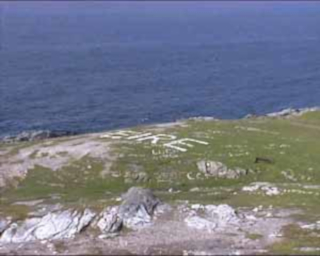
(Pictured: Markings to alert aircraft to neutral Ireland during World War II on Malin Head, County Donegal)
Robinson becomes the first woman in the university’s 406-year history to be elected to the position, making her the titular head of the University of Dublin of which Trinity College is the sole constituent, and represents it on ceremonial occasions. She is installed as Chancellor on December 17, 1998, replacing Dr. Francis Joseph Charles O’Reilly.
Born Mary Bourke in Ballina, County Mayo in 1944, the daughter of two physicians, she is educated at the University of Dublin (Trinity College), King’s Inns in Dublin and Harvard Law School to which she wins a fellowship in 1967. She graduates with a first class TCD law degree in 1967. She is Reid Professor of Constitutional and Criminal Law from 1969 to 1975, and lectures in European law from 1972 to 1990. She represents the university in Seanad Éireann from 1969 to 1989. She serves as the seventh (and first female) President of Ireland from 1990 to 1997.
Cusack becomes a national school teacher, and after teaching in various parts of Ireland becomes a professor in 1874 at Blackrock College, then known as the French College. In 1877, he establishes his own Civil Service Academy, Cusack’s Academy, in Dublin which proves successful in preparing pupils for the civil service examinations.
A romantic nationalist, Cusack is also “reputed” to have been associated with the Fenian movement. He is active in the Gaelic revival as a member of the Society for the Preservation of the Irish Language which is founded in 1876, and later the Conradh na Gaeilge who in 1879 breaks away from the Society. Also in 1879, he meets Pat Nally, who is a member of the Irish Republican Brotherhood and a leading nationalist and athlete. He finds that Nally’s views on the influence of British landlordism on Irish athletics are the same as his. He recalls how both Nally and himself while walking through the Phoenix Park in Dublin seeing only a handful of people playing sports in the park so depressed them that they agreed it was time to “make an effort to preserve the physical strength of [their] race.” Nally organises a National Athletics Sports meeting in County Mayo in September 1879 which is a success, with Cusack organising a similar event which is open to ‘artisans’ in Dublin the following April.
In 1970 Haughey is twice tried for conspiracy to use government funds to procure arms for the outlawed IRA. The first trial is aborted, and he wins acquittal in the second. Dismissed from the government, he remains in the Dáil and gains strong support among his party’s grass roots. When Fianna Fáil is returned to office in 1977, he is made Minister for Health and Minister for Social Welfare. On the resignation of party leader Jack Lynch in 1979, he is elected party leader and becomes Taoiseach. In June 1981 his government falls, but he returns to power briefly in 1982. He becomes Taoiseach again after elections in February 1987, though his government lacks a majority in the Dáil. When Fianna Fáil forms a government with the Progressive Democrats in July 1989, thereby eschewing the party’s traditional rejection of coalition rule, he is made Taoiseach for a fourth time.
Haughey’s first two terms in office are marked by deteriorating relations with Great Britain, a declining economy, and deep divisions within Fianna Fáil. Despite the controversies that plague his government, the charismatic Haughey remains party leader after losing office for a second time in late 1982. During his later terms, he successfully mounts a fiscal austerity program to address Ireland’s financial crisis. In 1992 he resigns and retires after being implicated in a phone tapping scandal of two journalists. He denies the allegations. He remains out of public life until 1997, when an official tribunal of inquiry determines that he had received large sums of money from a prominent businessman while Taoiseach. The Dáil then establishes another tribunal to investigate his financial affairs, and many other irregularities are uncovered. He eventually agrees to pay €6.5 million in back taxes and penalties.
Haughey dies at the age of 80 from prostate cancer, from which he had suffered for a decade, on June 13, 2006, at his home in Kinsealy, County Dublin. He receives a state funeral on June 16. He is buried in St. Fintan’s Cemetery, Sutton, Dublin, following mass at Donnycarney. The then Taoiseach Bertie Ahern delivers the graveside oration. The funeral rites are screened live on RTÉ One and watched by a quarter of a million people. The funeral is attended by PresidentMary McAleese, the Taoiseach, Bertie Ahern, members of the Oireachtas, many from the world of politics, industry and business. The chief celebrant is Haughey’s brother, Father Eoghan Haughey.
Geoghegan is educated at Coláiste Muire, Toormakeady, in County Mayo and at Carysfort College in Blackrock, from where she qualifies as a teacher. She is married to John Quinn, with whom she has two children. Her novel The Green Diamond, about four young women sharing a house in Dublin in the 1960s, is published in 1996.
When Fianna Fáil returns to power after the 1987 general election, Geoghegan-Quinn becomes Minister of State at the Department of the Taoiseach. She expects a senior government position but is disappointed. She resigns in 1991, in opposition to Charles Haughey’s leadership of the party. The following year Albert Reynolds, whom she backs for the leadership, becomes Taoiseach and Fianna Fáil leader. For her loyalty to Reynolds, she is appointed Minister for Transport, Tourism and Sport. She becomes Minister for Justice and Equality in 1993, in which post she introduces substantial law reform legislation, including the decriminalisation of homosexuality. She is also briefly acting Minister for Equality and Law Reform in late 1994, following the resignation of Labour minister Mervyn Taylor from Reynolds’ coalition government.
When Reynolds resigns as leader of Fianna Fáil in November 1994, Geoghegan-Quinn is seen as his preferred successor. In the resulting leadership election, she stands against Bertie Ahern. A win would make her the first female Taoiseach. On the day of the vote, however, she withdraws from the contest “in the interests of party unity.” It is reported that she has the support of only 15 members of the 66-strong parliamentary party.
At the 1997 general election Geoghegan-Quinn retires from politics completely, citing privacy issues, after details about her 17-year-old son’s expulsion from school appeared in the newspapers. Other reports suggest that she sees her prospects for promotion under Ahern as poor, and a weak showing in constituency opinion polls indicate her seat could be in danger. She becomes a non-executive director of Aer Lingus, a member of the board of the Declan Ganley-owned Ganley Group and writes a column for The Irish Times.
Geoghegan-Quinn is appointed to the European Court of Auditors in 1999, replacing former Labour minister Barry Desmond. She is appointed for a second term at the Court of Auditors in March 2006, and resigns on February 9, 2010. She is nominated by Taoiseach Brian Cowen to become Ireland’s European Commissioner in November 2009, and is subsequently allocated the Research, Innovation and Science portfolio.
In April 2010, after numerous calls are made over several days for Geoghegan-Quinn to surrender her pensions as an Irish former politician, which are worth over €104,000, while she remains in a paid public office, she does so.
In July 2015, it is announced that Geoghegan-Quinn will chair an independent panel to examine issues of gender equality among Irish higher education staff.
She assumes responsibility for the UN human rights programme at the time when the Office of the High Commissioner and the Centre for Human Rights are consolidated into a single Office of the High Commissioner for Human Rights (OHCHR).
As High Commissioner, Robinson gives priority to implementing the Secretary-General’s reform proposal to integrate human rights into all the activities of the United Nations. During her first year as High Commissioner, she travels to Rwanda, South Africa, Colombia and Cambodia, among other countries. In September 1998, she becomes the first High Commissioner to visit China and signs an agreement with the Government for OHCHR to undertake a wide-ranging technical-cooperation programme to improve human rights in that country. She also strengthens human rights monitoring in such conflict areas as Kosovo in the Federal Republic of Yugoslavia. Her term of office expires in 2002 after sustained pressure from the United States leads her to declare she is no longer able to continue her work.
Robinson comes to the United Nations after a distinguished, seven-year tenure as President of Ireland. She is the first Head of State to visit Rwanda in the aftermath of the 1994 genocide there. She is also the first Head of State to visit Somalia following the crisis there in 1992, and receives the CARE Humanitarian Award in recognition of her efforts for that country.
Before she is elected President of Ireland in 1990, Robinson serves as Senator for 20 years. Born on May 21, 1944 in Ballina, County Mayo, she is called to the bar in 1967 and two years later becomes the youngest Reid Professor of Constitutional Law at Trinity College, Dublin. In 1973, she becomes a member of the English Bar (Middle Temple). She becomes a Senior Counsel in 1980, and serves as a member of the Advisory Commission of Inter-Rights (1984-1990) and as a member of the International Commission of Jurists (1987-1990).
Educated at Trinity College, Robinson holds law degrees from the King’s Inns in Dublin and from Harvard University. She has been awarded numerous honorary degrees, medals and prizes from universities and humanitarian organizations around the world. In July 2009, she is awarded the Presidential Medal of Freedom, the highest civilian honour awarded by the United States, by U.S. PresidentBarack Obama.
To make up for a deficiency in their living Hannay writes a short story and sends it to a London publisher. It is accepted for publication, and he receives a check of £10. On his wife’s advice, he gives up writing fiction and commits himself to the study of Christian theology with her. This bears fruit with the publications of The Spirit and Origin of Christian Monasticism (1903) and The Wisdom of the Desert (1904).
Hannay then serves as rector of Holy Trinity Church in Westport, County Mayo. It is here that he makes his debut as a novelist. His early writings raise the ire of nationalist Catholics, and he withdraws from the Gaelic League in the wake of ongoing protests about the tour of his successful play General John Regan.
Hannay becomes rector of Kildare parish from 1918 to 1920, and after serving as chaplain to the Lord Lieutenant of Ireland, he joins the British ambassadorial team in Budapest in 1922. He returns to officiate at Mells, Somerset from 1924 to 1934, after which he is appointed vicar of Holy Trinity Church in the London suburb of Kensington where he serves from 1934 until his death in London on February 2, 1950.
Hannay enjoys sailing and is taught the rudiments by his father and grandfather in Belfast. When he is based in Westport, the financial success of his writing enables him to purchase a boat, a Dublin Bay Water Wag. In recognition of Hannay, the Water Wag Club of Dun Laoghaire returns to Westport and Clew Bay in 2016. In the frontispiece of his book The Inviolable Sanctuary Hannay includes a picture of the Water Wag.
In 1885, Gildea founds the Soldiers and Sailors Families Association, which becomes the Soldiers, Sailors, Airmen and Families Association in 1919. He serves as its chairman and treasurer until his death.
Gildea is appointed Companion of the Order of the Bath (CB) in the 1898 New Year Honours and Commander of the Royal Victorian Order (CVO) in 1901. Knighted in 1902, he is later appointed Knight Commander of the Royal Victorian Order (KCVO), and in the 1920 civilian war honours is appointed Knight Grand Cross of the Order of the British Empire (GBE).
James Gildea dies on November 6, 1920, at Earl’s Court, London.
Gaughan, the eldest of six children, is born in Ballina, County Mayo, on October 5, 1949. He grows up at Healy Terrace and is educated at St. Muredach’s College, Ballina. After finishing his schooling, he emigrates from Ireland to England in search of work.
While in London, Gaughan becomes a member of the Official Irish Republican Army through Official Sinn Féin‘s English wing Clann na hÉireann and becomes an IRA volunteer in a London-based Active Service Unit. In December 1971, he is sentenced at the Old Bailey to seven years imprisonment for his part in an IRA fundraising mission to rob a bank in Hornsey, north London, which yields just £530, and for the possession of two revolvers.
Gaughan is initially imprisoned at Wormwood Scrubs, where he spends two years before being transferred to the top security HM Prison Albany on the Isle of Wight. While at Albany Prison, he requests political status, which is refused, and he is then placed in solitary confinement. He is later transferred to Parkhurst Prison, where four of the Belfast Ten are on hunger strike for political status.
On March 31, 1974, Gaughan, along with current Sinn Féin MLA Gerry Kelly, Paul Holme, Hugh Feeney and fellow Mayoman Frank Stagg, go on hunger strike to support the fight of Dolours and Marion Price to obtain political status and to be transferred to a jail in Ireland. The prisoners’ demands are as follows:
The right to political status
The right to wear their own clothes
A guarantee that they would not be returned to solitary confinement
The right to educational facilities and not engage in penal labour
The setting of a reasonable date for a transfer to an Irish prison
British policy at this time is to force-feed hunger strikers. According to the National Hunger Strike Commemoration Committee, “six to eight guards would restrain the prisoner and drag him or her by the hair to the top of the bed, where they would stretch the prisoner’s neck over the metal rail, force a block between his or her teeth and then pass a feeding tube, which extended down the throat, through a hole in the block.”
After visiting Gaughan in jail, his brother John describes his condition, “His throat had been badly cut by force feeding and his teeth loosened. His eyes were sunken, his cheeks hollow and his mouth was gaping open. He weighed about six stone.”
During his hunger strike, Gaughan’s weight drops from 160 lbs. to 84 lbs. He is force-fed for the first time on April 22, and this occurs 17 times during course of his hunger strike. The last time he is force-fed is the night before his death. After a hunger strike that lasts 64 days, Michael Gaughan dies on Monday, June 3, 1974, at the age of 24.
The cause of Gaughan’s death is disputed. The British government states that he died of pneumonia. The Gaughan family state that he died after prison doctors injured him fatally when food lodged in a lung punctured by a force-feeding tube. His death causes controversy in English medical circles, as some forms of treatment can be classed as assault if given without the express permission of the patient.
The timing of Gaughan’s death comes just one week after the British Government had capitulated to the demands of Ulster loyalist hunger strikers. After his death, the British government’s policy of force-feeding ends and the remaining hunger strikers are given assurances that they will be repatriated to Irish prisons. However, these promises are reneged on by the British government.
Gaughan’s body is initially removed from London and on June 7-8 over 3,000 mourners line the streets of Kilburn and march behind his coffin, which is flanked by an IRA honour guard, to a Requiem Mass held in the Church of the Sacred Heart of Jesus.
Following the Requiem Mass, his body is transported to Dublin, where again it is met by mourners and another IRA honour guard who bring it to the Church of the Immaculate Conception on Merchant’s Quay, where thousands file past as it lay in state. The following day, his body is removed to Ballina, County Mayo. A funeral mass takes place on June 9, at St. Muredach’s Cathedral, and the procession then leads to Leigue Cemetery. Gaughan is given a full IRA funeral and is laid to rest in the republican plot, where Frank Stagg would join him after being reburied in November 1976. His funeral is attended by over 50,000 people and is larger than the funeral of former president Éamon de Valera the following year.
Rabbitte becomes involved in electoral politics for the first time in late 1982, when he unsuccessfully contests Dublin South-West for the Workers’ Party (WP) at the November general election. He is elected to Dublin County Council in 1985. He enters Dáil Éireann as a Workers’ Party Teachta Dála (TD) for Dublin South-West at the 1989 election. He retains his seat at every election until 2016.
After Tomás Mac Giolla‘s retirement as President of the Workers’ Party in 1988, Rabbitte is seen as one of those who wants to move the party away from its hard left position. In 1992, he plays a prominent role with Proinsias De Rossa in an attempt to jettison some of the party’s harder left positions. This eventually splits the Workers’ Party.
In 1994, a new ‘Rainbow Coalition’ government of Fine Gael, the Labour Party and Democratic Left comes to power. Rabbitte is a member of the junior ministerial team, serving as Minister of State to the Government, as well as Minister for State at the Department of Enterprise and Employment with responsibility for Commerce, Science and Technology.
Following the 1997 general election the Rainbow Coalition loses power. The following year sees a merger between the Labour Party and Democratic Left, with Rabbitte participating in the negotiations. In October 2002 he succeeds Ruairi Quinn as the new leader of the Labour Party. Under his leadership the party makes some gains in the local elections of 2004.
The Labour Party agrees to enter a pre-election pact, commonly known as ‘The Mullingar Accord,’ with Fine Gael in an attempt to offer the electorate an alternative coalition government at the 2007 general election. This move causes some tension in the parliamentary party, as some members prefer not to be aligned with any party in advance of an election.
Following the disappointing result in the election for Labour, Rabbitte announces he is stepping down as leader on August 23, 2007. He is succeeded as party leader by Eamon Gilmore. Rabbitte is re-elected on the first count in the 2011 general election. His running mate Eamonn Maloney is also elected. On March 9, 2011, he is appointed as Minister for Communications, Energy and Natural Resources.
In July 2014, Rabbitte is replaced by Alex White as part of a reshuffle of the cabinet. He does not contest the 2016 general election.






 seamus dubhghaill