McClean is born on February 12, 1941. Having been abandoned as a baby, he starts life as an orphan at Bethany Home in Dublin. He spends much of his teenage years working on a farm until he becomes bored and enlists in the British Army. After Chay Blyth and John Ridgway row the Atlantic in 1966, he announces to both that he is going to complete this alone.
McClean starts his military career in the Parachute Regiment and then progresses into the Special Air Service (SAS). Following his retirement from military service, he gains fame for numerous feats of endurance. He holds the world record as the first man to row solo across the Atlantic Ocean from west to east which he does in 1969. In 1982 he sails across the Atlantic in the smallest boat to accomplish that crossing. The self-built boat measures 9-feet and 9-inches, and because of the weight of the food takes seven weeks to cross. His record is broken three weeks later by a sailor manning a 9-feet and 1-inch long boat. In response, McClean uses a chainsaw to cut two feet off his own vessel, making it 7-feet and 9-inches long. During the return trip he loses his mast and the journey takes even longer than his first attempt but he regains the record.
He is a survival expert who lives on the island of Rockall from May 26 to July 4, 1985 to affirm the United Kingdom‘s claim to it. This is the third longest human occupancy of the island, surpassed in 1997 by a team from Greenpeace which spends 42 days on the island, and in 2014 by Nick Hancock who spends 45 days there. Two years later, the then 44-year-old McClean sets about regaining his transatlantic rowing record and achieves his goal crossing the Atlantic in 54 days, a record still held.
In 1990 McClean completes a west-east crossing in a 37-foot bottle-shaped vessel, which had been constructed at Market Harborough by Springer Engineering, a firm with a past history of steel fabrication and narrowboat construction. The Typhoo Atlantic Challenger sails from New York to Falmouth, England. This vessel is now preserved at Fort William Diving Centre.
McClean’s most recent feat is the construction, in 1996, of a boat shaped like a giant whale, which completes a circumnavigation of Great Britain. The boat, ‘Moby’ Prince of Whales, stands 25-feet high and 65-feet long. It has a spout which can launch water as high as 6 metres in the air. The Moby Dick, as of 2017, is in the process of conversion to electric power for an Atlantic crossing.
An active member of parliament, O’Conor is an effective though not an eloquent speaker and a leading exponent of Roman Catholic opinion. He frequently speaks on Irish education and land tenure. He criticises unfavourably the Queen’s Colleges established in 1845 and the model schools, and advocates separate education for Roman Catholics. In 1867 he introduces a measure to extend the Industrial Schools Act to Ireland, which becomes law the following year.
O’Conor opposes William Ewart Gladstone‘s Irish University Bill of 1873, and in May 1879 brings forward a measure, which has the support of almost every section of Irish political opinion, for the creation of a new examining university, St. Patrick’s, with power to make grants based on the results of examination to students of denominational colleges affiliated to it. This is withdrawn on July 23 on the announcement of the University Education (Ireland) Act 1879 creating the Royal University of Ireland.
O’Conor steadily lurges a reform of the Irish land laws. On social and industrial questions he also speaks with authority. From 1872 onwards he professes his adherence to home rule and supports Isaac Butt in his motion for inquiry into the parliamentary relations of Great Britain and Ireland in 1874. He also acts with the Irish leader in his endeavours to mitigate the severity of coercive legislation, though declaring himself not in all circumstances opposed to exceptional laws.
Following his parliamentary career in 1880, O’Conor is a member of the Registration of Deeds Commission of 1880, and takes an active part in the Bessborough land commission of the same year. He is a member of both the parliamentary committee of 1885 and the royal commission of 1894 on the financial relations between Great Britain and Ireland, and becomes chairman of the commission on the death of Hugh Culling Eardley Childers in 1896. He is also active in local government, presiding over parliamentary committees on Irish grand jury laws and land valuation in 1868 and 1869, and being elected to the first county council of Roscommon in 1898. He is Lord-Lieutenant of the county from 1888 until his death.
O’Conor is much interested in antiquarian studies. He serves for many years as president of the Antiquarian Society of Ireland, as well as of the Royal Irish Academy. He is president of the Irish Language Society, and procures the insertion of Irish language into the curriculum of the intermediate education board.
O’Conor dies at Clonalis House, Castlerea, County Roscommon, on June 30, 1906, and is buried in the new cemetery, Castlerea.
On March 23, 1847, the Native Americans of the Choctaw Nation take up an amazing collection. They raise $170 for Irish Famine relief, an incredible sum at the time worth in the tens of thousands of dollars today.
The Choctaw have an incredible history of deprivation themselves, forced off their lands in 1831, they embark on a 500-mile trek to Oklahoma called the “Trail of Tears.” Ironically the man who forces them off their lands is Andrew Jackson, the son of Irish immigrants.
On September 27, 1830, the Treaty of Dancing Rabbit Creek is signed. It represents one of the largest transfers of land that is signed between the United States Government and Native Americans without being instigated by warfare. By the treaty, the Choctaws sign away their remaining traditional homelands, opening them up for European American settlement. The tribes are then sent on a forced march.
As historian Edward O’Donnell writes “Of the 21,000 Choctaws who started the journey, more than half perished from exposure, malnutrition, and disease. This despite the fact that during the War of 1812 the Choctaws had been allies of then-General Jackson in his campaign against the British in New Orleans.”
Sixteen years later the Choctaws meet in their new tribal land and send money to a U.S. famine relief organization for Ireland. It is the most extraordinary gift of all to famine relief in Ireland. The Choctaws send the money at the height of the Famine, “Black 47,” when close to a million Irish are starving to death.
In 1992 Irish commemoration leaders take part in the 500-mile trek from Oklahoma to Mississippi. The Choctaw make Ireland’s presidentMary Robinson an honorary chief. They do the same for Don Mullan. Even better, both groups become determined to help famine sufferers, mostly in Africa and the Third World, and have done so ever since.
The gift is remembered in Ireland. A plaque on Dublin‘s Mansion House that honors the Choctaw contribution reads: “Their humanity calls us to remember the millions of human beings throughout our world today who die of hunger and hunger-related illness in a world of plenty.”
(From: “How Choctaw Indians raised money for Irish Great Hunger relief” by IrishCentral Staff, http://www.irishcentral.com, November 27, 2020 | Pictured: Kindred Spirits monument, a tribute to the Choctaw Nation, in Midleton, County Cork, Ireland)
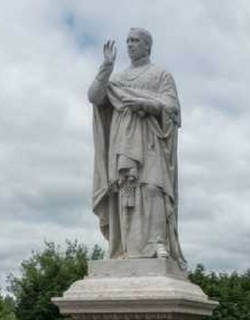
MacHale’s parents are Patrick and Mary Mulkieran MacHale. He is so feeble at birth that he is baptised at home by Father Andrew Conroy. By the time he is five years of age, he begins attending a hedge school. Three important events happen during his childhood: the Irish Rebellion of 1798, the landing at Killala of French troops, whom the boy, hidden in a stacked sheaf of flax, watches marching through a mountain pass to Castlebar, and a few months later the brutal hanging of Father Conroy on a false charge of high treason.
With his friend and ally, Daniel O’Connell, MacHale takes a prominent part in the important question of Catholic emancipation, impeaching in unmeasured terms the severities of the former penal code, which had branded Catholics with the stamp of inferiority. During 1826 his zeal is omnipresent. He calls on the Government to remember how the Act of Union in 1800 was carried by William Pitt the Younger on the distinct assurance and implied promise that Catholic emancipation, which had been denied by the Irish Parliament, should be granted by the Parliament of the Empire.
Oliver Kelly, Archbishop of Tuam, dies in 1834, and the clergy selects MacHale as one of three candidates, to the annoyance of the Government who despatches agents to induce Pope Gregory XVI not to nominate him to the vacant see. Disregarding their request, the pope appoints MacHale Archbishop of Tuam. He is the first prelate since the Reformation who has received his entire education in Ireland. The corrupt practices of general parliamentary elections and the Tithe War cause frequent rioting and bloodshed and are the subjects of denunciation by the new archbishop, until the passing of a Tithes bill in 1838. He also leads the opposition to the ProtestantSecond Reformation, which is being pursued by evangelical clergy in the Church of Ireland, including the Bishop of Tuam, Killala and Achonry, Thomas Plunket.
The repeal of the Acts of Union 1800, advocated by O’Connell, enlists MacHale’s ardent sympathy and he assists the Liberator in many ways, and remits subscriptions from his priests for this purpose. In his zeal for the cause of the Catholic religion and of Ireland, so long downtrodden, but not in the 1830s, he frequently incurs from his opponents the charge of intemperate language, something not altogether undeserved. In his anxiety to reform abuses and to secure the welfare of Ireland, by an uncompromising and impetuous zeal, he makes many bitter and unrelenting enemies, particularly British ministers and their supporters.
The Great Famine of 1846–47 affects his diocese more than any. In the first year he announces in a sermon that the famine is a divine punishment on his flock for their sins. Then by 1846 he warns the Government as to the state of Ireland, reproaches them for their dilatoriness, and holds up the uselessness of relief works. From England as well as other parts of the world, cargoes of food are sent to the starving Irish. Bread and soup are distributed from the archbishop’s kitchen. Donations sent to him are acknowledged, accounted for, and disbursed by his clergy among the victims.
The death of O’Connell in 1847 is a setback to MacHale as are the subsequent disagreements within the Repeal Association. He strongly advises against the violence of Young Ireland. Over the next 30 years he becomes involved in political matters, particularly those involving the church. Toward the end of his life he becomes less active in politics.
MacHale attends the First Vatican Council in 1869. He believes that the favourable moment has not arrived for an immediate definition of the dogma of papal infallibility. Better to leave it a matter of faith, not written down, and consequently he speaks and votes in the council against its promulgation. Once the dogma had been defined, he declares the dogma of infallibility “to be true Catholic doctrine, which he believed as he believed the Apostles’ Creed“. In 1877, to the disappointment of the archbishop who desires that his nephew should be his co-adjutor, Dr. John McEvilly, Bishop of Galway, is elected by the clergy of the archdiocese, and is commanded by Pope Leo XIII after some delay, to assume his post. He had opposed this election as far as possible but submits to the papal order.
Every Sunday MacHale preaches a sermon in Irish at the cathedral, and during his diocesan visitations he always addresses the people in their native tongue, which is still largely used in his diocese. On journeys he usually converses in Irish with his attendant chaplain and has to use it to address people of Tuam or the beggars who greet him whenever he goes out. He preaches his last Irish sermon after his Sunday Mass, April 1881. He dies in Tuam seven months later, on November 7, 1881.
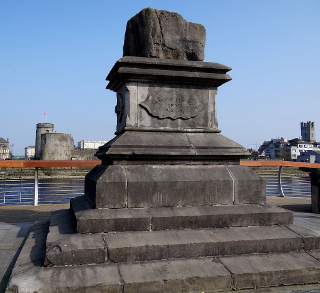
The Treaty of Limerick, which actually consists of two treaties, is ratified by William III of England, widely known as William of Orange, on February 24, 1692.
The Treaty is signed on October 3, 1691 ending the Williamite War in Ireland between the Jacobites and the supporters of William of Orange. Reputedly they are signed on the Treaty Stone, an irregular block of limestone which once served as a mounting block for horses. This stone is now displayed on a pedestal in Limerick, County Limerick, put there to prevent souvenir hunters from taking pieces of it. Because of the treaty, Limerick is sometimes known as the Treaty City.
After his victory at the Battle of the Boyne in July 1690, William III issues the Declaration of Finglas which offers a pardon to Jacobite soldiers but excludes their senior officers from its provisions. This encourages the Jacobite leaders to continue fighting and they win a major victory during the 1691 Siege of Limerick. However, defeats the following year at the Battle of Aughrim and the second siege of Limerick leave the Williamites victorious. Nonetheless the terms they offer to Jacobite leaders at Limerick are considerably more generous than those a year earlier at Finglas.
One treaty, the Military Articles, deals with the treatment of the disbanded Jacobite army. This treaty contains twenty-nine articles. Under the treaty, Jacobite soldiers in formed regiments have the option to leave with their arms and flags for France to continue serving under James II of England in the Irish Brigade. Some 14,000 Jacobites choose this option. Individual soldiers wanting to join the French, Spanish or Austrian armies also emigrate in what becomes known as the Flight of the Wild Geese. The Jacobite soldiers also have the option of joining the Williamite army. One thousand soldiers chose this option. The Jacobite soldiers thirdly have the option of returning home which some 2,000 soldiers choose.
The second treaty, the Civil Articles, which contains thirteen articles, protects the rights of the defeated Jacobite landed gentry who choose to remain in Ireland, most of whom are Catholics. Their property is not to be confiscated so long as they swear allegiance to William III and Mary II, and Catholic noblemen are to be allowed to bear arms. William requires peace in Ireland and is allied to the Papacy in 1691 within the League of Augsburg.
It is often thought that the Treaty of Limerick is the only treaty between Jacobites and Williamites. A similar treaty had been signed on the surrender of Galway on July 22, 1691, but without the strict loyalty oath required under the Treaty of Limerick. The Galway garrison had been organised by the mostly-Catholic landed gentry of counties Galway and Mayo, who benefited from their property guarantees in the following century.
(Pictured: The Treaty Stone on which the Treaty of Limerick may have been signed)
Matt Molloy, Irish musician and member of The Chieftains, is born on January 12, 1947, at Ballaghaderreen, County Roscommon, a region known for producing talented flautists. Coming from a strong musical background, he is considered as one of the most brilliant Irish musicians, his style that adapts piping techniques to the flute has influenced many contemporary Irish flute players.
As a child, Molloy begins playing the flute at age 8 and by the age of 18 he wins the All-Ireland Flute Championship and has a string of successes in National Fleadh Cheoil and Oireachtas. He moves to Dublin in the mid 1960s where he starts playing in the music scene and becomes acquainted with Paddy Moloney.
In addition to playing, Molloy owns a pub on Bridge Street in Westport, County Mayo, called Matt Molloy’s, where he has recorded a live session album. His pub is well known for having sessions including many different musicians.
The flutes used in traditional Irish music are called concert flutes. These are the standard instruments found in orchestras during the 19th century, prior to the introduction of Boehm system flutes circa 1843. They are conical-bore, transverse flutes, typically constructed of blackwood. They are played using ‘simple system’ (keyless) fingering or ‘old system’ (four to eight keys) fingering. They have a more robust and breathy tone compared to metal flutes.
In addition to the flute, Molloy plays the tin whistle, though not very often. The tin whistle is a vertical fipple-flute. The fipple is the duct in the mouthpiece that directs air to produce sound. The first tin whistles of the 1800s were rolled plates of tin forming a tube, with a wooden block in the mouthpiece carved to form the fipple. Today’s tin whistles are made of metals including nickel-silver, brass and aluminum. They have a range of two octaves, and are made in a wide range of keys.
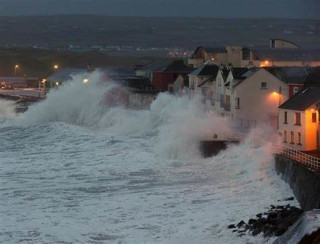
On December 24, 2015, the Electricity Supply Board networks says that around 6,000 customers are without power as a result of Storm Eva. The worst affected areas are Fermoy in County Cork and Kilcoole in County Wicklow. High winds and heavy rain batter the west and northwest as Storm Eva moves across the country.
Eva is the fifth storm to be officially named by Met Éireann on December 22, 2015. An orange wind warning is issued for counties Clare, Galway, Mayo, Sligo and Donegal on the same day. Gales are also expected in the northwest of the United Kingdom, with storm force winds over parts of the Outer Hebrides. There are fears that the storm could cause further disruption to Cumbria in England, where areas were already dealing with the aftermath of flooding from Storm Desmond and in some cases had been flooded twice already. The army and Environment Agency staff are called in to be on stand-by to bolster flood defences.
Rain associated with the passage of Eva causes disruption when rivers burst their banks in the Cumbrian towns of Appleby-in-Westmorland, Keswick and Kendal on the December 22. Appleby-in-Westmorland receives three to four feet of flood water. The village of Glenridding is flooded for the third time in the month. Six thousand houses in Ireland are left without power. In London, Secretary of State for Environment, Food and Rural AffairsLiz Truss convenes a Cabinet Office Briefing Rooms (COBR) meeting to decide on emergency measures, which include the deployment of soldiers from the 2nd Battalion, Duke of Lancaster’s Regiment to the affected areas. On December 24, flood defence gates are closed in Carlisle, Keswick and Cockermouth to limit the damage expected from rainfall and 20 water pumps and two kilometres of temporary flood barriers are transported to northern England. Ferries operating between Dublin and Holyhead are cancelled due to bad weather on the Irish Sea.
Nominated by the Labour Party and supported by the Green Party and the Workers’ Party, Robinson becomes Ireland’s first woman president in 1990 by mobilizing a liberal constituency and merging it with a more conservative constituency opposed to the Fianna Fáil party. As president, she adopts a much more prominent role than her predecessors and she does much to communicate a more modern image of Ireland. Strongly committed to human rights, she is the first head of state to visit Somalia after it suffers from civil war and famine in 1992 and the first to visit Rwanda after the genocide in that country in 1994.
Shortly before her term as president expires, Robinson accepts the post of United Nations High Commissioner for Human Rights (UNHCHR). As high commissioner, she changes the priorities of her office to emphasize the promotion of human rights at the national and regional levels. She was the first UNHCHR to visit China, and she also helps to improve the monitoring of human rights in Kosovo. In 2001 she serves as secretary-general of the World Conference against Racism held in Durban, South Africa. In 1998 she is elected chancellor of Trinity College, a post she holds until 2019.
After stepping down as UNHCHR, Robinson founds the nongovernmental organization Realizing Rights: The Ethical Globalization Initiative (2002–2010). Its central concerns include equitable international trade, access to health care, migration, women’s leadership and corporate responsibility. She is also a founding member of the Council of Women World Leaders, serves as honorary president of Oxfam International, a private organization that provides relief and development aid to impoverished or disaster-stricken communities worldwide, and is a member of the Club of Madrid, which promotes democracy. She also holds various posts at the United Nations, and in 2010, she establishes the Mary Robinson Foundation—Climate Justice, which operates until 2019.
When the Irish Rebellion of 1798 breaks out in Ireland, Wolfe Tone urges the French Directory to send effective assistance to the Irish rebels. All that can be promised is a number of raids to descend simultaneously around the Irish coast. One of these raids under General Jean Joseph Amable Humbert succeeds in landing a force near Killala, County Mayo, and gains some success in Connacht (particularly at Castlebar) before it is subdued by General Gerard Lake and Charles Cornwallis. Wolfe Tone’s brother Matthew is captured, tried by court-martial and hanged. A second raid, accompanied by James Napper Tandy, comes to a disastrous end on the coast of County Donegal.
Wolfe Tone takes part in a third raid, under Admiral Jean-Baptiste-François Bompart, with General Jean Hardy in command of a force of 2,800 men. He certainly knows before departing that the odds against them are incredibly long. Most of the United Irish organization has already spent itself in Wexford, Ulster, and other places. There is one slim reed of hope for success – the news from Hubert, who is sweeping the British before him in Mayo with his 1,000 Frenchmen and Irish rebel allies. Wolfe Tone once said he would accompany any French force to Ireland even if it were only a corporal’s guard, so he sails off with Hardy’s Frenchmen aboard the Hoche.
They are intercepted by a large British fleet at Buncrana on Lough Swilly on October 12, 1798. Escape aboard one of the small, fast ships is Wolfe Tone’s only hope to avoid a hangman’s noose but he refuses to transfer from the large, slow Hoche, which has little choice but certain sinking or capture. He refuses offers by Napoleon Bonaparte and other French officers of escape in a frigate before the Battle of Tory Island. “Shall it be said,” he asks them, “that I fled while the French were fighting the battle of my country?”
The Hoche withstands an attack by five British ships for several hours, with Wolfe Tone commanding one of her batteries. Inevitably the masts and rigging of the Hoche are shot away and she strikes her colors. Wolfe Tone is dressed in a French adjutant general‘s uniform, but there is little chance of him avoiding detection with so many former acquaintances among the British. He is thrown into chains taken prisoner when the Hoche surrenders.
When the prisoners are landed at Letterkenny Port a fortnight later, Sir George Hill recognises Wolfe Tone in the French adjutant general’s uniform in Lord Cavan’s privy-quarters at Letterkenny. At his trial by court-martial in Dublin on November 8, 1798, Wolfe Tone makes a speech avowing his determined hostility to England and his intention “by frank and open war to procure the separation of the countries.” Recognising that the court is certain to convict him, he asks that “the court should adjudge me to die the death of a soldier, and that I may be shot.” His request to be shot is denied.
On November 10, 1798, Wolfe Tone is found guilty and sentenced to be hanged on November 12. Before this sentence is carried out, either he attempts suicide by slitting his throat or British soldiers torture and mortally wound him. Military surgeon Benjamin Lentaigne treats him just hours before he is due to be hanged. The story goes that he is initially saved when the wound is sealed with a bandage, and he is told if he tries to talk the wound will open and he will bleed to death.
A pamphlet published in Latin by Dr. Lentaigne some years after Wolfe Tone’s official “suicide” refers to an unusual neck wound suffered by an unnamed patient which indicates that “a bullet passed through his throat.” This leads to speculation that Wolfe Tone may have been shot.
Theobald Wolfe Tone dies on November 19, 1798, at the age of 35 in Provost’s Prison, Dublin, not far from where he was born. He is buried in Bodenstown Graveyard in County Kildare, near his birthplace at Sallins, and his grave is in the care of the National Graves Association.
(Pictured: “Capture Of Wolfe Tone Date 1798,” a drawing by Mary Evans Picture Library, the UK’s leading source for historical images)
In Mayo, Republicans organise themselves into Flying Columns of thirty-five men. The Columns are usually named after their Commanders such as Dr. John Madden in the West, Frank Carty in the Ox Mountains or Tom Carney in East Mayo. Each Column contains an explosives specialist, machine gunners, signalers, first aiders and riflemen. The field of operations is considerably wide. This causes considerable confusion among National Army Garrisons in the main towns of County Mayo. When they eventually reach the sites of ambushes, railways blown up or outposts attacked, the Republican Columns are long gone.
The Republicans also undertake large-scale operations such as “The Storming of Ballina” which occurs on Tuesday, September 12, 1922. The Republicans attack while the majority of the National Army Garrison is at a funeral Mass. Using a captured armoured car, the Republicans fight their way through the town clearing key buildings as they go. A large mine is detonated at the town post office with the resulting shockwave throwing people through the air and shattering windows in the nearby streets. The Republicans celebrate their victory by relieving many of the shops of their goods. The Republicans then divide their forces in two. One Unit under Michael Kilroy heads west out towards Belmullet. The other Unit heads to a Republican HQ and supply dump at Lough Talt.
Brigadier-General Lawlor gathers all available National Army Forces in County Mayo for a counter strike against the Republicans. Two separate National Army Columns set out from Ballina. The first, under Brigadier-General Lawlor pursues the Republicans heading for Lough Talt. The Republicans fight a strong rearguard action through the Ox Mountains as they withdraw from Lough Talt. The fighting, which continues throughout the day, sees Lawlor wounded twice and one of Mayo’s own heroes of the War of Independence, Commandant-General Joe Ring, killed in action.
Meanwhile, Brigadier-General Neary leads a second National Army Column after General Kilroy’s retreating Column across north Mayo. Neary’s men run straight into a classic IRA ambush at Glenamoy. Six National Army troops are killed, and many captured along with forty-five to fifty rifles. The National Army troops are in such a disheveled state Kilroy orders them fed and released. It is a valuable insight into the morale of the army facing the Republicans. Uniforms including underwear, boots and food are in short supply. Many have not been paid for weeks.
The Republican operations at Ballina, Lough Talt and Glenamoy boost their morale but leaves the National Army Commanders bitter and out for revenge. This bitterness is soon reflected in combat. National Army troops begin mixing ground glass with the gunpowder in their rifle rounds. In response, the Republicans began using “dum-dum” or expanding bullets.
(From: Stair na hÉireann | History of Ireland, http://www.stairnaheireann.net, September 12, 2017 | Pictured: Michael Kilroy)