seamus dubhghaill

Promoting Irish Culture and History from Little Rock, Arkansas, USA


Leave a comment

Birth of Willie Frazer, Northern Irish Loyalist Activist

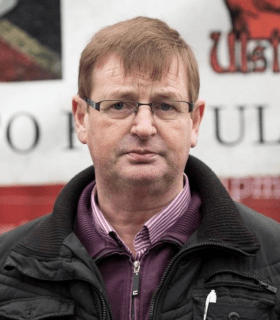
William Frederick Frazer, Northern Irish Ulster loyalist activist and advocate for those affected by Irish republican violence in Northern Ireland, is born on July 8, 1960. He is the founder and leader of the advocacy group Families Acting for Innocent Relatives (FAIR). He is also a leader of the Love Ulster campaign and then, the Belfast City Hall flag protests.

Frazer grows up in the village of Whitecross, County Armagh, Northern Ireland, as one of nine children, with his parents Bertie and Margaret. He is an ex-member of the Territorial Army and a member of the Free Presbyterian Church of Ulster. He attends a local Catholic school and plays Gaelic football up to U14 level. He describes his early years as a “truly cross-community lifestyle.” Growing up, he is a fan of the American actor John Wayne and wrestling. His father, who is a part-time member of the British Army‘s Ulster Defence Regiment (UDR) and a council worker, is killed by the Provisional Irish Republican Army (IRA) on August 30, 1975. The family home had previously been attacked with petrol bombs and gunfire which Frazer claims were IRA men, due to his father’s UDR membership. He states that his family is well respected in the area including by “old-school IRA men” and receives Mass cards from Catholic neighbours expressing their sorrow over his father’s killing. Over the next ten years, four members of Frazer’s family who are members or ex-members of the Royal Ulster Constabulary (RUC) or British Army are killed by the IRA. An uncle who is also a member of the UDR is wounded in a gun attack.

Soon after his father’s death, the IRA begins targeting Frazer’s older brother who is also a UDR member. Like many South Armagh unionists, the family moves north to the village of Markethill. After leaving school, he works as a plasterer for a period before serving in the British Army for nine years. Following this he works for a local haulage company, then sets up his own haulage company, which he later sells.

During the Drumcree conflict, Frazer is a supporter of the Portadown Orange Order who demand the right to march down the Garvaghy Road against the wishes of local residents. He is president of his local Apprentice Boys club at the time.

For a brief period after selling his haulage firm, Frazer runs “The Spot,” a nightclub in Tandragee, County Armagh, which closes down after two Ulster Protestant civilians who had been in the club, Andrew Robb and David McIlwaine, are stabbed to death in February 2000 by the Ulster Volunteer Force (UVF), after one of them had allegedly made derogatory remarks about dead UVF Mid-Ulster Brigade leader Richard Jameson. Frazer is confronted in an interview on BBC Radio Ulster about the murders by the father of one of the victims, Paul McIlwaine. During the Smithwick Tribunal, set up to investigate allegations of collusion in the 1989 Jonesborough ambush, it is alleged by a member of Garda Síochána that Frazer is a part of a loyalist paramilitary group called the Red Hand Commando. Frazer denies this allegation, saying they put his life in danger.

Frazer applies for a licence to hold a firearm for his personal protection and is turned down, a chief inspector says, in part because he is known to associate with loyalist paramilitaries.

FAIR, founded by Frazer in 1998, claims to represent the victims of IRA violence in South Armagh. It has been criticised by some for not doing the same for victims of loyalist paramilitary organisations or for those killed by security forces.

In February 2006, Frazer is an organiser of the Love Ulster parade in Dublin that has to be cancelled due to rioting. In January 2007, he protests outside the Sinn Féin Ard Fheis in Dublin that votes to join policing structures in Northern Ireland. He expresses “outrage at the idea that the ‘law-abiding population’ would negotiate with terrorists to get them to support democracy, law and order.”

In January 2007, Frazer dismisses Police Ombudsman Nuala O’Loan‘s report into security force collusion with loyalist paramilitaries.

In March 2010, Frazer claims to have served a civil writ on deputy First Minister Martin McGuinness, of Sinn Féin, seeking damages arising from the killing of his father by the Provisional IRA. Both Sinn Féin and the courts deny that any such writ had been served, but in June 2010 Frazer announces that he will seek to progress his claim in the High Court. There has since been no report of any such litigation. He previously pickets McGuinness’s home in Derry in 2007 to demand support for calls for Libya to compensate victims of IRA attacks. Accompanied by two other men, he attempts to post a letter to the house but is confronted by local residents and verbally abused. When McGuinness stands for election in the 2011 Irish presidential election, Frazer announces that he and FAIR will picket the main Sinn Féin election events, however, no such pickets take place.

In September 2010, the Special EU Programmes Body (SEUPB) revokes all funding to FAIR due to “major failures in the organisation’s ability to adhere to the conditions associated with its funding allocation” uncovered following a “thorough audit” of the tendering and administration procedures used by FAIR.

In November 2011, the SEUPB announces that it is seeking the return of funding to FAIR and another Markethill victims’ group, Saver/Naver. FAIR is asked to return £350,000 while Saver/Naver is asked to return £200,000. Former Ulster Unionist Party (UUP) leader Reg Empey demands that the conclusions about FAIR’s finances be released into the public domain.

In January 2012, Frazer announces a protest march to be held on February 25 through the mainly Catholic south Armagh village of Whitecross, to recall the killing of ten Protestant workmen by the South Armagh Republican Action Force (SARAF) in January 1976 in the Kingsmill massacre. He also names individuals whom he accuses of responsibility for the massacre. He later announces that the march is postponed “at the request of the Kingsmills families.” A 2011 report by the Historical Enquiries Team finds that members of the Provisional IRA carried out the attack despite the organisation being on ceasefire.

A delegation including Frazer, UUP politician Danny Kennedy and relatives of the Kingsmill families travel to Dublin in September 2012 to seek an apology from the Taoiseach, Enda Kenny. The apology is sought for what they describe as the Irish government‘s “blatant inaction” over the Kingmills killings. The Taoiseach says he cannot apologise for the actions of the IRA but assures the families there is no hierarchy for victims and their concerns are just as important as any other victims’ families. The families express disappointment although Frazer states he is pleased to have met the Taoiseach.

On November 16, 2012, Frazer announces that he is stepping down as director of FAIR, after he had reviewed a copy of the SEUPB audit report which, he claims, shows no grounds for demanding the reimbursement of funding. He adds, “I will still be working in the victims sector.”

In 2019, the BBC investigative journalism programme Spotlight reports that Frazer distributed assault rifles and rocket launchers from Ulster Resistance to loyalist terror groups who used them in more than 70 murders. A police report on the activities of the former Ulster Defence Association (UDA) boss Johnny Adair states he was receiving weapons from Ulster Resistance in the early 1990s and his contact in Ulster Resistance was Frazer.

In addition to his advocacy for Protestant victims, Frazer contests several elections in County Armagh. He is not elected and, on most occasions, loses his deposit. He runs as an Ulster Independence Movement candidate in the 1996 Forum Elections and the 1998 Assembly elections, and as an independent in the 2003 Assembly elections and a council by-election.

Frazer’s best electoral showing is 1,427 votes (25.9%) in a Newry and Mourne District Council by-election in August 2006, when he has the backing of the local UUP and Democratic Unionist Party (DUP).

In the 2010 United Kingdom general election, Frazer contests the Newry and Armagh Parliamentary constituency as an independent candidate. He received 656 votes (1.5%). The seat is retained by Sinn Féin’s Conor Murphy who received 18,857 votes.

In the 2011 Northern Ireland Assembly election Frazer is listed as a subscriber for the Traditional Unionist Voice (TUV) candidate for the Newry and Armagh constituency, Barrie Halliday, who secures 1.8% of the vote. At Newry Crown Court on Wednesday, June 21, 2017, Pastor Barrie Gordon Halliday is sentenced to nine months in prison, suspended for eighteen months, when he pleads guilty to seventeen counts of VAT repayment fraud.

In November 2012, Frazer announces his intention to contest the 2013 Mid Ulster by-election necessitated by Martin McGuinness’s decision to resign the parliamentary seat to concentrate on his Assembly role. He is quoted in The Irish News in January 2013 as stating that he will not condemn any paramilitary gunman who shoots McGuinness.

Despite his earlier advocacy of Ulster nationalism, in 2013 Frazer declares himself in favour of re-establishing direct rule in Northern Ireland.

On April 24, 2013, Frazer and others, including former British National Party (BNP) fundraiser Jim Dowson and David Nicholl, a former member of the paramilitary-linked Ulster Democratic Party (UDP), announce the launch of a new political party called the Protestant Coalition.

Frazer dies of cancer in Craigavon, County Armagh, Northern Ireland, on June 28, 2019. Traditional Unionist Voice (TUV) leader Jim Allister and DUP Assembly member Jim Wells pay tribute to his memory.


Leave a comment

Birth of Brendan Smyth, Priest & Convicted Sex Offender

Brendan Smyth, O.Praem, a Catholic priest and convicted sex offender, is born on June 8, 1927, in Belfast, Northern Ireland. He becomes notorious as a child molester, using his position in the Catholic Church to obtain access to his victims. During a period of over 40 years, he sexually abuses and indecently assaults at least 143 children in parishes in Belfast, Dublin and the United States. His actions are frequently hidden from police and the public by Roman Catholic officials. Controversy surrounding his case contributes to the downfall of the government of the Republic of Ireland in December 1994.

Born John Gerard Smyth, upon joining the Norbertine Roman Catholic religious order in 1945, he changes his name to Brendan. The Norbertines, also known as the “Premonstratensians,” are aware of Smyth’s crimes as early as the late 1970s, yet they do not report him to either the Garda Síochána or the Royal Ulster Constabulary (RUC). He is moved from parish to parish and between dioceses and countries whenever allegations are made. In some cases, the order does not inform the diocesan bishop that Smyth has a history of sexual abuse and should be kept away from children. He abuses children in parishes in Rhode Island and North Dakota and at one time works in Boston and is suspected of similar actions while on pastoral work in Wales and Italy. Norbertine Father Bruno Mulvihill makes several attempts to alert church authorities about the abuse committed by Smyth.

Smyth’s first conviction follows the reporting to police of his abuse of four siblings in Belfast’s Falls Road. After his arrest in 1991, he flees to the Republic of Ireland, where he spends the next three years on the run, staying mostly at Kilnacrott Abbey. This leads to the collapse of the Fianna Fáil–Labour Party coalition government in December 1994 when the poor handling of an extradition request from the RUC by the Irish Attorney General‘s office leads to a further delay of Smyth’s trial. An award-winning UTV Counterpoint programme on the scandal by journalist Chris Moore, followed by a book, accuses the head of the Norbertines and the Archbishop of Armagh of mishandling the case, and the Norbertines of negligence and a failure to tell others of Smyth’s crimes, enabling him to sexually abuse large numbers of children for 40 years.

Smyth dies in prison of a heart attack at the age of 70 on August 22, 1997, after collapsing in the exercise yard, one month into a 12-year prison sentence. The Norbertines hold his funeral before dawn and cover his grave with concrete to deter vandalism. He is buried in Kilnacrott Abbey, which is later put up for sale with 44 acres of land, including the grave.

On October 27, 2005, the title “Reverend” is removed from his gravestone following a campaign by one of Smyth’s victims.

Reviewers of the case differ as to whether there is a deliberate plot to conceal Smyth’s behaviour, incompetence by his superiors at Kilnacrott Abbey, or some combination of factors. Cahal Daly, both as Bishop of Down and Connor, a diocese where some of the abuse takes place, and later as Cardinal Archbishop of Armagh, is recorded as having been privately furious at the Norbertine “incompetence.” Smyth’s activities are investigated by the Northern Ireland Historical Institutional Abuse Inquiry, finding that: “…despite knowing his history of abusing children, the Norbertine religious order moved Smyth to different dioceses where he abused more children…”

In 2010, Daly’s successor as Roman Catholic Archbishop of Armagh, Cardinal Seán Brady, faces “huge pressure to resign” after he admits that in 1975, he witnessed two teenage boys sign oaths of silence after testifying in a Church inquiry against Smyth. Survivor groups see this as evidence of collusion, but Brady says he “did not have the authority” to turn Smyth in. On March 17, 2010, the Deputy First Minister of Northern Ireland, Martin McGuinness, calls for Brady to resign.

In 2013, some of Smyth’s alleged Rhode Island victims between 1965 and 1968, both male and female, call for the Diocese of Providence to investigate Smyth. As of 2019, he is among those listed by the Diocese of Providence as being “credibly accused” of committing sex abuse.

Module 6 of the 2014-2016 Northern Ireland Historical Institutional Abuse Inquiry is dedicated to Smyth’s crimes in Northern Ireland.

A two-part dramatisation of the Smyth case, Brendan Smyth: Betrayal of Trust, is broadcast by the BBC on March 13, 2011, with Ian Beattie in the title role and Richard Dormer as Chris Moore.

(Pictured: Father Brendan Smyth, Our Lady of Mercy, East Greenwich, Rhode Island, USA, c. 1965)


Leave a comment

Ahern and Paisley Publicly Shake Hands for the First Time

History is made on April 4, 2007, as Taoiseach Bertie Ahern and Democratic Unionist Party (DUP) leader Ian Paisley shake hands for the first time in public prior to their milestone meeting at Farmleigh, the official Irish state guest house in Dublin.

Ahern is urged by Paisley to ensure that criminals who flee across the Irish border are arrested. The Democratic Unionist leader makes the proposal during a cordial one-and-a-half-hour meeting at Farmleigh in Phoenix Park, where the two leaders exchange their first public handshake.

Afterwards Paisley, who receives an invitation from the taoiseach to visit the Battle of the Boyne site later in the year, says that they had also discussed the need for the new administrations in Northern Ireland and in the Republic of Ireland to work for each other’s best interests. “We can confidently state that we are making progress to ensure our two countries can develop and grow side by side in the spirit of generous cooperation,” he declares. “I trust that old barriers and threats will be removed in my day. Business opportunities are flourishing. Genuine respect for the understanding of each other’s differences and, for that matter, similarities is now developing.”

Earlier the DUP leader, who becomes the First Minister of the new power-sharing government on May 8 alongside Sinn Féin‘s Martin McGuinness as deputy First Minister, firmly shakes the hand of Ahern in public for the first time. As he arrives at Farmleigh, he quips, “I better shake the hands of this man. I’ll give him a firm handshake.”

Paisley, who is accompanied by his son, Ian Paisley, Jr., affectionately grabs the taoiseach by the shoulder. There is another handshake after the meeting at Farmleigh is finished.

Paisley says, “Mr. Ahern has come to understand me as an Ulsterman of plain speech. He didn’t ever need a dictionary to find out what I was saying. We engaged in clear and plain speech about our hopes and our aspirations for the people we both serve. The prime minister kindly congratulated me on my election victory.”

Paisley says that he had raised a number of issues crucial to unionists. “I have taken the opportunity to raise with the prime minister a number of key matters including ensuring that fugitives from justice who seek to use the border to their advantage are quickly apprehended and returned without protracted legal wrangle.” He adds, “I raised other legal issues of interests to unionists, and we discussed cooperation of an economic nature that will be to our mutual benefit.” He also says he had raised the issue of bringing Northern Ireland’s corporation tax into line with that of Ireland.

Regarding the invitation to visit the site of the Battle of the Boyne, Paisley says, “We both look forward to the visit to the battle site at the Boyne… Not to refight it, because that would be unfair, for he would have the home advantage. No Ulsterman ever gives his opponents an advantage. He adds, “Such a visit would help to demonstrate how far we have come when we can celebrate and learn from the past, so the next generation more clearly understands.”

Ahern pays tribute to the leadership shown by Paisley in helping to deliver a better future for the people of Northern Ireland. As Northern Ireland’s politicians continue at great pace to prepare for the return of power sharing, the taoiseach says that the progress has been very encouraging. “At this important time in our history, we must do our best to put behind us the terrible wounds of our past and work together to build a new relationship between our two traditions,” he says. “That new relationship can only be built on a basis of open dialogue and mutual respect. I fervently believe that we move on from here in a new spirit of friendship. The future for this island has never been brighter. I believe that this is a future of peace, reconciliation and rising prosperity for all. We stand ready to work with the new executive. We promise sincere friendship and assured cooperation. I believe that we can and will work together in the interests of everyone on this island.”

Ahern says he believes that the Battle of the Boyne site can be a symbol of the new beginning in the relationship between governments in Belfast and Dublin. “I believe that this site can become a valuable and welcome expression of our shared history and a new point of departure for an island, north and south, which is at ease with itself and respectful of its past and all its traditions,” he declared.

The Battle of the Boyne was fought in 1690 between the followers of England‘s King William of Orange, a Protestant, and the deposed King James, a Catholic, in Drogheda, eastern Ireland. Ireland was at that point under English rule. The battle is commemorated by many Northern Irish loyalists on July 12 each year.

Ministerial posts within the new devolved Stormont government have yet to be finalised. Already Sinn Féin has announced that MPs Michelle Gildernew and Conor Murphy and assembly members Gerry Kelly and Caitríona Ruane will be members of the government. However, the party has not yet indicated which of the four will take the three senior cabinet posts in education, agriculture and regional development and which one will be the junior minister in the Office of First and Deputy First Minister.

The DUP has also yet to name its ministers, but it has chosen finance, economy, environment and culture arts and leisure as the government departments it will head. The DUP’s deputy leader, Peter Robinson, and Nigel Dodds, the Belfast North MP, who both served in the last devolved government, are tipped to be the finance and economy ministers.

The Social Democratic and Labour Party (SDLP) announces the previous day that Margaret Ritchie, the assembly member for South Down, will be its only minister in the executive, taking charge of the Department of Social Development.

The Ulster Unionist Party (UUP) has yet to declare who their two ministers will be at the Departments of Health and Employment and Learning.

(From: “Upbeat Paisley shares first handshake with Irish PM” by Hélène Mulholland and agencies, The Guardian, http://www.theguardian.com, April 4, 2007)


Leave a comment

Birth of Michelle O’Neill, Vice President of Sinn Féin

Michelle O’Neill (née Doris), Irish politician who serves as deputy First Minister of Northern Ireland between 2020 and 2022, is born in Fermoy, County Cork, Republic of Ireland, on January 10, 1977. She has been serving as Vice President of Sinn Féin since 2018 and is the Member of the Legislative Assembly (MLA) for Mid Ulster since 2007.

O’Neill comes from an Irish republican family in Clonoe, County Tyrone, Northern Ireland. Her father, Brendan Doris, was a Provisional Irish Republican Army (IRA) prisoner and Sinn Féin councillor. Her uncle, Paul Doris, is a former national president of the Irish Northern Aid Committee (NORAID). A cousin, Tony Doris, was one of three IRA members killed by the British Army‘s Special Air Service (SAS) in the Coagh ambush in 1991. Another cousin, IRA volunteer Gareth Malachy Doris, was shot and wounded during the 1997 Coalisland attack.

After the death of Brendan Doris in 2006, Martin McGuinness pays tribute to the Doris family as “a well-known and respected republican family [who] have played a significant role in the republican struggle for many years.”

O’Neill attends St. Patrick’s Girls’ Academy, a Catholic grammar school in Dungannon, County Tyrone. She subsequently begins to train as an accounting technician, before pursuing a political career.

O’Neill becomes involved in republican politics in her teens, assisting her father with constituency work in his role as a Dungannon councillor. She joins Sinn Féin after the Good Friday Agreement in 1998, at the age of 21, and starts working as an advisor to Francie Molloy in the Northern Ireland Assembly, holding this role until 2005.

O’Neill serves on the Dungannon and South Tyrone Borough Council from 2005 to 2011. She serves as the first female Mayor of Dungannon and South Tyrone from 2010 to 2011. In the 2007 Northern Ireland Assembly election she is elected to represent Mid Ulster in the Northern Ireland Assembly. In 2011, she is appointed to the Northern Ireland Executive by deputy First Minister Martin McGuinness as Minister for Agriculture and Rural Development. In 2016, she is promoted to Minister of Health. In January 2020, she becomes deputy First Minister of Northern Ireland after the New Decade, New Approach (NDNA) agreement restores the power sharing executive.

O’Neill automatically relinquishes her office following Paul Givan‘s resignation as first minister on February 3, 2022. Sinn Féin becomes the largest party after the 2022 Northern Ireland Assembly election, putting O’Neill in line to become the First Minister of Northern Ireland, and the Democratic Unionist Party (DUP) leader to become the deputy First Minister of Northern Ireland. However, she remains to be officially sworn in as First Minister because, as part of its opposition to the Northern Ireland Protocol, the DUP has refused to nominate a deputy First minister and there is therefore no functioning executive of Northern Ireland.

In August 2022, O’Neill is asked in a BBC interview whether it was right during the Troubles for the Provisional IRA “to engage in violent resistance to British rule.” She is criticised for her response, “I think at the time there was no alternative, but now thankfully we have an alternative to conflict, and that is the Good Friday Agreement – that is why it’s so precious to us all.”

In May 2023, O’Neill attends the coronation of King Charles, saying, “Well obviously I wanted to be here. We live in changing times, and it was the respectful thing to do, to show respect and to be here for all those people at home, who I had said I would be a first minister for all. Attendance here is about honouring that and fulfilling my promise.”

Under O’Neill’s leadership, Sinn Fein has led most opinion polls for the next United Kingdom general election.


Leave a comment

28th Summit of the British-Irish Council

The British-Irish Council holds its 28th summit at Cathays Park, Cardiff, Wales, on November 25, 2016, and focuses on the United Kingdom‘s exit from the European Union (EU) and the Council’s Early Years policy.

The meeting is an important opportunity to discuss developments and reflect on the perspectives and priorities of all participants since the last British-Irish Council summit in July 2016. There is specific focus during the EU exit roundtable session on agriculture, agri-food and fisheries, trade, and implications of the UK’s exit from the EU.

UK government ministers also emphasize their continued commitment to work closely with all seven member administrations on the UK’s exit from the EU, using existing structures of bilateral and multilateral engagement.

Secretary of State for Wales, Alun Cairns, says, “The British-Irish Council summit is an important forum as we prepare to leave the European Union. The meeting allows us to maintain and strengthen relations between our governments and ensure we are all in the best position to face challenges and find new opportunities. It’s important to remember the UK is leaving the EU, but we are not leaving Europe. We want the best possible relationship with the EU as a whole. The eight council members will discuss issues including Brexit and provide the best opportunities for our young people as part of Early Years strategy. I look forward to some positive and constructive talks on both topics.”

Secretary of State for Northern Ireland, James Brokenshire, says, “At July’s BIC meeting we established an important commitment to maintain intensive and open dialogue and today’s sessions reflected the kind of mature cooperation that close friends and partners enjoy. There was a strong collective will to continue to work together in order to achieve the best outcomes for the people we represent. The UK wants the strongest possible economic links with our European neighbours, especially with Ireland – our nearest neighbour and the only EU member with which we share a land border. So as we forge a new relationship between the UK and Europe we must also maintain and strengthen the bonds within these islands. The BIC will continue to make a vital contribution to that effort and underlines our commitment to the structures set out in the Belfast Agreement and its successors.”

Minister at the Department for Exiting the European Union, Robin Walker, says, “As we begin the work of leaving the European Union, forums such as the British-Irish Council are an important way of maintaining close cooperation and open dialogue between our governments. This includes maintaining our special and friendly relationship with Ireland which has gone from strength to strength over many years. And we will continue to build on this strong relationship as we make a success of Brexit and maximise the opportunities for both our countries.”

A second session at the council addresses the Early Years policies of the eight administrations and welcomes the latest sector report highlighting progress since the 2012 summit. All in attendance acknowledge the critical importance of investment in early years provision in creating strong foundations for children, families and societies to thrive.

The meeting is hosted by the Welsh government, and First Minister of Wales Carwyn Jones welcomes delegation heads. In addition to the UK government ministerial team, the following representatives attend:

The British-Irish Council is a forum for discussion. It was established by the Belfast Agreement to promote positive, practical relationships among the people of the islands and to provide a forum for consultation and co-operation.

(From: “British-Irish Council Summit: Focus on EU exit and ‘Early Years’ policy” press release by the Government of the United Kingdom, http://www.gov.uk, November 25, 2016)


Leave a comment

Ian Paisley Announces Retirement as Northern Ireland’s First Minister

In a March 4, 2008, announcement, the Rev. Ian Paisley signals the end of an era by announcing he will retire as First Minister of Northern Ireland. He also confirms he is stepping down as leader of the Democratic Unionist Party (DUP), the party he founded in the early 1970s. The news represents a huge moment in the politics and recent history of Northern Ireland, removing from the scene as it does one of its most striking figures.

The 81-year-old announces he will quit both posts following an international investment conference in Belfast in May 2008 but will remain as an MP and Assembly member.

“I came to this decision a few weeks ago when I was thinking very much about the conference and what was going come after the conference,” Paisley tells Ulster Television. “I thought that it is a marker, a very big marker and it would be a very appropriate time for me to bow out.”

Paisley denies he is leaving in part over allegations that his son, Ian Paisley Jr., lobbied Downing Street on behalf of a wealthy party member. He says his son has been “wrongly accused.” He is also weakened over defeat in a recent by-election – an indication that a section of the DUP’s electorate is uneasy about his historic decision to share power with Sinn Féin.

Significantly, Paisley does not back any contender in the DUP leadership contest to succeed him. “This is not the Church of Rome. I have no right to say who will succeed me. I will not be like Putin in Russia saying to the president – ‘this is the way you have to go.’ When I make a break it will be [a] break.”

Paisley defends his decision to enter into government with Sinn Féin. “It was the right thing to do because it was the only thing to do to save us from a united Ireland. We were threatened that we would be more Irish in our rulership, that there would be more Dublin say in government. That was what the British government threatened. We managed to put that to a rest.”

“We have laid to rest that and republicans have come to see that they have to put up with Paisley and his clan. We took what was meant for our destruction and turned it into our salvation.”

Speaking from Dubai the previous night, the deputy First Minister, Martin McGuinness, says, “It wasn’t unexpected. It was the right decision to go into sharing power with Sinn Féin which changed the politics of Ireland forever.”

The Sinn Féin MP describes Paisley as “courageous” for agreeing to enter into the power-sharing government. “We have had a positive and constructive working relationship,” McGuinness said.

Paisley’s fiercest critic within unionism, the ex-DUP MEP, Jim Allister, claims opposition to his power-sharing with Sinn Féin and his relationship with McGuinness means that Paisley “jumped before he was pushed.”

Allister’s new party, Traditional Unionist Voice (TUV), split the DUP vote in a by-election in February 2008 and cost the party a council seat in County Down. It was Paisley’s first electoral test since he agreed to share power with Sinn Féin following the St. Andrews Agreement at the end of 2006.

In April 2008, Peter Robinson is chosen to succeed Paisley as leader of the Democratic Unionist Party. The 36 DUP members of the Northern Ireland Assembly unanimously select Robinson, who has been MP for Belfast East since 1979 and Paisley’s deputy since 1980. He is the Minister of Finance and Personnel in the Northern Ireland Executive – Northern Ireland’s power-sharing government – for the previous year.

(From: “Paisley to step down as Ulster’s first minister” by Henry McDonald, Ireland correspondent, The Guardian, March 4, 2008)


Leave a comment

Reverend Ian Paisley Elected MP for North Antrim

After having been in prison for unlawful assembly and breach of the peace, the “anti-popery” Reverend Ian Richard Kyle Paisley, loyalist politician and Protestant religious leader from Northern Ireland, is elected to Westminster on July 18, 1970, as an MP for North Antrim.

Paisley is born on April 6, 1926, in Armagh, County Armagh. He becomes a Protestant evangelical minister in 1946 and remains one for the rest of his life. In 1951, he co-founds the fundamentalist Free Presbyterian Church of Ulster and is its leader until 2008. He becomes known for his fiery speeches and regularly preaches and protests against Catholicism, ecumenism and homosexuality. He gains a large group of followers who are referred to as “Paisleyites.”

Paisley becomes involved in Ulster unionist/loyalist politics in the late 1950s. In the mid-late 1960s he leads and instigates loyalist opposition to the Catholic civil rights movement in Northern Ireland. This leads to the outbreak of the Troubles in the late 1960s, a conflict that engulfs Northern Ireland for the next thirty years. In 1970, he becomes Member of Parliament for North Antrim and the following year he founds the Democratic Unionist Party (DUP), which he leads for almost forty years. In 1979, he becomes a Member of the European Parliament.

Throughout the Troubles, Paisley is seen as a firebrand and the face of hard-line unionism. He opposes all attempts to resolve the conflict through power-sharing between unionists and Irish nationalists/republicans, and all attempts to involve the Republic of Ireland in Northern affairs. His efforts help bring down the Sunningdale Agreement of 1974. He also opposes the Anglo-Irish Agreement of 1985, with less success. His attempts to create a paramilitary movement culminate in Ulster Resistance. He and his party also oppose the Northern Ireland peace process and Good Friday Agreement of 1998.

In 2005, Paisley’s DUP becomes the largest unionist party in Northern Ireland, displacing the Ulster Unionist Party (UUP), which has dominated unionist politics since 1905. In 2007, following the St. Andrews Agreement, the DUP finally agrees to share power with republican party Sinn Féin and consent to all-Ireland governance in certain matters. He and Sinn Féin’s Martin McGuinness become First Minister and deputy First Minister respectively in May 2007. He steps down as First Minister and DUP leader in May 2008 and leaves politics in 2011. He is made a life peer in 2010 as Baron Bannside.

In November 2011, Paisley announces to his congregation that he is retiring as a minister. He delivers his final sermon to a packed attendance at the Martyrs’ Memorial Hall on December 18, 2011, and finally retires from his religious ministry on January 27, 2012.

Paisley dies in Belfast on September 12, 2014. He is buried in Ballygowan, County Down on September 15 following a private funeral and a public memorial for 800 invited guests is held in the Ulster Hall on October 19. An obituary in The New York Times reports that late in life Paisley had moderated and softened his stances against Roman Catholics but that “the legacies of fighting and religious hatreds remained.”


Leave a comment

Birth of Bobby Storey, Provisional Irish Republican Army Volunteer

Robert “Bobby” Storey, a Provisional Irish Republican Army (IRA) volunteer, is born in Belfast, Northern Ireland, on April 11, 1956. Prior to an 18-year conviction for possessing a rifle, he also spends time on remand for a variety of charges and in total serves 20 years in prison. He also plays a key role in the Maze Prison escape, the biggest prison break in British penal history.

The family is originally from the Marrowbone area, on the Oldpark Road in North Belfast. The family has to move when Storey is very young due to Ulster loyalist attacks on the district, moving to Manor Street, an interface area also in North Belfast. His uncle is boxing trainer Gerry Storey and his father, also called Bobby, is involved in the defence of the area in the 1970s when Catholics are threatened by loyalists.

Storey is one of four children. He has two brothers, Seamus and Brian, and a sister Geraldine. Seamus and his father are arrested after a raid on their home which uncovers a rifle and a pistol. While his father is later released, Seamus is charged. He escapes from Crumlin Road Prison with eight other prisoners in 1971, and they are dubbed the Crumlin Kangaroos.

On his mother Peggy’s side of the family there is also a history of republicanism, but Storey says the dominant influences on him are the events happening around him. These include the McGurk’s Bar bombing in the New Lodge, some of those killed being people who knew his family, and also Bloody Sunday. This then leads to his attempts to join the IRA. He leaves school at fifteen and goes to work with his father selling fruit. At sixteen, he becomes a member of the IRA.

On April 11, 1973, his seventeenth birthday, Storey is interned and held at Long Kesh internment camp. He had been arrested 20 times prior to this but was too young for internment. In October 1974, he takes part in the protest at Long Kesh against living conditions where internees set fire to the “cages” in which they are being held. He is released from internment in May 1975. He is arrested on suspicion of a bombing at the Skyways Hotel in January 1976 and a kidnapping and murder in the Andersonstown district of Belfast in March 1976, but is acquitted by the judge at his trial. He is arrested leaving the courthouse and charged with a shooting-related incident. He is released after the case cannot be proven, only to be charged with shooting two soldiers in Turf Lodge. Those charges are dropped in December 1977. The same month he is arrested for the murder of a soldier in Turf Lodge, but the charges are again dropped. In 1978 he is charged in relation to the wounding of a soldier in Lenadoon, but is acquitted at trial due to errors in police procedure.

On December 14, 1979, he is arrested in Holland Park, London, with three other IRA volunteers including Gerard Tuite, and charged with conspiring to hijack a helicopter to help Brian Keenan escape from Brixton Prison. Tuite escapes from the same prison prior to the trial, and the other two IRA volunteers are convicted, but Storey is acquitted at the Old Bailey in April 1981. That August, after a soldier is shot, he is arrested in possession of a rifle and is convicted for the first time, being sentenced to eighteen years’ imprisonment.

Storey is one of the leaders of the Maze Prison escape in 1983, when 38 republican prisoners break out of the H-Blocks, the largest prison escape in British penal history and the largest peacetime prison escape in Europe. He is recaptured within an hour and sentenced to an additional seven years’ imprisonment. Released in 1994, he is again arrested in 1996 and charged with having personal information about a British Army soldier, and Brian Hutton, the Lord Chief Justice of Northern Ireland. At his trial at Crumlin Road Courthouse in July 1998, he is acquitted after his defence proves the personal information had previously been published in books and newspapers.

Having spent over twenty years in prison, much of it on remand, Storey’s final release is in 1998, and he again becomes involved in developing republican politics and strategy, eventually becoming the northern chairman of Sinn Féin.

On January 11, 2005, Ulster Unionist Member of Parliament for South Antrim David Burnside tells the British House of Commons under parliamentary privilege that Storey is head of intelligence for the IRA.

On September 9, 2015, Storey is arrested and held for two days in connection with the killing of former IRA volunteer Kevin McGuigan the previous month. He is subsequently released without any charges, and his solicitor John Finucane states Storey will be suing for unlawful arrest.

Storey dies in England on June 21, 2020, following an unsuccessful lung transplant surgery. Sinn Féin president Mary Lou McDonald describes him as “a great republican” in her tribute. His funeral procession in Belfast on June 30 is attended by over 1,500 people including McDonald, deputy First Minister Michelle O’Neill, and former Sinn Féin president Gerry Adams, but is criticised for breaking social distancing rules implemented in response to the COVID-19 pandemic which, at the time operating in Northern Ireland, limited funeral numbers to no more than 30 mourners.

In the 2017 film Maze, dramatising the 1983 prison break, directed by Stephen Burke, Storey is portrayed by Irish actor Cillian O’Sullivan.


Leave a comment

Death of Martin McGuinness, Irish Republican Sinn Féin Politician

Martin McGuinness, former member of the Provisional Irish Republican Army‘s (IRA) Army Council and Sinn Féin‘s chief negotiator in the peace process, dies on the morning of March 21, 2017 at Derry‘s Altnagelvin Area Hospital with his family by his bedside. He had been diagnosed with a rare heart disease in December 2016. In 2011, McGuinness contests the presidential election which is won by Michael D. Higgins.

McGuinness is born James Martin Pacelli McGuinness on May 23, 1950 in Derry. He attends St. Eugene’s Primary School and later the Christian Brothers technical college, leaving school at the age of 15.

McGuinness joins the IRA about 1970, and by 1971 he is one of its leading organizers in Derry. In 1973 a Special Criminal Court in the Republic of Ireland sentences him to six months in prison after he is caught in a car containing large quantities of explosives and ammunition. Although the IRA keeps secret the membership of its seven-person Army Council, few doubt that McGuinness is one of its most important members from the 1970s through the 1990s. Even while reportedly planning attacks on civilians in Northern Ireland and on the British mainland, McGuinness is involved in spasmodic secret talks with British government ministers and officials to end the conflict. In 1972 McGuinness, with fellow IRA leader Gerry Adams, privately negotiates with British Secretary of State for Northern Ireland William Whitelaw, but these and other talks over the next two decades are unsuccessful.

McGuinness contests seats in the British House of Commons on several occasions, losing in 1983, 1987, and 1992. However, in 1997 he is elected to the House of Commons to represent the constituency of Mid Ulster and, in line with party policy, he does not take his seat. He subsequently wins reelection to the seat in 2001, 2005, and 2010.

McGuinness is the IRA’s chief negotiator in the deliberations, also secret at first, that culminate in the Good Friday Agreement in 1998. This pact finally ends the conflict and eventually brings Sinn Féin into a coalition government to rule Northern Ireland. He is elected to the new Northern Ireland Assembly and in 1999 is appointed Minister of Education. In this post he eliminates the controversial eleven-plus examination, which determines which type of secondary school a child should attend. The test had been abolished in most of the rest of the United Kingdom more than 25 years earlier.

Disagreements over such issues as policing and the decommissioning of arms causes Northern Ireland’s Executive and Assembly to be suspended for some years, but a fresh agreement in 2006 paves the way for them to be revived. In elections in March 2007, both Sinn Féin and the antirepublican Democratic Unionist Party (DUP) gain seats, becoming the two largest parties in the Northern Ireland Assembly. McGuinness becomes Deputy First Minister, working with First Minister Ian Paisley, leader of the DUP. The two men, previously bitter enemies, perform so well together that they are dubbed the “Chuckle brothers.”

When Paisley retires in 2008, he is succeeded by the DUP’s Peter Robinson, who is considered to be even more militantly antirepublican. Once again, however, a shared need to rebuild the economy and attract international investment leads to cooperation between former opponents. In 2009 their government is in jeopardy as Sinn Féin and the DUP argue over the devolution of the police and justice system in Northern Ireland. McGuinness and Robinson are involved in the ensuing negotiations, and in February 2010 an agreement is reached for the transfer of powers from Britain to Northern Ireland in April.

In the Assembly elections in May 2011, McGuinness and Robinson are a formidable pair, and voters respond to their call for stability in a time of economic uncertainty. Sinn Féin gains an additional seat and increases its overall share of the vote, and McGuinness is assured an additional term as Deputy First Minister. In the autumn he steps down to run as Sinn Féin’s candidate for the presidency of Ireland. After finishing third in the election held on October 28, he returns to the position of Deputy First Minister a few days later. On June 27, 2012, in an event widely seen as having great symbolic importance for the ongoing reconciliation efforts in Northern Ireland, McGuinness and Elizabeth II shake hands twice, once in private and again in public, during a visit by the British monarch to Belfast.

In January 2017 McGuinness resigns as Deputy First Minister in response to First Minister Arlene Foster’s refusal to temporarily step down from her position during the investigation of a scandal relating to the government’s Renewable Heat Incentive (RHI), a mishandled program under which large amounts of state funds allegedly had been squandered. Foster had served as head of the department that oversaw the RHI before becoming First Minister. Under the power-sharing agreement the posts of First Minister and Deputy First Minister constitute a single joint office so that the resignation of one minister results in termination of the other’s tenure. When Sinn Féin chooses not to nominate a replacement for McGuinness within the required seven-day period, authority reverts to the British government’s Secretary of State for Northern Ireland in advance of a snap election on March 2.

Even before McGuinness’s resignation there had been speculation late in 2016 that he might step down for health reasons, and soon after resigning he confirms that he is suffering from amyloidosis, a rare disease brought about by deposits of abnormal protein in organs and tissue. With McGuinness removing himself from “frontline politics,” Michelle O’Neill leads Sinn Féin into the election. The disease claims McGuinness’s life only months later on March 21, 2017.


Leave a comment

Killing of PSNI Officer Stephen Carroll

stephen-carroll

Stephen Carroll, a Police Service of Northern Ireland (PSNI) officer, is killed by the Continuity Irish Republican Army on March 9, 2009 in Craigavon, County Armagh, Northern Ireland. Carroll’s killing marks the first time a serving police officer has been killed since the Good Friday Agreement in 1998.

Two days prior to the attack the Real Irish Republican Army shoots dead two British soldiers outside the Massereene Barracks in Antrim, County Antrim. This period marks a significant escalation in the campaign by dissident republicans.

The Continuity IRA smashes a window with a brick knowing the PSNI would respond. At about 9:45 PM two police vehicles arrive at the scene. The officers are fired upon as they attempt to exit their vehicles. A gunman shoots Carroll from 50 metres away with an AK-47 while in his patrol car. Carroll is shot in the head.

The Continuity IRA claims responsibility saying their North Armagh Battalion is responsible for the attack and that “As long as there is British involvement in Ireland, these attacks will continue.”

On March 10 there is a one-minute silence in the Northern Ireland Assembly. Prime Minister Gordon Brown states that “These are murderers who are trying to distort, disrupt and destroy a political process that is working for the people of Northern Ireland.” Chief Constable Sir Hugh Orde calls it a “sad day” and says the gunmen are “criminal psychopaths.”

Richard Walsh, the spokesman for Republican Sinn Féin, a party linked to the Continuity IRA, says the killings are “an act of war” rather than murder. “We have always upheld the right of the Irish people to use any level of controlled and disciplined force to drive the British out of Ireland. We make no apology for that.” He also describes the PSNI as “an armed adjunct of the British Army.”

Deputy First Minister of Northern Ireland Martin McGuinness says those responsible are “traitors to the island of Ireland” and that “they have betrayed the political desires, hopes and aspirations of all of the people who live on this island.”