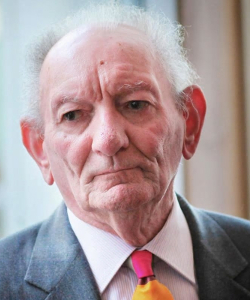
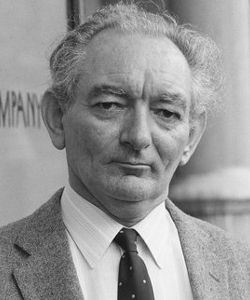
Recognised for early works such as Philadelphia, Here I Come! and Faith Healer, Friel has 24 plays published in a career of more than a half-century. He is elected to the honorary position of Saoi of Aosdána. His plays are commonly produced on Broadway in New York City throughout this time, as well as in Ireland and the United Kingdom. In 1980 Friel co-founds Field Day Theatre Company, and his play Translations is the company’s first production. With Field Day, Friel collaborates with Seamus Heaney, 1995 recipient of the Nobel Prize in Literature. Heaney and Friel first become friends after Friel sends the young poet a letter following publication of his book Death of a Naturalist. Friel’s play Dancing at Lughnasa wins three Tony Awards in 1992.
After a long illness Friel dies at the age of 86 in the early morning of Friday, October 2, 2015, in Greencastle, County Donegal. He is survived by his wife Anne and children Mary, Judy, Sally and David. A daughter, Patricia, predeceases him in 2012.
By 1649, Ireland has already been at war for eight years, since the outbreak of the Irish Rebellion of 1641. The English Parliament holds only two small enclaves, Dublin and Derry, in Ireland.
In July 1649, Ormond, marches his coalition forces of 11,000 men to the outskirts of Dublin with the intent of taking the city from its Parliamentary garrison, which had landed there in 1647. Ormond takes Rathfarnham Castle and camps at Palmerston Park in Rathgar, about 4 km south of the city. The area from Ormond’s camp to the city of Dublin is now a heavily urbanised area, but in 1649, it is open countryside. Ormond begins inching his forces closer to Dublin by taking the villages around its perimeter and to this end, sends a detachment of troops to occupy Baggotrath Castle, on the site of present-day Baggot Street bridge. For reasons which have never been clear, they take several hours to reach Baggotrath, a distance of about a mile, and they arrive to find that the Parliamentary troops have already occupied the castle.
However, Ormond is not expecting Michael Jones, the Parliamentary commander, to take the initiative and has not drawn up his troops for battle. Unfortunately for the Royalists, this is exactly what Jones does, launching a surprise attack on August 2 from the direction of Irishtown with 5,000 men and sending Ormond’s men at Baggotsrath reeling backwards towards their camp in confusion.
Too late, Ormond and his commanders realise what is going on and send units into action piecemeal to try to hold up the Parliamentarian advance, so that they can form their army into battle formation. However, Jones’ cavalry simply outflanks each force sent against them, sending them too fleeing back south through the townland of Rathmines. The battle becomes a rout as scores of fleeing Royalist and Confederate soldiers are cut down by the pursuing Roundheads. The fighting finally ends when the English Royalist troops under Murrough O’Brien, 1st Earl of Inchiquin, mounts a disciplined rearguard action, allowing the rest to get away. Ormond claims he has lost less than a thousand men. Jones claims to have killed around 4,000 Royalist or Confederate soldiers and taken 2,517 prisoners, while losing only a handful himself. Ormond certainly loses at least one leading officer, Christopher Plunkett, 2nd Earl of Fingall, who is fatally wounded and dies in Dublin Castle a few days later. Ormond also loses his entire artillery train and all his baggage and supplies.
In the aftermath of the battle, Ormond withdraws his remaining troops from around Dublin, allowing Oliver Cromwell to land in the city at Ringsend with 15,000 veteran troops on August 15. Cromwell calls the battle “an astonishing mercy,” taking it as a sign that God has approved of his conquest of Ireland. Over the next four years he completes the Cromwellian conquest of Ireland.
Without Jones’ victory at Rathmines, the New Model Army would have had no port to land at in Ireland and the Cromwellian conquest of Ireland would have been much more difficult. Ormond’s incompetent generalship at Rathmines disillusions many Irish Confederates with their alliance with the English Royalists and Ormond is ousted as commander of the Irish forces the following year.
Devine, also known as “Red Mickey” because of his red hair, is born into a family from the Springtown Camp, Derry, Northern Ireland. In 1960, when he is six years of age, the Devine family including his grandmother, sister Margaret and parents Patrick and Elizabeth, move to the then newly built Creggan estate to the north of Derry city centre. He is educated at Holy Child Primary School and St. Joseph’s Secondary School, both in the Creggan.
After British soldiers shoot and kill two unarmed civilians, Dessie Beattie and Raymond Cusack, Devine joins the James Connolly Republican Club in Derry in July 1971. Bloody Sunday has a deep impact on him. In the early 1970s, Devine joins the Irish Labour Party and Young Socialists.
Devine helps found the Irish National Liberation Army (INLA) in 1975. In 1976, after an arms raid in County Donegal in the Republic of Ireland, he is arrested in Northern Ireland. He is convicted and sentenced to twelve years in prison. He joins the blanket protest before joining the hunger strike.
Devine participates in a brief hunger strike in 1980, which is called off without fatalities. However, on June 22, 1981, Devine joins the 1981 hunger strike at the Maze Prison. He dies on August 20, the tenth and last of the hunger strikers to die.
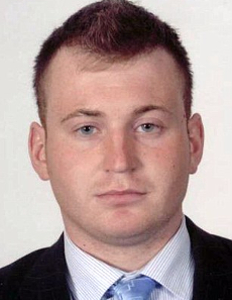
Kerr is Roman Catholic, a group which at the time constitutes approximately 30% of PSNI officers, and is 25 years old at the time of his death. He is a member of a Gaelic Athletic Association club, the Beragh Red Knights. The guard of honour at Kerr’s funeral is formed of club members and PSNI officers, a funeral also attended by the leaders of Ireland’s four main churches.
Kerr’s murder is condemned by almost all sections of Northern Irish politics and society as well as bringing international condemnation. On April 6, a Peace Rally is organised in Belfast by the Irish Congress of Trade Unions, which is reported to be attended by up to 7,000 persons. Similar events are held in Omagh, Enniskillen, and London.
BBC Ireland correspondent Mark Simpson comments, in relation to the unified response of the community, “A murder designed to divide people has actually brought them closer together.” Graffiti praising the murder is daubed on walls in predominantly republican areas of Derry.
On July 26, 2011 five men are arrested in connection with the investigation. They are later released. On November 26, 2012, investigating detectives announce the arrest of a 22-year-old man in Milton Keynes. On November 27, a 39-year-old man in County Tyrone is arrested and questioned. However, as of 2017 no persons have been charged with Constable Kerr’s murder.
John Beresford, Irish statesman, is born in Cork on March 14, 1738. He is a younger son of Sir Marcus Beresford who, having married Catherine, sole heiress of James Power, 3rd Earl of Tyrone, is created Earl of Tyrone in 1746. After the death of the earl in 1763, Beresford’s mother successfully asserts her claim suo jure to the barony of La Poer. John Beresford thus inherits powerful family connections. He is educated at Kilkenny College and Trinity College, Dublin and is called to the Irish bar.
Beresford enters the Irish House of Commons as member for County Waterford in 1761. In 1768, 1783, 1789 and finally in 1798, he stands also for Coleraine, however choosing each time to sit for Waterford.
His industry, added to the influence of his family, procures his admission to the Privy Council of Ireland in 1768, and his appointment as one of the commissioners of revenue two years later. In 1780 he becomes first commissioner of revenue, a position which gives him powerful influence in the Irish administration. He introduces some useful reforms in the machinery of taxation and is the author of many improvements in the architecture of the public buildings and streets of Dublin. He is first brought into conflict with Henry Grattan and the popular party in 1784, by his support of the proposal that the Irish parliament in return for the removal of restrictions on Irish trade should be bound to adopt the English navigation laws.
In 1786, Beresford is sworn a member of the Privy Council of Great Britain, and the power which he wields in Ireland through his numerous dependants and connections grows to be so extensive that a few years later he is spoken of as the “King of Ireland.” He is a vehement opponent of the increasing demand for Catholic Emancipation and when it becomes known that the Earl Fitzwilliam is to succeed John Fane, 10th Earl of Westmorland, as Lord Lieutenant of Ireland in 1795 for the purpose of carrying out a conciliatory policy, Beresford expresses strong hostility to the appointment. One of Fitzwilliam’s first acts is to dismiss Beresford from his employment for corruption, but with permission to retain his entire official salary for life, and with the assurance that no other member of his family will be removed. Fitzwilliam has been encouraged in this course of action by William Ponsonby. Beresford immediately exerts all his influence with his friends in England, to whom he describes himself as an injured and persecuted man. He appeals to William Pitt the Younger and goes to London to lay his complaint before the English ministers.
The recall of Fitzwilliam, which is followed by such momentous consequences in the history of Ireland is, as the viceroy himself believes, mainly due to Beresford’s dismissal. There has been a misunderstanding on the point between Pitt and Fitzwilliam. The latter, whose veracity is unimpeachable, asserts that previous to his coming to Ireland he had informed the prime minister of his intention to dismiss Beresford, and that Pitt had raised no objection. Pitt denies all recollection of any such communication, and on the contrary describes the dismissal as an open breach of the most solemn promise. In a letter to Frederick Howard, 5th Earl of Carlisle, justifying his action, Fitzwilliam mentions that malversation had been imputed to Beresford. Beresford sends a challenge to Fitzwilliam, but the combatants are interrupted on the field and Fitzwilliam then makes an apology.
When John Pratt, 1st Marquess Camden, replaces Fitzwilliam in the viceroyalty in March 1795, Beresford resumes his former position. On the eve of the Irish Rebellion of 1798 his letters to William Eden, 1st Baron Auckland, give an alarming description of the condition of Ireland and he counsels strong measures of repression. When first consulted by Pitt on the question of the union, Beresford appears to dislike the idea, but he soon becomes reconciled to the policy and warmly supports it. After the union Beresford continues to represent County Waterford in the Parliament of the United Kingdom, and he remains in office until 1802, taking an active part in settling the financial relations between Ireland and Great Britain.
In 1760, Beresford marries Constantia Ligondes, who dies in 1772. In 1774, he marries Barbara Montgomery, a celebrated beauty who figures in Sir Joshua Reynolds‘ picture of The Graces. He has large families by both marriages. His sons include Marcus Beresford, George Beresford, and John Claudius Beresford. John Beresford dies near Derry on November 5, 1805.
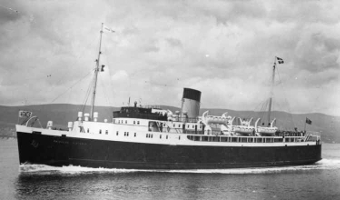
Princess Victoria is built in 1947 by William Denny and Brothers, Dumbarton. She is the first purpose-built ferry of her kind to operate in British coastal waters and could hold 1,500 passengers plus cargo and had sleeping accommodations for 54.
Captained by James Ferguson, the vessel leaves Stranraer‘s railway loading pier at 7:45 AM on January 31, 1953 with 44 tons of cargo, 128 passengers, and 51 crew. Captain Ferguson has served as master on various ferries on the same route for seventeen years. A gale warning is in force but he makes the decision to put to sea. Loch Ryan is a sheltered inlet and the immediate force of the wind and sea is not apparent, but it is noted that spray is breaking over the stern doors. A “guillotine door” has been fitted, because of a previously identified problem with spray and waves hitting the stern doors, but it is rarely used, because it takes too long to raise and lower. This would provide extra protection for the sliding stern doors but on this occasion it is not lowered.
Shortly after clearing the mouth of Loch Ryan, the ship turns west towards Larne, County Antrim, Northern Ireland and exposes her stern to the worst of the high seas. Huge waves damage the low stern doors, allowing water to enter the car deck. The crew struggles to close the doors again but they prove to be too badly damaged and water continues to flood in from the waves. The scuppers do not appear to be allowing the water to drain away. The ship takes a list to starboard and at this point Captain Ferguson decides to retreat to the safety of Loch Ryan by going astern and using the bow rudder. This proves to be impossible, because the extreme conditions prevent the deckhands from releasing the securing pin on the bow rudder. Ferguson then makes a decision to try to reach Northern Ireland by adopting a course which keeps the stern of the craft sheltered from the worst of the elements. At 9:46 AM, two hours after leaving Stranraer, a message is transmitted in Morse code (the Princess Victoria does not have a radio telephone) by radio operator David Broadfoot to the Portpatrick Radio Station: “Hove-to off mouth of Loch Ryan. Vessel not under command. Urgent assistance of tugs required.”
With a list to starboard exacerbated by shifting cargo, water continues to enter the ship. At 10:32 AM an SOS transmission is made, and the order to abandon is given at 2:00 PM. Possibly the first warship in the area is HMS Launceston Castle, commanded by Lt. Cdr J M Cowling, a frigate which is en route to Derry. Searches are carried out but Launceston Castle is forced to leave when her condensers are contaminated by salt. Upon the upgrade of the assistance message to an SOS, the Portpatrick Lifeboat the Jeannie Spiers is dispatched, as is the destroyer HMS Contest. Contest, commanded by Lt. Commander HP Fleming, leaves Rothesay at 11:09 AM but, although she comes close to her position at 1:30 PM, poor visibility prevents the crew from seeing the sinking ship. The destroyer has been trying to maintain a speed of 31 knots to reach the listing ferry but, after sustaining damage from the seas, Captain Fleming is forced to reduce speed to 16 knots.
The Princess Victoria is still reporting her position as 5 miles northwest of Corsewall Point but her engines are still turning and even at the speed of 5 knots are gradually drawing the vessel closer to Northern Ireland and away from her reported position. At 1:08 PM, the ship broadcasts that her engines have stopped. The final morse code message at 1:58 PM reports the ship “on her beam end” five miles east of the Copeland Islands.
The Court of Enquiry into the sinking, held in March 1953 at Crumlin Road Courthouse in Belfast, finds that the Princess Victoria was lost due to a combination of factors. In a 30,000 page report the enquiry finds that firstly, the stern doors are not sufficiently robust. Secondly, arrangements for clearing water from the car deck are inadequate. The report concludes “If the Princess Victoria had been as staunch as those who manned her, then all would have been well and the disaster averted.” The court also notes the failure of the duty destroyer HMS Tenacious from the 3rd Training Squadron based at HMS Sea Eagle at Londonderry Port to be able to put to sea as too many men had been released on shore leave. As a consequence of the enquiry the duty destroyer from the 3rd Squadron is subsequently based “on station” at the mouth of Lough Foyle on one hour readiness to put to sea.
The wreck lay undiscovered until 1992 when a team from Cromarty Firth Diving, led by John MacKenzie and funded by the BBC, working from data provided by a Royal Navy seabed survey carried out in 1973, are able to locate it five miles north northeast of the Copeland Islands in 90 metres of water. Video footage and stills from this expedition are transmitted on a BBC programme called Home Truths (Things Don’t Happen to Boats Like This) on the 40th anniversary of the sinking in 1993.
Friel receives his B.A. from St. Patrick’s College, Maynooth (1945–48), and qualifies as a teacher at St. Joseph’s Training College in Belfast. He marries Anne Morrison in 1954, with whom he has four daughters and one son. Between 1950 and 1960, he works as a math teacher in the Derry primary and intermediate school system, taking leave in 1960 to pursue a career as a writer, living off his savings. In the late 1960s, the Friels move from 13 Malborough Street, Derry to Muff, County Donegal, eventually settling outside Greencastle, County Donegal.
Recognised for early works such as Philadelphia, Here I Come! and Faith Healer, Friel has 24 plays published in a more than half-century spanning career that culminates in his election to the position of Saoi of Aosdána. His plays are commonly featured on Broadway throughout this time. In 1980, Friel co-founds Field Day Theatre Company, and his play Translations is the company’s first production. With Field Day, Friel collaborates with Seamus Heaney, 1995 recipient of the Nobel Prize in Literature. Heaney and Friel first become friends after Friel sends the young poet a letter following the publication of Death of a Naturalist.
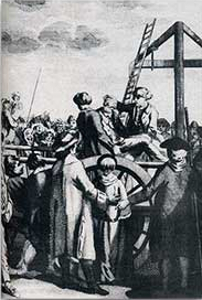
John MacNaghten, Anglo-Irish land owner, gambler, and convicted murderer also known as “Half-Hanged MacNaghten,” is hanged at Strabane jail on December 15, 1761, for his involvement in the killing of Mary Anne Knox, daughter of Andrew Knox MP.
MacNaghten is born into a landed Anglo-Irish family and attends Raphoe Royal school in County Donegal. In 1740, he inherits his family estate worth £500 a year and that same year enters Trinity College, Dublin. MacNaghten marries the sister-in-law of the first earl of Massereene. However, he is quickly enamoured of the extravagant lifestyle of Ascendancy Dublin where he becomes a popular and colourful character. He develops an addiction to gambling and squanders away a large part of his inheritance, running up substantial gaming debts and by 1750 is threatened with arrest.
Following the death of his wife in childbirth, he is appointed to the lucrative post of tax collector for Coleraine but gambles away £800 of the King’s money. His estate is sequestered and by 1760 he is penniless.
He gains support trying to help overcome his addiction from a childhood friend, Andrew Knox. Knox is a wealthy land-owner and Member of Parliament (MP) for Donegal who lives on an estate at Prehen about two miles outside the city of Derry. Mary Ann, Knox’s 15-year-old daughter, is already a substantial heiress, having received some £6,000, and would collect a further legacy if her brother dies without issue. MacNaghten and Mary Ann develop a relationship as the former visits Prehen regularly. Nonetheless by 1761 their relationship has run into difficulties.
The practice of abduction and marriage is prevalent in 18th century Ireland among young men of social standing but with little property and, within their society, it is tolerated. So, on November 10, 1761, MacNaghten and his followers attempt to abduct Mary Ann from a carriage on a family journey to Dublin Parliament with the intention of eloping with her. The attempt fails miserably as MacNaghten shoots and mortally wounds her by mistake. He is taken to Lifford Courthouse in County Donegal, where a court finds MacNaghten guilty of murder and he is sentenced to execution by hanging.
At Strabane jail on December 15, 1761, MacNaghten hurls himself from the gallows with such force that the rope breaks. He has the sympathy of the crowd who believe this is divine intervention for a man distraught with grief over the death of his love. Despite the belief that MacNaghten could not be hanged a second time, he fails to use the cover of a sympathetic crowd to make good his escape. Rather he defies the public mood of the people with the never-to-be-forgotten words, “I vow that no one will ever speak of me as Half-Hanged MacNaghten.” He returns himself to the jurisdiction of the hangman and, with a new rope, is dispatched into the arms of eternity.
John McNaghton is buried at Patrick Street graveyard, Strabane, County Tyrone.
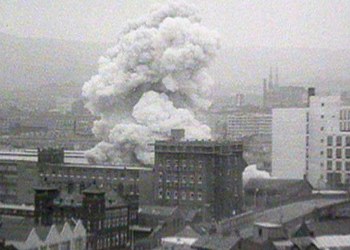
At least twenty Provisional Irish Republican Army (IRA) bombs explode in Belfast on July 21, 1972, during the Troubles in what has become known as “Bloody Friday.” Most of the bombs are car bombs and most target infrastructure, especially the transport network. Nine people are killed, including two British soldiers and five civilians, while 130 are injured.
In late June and early July 1972, a British government delegation led by William Whitelaw holds secret talks with the Provisional IRA leadership. As part of the talks, the IRA agrees to a temporary ceasefire beginning on June 26. The IRA leaders seek a peace settlement that includes a British withdrawal from Northern Ireland by 1975 and the release of republican prisoners. However, the British refuse and the talks break down. The ceasefire comes to an end on July 9.
Bloody Friday is the IRA’s response to the breakdown of the talks. According to the IRA’s Chief of Staff, Seán Mac Stíofáin, the main goal of the bombing operation is to wreak financial harm. It is a “message to the British government that the IRA could and would make a commercial desert of the city unless its demands were met.” Some also see it as a reprisal for Bloody Sunday in Derry six months earlier. The attack is carried out by the IRA’s Belfast Brigade and the main organiser is Brendan Hughes, the brigade’s Officer Commanding.
The bombings occur during an 80-minute period on the afternoon of Friday, July 21. At least 24 bombs are planted. At least 20 explode and the rest fail to detonate or are defused. At the height of the bombing, the middle of Belfast “resembled a city under artillery fire; clouds of suffocating smoke enveloped buildings as one explosion followed another, almost drowning out the hysterical screams of panicked shoppers.” According to The Guardian, “for much of the afternoon, Belfast was reduced to near total chaos and panic. Thousands streamed out of the stricken city…and huge traffic jams built up. All bus services were cancelled, and on some roads, hitchhikers frantically trying to get away lined the pavements.”
Nine people are killed and 130 are injured, some of them horrifically mutilated. Of those injured, 77 are women and children. All of the deaths are caused by two of the bombs – at Oxford Street bus depot and at Cavehill Road. The Oxford Street bomb kills two British soldiers and four Ulsterbus employees. One employee is a Royal Ulster Constabulary (RUC) reservist, one is an Ulster loyalist paramilitary, and the other two are civilians. The Cavehill Road bomb kills three civilians.
The IRA’s Belfast Brigade claims responsibility for the bombings and says that it had given warnings to the security forces before the bombs exploded. It says that the Public Protection Agency, the Samaritans and the press “were informed of bomb positions at least 30 minutes to one hour before each explosion.” Mac Stíofáin says, “It required only one man with a loud hailer to clear each target area in no time” and alleged that the warnings for the two bombs that claim lives are deliberately ignored by the British for “strategic policy reasons.”
Earhart first makes headlines in 1928 when she becomes the first woman to cross the Atlantic as a passenger on a trans-Atlantic airplane flight. At the time of her 1932 flight, just one other person, Charles Lindbergh, has flown solo across the Atlantic. A female aviator, Ruth Nichols, attempts the flight in 1931, but crashes in Canada.
After departing Newfoundland, Earhart encounters many difficulties including fatigue, a leaky fuel tank, and a cracked manifold that spews flames out the side of the engine cowling. Ice forms on her Lockheed Vega 5B‘s wings and causes an unstoppable 3,000-foot descent to just above the waves.
Earhart’s plan is to fly to Paris, which was also Lindbergh’s destination, but the weather and mechanical problems force her to land at a farm near Derry, completing the flight in 14 hours and 56 minutes. She describes her landing in a pasture, “After scaring most of the cows in the neighborhood, I pulled up in a farmer’s back yard.”





 seamus dubhghaill