seamus dubhghaill

Promoting Irish Culture and History from Little Rock, Arkansas, USA


Leave a comment

Birth of William Orpen, Irish-born Artist

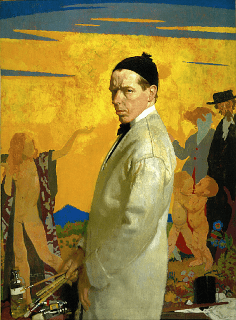
Major Sir William Newenham Montague Orpen, KBE, RA, RHA, Irish artist who mainly works in London and is best known for his vigorously characterized portraits, is born on November 27, 1878, at Oriel, Grove Avenue, Stillorgan, County Dublin. He also works as an official war artist during World War I.

Orpen is the fourth and youngest son of Arthur Herbert Orpen (1830–1926), a solicitor, and his wife, Anne Caulfield (1834–1912), the eldest daughter of the Right Rev. Charles Caulfield (1804–1862), the Bishop of Nassau. Both his parents are amateur painters, and his eldest brother, Richard Caulfield Orpen, becomes a notable architect. His nieces are Bea Orpen and Kathleen Delap. The historian Goddard Henry Orpen is his second cousin. The family lives at “Oriel,” a large house with extensive grounds containing stables and a tennis court. He appears to have a happy childhood there.

Orpen is a naturally talented painter, and six weeks before his thirteenth birthday is enrolled at the Dublin Metropolitan School of Art. During his six years at the college, he wins every major prize there, plus the British Isles gold medal for life drawing, before leaving to study at the Slade School of Fine Art in London between 1897 and 1899. At the Slade he masters oil painting and begins to experiment with different painting techniques and effects.

While at the Slade, Orpen becomes engaged to Emily Scobel, a model and the subject of his painting The Mirror (1900). She ends their relationship in 1901, and he marries Grace Knewstub, the sister-in-law of Sir William Rothenstein. He and Knewstub have three daughters together, but the marriage is not a happy one. By 1908, he has begun a long-running affair with Evelyn Saint-George, a well-connected American millionairess based in London, with whom he also has a child.

Orpen first exhibits at the New English Art Club (NEAC) in 1899, becoming a member in 1900. In 1901, he holds a solo exhibition at the Carfax Gallery in central London. His portraits, which establish his reputation, show the influence of the Realist artist Édouard Manet. He also becomes known as a painter of group portraits such as Homage to Manet (1909), in which he portrays members of the contemporary English art world sitting in conversation beneath a famous portrait by that artist.

At the start of World War I, a number of Irish people living in England return to Ireland to avoid conscription. Among them is Orpen’s studio assistant and former pupil, Seán Keating. Keating encourages him to do likewise, but he refuses and commits himself to supporting the British war effort. In December 1915, he is commissioned into the Royal Army Service Corps and reports for clerical duty at London’s Kensington Barracks in March 1916. Throughout 1916 he continues painting portraits, most notably one of a despondent Winston Churchill, but soon starts using both his own contacts and those of Evelyn Saint-George, to secure a war artist posting.

He is the official painter of the Paris Peace Conference after World War I. Throughout 1919 he paints individual portraits of the delegates to the Conference and these form the basis of his two large paintings, A Peace Conference at the Quai d’Orsay and The Signing of Peace in the Hall of Mirrors. In both pictures, the architecture overwhelms the gathered politicians and statesmen who’s political wranglings and vainglory diminish them in Orpen’s eyes.

Orpen is appointed Knight Commander of the Order of the British Empire in 1918 and is elected an associate of the Royal Academy of Arts in 1919.

Orpen becomes seriously ill in May 1931, and, after suffering periods of memory loss, dies at the age of 52 on September 29, 1931, in South Kensington, London, of liver and heart failure. He is buried at Putney Vale Cemetery in southwest London. A stone tablet in the Island of Ireland Peace Park Memorial at Mesen, Belgium, commemorates him. He is posthumously regarded as a facile and prolific, but somewhat superficial, artist who nevertheless achieves great popularity in his day.

(Pictured: “Self-portrait” (1913), oil on canvas by William Orpen, Saint Louis Art Museum)

Leave a comment

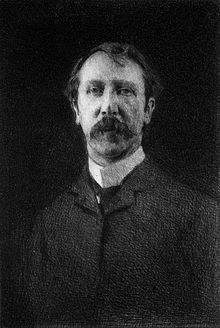
Death of Norman Garstin, Painter, Teacher, Art Critic & Journalist

Norman Garstin, Irish painter, teacher, art critic and journalist associated with the Newlyn School of painters, dies on June 22, 1926, at Penzance, Cornwall, England.

Garstin is born on August 28, 1847, in Caherconlish, County Limerick, to Captain William Garstin and Mary Moore Garstin. He is raised by aunts and grandparents following his father’s suicide and his mother’s incapacitating disabilities.

Garstin attends Victoria College on the island of Jersey and then he works in architecture and engineering for brief periods. He then travels to South Africa where he befriends Cecil Rhodes, works as a journalist and is involved in government in Cape Town.

Pursuing an interest in art, Garstin trains in 1880 in Antwerp at the Royal Academy of Fine Arts. From 1882 to 1884 he studies in Paris at an academy founded by Carolus-Duran. He then travels and paints his way through Spain, Morocco and Venice, Italy.

In 1886, Garstin marries Louisa Jones, also known as Dochie. Many of Garstin’s friends from school in Antwerp had settled in Newlyn. He and Dochie move to Mount Vernon in Newlyn by 1886. They have three children: Crosbie, Denis and Alethea. The boys take up journalism and Alethea becomes an artist. The family moves to Penzance by 1895.

In 1888 Garstin becomes a member of the New English Art Club (NEAC). He becomes a member of the Newlyn Society of Artists (NSA) and is on the Newlyn Art Gallery‘s Provisional Committee for its opening in 1895. Regarding the plein-air approach used by St. Ives and Newlyn artists he says they are “filled with this idea of a fresh unarranged nature to be studied in her fields, and by her streams, and on the margin of her great seas – in these things they were to find the motives of their art.”

Garstin is a teacher and takes groups to “his favorite painting haunts on the Continent.” For instance, Frances Hodgkins, a New Zealand artist, attends Garstin’s 1901 and 1902 summer sketching classes in France. He teaches Harold Harvey, the only Cornish Newlyn School painter, and his daughter, Alethea.

Garstin’s work consists primarily of small oil panels in the plein air style, something he had picked up from the French Impressionists, like Édouard Manet. He is also fascinated by Japanese prints and admires the work of the American painter James Abbott McNeill Whistler. Some of his works are at Tate and Penlee House.

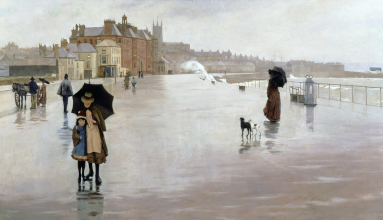
One of Garstin’s best and most famous works is his 1889 painting The Rain, It Raineth Every Day of the Penzance promenade. The title of the work comes from William Shakespeare‘s King Lear and Twelfth Night. “The composition of this painting demonstrates Garstin’s admiration for Japanese art,” says Penlee House.

Garstin dies in Penzance on June 22, 1926.

(Pictured: “The Rain It Raineth Every Day” oil on canvas by Norman Garstin, 1889, Penlee House)


Leave a comment

Death of George Moore, Novelist, Poet & Critic

George Augustus Moore, novelist, short story writer, poet, art critic, memoirist, and dramatist, dies at his home in London on January 21, 1933. He is considered an innovator in fiction in his day.

Moore is born in Moore Hall, near Lough Carra, County Mayo on February 24, 1852. He comes from a distinguished Catholic family of Irish landholders. When he is 21, he leaves Ireland for Paris to become a painter. His Reminiscences of the Impressionist Painters (1906) vividly describes the Café Nouvelle-Athènes and the circle of Impressionist painters who frequent it. He is particularly friendly with Édouard Manet, who sketches three portraits of him. Another account of the years in Paris, in which he introduces the younger generation in England to his version of fin de siècle decadence, is his first autobiography, Confessions of a Young Man (1888).

Deciding that he has no talent for painting, Moore returns to London in 1882 to write. His first novels, A Modern Lover (1883) and A Mummer’s Wife (1885), introduce a new note of French Naturalism into the English scene, and he later adopts the realistic techniques of Gustave Flaubert and Honoré de Balzac. Esther Waters (1894), his best novel, deals with the plight of a servant girl who has a baby out of wedlock. It is a story of hardship and humiliation illumined by the novelist’s compassion. It is an immediate success, and he follows it with works in a similar vein: Evelyn Innes (1898) and Sister Teresa (1901).

In 1901 Moore moves to Dublin, partly because of his loathing for the South African War and partly because of the Irish Literary Revival spearheaded by his friend, the poet William Butler Yeats. In Dublin he contributes notably to the planning of the Abbey Theatre. He also produces The Untilled Field (1903), a volume of fine short stories reminiscent of Ivan Turgenev’s writing that focuses on the drudgery of Irish rural life, and a short poetic novel, The Lake (1905). The real fruits of his life in Ireland, however, come with the trilogy Hail and Farewell (Ave, 1911; Salve, 1912; Vale, 1914). Discursive, affectionate, and satirical by turns, it reads like a sustained monologue that is both a carefully studied piece of self-revelation and an acute, though not always reliable, portrait gallery of his Irish acquaintance, which included Yeats, George William Russell, and Lady Gregory. Above all it is a perfectly modulated display of the comic spirit.

The increasing narrowness of the Irish mind, politics, and clericalism sends Moore back to England in 1911. After Hail and Farewell, he makes another literary departure. Aiming at epic effect he produces The Brook Kerith (1916), an elaborate and stylish retelling of the Gospel story that is surprisingly effective despite some dull patches. He continues his attempts to find a prose style worthy of epic theme in Héloïse and Abélard (1921). His other works include A Story-Teller’s Holiday (1918), a blend of autobiography, anecdote, Irish legend, and satire, Conversations in Ebury Street (1924), autobiography, The Pastoral Loves of Daphnis and Chloe (1924) and Ulick and Soracha (1926), an Irish legendary romance.

George Moore dies at his home at Ebury Street in the London district of Belgravia on January 21, 1933, leaving a fortune of £70,000. He is cremated in London at a service attended by Ramsay MacDonald among others. An urn containing his ashes is interred on Castle Island in Lough Carra in view of the ruins of Moore Hall, which had been burned by anti-treaty forces in 1923, during the final months of the Irish Civil War.


Leave a comment

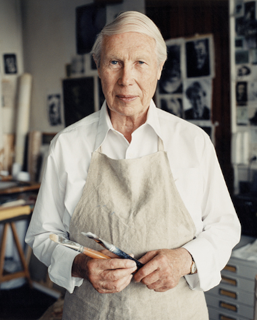
Death of Irish Painter Louis le Brocquy

Louis le Brocquy, Irish painter, dies in Dublin at the age of 95 on April 25, 2012.

Le Brocquy is born in Dublin on November 10, 1916, to Albert and Sybil le Brocquy. He is educated at St. Gerard’s School, studies chemistry at Kevin Street Technical School in 1934, and then Trinity College Dublin before working at his family’s oil refinery. Turning to art at the age of 21, he learns through studying the works of Diego Velázquez, Édouard Manet, and Paul Cézanne, in various museums across Europe. Returning to Ireland at the outbreak of World War II, he focuses his attention on depicting themes from Celtic mythology as well as individuals of Ireland’s Travellers ethnic minority.

Le Brocquy’s work receives many accolades in a career that spans some seventy years of creative practice. In 1956, he represents Ireland at the Venice Biennale, winning the Premio Acquisito Internationale (a once-off award when the event was acquired by the Nestle Corporation) with A Family (National Gallery of Ireland), subsequently included in the historic exhibition Fifty Years of Modern Art at the 1958 Brussels World’s Fair. That same year he marries the Irish painter Anne Madden and leaves London to work in the French Midi.

Le Brocquy is widely acclaimed for his evocative “Portrait Heads” of literary figures and fellow artists, which include William Butler Yeats, James Joyce, and his friends Samuel Beckett, Francis Bacon and Seamus Heaney. In his later years le Brocquy’s early “Tinker” subjects and Grey period “Family” paintings, attract attention on the international marketplace placing le Brocquy within a very select group of British and Irish artists whose works have commanded prices in excess of £1 million during their lifetimes. Others in this group include Lucian Freud, David Hockney, Frank Auerbach, and Francis Bacon.

Today, Le Brocquy’s work is represented in numerous public collections from the San Diego Museum of Art and the Solomon R. Guggenheim Museum in New York City to the Tate Modern in London. In Ireland, he is honoured as the first and only painter to be included during his lifetime in the Permanent Irish Collection of the National Gallery of Ireland.

Le Brocquy designs the covers for the albums The Lark in the Morning and The Rising of the Moon: Irish Songs of Rebellion. A member of Aosdána, he is elected Saoi in 1994, which is the highest honour that members of Aosdána can bestow upon a fellow member. No more than seven living members can be so honoured at one time.

Le Brocquy dies in Dublin on April 25, 2012, and is survived by his daughter Seyre from his first marriage (1938–1948) to Jean Stoney, and his two grandsons John-Paul and David; his second wife Anne Madden, and their two sons, Pierre and Alexis.


Leave a comment

Birth of George Moore, Writer, Poet & Dramatist

george-augustus-moore

George Augustus Moore, novelist, short story writer, poet, art critic, memoirist, and dramatist, is born in Moore Hall, near Lough Carra, County Mayo on February 24, 1852. He is considered an innovator in fiction in his day.

Moore comes from a distinguished Catholic family of Irish landholders. When he is 21, he leaves Ireland for Paris to become a painter. His Reminiscences of the Impressionist Painters (1906) vividly describes the Café Nouvelle-Athènes and the circle of Impressionist painters who frequent it. He is particularly friendly with Édouard Manet, who sketches three portraits of him. Another account of the years in Paris, in which he introduces the younger generation in England to his version of fin de siècle decadence, is his first autobiography, Confessions of a Young Man (1888).

Deciding that he has no talent for painting, Moore returns to London in 1882 to write. His first novels, A Modern Lover (1883) and A Mummer’s Wife (1885), introduce a new note of French Naturalism into the English scene, and he later adopts the realistic techniques of Gustave Flaubert and Honoré de Balzac. Esther Waters (1894), his best novel, deals with the plight of a servant girl who has a baby out of wedlock. It is a story of hardship and humiliation illumined by the novelist’s compassion. It is an immediate success, and he follows it with works in a similar vein: Evelyn Innes (1898) and Sister Teresa (1901).

In 1901 Moore moves to Dublin, partly because of his loathing for the South African War and partly because of the Irish Literary Revival spearheaded by his friend, the poet William Butler Yeats. In Dublin he contributes notably to the planning of the Abbey Theatre. He also produces The Untilled Field (1903), a volume of fine short stories reminiscent of Ivan Turgenev’s writing that focuses on the drudgery of Irish rural life, and a short poetic novel, The Lake (1905). The real fruits of his life in Ireland, however, come with the trilogy Hail and Farewell (Ave, 1911; Salve, 1912; Vale, 1914). Discursive, affectionate, and satirical by turns, it reads like a sustained monologue that is both a carefully studied piece of self-revelation and an acute, though not always reliable, portrait gallery of his Irish acquaintance, which included Yeats, George William Russell, and Lady Gregory. Above all it is a perfectly modulated display of the comic spirit.

The increasing narrowness of the Irish mind, politics, and clericalism sends Moore back to England in 1911. After Hail and Farewell, he makes another literary departure. Aiming at epic effect he produces The Brook Kerith (1916), an elaborate and stylish retelling of the Gospel story that is surprisingly effective despite some dull patches. He continues his attempts to find a prose style worthy of epic theme in Héloïse and Abélard (1921). His other works include A Story-Teller’s Holiday (1918), a blend of autobiography, anecdote, Irish legend, and satire, Conversations in Ebury Street (1924), autobiography, The Pastoral Loves of Daphnis and Chloe (1924) and Ulick and Soracha (1926), an Irish legendary romance.

George Moore dies at his home at Ebury Street in the London district of Belgravia on January 21, 1933, leaving a fortune of £70,000. He is cremated in London at a service attended by Ramsay MacDonald among others. An urn containing his ashes is interred on Castle Island in Lough Carra in view of the ruins of Moore Hall, which had been burned by anti-treaty forces in 1923, during the final months of the Irish Civil War.


Leave a comment

Birth of Sir Hugh Percy Lane, Gallery Director & Collector

hugh-percy-lane

Sir Hugh Percy Lane, art dealer, collector, and gallery director, is born in County Cork on November 9, 1875. He is best known for establishing Dublin‘s Municipal Gallery of Modern Art, the first known public gallery of modern art in the world, and for his contribution to the visual arts in Ireland, including the Lane Bequest.

Lane is brought up in Cornwall, England, and begins his career as an apprentice painting restorer and later becomes a successful art dealer in London.

Through regular visits to the home of his aunt, Lady Gregory, in Coole Park, near Gort in County Galway, Lane remains in contact with Ireland. He soon counts among his family, friends, and social circle those who collectively form the core of the Irish cultural renaissance in the early decades of the 20th century.

Extolling the cause of Irish art abroad, Lane also becomes one of the foremost collectors and dealers of Impressionist paintings in Europe, and amongst those works purchased by him for the new gallery are La Musique aux Tuileries by Édouard Manet, Sur la Plage by Edgar Degas, Les Parapluies by Pierre-Auguste Renoir, and La Cheminée by Jean-Édouard Vuillard.

The Municipal Gallery of Modern Art opens in January 1908 in temporary premises in Harcourt Street, Dublin. Lane hopes that Dublin Corporation will run it, but the corporation is unsure if it will be financially viable. Lane does not live to see his gallery permanently located as he dies on May 7, 1915, during the sinking of the RMS Lusitania off the west coast of Cork. The gallery, extended in 2005, is now in Parnell Square in central Dublin.

For his “services to art” in Ireland, Lane is knighted in June 1909 at the comparatively young age of 33.

Following his death, Lane’s will bequeaths his collection to London, but an unwitnessed later codicil bequeaths it to Dublin. Having possession, London’s National Gallery does not recognise the codicil. At the request of Lane’s aunt, Lady Gregory, W.T. Cosgrave, leader of the Irish Government unsuccessfully approaches Ramsay MacDonald on the matter in 1929. When John A. Costello becomes Taoiseach in 1948, he initiates further negotiations with the government of the United Kingdom, eventually leading to a compromise in 1959, under Taoiseach Seán Lemass, whereby half of the Lane Bequest will be loaned and shown in Dublin every five years. In 1993 the agreement is varied so that 31 of the 39 paintings would stay in Ireland. The remaining 8 are divided into two groups, so that four would be loaned for six years at a time to Dublin. In 2008, The National Gallery in London arranges for the entire collection to be on display in Dublin together for the first time.