seamus dubhghaill

Promoting Irish Culture and History from Little Rock, Arkansas, USA


Leave a comment

Death of Cathal O’Shannon, Journalist & Television Presenter

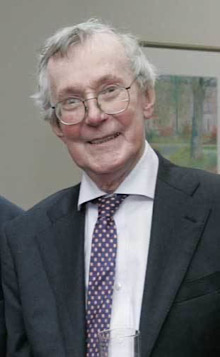
Cathal O’Shannon, Irish journalist and television presenter, dies in Dublin on October 22, 2011. He is a former journalist with The Irish Times and television reporter/presenter and documentary film maker with RTÉ. He is probably best known for presenting documentaries on Irish history, produced mainly for Irish television viewers and broadcast by RTÉ.

O’Shannon is awarded lifetime membership of the Irish Film & Television Academy in 2010, to which he says it is “particularly gratifying that it occurs before I pop my clogs”.

The Irish radio and television broadcaster Terry Wogan describes O’Shannon as possibly the greatest Irish television journalist of the 20th century.

O’Shannon is born in Marino, Dublin, on August 23, 1928, the son of Cathal O’Shannon (Sr.), a socialist and Irish Republican. He receives his formal education at Coláiste Mhuire in Parnell Square, Dublin. In 1945, despite his father’s politics, as a 16-year-old, he volunteers for war time service with the Royal Air Force in Belfast during World War II, utilizing a forged birth certificate to disguise being underage for enlistment with the British Armed Forces. After air crew training he is posted to the Far East, as a tail gunner in an Avro Lancaster bomber to take part in the Burma campaign, but the war ends with the downfall of the Japanese Empire before he is required to fly combat sorties.

O’Shannon first becomes a journalist with The Irish Times on leaving the Royal Air Force in 1947. Later he joins the Irish state broadcasting service Raidió Teilifís Éireann (RTÉ).

In July 1972, O’Shannon records a notable television interview with 31-year-old Muhammad Ali, when Ali is in Dublin to compete at Croke Park in a bout with Alvin Lewis.

O’Shannon receives a Jacob’s Award for his 1976 TV documentary, Even the Olives are Bleeding, which details with the activities of the “Connolly Column” in the Spanish Civil War. Two years later he is honoured with a second Jacob’s Award for his television biography Emmet Dalton Remembers (1978).

In 1978, O’Shannon leaves RTÉ to join Canadian company Alcan which is setting up an aluminum plant at Aughinish, County Limerick, in 1978. He is head-hunted to become its Director of Public Affairs, an important post at a time when there are environmental concerns about the effects of aluminum production. He admits that he is attracted by the salary, “five times what RTÉ were paying me,” but he also later says that one reason for the move is that he had become unhappy with working at RTÉ, stating in an interview that: “The real reason I got out of RTÉ was that they wouldn’t let me do what I wanted to do journalistically.” He had submitted proposals to the station’s editors for television documentary series on the Irish Civil War, and also one on the wartime Emergency period, but they had been rejected. While he enjoys the social life with lavish expenses which his public relations duties involve, his friends believe that he misses the varied life and travel of journalism. He retires early from Aughinish in 1992, and returns to making television documentaries with RTÉ.

In January 2007, O’Shannon’s last documentary, Hidden History: Ireland’s Nazis, is broadcast by RTÉ as a two-part series. It explores how a number of former Nazis and Nazi collaborators from German-occupied Europe went to live in Republic of Ireland after World War II, the best known of whom is Otto Skorzeny, who lives for a period in County Kildare. Others include such Breton nationalists as Alan HeusaffYann Fouéré and Yann Goulet, as well as two BelgiansAlbert Folens and Albert Luykx.

O’Shannon’s wife, Patsy, whom he met while they were working at The Irish Times office in London, dies in 2006. They had been married for more than 50 years.

On January 12, 2007, O’Shannon announces his retirement at the age of 80. In a 2008 television documentary, he admits that throughout his marriage he had been a serial womaniser and had repeatedly engaged in extra-marital affairs unbeknownst to his wife.

After weakening health for two years, and spending his last days in a hospice at Blackrock, O’Shannon dies at the Beacon Hospital in Dublin on October 22, 2011, in his 84th year. His body is reposed at Fanagans Funeral Home in Dublin on October 25, followed by a funeral the following day at Glasnevin Cemetery Chapel, where his remains are cremated afterward.

Director General of RTÉ Noel Curran says O’Shannon had brought into being “some of the great moments in the RTÉ documentary and factual schedule over the past five decades.” In tribute, RTÉ One shows the documentary Cathal O’Shannon: Telling Tales on November 10, 2011. It had originally aired in 2008 to mark his 80th birthday

Leave a comment

The Irish Army Mutiny

The Army Mutiny is an Irish Army crisis that begins on March 7, 1924, provoked by a proposed reduction in army numbers in the immediate post-Civil War period. A second grievance concerns the handling of the Northern Boundary problem. As the prelude to a coup d’état, the decisions made by influential politicians and soldiers at the time have continuing significance for the Government of Ireland.

In the early weeks of the Irish Civil War, the National Army is comprised of 7,000 men. These come mainly from pro-Treaty Irish Republican Army (IRA) brigades, especially the Dublin Guard, whose members have personal ties to Michael Collins. They face around 15,000 anti-Treaty IRA men and Collins recruits experienced soldiers from wherever he can. The army’s size mushrooms to 55,000 men, many of whom are Irishmen with combat experience in World War I – 20,000 National Volunteers had joined the British Army on the urgings of Nationalist leader John Redmond.

Likewise, Irishmen who had served in the British forces account for over half of the 3,500 officers. W. R. E. Murphy, second-in-command (January–May 1923), had been a lieutenant colonel in the British Army, as had Emmet Dalton. Two more of the senior generals, John T. Prout and J. J. “Ginger” O’Connell, had served in the United States Army. Collins promotes fellow members of the Irish Republican Brotherhood (IRB) but is slow to put Squad members in high positions.

In December 1922, following Collins’s death, Liam Tobin forms the Irish Republican Army Organisation (IRAO), taking in Dublin Guard and other Irish Army officers who share his view that “higher command…was not sufficiently patriotic.” President of the Executive Council of the Irish Free State W. T. Cosgrave, head of the government, attempts to appease the IRAO. He meets with them several times before the 1923 Irish general election and persuades the opposing IRB faction of generals under Richard Mulcahy to keep quiet.

With the election over, Mulcahy now ignores the IRAO as he starts the process of demobilising 37,000 men. In November, sixty IRA officers mutiny and are dismissed without pay. The IRAO now pressures the Government into establishing a committee to supervise future demobilisation. The committee, consisting of Eoin MacNeill, Ernest Blythe, and IRAO sympathiser Joseph McGrath, effectively undermines the authority of the Army Council.

On March 7, 1924, a representative of the IRAO hands a demand to end demobilisation to W. T. Cosgrave. The ultimatum is signed by senior Army officers, Major-General Liam Tobin and Colonel Charles Dalton. Tobin knows his own position is to be scrapped in the demobilisation. Frank Thornton and Tom Cullen are also involved. That morning 35 men of the 36th Infantry Battalion refuse to parade, and the preceding week officers had absconded with arms from the McCan Barracks in Templemore, Gormanston Camp in County Meath, Baldonnel Aerodrome in Baldonnel, Dublin, and Roscommon. The immediate response is an order for the arrest of the two men on a charge of mutiny. This causes alarm throughout Dublin when announced.

On March 8, General Mulcahy makes an announcement to the Army:

“Two Army officers have attempted to involve the Army in a challenge to the authority of the Government. This is an outrageous departure from the spirit of the Army. It will not be tolerated…officers and men…will stand over their posts and do their duty today in this new threat of danger in the same wonderful, determined spirit that has always been the spirit of the Army.”

Leader of the Opposition, Thomas Johnson, issues a statement of support for the Government. In contrast, Minister for Industry and Commerce, Joseph McGrath, whose home Mulcahy orders to be searched, resigns because of dissatisfaction with the government’s attitude to the IRAO officers and support for their perception that the Irish Army treats former British officers better than former IRA officers. Fearing an incendiary speech by McGrath, Cosgrave first offers the IRAO an inquiry and an amnesty before then taking sick leave thus making Minister for Justice, Kevin O’Higgins, de facto head of the Government.

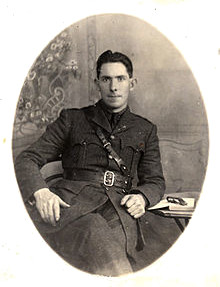
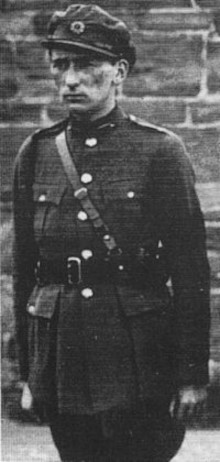
(Pictured: Major General Liam Tobin, a leading figure in the Army Mutiny)


Leave a comment

Death of Paddy Daly, IRA Volunteer & National Army Officer

Paddy Daly, sometimes referred to as Paddy O’Daly, dies at his home in County Dublin on January 16, 1957. He serves in the Irish Republican Army (IRA) during the Irish War of Independence (1919–1921) and subsequently holds the rank of major general in the Irish National Army from 1922 to 1924.

Daly is born in Dublin in 1888. He fights in the 1916 Easter Rising under the command of his namesake Edward Daly, leading the unsuccessful attempt to destroy the Magazine Fort in the Phoenix Park. He is later wounded in the particularly vicious fighting near the Linenhall. He is subsequently interned in Frongoch internment camp for his part in the rebellion until 1918, when he is released as part of a general amnesty for Irish prisoners.

During the Irish War of Independence, Daly serves as leader of the “Squad,” Michael Collins‘ assassination unit.

On December 19, 1919, Daly along with Dan Breen lead an abortive ambush, at Ashtown railway station near the Phoenix Park, on the British Viceroy, Lord Lieutenant of Ireland and Supreme Commander of the British Army in Ireland, Lord French, as he returns from a private party which he had hosted the previous evening at his country residence in Frenchpark, County Roscommon. Lord French escapes the ambush, but Martin Savage is shot dead.

Daly and the men under his command are responsible for the killing of many British intelligence officers, in particular District Inspector Redmond, who had been putting increasing pressure on the Squad. Daly himself personally kills several people, including Frank Brooke, director of Great Southern and Eastern Railway, who serves on an advisory council to the British military, in June 1920. He does not directly lead any of the attacks on Bloody Sunday but is on standby in one of the Squad’s safe houses. In the aftermath, November 23, 1920, he is arrested and interned in Abercorn Barracks in Ballykinler, County Down.

Daly is released on parole from Ballykinler in March 1921, the British apparently being unaware of his senior position within the Dublin Brigade of the IRA. After his release, he, along with Emmet Dalton, is also involved in the attempt to free Seán Mac Eoin from Mountjoy Prison on May 14, 1921. He and his men hijack a British Army Peerless armoured car in Clontarf at the corporation abattoir, while it is escorting a consignment of meat to a barracks and shoot dead two soldiers in the process. The plan involves Dalton and Joe Leonard impersonating two British army officers and using forged documents to “transfer” MacEoin to Dublin Castle. They gain entry to Mountjoy but are discovered before they can free MacEoin and have to shoot their way out. They later abandon the armoured car after removing the Hotchkiss machine guns and setting fire to what they can. Toward the end of the war, in May 1921, the two principal fighting units of the IRA’s Dublin Brigade, the “Squad” and the “Active Service Unit” are amalgamated after losses suffered in the burning of the Custom House. Daly is named Officer Commanding (OC) of this new unit, which is named the Dublin Guard.

Daly’s own account of his activities during the Irish War of Independence is held at the Bureau of Military History in Cathal Brugha Barracks.

After the Anglo-Irish Treaty splits the IRA, Daly and most of his men side with the pro-treaty party, who go on to found the Irish Free State. He is appointed to the rank of brigadier in the newly created Irish National Army, which is inaugurated in January 1922. When the Irish Civil War breaks out in June 1922, he commands the Free State’s troops who secure Dublin, after a week of fighting.

In August 1922, during the Irish Free State offensive that re-takes most of the major towns in Ireland, Daly commands a landing of 450 troops of the Dublin Guard at Fenit, County Kerry, which goes on to capture Tralee from the anti-treaty forces. Acting with severe brutality in Kerry, he comments that, “nobody had asked me to take kid-gloves to Kerry, so I didn’t.” As the Civil War develops into a vicious guerrilla conflict, he and his men are implicated in a series of atrocities against anti-treaty prisoners, culminating in a series of killings with land mines in March 1923. Daly, and others under his command, claim that those killed were accidentally blown up by their own mines. Statements by the Garda Síochána, two Free State lieutenants on duty, W. McCarthy and Niall Harrington, and one survivor, Stephen Fuller, maintain the claims are fabricated.

Daly resigns from the Free State army in 1924 after an incident in Kenmare, County Kerry, concerning the daughters of a doctor. A court martial is held but collapses as no one is prepared to give evidence. He volunteers his services for the Irish Army again in 1940 and is appointed as a Captain to the non-combatant Construction Corps.

Daly is a carpenter by trade. He marries Daisy Gillies in 1910. His brother James (Seamus) marries Daisy’s sister Nora, a Cumann na mBan activist, in a joint wedding ceremony. After Daisy’s death in 1919, Daly marries Bridget Murtagh, also a Cumann na mBan activist, in 1921. Murtagh and Nora O’Daly carry out intelligence gathering for the planned attack on the Magazine Fort in 1916. She is a sister of Elizabeth Murtagh, the first wife of Commandant Michael Love who serves with Daly in the Collins Squad of the IRA, in the Irish Free State Army of the 1920s and during the Emergency period. Murtagh dies in childbirth in 1930. Daly subsequently marries Norah Gillies, his first wife’s niece.

On his death on January 16, 1957, Daly is buried with full military honours in Mount Jerome Cemetery. He is survived by his brothers, Comdt Seamus O’Daly and Capt Frank O’Daly, his sons Patrick and Colbert, and his daughters Brede and Philomena.


Leave a comment

Birth of Cathal O’Shannon, Journalist & Television Presenter

Cathal O’Shannon, Irish journalist and television presenter, is born in Marino, Dublin, on August 23, 1928. He is a reporter with The Irish Times, and television reporter/presenter and documentary film maker with RTÉ. The Irish radio and television broadcaster Terry Wogan describes O’Shannon as possibly the greatest Irish television journalist of the 20th century.

O’Shannon is the son of Cathal O’Shannon (Sr.), a Socialist and Irish Republican. He receives his formal education at Colaiste Mhuire School, in Parnell Square, Dublin. Despite his father’s politics, as a 16-year-old he volunteeres for war time service with the Royal Air Force (RAF) in Belfast in 1945 during World War II. He utilizes a forged birth certificate to disguise being underage for enlistment with the British Armed Forces. After air crew training, he is posted to the Far East, as a tail gunner in an Avro Lancaster bomber to take part in the Burma campaign, but the war ends with the downfall of the Japanese Empire before he is required to fly combat sorties.

O’Shannon first becomes a journalist with The Irish Times on leaving the RAF in 1947. Later he joins the Irish state broadcasting service Raidió Teilifís Éireann (RTÉ).

In July 1972 O’Shannon records a notable television interview with 31-year-old Muhammad Ali, when Ali is in Dublin to compete at Croke Park in a bout with Alvin Lewis.

O’Shannon receives a Jacob’s Award for his 1976 TV documentary, Even the Olives are Bleeding, which details the activities of the “Connolly Column” in the Spanish Civil War. Two years later he is honoured with a second Jacob’s Award for his television biography Emmet Dalton Remembers (1978).

In 1978, O’Shannon leaves RTÉ to join Canadian company Alcan, which is setting up an aluminum plant at Aughinish, County Limerick, in 1978. He is head-hunted to become its Director of Public Affairs, an important post at a time when there are environmental concerns about the effects of aluminium production. He admits that he was attracted by the salary, “five times what RTÉ were paying me,” but he also later says that one of the reasons for the move is that he had become unhappy with working at RTÉ, stating in an interview that “The real reason I got out of RTÉ was that they wouldn’t let me do what I wanted to do journalistically.” He had submitted proposals to the station’s editors for a television documentary series on the Irish Civil War, and also one on the wartime Emergency period, but they had been rejected. While he enjoys the social life with lavish expenses which his public relations duties involve, his friends believe that he missed the varied life and travel of journalism. He retires early from Aughinish in 1992 and returns to making television documentaries with RTÉ.

In January 2007, O’Shannon’s last documentary, Hidden History: Ireland’s Nazis, is broadcast by RTÉ as a two-part series. It explores how a number of former Nazis and Nazi collaborators from German-occupied Europe go to live in the Republic of Ireland after World War II — the best known of whom is Otto Skorzeny, who lives for a period in County Kildare. Others include such Breton nationalists as Alan Heusaff, Yann Fouéré and Yann Goulet, as well as two Belgians, Albert Folens and Albert Luykx.

O’Shannon announces his retirement at the age of 80 on January 12, 2007.

O’Shannon is awarded lifetime membership in the Irish Film & Television Academy in 2010, to which he says is “particularly gratifying that it occurs before I pop my clogs.”

After weakening health for two years, and spending his last days in hospice at Blackrock, O’Shannon dies at the Beacon Hospital in Dublin on October 22, 2011. His body is reposed at Fanagans Funeral Home in Dublin on October 25, 2011, followed by a funeral the following day at Glasnevin Cemetery Chapel, where it is afterwards cremated.

O’Shannon’s wife, Patsy, whom he met while they were working for The Irish Times office in London, dies in 2006. They are married for more than 50 years. In a 2008 television documentary O’Shannon admits that throughout his marriage he had been a serial womaniser, who had repeatedly engaged in extra-marital affairs unbeknownst to his wife.

Director-General of RTÉ Noel Curran says O’Shannon had brought into being “some of the great moments in the RTÉ documentary and factual schedule over the past five decades.” In tribute, RTÉ One shows the documentary Cathal O’Shannon: Telling Tales on November 10, 2011. It had originally aired in 2008 to mark his 80th birthday.


Leave a comment

Birth of Emmet Dalton, Soldier & Film Producer

James Emmet Dalton MC, Irish soldier and film producer, is born in Fall River, Massachusetts, on March 4, 1898. He serves in the British Army in World War I, reaching the rank of captain. However, on his return to Ireland he becomes one of the senior figures in the Dublin Brigade of the Irish Republican Army (IRA) which fights against British rule in Ireland.

Dalton is born to Irish American parents James F. and Katharine L. Dalton. The family moves back to Ireland when he is two years old. He grows up in a middle-class Catholic background in Drumcondra in North Dublin and lives at No. 8 Upper St. Columba’s Road. He is educated by the Christian Brothers at O’Connell School in North Richmond Street. He joins the nationalist militia, the Irish Volunteers, in 1913 and the following year, though only fifteen, is involved in the smuggling of arms into Ireland.

Dalton joins the British Army in 1915 for the duration of the Great War. His decision is not that unusual among Irish Volunteers, as over 20,000 of the National Volunteers join the British New Army on the urgings of Nationalist leader John Redmond. His father, however, disagrees with his son’s decision. He initially joins the 7th battalion of the Royal Dublin Fusiliers (RDF) as a temporary 2nd Lieutenant. By 1916 he is attached to the 9th Battalion, RDF, 16th (Irish) Division under Major-General William Hickie, which contains many Irish nationalist recruits.

During the Battle of the Somme in September 1916, Dalton is involved in bloody fighting during the Battle of Ginchy, in which over 4,000 Irishmen are killed or wounded. He is awarded the Military Cross for his conduct in the battle. Afterwards he is transferred to the 6th Battalion, Leinster Regiment, and sent to Thessaloniki then Palestine, where he commands a company and then supervises a sniper school in el-ʻArīsh. In 1918 he is re-deployed again to France, and in July promoted to captain, serving as an instructor.

On demobilisation in April 1919, Dalton returns to Ireland. There, finding that his younger brother Charlie had joined the IRA, he himself follows suit. He later comments on the apparent contradiction of fighting both with and against the British Army by saying that he had fought for Ireland with the British and fought for Ireland against them.

Dalton becomes close to Michael Collins and rises swiftly to become IRA Director of Intelligence and is involved in The Squad, the Dublin-based assassination unit. On May 14, 1921, he leads an operation with Paddy Daly that he and Collins had devised. It is designed to rescue Gen. Seán Mac Eoin from Mountjoy Prison using a hijacked British armoured car and two of Dalton’s old British Army uniforms.

Dalton follows Collins in accepting the Anglo-Irish Treaty in 1922 and is one of the first officers, a Major General, in the new National Army established by the Irish Provisional Government of the Irish Free State. The Treaty is opposed by much of the IRA and Civil War between pro and anti-treaty factions eventually results.

Dalton is in command of troops assaulting the Four Courts in the Battle of Dublin which marks the start of the war in June 1922. At Collins’ instigation he, as Military liaison officer with the British during the truce, takes control of the two 18 pounder guns from the British that are trained on the buildings. He becomes commander of the Free State Army under Richard Mulcahy‘s direction. He is behind the Irish Free State offensive of July–August 1922 that dislodges the Anti-Treaty fighters from the towns of Munster. He proposes seaborne landings to take the Anti-Treaty positions from the rear and he commands one such naval landing that takes Cork in early August. In spite of firm loyalty to the National Army, he is critical of the Free State’s failure to follow up its victory, allowing the Anti-Treaty IRA to regroup resuming the guerrilla warfare started in 1919.

On August 22, 1922, he accompanies Collins in convoy, touring rural west Cork. The convoy is ambushed near Béal na Bláth and Collins is killed in the firefight. He had advised Collins to drive on, but Collins, who is not an experienced combat veteran, insists on stopping to fight.

Dalton is married shortly afterwards, on October 9, 1922, to Alice Shannon in Cork’s Imperial Hotel. By December 1922 he has resigned his command in the Army. He does not agree with the execution of republican prisoners that mark the latter stages of the Civil War. After briefly working as clerk of the Irish Senate, Seanad Éireann, he leaves the job to work in the movie industry.

Over the following forty years, Dalton works in Ireland and the United States in film production. In 1958 he founds Irish Ardmore Studios in Bray, County Wicklow. His company helps produce films such as The Blue Max, The Spy Who Came In from the Cold and The Lion in Winter, all of which are filmed in Ireland. His daughter is Irish actress Audrey Dalton.

Dalton dies in his daughter Nuala’s house in Dublin on March 4, 1978, his 80th birthday, never having seen the film that Cathal O’Shannon of RTÉ had made on his life. During the making of the film, they visit the battlefields in France, Kilworth Camp in Cork, Béal Na Bláth, and other places that Dalton had not visited since his earlier years. He wishes to be buried as near as possible to his friend Michael Collins in Glasnevin Cemetery in Dublin and is buried there in March 1978 after a military funeral. None of the ruling Fianna Fáil government ministers or TDs attend.

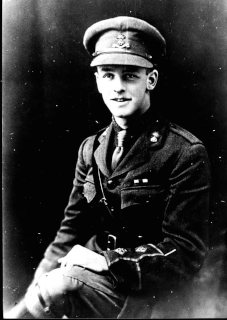
(Pictured: Dalton photographed in lieutenant’s uniform, Royal Dublin Fusiliers, taken circa. 1914-1918)


Leave a comment

Ballinalee Raid in Search of Seán Mac Eoin

The Royal Irish Constabulary (RIC) raid a cottage near Ballinalee, County Longford, on January 7, 1921, looking for Seán Mac Eoin. Mac Eoin opens fire from the cottage, killing District Inspector Thomas McGrath, wounding a constable, and escaping.

Mac Eoin is a soldier and eventual politician of the Fine Gael party. He is commonly referred to as the “Blacksmith of Ballinalee.” He is born John Joseph McKeon on September 30, 1893, at Bunlahy, Granard, County Longford, the eldest son of Andrew McKeon and Catherine Treacy. He joins the United Irish League in 1908. His Irish nationalist activities begin in earnest in 1913, when he joins the Clonbroney Company of the Irish Volunteers. Late that year he is sworn into the Irish Republican Brotherhood and joins the Granard circle of the organization.

Mac Eoin comes to prominence in the Irish War of Independence as leader of an Irish Republican Army (IRA) flying column. On November 4, 1920, his column holds the village of Ballinalee situated on the Longford Road between Longford and Granard. They stand against superior British forces, forcing them to retreat and abandon their ammunition. In a separate attack on November 8, he leads his men against the RIC at Ballinalee. An eighteen-year-old Constable Taylor is killed. Constable E. Shateford and two others are wounded. The story is that the small garrison sings “God Save the King” as they take up positions to return fire.

On the afternoon of January 7, 1921, a joint RIC and British Army patrol consisting of ten policemen led by an Inspector, with a security detachment of nine soldiers, appears on Anne Martin’s street. Mac Eoin’s own testimony at his trial, which is not contested by any parties present, states, “I was at the table writing when I was informed of the advance of the party. My account books were left in this house for safety. I was in partial uniform, wearing Sam Browne belt and revolver with two Mills No. 4 bombs in my pocket. Owing to some females being in the house, I had to get out as I could not endanger them by putting up a defence in the house, and as this Officer and Police Force had already signified to my sister and mother their intention to shoot me on sight, I decided to give them a run for their money. I stepped out on the street, about three paces directly in front of the oncoming force and opened fire with my revolver. The leading file fell, and then the second file in the gateway brought their rifles to the ready. I then threw a bomb and jumped back behind the porch to let it burst. When it had burst and the smoke had lifted, I saw that the whole force had cleared away, save the officer who was dead or dying on the street.” The casualties from this incident are District Inspector Thomas McGrath killed, and a police constable wounded.

Mac Eoin is captured at Mullingar railway station in March 1921, imprisoned and sentenced to death for the murder of RIC District Inspector McGrath in the shooting at Anne Martin’s street in January 1921. Michael Collins organises a rescue attempt in June 1921. Six IRA Volunteers, led by Paddy Daly and Emmet Dalton, capture a British armoured car and, wearing British Army uniforms, gain access to Mountjoy Prison. However, Mac Eoin is not in the part of the jail they believed and, after some shooting, the party retreats.

Within days, Mac Eoin is elected to Dáil Éireann at the 1921 Irish elections, as a TD for Longford–Westmeath. He is eventually released from prison, along with all other members of the Dáil, after Collins threatens to break off treaty negotiations with the British government unless he is freed. It is rumoured that Sean Mac Eoin serves as the best man at Collins’ wedding.


Leave a comment

Four Courts Bombardment, Civil War Begins

four-courts-bombing

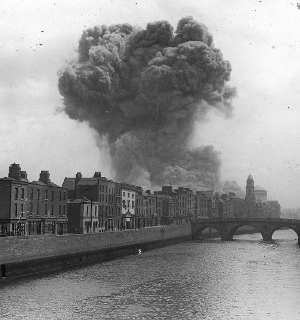
On June 28, 1922, the Provisional Government of the Irish Free State bombards the Four Courts in Dublin, which anti-Treaty forces had taken by force, and the Irish Civil War begins.

On April 14, 1922, a column of 200 men led by Rory O’Connor occupies the Four Courts, hoping to provoke an armed confrontation with British forces which are in the process of evacuating from Ireland following the signing of the Anglo-Irish Treaty the previous winter which had split the Irish Republican Army (IRA) into two opposing factions. The occupation is a direct challenge to the legitimacy of the Provisional government who seeks a smooth transition to a viable independent Irish state in the 26 counties of southern Ireland.

On June 22 Field Marshal Sir Henry Wilson is gunned down by two IRA assassins and on June 26, the Free State Army Deputy Chief of Staff General J.J. O’Connell is kidnapped by the Four Courts IRA garrison. Michael Collins has also shipped guns issued by the British to arm the new Irish Army to Northern IRA units to defend themselves from Ulster loyalists.

Collins, no longer able to resist British pressure, receives two 18-pounder artillery guns and a stock of 200 artillery shells from the store at Kilmainham. The guns are set up at Parliament Street and Winetavern Street and Bridgefoot Street and Usher’s Quay across the River Liffey from the facade of the heavily fortified Four Courts where the Anti-Treaty IRA has barricaded themselves. Free State troops establish a cordon around the building, closing streets with riflemen and machine gunners occupying windows and rooftops. Among the IRA leaders inside are Chief-of-Staff Joe McKelvey, Director of Engineering Rory O’Connor, Quarter Master General Liam Mellows, commander of the IRA’s 2nd Southern Division Ernie O’Malley, Commandant Paddy O’Brien, Commandant Tom Barry and many others. The IRA mostly drawn from 1st and 2nd Battalions of the 1st Dublin Brigade are armed with rifles, five Thompson submachine guns and two Lewis machine guns as well as an armoured car nicknamed “The Mutineer.”

The bombardment begins on June 28 as artillery guns supervised by Emmet Dalton begin blasting the Four Courts at point blank range every fifteen minutes from across the River Liffey. The complex of buildings also comes under a hail of rifle and machine gun fire. However, the strong stone walls of the 18th century Four Courts hold out. A number of the shells overshoot their target and land near General McCready’s British Army headquarters. IRA leader Ernie O’Malley later claims to have witnessed a gun crew fighting a duel with a sniper in the dome of the courts. The failures of the first day lead the impatient British to offer two more 18-pounders as well as heavy howitzers and aircraft in order to destroy the Four Courts once and for all.

On the 29th, Free State troops storm the eastern wing of the Four Courts, suffering three fatalities, 14 wounded and taking 33 prisoners. The republicans’ armored car, “The Mutineer,” is disabled and abandoned by its crew. Early the following day Paddy O’Brien is injured by shrapnel and Ernie O’Malley takes over military command in the Four Courts. By this time the shelling has caused the Four Courts to catch fire. In addition, orders arrive from Oscar Traynor, the anti-treaty IRA commander in Dublin, for the Four Courts garrison to surrender, as he is unable to reach their position to help them. At 3:30 PM on June 30, O’Malley surrenders the Four Courts to Brig. Gen. Paddy Daly of the Free State’s Dublin Guard unit.