seamus dubhghaill

Promoting Irish Culture and History from Little Rock, Arkansas, USA


Leave a comment

Formation of An Taisce – The National Trust for Ireland

An Taisce – The National Trust for Ireland – a non-governmental organisation (NGO) active in the areas of the environment and built heritage in the Republic of Ireland, is established on June 28, 1948. It considers itself the oldest environmental and non-governmental organisation in the Republic of Ireland. Naturalist Robert Lloyd Praeger is its first president.

An Taisce is a membership organisation and charity, not a state or semi-state organisation. However, it receives government funding for specific programmes, such as Blue Flag beaches, Green Schools and the annual National Spring Clean, and it has a statutory role in certain planning and environmental processes in the country.

An Taisce’s range of expertise extends across the Republic of Ireland’s natural, built, and social heritage. It seeks to educate, inform, and lead public opinion on the environment, to advocate and influence policy, and to manage a small portfolio of heritage properties. It does not operate in Northern Ireland.

The Planning Acts provide for An Taisce, and about twenty other prescribed bodies, to be informed of all planning applications in areas of scenic beauty or high amenity significance or where architectural, archaeological or environmental issues need to be considered. Local authorities are required, in certain defined circumstances under the Planning & Development Regulations, to consult An Taisce on development proposals.

The organisation is split into three operational divisions:

  • The Environmental Education Unit operates nationwide programmes on behalf of the Irish government’s Department of the Environment, Community and Local Government, the National Transport Authority and the European Union, such as the Blue Flag water quality accreditation programme and Green Schools Programme that aims to promote higher environmental standards in schools.
  • The Environmental Advocacy Unit monitors roughly 5% of all planning (local authority development approval) applications made annually, making submissions on a small number of those received, and appealing about 300 decisions a year to An Bord Pleanála, the statutory planning appeals board. The Advocacy Unit also monitors environmental standards and co-ordinates policy formation from the elected advocacy committees amongst the membership.
  • The Properties Unit takes ownership of and looks after properties that have either historical significance or are environmentally sensitive. The trust properties are taken care of by both professional staff and volunteers who are involved with the day-to-day management of income generating properties such as Tailors’ Hall, which it also makes available for private hire, and the restoration of important resources such as the Boyne Navigation.

The organisation comprises over 5,000 members, with a range of membership fees. Some members are also organised in local organisations. Overall steering of the organisation is in the hands of a council, which in turn elects a board of management, and other internal policy and operational committees.


Leave a comment

Leo Varadkar Elected Taoiseach

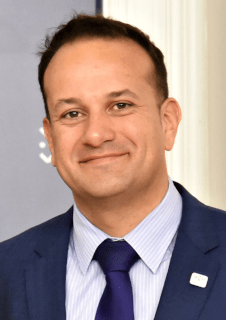
On June 2, 2017, Leo Varadkar, son of Indian immigrants, wins the leadership contest against his only rival, Minister for Housing, Local Government and Heritage Simon Coveney, with 60% of the votes to lead Fine Gael, the biggest party in the coalition government. He is set to become the first openly gay Taoiseach (prime minister) of the Republic of Ireland and the youngest leader in the European Union. His election is seen as a change in political generations and social outlook in Ireland.

The current Taoiseach, 66-year-old Enda Kenny, announced his resignation the previous month after six years at the head of the centrist party, setting off a battle to lead the ruling Fine Gael.

“If somebody of my age, of my mixed-race background and of all the things that make up my character can potentially become leader of our country, then I think that sends out a message to every child born today that there is no office in Ireland that they can’t aspire to,” Varadkar tells Newstalk radio.

The Fine Gael parliamentary party votes overwhelmingly (70 percent) in favor of Varadkar while 65 percent of members favor Coveney. As Varadkar is backed by most lawmakers and local representatives, he gains victory under the center-right party’s electoral college system.

Varadkar’s position is confirmed later in the month after parliament resumes following a break.

Varadkar’s father, Ashok, a doctor, moves to Ireland in the 1970s and his youngest son is born in Dublin in 1979. He studies medicine at Trinity College Dublin and spends several years as a junior doctor before qualifying as a general practitioner in 2010.

Varadkar is first elected in local elections in 2003 and in 2007 to the lower house of Ireland’s assembly, the Dáil Éireann. He comes to public prominence in 2015 when Ireland votes in favor of same-sex marriage.

Varadkar is on the right wing of the centrist Fine Gael party and has held three cabinet posts since 2011 – Minister for Social Protection, Minister for Health and Minister for Transport, Tourism and Sport. More recently, in the time leading up to his election as Taoiseach, he heads a publicity campaign highlighting social welfare fraud.

Varadkar’s most pressing first international task is negotiating Ireland’s new arrangement with the United Kingdom after it leaves the European Union.

In a radio interview in 2015, Varadkar speaks for the first time about being gay, “It’s not something that defines me. I’m not a half-Indian politician, or a doctor politician or a gay politician for that matter. It’s just part of who I am. It doesn’t define me. It is part of my character I suppose.”

Varadkar’s partner is also a doctor in Dublin.

(From: “Ireland’s ruling party elects Varadkar new leader” by Jane Mcintosh, Deutsche Welle (DW), http://www.dw.com, June 2, 2017)


Leave a comment

Mary Lou McDonald Ratified as Leader of Sinn Féin

Mary Lou McDonald is ratified as the new president of Sinn Féin at a special party Ardfheis on February 10, 2018. Approximately 2,000 party delegates gather for the meeting in Dublin. After almost 35 years, Gerry Adams officially steps down as party leader, a role he has held since November 1983.

McDonald takes the helm with a sweeping speech that touches on everything from abortion to Brexit and promises a united Ireland “in our time.”

McDonald, 48, is the first woman to lead the party, and the first Sinn Féin leader with no direct connection to Ireland’s period of violence known as the Troubles. “We must only agree that the past is never again repeated,” she says. “On other things, we can agree to disagree. The poet Maya Angelou put it well: ‘History, despite its wrenching pain, cannot be unlived. But if faced with courage, need not be lived again.’”

McDonald takes over for Adams, a divisive politician who was the face of the Irish republican movement as it shifted from violence to peace. The end of Adams’ tenure marks a new era for the party, which wants to unite the United Kingdom’s Northern Ireland with the Republic of Ireland to the south.

Adams, who announced in November 2017 he was stepping down after almost 35 years, was the key figure in the peace process that saw the signing of the 1998 Good Friday Agreement and the formation of a power sharing government between Northern Ireland’s pro-British and republican factions. But many believe Sinn Féin’s popularity among voters has been hindered by the presence of leaders linked to the Troubles, which killed over 3,600 people.

McDonald immediately puts her own stamp on the future, trying to infuse new energy into the movement that has lawmakers on both sides of the Irish border. But she also focuses on Sinn Féin’s founding principle: a united Ireland. “We are the generation of republicans who will see the rising of the moon,” she says. “Sinn Féin in government, both North and South. Irish unity in our time.”

McDonald also lays out her positions on the key issues of the day.

On the United Kingdom’s upcoming departure from the European Union, or Brexit, she says Sinn Féin will not accept any deal that reinstates border controls between Northern Ireland and the Republic. Brexit represents a threat to the prosperity of Ireland as a whole.

“Ireland will not be the collateral damage in the political games and antics of Tories in London,” she says, referring to the Conservative Party of British Prime Minister Theresa May.

McDonald also says the party will campaign for women’s right to an abortion in Ireland’s upcoming referendum on the issue and says she is committed to reaching an agreement that will restore Northern Ireland’s power sharing government on the basis of “respect and integrity for all.”

Northern Ireland’s last government collapsed more than a year earlier amid a corruption scandal.

(From: “Mary Lou McDonald takes over as Sinn Féin party leader” by Danica Kirka, AP News, apnews.com, February 10, 2018)


Leave a comment

Birth of Seán Lemass, Fianna Fáil Leader & Taoiseach

Seán Francis Lemass, born John Francis Lemass, Irish patriot and Fianna Fáil politician who serves as Taoiseach and Leader of Fianna Fáil from 1959 to 1966, is born at Norwood Lodge, Ballybrack, Dublin on July 15, 1899. He also serves as Tánaiste (1945-48, 1951-54 and 1957-59), Minister for Industry and Commerce (1932-39, 1945-49, 1951-54 and 1957-59), Minister for Supplies (1939-45) and Teachta Dála (TD) (1924-69).

Lemass is the second of nine children born to John T. Lemass and his wife Frances (née Phelan) Lemass. He is educated at O’Connell School, where he is described as studious (his two best subjects being history and mathematics).

Lemass is persuaded to join the Irish Volunteers. He becomes a member of the A Company of the 3rd Battalion of the Dublin Brigade. The battalion adjutant is Éamon de Valera, future Taoiseach and President of Ireland. While out on a journey in the Dublin mountains during Easter 1916, he is informed of the Easter Rising that is taking place in Dublin. On April 25, Seán and his brother Noel are allowed to join the Volunteer garrison at the General Post Office (GPO). He is equipped with a shotgun and was positioned on the roof. He also is involved in fighting on Moore Street. However, the Rising ends in failure and all involved are imprisoned. He is held for a month in Richmond Barracks but, due to his age, he is released. Following this, his father wants his son to continue with his studies and be called to the Irish Bar.

Lemass opposes the establishment of the Irish Free State as a dominion under the Anglo-Irish Treaty of 1921 and becomes a member of the headquarters staff of the Irish Republican Army in the Irish Civil War (1922–23). He plays a key role in persuading de Valera to found a new republican party, Fianna Fáil, in 1926. After de Valera rises to the premiership in 1932, Lemass holds portfolios in all his cabinets for 21 of the next 27 years, notably as Minister of Industry and Commerce and then as Tánaiste.

When de Valera becomes President of Ireland in 1959, Lemass is appointed Taoiseach on June 23, 1959, on the nomination for Dáil Éireann. Under him the country takes a more outward-looking approach, and he especially presses for Ireland’s entry into the European Economic Community (EEC), now the European Communities, embedded in the European Union, and for reconciliation with Northern Ireland. His greatest legacy, Ireland’s membership in the EEC, is not secured until 1973, after his death.

In 1966, Ireland celebrates the 50th anniversary of the 1916 Easter Rising. Éamon de Valera comes within 1% of defeat in that year’s Irish presidential election, less than two months after the celebrations in which he played such a central part. On November 10, 1966, Lemass announces to the Dáil his decision to retire as Fianna Fáil leader and Taoiseach with his usual penchant for efficiency, “I have resigned.” He retires to the backbenches and remains a TD until 1969. On the day of his retirement, Jack Lynch becomes the new leader of Fianna Fáil and Taoiseach.

During the last few years of his leadership, Lemass’s health begins to deteriorate. He had been a heavy pipe smoker all his life, smoking almost a pound of tobacco a week in later life. At the time of his retirement, it is suspected that he has cancer, but this assumption is later disproved. In February 1971, while attending a rugby game at Lansdowne Road, he becomes unwell. He is rushed to hospital and is told by his doctor that one of his lungs is about to collapse.

On Tuesday, May 11, 1971, Lemass dies at the age of 71 in the Mater Hospital in Dublin. He is afforded a state funeral and is buried in Deans Grange Cemetery.


Leave a comment

Birth of Composer Siobhán Cleary

Siobhán Cleary, composer, is born in Dublin on May 10, 1970. Her most successful compositions are her orchestral works Alchemy and Cokaygne and her choral piece Theophilus Thistle and the Myth of Miss Muffett. Her opera Vampirella is first performed in Dublin in March 2017. She is a member of Aosdána.

Cleary starts to compose from an early age, often writing pieces while she is supposed to be practising at the piano. When she begins to study music at Maynooth University, she is initially inspired by Luciano Berio‘s Sinfonia, and soon afterwards by the works of the Irish composer Gerald Barry, the Frenchman Olivier Messiaen and the Hungarian György Ligeti. She continues her studies at Queen’s University Belfast and Trinity College, Dublin. In addition, she follows courses in composition with the Italian composer Franco Donatoni and the Dutchman Louis Andriessen and receives private tuition from the American Tom Johnson and the South African Kevin Volans. She also studies film scoring with the Italian composer Ennio Morricone and the American Don Brandon Ray.

Inspired by the alchemists’ Opus Alchymicum which describes how cheaper metals are transmuted into gold, Cleary’s orchestral work Alchemy (2001) is, like the stages in the Opus, presented in four parts: it evolves from the slow nigrendo, the moderate albedo, the strong citronatus, and the burning rubedo. The work is performed by the RTÉ National Symphony Orchestra in January 2002.

Cleary’s tone poem Cokaygne (2009), which, like Alchemy, is commissioned by RTÉ for the National Symphony Orchestra, is based on a poem and old sources which evoke a land of extreme luxury and contentment. The elaborately orchestrated piece is performed by the RTÉ National Symphony Orchestra in November 2009, Vladimir Altschuler conducting. It is performed by the RTÉ National Symphony Orchestra once again in June 2016, this time under the baton of Alan Buribayev.

Cleary’s choral work Theophilus Thistle and the Myth of Miss Muffett (2010), commissioned by the Cork International Choral Festival, is first performed in April 2011 by Chamber Choir Ireland directed by Paul Hillier. The work is based on a series of tongue twisters and other strange combinations of words popular in various European languages and dialects, moving from Italy, through Germany and Spain, finishing in Ireland. In 2013, it is performed twice by Chamber Choir Ireland in Dublin and Cork in connection with Ireland’s presidency of the European Union. The journalist and music critic Terry Blain comments on the choir’s “dazzingly virtuosic performance” in Belfast in 2013, qualifying the piece as “a tour de force of 21st century vocal chicanery, a clever and richly entertaining composition.” Theophilus Thistle is also performed the same year in the United States as part of the “Imagine Ireland” festival.

The chamber opera Vampirella with a libretto by Katy Hayes is first performed by students from the Royal Irish Academy of Music and the Lir National Academy of Dramatic Art at Dublin’s Smock Alley Theatre in March 2017. Based on a short story by Angela Carter telling how a young English soldier is seduced by a vampire countess, it is directed by Conor Hanratty and conducted by Andrew Synnott. Michael Dervan of The Irish Times finds the electronic sounds in the score particularly effective, commenting, “Perhaps this is a case of a genuinely electronic opera trying to break out of a more conventional mold.”

In 1996, Cleary receives a young artists award from Pépinières européennes pour jeunes artistes, followed in 1997 by the first prize in the Arklow Music Festival Composers’ Competition. In 2008, she is invited to become a member of Aosdána, an Irish association of creative artists.


Leave a comment

Birth of Brian Cowen, Former Taoiseach & Leader of Fianna Fáil

Brian Cowen, Irish former politician who is Taoiseach and Leader of Fianna Fáil from 2008 to 2011, is born in Tullamore, County Offaly, on January 10, 1960.

Cowen is exposed to politics at a young age. His grandfather was a councillor in the Fianna Fáil party, and his father, Bernard Cowen, held a seat in Dáil Éireann, the lower house of the Oireachtas (Irish parliament). He is an exemplary debater in school and often speaks at his father’s election rallies. He studies at University College Dublin and at the Incorporated Law Society of Ireland, where he is trained as a solicitor. His father’s death in 1984 prompts a by-election for the seat he had held in the Dáil. At the age of 24, he captures the seat, becoming one of the youngest members ever to sit in the Dáil.

Cowen’s political mentor is Albert Reynolds, who becomes Taoiseach in 1992 when Fianna Fáil is in a coalition government with the Progressive Democrats. He is an outspoken critic of the coalition, famously stating about the Progressive Democrats, “When in doubt, leave them out!” He serves as Minister for Labour (1992–93), and in 1993, after the breakup of the Fianna Fáil–Progressive Democrats government, he helps to negotiate the short-lived coalition of Fianna Fáil and the Labour Party. He then serves as Minister for Transport, Energy, and Communications (1993–94), leaving office after Fianna Fáil is forced into opposition by the formation of a Fine Gael–Labour–Democratic Left coalition.

During Fianna Fáil’s years out of government, Cowen serves successively as opposition Spokesperson for Agriculture, Food, and Forestry (1994–97) and Spokesperson for Health (1997). Following elections in 1997, Fianna Fáil leader Bertie Ahern forms a coalition government with the Progressive Democrats, and the party once again returns to power. Cowen serves as Minister for Health and Children (1997–2000), Minister for Foreign Affairs (2000–04), and Minister for Finance (2004–08). In June 2007 he was appointed Tánaiste.

Cowen is known for his sharp tongue and sometimes rough-hewn manner, but he is also recognized for his fierce intelligence, wit, and jovial demeanour. A combative politician and loyal party member, he is for many years seen as an obvious successor to Ahern. In April 2008, amid an investigation into possible past financial misconduct, Ahern announces that he will resign as Taoiseach and Leader of Fianna Fáil the following month. Cowen, who had remained supportive of Ahern throughout, is elected Leader of Fianna Fáil in April 2008. He becomes Taoiseach the following month and is faced with leading the country amid the global financial crisis that creates Ireland’s worst economy since the 1930s.

Cowen’s government oversees the bailout of Ireland’s banking system, which had been thrown into crisis by the collapse of the housing market, but the rescue comes at the cost of a skyrocketing deficit. As the country’s economic difficulties deepen, he seeks a cure that he hopes would obviate the need of foreign intervention, proposing an increase in income taxes and cuts in services. In November 2010, however, as concern for Ireland’s financial stability grows among its eurozone partners, he agrees to accept a bailout of more than $100 million from the European Union and the International Monetary Fund. There is concern in Ireland that one condition for foreign aid might be an increase in Ireland’s comparatively low corporate taxes. The Green Party, Fianna Fáil’s junior partner in the governing coalition, responds to the situation by calling for early elections.

In mid-January 2011 Cowen’s leadership of Fianna Fáil is challenged by Minister for Foreign Affairs Micheál Martin, partly in response to rumours that had swirled of a golf course meeting that had taken place between the Taoiseach and the former head of the Anglo Irish Bank before the government’s bailout of the Irish banking industry. He survives a leadership vote, but about one-third of the party’s parliamentary bloc votes against him. In a rapid succession of events that occur over the course of a few days, an unsuccessful reshuffle of the cabinet follows the resignation of six cabinet ministers, after which Cowen calls for an election to be held on March 11 and then announces that he will step down as party leader but continue as caretaker Taoiseach until the election. The Green Party then withdraws from the ruling coalition, forcing an even earlier election. Waiting until the parliament passes a finance bill that is necessary to meet the conditions of an International Monetary Fund–European Union loan but which imposes austerity measures that had proved very unpopular with much of the Irish public, he officially calls the election for February 25. Martin takes over as the Leader of Fianna Fáil, which suffers a crushing defeat in the election at the hands of Fine Gael.

In May 2014, Cowen becomes part of the board of Topaz Energy. He is appointed to the board of Beacon Hospital in February 2015. In July 2017, he is conferred with an honorary doctorate from the National University of Ireland. During his 50-minute acceptance speech he criticises the EU for its behaviour towards Ireland during the financial crisis and expresses regret that so many jobs were lost during the recession. Following the conferring ceremony, the NUI faces considerable public criticism for deciding to make the award to Cowen. Former (and founding) President of the University of Limerick, Edward M. Walsh, announces that he will hand back his own honorary doctorate in protest, and does so on November 14, 2018.

On July 5, 2019, Cowen is admitted to Beacon Hospital after suffering a major brain hemorrhage. He is then transferred to St. Vincent’s University Hospital where he spends five months before transferring to a physical rehabilitation facility. As of late 2020, while he is still in hospital following a stroke the previous year, he has been making steady progress.


Leave a comment

Birth of Charlie McCreevy, Fianna Fáil Politician

Charles McCreevy, former Fianna Fáil politician, is born in Sallins, County Kildare, on September 30, 1949. He serves as European Commissioner for Internal Market from 2004 to 2010, Minister for Finance from 1997 to 2004, Minister for Tourism, Transport and Communication from 1993 to 1994 and Minister for Social Welfare from 1992 to 1993. He also serves as a Teachta Dála (TD) for the Kildare constituency (and later the Kildare North constituency) from 1977 to 2004.

McCreevy is educated locally at Naas by the Congregation of Christian Brothers, and later at the fee paying Franciscan Gormanston College. He studies Commerce at University College Dublin and goes on to become a chartered accountant. His family background is modest, his father and ancestors since the late 18th century are lockkeepers on the Grand Canal, a job carried on by his mother after the death of his father, when McCreevy is four years old.

McCreevy’s political career begins with when he wins a seat in the Kildare constituency at the 1977 Irish general election, which is a landslide for Charles Haughey‘s supporters in Fianna Fáil and he is re-elected at every subsequent election until he joins the European Commission. Between 1979 and 1985, he serves as an elected member of the Kildare County Council.

In the 1979 Fianna Fáil leadership election, McCreevy strongly supports the controversial Charles Haughey, who narrowly wins the post. However, in a time of severe budgetary difficulties for Ireland, he soon becomes disillusioned with the new Taoiseach and his fiscal policies. In October 1982, he launches a motion of no-confidence in the party leader, which evolves into a leadership challenge by Desmond O’Malley. In an open ballot and supported by only 21 of his 79 colleagues, the motion fails and McCreevy is temporarily expelled from the parliamentary party.

In later years O’Malley is expelled from Fianna Fáil itself and forms the Progressive Democrats (PDs), espousing conservative fiscal policies. Although considered ideologically close to the PDs, and a personal friend of its erstwhile leader, Mary Harney, McCreevy chooses to remain a member of Fianna Fáil, where he eventually serves in joint FF-PD Governments.

For his first 15 years as TD, while Haughey remains leader, McCreevy remains a backbencher. In 1992, Albert Reynolds becomes Taoiseach and McCreevy is appointed Minister for Social Welfare. In this role, he is principally remembered for a set of 12 cost-cutting measures, collectively termed the “dirty dozen”, which are arguably minor in their direct impact but provide a major political headache for his party in the 1992 Irish general election.

In 1993, McCreevy becomes Minister for Tourism, Transport and Communication, which he holds until the government falls in December 1994. In opposition under new Fianna Fáil leader Bertie Ahern, he is appointed Opposition Spokesperson for Finance. In this role he is viewed as actively pro-enterprise, anti-spending and a key advocate for tax cuts.

In 1997, Fianna Fáil returns to power and McCreevy becomes Minister for Finance. His period coincides with the era of the “Celtic Tiger,” which sees the rapid growth of the Irish economy due to social partnership between employers, government and unions, increased female participation in the labour force, decades of tuition-free secondary education, targeting of foreign direct investment, a low corporation tax rate, an English-speaking workforce only five time-zones from New York City, and membership of the European Union – which provides payments for infrastructural development, export access to the European Single Market and a Eurozone country. He is a consistent advocate of cutting taxes and spending.

In 2004, McCreevy is selected by the Government of Ireland to replace David Byrne as Ireland’s European Commissioner. He is appointed to the Internal Market and Services portfolio, by President of the European Commission José Manuel Barroso. At his confirmation hearings in the European Parliament MEPs describe him as “fluent and relaxed.” He also informs them that he has campaigned for the ratification of every European Treaty since 1972.

In October 2007, McCreevy, commenting on the Northern Rock bank’s loss of investor confidence, claims that banking regulations in the UK, which forces banks to be open to scrutiny from outside investors, caused the panic. He says if access to the bank’s dealings had been restricted, then the trouble could have been avoided.

Irish constitutional law requires a referendum to alter the constitution for such a major change as the adoption of the Treaty of Lisbon. Interviewed beforehand, McCreevy says that he has not read the Treaty in full himself, though he understands and endorses it. The referendum is held on June 12, 2008, and the Irish electorate does not approve the Treaty. He is heavily criticised in the European Parliament and by the leader of the Socialist group in the European Parliament, Martin Schulz, who demands on June 17, 2008, that McCreevy be removed as a European Commissioner. Schulz slightly misquotes McCreevy, whom he stated had contributed to Ireland’s rejection of the Treaty of Lisbon with remarks during the referendum campaign that no “sane person” would read the document.

Following McCreevy’s departure from the commission, he is forced to resign from the board of a new banking firm, NBNK Investments, after an EU ethics committee finds a conflict of interest with his work as a European Commissioner in charge of financial regulation.


Leave a comment

Paisley & Adams Commit to Forming Powersharing Executive

On March 26, 2007, Democratic Unionist Party (DUP) leader Ian Paisley and Sinn Féin leader Gerry Adams commit themselves to forming a powersharing executive by May 8, 2007, after engaging directly for the first time at Parliament Buildings, Stormont. Taoiseach Bertie Ahern and British prime minister Tony Blair hail this first meeting and agreement as a historic, reconciliatory, and transforming moment in British-Irish history.

The government had set this date as a final deadline for a restoration of power-sharing before direct rule from London is restored permanently and now has to rush emergency legislation through the House of Commons to prevent this.

“After a long and difficult time in our province, I believe that enormous opportunities lie ahead for our province,” Paisley tells reporters, as he sits at a conference table next to Adams. The agreement “marks the beginning of a new era of politics on this island,” Adams agrees, but adds that he finds it “disappointing” that Northern Ireland‘s political institution cannot be restored immediately.

British prime minister Tony Blair hails the agreement, saying “This is a very important day for the people of Northern Ireland but also for the people and the history of these islands.” After talking by phone with his Irish counterpart, Taoiseach Bertie Ahern, he tells reporters, “In a sense, everything we have done over the last ten years has been a preparation for this moment, because the people of Northern Ireland have spoken through the election. They have said we want peace and power-sharing, and the political leadership has then come in behind that and said we will deliver what people want.”

In Ireland, Ahern calls the day’s developments “unprecedented and very positive,” and says both governments will cooperate with the new May 8 date for devolution.

The Secretary of State for Northern Ireland, Peter Hain, says a one clause emergency bill will be put through parliament with the agreement of opposition parties, and will need royal assent before midnight the following evening to prevent the dissolution of the Stormont assembly. He describes the day’s events as “really, really momentous.”

“Today the clouds have lifted, and the people can see the future,” Hain tells BBC Radio 4‘s The World at One. “These pictures of Ian Paisley and Gerry Adams will resonate around the world. They are a graphic manifestation of the power of politics over bigotry and conflict, bitterness and horror.”

The crucial meeting sees delegations from the DUP and Sinn Féin spend an hour together inside a room at Stormont to hammer out the final agreement for a return to power-sharing. Afterwards, both leaders talk about the work still needing to be done, including regular meetings between Paisley and Sinn Féin’s Martin McGuinness as the de facto first and deputy first ministers.

Clearly conscious of the historical significance of their talks, Paisley and Adams speak of the suffering caused by the decades of inter-community violence and their responsibility to ensure permanent peace and reconciliation. Northern Ireland’s politicians must “never forget those who have suffered during the dark period from which we are, please God, emerging,” Paisley says. “I want to make it clear that I am committed to delivering not only for those who voted for the DUP but for all the people of Northern Ireland. We must not allow our justified loathing for the horrors and tragedies of the past to become a barrier to creating a better and more stable future for our children,” he adds.

Adams says there is now new hope for the future, following the previous “sad history of orange and green.” He adds, “There are still many challenges, many difficulties, to be faced. But let us be clear: the basis of the agreement between Sinn Féin and the DUP follows Ian Paisley’s unequivocal and welcome commitment to support and participate fully in the political institutions on May 8. We’ve all come a very long way in the process of peace making and national reconciliation. We are very conscious of the many people who have suffered. We owe it to them to build the best future possible.”

The proposal for the historic meeting comes after a frantic weekend of consultation in Belfast and Berlin, where Blair and Ahern are attending a ceremony to mark 50 years of the European Union. Both prime ministers had repeatedly insisted the assembly would be dissolved if no agreement on an executive had been reached by today’s legal deadline. Britain is forced into a last-minute change of strategy after Paisley’s DUP agrees in principle on March 24 to share power with Sinn Féin but demands an extension of the deadline for the formation of the executive until May.

The DUP, which is badly split, says they need the additional time to see if Sinn Féin will comply with its commitment to cooperate with the Police Service of Northern Ireland. Until now Paisley’s DUP has always refused to meet Sinn Féin. Each represents what used to be seen as the two extremes of Northern Ireland sectarian politics.

(From: “Paisley and Adams agree deal” by Peter Walker and Owen Bowcott, The Guardian (www.theguardian.com), March 26, 2007 | Pictured: Ian Paisley and Gerry Adams hold their first face-to-face talks. Photograph: Paul Faith/ PA)


Leave a comment

Birth of Raymond Crotty, Economist, Writer, Academic & Farmer

Raymond Dominick Crotty, economist, writer, academic and farmer who is known for his opposition to Ireland’s membership of the European Union, is born in Kilkenny, County Kilkenny on January 22, 1925.

Crotty grows up in Kilkenny and, while a student at St. Kieran’s College, Kilkenny, he begins breeding pigs in his spare time. Rather than move on to university, he pursues his interest in agriculture by going to work for a farmer relative in 1942. A year later he undertakes a 12-month course at the Albert Agricultural College in Glasnevin, Dublin. In 1945, he purchases a 204-acre farm in Dunbell, not far from Kilkenny, and spends the next two decades putting into practice his developing knowledge of agricultural production.

In 1956, while still a farmer, Crotty enrolls as a distance-learning student at the University of London, obtaining a BSc (Econ.) degree in 1959. He spends two further years studying for a MSc (Econ.) degree at the London School of Economics. In 1961, he obtains a post as lecturer in Agricultural Economics at University of Wales, Aberystwyth. During the 1960s, he sells his farm and becomes an economic adviser to various development agencies, including the World Bank. His work brings him to various parts of the developing world, including Latin America, India, and Africa. In 1976, he receives a fellowship at the University of Sussex. In 1982, he becomes a lecturer in statistics at Trinity College, Dublin.

Crotty’s knowledge and experience of agricultural economics shapes his attitude to Ireland’s participation in the European Economic Community. His years as a farmer teaches him that Irish agriculture is structured so as to discourage efficient use of the land.

Crotty grows to believe that agricultural efficiency can best be achieved by the imposition of an annual land tax. This would allow taxes on inputs and outputs to be removed or reduced and would encourage only those prepared to maximise the potential of their land to remain in farming. In putting forward this proposal, he is reflecting the influence of American economist Henry George, who held that land owned by private individuals should be subject to a tax on the land because of the advantage bestowed on the owner. He believes that Irish agriculture would be damaged if Ireland joined the European Economic Community (EEC) as, instead of becoming more efficient, farmers would grow to depend on external subsidies under the Common Agricultural Policy (CAP).

Furthermore, Crotty maintains that Ireland’s status as an ex-colony makes it unsuited for membership of a bloc of nations that include former colonial powers. In 1962, in the early stages of the public debate on whether Ireland should join the EEC, he expresses his concerns about the possible loss of Ireland’s national identity within what he termed a “European super state.”

In 1972, Crotty joins Trinity College academic Anthony Coughlan in opposing Ireland’s accession to the EEC. Over the next twenty years he campaigns against further integration of Ireland into the EEC, most notably during the attempts to ratify the Single European Act in the mid-1980s. He stands for election in the 1989 European Parliament election as a candidate in the Dublin constituency. He receives 25,525 votes (5.69% of the valid votes cast), not enough to elect him. In 1992, he once again allies himself with Coughlan in urging Irish voters to reject the Maastricht Treaty in the referendum held on June 18.

Despite failing to win majority support for his views in elections and referendums, Crotty continues until the end of his life his campaign against Ireland’s membership of the European Union.

Crotty is a prolific writer, producing books, pamphlets, articles, and letters on subjects such as economics, history, and Ireland’s involvement with Europe. His final work, When Histories Collide: The Development and Impact of Individualistic Capitalism, is edited by his son Raymond and published posthumously in 2001. It is an economic history of mankind from the earliest stages of human development to the present day. Reviewing it on behalf of the American Sociological Association, Professor Michael Mann of University of California, Los Angeles (UCLA) describes it as “an extraordinary book by an extraordinary man” and “a must-read.”

Raymond Crotty dies at St. Vincent’s Hospital, Dublin, at the age of 68, on January 1, 1994, and is buried in Tulla Cemetery outside Kilkenny.


Leave a comment

The Founding of Fine Gael

fine-gael-logo

Fine Gael, a liberal-conservative political party in Ireland, is founded on September 8, 1933, following the merger of its parent party Cumann na nGaedheal, the National Centre Party and the National Guard, popularly known as the “Blueshirts.” The party’s origins lie in the struggle for Irish independence and the pro-Treaty side in the Irish Civil War. Michael Collins, in particular, is often identified as the founder of the movement.

Fine Gael is currently the third-largest party in Ireland in terms of members of Dáil Éireann and largest in terms of Irish members of the European Parliament. The party has a membership of 21,000 in 2017. Leo Varadkar succeeds Enda Kenny as party leader on June 2, 2017, and as Taoiseach on June 14. Kenny had been leader since 2002, and Taoiseach since 2011.

Fine Gael is generally considered to be more of a proponent of market liberalism than its traditional rival, Fianna Fáil. Apart from brief minority governments, Fine Gael has rarely governed Ireland without a coalition that also includes the Labour Party, a social-democratic, centre-left party. Fine Gael describes itself as a “party of the progressive centre” which it defines as acting “in a way that is right for Ireland, regardless of dogma or ideology.” The party lists its core values as “equality of opportunity, free enterprise and reward, security, integrity and hope.”

In international politics, Fine Gael is highly supportive of the European Union, along with generally supporting strengthened relations with the United Kingdom and opposition to physical force Irish republicanism. The party’s youth wing, Young Fine Gael, is formed in 1977, and has approximately four thousand members. Fine Gael is a founding member of the European People’s Party.

Having governed in coalition with the Labour Party between 2011 and 2016, and in a minority government along with Independent TDs from 2016 to 2020, Fine Gael currently forms part of an historic coalition government with its traditional rival, Fianna Fáil, and the Green Party. On June 27, 2020, Micheál Martin of Fianna Fáil is appointed as Taoiseach and forms a new government. Leo Varadkar serves as Tánaiste with both parties agreeing that in December 2022, Varadkar will serve again as Taoiseach.