seamus dubhghaill

Promoting Irish Culture and History from Little Rock, Arkansas, USA


Leave a comment

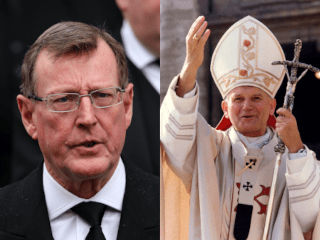
The Historic Meeting of David Trimble & Pope John Paul II

David Trimble becomes the first Ulster Unionist leader to meet a Pope when his historic meeting with John Paul II takes place in Rome on April 21, 1999. The meeting is widely welcomed as a sign that old prejudices are ending but Trimble is hotly criticised by both Protestants and Catholics in his Upper Bann constituency.

The First Minister is one of 54 Nobel Peace Prize laureates who meets Pope John Paul II briefly at the Vatican, as part of a two-day trip organised by former Russian leader Mikhail Gorbachev. The Nobel Prize winners meet the Pope as a group and are then introduced and shake hands individually. There is a group photograph but no filming of the event. Careful stage-management ensures there are no public photographs of the two men close together.

A spokesman for Trimble says the UUP leader told the Pope he hopes this will be the year when peace will be secured in Northern Ireland. The Pope recalls his visit to Ireland and says murder cannot be condoned or called by another name.

Although the meeting is welcomed on both sides of the North divide, it does little to enhance Trimble’s standing in Upper Bann, particularly in troubled Portadown. In Portadown’s loyalist estates, there is open hostility toward Trimble. Many residents accusing their MP of “putting his personal status above the interests of his constituents.” The response is typified by one angry woman who says, “The loyalist people of this town and Drumcree, put David Trimble into office. Now he has turned his back on us. That’s a fatal mistake, this town and Drumcree will now destroy Trimble.”

“It’s unbelievable that this meeting is actually taking place,” says Orangeman Ivor Young. “It totally contradicts the oath that David Trimble took when he joined the Orange Order. We all knew Trimble was a traitor, this latest escapade puts the final nail in his political coffin here in Upper Bann. There is no way that he will ever be elected here again.”

Trimble also comes in for further criticism from Portadown Orange District, whose Drumcree protest has continued for the past 288 days. David Jones, the District’s press officer says that the people of Portadown once again see their local MP on “a world stage,” instead of being involved locally. “There are a lot of people around Portadown who aren’t very impressed that David Trimble has gone off to meet the Pope and hasn’t got more involved in trying to get the situation here solved,” says Jones.

On Portadown’s Garvaghy Road, Catholics are also critical of Trimble’s visit to Rome. “It’s amazing how he can travel to Rome to meet and talk to strangers,” says one nationalist resident, “yet he can’t be bothered to travel less than 30 miles to meet us, to talk about the serious issues that confront this community. After all we are as much his constituents as are the loyalists in this town.”

The meeting is the first time that the First Minister of Northern Ireland or the head of the Ulster Unionist Party has met the Pope in Rome. It also represents a rare appearance by an Orangeman at the heart of the Roman Catholic Church. Trimble and his entourage meet the Pope in the sumptuous surroundings of the Consistory Hall, the same room where the Cardinals of the Church gather to advise the Pope.

Earlier in the morning Trimble says in an interview with the Vatican radio that besides giving an update on developments in Northern Ireland, he wishes to “express to his Holiness the Pope that he and the Church will do what it can to persuade the paramilitaries to commit themselves irrevocably to peaceful means.”

Other Nobel prize winners who meet the Pope include peace activist Betty Williams, former Soviet leader Mikhail Gorbachev, former South African leader F. W. de Klerk, Guatemalan human rights activist Rigoberta Menchu, British scientist Joseph Rotblat, and former Israeli leader Shimon Peres.

Trimble’s fellow Nobel laureate, SDLP leader John Hume, is unable to attend the meeting.

(From: “Anger erupts at home as Trimble meets Pope” by Chris Anderson, Independent.ie (www.independent.ie), April 23, 1999)


Leave a comment

Remembrance Sunday Ceremonies 2016

Taoiseach Enda Kenny and Tánaiste Frances Fitzgerald attend Remembrance Sunday ceremonies in Northern Ireland on November 13, 2016, while a cross commemorating Irish soldiers in World War I is dedicated at Dublin‘s Glasnevin Cemetery.

Kenny, who has taken part in the ceremony every year since 2012, lays a wreath of green laurels alongside the many red poppies at the war memorial in Enniskillen, County Fermanagh. Northern Ireland’s First Minister Arlene Foster, a Member of the Legislative Assembly (MLA) for Fermanagh and South Tyrone, also attends the event.

Although there are no discussions between the pair, Kenny confirms he will meet with Foster in Dublin on Tuesday, November 15. The pair are also due to meet in Armagh on Friday, November 18 for a North/South ministerial meeting, where Brexit-related issues are expected to dominate the agenda.

Tánaiste Frances Fitzgerald travels to Belfast, where she lays a laurel wreath at the Cenotaph at city hall. Fitzgerald is joined at the ceremony by Secretary of State for Northern Ireland James Brokenshire.

Speaking afterwards, Fitzgerald, whose grandfather served as a soldier in the British army and whose father was a colonel in the Irish Army, says it has been an important engagement. “So many people across the island lost their lives; 50,000 families affected by loss of a loved one during the First World War. We have had a government minister here since 2012 and I think it is really important to come together, to remember together and to look at our shared histories.”

In England, British Prime Minister Theresa May is among those who gather at the Cenotaph in London for a commemoration ceremony.

Meanwhile, Heather Humphreys, the Minister for Arts, Heritage, Regional, Rural and Gaeltacht Affairs, dedicates the France-Ireland Memorial at Glasnevin Cemetery. Humphreys is joined by the French Minister of State for Veterans and Remembrance at the Ministry of Defence Jean-Marc Todeschini for the ceremony. The memorial is a gift to Ireland from France in recognition of Irish sacrifices made “in the defence and freedom of France, particularly in the First World War.”

(From: “Taoiseach, Tánaiste attend Remembrance Sunday ceremonies,” Raidió Teilifís Éireann (RTÉ), http://www.rte.ie, November 13, 2016 | Pictured: Taoiseach Enda Kenny lays a wreath of green laurels in Enniskillen)


Leave a comment

The Murder of Joseph “Jo Jo” O’Connor

Joseph “Jo Jo” O’Connor, a leading member of the Continuity Irish Republican Army according to security sources in Northern Ireland, is shot to death in west Belfast on October 13, 2000. Provisional Irish Republican Army (PIRA) gunmen are blamed for the murder.

The 26-year-old O’Connor is shot dead as he sits in a car outside his mother’s house in Whitecliffe Parade in Ballymurphy. He comes from a well-known republican family and is understood to have been involved in welfare work for “Real IRA” prisoners. Royal Ulster Constabulary (RUC) sources do not suggest a motive for the shooting, except to say it is not sectarian and they believe it is a result of an inter-republican dispute. Continuity IRA sources deny their organisation is involved and the killing is condemned by Republican Sinn Féin.

O’Connor had just left his mother’s home and got into the passenger seat of a car when two hooded gunmen approach on foot and shoot him at point-blank range. He is hit in the head and dies instantly. A relative who is in the driver’s seat is uninjured.

O’Connor’s cousin, who lives nearby, says, “I heard one shot, then a silence, and then four more shots in quick succession.” Tensions between mainstream and dissident republicans at the time are high in Belfast but without serious violence.

O’Connor, who lives nearby in the Springhill Estate, is married with two young sons. His grandfather, Francisco Notarantonio, was shot dead by the Ulster Defence Association (UDA) in highly controversial circumstances at the same house 13 years earlier. That killing is at the centre of a legal battle between the British Ministry of Defence and the Sunday People over allegations of security force involvement.

O’Connor’s killing is condemned by First Minister of Northern Ireland David Trimble. He calls on the RUC Chief Constable, Ronnie Flanagan, to state who he believes is responsible. “I understand a police operation is still ongoing and there may very well be further developments, but the question we will all ask is who was responsible for this murder.”

The killing is condemned by Republican Sinn Féin. A Sinn Féin councillor, Sean McKnight, says local people are “shocked” by the killing. “We call on those responsible for this deliberate shooting to declare themselves and spell out to the people what their motives are,” a spokesman says. “Local sources indicate the deceased man was associated with the 32 County Sovereignty Movement. Republican Sinn Féin has no hesitation in condemning this action and points out the obvious dangers that lie ahead.”

The Social Democratic and Labour Party (SDLP) representative for Belfast West, Alex Attwood, condemns the murder as pointless but says no one should “rush to premature judgment” about who is responsible. “The overwhelming mass of political and wider opinion is determined to consolidate the political and peace process and no words, no acts and no narrow politics will destabilise it.”

(From “Leading ‘Real IRA’ member is shot dead in Ballymurphy” by Suzanne Breen, The Irish Times, October 14, 2000)