seamus dubhghaill

Promoting Irish Culture and History from Little Rock, Arkansas, USA


Leave a comment

Birth of Arlene Foster, Northern Ireland Politician & Broadcaster

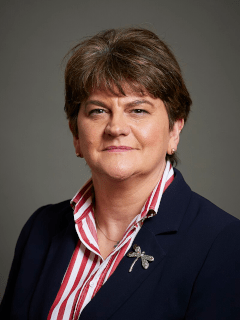
Arlene Isobel Foster (née Kelly), Baroness Foster of Aghadrumsee, DBE, PC, British broadcaster and politician from Northern Ireland, is born in Enniskillen, County Fermanagh, Northern Ireland, on July 17, 1970. She serves as First Minister of Northern Ireland from 2016 to 2017 and 2020 to 2021 and leader of the Democratic Unionist Party (DUP) from 2015 to 2021, the first woman to hold either position. She is a Member of the House of Lords, having previously been a Member of the Legislative Assembly (MLA) for Fermanagh and South Tyrone from 2003 to 2021.

Foster is raised in the townland of Dernawilt, on the outskirts of Aghadrumsee. When she is nine, her family moves to the Castlebalfour Estate, a housing estate in nearby Lisnaskea, following a nighttime attempt by the Provisional Irish Republican Army (IRA) to kill her father, a Royal Ulster Constabulary (RUC) reservist, who is shot and severely injured at their family farm.

As a teenager, Foster is on a school bus that is bombed by the IRA, the vehicle targeted because its driver is a soldier in the Ulster Defence Regiment (UDR). A girl sitting near her is seriously injured. She is a pupil at Enniskillen Collegiate Grammar School in Enniskillen from 1982 to 1989, and attends Queen’s University Belfast (QUB), where she graduates with an LLB degree. Her political career begins at QUB when she joins the Queen’s Unionist Association, part of the Ulster Unionist Party (UUP). She serves as the association’s chair from 1992 to 1993.

After leaving QUB Foster remains active in the UUP, chairing its youth wing, the UYUC, in 1995. In 1996, she becomes an Honorary Secretary of the UUP’s ruling body, the Ulster Unionist Council, a position which she holds until her resignation from the UUP on December 18, 2003. She is a councillor on Fermanagh District Council representing Enniskillen from 2005 to 2010.

Foster serves in the Northern Ireland Executive as Minister of the Environment from 2007 to 2008, Minister for Enterprise and Investment from 2008 to 2015 and Minister for Finance and Personnel from 2015 to 2016. In December 2015, she is elected unopposed to succeed Peter Robinson as leader of the DUP. In January 2016, she becomes First Minister of Northern Ireland and shares power with Martin McGuinness.

McGuinness resigns as deputy First Minister in January 2017 amid the Renewable Heat Incentive scandal, which involves a green energy scheme that Foster set up during her time as Minister for Enterprise and Investment. The scheme is set to cost the taxpayer £490 million and there are allegations of corruption surrounding her role in implementing the scheme. McGuinness asks her to step aside as First Minister while her involvement in the scheme is investigated, but she refuses to step aside or resign and says that the voices calling for her resignation are those of “misogynists and male chauvinists.” Under the terms of the Northern Ireland power-sharing agreement, the First and deputy First Ministers are equal and, therefore, she cannot remain in her post as First Minister and is subsequently removed from office. McGuinness’s resignation causes a 2017 snap assembly election to be held, in which the DUP loses ten seats. After no party receives an outright majority in the 2017 United Kingdom general election, the DUP enters into an agreement with the Conservative Party to support Prime Minister Theresa May‘s government. In January 2020, she becomes First Minister of Northern Ireland again after the Executive is reinstated under the terms of the New Decade, New Approach agreement.

On April 28, 2021, after more than twenty DUP MLAs and four DUP MPs sign a letter “…voicing no confidence in her leadership,” Foster announces that she will resign as party leader and as First Minister. She is succeeded by Edwin Poots as DUP leader on May 28, 2021. She leaves office as First Minister on June 14, 2021, and is succeeded by Paul Givan as First Minister on June 17, 2021. She resigns from the Northern Ireland Assembly in October 2021 and becomes a presenter on GB News.

In May 2024, it is confirmed that Foster will be appointed chairperson of Intertrade UK, a new body to promote trade within the UK which is announced as part of the UK government package to restore devolution.

Foster and her husband, Brian, have three children. They live on the outskirts of Brookeborough, a village in the east of County Fermanagh. In 2008, she is recognised as Assembly member of the year at the Women in Public Life Awards.

(Pictured: Official portrait of Baroness Foster of Aghadrumsee, January 30, 2024)


Leave a comment

Birth of Jim Lynagh, Member of the East Tyrone Brigade, Provisional IRA

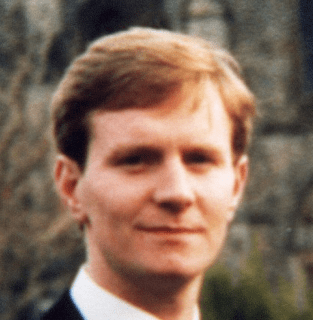
Jim Lynagh, member of the East Tyrone Brigade of the Provisional Irish Republican Army (IRA), one of twelve children, is born on the Tully Estate, a housing estate in the townland of Killygowan on the southern edge of Monaghan, County Monaghan, on April 13, 1956.

Lynagh joins the Provisional Irish Republican Army in the early 1970s. In December 1973 he is badly injured in a premature bomb explosion, arrested, and spends five years in the Maze Prison. While imprisoned, he studies and becomes a great admirer of Mao Zedong. After his release from prison in 1979 he is elected as a Sinn Féin councillor for Monaghan and holds this position until he is killed.

After his release from prison Lynagh becomes active in the IRA again, active with the Provisional IRA East Tyrone Brigade. He quickly becomes a unit commander and gradually builds up his ruthless reputation. After a series of Ulster loyalist attacks against Irish nationalist politicians in late 1980 and early 1981, he is suspected of involvement in an attack on the Stronge estate near Middletown, County Armagh, where the IRA murdered the retired Ulster Unionist Party Stormont speaker, Sir Norman Stronge, and his son James, a Royal Ulster Constabulary (RUC) officer, before burning down their home, Tynan Abbey, and shooting their way out through a police cordon.

Lynagh is known as “The Executioner” by the Royal Ulster Constabulary. He is arrested and interrogated many times by the Garda Síochána in County Monaghan but is never charged. During this period, he devises a Maoist military strategy, aimed at escalating the war against the British state in Northern Ireland. The plan envisages the destruction of police stations and British Army military bases in parts of Northern Ireland to create “liberated” areas that will be thereby rendered under the domination of the IRA. In 1984 he starts co-operating with Pádraig McKearney who shares his views. The strategy begins materialising with the destruction of an RUC police station in Ballygawley in December 1985 which kills two police officers, and in The Birches in August 1986.

Lynagh is killed by the British Army’s Special Air Service on May 8, 1987 during an attack on the isolated rural part-time police station at the small County Armagh village of Loughgall, the third such attack that he had taken part in. During the incident the IRA detonates a 200-lb. bomb, and attacks the station with automatic weapons, and in the process are ambushed by the British Army which is lying in wait for them, having been forewarned of the IRA operation. All eight of the IRA attacking force are killed in the exchange of fire, the British forces involved incurring no fatalities. The incident subsequently becomes known as the Loughgall ambush.

At the time of his death, Lynagh is living in a flat on Dublin Street in Monaghan. He is buried at St. Joseph’s Cemetery (Latlurcan Cemetery) in Monaghan. During his funeral, as his coffin is carried through the village of Emyvale, Irish Garda Síochána officers are attacked by the crowd of mourners after they pursue three gunmen who had fired a volley over his coffin.


Leave a comment

Northern Ireland Forensic Science Laboratory Bombing

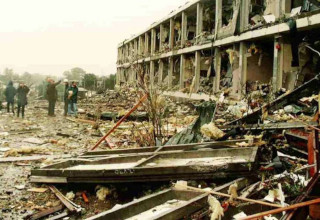
A Provisional Irish Republican Army (IRA) van bomb explodes outside the Northern Ireland Forensic Science Laboratory (NIFSL) on the Newtownbreda Road on the outskirts of Belfast late in the evening of September 23, 1992. It is one of the biggest bombs detonated in a residential area of Northern Ireland. The blast comes after a temporary lull in an IRA bombing campaign.

The 2,000 lb. (900kg) bomb goes off outside the laboratory at Newtownbreda while Army bomb disposal experts are moving in to investigate a large, abandoned van. The alarm is raised when the IRA makes a telephone warning saying that it has planted a “massive van bomb.”

The device reduces every room to rubble. It also causes damage, in some cases severe, to more than 700 homes and other premises. One estimate puts repair costs after the blast at about £20 million.

The wrecking of the laboratory is a blow to the authorities, because the blast destroys valuable forensic evidence for use in the prosecution of terrorist suspects. But on a personal level it is a traumatic night for hundreds of families who live through the explosion and face the task of repairing their homes.

The blast is unusually loud and destructive. It shakes Belfast and is heard for miles around. Many people living some distance away are convinced the explosion had been outside their door. One man who lives 10 miles away believes his home is under attack and goes outside with a golf club to investigate.

Emergency staff say the area affected is one of the largest they had ever known, with damage reported up to a radius of a mile and a half. But the brunt of the damage is suffered by Belvoir Park, a model and almost incident-free largely Protestant housing estate built by a public authority but now largely privately owned, which is separated from the laboratory by a dual carriageway.

Up to 50 homes are demolished. In one experience which is typical of many, a 65-year-old widow who lives alone is watching television when the bomb goes off. Much of the plaster ceiling collapses while the window shatters into fragments and showers the room. An immediate power cut plunges the house into darkness. She escapes with only a slight cut to the head.

After the explosion people roam the darkened estate in cars and on foot, checking for relatives and friends while police officers help tend those suffering from shock and injuries. No one is seriously hurt. A number of pet cats and dogs panic and run off into the night.

In the early hours of September 24, rain pours through damaged roofs, making life even more difficult for families involved in immediate repair work. At 5:00 AM, almost eight hours after the blast, workmen are still engaged in boarding up broken windows.

(From: “Damage in huge blast put at 20m pounds: A Belfast housing estate counts the cost of an IRA bomb which may have destroyed vital criminal evidence” by David McKittrick, Ireland Correspondent, The Independent, http://www.independent.co.uk)


Leave a comment

Birth of Joe McDonnell, Irish Hunger Striker

joseph-mcdonnell

Joseph (Joe) McDonnell, a volunteer in the Provisional Irish Republican Army (IRA), is born on Slate Street in the lower Falls Road of Belfast, Northern Ireland on September 14, 1951. He dies after 61 days on hunger strike during the 1981 Irish hunger strike.

McDonnell is one of ten children. He attends a nearby Roman Catholic school. He marries Goretti in 1970 and moves into her sister’s house in Lenadoon. There are only two Catholic houses in this predominantly Ulster Protestant housing estate, and their house is attacked on numerous occasions.

McDonnell is arrested in Operation Demetrius and, along with Gerry Adams and others, is interned on the prison ship HMS Maidstone. He is later moved to HM Prison Maze in County Down for several months. Upon release, he joins the Provisional IRA Belfast Brigade. He meets Bobby Sands during the preparation for a firebomb attack on the Balmoral Furnishing Company’s premises in Dunmurry. During the ensuing shoot-out between the IRA and the Royal Ulster Constabulary (RUC) and British Army, both men, along with Séamus Finucane and Seán Lavery, are arrested. McDonnell and the others are sentenced to 14 years in prison for possession of a firearm. None of the men accept the jurisdiction of the court.

McDonnell agrees with the goals of the 1981 Irish hunger strike, namely: the right not to wear a prison uniform; the right not to do prison work; the right of free association with other prisoners; the right to organise their own educational and recreational facilities and the right to one visit, one letter and one parcel per week.

Although McDonnell is not involved in the first hunger strike in 1980, he joins Bobby Sands and the others in the second hunger strike the following year. During the strike he fights the general election in the Republic of Ireland, and only narrowly misses election in the Sligo–Leitrim constituency. He goes 61 days without food before dying on July 8, 1981. He has two children. His wife takes an active part in the campaign in support of the hunger strikers.

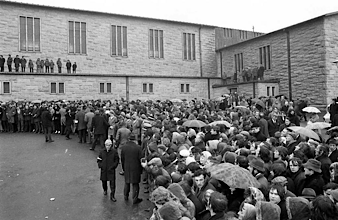
McDonnell is buried in the grave next to Bobby Sands at Milltown Cemetery in west Belfast. John Joe McGirl, McDonnell’s election agent in Sligo–Leitrim, gives the oration at his funeral. Quoting Patrick Pearse, he states, “He may seem the fool who has given his all, by the wise men of the world; but it was the apparent fools who changed the course of Irish history.”

McDonnell is commemorated on the Irish Martyrs Memorial at Waverley Cemetery in Sydney, Australia and is also commemorated in The Wolfe Tones song, “Joe McDonnell.”


Leave a comment

The Battle at Springmartin

kelly-bar-bombing

The Battle at Springmartin, a series of gun battles in Belfast, Northern Ireland, begins on May 13, 1972, and continues into the following day. It involves the British Army, the Provisional Irish Republican Army (IRA), and the Ulster Volunteer Force (UVF).

The night before the bombing, snipers from the UVF West Belfast Brigade take up position along the second floor of an abandoned row of flats at the edge of the Ulster Protestant Springmartin estate. The flats overlooked the Catholic Ballymurphy estate. Rifles, mostly World War II stock, are ferried to the area from dumps in the Shankill Road.

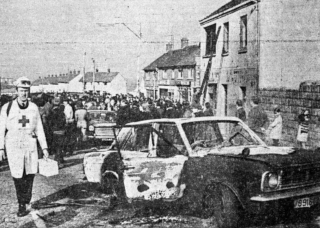
The violence begins shortly after 5:00 PM on Saturday, May 13, 1972, when a car bomb, planted by Ulster loyalists, explodes without warning outside the crowded Kelly’s Bar, at the junction of the Springfield Road and Whiterock Road. The pub is in a mainly Irish Catholic and nationalist area of Ballymurphy and most of its customers are from the area. At the time of the blast, the pub is crowded with men watching an association football match between England and West Germany on colour television. Following the blast, the UVF snipers open fire on the survivors. This begins the worst fighting in Northern Ireland since the suspension of the Parliament of Northern Ireland and the imposition of direct rule from London.

Sixty-three people are injured, eight of them seriously. John Moran, age 19, who had been working at Kelly’s as a part-time barman, dies of his injuries on May 23.

For the rest of the night and throughout the next day, local IRA units fight gun battles with both the UVF and British Army. Most of the fighting takes place along the interface between the Catholic Ballymurphy and Ulster Protestant Springmartin housing estates, and the British Army base that sits between them. Five civilians (four Catholics, one Protestant), a British soldier and a member of the IRA Youth Section are killed in the violence. Four of the dead are teenagers.

At first, the British Army claims that the blast had been an “accident” caused by a Provisional IRA bomb. The Secretary of State for Northern Ireland, William Whitelaw, tells the House of Commons on May 18 that the blast is caused by a Provisional IRA bomb that exploded prematurely. However, locals suspect that the loyalist Ulster Defence Association (UDA) had planted the bomb. Republican sources say that IRA volunteers would not risk storing such a large number of explosives in such a crowded pub. It later emerges that the bomb had indeed been planted by loyalists.

A memorial plaque on the site of the former pub names three members of staff who lost their lives as a result of the bomb and the gun battles that followed. It reads:

This plaque marks the spot
where Kelly’s Bar once stood
and here on 13th May 1972
a no warning Loyalist car bomb exploded.
As a result, 66 people were injured
and three innocent members of staff
of Kelly’s Bar lost their lives.
They were:
Tommy McIlroy (died 13th May 1972)
John Moran (died from his injuries 23rd May 1972)
Gerard Clarke (died from his injuries 6th September 1989)
Ar dheis Dé go raibh a namacha”


Leave a comment

Death of Hunger Striker Joe McDonnell


joe-mcdonnell

Joseph (Joe) McDonnell, a volunteer in the Provisional Irish Republican Army (IRA), dies on July 8, 1981, after 61 days on hunger strike during the 1981 Irish hunger strike.

McDonnell is born on Slate Street in the lower Falls Road of Belfast, Northern Ireland on September 14, 1951, as one of ten children. He attends a nearby Roman Catholic school. He marries Goretti in 1970 and moves into her sister’s house in Lenadoon. There are only two Catholic houses in this predominantly Ulster Protestant housing estate, and their house is attacked on numerous occasions.

McDonnell is arrested in Operation Demetrius and, along with Gerry Adams and others, is interned on the prison ship HMS Maidstone. He is later moved to HM Prison Maze in County Down for several months. Upon release, he joins the Provisional IRA Belfast Brigade. He meets Bobby Sands during the preparation for a firebomb attack on the Balmoral Furnishing Company’s premises in Dunmurry. During the ensuing shoot-out between the IRA and the Royal Ulster Constabulary (RUC) and British Army, both men, along with Séamus Finucane and Seán Lavery, are arrested. McDonnell and the others are sentenced to 14 years in prison for possession of a firearm. None of the men accept the jurisdiction of the court.

McDonnell agrees with the goals of the Irish hunger strike, namely: the right not to wear a prison uniform; the right not to do prison work; the right of free association with other prisoners; the right to organise their own educational and recreational facilities and the right to one visit, one letter and one parcel per week.

Although McDonnell is not involved in the first hunger strike in 1980, he joins Bobby Sands and the others in the second hunger strike the following year. During the strike he fights the general election in the Republic of Ireland, and only narrowly misses election in the Sligo–Leitrim constituency. He goes 61 days without food before dying on July 8, 1981. He has two children. His wife takes an active part in the campaign in support of the hunger strikers.

McDonnell is buried in the grave next to Bobby Sands at Milltown Cemetery in west Belfast. John Joe McGirl, McDonnell’s election agent in Sligo–Leitrim, gives the oration at his funeral. Quoting Patrick Pearse, he states, “He may seem the fool who has given his all, by the wise men of the world; but it was the apparent fools who changed the course of Irish history.”

McDonnell is commemorated on the Irish Martyrs Memorial at Waverley Cemetery in Sydney, Australia and is also commemorated in The Wolfe Tones song, “Joe McDonnell.”