Known principally for his contribution to Ulster politics at local level, Armstrong serves as JP and is appointed High Sheriff of Armagh for 1875 and High Sheriff of Longford for 1894. He is a County Councillor for Armagh from 1899 to 1920, and a Member of the Irish Convention in 1917–18. Vice-Lieutenant of County Armagh in 1920, he is a Senator of Queen’s University Belfast from 1920 to 1937.
Armstrong is returned unopposed to the Imperial House of Commons for Mid-Armagh in the 1921 Mid Armagh by-election, at the advanced age of 76, becoming one of the oldest first-time MPs whose birth date is recorded. Certainly, he immediately becomes the oldest member of the current House of Commons. He is a Senator of Northern Ireland from 1921 to 1937, and Lord Lieutenant of Armagh from 1924 to 1939. For twenty-five years he is a member of the Representative Body of the Church of Ireland. He is Chairman of the County Armagh Education Committee from 1925 to 1931, and President of the Association of Education Committees of Northern Ireland. In 1932, he is made a Privy Councillor for Northern Ireland, and in 1938 he serves as a Justice for the Government of Northern Ireland in the absence of the Governor.
In his later years, Armstrong provides financial support for Jewish refugees fleeing Nazi-occupied Europe.
In 1883, Armstrong marries Margaret Leader, daughter of William Leader of Rosnalea, County Cork. They have five sons and three daughters, of whom C. W. Armstrong also becomes a politician.
Armstrong dies at his home in Dean’s Hill, Armagh, on December 4, 1943, at the age of 99 years.
At dawn on the morning of November 20, 1917, the 16th (Irish) Division of the British Army assaults an area of the German lines known as “Tunnel Trench,” named for an elaborate tunnel system that runs along it. The attack is meant as a diversion for the main attack, about eight miles to the southeast at Cambrai, France, where six infantry and two cavalry divisions of the British Expeditionary Force, with additional support from fourteen squadrons of the Royal Flying Corps, join the British Tank Corps in a surprise attack on the German lines.
By autumn 1917, three years into World War I, continuous shelling and lack of drainage has transformed the Ypres Salient, on the Western Front, into a waterlogged quagmire. In Ireland, meanwhile, a month earlier, Eamon de Valera becomes president of Sinn Féin and decides to push for an independent Irish republic. Despite the growing political turmoil at home, in France, on firm ground near the town of Cambrai, the British Army’s 16th (Irish) Division again proves to be formidable adversaries for the Germans.
According to the divisional historian, at Cambrai, the “swift and successful operation by 16th Division was a model of attack with a limited objective.” In addition to securing 3,000 yards of trench, 635 prisoners are captured from the German army’s 470th and 471st Regiments and 330 German bodies are counted in the trenches. More importantly, though, the mayhem caused by the diversionary assault contributes greatly to the initial success of the Cambrai offensive, though the offensive eventually sputters, dragging the war into 1918.
Cambrai becomes the field of operations when the British Commander-in-Chief, Field MarshalDouglas Haig, recognising that it is impossible to launch further military operations in the Ypres sector, seeks a new battlefield where he hopes success can be achieved before year’s end. Lieutenant ColonelJohn Fuller of the Tank Corps and GeneralJulian Byng, commander of the Third Army, recommend that a massed assault by 400 tanks should be mounted across the firm, chalky ground to the southwest of Cambrai. Haig adopts this proposal, confident that the tanks can punch a hole through the mighty Hindenburg Line and allow his underused Cavalry Divisions to break through to the enemy rear.
In order to create maximum confusion among the Germans, Sir Aylmer Haldane, commander of VI Corps, is ordered to stage a diversionary attack. The area selected for the assault is about eight miles to the northwest of Cambrai, where the British line passes through the villages of Bullecourt and Fontaine-lès-Croisilles. The units select to make this subsidiary attack are 3rd Army and 16th (Irish) Division.
The defences of the Hindenburg Line opposite VI Corps positions consists of Tunnel Trench, a heavily defended front-line trench, with a second, or support trench, some 300 yards behind. The whole area is scattered with concrete machine gun forts, or Mebus, similar to those that had decimated the 16th (Irish) Division at the Battle of Langemarck three months earlier.
Tunnel Trench is so called because it has a tunnel 30 or 40 feet below ground along its entire length, with staircase access from the upper level every 25 yards. The entire tunnel has electric lighting, and side chambers provide storage space for bunks, food, and ammunition. Demolition charges are set that can be triggered from the German rear in order to prevent the defences from falling into British hands.
The 16th (Irish) Division, attacking on a three-brigade front, is assigned the task of capturing a 2,000-yard section of the trench network. On the right flank of the Irishmen, 3rd Division’s 9th Brigade is detailed to capture an additional 800 yards. One unusual feature of the attack is that there is to be no preliminary bombardment as surprise is the key to the success of the operation. Once the assault begins, however, 16th (Irish) Division’s artillery, reinforced with guns from the 34th Division, is to open a creeping barrage upon the German positions.
The morning of the advance, November 20, is overcast, with low visibility. At 6:20 a.m., the Divisional 18 pounder-field guns open fire, and the leading assault companies spring from their jump-off positions. At the same time, Stokes mortars begin to lay a smoke barrage upon the German trenches in imitation of a gas attack. This deception proves successful, as many German troops don cumbersome gas masks and retreat to the underground safety of the tunnel, thus leaving the exposed portion of the trench undefended.
On the left flank, the attack of the 49th Brigade is launched by 2nd Royal Irish Regiment and 7/8th Royal Irish Fusiliers. They quickly cross the 200 yards of no-man’s-land and reach the enemy frontline just as the barrage lifts. Resistance above ground is minimal, and storming parties began the task of flushing the Germans from the tunnel with Mills bombs and bayonets.
Once the tunnel is secure, sappers, acting on information obtained by 7th Leinster Regiment’s intelligence officer, cut the leads connecting the demolition charges. Supporting companies then press on to capture Tunnel Support Trench, while Divisional support units rapidly wire and made secure the new defensive front in anticipation of German counterattacks.
Only on the extreme left flank does 49th Brigade encounter any serious opposition. In this sector, Company “B” of the 7/8th Royal Irish Fusiliers suffers heavy losses inflicted by concentrated machine gun fire from Mebus Flora. Nearly one-hour elapses before resistance from this strong point can be overcome.
In the centre, 10th and 2nd Royal Dublin Fusiliers head the attack of the 48th Brigade. The advance here is so rapid that the Irish find many Germans still wearing gas masks and unable to fight. Two more Mebus, Juno and Minerva, are stormed and many more prisoners taken, particularly by 10th Royal Dublin Fusiliers which captures 170 Germans.
After capturing their assigned section of Tunnel Trench, two companies of Rangers press forward to assault the strong points known as Mars and Jove. The Division had learned from the disastrous frontal attack made at Langemarck, and so the Rangers work around to the rear before pressing home with the bayonet.
Unfortunately, 3rd Division fails in its attempt to capture the trench network immediately to the right of 16th (Irish) Division, and the flank of the Connaught Rangers is thus exposed to a savage counterattack. The Rangers ferociously engage the Germans and use captured “potato masher” grenades brought up from the tunnel to great effect. Eventually, overwhelming numbers begin to tell, and “A” Company is forced to yield Jove and fall back upon “B” Company, which is holding Mars.
These two isolated companies doggedly hold their ground for several hours. The situation only improves when the Divisional pioneer battalion, the 11th Hampshire Regiment, digs a communication trench across the fire-swept no-man’s-land, thereby allowing the support companies of the Rangers to come to the aid of their comrades. The front is finally stabilised three days later when 7th Leinster Regiment recaptures and consolidates Jove and successfully assaults the untaken section of Tunnel Trench.
On the first day of the Battle of Cambrai, General Byng’s eight attacking Divisions achieve complete surprise and pierce the Hindenburg Line, driving the Germans back four miles toward Cambrai itself. Having captured 8,000 prisoners and 100 guns for the loss of only 5,000 British casualties, it is small wonder that church bells are sounded in celebration in Britain for the first time during the war.
Unfortunately, Byng lacks sufficient reserves to exploit, or consolidate his success, and German counterattacks, launched by some 20 Divisions, recover most of the lost ground. Although the battle ultimately ends in failure for the British, the willingness to employ new weaponry and tactics at Cambrai and during the diversionary assault upon Tunnel Trench, points the way to the final victory in 1918.
Although the capture of Tunnel Trench contributes greatly to the early success at Cambrai, it proves costly as VI Corps suffers 805 casualties. Most of these occur close to Jove Mebus, where the Connaught Rangers had engaged the enemy in hand-to-hand combat.
Perhaps an idea of the ferocious nature of this form of trench warfare can be gleaned from Father William Doyle, chaplain of the 8th Royal Irish Fusiliers, who once remarks, “We should have had more prisoners, only a hot-blooded Irishman is a dangerous customer when he gets behind a bayonet and wants to let daylight through everybody.”
(From: “Tunnel Trench: 16th (Irish) Division Clears the Way at Cambrai,” by Kieron Punch, posted by The Wild Geese, http://www.thewildgeese.irish, January 18, 2013 | Pictured: Troops from the Royal Irish Regiment about to go into action at Cambrai)
The Battle of the Somme ends on November 18, 1916. This dreadful battle claims more Irish lives in combat than any other battle in history.
On the first day of battle alone, July 1, 1916, twenty thousand soldiers of the British Army are killed and forty thousand are wounded. The 36th (Ulster) Division suffers an estimated 5,500 casualties, almost all of whom are drawn from what is now Northern Ireland. Nearly 2,000 Irish soldiers are killed in the first few hours of fighting following a morning mist that poet Siegfried Sassoon references as “of the kind commonly called heavenly.”
The Battle of the Somme, also known as the Somme Offensive, is a battle in World War I fought by the armies of the British Empire and the French Third Republic against the German Empire. It takes place between July 1 and November 18, 1916, on both sides of the upper reaches of the river Somme in France. The battle is intended to hasten a victory for the Allies and is the largest battle of World War I on the Western Front. More than 3 million men fight in this battle and one million men are wounded or killed, making it one of the bloodiest battles in human history.
The French and British commit themselves to an offensive on the Somme during Allied discussions at Chantilly, Oise, in December 1915. The Allies agree upon a strategy of combined offensives against the Central Powers in 1916, by the French, Russian, British and Italian armies, with the Somme offensive as the Franco-British contribution. Initial plans call for the French army to undertake the main part of the Somme offensive, supported on the northern flank by the Fourth Army of the British Expeditionary Force (BEF). When the Imperial German Army begins the Battle of Verdun on the Meuse on February 21, 1916, French commanders divert many of the divisions intended for the Somme and the “supporting” attack by the British becomes the principal effort.
The first day on the Somme, July 1, sees a serious defeat for the German Second Army, which is forced out of its first position by the French Sixth Army, from Foucaucourt-en-Santerre south of the Somme to Maricourt on the north bank and by the Fourth Army from Maricourt to the vicinity of the Albert–Bapaume Road. The first day on the Somme is, in terms of casualties, also the worst day in the history of the British Army, which suffers 57,470 casualties. These occur mainly on the front between the Albert–Bapaume road and Gommecourt, where the attack is defeated, and few British troops reach the German front line. The British troops on the Somme comprise a mixture of the remains of the pre-war standing army, the Territorial Force, and Kitchener’s Army, a force of volunteer recruits including many Pals Battalions, recruited from the same places and occupations.
The battle is notable for the importance of air power and the first use of the tank. At the end of the battle, British and French forces have penetrated 6 miles into German-occupied territory, taking more ground than in any of their offensives since the First Battle of the Marne in 1914. The Anglo-French armies fail to capture Péronne and halt three miles from Bapaume, where the German armies maintain their positions over the winter. British attacks in the Ancre valley resume in January 1917 and force the Germans into local withdrawals to reserve lines in February, before the scheduled retirement to the Siegfriedstellung (Hindenburg Line) begins in March.
Debate continues over the necessity, significance and effect of the battle. David Frum opines that a century later, “‘the Somme’ remains the most harrowing placename” in the history of the British Commonwealth.
(Pictured: Men of the Royal Irish Rifles rest during the opening hours of the Battle of the Somme. July 1, 1916)
In April 1916, Germany offers the Irish 20,000 Mosin–Nagant 1891 rifles, ten machine guns and accompanying ammunition, but no German officers. It is a fraction of the quantity of the arms Casement had hoped for, with no military expertise on offer. The weapons leave Germany bound for Ireland on a German cargo vessel named the SS Libau, disguised as a Norwegian vessel, Aud-Norge.
Casement confides his personal papers to Dr. Charles Curry, with whom he has stayed at Riederau on the Ammersee, before leaving Germany. He departs with Robert Monteith and Sergeant Daniel Beverley (Bailey) of the Irish Brigade in a submarine, initially the SM U-20, which develops engine trouble, and then the SM U-19, shortly after the Aud sails. According to Monteith, Casement believes the Germans are toying with him from the start and providing inadequate aid that will doom a rising to failure. He wants to reach Ireland before the shipment of arms and to convince Eoin MacNeill, who he believes is still in control, to cancel the rising.
Casement sends John McGoey, a recently arrived Irish American, through Denmark to Dublin, ostensibly to advise what military aid is coming from Germany and when, but with Casement’s orders “to get the Heads in Ireland to call off the rising and merely try to land the arms and distribute them.” McGoey does not reach Dublin, nor does his message. His fate is unknown until recently. Evidently abandoning the Irish Nationalist cause, he joins the Royal Navy in 1916, survives the war, and later returns to the United States, where he dies in an accident on a building site in 1925.
About 2:00 a.m. on the morning of April 21, 1916, three days before the rising begins, Robert Monteith, Daniel Bailey (calling himself Beverly), and Casement climb into a small boat for the trip to shore at Banna Strand in Tralee Bay, County Kerry. Their boat, now in the Imperial War Museum in London, capsizes before they reach shore.
Monteith helps an exhausted Casement to safety on shore. Casement is convinced that the Rising cannot be successful without a large number of German troops, and the best he has been able to obtain is one boatload of arms. Suffering from a recurrence of the malaria that had plagued him since his days in the Congo, and too weak to travel, Monteith and Bailey leave Casement at the ruins of McKenna’s Fort, an ancient ring fort in Rahoneen, Ardfert, now renamed Casement’s Fort, and head for Tralee.
About 1:30 p.m., Casement is discovered by two Royal Irish Constabulary (RIC) officers. He nearly talks his way out of being arrested, but a 12-year-old boy at the scene points out a piece of paper Casement had tossed away as the police approach. On that paper is a German code list. He is arrested on charges of high treason, sabotage and espionage against the Crown. He manages to send word to Dublin about the inadequate German assistance.
The Kerry Brigade of the Irish Volunteers might have tried to rescue Casement over the next three days, but its leadership in Dublin holds that not a shot is to be fired in Ireland before the Easter Rising is in train and therefore orders the Brigade to “do nothing.” A subsequent internal inquiry attaches “no blame whatsoever” to the local Volunteers for failing to attempt a rescue. Casement is taken to Brixton Prison and placed under special observation for fear of an attempt of suicide as there is no staff at the Tower of London to guard suicidal cases.
On the day of his execution by hanging at Pentonville Prison, August 3, 1916, Casement is received into the Catholic Church at his request. He is attended by two Catholic priests, Dean Timothy Ring and Father James Carey, from the East London parish of SS Mary and Michael. The latter, also known as James McCarroll, says of Casement that he was “a saint … we should be praying to him [Casement] instead of for him.” At the time of his death he is 51 years old.
Casement’s body is buried in quicklime in the prison cemetery at the rear of Pentonville Prison, though his last wish was to be buried at Murlough Bay on the north coast of County Antrim, in present-day Northern Ireland. Finally, in 1965, his remains are repatriated to Ireland. His remains lay in state at the Garrison Church, Arbour Hill (now Arbour Hill Prison) in Dublin for five days, close to the graves of other leaders of the 1916 Easter Rising, although he would not be buried beside them. After a state funeral, the remains are buried with full military honours in the republican plot in Glasnevin Cemetery in Dublin, alongside other Irish republicans and nationalists. The President of Ireland, Éamon de Valera, who is then in his mid-eighties and the last surviving leader of the Easter Rising, attends the ceremony, along with an estimated 30,000 others.
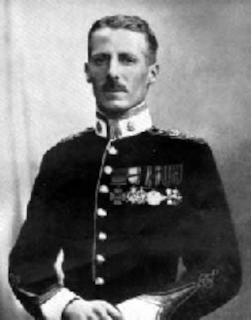
Roupell is born into a military family. His father, Francis Frederick Fyler Roupell, having served with the British Army in the 70th (Surrey) Regiment of Foot and commanded the 1st Battalion, East Surrey Regiment from 1895 to 1899, is promoted to colonel in 1901. He had married Edith Maria Bryden at Kingston in 1887.
At the outbreak of war in the summer of 1914, the 1st Battalion the East Surreys are deployed as part of the British Expeditionary Force (BEF) into northern Belgium. Roupell commands a platoon in the BEF’s first major action, the Battle of Mons, in August 1914. He keeps a diary throughout the war, which has since been a, sometimes humorous, source of insight and observation on the events that he witnessed and participated in. In the trenches at Mons, he recounts how he had to hit his men on the backside with his sword in order to gain their attention and remind them to fire low as they had been taught.
Soon after, following the retreat from Mons in September 1914, Roupell leads his platoon in the First Battle of the Aisne. Once again, he comes under heavy fire, this time while crossing the Aisne on a raft. The Surreys’ advance is pushed back with heavy casualties.
On April 20, 1915, during the continued fighting around Ypres, Roupell is commanding a company of his battalion in a front trench on “Hill 60,” which is subjected to a most severe bombardment throughout the day. Although wounded in several places, he remains at his post and leads his company in repelling a strong German assault. During a lull in the bombardment, he has his wounds hurriedly dressed, and then insists on returning to his trench, which is again being subjected to severe bombardment. Toward evening, his company being dangerously weakened, he goes back to his battalion headquarters, represents the situation to his commanding officer, and brings up reinforcements, passing back and forth over ground swept by heavy fire. With these reinforcements he holds his position throughout the night, and until his battalion is relieved next morning. For these actions he is awarded the Victoria Cross.
Roupell is presented with his VC by King George V on July 12, 1915. In addition to his Victoria Cross, he is awarded the Russian Order of St. George (4th Class) and the French Croix de guerre and is mentioned in dispatches. He is retrospectively appointed temporary captain with effect from December 29, 1914, to April 20, 1915, inclusive, and again later the same year.
Roupell is aboard TSS The Queen when it is captured and sunk in the English Channel in October 1916. He is appointed acting brigade major on December 29, 1917. On May 9, 1918, he is seconded to the general staff with the rank of temporary major.
Following the end of hostilities in Europe, Roupell, still an acting major, is promoted to acting lieutenant colonel in charge of a battalion from December 1918 to March 1919. His appointment to the general staff is confirmed on July 1, 1919. During this time, he is attached to the allied force under Edmund Ironside and sent to support Tsarist Russians as part of the Allied intervention in the Russian Civil War. On a visit to a Tsarist unit, they mutiny, and he and others are taken prisoner near Arkhangelsk, sent to Moscow, and finally repatriated in 1920.
Early in 1921, Roupell marries Doris P. Sant in Paddington. Daughter Phoebe and son Peter are born in 1922 and 1925, respectively.
Roupell’s inter-war military career continues with appointments as staff captain (1921), brigade major (1926), and promotion to substantive major (1928). During the inter-war period, he serves in Gibraltar, the Regimental Depot, India and the Sudan and he attends the Staff College, Camberley. As major (GSO2), he spends two years from 1929 at the Royal Military College of Canada, and in 1934 a year with the British troops in China. Following his return, he is promoted to lieutenant colonel in 1935.
At the outbreak of World War II, in September 1939, Roupell is promoted to colonel and made an acting brigadier, placed in command of 36th Infantry Brigade from October 7, 1939. His brigade is deployed as part of the 12th (Eastern) Division in April 1940 and becomes part of the British Expeditionary Force (BEF), taking part in the Battle of France. The German thrust near the river Somme toward Abbeville eventually cuts off the BEF, northern French and Belgian forces from the rest of France. His brigade headquarters near Doullens is attacked by enemy troops and, on being told of the threat, he exclaims, “Never mind the Germans. I’m just going to finish my cup of tea.”
When the brigade headquarters is overrun on May 20, 1940, Roupell gives the order for the survivors to split up into small groups and endeavour to re-contact Allied troops. He, with a captain and French interpreter, avoid capture, hiding by day and walking at night for over a month. They arrive at a farm near Rouen where the two officers remain for almost two years, working as labourers. With the help of the French Resistance, they are moved through unoccupied France into non-belligerent Spain, finally boarding a ship in Gibraltar and returning to the United Kingdom.
Following his return, Roupell is appointed commanding officer of the 114th Brigade, part of the 38th (Welsh) Infantry Division, on March 18, 1943, a command he holds until November 2 of that year. The brigade is not destined to see battle, however, and he is soon appointed as garrison commander at Chatham, where he remains until retirement.
In 1946, Roupell is formally retired from the army on retirement pay and granted the honorary rank of brigadier and, at the age of 58, is excused from the reserve list of officers in 1950. He is appointed a Deputy lieutenant of Surrey in 1953.
In 1954, Roupell is appointed Colonel of the East Surreys, succeeding Lieutenant General Arthur Dowler, and is to be the last Colonel of the East Surrey Regiment, relinquishing office in 1959 when amalgamation with the Queen’s Royal Regiment (West Surrey) takes place to form the Queen’s Royal Surrey Regiment. He is appointed a Companion of the Order of the Bath in 1956.
Roupell dies at the age of 81 in Shalford, Surrey, on March 4, 1974. His body is cremated at Guildford Crematorium, where his ashes are scattered.
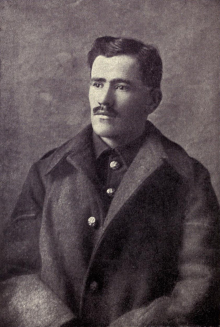
Ledwidge starts writing at an early age and is first published in a local newspaper at the age of fourteen. Finding work as a labourer and miner, he is also a trade union activist and a keen patriot and nationalist, associated with Sinn Féin. He becomes friendly with a local landowner, the writer Lord Dunsany, who gives him a workspace in the library of Dunsany Castle and introduces him to literary figures including William Butler Yeats and Katharine Tynan, with whom he has a long-term correspondence. He is elected to a local authority post and helps organise the local branch of the Irish Volunteers, while Dunsany edits and helps him secure publication for a first volume of his poetry.
Having sided with the faction of the Irish Volunteers which oppose participation in the war, he enlists in the Royal Inniskilling Fusiliers in October 1914, and continues to write poetry on assignment, sending work to Lord Dunsany and to family and other friends. The poems he writes on active service reveal his pride at being a soldier, as he believes, in the service of Ireland. He often wonders whether he would find a soldier’s death.
On July 31, 1917, a group from Ledwidge’s battalion of the Royal Inniskilling Fusiliers are road-laying in preparation for an assault during the Third Battle of Ypres, near the village of Boezinge, Ypres Salient, Belgium.
According to Irish author and lecturer Alice Curtayne, “Ledwidge and his comrades had been toiling since the early morning at roadmaking. The army’s first need was men; their second, guns; their third roads. These latter consisted mainly of heavy beech planks bolted together, which could be rapidly laid down. No advance could be supported in that sodden land without a sufficiency of these communications tracks, six or seven feet wide. Supplies were conveyed by pack mules over the wooden paths. Survivors concur in placing the road work done by B Company that day one mile northeast of Hellfire Corner, so called because it was very exposed to German shelling. There was a violent rainstorm in the afternoon, shrouding the region in a gray monochrome. Sullenly, the enemy’s long-range guns continued to fling their shells far behind the lines. Roadwork could not be suspended, however, as the tracks were in use as fast as they were laid down. Tea was issued to the men and drenched to the skin, they stopped to swallow it. A shell exploded beside Ledwidge, and he was instantly killed.”
A Roman Catholicmilitary chaplain, Father Devas, is the first on the scene. That night, Father Devas writes in his diary, “Crowds at Holy Communion. Arranged for service but washed out by rain and fatigues. Walk in rain with dogs. Ledwidge killed, blown to bits, at Confession yesterday and Mass and Holy Communion this morning. R.I.P.”
Ledwidge is first buried at Carrefour de Rose, and later re-interred in the nearby Artillery Wood Military Cemetery, at Boezinge, where the Welsh poet Hedd Wyn, who was killed in action on the same day, also lies buried.
Dunsany arranges for the publication of more of Ledwidge’s poems, and a collected edition in 1919. Further poems, from the archives at Dunsany Castle and some material held by family, are later published by Ledwdige’s biographer, Alice Curtayne, and by one of the Ledwidge memorial societies. Ledwidge is selected as one of twelve prominent war poets for the exhibition Anthem for Doomed Youth at the Imperial War Museum in London in 2002, and memorialised at an event in Inchicore, Dublin, in 2017, with his work set to music by Anúna. A museum of his life and work is opened in his birthplace cottage in 1982. Some of his manuscripts are held in the National Library of Ireland and more in the archives of Dunsany Castle.
The Battle of the Somme, also known as the Somme Offensive, is a battle of the World War I fought by the armies of the British and French empires against the German Empire. It takes place between July 1 and November 18, 1916, on both sides of the upper reaches of the river Somme in France. The battle is intended to hasten a victory for the Allies and is the largest battle of World War I on the Western Front. More than 3 million men fight in this battle and one million men are wounded or killed, making it one of the bloodiest battles in human history.
The French and British commit themselves to an offensive on the Somme during Allied discussions at Chantilly, Oise, in December 1915. The Allies agree upon a strategy of combined offensives against the Central Powers in 1916, by the French, Russian, British and Italian armies, with the Somme offensive as the Franco-British contribution. Initial plans call for the French army to undertake the main part of the Somme offensive, supported on the northern flank by the Fourth Army of the British Expeditionary Force (BEF). When the Imperial German Army begins the Battle of Verdun on the Meuse on February 21, 1916, French commanders divert many of the divisions intended for the Somme and the “supporting” attack by the British becomes the principal effort.
The first day on the Somme, July 1, sees a serious defeat for the German Second Army, which is forced out of its first position by the French Sixth Army, from Foucaucourt-en-Santerre south of the Somme to Maricourt on the north bank and by the Fourth Army from Maricourt to the vicinity of the Albert–Bapaume road. The first day on the Somme is, in terms of casualties, also the worst day in the history of the British army, which suffers 57,470 casualties. These occur mainly on the front between the Albert–Bapaume road and Gommecourt, where the attack is defeated, and few British troops reach the German front line. The British troops on the Somme comprise a mixture of the remains of the pre-war standing army, the Territorial Force, and Kitchener’s Army, a force of volunteer recruits including many Pals Battalions, recruited from the same places and occupations.
The battle is notable for the importance of air power and the first use of the tank. At the end of the battle, British and French forces have penetrated 6 miles into German-occupied territory, taking more ground than in any of their offensives since the First Battle of the Marne in 1914. The Anglo-French armies fail to capture Péronne and halt three miles from Bapaume, where the German armies maintain their positions over the winter. British attacks in the Ancre valley resume in January 1917 and force the Germans into local withdrawals to reserve lines in February, before the scheduled retirement to the Siegfriedstellung (Hindenburg Line) begins in March.
Debate continues over the necessity, significance and effect of the battle. David Frum opines that a century later, “‘the Somme’ remains the most harrowing place-name” in the history of the British Commonwealth.



 seamus dubhghaill