seamus dubhghaill

Promoting Irish Culture and History from Little Rock, Arkansas, USA


Leave a comment

Cathal Brugha Fatally Wounded by Sniper

cathal-brugha

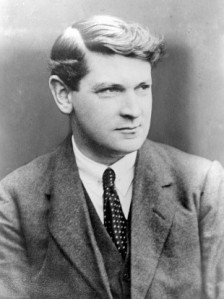
Cathal Brugha, a leading figure in the Anti-Treaty Irish Republican Army (IRA), is shot by a sniper on July 5, 1922, as he appears in the doorway of the Hammam Hotel during the Irish Civil War. He dies two days later.

Brugha is born in Dublin of mixed Roman Catholic and Protestant parentage. He is the tenth of fourteen children and is educated at the Jesuit Belvedere College but is forced to leave at the age of sixteen because of the failure of his father’s business.

In 1899, Brugha joins the Gaelic League, and subsequently changes his name from Charles Burgess to Cathal Brugha. He becomes actively involved in the Irish Republican Brotherhood (IRB) and in 1913 he becomes a lieutenant in the Irish Volunteers. He leads a group of twenty Volunteers to receive the arms smuggled into Ireland in the Howth gun-running of 1914.

Brugha is second-in-command at the South Dublin Union under Commandant Éamonn Ceannt in the Easter Rising of 1916. On the Thursday of Easter Week, being badly wounded, he is unable to leave when the retreat is ordered. Brugha, weak from loss of blood, continues to fire upon the enemy and is found by Éamonn Ceannt singing God Save Ireland with his pistol still in his hands. Initially not considered likely to survive, he recovers over the next year but is left with a permanent limp.

During the War of Independence, Brugha organises an amalgamation of the Irish Volunteers and the Irish Citizen Army into the Irish Republican Army (IRA). He proposes a Republican constitution at the 1917 Sinn Féin convention which is unanimously accepted. In October 1917, he becomes Chief of Staff of the Irish Republican Army and holds that post until March 1919.

Brugha is elected speaker of Dáil Éireann at its first meeting on January 21, 1919, and he reads out the Declaration of Independence in Irish. On the following day, he is appointed president of the ministry pro tempore and retains this position until April 1, 1919, when Éamon de Valera takes his place.

In the months between the Anglo-Irish Treaty debates and the outbreak of Civil War, Brugha attempts to dissuade his fellow anti-treaty army leaders, including Rory O’Connor, Liam Mellows, and Joe McKelvey, from taking up arms against the Free State. When the IRA occupies the Four Courts, he and Oscar Traynor call on them to abandon their position. When they refuse, Traynor orders the occupation of the area around O’Connell Street in the hope of easing the pressure on the Four Courts and of forcing the Free State to negotiate.

On 28 June 1922, Brugha is appointed commandant of the forces in O’Connell Street. The outbreak of the Irish Civil War ensues in the first week of July when Free State forces commence shelling of the anti-treaty positions.

Most of the anti-Treaty fighters under Oscar Traynor escape from O’Connell Street when the buildings they were holding catch fire, leaving Brugha in command of a small rearguard. On 5 July, he orders his men to surrender but refuses to do so himself. He then approaches the Free State troops, brandishing a revolver. He sustains a bullet wound to the leg which severs a major artery, ultimately causing him to bleed to death on July 7, 1922, eleven days before his 48th birthday. He is buried in Glasnevin Cemetery.


Leave a comment

Death of Jeremiah O’Donovan Rossa

jeremiah-odonovan-rossa

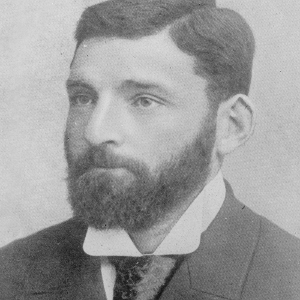
Jeremiah O’Donovan Rossa, Irish Fenian leader and prominent member of the Irish Republican Brotherhood, dies suddenly in Staten Island, New York, on June 29, 1915.

Jeremiah O’Donovan Rossa is born Jeremiah O’Donovan at Reenascreena, Rosscarbery, County Cork, on September 10, 1831. Rossa becomes a shopkeeper in Skibbereen where, in 1856, he establishes the Phoenix National and Literary Society, the aim of which is “the liberation of Ireland by force of arms.” This organisation later merges with the Irish Republican Brotherhood (IRB), founded two years later in Dublin.

In December 1858, Roosa is arrested and jailed without trial until July 1859. He is charged with plotting a Fenian rising in 1865, put on trial for high treason, and sentenced to penal servitude for life due to previous convictions. He serves his time in Pentonville, Portland, and Chatham prisons in England.

In an 1869 by-election, Roosa is returned to the British House of Commons for the Tipperary constituency, defeating the Liberal Catholic Denis Caulfield Heron by 1054 to 898 votes. The election is declared invalid because Rossa is an imprisoned felon.

After giving an understanding that he will not return to Ireland, Rossa is released as part of the Fenian Amnesty of 1870. Boarding the S.S. Cuba, he leaves for the United States with his friend John Devoy and three other exiles. Together they were dubbed “The Cuba Five.”

Rossa takes up residence in New York City, where he joins Clan na Gael and the Fenian Brotherhood. He organises the first ever bombings by Irish republicans of English cities in what is called the “dynamite campaign.” The campaign lasts through the 1880s and makes him infamous in Britain. The British government demands his extradition from America but without success.

In 1885, Rossa is shot outside his office near Broadway by an Englishwoman, Yseult Dudley, but his wounds are not life-threatening. He is allowed to visit Ireland in 1894, and again in 1904. On the latter visit, he is made a “Freeman of the City of Cork.”

Rossa is seriously ill in his later years and is finally confined to a hospital bed in St. Vincent’s Hospital, Staten Island, where he dies at the age of 83 on June 29, 1915. His body is returned to Ireland for burial and a hero’s welcome. The funeral at Glasnevin Cemetery on August 1, 1915, is a huge affair, garnering substantial publicity for the Irish Volunteers and the IRB at time when a rebellion, later to emerge as the Easter Rising, is being actively planned. The graveside oration given by Patrick Pearse remains one of the most famous speeches of the Irish independence movement stirring his audience to a call to arms.


2 Comments

Michael Collins Made President of the IRB

michael-collins

Michael Collins, who is also a leader in the Irish Republican Army, is made president of the Irish Republican Brotherhood (IRB) on June 28, 1919.

At the start of the 20th century, the IRB is a stagnating organisation, concerned more with Dublin municipal politics than the establishment of a republic. A younger generation of Ulster republicans aim to change this and, in 1905, Denis McCullough and Bulmer Hobson found the Dungannon Clubs, whose purpose is to discourage enlistment into the British Army and encourage enlistment into the IRB.

In 1909, Michael Collins is introduced to the brotherhood by Sam Maguire. By 1914, the Supreme Council is largely purged of its older, tired leadership, and is dominated by enthusiastic men such as Hobson, McCullough, Patrick McCartan, John MacBride, Seán Mac Diarmada, and Tom Clarke. The latter two are to become the primary instigators of the Easter Rising in 1916.

Following the Rising some republicans, notably Éamon de Valera and Cathal Brugha, leave the organization as they view it as no longer necessary since the Irish Volunteers now perform its function. The IRB, during the War of Independence (1919-1921), is under the control of Michael Collins, who initially is secretary and subsequently, on June 28, 1919, is made president of the Supreme Council.

When the Anglo-Irish Treaty is signed on December 6, 1921, it is debated by the Supreme Council, which votes to accept it by an 11-4 vote. Those who oppose the Treaty include former leader Harry Boland, Austin Stack, and Liam Lynch. Anti-Treaty republicans like Ernie O’Malley, who fought during the Civil War against the Treaty, see the IRB as being used to undermine the Irish Republic.

The IRB becomes quiescent during the Irish Civil War, which ends in May 1923, but it emerges again later that year as a faction within the National Army. It supports Minister for Defence Richard Mulcahy against the “Old IRA,” which fights against the recruitment of ex-British Army personnel and the demobilization of old IRA men. This comes to a head with the Army Mutiny of 1924, in the wake of which Mulcahy resigns and other IRB members of the army are dismissed by acting President of the Executive Council Kevin O’Higgins. The IRB subsequently dissolves itself, although it is not known whether a formal decision is made, or it simply ceases to function.


Leave a comment

Executions of Seán MacDiarmada & James Connolly

macdiarmada-connolly

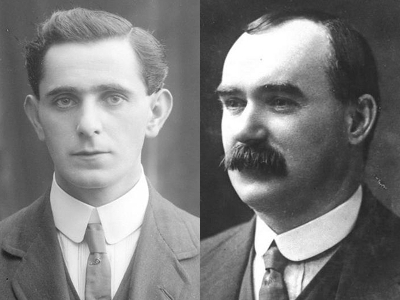
The British army executes Seán MacDiarmada and James Connolly, the last of the Easter Rising leaders to be executed in Dublin, in the Stonebreaker’s Yard at Kilmainham Gaol on May 12, 1916.

Seán MacDiarmada is born in 1884 in Leitrim. He emigrates to Glasgow in 1900 and from there to Belfast in 1902. A member of the Gaelic League, he is acquainted with Bulmer Hobson. He joins the Irish Republican Brotherhood (IRB) in 1906 while still in Belfast, transferring to Dublin in 1908 where he assumes managerial responsibility for the IRB newspaper Irish Freedom in 1910. Although MacDiarmada is afflicted with polio in 1912, he is appointed as a member of the provisional committee of Irish Volunteers from 1913 and is subsequently drafted onto the military committee of the IRB in 1915. During the Rising, MacDiarmada serves in the General Post Office (GPO). Following the surrender, MacDiarmada nearly escapes execution by blending in with the large body of prisoners. He is eventually recognised by Daniel Hoey of G Division and faces a court-martial on May 9.

James Connolly is born in Edinburgh in 1868. Connolly is first introduced to Ireland as a member of the British Army. Despite returning to Scotland, the strong Irish presence in Edinburgh stimulates Connolly’s growing interest in Irish politics in the mid-1890s, leading to his emigration to Dublin in 1896 where he founds the Irish Socialist Republican Party. He spends much of the first decade of the twentieth century in America. He then returns to Ireland to campaign for worker’s rights with James Larkin. A firm believer in the perils of sectarian division, Connolly campaigns tirelessly against religious bigotry. In 1913, Connolly is one of the founders of the Irish Citizen Army. During the Easter Rising he is appointed Commandant-General of the Dublin forces, leading the group that occupies the General Post Office.

The treatment accorded to Connolly is particularly despicable. Crippled by an infected wound in the ankle, he is carried to Kilmainham Gaol, tied to a chair, and shot. As the men are loading their rifles, Connolly forgives the men of the army firing squad for their actions. Shaken by their distasteful task, a ragged volley of shots resounds from their rifles. He is the last of the leaders to be executed.


Leave a comment

Execution of Thomas Kent

thomas-kent

Irish nationalist Thomas Kent is executed at Cork Detention Barracks on May 9, 1916. Kent’s story is one of the stranger episodes that happens after the rebellion in Dublin has been quelled. Unlike the Dublin rebels, Kent does not go out to fight. Rather the British come to him looking for trouble.

Kent is part of a prominent nationalist family who lives at Bawnard House, Castlelyons, County Cork. After spending some time in Boston, he returns to Ireland because of poor health. He is active in the Land League, Sinn Féin, and the Irish Republican Brotherhood. With the launch of the Irish Volunteers in 1913, he is prominent with another legendary Cork man, Terence MacSwiney, in organizing and training recruits.

The Kent family is prepared to take part in the Easter Rising but when the mobilisation order is countermanded by Eoin MacNeill, commander of the Irish Volunteers, on April 22, they stay at home. The rising nevertheless goes ahead in Dublin on Easter Monday. The Royal Irish Constabulary (RIC) is dispatched to arrest well-known sympathizers throughout the country including, but not limited to, known members of the Irish Republican Brotherhood, Sinn Féin, and the Irish Volunteers.

When the Kent residence is raided at 3:45 AM on May 2, the RIC is met with resistance from Thomas and his brothers Richard, David, and William. A gunfight lasts for four hours, during which RIC officer Head Constable William Rowe is killed and David Kent is seriously wounded. Eventually the Kents are forced to surrender, although Richard makes a last-minute dash for freedom and is fatally wounded.

Thomas and William are tried by court martial on May 4 on a charge of “armed rebellion.” William, who is not political, is found innocent, but Thomas is found guilty in the death of Constable Rowe and is sentenced to death. Before being led out for his execution, Kent says, “I have done my duty as a soldier of Ireland and in a few moments, I hope to see the face of God.” He is executed by firing squad in Cork in the early morning hours of May 9. David Kent is brought to Dublin where he is charged with the same offence, found guilty, and sentenced to death, but the sentence is commuted, and he is sentenced to five years penal servitude.

Apart from the singular case of Roger Casement, Thomas Kent is the only person outside of Dublin to be executed for his role in the events surrounding Easter Week. He is buried on the grounds of Cork Prison, formerly the Military Detention Barracks at the rear of Collins Barracks, Cork. The former army married quarters at the rear of Collins Barracks are named in his honour.

Taoiseach Enda Kenny offers a state funeral to the Kent family early in 2015 which they accept. Kent’s remains are exhumed from Cork prison in June 2015 after being buried for 99 years. The state funeral is held on September 18, 2015, at St. Nicholas’ Church in Castlelyons. Kent lay in state at Collins Barracks in Cork the day before. The requiem mass is attended by President Michael D. Higgins, with Enda Kenny delivering the graveside oration.


Leave a comment

Executions of Èamonn Ceannt, Michael Mallin, Seán Heuston, & Con Colbert

colbert-ceannt-mallin-heuston

Irish patriots Èamonn Ceannt, Michael Mallin, Seán Heuston, and Cornelius “Con” Colbert are executed by firing squad in the Stonebreakers Yard at Kilmainham Gaol on May 8, 1916, as the executions following the 1916 Easter Rising continue.

Éamonn Ceannt, one of the seven signatories of the Proclamation of the Irish Republic, is born in Ballymoe, Glenamaddy in County Galway in 1881. Prior to the Rising, Ceannt is an employee of the Dublin Corporation. He is a co-founder of the Irish Volunteers, partaking in the successful Howth gun-running operation of 1914. His involvement in republican activities is complemented by his interest in Irish culture, specifically Irish language and history, although he is also an accomplished uilleann piper. Ceannt is appointed Director of Communications of the Provisional Government and is Commandant of the Fourth Battalion of the Irish Volunteers, who are stationed at the South Dublin Union, now the site of St. James’s Hospital. Ceannt has about 100 men with him, including his second-in-command Cathal Brugha, and W.T. Cosgrave who goes on later to become Taoiseach. Ceannt and his men at the South Dublin Union take part in some of the fiercest fighting in the rebellion and hold out against far superior numbers of British troops.

Michael Mallin, a silk weaver by trade, is born in Dublin on December 1, 1874. Mallin is the Chief of Staff of the Irish Citizen Army (ICA), second in command only to James Connolly. He trains and drills the ICA and is the Commandant of the St. Stephen’s Green Royal College of Surgeons garrison during the Rising. Countess Markievicz is his second in command. This location sees less action than some of the other sites chosen by the rebels because the British concentrate their efforts on the most strategically important targets such as the General Post Office (GPO) and Four Courts. Mallin surrenders on April 30.

Seán Heuston, born in Dublin on February 21, 1891, is responsible for the organisation of Fianna Éireann in Limerick. Along with Con Colbert, Heuston is involved in the education of the schoolboys at Scoil Éanna, organising drill and musketry exercises. Heuston is the Officer Commanding of the Volunteers in the Mendicity Institution on the south side of Dublin. With 26 Volunteers under his command, they hold their position for two days. With his position becoming untenable against considerable numbers, and the building almost completely surrounded, Heuston sends a dispatch to Connolly informing him of their position. It is soon after sending this dispatch that Heuston decides to surrender. Heuston Railway Station in Dublin is named after him.

Con Colbert is born on October 19, 1888, at Monalena in Limerick, and is one of the younger generations of Irish republicans who take part in the Easter Rising. Prior to the Easter Rising he is an active member of the republican movement. He is one of the founding members of Fianna Éireann. A dedicated pioneer, Colbert is known not to drink or smoke. During the Rising, Colbert is the commander of a group of Volunteers stationed at Watkin’s Brewery on Ardee Street, and later at Jameson’s Distillery on Marrowbone Lane. They hold their position until receiving the order to surrender from Patrick Pearse.


Leave a comment

Executions of Edward Daly, Michael O’Hanrahan, Joseph Mary Plunkett, & William Pearse

plunkett-daly-ohanrahan-pearse

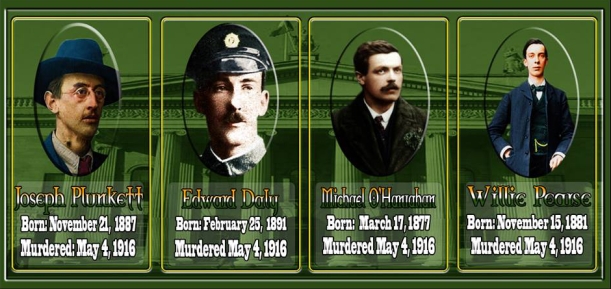
The executions of leaders and participants of the 1916 Easter Rising by the British continue as Edward Daly, Michael O’Hanrahan, Joseph Mary Plunkett, and William Pearse are executed by firing squad in the Stonebreakers Yard at Kilmainham Gaol in Dublin on May 4, 1916.

Edward Daly is born in Limerick in 1891 to a family that has a history of republican activity. His uncle, John Daly, had taken part in the rebellion of 1867. Edward Daly leads the First Battalion during the 1916 Easter Rising, which raids the Bridewell and Linenhall Barracks, eventually seizing control of the Four Courts. A close friend of Tom Clarke, their ties are made even stronger by the marriage of Clarke to Daly’s sister.

Michael O’Hanrahan is born in Wexford in 1877. As a young man, O’Hanrahan shows great promise as a writer, becoming heavily involved in the promotion of the Irish language. He founds the first Carlow branch of the Gaelic League, and publishes two novels, A Swordsman of the Brigade and When the Norman Came. Like many of the other executed leaders, he joins the Irish Volunteers from their inception and is second in command to Thomas MacDonagh at Jacob’s Biscuit Factory during the Rising, although this position is largely usurped by the arrival of John MacBride.

Joseph Mary Plunkett is born in Dublin in 1887, the son of a papal count. Plunkett is initially educated in England, though he returns to Ireland and graduates from University College Dublin in 1909. After his graduation, Plunkett spends two years traveling due to ill health, returning to Dublin in 1911. Plunkett shares Thomas MacDonagh’s enthusiasm for literature and is an editor of the Irish Review. Along with MacDonagh and Edward Martyn, he helps to establish an Irish national theatre. He joins the Irish Volunteers in 1913, subsequently gaining membership of the Irish Republican Brotherhood in 1914. Plunkett travels to Germany to meet Roger Casement in 1915. During the planning of the Rising, Plunkett is appointed Director of Military Operations, with overall responsibility for military strategy. Plunkett is stationed in the General Post Office during the Rising. Seven hours prior to his execution, Plunkett marries his sweetheart, Grace Gifford, in the prison chapel.

William “Willie” Pearse, the younger brother of Patrick, is born in Dublin in 1881. Willie shares his brother’s passion for an independent Ireland. He assists Patrick in running St. Enda’s School. The two brothers are extremely close and fight alongside each other in the General Post Office. He is not one of the planners of the revolt, nor is he one of its commanders. Willie is merely one of the soldiers involved with the Dublin actions. No other participant in Dublin whose actions or responsibilities are similar to Willie’s is executed in the days following the Rising, save perhaps John MacBride, whose earlier service with the Boers probably marks him for death. It seems likely that the sole reason Willie is executed by the British government is for the crime of being Patrick’s brother. It is repugnant British excesses such as this that soon reverse the Irish people’s initially negative opinion of the 1916 Easter Rising.


Leave a comment

Executions of Patrick Pearse, Thomas Clarke, & Thomas MacDonagh

pearse-clarke-mac-donagh

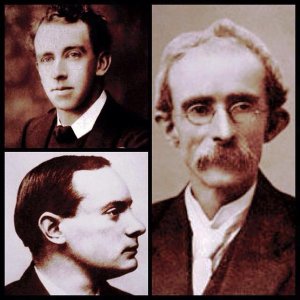
Patrick Pearse, Thomas Clarke, and Thomas MacDonagh are executed by firing squad in the Stonebreakers’ Yard at Kilmainham Gaol in Dublin on May 3, 1916. Pearse, Clarke, and MacDonagh are three of the seven signatories of the Proclamation of the Irish Republic.

Just three days after the end of the 1916 Easter Rising, the first military courts martial sits on May 2, 1916. Pearse, Clarke, and MacDonagh are immediately sentence to death. The three are taken that evening to the disused Kilmainham Gaol and are shot at dawn the following morning.

Patrick Pearse is born in Dublin in 1879, becoming interested in Irish cultural matters in his teenage years. In 1898, Pearse becomes a member of the Executive Commmittee of the Gaelic League. He graduates from the Royal University of Ireland in 1901 with a degree in Arts and Law. Pearse’s literary output is constant, and he publishes extensively in both Irish and English, becoming the editor of An Claidheamh Soluis, the newspaper of the Gaelic League. He is a keen believer in the value of education, and establishes two schools, Coláiste Éanna and Coláiste Íde, devoted to the education of Irish children through the Irish language.  Pearse is one of the founding members of the Irish Volunteers and the author of the Proclamation of the Irish Republic. He is Commander in Chief of the Irish forces and headquartered in the General Post Office (GPO) during the 1916 Easter Rising.

Thomas Clarke is born on the Isle of Wight in 1857, the son of a soldier in the British army. During his time in America as a young man, he joins Clan na Gael, later enduring fifteen years (1883-1898) of penal servitude for his role in a bombing campaign in London. In 1907, having returned from a second sojourn in America, his links with Clan na Gael in America copper-fastens his importance to the revolutionary movement in Ireland. He holds the post of Treasurer to the Irish Republican Brotherhood (IRB) and is a member of the Supreme Council from 1915. Clarke is the first signatory of the Proclamation of the Irish Republic through deference to his seniority. Clarke is also stationed at the GPO during Easter Week. Clarke tells his wife during his final night that he is relieved he is going to be executed because his greatest dread is that he would be sent back to prison.

Thomas MacDonagh is a native of Tipperary, born in 1878. He spends the early part of his career as a teacher. He moves to Dublin to study and is the first teacher on the staff at St. Enda’s School, the school he helps to found with Patrick Pearse. MacDonagh is well versed in literature, his enthusiasm and erudition earning him a position in the English department at University College Dublin. His play When the Dawn is Come is produced at the Abbey Theatre. He is appointed director of training for the Irish Volunteers in 1914, later joining the Irish Republican Brotherhood (IRB). MacDonagh is appointed to the IRB military committee in 1916. He is commander of the Second Battalion of Volunteers that occupies Jacob’s Biscuit Factory and surrounding houses during the Rising.

Immediately after the executions, Irish Parliamentary Party leader John Redmond warns British Prime Minister Herbert Asquith that “if any more executions take place in Ireland the position will become impossible for any constitutional party or leader.”

Asquith himself warns Sir John Maxwell that “anything like a large number of executions would…sow the seeds of lasting trouble in Ireland.”

These warnings fall upon deaf ears as thirteen additional executions take place in the following days.


Leave a comment

Rebels Surrender Ends the 1916 Easter Rising

pearse-surrenders-to-lowe

The Irish Volunteers and Irish Citizen Army rebels headquartered at the General Post Office (GPO) on Sackville Street, after days of shelling, are forced to abandon their headquarters when fire caused by the shells spreads to the GPO. James Connolly, Commandant of the Dublin Brigade, has been incapacitated by a bullet wound to the ankle and has passed command on to Patrick Pearse. Michael Joseph O’Rahilly, a founding member of the Irish Volunteers, is killed in a sortie from the GPO. The rebels tunnel through the walls of the neighbouring buildings in order to evacuate the Post Office without coming under fire and take up a new position at 16 Moore Street.

On Saturday, April 29, 1916, from the new headquarters on Moore Street, after realising that they will not break out of this position without further loss of civilian life, Pearse issues an order for all companies to surrender. Pearse surrenders unconditionally to Brigadier-General William Henry Muir Lowe (photo). The surrender document reads:

“In order to prevent the further slaughter of Dublin citizens, and in the hope of saving the lives of our followers now surrounded and hopelessly outnumbered, the members of the Provisional Government present at headquarters have agreed to an unconditional surrender, and the commandants of the various districts in the City and County will order their commands to lay down arms.”

The other posts surrender only after Pearse’s surrender order, carried by nurse Elizabeth O’Farrell, reaches them. Sporadic fighting, therefore, continues into Sunday, April 30, when word of the surrender is received by the other rebel garrisons. Command of British forces has passed from Lowe to General John Maxwell, who arrives in Dublin just in time to accept the surrender. Maxwell is made temporary military governor of Ireland.

The surrender signals the end of the 1916 Easter Rising, the most significant campaign in the struggle for Irish independence since the Irish Rebellion of 1798. The Rising leaves large parts of the city decimated and results in thousands of casualties. It is also, unambiguously, a spectacular military failure. And yet it is the spark that lights the fuse on the Irish War of Independence which, within five years, forces the British government to the negotiating table to discuss the terms of Irish independence.

Martial law, which was declared in Dublin by British authorities, remains in effect in Ireland through the fall of 1916.

The 1916 Easter Rising results in at least 485 deaths, according to the Glasnevin Trust. More than 2,600 are wounded, including at least 2,200 civilians and rebels, at least 370 British soldiers, and 29 policemen. The vast majority of the Irish casualties are buried in Glasnevin Cemetery in the aftermath of the fighting. British families come to Dublin Castle in May 1916 to reclaim the bodies of British soldiers and funerals are arranged. Soldiers whose bodies are not claimed are given military funerals in Grangegorman Military Cemetery.


Leave a comment

The Battle of Ashbourne

fingal-brigade-ira

As the end of the 1916 Easter Rising becomes increasingly apparent and the rebels in Dublin are being squeezed harder and harder by the British forces, the rebels outside the city achieve a small victory on Friday, April 28, 1916, in what comes to be known as the Battle of Ashbourne.

The Battle of Ashbourne is a direct confrontation and gun battle between up to 70 members of the Royal Irish Constabulary (RIC) and about 37 Irish Volunteers, led by Thomas Ashe and Richard Mulcahy. It is one of the few engagements outside of Dublin city centre and is, in contrast to the main Rising in Dublin, a successful one.  It is also an example of the guerilla warfare that becomes a normal method of operation during the Irish War of Independence.

After the Volunteers battalion is mobilized on Easter Sunday, they are split into smaller groups, known as flying columns, and are sent north of Dublin city towards Ashbourne. Their mission is to destroy the railway line near Batterstown and disrupt the movement of British troops into the city. They set out by bicycles, mostly armed with shotguns. After raiding a number of barracks in the area, cutting communications, and collecting rifles, they reach the Cross of the Rath at Ashbourne.

There they are met with a barricade that has been hastily erected by the RIC members stationed in the barracks nearby. The RIC constables quickly surrender and are sent to the barracks to order a full surrender, but they do not return. The Volunteers take up positions across the road while James O’Connor and Ashe try to break in the door. The constables begin firing from the upper windows of the building and a gun battle breaks out.

The fighting intensifies as RIC reinforcements arrive from Navan, Dunboyne, and Slane. Two Volunteers, John Crennigan and Thomas Rafferty, are fatally wounded. When District Inspector Gray is killed, the constables surrender and are taken prisoner. The Volunteers gather their arms and ammunition while Ashe warns the constables that they will be shot if they take up arms against the Irish people again.

In total, fourteen people are killed in the battle – two Volunteers, eight RIC members, two civilians driving the RIC cars, and two innocent civilians caught in the crossfire. Many more are injured.

The Volunteers’ victory is short lived, however, as in the early afternoon of the next day Ashe receives word of the surrender in Dublin. He demobilises the battalion and sends the men home. Many, including O’Connor, are arrested within days and interned in Wakefield Prison and Frongoch Internment Camp.

Ashe eventually spends time in jail for his role in the uprising and is jailed again in 1917. He begins a hunger strike on September 20, demanding POW status. Ashe dies after just five days on hunger strike from injuries received while being force-fed. The manner of his death outrages the Irish population.

As a side note, Thomas Ashe is a cousin of actor Gregory Peck.