seamus dubhghaill

Promoting Irish Culture and History from Little Rock, Arkansas, USA


Leave a comment

Death of Frank Fay, Actor & Co-founder of the Abbey Theatre

Frank J. (Francis John) Fay, actor, theatrical producer and co-founder of the Abbey Theatre in Dublin, dies on January 2, 1931.

Fay is born on August 30, 1870, at 10 Lower Dorset Street, Dublin, the eldest son of four children of William Patrick Fay, a government clerk, and his wife, Martha Fay (née Dowling). He is educated at Belvedere College, Dublin, where he learns shorthand and typing, before leaving to become a secretary for an accountancy firm in Dublin. From an early age he has a passion for the theatre and immerses himself in books on the subject, becoming a drama expert. His brother, William George Fay, shares his enthusiasm and they take part in many amateur productions, setting up the Ormonde Dramatic Company in 1891.

Fay is an ardent nationalist, and Arthur Griffith appoints him drama critic for his newspaper, the United Irishman (1899–1902), where he develops his ideas on how the theatre should be run. Initially in favour of plays in the Irish language, he soon abandons this as unworkable. In May 1901 he attacks W. B. Yeats for his faulty notions about theatre and even his work as a dramatist, ending with the fiercely nationalistic assertion that “there is a herd of Saxon and other swine fattening on us. They must be swept into the sea with the pestilent breed of West Britons with which we are troubled, or they will sweep us there.” Yeats’s and Lady Gregory‘s next play is Cathleen ni Houlihan.

In 1902, Fay writes a famous article advocating a national theatre company that will “be the nursery of an Irish dramatic literature which, while making a world-wide appeal, would see life through Irish eyes.” He is a member of his brother’s National Dramatic Society, which merges with the Irish Literary Theatre in 1902 to form the Irish National Theatre Society, the originating body of the Abbey Theatre. The following year Yeats declares that the national theatre owes its existence to the two Fay brothers. Fay soon abandons Griffith and begins to champion the cause of Yeats.

An excellent tragic actor, Fay can make audiences forget his less than five feet six-inch stature through the power of his voice. When the Abbey Theatre opens on December 27, 1904, he stars in Yeats’s On Baile’s Strand as Cú Chulainn, a role he makes his own. He spends much time training the other actors. As an elocution teacher he has no equal. One play has Yeats leaving with his “head on fire” because of the quality of the voices on stage. Yeats dedicates his play The King’s Threshold (1904) with the words: “In memory of Frank Fay and his beautiful speaking in the character of Seanchan.”

Fay has a close but turbulent relationship with his brother William, whom he defers to in all theatrical matters except acting. Their heated arguments sometimes lead to blows. His temper is always volatile, and he is prone to histrionics and fits of depression. After 1905, the Abbey Theatre becomes a limited company owing to the patronage of Annie Horniman, and the Fays lose most of their control, which results in much tension and bitterness. In 1907, Fay plays Shawn Keogh in the first production of The Playboy of the Western World by John Millington Synge.

Disagreements with Yeats over the approach to choosing and staging of plays comes to a head late in late 1907 and the Fays resign on January 13, 1908. On March 13 they are suspended from the Irish National Theatre Society. They tour the United States with Charles Frohman before separating. Fay then tours England in minor Shakespearean roles and melodrama. Between 1912 and 1914, Thomas MacDonagh and Joseph Mary Plunkett attempt to persuade him to become actor-manager of an Irish theatre. In 1918 he returns to the Abbey Theatre in two short-lived revivals of Yeats’s The Hour Glass and The King’s Threshold. He retires to Dublin permanently in 1921, teaching elocution and directing plays in local colleges.

Fay marries, in 1912, Freda, known as “Bird.” They live at Upper Mount Street, Dublin, and have one son, Gerard, who becomes a popular writer and memoirist. Fay dies on January 2, 1931, having never really recovered from the death of his wife, and is buried at Glasnevin Cemetery. He is credited with creating the Abbey Theatre style of acting, which becomes internationally known, and influences many other schools of acting. He wanted actors to behave as naturally as possible and to speak the lines as people would in real life, rather than with an exaggerated stage delivery. His training is a major influence on subsequent generations, as actors learned to “speak words with quiet force, like feathers borne on puffs of wind.”

(From: “Fay, Frank J. (Francis John)” by Patrick M. Geoghegan, Dictionary of Irish Biography, http://www.dib.ie, October 2009) | Pictured: Portrait of Frank Fay by John Butler Yeats, commissioned by Annie Horniman for the opening of the Abbey Theatre, December 27, 1904)


Leave a comment

Birth of Frank Fay, Actor, Producer and Co-founder of the Abbey Theatre

Frank J. (Francis John) Fay, actor, theatrical producer and co-founder of the Abbey Theatre in Dublin, is born on August 30, 1870, at 10 Lower Dorset Street, Dublin.

Fay is the eldest son of four children of William Patrick Fay, a government clerk, and his wife, Martha Fay (née Dowling). He is educated at Belvedere College, Dublin, where he learns shorthand and typing, before leaving to become a secretary for an accountancy firm in Dublin. From an early age he has a passion for the theatre and immerses himself in books on the subject, becoming a drama expert. His brother, William George Fay, shares his enthusiasm and they take part in many amateur productions, setting up the Ormonde Dramatic Company in 1891.

Fay is an ardent nationalist and Arthur Griffith appoints him drama critic for his newspaper, the United Irishman (1899–1902), where he develops his ideas on how the theatre should be run. Initially in favour of plays in the Irish language, he soon abandons this as unworkable. In May 1901 he attacks W. B. Yeats for his faulty notions about theatre and even his work as a dramatist, ending with the fiercely nationalistic assertion that “there is a herd of Saxon and other swine fattening on us. They must be swept into the sea with the pestilent breed of West Britons with which we are troubled, or they will sweep us there.” Yeats’s and Lady Gregory‘s next play is Cathleen ni Houlihan.

In 1902, Fay writes a famous article advocating a national theatre company that will “be the nursery of an Irish dramatic literature which, while making a world-wide appeal, would see life through Irish eyes.” He is a member of his brother’s National Dramatic Society, which merges with the Irish Literary Theatre in 1902 to form the Irish National Theatre Society, the originating body of the Abbey Theatre. The following year Yeats declares that the national theatre owes its existence to the two Fay brothers. Fay soon abandons Griffith and begins to champion the cause of Yeats.

An excellent tragic actor, Fay can make audiences forget his less than five feet six inch stature through the power of his voice. When the Abbey Theatre opens on December 27, 1904, he stars in Yeats’s On Baile’s Strand as Cú Chulainn, a role he makes his own. He spends much time training the other actors. As an elocution teacher he has no equal. One play has Yeats leaving with his “head on fire” because of the quality of the voices on stage. Yeats dedicates his play The King’s Threshold (1904) with the words: “In memory of Frank Fay and his beautiful speaking in the character of Seanchan.”

Fay has a close but turbulent relationship with his brother William, whom he defers to in all theatrical matters except acting. Their heated arguments sometimes lead to blows. His temper is always volatile and he is prone to histrionics and fits of depression. After 1905, the Abbey Theatre becomes a limited company owing to the patronage of Annie Horniman, and the Fays lose most of their control, which results in much tension and bitterness. In 1907, Fay plays Shawn Keogh in the first production of The Playboy of the Western World by John Millington Synge.

Disagreements with Yeats over the approach to choosing and staging of plays comes to a head late in late 1907 and the Fays resign on January 13, 1908. On March 13 they are suspended from the Irish National Theatre Society. They tour the United States with Charles Frohman before separating. Fay then tours England in minor Shakespearean roles and melodrama. Between 1912 and 1914, Thomas MacDonagh and Joseph Mary Plunkett attempt to persuade him to become actor-manager of an Irish theatre. In 1918 he returns to the Abbey Theatre in two short-lived revivals of Yeats’s The Hour Glass and The King’s Threshold. He retires to Dublin permanently in 1921, teaching elocution and directing plays in local colleges.

Fay marries, in 1912, Freda, known as “Bird.” They live at Upper Mount Street, Dublin, and have one son, Gerard, who becomes a popular writer and memoirist. Fay dies on January 2, 1931, having never really recovered from the death of his wife, and is buried at Glasnevin Cemetery. He is credited with creating the Abbey Theatre style of acting, which becomes internationally known, and influences many other schools of acting. He wanted actors to behave as naturally as possible and to speak the lines as people would in real life, rather than with an exaggerated stage delivery. His training is a major influence on subsequent generations, as actors learned to “speak words with quiet force, like feathers borne on puffs of wind.”

(From: “Fay, Frank J. (Francis John)” by Patrick M. Geoghegan, Dictionary of Irish Biography, http://www.dib.ie, October 2009) | Pictured: Portrait of Frank Fay by John Butler Yeats, commissioned by Annie Horniman for the opening of the Abbey Theatre, December 27, 1904)


Leave a comment

Birth of Author Eilís Dillon

eilis-dillon

Eilís Dillon, Irish author of 50 books, is born in Galway, County Galway on March 7, 1920. Her work has been translated into 14 languages.

Dillon is the third of five children of Professor Thomas Dillon and his wife Geraldine (née Plunkett), who is the sister of Joseph Mary Plunkett. She is raised at Dangan House outside of Galway City before moving to the small fishing village of Barna. She attends the local primary school where she becomes proficient in the Irish language and gains an intimate knowledge of tradition in the Connemara. Her family is involved in Irish revolutionary politics. Her uncle, Joseph Mary Plunkett, is a signatory of the 1916 Proclamation of the Irish Republic and is executed after the Easter Rising.

Educated by the Ursuline nuns in Sligo, she works briefly in the hotel and catering trade. In 1940 she marries Cormac Ó Cuilleanáin, an academic from University College Cork and 17 years her senior. They have at least three children, including the Irish poet and Trinity College Dublin professor Eiléan Ní Chuilleanáin and her brother, Cormac Ó Cuilleanáin, also a Trinity professor, who writes novels as Cormac Millar.

Dillon’s first books are written in Irish including An Choill Bheo, published in 1948, Oscar agus an Cóiste sé nEasóg in 1952 and Ceol na coille in 1955. After the success of The Lost Island, published in 1952, she writes almost exclusively in English. Most of her books are aimed at teen readers with themes of self-discovery and problem solving evident.

Dillon’s adult fiction career begins in 1953 with the publication of the detective novel Death at Crane’s Court. This is followed by Sent to His Account in 1954 and Death in the Quadrangle in 1956. These novels are known for their depiction of contemporary Ireland. Over the following decade Dillon publishes many novels including The Bitter Glass (1959), Across the Bitter Sea (1973) and The Wild Geese (1981).

In 1964 she moves to Rome due to her husband’s poor health. While there she acts as adviser to International Commission on English in the Liturgy. She returns to Cork with her husband in 1969 where he dies the following year. She continues to visit Italy over the next several years, setting some of her stories there including Living in Imperial Rome (1974) and The Five Hundred (1972), though these are not as popular as her Irish books. In 1974 she marries the American-based critic and professor Vivian Mercier, dividing her time between California, Italy and Dublin.

In her later years Dillon plays a prominent role in Irish culture. She is a Fellow of the Royal Society for Literature and a member of Aosdána, serves on the Irish Arts Council 1974–1979, chairs the Irish Writers’ Union and the Irish Writers’ Centre, and founds the Irish Children’s Book Trust. In 1987 she and her husband move permanently to Dublin where she supports up and coming Irish authors. Her last story is Children of Bach published in 1993.

Eilís Dillon dies on July 19, 1994, and is buried beside her second husband in Clara, County Offaly. A prize in her memory is given annually as part of the Bisto Book of the Year Awards.


1 Comment

Birth of Edward Martyn, Playwright & Activist

edward-martyn

Edward Martyn, Irish playwright and early republican political and cultural activist, is born in County Galway on January 30, 1859. He serves as the first president of Sinn Féin from 1905 to 1908.

Martyn is the elder son of John Martyn of Tullira Castle, Ardrahan and Annie Mary Josephine (née Smyth) of Masonbrook, Loughrea, both of County Galway. He is educated at Belvedere College, Dublin, and Wimbledon College, London, both Jesuit schools, after which he enters Christ Church, Oxford in 1877, but leaves without taking a degree in 1879. His only sibling, John, dies in 1883.

Martyn begins writing fiction and plays in the 1880s. While his own output is undistinguished, he acquires a well-earned reputation as a noted connoisseur of music, both European classical and Irish traditional. He is a fine musician in his own right, giving memorable performances for guests on an organ he has installed at Tullira. He uses his wealth to benefit Irish culture.

Martyn is reportedly pivotal in introducing William Butler Yeats and Lady Gregory to each other in 1896. The three found the Irish Literary Theatre, for whom Martyn writes his best and most popular plays, The Heather Field and A Tale of a Town. He covers the costs of the company’s first three seasons, which proves crucial to establishing the company and the future of the Abbey Theatre. He later parts ways with Yeats and Gregory, something he later regrets, but remains on warm terms with Lady Gregory until the end of his life.

Martyn is a cousin and friend to George Moore (1852–1933). The two make frequent trips all over Europe, where Moore influences Martyn’s views on modern art, which result in the latter purchasing several works by Edgar Degas, Claude Monet, Jean-Baptiste-Camille Corot and Kitagawa Utamaro, all later donated to the National Gallery of Ireland. Moore does not share Martyn’s fenian ideas nor espousal of violent means to achieve national sovereignty. Their different political opinions eventually drive their friendship apart.

Martyn is descended from Richard Óge Martyn, a leading Irish Confederate, and Oliver Óge Martyn, a Jacobite who fights in the Williamite War in Ireland. Yet by his lifetime, the family are unionists. Martyn’s outlook begins to change in the 1880s after studying Irish history, as well as living through the events of the Irish Land War. He comes out as an Irish republican when he famously refuses to allow “God Save The Queen” to be sung after a dinner party at Tullira. By this stage he is involved with the political work of Maude Gonne and Arthur Griffith and is a vocal opponent of the visit of Queen Victoria to Ireland in 1897. He also protests the visit by Edward VII in 1903, this time as chairman of the People’s Protection Committee. He is the first president of Sinn Féin from 1905 to 1908. In 1908 he resigns from the party and politics in general to concentrate on writing and his other activities.

He is on close personal terms with Thomas MacDonagh, Joseph Mary Plunkett and Patrick Pearse, and deeply mourns their executions in the aftermath of the Easter Rising. A parish hall and church that he founded at Labane, near Tullira, are burned by the Black and Tans. He supports the Anglo-Irish Treaty of 1921.

Martyn dies at Tullira on December 5, 1923, after years of ill health. Friends and family are shocked at a provision in his will that directs that his body be donated for the use of medical science and, after dissection, be buried in an unmarked pauper’s grave. The Palestrina Choir sings at his graveside. He bequeaths his papers to the Carmelites of Clarendon Street in Dublin, who subsequently misplace and lose them. Portraits of Martyn exist by, among others, John Butler Yeats and Sarah Purser. On his death the senior line of the Martyn family dies out. His property is inherited by his cousins, the Smyths of Masonbrook and Lord Hemphill. Tullira is sold by the latter forty years later changing ownership several times since.


Leave a comment

Death of Author Eilís Dillon

Eilís Dillon, Irish author of 50 books, dies on July 19, 1994. Her work has been translated into fourteen languages.

Dillon is the third of five children of Professor Thomas Dillon and his wife Geraldine née Plunkett, who is the sister of Joseph Mary Plunkett. She is raised at Dangan House outside of Galway before moving to the small fishing village of Barna. She attends the local primary school where she becomes proficient in Irish and gains an intimate knowledge of tradition in the Connemara. Dillon’s family is involved in Irish revolutionary politics. Her uncle, Joseph Mary Plunkett, is a signatory of the 1916 Proclamation of the Irish Republic and is executed after the Easter Rising.

Educated by the Ursuline nuns in Sligo, she works briefly in the hotel and catering trade. In 1940 she marries Cormac Ó Cuilleanáin, an academic from University College Cork and seventeen years her senior. They have at least three children, including the Irish poet and Trinity College, Dublin professor Eiléan Ní Chuilleanáin and her brother, Cormac Ó Cuilleanáin, also a Trinity professor, who writes novels as Cormac Millar.

Dillon’s first books are written in Irish including An Choill Bheo, published in 1948, Oscar agus an Cóiste sé nEasóg in 1952 and Ceol na coille in 1955. After the success of The Lost Island, published in 1952, she writes almost exclusively in English. Most of her books are aimed at teen readers with themes of self-discovery and problem solving evident.

In 1964 she moves to Rome due to her husband’s poor health. While there she acts as adviser to International Commission on English in the Liturgy. She returns to Cork with her husband in 1969 where he dies the following year. She continues to visit Italy over the next several years, setting some of her stories there including Living in Imperial Rome (1974) and The Five Hundred (1972), though these are not as popular as her Irish books. In 1974 she marries the American-based critic and professor Vivian Mercier, dividing her time between California, Italy and Dublin.

Dillon’s adult fiction career begins in 1953 with the publication of the detective novel Death at Crane’s Court. This is followed by Sent to His Account in 1954 and Death in the Quadrangle in 1956. These novels are known for their depiction of contemporary Ireland. Over the following decade Dillon publishes many novels including The Bitter Glass (1959), Across the Bitter Sea (1973) and The Wild Geese (1981).

In her later years Dillon plays a prominent role in Irish culture. She is a Fellow of the Royal Society for Literature and a member of Aosdána, serves on the Irish Arts Council from 1974 until 1979, chairs the Irish Writers’ Union and the Irish Writers’ Centre, and founds the Irish Children’s Book Trust.

In 1987 Dillon and her husband move permanently to Dublin where she supports up and coming Irish authors. Her last story is Children of Bach published in 1993. Eilís Dillon dies on July 19, 1994, and is buried beside her second husband in Clara, County Offaly. A prize in her memory is given annually as part of the Bisto Book of the Year Awards.


Leave a comment

Birth of Irish Nationalist Joseph Mary Plunkett

joseph-mary-plunkett

Joseph Mary Plunkett, Irish nationalist, poet, journalist, and a leader of the 1916 Easter Rising, is born at 26 Upper Fitzwilliam Street in Dublin on November 21, 1887.

Both his parents come from wealthy backgrounds, and his father, George Noble Plunkett, has been made a papal count. Despite being born into a life of privilege, young Joe Plunkett does not have an easy childhood.

Plunkett contracts tuberculosis at a young age. This is to be a lifelong burden. His mother is unwilling to believe his health is as bad as it is. He spends part of his youth in the warmer climates of the Mediterranean and North Africa. He spends time in Algiers where he studies Arabic literature and language and composes poetry in Arabic. He is educated at the Catholic University School and by the Jesuits at Belvedere College in Dublin and later at Stonyhurst College, in Lancashire, England, where he acquires some military knowledge from the Officers’ Training Corps. Throughout his life, Plunkett takes an active interest in Irish heritage and the Irish language and also studies Esperanto. He is one of the founders of the Irish Esperanto League. He joins the Gaelic League and begins studying with Thomas MacDonagh, with whom he forms a lifelong friendship. The two are both poets with an interest in theatre, and both are early members of the Irish Volunteers, joining their provisional committee. Plunkett’s interest in Irish nationalism spreads throughout his family, notably to his younger brothers George and John, as well as his father, who allows his property in Kimmage, south Dublin, to be used as a training camp for young men who wish to escape conscription in Britain during the First World War. Men there are instead trained to fight for Ireland.

Sometime in 1915 Plunkett joins the Irish Republican Brotherhood (IRB) and soon after is sent to Germany to meet with Roger Casement, who is negotiating with the German government on behalf of Ireland. Casement’s role as emissary is self-appointed, and, as he is not a member of the IRB, the organisation’s leadership wishes to have one of their own contact Germany to negotiate German aid for an uprising the following year. Plunkett is seeking, but not limiting himself to, a shipment of arms. Casement, on the other hand, spends most of his energies recruiting Irish prisoners of war in Germany to form a brigade to fight instead for Ireland. Some nationalists in Ireland see this as a fruitless endeavour, and prefer to seek weapons. Plunkett successfully gets a promise of a German arms shipment to coincide with the rising.

Plunkett is one of the original members of the IRB Military Committee that is responsible for planning the Easter Rising, and it is largely his plan that is followed. Shortly before the rising is to begin, Plunkett is hospitalised following a turn for the worse in his health. He has an operation on his neck glands days before Easter and has to struggle out of bed to take part in what is to follow. Still bandaged, he takes his place in the General Post Office with several other of the rising’s leaders, including Patrick Pearse and Tom Clarke, though his health prevents him from being terribly active. His energetic aide-de-camp is Michael Collins.

Following the surrender Plunkett is held in Kilmainham Gaol, and faces a court-martial. Seven hours before his execution by firing squad at the age of 28, he is married in the prison chapel to his sweetheart Grace Gifford, a Protestant convert to Catholicism, whose sister, Muriel, had years before also converted and married his best friend Thomas MacDonagh, who is also executed for his role in the Easter Rising. Plunkett is executed by firing squad on May 4, 1916, and is the fourth and youngest signatory of the Proclamation of the Irish Republic to be executed.

Plunkett’s brothers, George Oliver Plunkett and Jack Plunkett, join him in the Easter Rising and later become important Irish Republican Army (IRA) men. His father’s cousin, Horace Plunkett, is a Protestant and unionist who seeks to reconcile unionists and nationalists. Horace Plunkett’s home is burned down by the Anti-Treaty IRA during the Irish Civil War.

The main railway station in Waterford City is named after Plunkett as is Joseph Plunkett Tower in Ballymun. Plunkett barracks in the Curragh Camp, County Kildare is also named after him.


Leave a comment

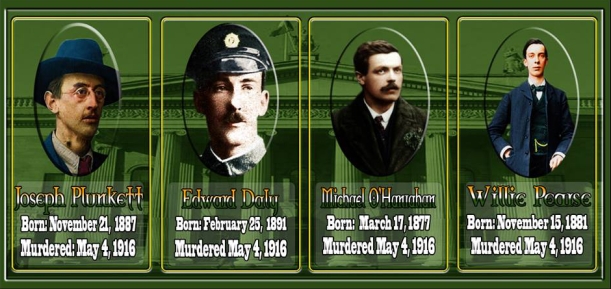
Executions of Edward Daly, Michael O’Hanrahan, Joseph Mary Plunkett, & William Pearse

plunkett-daly-ohanrahan-pearse

The executions of leaders and participants of the 1916 Easter Rising by the British continue as Edward Daly, Michael O’Hanrahan, Joseph Mary Plunkett, and William Pearse are executed by firing squad in the Stonebreakers Yard at Kilmainham Gaol in Dublin on May 4, 1916.

Edward Daly is born in Limerick in 1891 to a family that has a history of republican activity. His uncle, John Daly, had taken part in the rebellion of 1867. Edward Daly leads the First Battalion during the 1916 Easter Rising, which raids the Bridewell and Linenhall Barracks, eventually seizing control of the Four Courts. A close friend of Tom Clarke, their ties are made even stronger by the marriage of Clarke to Daly’s sister.

Michael O’Hanrahan is born in Wexford in 1877. As a young man, O’Hanrahan shows great promise as a writer, becoming heavily involved in the promotion of the Irish language. He founds the first Carlow branch of the Gaelic League, and publishes two novels, A Swordsman of the Brigade and When the Norman Came. Like many of the other executed leaders, he joins the Irish Volunteers from their inception and is second in command to Thomas MacDonagh at Jacob’s Biscuit Factory during the Rising, although this position is largely usurped by the arrival of John MacBride.

Joseph Mary Plunkett is born in Dublin in 1887, the son of a papal count. Plunkett is initially educated in England, though he returns to Ireland and graduates from University College Dublin in 1909. After his graduation, Plunkett spends two years traveling due to ill health, returning to Dublin in 1911. Plunkett shares Thomas MacDonagh’s enthusiasm for literature and is an editor of the Irish Review. Along with MacDonagh and Edward Martyn, he helps to establish an Irish national theatre. He joins the Irish Volunteers in 1913, subsequently gaining membership of the Irish Republican Brotherhood in 1914. Plunkett travels to Germany to meet Roger Casement in 1915. During the planning of the Rising, Plunkett is appointed Director of Military Operations, with overall responsibility for military strategy. Plunkett is stationed in the General Post Office during the Rising. Seven hours prior to his execution, Plunkett marries his sweetheart, Grace Gifford, in the prison chapel.

William “Willie” Pearse, the younger brother of Patrick, is born in Dublin in 1881. Willie shares his brother’s passion for an independent Ireland. He assists Patrick in running St. Enda’s School. The two brothers are extremely close and fight alongside each other in the General Post Office. He is not one of the planners of the revolt, nor is he one of its commanders. Willie is merely one of the soldiers involved with the Dublin actions. No other participant in Dublin whose actions or responsibilities are similar to Willie’s is executed in the days following the Rising, save perhaps John MacBride, whose earlier service with the Boers probably marks him for death. It seems likely that the sole reason Willie is executed by the British government is for the crime of being Patrick’s brother. It is repugnant British excesses such as this that soon reverse the Irish people’s initially negative opinion of the 1916 Easter Rising.