seamus dubhghaill

Promoting Irish Culture and History from Little Rock, Arkansas, USA


Leave a comment

Birth of Gerard Hogan, Judge, Lawyer & Academic

Gerard William Augustine Hogan, MRIA, Irish judge, lawyer and academic who has served as a Judge of the Supreme Court of Ireland since October 2021, is born on August 13, 1958, in Carrick-on-Suir, County Tipperary. He previously serves as Advocate General of the European Court of Justice from 2018 to 2021, a Judge of the Court of Appeal from 2014 to 2018 and a Judge of the High Court from 2010 to 2014. He first works as a barrister and lecturer in law specialising in constitutional and administrative law.

Hogan is born to Mai and Liam Hogan. His father is the deputy principal of the Christian Brothers secondary school in the town. He is educated at University College Dublin (UCD), from where he receives BCL and LLM degrees in 1979 and 1981. He co-authors his first book Prisoners’ Rights: A Study in Irish Prison Law in 1981 with Paul McDermott and Raymond Byrne. He obtains a John F. Kennedy memorial scholarship to study for an LLM at the University of Pennsylvania Law School. He subsequently attends the King’s Inns. He holds two doctorates – an LLD from UCD and a PhD in law from Trinity College Dublin in 2001.

In 1986, early in his legal career, he supports the Anti-Apartheid Movement with other legal scholars, including Mary McAleese, Mary Robinson and Bryan MacMahon. He is involved with the Progressive Democrats and in 1988 writes the party’s proposed new Constitution of Ireland with Michael McDowell. In May 2021, he is made a member of the Royal Irish Academy.

Hogan is called to the Bar in July 1984 and becomes a Senior Counsel in 1997. He appears domestically in cases in the High Court and the Supreme Court and internationally at the European Court of Human Rights and the European Court of Justice.

Hogan is noted in particular for his experience in constitutional law. He acts for the Attorney General of Ireland in references made by President Mary Robinson under Article 26 of the Constitution of Ireland to the Supreme Court regarding the Information (Termination of Pregnancies) Bill 1995 and the Employment Equality Bill of 1997. He appears again for the Attorney General (with Dermot Gleeson and Paul Gallagher) in another reference made by President Mary McAleese regarding the Health (Amendment) (No. 2) Bill 2004.

Hogan is a law lecturer and fellow at Trinity College Dublin from 1982 to 2007. He lectures on constitutional law, competition law and the law of tort. He is regarded as “one of the foremost constitutional and administrative lawyers in Ireland.” He is the co-author of Administrative Law in Ireland and JM Kelly: The Irish Constitution, the core Irish legal texts in Irish administrative and constitutional law respectively. He also writes a text on political violence and a book chronicling the origins of the Constitution of Ireland.

During his career as a barrister, Hogan is involved in cases involving employment law, habeas corpus, immigration law, judicial review, company law and commercial law.

Hogan appears for Katherine Zappone and Ann Louise Gilligan in Zappone v. Revenue Commissioners in the High Court and Miss D in her case related to the rights to travel abroad for an abortion. He represents the State in the High Court and the Supreme Court in litigation that emerges following a court finding that an offence of unlawful carnal knowledge is unconstitutional. In 2008, he acts for Colm Murphy and Seamus Daly in the Supreme Court who are contesting an action taken by families of victims of the Omagh bombing when they are refused access to books of evidence.

Hogan is involved in several tribunals and Oireachtas committee investigations, appearing either in the actual proceedings or in related court proceedings. He represents Desmond O’Malley at the Beef Tribunal in 1992, Dermot Desmond at the Moriarty Tribunal in 2004, and Jim Higgins and Brendan Howlin in actions related to the Morris Tribunal. He acts for the Committee on Members’ Interests of Seanad Éireann in action taken by Ivor Callely.

Hogan is the first barrister to appear in an Irish court without a wig, following the enactment of the Courts and Court Officers Act 1995.

Throughout his career, Hogan has been a member of committees and boards in areas requiring legal expertise. He chairs the Department of Justice‘s Balance in Criminal Law Review Group and is a member of three other review groups: the Constitution Review Group, the Competition and Mergers Review Group and the Offences Against the State Acts Review Group. He is also a member of the Competition Authority‘s Advisory Panel and the Committee on Court Practice and Procedure.

Hogan is appointed a Judge of the High Court in 2010. Soon after his appointment, he holds an emergency hearing in his home regarding a blood transfusion for a sick baby. He is one of three judges who hears a case taken by Marie Fleming, seeking a right to die in 2012. His reference to the European Court of Justice in 2014 regarding the International Safe Harbor Privacy Principles, results in a declaration by the Grand Chamber that the Safe Harbour Decision is invalid. He subsequently becomes a Judge of the Court of Appeal upon its establishment in October 2014.

In May 2018, Hogan is nominated by the Government of Ireland for appointment as the Advocate General to the European Court of Justice. His term begins in October 2018 and was scheduled to expire in October 2024. Anthony Collins is appointed in 2021 to complete his term following his appointment to the Supreme Court. He concludes his term on October 7, 2021.

In one of his first opinions, on a reference from the French Conseil d’État, Hogan finds that Regulation (EU) No 1169/2011 of the European Parliament and of the Council of October 25, 2011, requires that products originating from Israeli-occupied territories should indicate if these products come from such a territory. His opinion is followed by the Court of Justice.

In April 2021, the Irish government nominates Hogan to the Supreme Court of Ireland. He is appointed in October 2021.


Leave a comment

20th Anniversary of the 1981 IRA Hunger Strikes

hunger-strike-20th-anniversary

On August 12, 2001, loyalist protesters block a main road in north Belfast to prevent the republican Wolfe Tone Flute band from joining a parade in the Ardoyne district commemorating the 20th anniversary of the 1981 Irish Republican Army (IRA) hunger strikes.

The 20-minute blockade of the Ligoniel Road is in response to the local branch of the loyalist Apprentice Boys of Derry organisation being refused permission to drive their bus past the nationalist Ardoyne the previous day.

Billy Hutchinson, the Progressive Unionist Party Assembly member for Belfast North says, “Nationalists are saying that the Apprentice Boys can’t come down the Crumlin Road on a bus because it is seen to be a parade.” He adds further, “I think loyalists are saying if the Apprentice Boys can’t go down on a bus why should the Wolfe Tone band be allowed to go down on a bus?”

On August 11, police officers prevent the Ligoniel Walker Club of the Apprentice Boys of Derry from driving their bus down the Crumlin Road past the Ardoyne shops because it constitutes a parade and breaches a ruling by the Parades Commission. The club is prevented by the Commission from marching through the area and tries in vain to broker a last minute compromise to use their bus.

Gerry Kelly, Sinn Féin Assembly member for Belfast North, describes the loyalist protest as a “nonsense,” adding he does not believe that nationalist residents had objected to the organisation using their bus. “That is a decision the RUC (Royal Ulster Constabulary) took on the ground. I don’t think there would have been a problem from the people of Ardoyne,” he adds.

The Apprentice Boys vow to seek a judicial review into the decision to prevent them from traveling through the area to get to their main parade in Derry.

After a six and a half hour stand-off, Apprentice Boys representative Tommy Cheevers brands the Parades Commission a “farce.”

(From: “Hunger strike march blocked by loyalists” from The Irish Times, Sunday, August 12, 2001 | Photo credit: PA:Press Association)


Leave a comment

Trimble Rejects Power Sharing Compromise

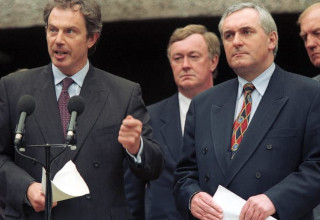
blair-ahern-stormont-castle-1999On July 14, 1999, Ulster Unionists under David Trimble reject a compromise for the creation of a power sharing government placing the Northern Ireland peace process in grave trouble. The proposals would have seen inclusive self-government introduced in Northern Ireland on Sunday, July 18, 1999.

Early in the day the government rushes legislation through the House of Commons providing for the suspension of the Executive if the Irish Republican Army (IRA) fails to decommission all its arms by May 2000 in line with a timetable, yet to be drawn up. It refuses to accept any Ulster Unionist amendments. But within 12 hours, British Prime Minister Tony Blair signals that three new amendments will be included to tighten the so-called failsafe mechanism when the bill is debated in the House of Lords in the evening.

The first amendment makes clear that decommissioning must proceed in line with a timetable to be drawn up by General John de Chastelain. The second provides for the automatic suspension of the Executive, while the third provides for the party in default to be clearly identified.

They fail to sway Trimble, who criticises The Way Forward as a hastily concocted scheme. However, he does leave the door open for further negotiations to save the agreement. “If there was a clear watertight scheme, in which there was at the outset an unequivocal commitment to change and a process that genuinely guaranteed to deliver that change, we would have to consider whether a scruple over a period of days could be justified.”

Sinn Féin is furious with party president Gerry Adams saying, “Those who may genuinely want to deal with the issue of guns are going about it in absolutely the worst and wrong way.” The party wants the assembly to be wound up immediately, and all members’ wages to be stopped. It wants the British and Irish governments to continue to implement all aspects of the agreement which are within their control. Adams is enraged by Blair’s move to amend the failsafe legislation. His party says it will consider applying for judicial review of the amended bill, believing it to compromise the International Commission on Decommissioning and unlawfully conflict with the agreement.

Blair and Taoiseach Bertie Ahern announce on the following day that the 15-month-old and ailing Good Friday Agreement will go into a review procedure involving all the political parties and be effectively parked over the summer.

Trimble, leader of the Ulster Unionists, resists intense government pressure as he refuses to back the British and Irish governments’ blueprint providing for a power-sharing executive the following week and IRA decommissioning in the summer. He repeats his party’s view that Sinn Féin can only join his cabinet once the IRA has started to hand over its weapons.

The outcome is a bitter personal setback for Blair. In a last-minute televised appeal to the Unionists not to “close the door’ on an agreement, he appears to acknowledge that they will have to try to find another way forward. “I believe in the end we will get an agreement on this. Whether we manage it by tomorrow morning, that is more difficult,” he says.

Trimble complains he had too little time to secure backing within his split party for The Way Forward, which the governments issued twelve days earlier after a week of intense negotiations at Stormont Castle. Blair’s handling of the affair is questioned.

Trimble’s problem with the legislative failsafe is that it punishes all parties for an IRA transgression of a decommissioning timetable, yet to be drawn up. It provides for the executive to be suspended, rather than carry on with Sinn Féin’s two ministerial posts allocated to other parties. The nationalist Social Democratic and Labour Party (SDLP), which could have given Trimble cover on the issue of expulsion, declines to say whether it will vote for Sinn Féin’s expulsion, which infuriates Ulster Unionists.

Negotiations to save the Good Friday Agreement have gone through four deadlines during the year. There are fears that the latest delay might lead to Sinn Féin withdrawing its declaration on IRA arms.

(Pictured: British Prime Minister Tony Blair and Taoiseach Bertie Ahern present a joint British-Irish blueprint for implementation of the Good Friday Agreement at Stormont Castle in Belfast, June 2, 1999 | Sean Gallup | Getty Images)


Leave a comment

Birth of Patrick McGilligan, Fine Gael Politician

patrick-mcgilligan

Patrick Joseph McGilligan, lawyer and Cumann na nGaedheal and Fine Gael politician, is born in Hanover Place, Coleraine, County Londonderry on April 12, 1889. He serves as the 14th Attorney General of Ireland from 1954 to 1957, Minister for Finance from 1948 to 1951, Minister for External Affairs from 1927 to 1932 and Minister for Industry and Commerce from 1924 to 1932. He serves as a Teachta Dála (TD) from 1923 to 1965.

McGilligan is the son of Patrick McGilligan, a draper, who serves as Member of Parliament (MP) for South Fermanagh from 1892 to 1895 for the Irish Parliamentary Party, and Catherine O’Farrell. He is educated at St. Columb’s College in Derry, Clongowes Wood College in County Kildare and University College Dublin. He joins Sinn Féin but is unsuccessful in his attempt to be elected as a MP at the 1918 general election. He is called to the bar in 1921.

McGilligan is elected as a Cumann na nGaedheal TD for the National University of Ireland at a by-election held on November 3, 1923. Between 1924 and 1932 he serves as Minister for Industry and Commerce, notably pushing through the Shannon hydroelectric scheme, then the largest hydroelectricity project in the world. In 1927 he sets up the Electricity Supply Board (ESB), and also the Agricultural Credit Corporation.

Also, in 1927 McGilligan takes over the External Affairs portfolio following the assassination of Kevin O’Higgins by the anti-Treaty elements of the Irish Republican Army (IRA), in revenge for O’Higgins’ support for the execution of Republican prisoners during the Irish Civil War. In this position he is hugely influential at the Committee on the Operation of Dominion Legislation and at the Imperial Conference in 1930 jointly with representatives of Australia, Canada, New Zealand, South Africa and the United Kingdom. The Statute of Westminster that emerges from these meetings gives greater power to dominions in the Commonwealth like the Irish Free State.

During McGilligan’s period in opposition from 1932 to 1948 he builds up a law practice and becomes professor of constitutional and international law at University College, Dublin. When the National University of Ireland representation is transferred to Seanad Éireann in 1937, he is elected as TD for the Dublin North-West constituency.

In 1948 McGilligan is appointed Minister for Finance in the first Inter-Party Government. As Minister he undertakes some major reforms. He instigates a new approach where Government invests radically in capital projects. Colleagues however complain of his frequent absence from the Cabinet table and the difficulty of contacting him at the Department of Finance. Between 1954 and 1957 he serves as Attorney General. He retires from Dáil Éireann at the 1965 general election, having served for over 40 years.

Patrick McGilligan dies in Dublin on November 15, 1979. Despite his well-known fondness for predicting that he would die young, he reaches the age of ninety. A later Attorney General, John M. Kelly, in the preface to his definitive text, The Irish Constitution (1980), notes the remarkable number of senior judges who are former students of McGilligan and suggests that, given his own firm belief in the value of judicial review, he deserves much of the credit for the remarkable development of Irish law in this field since the early 1960s.