seamus dubhghaill

Promoting Irish Culture and History from Little Rock, Arkansas, USA


Leave a comment

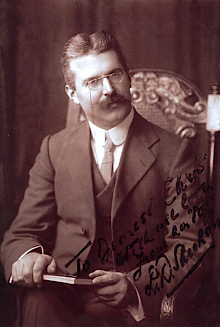
Birth of D. D. Sheehan, Nationalist Politician & Labour Leader

Daniel Desmond (‘D. D.’) Sheehan, Irish nationalist, politicianlabour leader, journalistbarrister and author, is born on May 28, 1873, at Dromtariffe, Kanturk, County Cork.

The eldest of the three sons and one daughter of Daniel Sheehan, tenant farmer, and his wife, Ellen (née Fitzgerald). He is educated at the local primary school. In his book Ireland since Parnell (1921) he states that witnessing the ragged poverty of labourers’ and smallholders’ children who attended the school made him determined to do something for the poor. The family’s Fenian tradition and his parents’ eviction from their holding in 1880 form his early years. At the age of sixteen he becomes a schoolteacher.

In 1890, Sheehan takes up journalism, serving as correspondent of the Kerry Sentinel and special correspondent of the Cork Daily Herald in Killarney. He also becomes correspondence secretary to the Kanturk trade and labour council, which campaigns on behalf of agricultural labourers. He manages to get reports of meetings into the Cork papers, and this helps the rapid spread of the association, which in 1890 becomes the Irish Democratic Trade and Labour Federation, under the leadership of Michael Davitt. It is, however, fatally disrupted by the Parnell split. While Sheehan continues to admire Davitt, and despite the pre-split Irish party leadership having opposed the federation as a threat to Charles Stewart Parnell‘s leadership, he becomes a Parnellite, and always remembers his only meeting with Parnell at Tralee, when the chief is presented with a loyal address (drafted by Sheehan) from his Killarney supporters. After Parnell’s death and the defeat of the Second Home Rule Bill, he temporarily drops out of Irish politics.

Following his marriage on February 6, 1894, to Mary Pauline O’Connor of Tralee, Sheehan joins the staff of the Glasgow Observer in pursuit of journalistic experience, then becomes editor of the Catholic News in Preston, Lancashire. In 1898, he returns to Ireland and works on various papers, including the Cork Constitution, before serving as editor of the Skibbereen-based Cork County Southern Star (1899–1901), where his Parnellism brings him into conflict with the Bishop of Ross, Denis Kelly. He expresses sympathy for the newly founded United Irish League (UIL), established by William O’Brien in Connacht with the dual aim of representing western smallholders and using a new land agitation as a vehicle for Irish Party reunion. He does not, however, join the UIL himself.

In August 1894, the Clonmel solicitor J. J. O’Shee, anti-Parnellite MP for West Waterford from 1895, forms the Irish Land and Labour Association (ILLA) to agitate on behalf of agricultural labourers and small tenant farmers. Its appearance reflects the breakdown of the centralised party discipline which had existed before the Parnell split, and recognition that the land war’s prime beneficiaries had been large and middle-sized tenant farmers rather than the nation as a whole. On returning from Britain in 1898, Sheehan throws himself into organising the ILLA and becomes its president. In 1900 there are 100 branches, mostly in Cork, Tipperary, and Limerick. The Irish Party leadership look on this organisation with some suspicion.

At the 1900 United Kingdom general election in Ireland Sheehan seeks the Irish Parliamentary Party (IPP) nomination for South Cork but was defeated by Edward Barry. After the death of Dr Charles Tanner, however, he succeeds in obtaining the IPP nomination for the constituency of Mid Cork, despite the party leadership’s attempts to deny recognition to ILLA branches in order to hand the nomination to its favoured candidate. Sheehan is elected unopposed on May 17, 1901. At the age of 28, he is the youngest Irish member of parliament. Although he has been admitted to the party, his position as a labour representative and his perceived independent base make him something of an outsider.

From October 1904 Sheehan allies himself with O’Brien, writing regularly for the latter’s weekly a The Irish People. Redmondites accuse him of opportunism, but he always maintains that his personal inclination as an old Parnellite has been towards John Redmond and that his support for O’Brien derives from the older man’s willingness from 1904 to identify himself with the labourers’ campaign. Although their alliance originally likely contains elements of expediency, Sheehan and O’Brien develop a deep personal friendship.

Sheehan’s support for O’Brien leads to a split in the ILLA in 1906, with Tipperary and Waterford branches following O’Shee and Redmond, and Sheehan retaining the support of his Cork base and of some branches in Limerick and Kerry. He serves on the Cork advisory committee which represents tenant interests in land purchase negotiations under the Wyndham Land Act. It’s policy of “conference plus business” combines an offer to negotiate with willing landlords and a threat of agitation against those unwilling to give satisfactory terms. His faction of the ILLA becomes the basis for the grassroots organisation of O’Brien’s followers, and sporadic attempts, financed by O’Brien, are made to spread it outside its Munster base. Both factions of the ILLA claim credit for the passage of the 1906 and 1911 Labourers’ (Ireland) Acts which provide for the allocation of cottages and smallholdings to labourers. In Cork and some other parts of Munster these buildings become popularly known as “Sheehan’s cottages,” a term which long outlives Sheehan’s political career. He also helps to bring about the creation of a “model village” at Tower, near Blarney, the result of cooperation between the local ILLA branch and the rural district council.

At the 1906 general election the Redmond leadership attempts to avoid an open split by allowing O’Brien’s supporters to return unopposed. However, the continuing conflict between the two factions rapidly leads to a formal break. Shortly after the election Sheehan is excluded from the IPP, and thereby deprived of the parliamentary stipend paid to MPs with insufficient resources to maintain themselves. With the support of O’Brien and the small group of O’Brienite MPs, he maintains that the party has no right to exclude an elected MP willing to take the party pledge. After resigning his seat to which he was re-elected without opposition on December 31, 1906, he demands readmission to the party and mounts an unsuccessful lawsuit demanding payment of the stipend. He is subsequently supported from the proceeds of collections outside church gates on Sundays.

Sheehan and the other O’Brienite MPs are readmitted to the party in 1908 as part of an attempt at general reconciliation after the disruptions following the rejection of the Irish Council Bill. Dissensions rapidly reappear over Augustine Birrell‘s 1909 land act, which the O’Brienites see as wriggling out of the financial responsibilities accepted by the British government in the Wyndham land act and as sabotaging land purchase, since landlords will not accept the terms offered. Sheehan’s section of the ILLA is denied official recognition and thereby prevented from sending delegates to a party convention called to consider the bill. At the convention, groups of “heavies”recruited from Joseph Devlin‘s Ancient Order of Hibernians (AOH) exclude delegates with Cork accents, while O’Brienite speakers are howled down. This leads to the formation in March 1909 of the All-for-Ireland League (AFIL), a body based on the existing O’Brienite organisation and advocating O’Brien’s policy of gradually implementing home rule through step-by-step cooperation with moderate unionist supporters of devolution. Although O’Brien’s temporary retirement for health reasons in April 1909 leads to the suspension of the AFIL, it is revived in response to an attempted purge of the O’Brienite MPs by the leadership and by O’Brien’s reappearance in response to the January 1910 general election. Sheehan writes regularly for its paper, the Cork Free Press.

In the general election the O’Brienites hold their seats while two Cork Redmondites are displaced. Sheehan is re-elected for Mid Cork, defeating the Redmondite W. G. Fallon in a campaign marked by widespread rioting and impassioned clerical denunciations of Sheehan. Fallon subsequently attempts to get up a “red scare” against the ILLA. The Cork ILLA later splits over Sheehan’s slightly erratic leadership. While the split is initially personality-driven, the breakaway faction, led by Patrick Bradley and centred in east Cork, moves back toward alignment with Redmond. At the December 1910 election the AFIL consolidates its position in Cork, but is defeated everywhere else. Sheehan retains his Mid Cork seat against a local candidate but is defeated in a simultaneous contest in East Limerick. He is also defeated when he stands for Cork County Council in June 1911, though the AFIL wins control of that body.

Sheehan studies law at University College Cork (UCC) (1908–09), where he is an exhibitioner and prizeman, and at King’s Inns, where he graduated with honours. He is called to the bar in 1911 and practised on the Munster circuit. In 1913–14 he is active in the AFIL’s attempts to avert partition by trying to recruit sections of British political opinion in favour of a conference between the parties. He becomes vice-chairman of the Imperial Federation League. This receives considerable attention among the British political classes but contributes to the decline of the AFIL’s electoral base. The policy of conciliation has been driven to a considerable extent by the belief that it is the only way of achieving home rule. The abolition of the House of Lords’ veto and the introduction of the third home rule bill by the Asquith government undercuts this argument and increases Redmond’s prestige, while AFIL denunciations of Redmondism are seen as driven by personal resentment and playing into the hands of unionists. The decision of the AFIL MPs to abstain from supporting the bill on its final passage through the House of Commons in 1914 as a protest against the prospect of a partition-based compromise is represented by Redmondites as a vote against home rule itself and contributed to AFIL loss of Cork County Council in June 1914.

On the outbreak of World War I, Sheehan supports O’Brien in calling for Irish enlistment for foreign service. In November 1914, at the age of forty-two, he enlists himself and is gazetted as a lieutenant in the Royal Munster Fusiliers. It is claimed that he is almost single-handedly responsible for raising the 9th (service) battalion of this regiment. Three of his sons also enlist. Two of his sons are killed in action with the Royal Flying Corps, and a daughter is disabled by injuries received in an air raid while serving as a nurse. In the spring and summer of 1915 he organises and leads recruiting campaigns in Cork, Limerick, and Clare. This is part of a nationwide drive for recruits, aimed in particular at the farming community, which reflects the realisation that the war is going to last much longer than expected.

In 1915, Sheehan is promoted to the rank of captain and serves with his battalion on the Loos-en-Gohelle salient and at the Battle of the Somme, contributing a series of articles from the trenches to the London Daily Express. Various ailments, including deafness caused by shellfire, and hospitalisation necessitate his transfer to the 3rd Royal Munster Fusiliers (Reserve) Battalion, and he resigns his commission on January 13, 1918, due to ill health. In April 1918 he speaks at Westminster against the bill extending conscription to Ireland, threatening to resist it by force. One of his last parliamentary speeches (in October 1918) is in support of a bill providing land grants for Irish ex-servicemen. With the growth of Sinn Féin and the virtual demise of the AFIL, his position in Cork grows increasingly untenable. The Sheehan family faces intimidation and are obliged to leave their home on the Victoria Road for London, where he has secured the Labour Party nomination for the LimehouseStepney division of the East End, later represented by Clement Attlee.

Sheehan is unsuccessful in the 1918 United Kingdom general election, and is obliged to leave politics after a financially disastrous involvement in an Achill Island mining company leads to his bankruptcy. Unable to practise at the bar because of the hearing loss caused by his war service, he returns to journalism and becomes editor and publisher of The Stadium, a daily newspaper for sportsmen. In 1921, shortly before the Anglo-Irish truce, he publishes Ireland since Parnell, a history of recent events heavily dependent on the writings of O’Brien but incorporating some personal reminiscences. It concludes by blaming the outbreak of the IRA guerrilla campaign on provocation by Crown forces, denouncing reprisals, and pleading for British recognition of Dáil Éireann and dominion home rule for an undivided Ireland.

Sheehan moves to Dublin in 1926 after hearing that the threats against him have been lifted. His wife, who has never fully recovered from the stresses and bereavements she has experienced since 1914, dies soon afterward. Sheehan himself becomes managing editor of Irish Press and Publicity Services and, in 1928, publisher and editor of the South Dublin Chronicle. The paper gives critical support to the Irish Labour Party, publishes campaigning articles on slum conditions, and advocates housing reform. In September 1930, he is an unsuccessful Labour candidate for Dublin County Council. In the 1930s, as his health deteriorates further, he works as coordinator for the ex-servicemen’s group the Old Comrades’ Association, editing both northern and southern editions of its annual journal. In 1942, he offers himself to Richard Mulcahy as a Fine Gael candidate for Cork South-East, but is turned down. He dies on November 28, 1948, while visiting his daughter at Queen Anne Street, London. Both he and his wife are buried in Glasnevin Cemetery.

(From: “Sheehan, Daniel Desmond (‘D. D.’)” by Patrick Maume, Dictionary of Irish Biography, http://www.dib.ie, October 2009)


Leave a comment

Execution of John Kehoe, the Last of the Molly Maguires

John “Black Jack” Kehoe, the last of the Molly Maguires, is hanged in Pottsville, Pennsylvania, on December 18, 1878.

The Molly Maguires is an Irish secret society that is allegedly responsible for some incidents of vigilante justice in the coalfields of eastern Pennsylvania. They defend their actions as attempts to protect exploited Irish American workers. They are, in fact, often regarded as one of the first organized labor groups.

In the first five years of the Great Famine in Ireland that begins in 1845, 500,000 immigrants come to the United States from Ireland — nearly half of all immigrants to the United States during these years. The tough economic circumstances facing the immigrants lead many Irish men to the anthracite fields in the mountains of eastern Pennsylvania. Miners work under dangerous conditions and are severely underpaid. Small towns owned by the mining companies further exploit workers by charging rent for company housing. In response to these abuses, secret societies like the Molly Maguires spring up, leading sporadic terrorist campaigns to settle worker/owner disputes.

Members of the Molly Maguires are accused of murder, arson, kidnapping, and other crimes. Industry owners become increasingly concerned about the threat posed by the Molly Maguires. Franklin B. Gowen, president of the Philadelphia and Reading Railroad, hires the Pinkerton Detective Agency to infiltrate the secret society and find evidence that can be used against them. James McParland, who later becomes the most celebrated private detective of the era, takes the high-risk assignment and goes undercover within the organization. For more than two years, he establishes his place in the Molly Maguires and builds trust among his fellow members.

Eventually, several Molly Maguires confess their roles in a murder to McParland. When he is finally pulled out of the society in February 1876, his information leads to the arrest and conviction of nineteen men.

In June 1877, ten Molly Maguires are hanged on a single day in what becomes known as “Pennsylvania’s Day of the Rope.” In December of the following year, Kehoe is arrested and hanged for the 1862 murder of Frank W. S. Langdon, a mine foreman, despite the fact that it is widely believed he is wrongly accused and not actually responsible for anyone’s death. Although the governor of Pennsylvania, John F. Hartranft, believes Kehoe’s innocence, he signs the death warrant anyway. Kehoe’s hanging at the gallows is officially hailed as “the Death of Molly-ism.”

Though the deaths of the vigilante Molly Maguires help quell the activity of the secret society, the increased assimilation of the Irish into mainstream society and their upward mobility out of the coal jobs is the real reason that protective secret societies like the Molly Maguires eventually fade into obscurity.

In 1979, Pennsylvania Governor Milton Shapp grants a posthumous pardon to Kehoe after an investigation by the Pennsylvania Board of Pardons. The request for a pardon is made by one of Kehoe’s descendants. Kehoe proclaims his innocence until his death. The Board recommends the pardon after investigating Kehoe’s trial and the circumstances surrounding it. Shapp praises Kehoe, saying the men called “Molly Maguires” are “martyrs to labour” and heroes in the struggle to establish a union and fair treatment for workers.


5 Comments

The Pearse Street Ambush

The Pearse Street Ambush takes place in Dublin on March 14, 1921, during the Irish War of Independence. Dublin awakes to the news that six Irish Republican Army (IRA) volunteers, captured in an ambush at Drumcondra two months earlier, have been hanged. The gates of Mountjoy Gaol are opened at 8:25 a.m. and news of the executions is read out to the distraught relatives of the dead. As many as 40,000 people gather outside and many mournfully say the Rosary for the executed men.

The Labour movement calls a half-day general strike in the city in protest at the hangings. The clandestine Republican government declares a day of national mourning. All public transport comes to a halt and republican activists make sure the strike is observed.

By the evening, the streets clear rapidly as the British-imposed curfew comes into effect at 9:00 p.m. each night. The city is patrolled by regular British troops and the much-feared paramilitary police, or Auxiliaries, as people scurry home and await IRA retaliation for the hangings. This is not long in coming.

Pearse Street is just south of the River Liffey, running from Ringsend, an old fishing port, to the city centre. Number 144 Pearse Street houses the company headquarters of the IRA’s Dublin Brigade 3rd Battalion at St. Andrews Catholic Hall. It has been used for this purpose since before the 1916 Easter Rising.

On the evening of March 14, Captain Peadar O’Meara sends the 3rd Battalion out to attack police or military targets. As many as thirty-four IRA men prowl the area, armed with the standard urban guerrilla arms of easily hidden handguns and grenades. One young volunteer, Sean Dolan, throws a grenade at a police station on nearby Merrion Square, which bounces back before it explodes, blowing off his own leg.

At around 8:00 p.m., with the curfew approaching, a company of Auxiliaries, based in Dublin Castle is sent to the area to investigate the explosion. It consists of one Rolls-Royce armoured car and two tenders holding about 16 men. Apparently, the Auxiliaries have some inside information as they made straight for the local IRA headquarters at 144 Pearse Street. One later testifies in court that “I had been notified there were a certain number of gunmen there.”

However, the IRA is waiting. As soon as the Auxiliaries approach the building, they are fired upon from three sides. What the newspapers describe as “hail of fire” tears into the Auxiliaries’ vehicles. Five of the eight Auxiliaries in the first tender are hit in the opening fusillade. Two of them are fatally injured, including the driver, an Irishman named O’Farrell, and an Auxiliary named L. Beard.

The IRA fighters, however, are seriously outgunned. The Rolls Royce armoured car is impervious to small arms fire (except its tyres, which are shot out) and the mounted Vickers heavy machine gun sprays the surrounding houses with bullets. The unwounded Auxiliaries also clamber out of their tenders and return fire at the gun flashes from street corners and rooftops.

Civilian passersby thow themselves to the ground to avoid the bullets but four are hit, by which side it is impossible to tell. The British military court of inquiry into the incident finds that the civilians had been killed by persons unknown, if by the IRA then they were “murdered,” if hit by Auxiliaries the shootings were “accidental.” This, aside from demonstrating the court’s bias, shows that no one is sure who had killed them.

Firing lasts for only five minutes but in that time seven people, including the two Auxiliaries, are killed or fatally wounded and at least six more are wounded. Eighteen-year-old Bernard O’Hanlon, originally from Dundalk, lay sprawled, dead, outside 145 Pearse Street, his British Bull Dog revolver under him which has five chambers, two of which contain expended rounds and three of which contain live rounds, indicating he had gotten off just two shots before being cut down.

Another IRA Volunteer, Leo Fitzgerald, is also killed outright. Two more guerrillas are wounded, one in the hip and one in the back. They, along with Sean Dolan, who had been wounded by his own grenade, are spirited away by sympathetic fire brigade members and members of Cumann na mBan and treated in nearby Mercer’s Hospital.

Three civilians lay dead on the street. One, Thomas Asquith, is a 68-year-old caretaker, another, David Kelly, is a prominent Sinn Féin member and head of the Sinn Féin Bank. His brother, Thomas Kelly, is a veteran Sinn Féin politician and a Member of Parliament since 1918. The third, Stephen Clarke, aged 22, is an ex-soldier and may have been the one who had tipped off the Auxiliaries about the whereabouts of the IRA meeting house. An internal IRA report notes that he was “under observation… as he was a tout [informant] for the enemy.”

Two IRA men are captured as they flee the scene. One, Thomas Traynor, a 40-year-old veteran of the Easter Rising, is carrying an automatic pistol, but claims to have had no part in the ambush itself. He had, he maintains, simply been asked to bring in the weapon to 144 Great Brunswick Street. The other is Joseph Donnelly, a youth of just 17 years of age.

As most of the IRA fighters get away through houses, over walls and into backstreets, the Auxiliaries ransack St. Andrew’s Catholic Hall at number 144 Pearse Street but find little of value. Regular British Army troops quickly arrive from nearby Beggars Bush Barracks and cordon off the area, but no further arrests are made. Desultory sniping carries on in the city for several hours into the night.

March 14, 1921, was bloody day in Dublin. Thirteen people had died violently in the city by the end of the day – six IRA Volunteers executed that morning, two more killed in action at Pearse Street, two Auxiliaries killed in action and three civilians in the crossfire. It is the worst day of political violence in the city since Bloody Sunday on November 21, 1920, when 31 had been killed.

(From: “The Pearse Street Ambush, Dublin, March 14, 1921” by John Dorney, The Irish Story, http://www.theirishstory.com, January 26, 2015 | Pictured: British Army troops keep crowds back from Mountjoy Prison during the executions, March 14 1921.)


Leave a comment

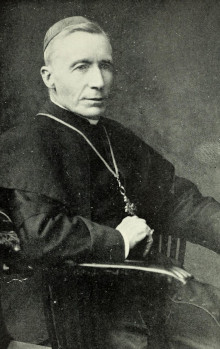
Birth of James Cardinal Gibbons, Archbishop of Baltimore

james-cardinal-gibbons

James Cardinal Gibbons, American prelate of the Catholic Church, is born in Baltimore, Maryland on July 23, 1834 to parents Thomas and Bridget (née Walsh) Gibbons who had emigrated from Toormakeady, County Mayo. In his role as Archbishop of Baltimore from 1877 to 1921, he serves as a bridge between Roman Catholicism and American Catholic values.

Gibbons is taken by his parents from Baltimore to Ireland in 1837. Following his father’s death in 1847, at the height of The Great Hunger, his mother moves the family back to the United States. He spends the next eight years as a grocer in New Orleans. In 1855 he enters a seminary in Baltimore, becoming a priest in 1861. He rises through the ranks of the Roman Catholic Church quickly, and by 1868 he is the youngest bishop in the United States. During a short stay in North Carolina, he writes The Faith of Our Fathers (1876), a defense of Catholicism that proves exceptionally popular, selling more than two million copies. He is elevated to Archbishop of Baltimore in 1877. He assumes a leadership role as the presiding prelate at the Third Plenary Council of Baltimore in 1884, and in 1886 he is made a cardinal by Pope Leo XIII.

As a leader of the Catholic Church hierarchy in the United States, Gibbons is outspoken in his praise for American democratic institutions and he advocates Americanization — the rapid assimilation of Catholic immigrants into American culture and institutions — both as a means to counter Protestant Americans’ suspicions toward Catholics and to avoid the fragmentation of the Catholic Church in the United States along ethnic lines. He is also sympathetic to the cause of organized labour and works to overcome suspicions within the Catholic Church toward the Knights of Labor, which has been considered a secret society by many clergymen.

On education, as on other social issues, Gibbons seeks ways of harmonizing the tenets of the Catholic faith with the principles of American democracy. He enters the controversy over control of parochial and public schools in 1891 when he defends Archbishop John Ireland’s experimental plan for cooperation between Catholic and public schools in the Minnesota towns of Faribault and Stillwater. To the dismay of conservative bishops, he refuses to condemn public education and encourages efforts to find common ground between the two systems. The Faribault-Stillwater plan remains controversial despite Gibbons’s support, and acrimony between the plan’s supporters and conservative opponents lingers until 1893.

During World War I, Gibbons is instrumental in the establishment of the National Catholic War Council, and afterwards supports the League of Nations. Although initially opposed to women’s suffrage, when the Nineteenth Amendment passes Gibbons urges women to exercise their right to vote “…not only as a right but as a strict social duty.”

James Cardinal Gibbons dies at the age of 86 in Baltimore on March 24, 1921. Throughout his career he is a respected and influential public figure. Although nonpartisan, he takes positions on a variety of foreign and domestic policy issues and is personally acquainted with every U.S. president from Andrew Johnson to Woodrow Wilson.


Leave a comment

Formation of the Independent Orange Order

independent-orange-orderThe Independent Orange Order, a Protestant fraternal organisation, is formed in Belfast on June 11, 1903 by Thomas Sloan and others associated with the Belfast Protestant Association, who have been expelled from the Orange Order because they voice opposition to it being used for party political ends by Ulster Unionists. Originally it is associated with the labour movement, but it soon realigns itself with traditional unionist politics.

It takes its name in memory of King William of Orange of the house of Orange who fights at the Battle of the Boyne, brings about the Glorious Revolution and the Bill of Rights giving the Westminster parliament ultimate power of the country rather than the Monarch. The Independent Order is small compared to the main organisation with 1,500 to 2,000 members. It is largely based around north County Antrim in Northern Ireland but has lodges around the world, including England, Scotland, and Australia. Its annual main Twelfth of July demonstration is held in a north Antrim town or village.

The first notable effect after the formation of the Independent Order is a more liberal interpretation of the rules of the “Old Order.” In the early years of the Institution, many suffer the full wrath of the “powers that be,” who are opposed to any splitting of the Orange Order. Jobs are lost, homes are burned, and their headquarters in Belfast is bombed.

Independent Orangeism today maintains that it is essential for the Orange Institution to be kept free from politics and to guard the principles of Reformation Protestantism. They often express alarm when they believe these principles are endangered by conciliatory politicians. They are opposed to ecumenism and, while being opposed to Orangeism being linked to the Ulster Unionist Party, they are not apolitical and tend to work alongside unionist politicians and parties.

The Institution also promotes Ulster Protestant history and proclaims the principle of “Liberty of Conscience.” They declare their right to think and act independently without direction from political or clerical masters, they seek to strengthen the position of Orangeism, and they often warn of the danger of the development of a social and cultural Orangeism devoid of Protestant principle.