seamus dubhghaill

Promoting Irish Culture and History from Little Rock, Arkansas, USA


Leave a comment

“Stones in His Pockets” Receives Three Tony Award Nominations

On May 7, 2001, the Broadway play Stones in His Pockets by Belfast playwright Marie Jones receives three nominations for the theatre world’s top honour, the Tony Awards, in New York. Conleth Hill and Sean Campion are nominated in the Leading Actor category and Ian McElhinney is nominated for Best Director. It is a two-hander written in 1996 by Jones for the DubbleJoint Theatre Company in Dublin.

The play is a tragicomedy about a small rural town in Ireland where many of the townspeople are extras in a Hollywood film. The story centres on Charlie Conlon and Jake Quinn, who, like much of the town, are employed as extras for the filming. The key point in the play is when a local teenager commits suicide, by drowning himself with stones in his pockets, after he is humiliated by one of the film stars. The script calls upon the cast of two to perform all 15 characters (men and women), often switching gender and voice swiftly and with minimal costume change. Comedy also derives from the efforts of the production crew to create the proper “Irish feel” – a romanticised ideal that often conflicts with the reality of daily life.

The play is first shown as a DubbleJoint Production premiering in West Belfast in August 1996. The set design, by Jack Kirwan, is simple – a backcloth depicting the cloudy sky above the Blasket Islands, a row of shoes (symbolising the myriad characters) and a trunk, a box, and two tiny stools. The lighting design is originally by James C. McFetridge and this design is used in both the London West End and the Broadway versions of the show.

The show moves to the Edinburgh Festival Fringe in 1999. It then returns to Ireland and has a brief run in Dublin before moving to London‘s Tricycle Theatre. It then transfers to the New Ambassadors Theatre in London’s West End. The show, however, proves so successful, its run is extended and moves to the Duke of York’s Theatre up the road, where it remains for three years.

The original cast of Hill and Campion take the show to Broadway and, as its West End run continues to play to packed houses, actors line up to play Charlie and Jake, most notably Bronson Pinchot, Rupert Degas and Simon Delaney.

The play wins the Irish Times/ESB Irish Theatre Award for Best Production in 1999, wins two Laurence Olivier Awards in 2001 for Best New Comedy and Best Actor (Conleth Hill) and is also nominated for three Tony Awards in 2001.

Gothenburg English Studio Theatre makes a production of Stones in His Pockets in 2009. It is directed by Malachi Bogdanov with Mike Rogers and Gary Whitaker.

The play is translated to Finnish and has been on repertoire since 2002 at Helsinki City Theatre in Finland.

The play is revived at London’s Tricycle Theatre in 2011, with Jamie Beamish as Charlie and Owen McDonnell as Jake, and at the Tron Theatre, Glasgow in 2012 performed by Robbie Jack and Keith Fleming.

For the 20th anniversary of the first production, The Dukes in Lancaster and The Theatre Chipping Norton co-produce a touring production which opens at The Dukes on February 25, 2016, and tours 35 venues between then and May 28, 2016. Charlie de Bromhead plays Jake and Conan Sweeny plays Charlie.

The original version of the play is created in collaboration with theatre director Pam Brighton, who later sues Marie Jones for co-authorship rights. Brighton loses the case in the high court, and subsequently becomes bankrupt.

Leave a comment

Birth of Neil Hannon, Northern Irish Singer & Songwriter

Edward Neil Anthony Hannon, Northern Irish singer and songwriter, is born in Derry, County Londonderry, on November 7, 1970. He is the creator and front man of the chamber pop group The Divine Comedy, and is the band’s sole constant member. He is the writer of the theme tunes for the television sitcoms Father Ted and The IT Crowd.

Hannon is the son of Brian Hannon, a Church of Ireland minister in the Diocese of Derry and Raphoe and later Bishop of Clogher. He spends some of his youth in Fivemiletown, County Tyrone, before moving with his family to Enniskillen, County Fermanagh, in 1982. While there he attends Portora Royal School.

Hannon enjoys synthesizer-based music as a youngster. He identifies The Human League and Orchestral Manoeuvres in the Dark (OMD) as “the first music that really excited [him].” In the late 1980s he develops a fondness of the electric guitar, becoming an “indie kid.”

Hannon is founder and mainstay of The Divine Comedy, a band which achieves their biggest commercial success in the last half of the 1990s with the albums Casanova (1996), A Short Album About Love (1997), and Fin de Siècle (1998). He continues to release albums under The Divine Comedy name, the most recent being Office Politics (2019). In 2000 he and Joby Talbot contribute four tracks for Ute Lemper‘s collaboration album, Punishing Kiss.

In 2004 Hannon plays alongside the Ulster Orchestra for the opening event of the Belfast Festival at Queen’s University Belfast. In 2005, he contributes vocals to his long-time collaborator Joby Talbot’s soundtrack for the movie version of The Hitchhiker’s Guide to the Galaxy.

In 2006 it is announced that Hannon is to lend his vocal ability to the Doctor Who soundtrack CD release, recording two songs – “Love Don’t Roam” for the 2006 Christmas special, “The Runaway Bride“, and a new version of “Song For Ten”, originally used in 2005’s “The Christmas Invasion.” On January 12, 2007, The Guardian website’s “Media Monkey” diary column reports that Doctor Who fans from the discussion forum on the fan website Outpost Gallifrey are attempting to organise mass downloads of the Hannon-sung “Love Don’t Roam,” which is available as a single release on the UK iTunes Store. This is in order to attempt to exploit the new UK Singles Chart download rules, and get the song featured in the Top 40 releases.

The same year Hannon adds his writing and vocal talents to the Air album Pocket Symphony, released in the United States on March 6, 2007. He is featured on the track “Somewhere Between Waking and Sleeping,” for which he writes the lyrics. This song had been originally written for and sung by Charlotte Gainsbourg on her album, 5:55. Though it is not included in its 2006 European release, it is added as a bonus track for its American release on April 24, 2007.

Hannon wins the 2007 Choice Music Prize for his 2006 album, Victory for the Comic Muse. He wins the 2015 Legend Award from the Oh Yeah organisation in Belfast.

Hannon is credited with composing the theme music for the sitcoms Father Ted and The IT Crowd, the former theme composed for the show and later reworked into “Songs of Love,” a track on The Divine Comedy’s breakthrough album Casanova. Both shows are created or co-created by Graham Linehan. A new Divine Comedy album, Bang Goes the Knighthood, is released in May 2010.

Hannon has collaborated with Thomas Walsh, from the Irish band Pugwash, to create a cricket-themed pop album under the name The Duckworth Lewis Method. The first single, “The Age of Revolution,” is released in June 2009, and a full-length album is released the following week. The group’s second album, Sticky Wickets, comes out in 2013.

Hannon contributes to a musical version of Swallows and Amazons, writing the music while Helen Edmundson writes the book and lyrics, which premiers in December 2010 at the Bristol Old Vic.

In April 2012 Hannon’s first opera commission, Sevastopol, is performed by the Royal Opera House. It is part of a program called OperaShots, which invites musicians not typically working within the opera medium to create an opera. Sevastopol is based upon Leo Tolstoy‘s Sevastopol Sketches. Hannon’s second opera for which he writes music, In May, premiers in May 2013 in Lancaster and is shown in 2014 with overwhelming success.

The world premiere of “To Our Fathers in Distress,” a piece for organ, is performed on March 22, 2014, in London, at the Royal Festival Hall. It is inspired by Hannon’s father, Rt. Revz. Brian Hannon, who suffers from Alzheimer’s disease.

Hannon’s partner is Irish musician Cathy Davey. The couple live in the Dublin area. He is previously married to Orla Little, with whom he has a daughter, Willow Hannon. With Davey, Hannon is a patron of the Irish animal charity My Lovely Horse Rescue, named after the Father Ted Eurovision song for which he wrote the music.

Politically, Hannon describes himself as being “a thoroughly leftie, Guardian-reading chap, but of the champagne socialist variety.”


Leave a comment

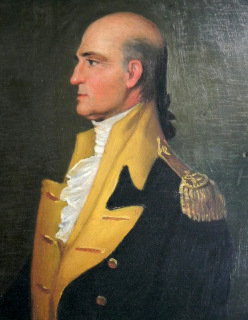
Death of Richard Butler, Irish-born Officer in the Continental Army

Richard Butler, an Irish-born officer in the Continental Army during the American Revolutionary War, is killed on November 4, 1791, while fighting Native Americans in the United States in a battle that is known as St. Clair’s defeat.

Born on April 1, 1743, in St. Bridget’s Parish, Dublin, Butler is the oldest son of Thomas and Eleanor Butler (née Parker). His father is an Irish aristocrat who serves in the British Army. He is the brother of Colonel Thomas Butler and Captain Edward Butler. All three brothers serve in the American Revolution and in the Northwest Indian War against the Northwestern Confederacy of Native American tribes in the Northwest Territories. His two other brothers, William and Percival, serve in the Revolution but do not see later military service.

In 1748 Butler’s father opens a gun shop in Dublin, but that same year the family moves to Lancaster, Pennsylvania, where he learns to make the Pennsylvania long rifles used in the French and Indian War.

By 1760, the family moves to the frontier at Carlisle, Pennsylvania, where Thomas and his sons manufacture long rifles and become friends with Daniel Morgan. The Butler gun shop still stands in Carlisle.

By the 1770s, Butler and his brother William are important traders at Fort Pitt in Pennsylvania and in Ohio. Butler Street in Pittsburgh is named for them.

At the outset of the American Revolution, the Continental Congress names Butler a commissioner in 1775 to negotiate with the Indians. He visits representatives of the Delaware, Shawnee, and other tribes to secure their support, or at least neutrality, in the war with Britain.

On July 20, 1776, Butler is commissioned a major in the 8th Pennsylvania Regiment in the Continental Army, serving first as second in command to his friend Daniel Morgan. He is promoted to lieutenant colonel on March 12, 1777, retroactive to September 1776. On June 7, 1777, he is promoted to colonel and placed in command of 9th Pennsylvania Regiment.

During the war Butler sees action at the Battle of Saratoga (1777) and the Battle of Monmouth (1778). His four other brothers also serve and are noted for their bravery as the “fighting Butlers.” In January 1781 he is transferred to the 5th Pennsylvania Regiment and leads the Continental Army at the Battle of Spencer’s Ordinary.

At the conclusion of the Battle of Yorktown in October 1781, General George Washington confers on Butler the honor of receiving Cornwallis’ sword of surrender, an honor which he gives to his second in command, Ebenezer Denny. At the last moment, Baron von Steuben demands that he receive the sword. This almost precipitates a duel between Butler and Von Steuben.

At the victory dinner for his officers, George Washington raises his glass and toasts, “The Butlers and their five sons!”

Following Yorktown, Butler remains in the Continental Army and is transferred to the 3rd Pennsylvania Regiment following a consolidation of the Army on January 1, 1783. On September 30 of the same year, he is breveted as a brigadier general. He remains in active service with the Continental Army until it is finally disbanded on November 3, 1783.

In 1783 Butler and his brothers become original members of the Pennsylvania Society of the Cincinnati, a military society of officers who had served in the Continental Army.

After the war, the Confederation Congress puts Butler in charge of Indians of the Northwest Territory. He negotiates the Treaty of Fort Stanwix in 1784, in which the Iroquois surrender their lands. He is also called upon during later negotiations, such as the Treaty of Fort McIntosh in 1785.

Butler returns to Pennsylvania and is a judge in Allegheny County. He also serves in the state legislature. He marries Maria Smith, and they have four children, only one of whom lives to have children and continue the line. He also fathers a son, Captain Butler (or Tamanatha) with Shawnee chief Nonhelema. He and his Shawnee son fight in opposing armies in 1791.

In 1791, Butler is commissioned a major general in the levies (i.e. militiamen conscripted into Federal service) under Major General Arthur St. Clair to fight against the Western Confederacy of Native Americans in the Northwest Territories (modern day Ohio). He is killed in action on November 4, 1791, in St. Clair’s Defeat at what is now Fort Recovery, Ohio.

Reportedly Butler is first buried on the battlefield, which site is then lost until it is accidentally found years later. The remains are laid to rest with the remains of the other fallen at Fort Recovery.

Butler County, Ohio, where Fort Hamilton stood, is named for Richard Butler, as are Butler County, Kentucky, and Butler County, Pennsylvania. The city of Butler, Pennsylvania and the General Richard Butler Bridge, located in the city of Butler, are also named for him. A miniature portrait of Butler is painted by “The Painter of The Revolution,” Colonel John Trumbull, in 1790 and is in the collection of Yale University.

Butler is also honored in the name of General Richard Butler KYSAAR, Butler County, Kentucky recognized August 20, 2016. A chapter of the Sons of the American Revolution is named for him as as is the General Richard Butler Chapter of the Daughters of the American Revolution (DAR), founded in Butler, Pennsylvania.


Leave a comment

Birth of Neil Shawcross, Post-Impressionist Artist

Neil Shawcross MBE, RHA, HRUA, Post-Impressionist artist, is born in Kearsley, Lancashire, England, on March 15, 1940. He has been a resident of Northern Ireland since 1962.

Shawcross studies at Bolton College of Art from 1955 to 1958, and Lancaster College of Art from 1958 to 1960, before moving to Belfast in 1962 to take up a part-time lecturer’s post at the Belfast College of Art, becoming full-time in 1968. He continues to lecture there until his retirement in 2004.

Primarily a portrait painter, his subjects include Nobel Prize winning poet Seamus Heaney, novelist Francis Stuart (for the Ulster Museum), former Lord Mayor of Belfast David Cook (for Belfast City Council), footballer Derek Dougan and fellow artists Colin Middleton and Terry Frost. He also paints the figure and still life, taking a self-consciously childlike approach to composition and colour. His work also include printmaking, and he has designed stained glass for the Ulster Museum and St. Colman’s Church, Lambeg, County Antrim.

Shawcross’s academic career includes a residency at Virginia Center for the Creative Arts in Amherst, Virginia in 1987, a residency at Vermont Studio Center in Johnson, Vermont in 1991, and a visiting assistant professorship at Pennsylvania State University in 1993.

Shawcross has exhibited nationally, with one-man shows in London, Manchester, Dublin and Belfast, and internationally in Hong Kong and the United States, and his work is found in many private and corporate collections.

Shawcross is elected an Associate of the Royal Ulster Academy of Art in 1975, and is made a full Academician in 1977. He wins the Academy’s Conor Award in 1975, its gold medal in 1978, 1982, 1987, 1994, 1997 and 2001, and its James Adam Prize in 1998. He is also a member of the Royal Hibernian Academy (RHA). He is awarded the Gallaher Portrait Prize in 1966.

Shawcross is conferred an honorary doctorate by Queen’s University Belfast in 2007. He is appointed Member of the Order of the British Empire (MBE) in the 2014 New Year Honours for services to arts in Northern Ireland.

In 2010, the Merrion Hotel, Dublin, hosts a private collection of the works of Shawcross. In 2015, he exhibits a collection of six foot tall book covers inspired by original Penguin paperbacks at the National Opera House in Wexford, County Wexford. In 2018, he donates to Belfast City Council a collection of 36 paintings dedicated to ‘Writers of Belfast’ in a show of appreciation to his adopted home city. A major retrospective of his works are exhibited at the F. E. McWilliam Gallery and Studio, Banbridge, County Down, in the same year.

Shawcross is a Patron of the charity YouthAction Northern Ireland. He lives in Hillsborough, County Down, Northern Ireland.


Leave a comment

Birth of Edward Hand, Soldier, Physician & Politician

Edward Hand, Irish soldier, physician, and politician who serves in the Continental Army during the American Revolutionary War, is born in Clyduff, King’s County (now County Offaly) on December 31, 1744. He rises to the rank of general and later is a member of several Pennsylvania governmental bodies.

Hand, the son of John Hand, is baptised in Shinrone. Among his immediate neighbours are the Kearney family, ancestors of United States President Barack Obama. He is a descendant of either the families of Mag Fhlaithimh (of south Ulaidh and Mide) or Ó Flaithimhín (of the Síol Muireadaigh) who, through mistranslation became Lavin or Hand.

Hand earns a medical certificate from Trinity College, Dublin. In 1767, he enlists as a Surgeon’s Mate in the 18th (Royal Irish) Regiment of Foot. On May 20, 1767, he sails with the regiment from Cobh, County Cork, arriving at Philadelphia on July 11, 1767. In 1772, he is commissioned an ensign. He marches with the regiment to Fort Pitt, on the forks of the Ohio River, returning to Philadelphia in 1774, where he resigns his commission.

In 1774, Hand moves to Lancaster, Pennsylvania, where he practices medicine. On March 13, 1775, he marries Catherine Ewing. Lancaster is the region of some of the earliest Irish and Scotch-Irish settlements in Pennsylvania. As a people, they are well known for their anti-English and revolutionary convictions. He is active in forming the Lancaster County Associators, a colonial militia. He is a 32nd degree Freemason, belonging to the Montgomery Military Lodge number 14.

Hand enters the Continental Army in 1775 as a lieutenant colonel in the 1st Pennsylvania Regiment under Colonel William Thompson. He is promoted to colonel in 1776 and placed in command of the 1st Continental, then designated the 1st Pennsylvania. Promoted to brigadier general in March 1777, he serves as the commander of Fort Pitt, fighting British loyalists and their Indian allies. He is recalled, after over two years at Fort Pitt, to serve as a brigade commander in Major General La Fayette‘s division.

In 1778, Hand attacks the Lenape, killing Captain Pipe‘s mother, brother, and a few of his children during a military campaign. Failing to distinguish among the Native American groups, he had attacked the neutral Lenape while trying to reduce the Indian threat to settlers in the Ohio Country, because other tribes, such as the Shawnee, had allied with the British.

After a few months, he is appointed Adjutant General of the Continental Army and serves during the Siege of Yorktown in that capacity. In recognition of his long and distinguished service, he is promoted by brevet to major general in September 1783. He resigns from the Army in November 1783.

Hand returns to Lancaster and resumes the practice of medicine. A Federalist, he is also active in civil affairs. Beginning in 1785, he owns and operates Rock Ford plantation, a 177-acre farm on the banks of the Conestoga River, one mile south of Lancaster, Pennsylvania. The Georgian brick mansion remains today, and the farm is a historic site open to the public.

Hand dies from typhoid fever, dysentery or pneumonia at Rock Ford on September 3, 1802, although medical records are unclear with some sources stating he died of cholera. There is no evidence Lancaster County suffered from a cholera epidemic in 1802. He is buried in St. James’s Episcopal Cemetery in Lancaster, the same church where he had served as a deacon.