Since the Troubles began, the South Armagh area—especially around Crossmaglen and other similar republican strongholds—is one of the most dangerous places for the British security forces, and the IRA’s South Armagh brigade carries out numerous ambushes on the British Army and Royal Ulster Constabulary (RUC). This includes the 1975 Drummuckavall ambush and the 1978 downing of a British Army Gazelle helicopter which leads to the death of one British soldier and four others being seriously injured.
A number of British security force members are killed in Crossmaglen during 1978. On March 4, British soldier Nicholas Smith (20), 7 Platoon, B Company, 2nd Royal Green Jackets, is killed by an IRA booby trap bomb while attempting to remove an Irish flag from a telegraph pole in Crossmaglen. On June 17, William Turbitt (42) and Hugh McConnell (32), both Protestant RUC officers, are shot by the IRA while on mobile patrol near Crossmaglen. McConnell is killed at the scene, but Turbitt is kidnapped. The next day, a Catholic priest, Fr. Hugh Murphy, is kidnapped in retaliation but later released after appeals from Protestant clergy. The body of Turbitt is found on July 10, 1978.
On December 21, 1978, when the patrol is near Rio’s Bar coming around a bend, a red Royal Mail-type van is spotted by the patrols commander Sergeant Richard Garmory. The van is fitted with armor plating and is facing away from the patrol. Garmory believes the van is in a suspicious place on the other side of the street. He notes what appear to be boxes in the back of the van, which actually provide cover for the IRA Volunteers. IRA members open fire from the back of the van with an M60 machine gun which is fitted down onto the floor in the back of the van. Three other IRA volunteers armed with AR-15-style rifles and another Volunteer with an AK-47 open up on the patrol. The British soldiers on patrol return fire but do not claim any hits. A handful of Christmas shoppers scramble for cover. Three soldiers at the front of the patrol are fatally wounded. They are treated by staff at a nearby health center and then taken to Musgrave Park Hospital but are declared dead on arrival. The soldiers killed are Graham Duggan (22), Kevin Johnson (20) and Glen Ling (18). All are members of the British Armies Grenadier Guards regiment. The patrol commander, Richard Garmory, says of the ambush:
On coming round the bend near the Rio Bar, I saw 40 yards away what looked like a British Rail parcel delivery van parked partly on the pavement on the left facing away from us. It had an 18-inch tailboard with a roll shutter that could be pulled down. The van immediately struck me as highly suspicious because I saw what looked like cardboard boxes piled to the top in the back, all flush with the tailboard so they would fall out if the van moved off fast. I instantaneously put my magnifying sight to my to my eye and saw four firing slits, two above the other two, among the boxes. I immediately opened fire.
Four months later the South Armagh brigade strikes again at British security forces, this time near Bessbrook which is several miles from Crossmaglen. Four RUC officers are killed in the 1979 Bessbrook bombing, when a 1,000 lb. land mine is detonated when the RUC patrol is passing by the bomb, killing all the officers outright.
(Pictured: South Armagh Brigade, Provisional Irish Republican Army, manning a temporary checkpoint close to Crossmaglen, 1978)
Since the beginning of its campaign in 1970, the Provisional IRA has carried out many improvised land mine and roadside bomb attacks on British forces in the region. In September 1972, three British soldiers are killed when their armoured vehicle is blown up by an IRA land mine at Sanaghanroe, near Dungannon. In March 1974, two IRA members are killed on the Aughnacloy Road near Dungannon when a land mine they are planting explodes prematurely.
The Dungannon attack occurs just months after the Warrenpoint ambush on August 27, 1979, where the IRA kills eighteen British soldiers with roadside bombs in south County Down — the deadliest single attack on British forces during The Troubles.
On December 16, 1979, two armoured British Army Land Rovers are driving along Ballygawley Road, about two miles outside Dungannon. A unit of the IRA had planted a 600–1,000-pound (270–450 kg) improvised land mine in a culvert under the road at Glenadush. When the second vehicle reaches the culvert, the land mine is detonated by remote control from a concealed location, showcasing their evolving tactics in guerrilla warfare and ambush strategy. The blast is powerful enough to launch the armoured Land Rover into the air and killing four soldiers from the Royal Regiment of Artillery outright: William Beck (23), Keith Richards (22), Simon Evans (19), and Allan Ayrton (23).
On May 12, 1992, a unit of the Provisional Irish Republican Army (IRA) East Tyrone Brigade launches a bomb attack on a British Army foot patrol near the republican stronghold of Cappagh, County Tyrone. One soldier of the Parachute Regiment, Alistair Hodgson, loses both legs as a result. The improvised land mine is described in an IRA statement as an “anti-personnel device.” Other paratroopers receive lesser wounds, according to the same statement. The incident triggers a rampage by members of the Parachute Regiment in the nearby, overwhelmingly Irish nationalist town of Coalisland, some ten miles to the east. The IRA attack is described as a “provocation” tactic, devised to produce an over-reaction by troops to make them even more unpopular among local nationalists.
The deployment of the paratroopers, which begins in April has already been criticised by republican activist and former Member of ParliamentBernadette Devlin McAliskey, who denounces beatings, shootings and damages to property reportedly carried out by the troops. These previous incidents include the destruction of fishing gear and boats in the townland of Kinturk, near Ardboe, and a brawl on April 22 between soldiers and motorists at a checkpoint in Stewartstown, in which plastic bullets are fired that end with a civilian and two paratroopers wounded. Unionist politician and Ulster Defence Regiment (UDR) officer Ken Maginnis, then-Member of Parliament for the area, calls for the withdrawal of the regiment after receiving a large number of complaints about their behaviour.
On May 12, two hours after the IRA ambush at Cappagh, members of the regiment seal off the town of Coalisland, ten miles east of Cappagh. According to a Social Democratic and Labour Party (SDLP) politician, the soldiers fabricate a bogus bomb warning, while the Royal Ulster Constabulary (RUC) states that the operation began when a joint police/military patrol was stoned by a crowd. Two pubs are ransacked by the troops and a number of civilian cars are damaged. Several people are allegedly hit with sticks. Following this, a lieutenant is suspended from duty and the regiment is removed from patrol duties in Coalisland.
On the evening of May 17, a fistfight begins at Lineside Road, where a group of young men are having a drink. A passing four-man patrol of the King’s Own Scottish Borderers regiment is challenged to a “boxing match” by the residents. The soldiers set aside their weapons and engage the youths. Noncritical injuries are reported on both sides. The official claim is that the patrol was attacked by a mob of at least 30 people. In the melée, a rifle and a light machine gun are stolen. The rifle is later recovered nearby. The youths smash a backpack radio which is left behind by the troops. Two KOSB soldiers are hospitalised, while in the end seven other soldiers, including paratroopers, receive lesser injuries, one of them hit by a car that crashes through two roadblocks set up by the British Army.
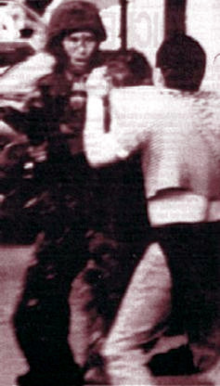
The Parachute Regiment is called to the scene again, and at 8:30 p.m., a major riot starts outside The Rossmore pub between local people and about 20 to 25 paratroopers. The soldiers claim one of their colleagues is isolated and dragged by the crowd. Some witnesses claim paratroopers were in a frenzy, showing their guns and inviting civilians to try to take them. Suddenly, shots are fired by the troops — first into the air and then toward the people outside the pub. Three civilians are rushed to hospital in Dungannon with gunshot wounds, while the soldiers return to their barracks. Another four civilians suffer minor injuries. The paratroopers claim that a “member of the growing crowd” attempted to fire the stolen machine gun at them, but the weapon jammed. One of the wounded is the brother of IRA volunteer Kevin O’Donnell, who had been killed by the Special Air Service (SAS) in February during an ambush at the nearby hamlet of Clonoe, shortly after carrying out a machine-gun attack on the local RUC base.
About 500 people attend a protest rally in Coalisland on May 19, and the wisdom of deploying the troops to patrol the town is questioned by members of the Dáil in Dublin. The Minister for Foreign Affairs of the Republic of Ireland, David Andrews, asks the British Government to withdraw the regiment. As a result, the paratroopers are redeployed outside the urban areas. The RUC claims that the stolen machine gun is found 11 days later at a farmhouse near Cappagh, along with another light machine gun and an AK-47 rifle. The IRA denies they had the machine gun in their possession. Republicans question whether the weapon had really been stolen, suggesting this was merely an excuse for the soldiers’ rampage in Coalisland. Bernardette McAliskey goes even further, suggesting that the recovery of the machine gun near Cappagh, where the initial IRA attack had taken place, was actually staged by the security forces as a publicity stunt. British officials accuse Sinn Féin of being the instigators of the riots, while Michael Mates, then Minister of State at the Northern Ireland Office, states that the incidents were due to “a gang of thugs motivated by the IRA.” Eventually the battalion’s 1992 tour in Northern Ireland is scaled down, with the patrols suspended before the official end of the deployment. The Third Brigade’s commander, Brigadier Tom Longland, is replaced by Brigadier Jim Dutton. This is the first occasion that a high-ranking officer is disciplined in such a way during the Troubles.
The last patrol takes place on June 27, when two paratroopers drown while crossing the River Blackwater. The same day there are further clashes with local residents, this time in the town of Cookstown, when a group of people that the BelfastNews Letter calls “drunken hooligans” assault a number of paratroopers trying to help an elderly man who is suffering a heart attack.
The 3rd Battalion of the Parachute Regiment is replaced by the 1st Battalion of the Coldstream Guards.
Six soldiers face criminal charges for their roles in the May riots but are acquitted one year later. Five are bound over. Maurice McHugh, the presiding magistrate, avers that the soldiers were “not entirely innocent,” while Sinn Féin sources dub the ruling “a farce.” Dungannon priest Father Denis Faul is of the opinion that the soldiers should have been charged with conspiracy. The Ulster TelevisiondocumentaryCounterpoint of June 1993 claims that Director of Public Prosecutions for Northern Ireland, Sir Alasdair Fraser, returned the case file to the RUC recommending no prosecution. The programme also interviews Alistair Hodgson, the soldier maimed at Cappagh, who says that “had another member of my unit been injured in the way that I was, I would have been with the rest of the lads attacking the locals.” Authors Andrew Sanders and Ian S. Wood suggest that the deployment of the battalion in Coalisland and elsewhere hindered the British policy of police primacy in Northern Ireland.
Fresh clashes between local residents and troops are reported at Coalisland on March 6, 1994, a few months before the first IRA ceasefire, when a crowd assaults two soldiers after the RUC searched a car. Plastic bullets are fired, and three civilians and two soldiers are slightly injured.
(Pictured: Confrontation between a British paratrooper and a civilian in Coalisland, May 1992)
Barry returns to Bandon in early 1919. He describes in his guerilla days in Ireland a Damascus-like conversion to Irish nationalism on hearing of the Easter Rising while with the Mesopotamian expeditionary force, but he is only accepted into the IRA with considerable caution. Initially tested in intelligence and training work, in mid-1920 he takes charge of the new brigade flying column, which is used both to train officers and to stage offensive actions.
Barry adapts his military experience successfully to the demands of guerrilla warfare, becoming the most famed of column leaders during the Irish War of Independence. In his memoirs, he pours scorn on the obsession of many with military titles and orthodox procedure, complaining of a “paper army.” He stresses the need for spontaneity, initiative, and knowledge of local conditions. “The reality,” he writes, “was a group of fellows, mostly in caps and not-too-expensive clothing, wondering how to tackle their job and where they would sleep that night or get their supper.” (The Reality of the Anglo–Irish War (1974)). He well realises that the war’s character does not permit any close control from the IRA’s GHQ in Dublin, hence increasing the importance of local leaders. His tactics put strong emphasis on speed of movement and on the need to attack the enemy at his weakest point. The column’s ambush successes are small in number but among the best-remembered of the war. He admits, however, that his own and his column’s lack of experience with mines frequently weakened their offensives.
The column’s first successful ambush is at Tooreen on October 22, 1920, followed on November 28 by the dramatic ambushing of a patrol of auxiliaries at Kilmichael while travelling from their Macroom base. A column of thirty-six men, divided into three sections, kill sixteen auxiliaries, with one captured and later shot, suffering two fatalities of their own. Controversy has raged since over whether a false surrender by the British force caused the brutality of some of the deaths. Together with the Bloody Sunday killings of a week earlier in Dublin, Kilmichael has a profound effect on the British military and political establishment, with the declaration in December of martial law for much of Munster and the implementation of wide-ranging internment, together with the authorisation of official reprisals.
After a short period in hospital with a heart condition, in early 1921 Barry leads unsuccessful attacks on Kilbrittain, Innishannon, Drimoleague, and Bandon barracks. The seizure of Burgatia House, outside Rosscarbery, in early February, and the successful resistance made there to British troops, wins much publicity but has little military significance. He is a leading figure in the brutal final stage of the war in the first six months of 1921, which sees widespread shooting of suspected spies and destruction of loyalist property. By March 1921, his flying column, with 104 men, is easily the largest in Ireland, and an explosives expert, Capt. McCarthy, has joined them.
The protracted engagement between Barry’s column and encircling British forces at Crossbarry on March 19, 1921, comes at a time when large-scale sweeps are making life increasingly difficult for the IRA. It consists of a daring and courageous breakout. Crossbarry is the largest action of the war, and Barry is to regard it as even more important than Kilmichael. Soon afterwards, Rosscarbery barracks is successfully attacked by a Barry-led party, representing one of the few successful such initiatives in 1921. Isolated triumphs, however, cannot hide the fact that pressure is increasing on the column, and he becomes increasingly critical of inactive regions. He is later to say that all County Kerry does during the war is to shoot one decent police inspector at Listowel Racecourse and a colleague of his. He is strongly critical also of the lack of assistance from GHQ and of the divisionalisation policy. He visits Dublin in May, travels around with Michael Collins, and is present when two American officers demonstrate the Thompson submachine gun. He is more aware than most of his 1st Southern Division colleagues of the scarcity of arms and ammunition at the war’s end.
During the truce, Barry becomes liaison officer for Munster, riling the British by insisting on his military rank, and criticising the IRA liaison men in Dublin for being overly deferential. He joins the overwhelming majority of the Cork IRA in opposing the Anglo–Irish Treaty but plays a characteristically maverick role throughout the treaty split. His independent attitude is heightened by his dislike of Liam Lynch, the republican IRA’s Chief of Staff, and his continuing respect for Michael Collins. He shows impatience at the long-drawn-out peace initiatives. In March 1922, therefore, he advocates armed confrontation with pro-treaty units over the occupation of barracks in Limerick, and on June 18 he submits a resolution, which only narrowly fails, at the army convention, giving British troops seventy-two hours to leave Dublin.
At the beginning of the Irish Civil War, Barry is arrested entering the Four Courts disguised as a woman. He escapes from an internment camp at Gormanston in early September 1922. For the rest of the war his actions mirror its confused nature. In late October 1922, he leads successful raids on the small towns of Ballineen and Enniskean, and later on Inchigeelagh and Ballyvourney. In December his column takes Carrick-on-Suir, demonstrating the weakness of the Free State army, but his talk of advancing on the Curragh and of large-scale actions does not materialise. There is no evidence that he is acting in accordance with any coordinated plan. By February 1923, he realises that the Republican IRA cause is hopeless and he is involved with Fr. Tom Duggan in efforts to get 1st Southern Division to declare a ceasefire. He journeys to Dublin to put pressure on the intransigent Lynch in this connection, telling Lynch, “I did more fighting in one week than you did in your whole life.”
Barry avoids capture in roundups after the war, remaining on the run until 1924. Unlike many republicans, he does not turn to constitutionalism, remaining strongly militaristic. He is always an unreconstructed republican, though by no means a naive one. In 1924 he becomes attached to Cleeves Milk Co., based in Limerick and Clonmel, and from 1927 to retirement in 1965 is general superintendent with the Cork harbour commissioners. He strongly advocates preserving the independence of the IRA army executive during the republican split of 1925–27. He is instrumental in continuing the drilling of IRA members and is a strong supporter of armed opposition to the Blueshirts.
During the 1930s Barry is arrested at various times for possession of arms and seditious utterances. He promotes an attack against a Freemasons’ meeting in Cork in 1936 and gives the orders for the killing on March 4 of that year of Vice-AdmiralHenry Boyle Somerville. He is opposed to the use by Frank Ryan of IRA volunteers to support the republican cause in the Spanish Civil War and to the proposals of Seán Russell for a bombing campaign in England. To maintain the link with traditional republicanism, he is elected IRA chief of staff in 1937. His plan, however, for the seizure of Armagh city, as part of a direct northern offensive, quickly collapses due to a leak of information, and he soon resigns his position. He forcefully attacks the bombing of English cities in 1938, regarding attacks on innocent civilians as immoral and counterproductive. He enlists in the National Army on July 12, 1940, only to be demobilised a month later. In 1946, he stands as an independent candidate in a by-election in the Cork Borough constituency, finishing at the bottom of the poll. He is more comfortable the following year touring the United States on an anti-partition platform.
In 1949 his Guerilla Days in Ireland is published. It proves a best-seller and has frequently been reprinted. It is well written in a forceful and direct style, one memoir needing no assistance from a ghost writer. Age does not mellow him: lawyers and bank managers are threatened by him over matters relating to his own column, and in 1974 he publishes a fierce pamphlet, angry at perceived slights in the Irish War of Independence memoir of Liam Deasy. He does strive to achieve a public reconciliation with Collins’s memory by unveiling the memorial to Collins at Sam’s Cross in 1966. On the outbreak of the Northern Ireland crisis in the late 1960s, he takes a militant line, castigating the argument that the Six Counties can be brought into the Republic by peaceful means, and asking when had peaceful means existed there. At the memorial meeting in Carrowkennedy, County Mayo, in 1971, he claims that there is a perfect right at the opportune time to take the Six Counties by force. He remains opposed to IRA bombing of civilian targets.
Barry dies in Cork on July 2, 1980. He is buried in St. Finbarr’s Cemetery, Cork. Early in the truce of 1921 he marries Leslie Price, one of the most active of Cumann na mBan members during and after the rising. They have no children.
While Barry always remains an influential figure in republican circles, he will be remembered best as the pioneer of guerrilla warfare, the hero of Kilmichael and Crossbarry. His military flair, individualism, and ruthlessness are well suited to the 1919–21 conflict. After that, his strained relations with colleagues and his lack of flexibility reduce his importance. While his life after the revolutionary era appears anti-climactic, he retains much of his charisma. In later years, he is ever willing to remind politicians and historians how far Ireland has retreated from republican ideals. He is often prickly and autocratic yet could be generous to old colleagues of either side of the treaty split. He is arguably the most intelligent but also the most intolerant of the revolutionary leaders.
(From: “Barry, Thomas Bernadine (‘Tom’)” by M. A. Hopkinson, Dictionary of Irish Biography, http://www.dib.ie, October 2009)
Fuller is born on January 1, 1900, in Kilflynn, County Kerry. He is the son of Daniel Fuller and Ellie Quinlan. His family is from Fahavane, in the parish of Kilflynn.
Fuller serves in the Kilflynn Irish Republican Army (IRA) flying column during the Irish War of Independence. He is First Lieutenant in the Kerry No.1 Brigade, 2nd Battalion. He opposes the Anglo-Irish Treaty and continues to fight with the anti-Treaty IRA during the Irish Civil War. Military records from the 1930s show, in his own hand, that he is in communication with Dublin regarding confirmation of membership in July 1922 and therefore eligible for war pensions. He becomes the most senior Kilflynn member upon the death of Captain George O’Shea.
In 1923, Fuller is captured by Free State troops and imprisoned in Ballymullen Barracks in Tralee by the Dublin Guard who had landed in County Kerry shortly before. On March 6, 1923, five Free State soldiers are blown up by a booby-trapped bomb at Baranarigh Wood, Knocknagoshel, north Kerry, including long-standing colleagues of Major General Paddy Daly, GOC Kerry Command. Prisoners receive beatings after the killings and Daly orders that republican prisoners be used to remove mines.
On March 7, nine prisoners from Ballymullen Barracks, six from the jail and three from the workhouse, are chosen with a broad geographical provenance and no well-known connections. They are taken lying down in a lorry to Ballyseedy Cross. There they are secured by the hands and legs and to each other in a circle around a land mine. Fuller is among them. His Kilflynn parish comrade Tim Tuomey is initially stopped from praying until all prisoners are tied up. As he and other prisoners then say their prayers and goodbyes, Fuller continues to watch the retreating Dublin Guard soldiers, an act which he later says saved him. The mine is detonated, and he lands in a ditch, suffering burns and scars. He crosses the River Lee and hides in Ballyseedy woods. He is missed amongst the carnage as disabled survivors are bombed and shot dead with automatic fire. Most collected body parts are distributed between nine coffins that had been prepared. The explosions and gunfire are witnessed by Rita O’Donnell who lives nearby and who sees human remains spread about the next day. Similar reprisal killings by the Dublin Guard follow soon after Ballyseedy.
Fuller crawls away to the friendly home of the Currans nearby. They take him to the home of Charlie Daly the following day. His injuries are treated by a local doctor, Edmond Shanahan, who finds him in a dugout. He moves often in the coming months, including to the Burke and Boyle families, and stays in a dugout that had been prepared at the Herlihys for seven months.
A cover-up begins almost immediately. Paddy Daly’s communication to Dublin about returning the bodies to relatives differs significantly from Cumann na mBan statements, which Daly complains about as simple propaganda, and later that of Bill Bailey, a local who had joined the Dublin Guard, who tells Ernie O’Malley that the bodies were handed over in condemned coffins as a band played jolly music. Fuller is named amongst the dead in newspaper reports before it is realised that he had escaped. Daly then sends a communication to GHQ that Fuller is reported as having become “insane.” The Dublin Guard scours the countryside for Fuller. The official investigation into the killings is presided over by Daly himself, with Major General Eamon Price of GHQ and Colonel J. McGuinness of Kerry Command. It blames Irregulars for planting the explosives and exonerates the Irish Army soldiers, and this is read out in the Dáil by the Minister for Defence, Richard Mulcahy.
Contrary statements to the Irish Army’s submissions are effectively ignored. Lieutenant Niall Harrington of the Dublin Guard, describes the evidence to the court and the findings as “totally untrue,” explaining that the actions were devised and executed by officers of the Dublin Guard. He contacts Kevin O’Higgins, Minister for Justice and Vice-President, a family friend, to deplore the findings. O’Higgins speaks to Richard Mulcahy, who does nothing. In a separate incident, Free State Lieutenant W.McCarthy, who had been in charge of about twenty prisoners, says that five of them had been removed in the night. They were reportedly shot in the legs then blown up by, in his words, “…a Free State mine, laid by themselves.” He resigns in protest. A Garda Síochána report into the events is also dismissed and is not made public for over 80 years.
Fuller leaves the IRA after the Civil War and follows a career as a farmer in Kerry. He joins Fianna Fáil, the political party founded by Republican leader Éamon de Valera in 1926 after a split from Sinn Féin. He is elected to the 9th Dáil on his first attempt, representing Fianna Fáil at the 1937 Irish general election, as the last of three Fianna Fáil TDs to be elected to the four seat Kerry North constituency. He is re-elected to the 10th Dáil at the 1938 Irish general election, when Fianna Fáil again wins three out of four seats, but loses his seat at the 1943 Irish general election to the independent candidate Patrick Finucane. He returns to farming thereafter.
Fuller never once mentions the Ballyseedy incident from a political platform and states later that he bore no ill-will towards his captors or those who were involved in his attempted extrajudicial killing. He does not want the ill feeling passed on to the next generation. He speaks publicly about the events in 1980, a few years before his death, on Robert Kee‘s groundbreaking BBC series Ireland: A Television History.
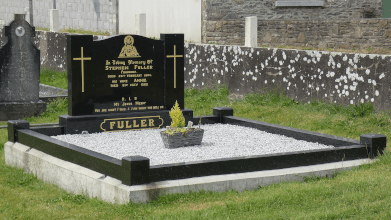
Fuller dies in Edenburn Nursing Home, Tralee, on February 23, 1984. He is buried near the Republican plot in Kilflynn where colleagues O’Shea, Tuomey and Timothy ‘Aero’ Lyons are buried.
Fuller’s son Paudie establishes the Stephen Fuller Memorial Cup for dogs of all ages, contested annually on the family farm.
Fuller’s fame largely rests on one night at Ballyseedy. To trace him through the rural society from which he and his fellow Volunteers originated and in which his life was spent, however, gives a fuller understanding of the devastating effects of the conflicts of 1916–23 on a tightly knit rural and small-town society, dominated by extended families of farmers and their service-industry relatives, and of how that society remembered and forgot those traumas.
(Pictured: Stephen Fuller’s grave in Kilflynn, by St. Columba’s Heritage Centre)
Daly is born in Dublin in 1888. He fights in the 1916 Easter Rising under the command of his namesake Edward Daly, leading the unsuccessful attempt to destroy the Magazine Fort in the Phoenix Park. He is later wounded in the particularly vicious fighting near the Linenhall. He is subsequently interned in Frongoch internment camp for his part in the rebellion until 1918, when he is released as part of a general amnesty for Irish prisoners.
During the Irish War of Independence, Daly serves as leader of the “Squad,”Michael Collins‘ assassination unit.
Daly and the men under his command are responsible for the killing of many British intelligence officers, in particular District Inspector Redmond, who had been putting increasing pressure on the Squad. Daly himself personally kills several people, including Frank Brooke, director of Great Southern and Eastern Railway, who serves on an advisory council to the British military, in June 1920. He does not directly lead any of the attacks on Bloody Sunday but is on standby in one of the Squad’s safe houses. In the aftermath, November 23, 1920, he is arrested and interned in Abercorn Barracks in Ballykinler, County Down.
Daly is released on parole from Ballykinler in March 1921, the British apparently being unaware of his senior position within the Dublin Brigade of the IRA. After his release, he, along with Emmet Dalton, is also involved in the attempt to free Seán Mac Eoin from Mountjoy Prison on May 14, 1921. He and his men hijack a British Army Peerless armoured car in Clontarf at the corporation abattoir, while it is escorting a consignment of meat to a barracks and shoot dead two soldiers in the process. The plan involves Dalton and Joe Leonard impersonating two British army officers and using forged documents to “transfer” MacEoin to Dublin Castle. They gain entry to Mountjoy but are discovered before they can free MacEoin and have to shoot their way out. They later abandon the armoured car after removing the Hotchkiss machine guns and setting fire to what they can. Toward the end of the war, in May 1921, the two principal fighting units of the IRA’s Dublin Brigade, the “Squad” and the “Active Service Unit” are amalgamated after losses suffered in the burning of the Custom House. Daly is named Officer Commanding (OC) of this new unit, which is named the Dublin Guard.
After the Anglo-Irish Treaty splits the IRA, Daly and most of his men side with the pro-treaty party, who go on to found the Irish Free State. He is appointed to the rank of brigadier in the newly created Irish National Army, which is inaugurated in January 1922. When the Irish Civil War breaks out in June 1922, he commands the Free State’s troops who secure Dublin, after a week of fighting.
In August 1922, during the Irish Free State offensive that re-takes most of the major towns in Ireland, Daly commands a landing of 450 troops of the Dublin Guard at Fenit, County Kerry, which goes on to capture Tralee from the anti-treaty forces. Acting with severe brutality in Kerry, he comments that, “nobody had asked me to take kid-gloves to Kerry, so I didn’t.” As the Civil War develops into a vicious guerrilla conflict, he and his men are implicated in a series of atrocities against anti-treaty prisoners, culminating in a series of killings with land mines in March 1923. Daly, and others under his command, claim that those killed were accidentally blown up by their own mines. Statements by the Garda Síochána, two Free State lieutenants on duty, W. McCarthy and Niall Harrington, and one survivor, Stephen Fuller, maintain the claims are fabricated.
Daly resigns from the Free State army in 1924 after an incident in Kenmare, County Kerry, concerning the daughters of a doctor. A court martial is held but collapses as no one is prepared to give evidence. He volunteers his services for the Irish Army again in 1940 and is appointed as a Captain to the non-combatant Construction Corps.
Daly is a carpenter by trade. He marries Daisy Gillies in 1910. His brother James (Seamus) marries Daisy’s sister Nora, a Cumann na mBan activist, in a joint wedding ceremony. After Daisy’s death in 1919, Daly marries Bridget Murtagh, also a Cumann na mBan activist, in 1921. Murtagh and Nora O’Daly carry out intelligence gathering for the planned attack on the Magazine Fort in 1916. She is a sister of Elizabeth Murtagh, the first wife of Commandant Michael Love who serves with Daly in the Collins Squad of the IRA, in the Irish Free State Army of the 1920s and during the Emergency period. Murtagh dies in childbirth in 1930. Daly subsequently marries Norah Gillies, his first wife’s niece.
On his death on January 16, 1957, Daly is buried with full military honours in Mount Jerome Cemetery. He is survived by his brothers, Comdt Seamus O’Daly and Capt Frank O’Daly, his sons Patrick and Colbert, and his daughters Brede and Philomena.
The Tooreen ambush (also known as the Toureen ambush or Ballinhassig ambush) is an ambush carried out by the Irish Republican Army (IRA) on October 22, 1920, during the Irish War of Independence. It takes place near Roberts Farm, Tooreen, near Ballinhassig in County Cork. The IRA ambushes two lorries of British soldiers, killing three and wounding four others. The British surrender and their weapons and ammunition are seized by the IRA. Later that night, British soldiers go on a rampage in nearby Bandon.
Up until the Tooreen ambush, the 3rd Cork Brigade had finished its training, but had not previously engaged in battle with British troops stationed in County Cork. The Tooreen ambush is one of the first major ambushes carried out by the West Cork Brigade under Tom Barry.
The Essex Regiment of the British Army is deployed to West Cork and has a reputation for violently raiding houses throughout the countryside and arresting people believed to be IRA volunteers. They are also alleged to torture their prisoners in order to get information on the whereabouts of the flying columns, so this makes them a despised enemy to the West Cork IRA.
The Essex Regiment is known to travel on the road from Bandon to Cork City every morning and return in the evenings. The road goes through the hamlet of Toureen which the Third West Cork Brigade is stationed at nearby and it is decided to ambush this column of the Essex Regiment as it makes its way to Cork city.
Thirty-two ambushers, twenty-one being riflemen of the Third West Cork Brigade, occupy ambush positions outside Toureen and lay in wait for the approaching Essex Regiment. The Regiment normally goes in two or three lorries to Cork City so the IRA places a homemade mine on the road for use against them.
Scouts signal the approach of two lorries which are coming down the road toward the ambush site. As the first lorry passes, the order to fire is given and a homemade three-pound bomb is thrown. The bomb lands inside the lorry but does not explode. The mine that is placed on the road also fails to detonate. As the volunteers open fire, the second lorry stops and the soldiers inside leap out and return fire, but the volunteers are hidden behind a large timber gate which gives them cover. The first lorry continues on to Cork Barracks. As the fight goes on, the officer in command of the British troops, Captain Dixon, is shot in the head and killed as is one of his men.
The remaining British soldiers surrender soon after, and the IRA men cease firing. The British soldiers are relieved of their weapons and ammunition, but otherwise unharmed. Fourteen rifles, bayonets, equipment, several Mills bombs, around 1,400 rounds of ammunition and a couple of revolvers are taken from them.
Two British soldiers, Lt. Dixon MC of the Suffolk Regiment and Pte. Charles William Reid of the Essex Regiment, are killed in the ambush. Five are wounded, including Sergeant Thomas Bennett RASC who dies in Cork on the following day. Six are unhurt except for shock. None of the IRA volunteers are killed or wounded during the ambush and aid is given to the wounded soldiers, while the dead are pulled away from the lorry and it is then set on fire by the volunteers. The two soldiers who are not hurt during the ambush are released along with their wounded and they return to their barracks.
Later that night, members of the Essex Regiment go on a violent rampage through Bandon, destroying property and seeking out anyone they believe to be connected to the ambush. It is believed that at least some of the rampaging soldiers are those released unharmed by the IRA earlier in the day. The reprisal attacks are indiscriminate and include attacks on homes and properties of business owners with “establishment” connections – including the Brennan family of Kilbrogan House.
A Military Court of Inquiry into the soldiers killed, is conducted on October 28, 1920. There are mixed references to these proceedings in The Irish Times and the Irish Independent, both of which contain errors.
Lt. Dixon is buried with full military honours in St. Paul’s Church in Dover, Kent, England. Sergeant Bennett is buried in St. Peter & St. Paul Church in his home village of Shorne, near Gravesend in Kent.
(Pictured: Plaque on a farm wall marking the location of the Tooreen ambush)
The Provisional IRA had been attacking British Army patrols and convoys with land mines and roadside bombs since the beginning of its campaign in the early 1970s. The deadliest attack was the Warrenpoint ambush of August 1979, when 18 soldiers were killed by two large roadside bombs near Warrenpoint, County Down. In July 1983, four soldiers of the local Ulster Defence Regiment (UDR) were killed when their vehicle struck an IRA land mine near Ballygawley, County Tyrone. It was the UDR’s biggest loss of life up until then.
On the morning of April 9, 1990, two UDR armoured landrovers are traveling from Abercorn Barracks to Downpatrick. An IRA unit has planted a 1,000-pound improvised land mine in a culvert under the Ballydugan Road, just outside the town. The unit waits in woodland overlooking the road, about 350 feet away. As the landrovers drive over the culvert, the IRA detonates the bomb by command wire. The huge blast blows the vehicle into a field and gouges a large crater in the road, 50 feet wide and 15 feet deep. A witness describes “a scene of utter carnage.” Four soldiers are killed: Michael Adams (23), John Birch (28), John Bradley (25), and Steven Smart (23). It is the biggest loss of life suffered by the UDR since the 1983 Ballygawley land mine attack. The soldiers in the other landrover suffer severe shock and are airlifted to hospital. According to police, a civilian driver also suffers shock, and another receives cuts and bruises.
The bombers escape on a motorcycle which had been stolen in Newry a week earlier, and is later found abandoned in Downpatrick. The IRA issues a statement saying the attack was carried out by members of its South Down Brigade.
A 23 year-old man is later sentenced to 15 years in prison for the attack. He had driven a scout car for the bombers when it was planted the day before the attack.
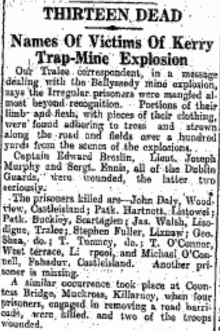
A party of eight Free State soldiers are sent to investigate a tip-off about an Irish Republican Army (IRA) arms dump. The tip-off is a ruse devised by the local IRA brigade to lure the enemy into a trap. At about 2:00 AM as they move stones to investigate the location where arms are allegedly buried, a mine explodes. Body parts are “strewn in all directions.” Paddy O’Connor, Michael Galvin, Laurence O’Connor, Michael Dunne and Edward Stapleton die instantly and a sixth is so badly injured, his legs are amputated. The IRA members who set the mine are hiding in a dugout about a mile away. The Knocknagoshel explosion represents the highest daily death toll among the Free State army in over six months.
Retaliation is swift and ferocious. Over the following two weeks, nineteen Republican prisoners die in County Kerry at the hands of the Free State. Knocknagoshel prompts an army statement that any future barricades or obstructions on the roads will be removed by republican prisoners. In his letter to officers in the Kerry Command, Brigadier Paddy O’Daly insists that “the taking out of prisoners is not to be regarded as a reprisal, but as the only alternative left us to prevent the wholesale slaughter of our men.” The implementation of O’Daly’s instructions is immediate and hugely repercussive.
On the night after the explosion, and in a move which reverberateds politically for generations, nine republican prisoners in Ballymullen Barracks in Tralee are taken to Ballyseedy on the Tralee to Killorglin road to clear a pile of rubble blocking the road. The nine, who had already been interrogated and abused in revenge for Knocknagoshel, are driven to the scene. It is suggested that one of the reasons these nine are selected from a wider group of prisoners is that they have no known links to the Catholic clergy or hierarchy so as not to antagonise the church which is actively and vocally supportive of the Free State and its leadership.
The army had planted a bomb in the rubble. They tie the prisoners by the wrists and their shoelaces and detonate the device. Eight of the nine are blown to pieces and killed instantly. The ninth, Stephen Fuller of Fahavane, Kilflynn, is thrown a considerable distance by the force of the explosion and, despite his injuries, manages to flee with the only eyewitness account of the incident.
When the dismembered remains of the eight dead men are placed in coffins and returned to their families at Ballymullen Barracks, there follows a “frenzy.” It is alleged that O’Daly orders the army band to play ragtime music as the bodies are handed over to the families at the gates of the barracks. The families react furiously, throwing stones at the soldiers and smashing the army coffins on the ground as they place the deceased in coffins they had brought themselves.
The funerals which follow prompted an outcry of condemnation of the actions of the Free State Army. As a result, it is decided that henceforth, prisoners who die in military custody in the Kerry Command areas will be buried by troops where they die rather than in their own parish. This is, as T. Ryle Dwyer argues, “tantamount to approving the barbarities that we being perpetrated and merely telling the soldiers to cover up their vile acts properly.”
Meanwhile, the police authorities move quickly to absolve themselves of any connections with the deaths at Ballyseedy on the basis that it was not reported to the Civic Guard in Kerry. The area is under an 11:00 PM curfew at the time and no patrols are undertaken after this hour. However, the superintendent Tralee notes, “In any event, in the Ballyseedy area at that time there were a considerable number of Irregulars, which rendered it unsafe for the Guards to patrol there.”
(From: “Body parts were ‘strewn in all directions’ – the bloody climax of the Civil War in Kerry” by Owen O’Shea, http://www.owenoshea.ie, March 7, 2021)
The Clonfin Ambush is carried out by the Irish Republican Army (IRA) on February 2, 1921, during the Irish War of Independence. It takes place in the townland of Clonfin between Ballinalee and Granard in County Longford. The IRA ambushes two lorries carrying members of the British Auxiliary Division, sparking a lengthy gun battle in which four Auxiliaries are killed and eight wounded. The Auxiliaries eventually surrender, and their weapons are seized. The IRA commander, Seán Mac Eoin, wins some praise for helping the wounded Auxiliaries. Following the ambush, British forces burn a number of houses and farms in the area, and shoot dead an elderly farmer.
The IRA’s North Longford Flying Column, twenty-one strong and led by Seán Mac Eoin, is formed in late 1920. In that year they kill four Royal Irish Constabulary (RIC) constables. In November, a company of the Auxiliary Division – a paramilitary police force made up of ex-military officers – has been stationed in the county to put down the local IRA and are reinforced in January 1921. Whereas previously the IRA had tried to operate in relatively large numbers, often attacking police barracks, from this point forward, their GHQ in Dublin orders smaller but more frequent attacks to be made.
The ambush site, on the road between Granard and Ballinalee, is well chosen. Mac Eoin selects a position where the ambushers have excellent cover and are barely visible to the British. The plan is to explode a mine as the lorries pass. The British assessment is that “the ambush was most cleverly laid.”
The IRA detonates the roadside improvised explosive device (IED) as two British lorries are passing a bridge, killing the driver of the first lorry instantly. The IRA unit then opens fire on the lorries, triggering a firefight lasting two hours. One of the Auxiliaries gets away and manages to summon reinforcements.
During the fighting, four members of the IRA party work their way around the flank of the Auxiliaries, killing their commander, Lt. Commander Francis Craven. After his death, the remaining policemen surrender. A total of four Auxiliaries are killed and eight wounded.
MacEoin’s treatment of his prisoners is humane. He congratulates them on the fight they had put up and prevents his fighters from assaulting the Auxiliaries. He also has water brought from nearby houses for the British wounded. When he is later captured by the British, three Auxiliaries testify at his court-martial to his generous treatment of them at Clonfin. Mac Eoin’s humane treatment reportedly delays the IRA’s getaway, and they are almost caught by 14 lorries of British reinforcements as they escape across Clonfin Wood. The IRA had captured 18 rifles, 20 revolvers ammunition, a Lewis gun and 800 rounds of ammunition.
In the aftermath of the ambush, British forces raid the nearby towns of Killoe, Ballinamuck, Drumlish, Ballinalee, Edgeworthstown, Granard and Ardagh. A number of houses and farms are burned. They shoot dead an elderly farmer, Michael Farrell, in reprisal for the ambush.
The IRA flying column lays low after the ambush and does not attempt any more attacks until the end of the month. MacEoin, the Longford IRA leader, is captured at Mullingar railway station in early March and charged with the murder of RIC DI MGrath. He is released in July under the terms of the Truce which ends hostilities. In his absence, the Longford IRA are not able to sustain the intensity of their campaign.
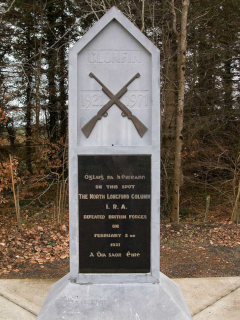
A stone monument is erected at the site of the ambush in 1971 to mark the 50th anniversary of the event. The IRA combatants are MacEoin (Ballinalee), Sean Duffy (Ballinalee), James J. Brady (Ballinamuck), Tom Brady (Cartronmarkey), Paddy Callaghan (Clonbroney), Seamus Conway (Clonbroney), Pat Cooke (Tubber), Seamus Farrelly (Purth), Paddy Finnegan (Molly), Larry Geraghty (Ballymore), Mick Gormley (Killoe), Hugh Hourican (Clonbroney), Jack Hughes (Scrabby), Mick Kenny (Clonbroney), Paddy Lynch (Colmcille), John McDowell (Clonbroney), Jack Moore (Streete), Mick Mulligan (Willsbrook), Michael F. Reynolds (Killoe), Sean Sexton (Ballinalee) and Jim Sheeran (Killoe).
(Pictured: The stone monument located at Clonfin, near the village of Ballinalee, County Longford, marking the site of the ambush. Erected in 1971 to mark the 50th anniversary of the event, the limestone monument features strong military, anti-British language and symbolism.)





 seamus dubhghaill