seamus dubhghaill

Promoting Irish Culture and History from Little Rock, Arkansas, USA


Leave a comment

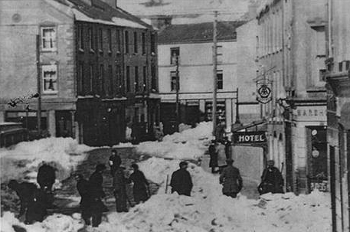
The 1947 Blizzard

blizzard-of-1947

The worst blizzard in living memory hits Ireland on February 25, 1947. The penetrating Arctic winds had been blowing for several weeks. Munster and Leinster had been battling the snows since the middle of January.

On the evening of February 24, a major Arctic depression approaches the coast of Cork and Kerry and advances northeast across Ireland. By morning, Ireland is being pounded by the most powerful blizzard of the 20th century. The winter of 1946-1947 is the coldest and harshest winter in living memory. Temperatures rarely rise above freezing and the snows that have fallen across Ireland in January remain until the middle of March.

Worse still, all subsequent snowfall in February and March simply piles on top of all that has previously fallen. There is no shortage of snow that bitter winter. Of the fifty days between January 24 and March 17, it snows on thirty of them.

“The Blizzard” of February 25th is the greatest single snowfall on record and lasts for almost fifty consecutive hours. It smothers the entire island in a blanket of snow. Driven by persistent easterly gales, the snow drifts until every hollow, depression, arch and alleyway is filled and the Irish countryside becomes a vast ashen wasteland.

Everything on the frozen landscape is a sea of white. The freezing temperatures solidify the surface and it is to be an astonishing three weeks before the snows begins to melt.

(Pictured: Snow drifts on Main Street, Boyle, County Roscommon, February 1947)


2 Comments

Death of Maurice FitzThomas FitzGerald, 1st Earl of Desmond

fitzgerald-coat-of-arms

Maurice FitzThomas FitzGerald, 1st Earl of Desmond, Irish nobleman in the Peerage of Ireland, Captain of Desmond Castle in Kinsale, so-called ruler of Munster, and for a short time Lord Justice of Ireland, dies at Dublin Castle on January 25, 1356.

FitzGerald is the second son of Thomas FitzMaurice FitzGerald, 2nd Baron Desmond by his wife Margaret. His father dies in 1296 when he is still a child. He succeeds his elder brother Thomas FitzGerald, 3rd Baron Desmond as 4th Baron Desmond in 1307, and also inherits great wealth and large estates.

By 1326 FitzGerald’s influence is such that there are rumours of a conspiracy to make him King of Ireland. Modern historians tend to dismiss the story, on the ground that the alleged conspirators were other magnates who were more interested in increasing their own power than aggrandising FitzGerald.

FitzGerald is created Earl of Desmond by Letters Patent dated at Gloucester, England, August 27, 1329, by which patent also the county palatine of Kerry is confirmed to him and his male heirs, to hold of the Crown by the service of one knight’s fee. This is part of a Crown policy of attempting to win the support of the magnates by conferring earldoms on them.

In January 1330 FitzGerald is summoned by Sir John Darcy, Lord Justice of Ireland, to fight armed Irish rebels, with a promise of the King’s pay. It is FitzGerald who introduces the practice of Coigne and Livery, the quartering of troops on the inhabitants of the district they are sent to protect.

Accepting the King’s proposal, in addition to dealing with Munster and Leinster, FitzGerald routs the O’Nolans and O’Murroughs and burns their lands in County Wicklow and forces them to give hostages. He recovers the castle of Ley from the O’Dempsies, and has a liberate of £100 sterling dated at Drogheda August 24, 1335, in return for the expense he has incurred in bringing his men-at-arms, hobelars, and foot-soldiers, from various parts of Munster to Drogheda, and there, with Lord Justice Darcy, disperses the King’s enemies.

In 1331 there are further rumours of an attempt to make him King. Although there seems to be no foundation for them, the Crown takes them seriously enough to imprison FitzGerald for several months. He is released when a number of fellow nobles stand surety for his good behaviour.

In 1339 FitzGerald is engaged against Irish rebels in County Kerry where it is said he slays 1,400 men, and takes Nicholas, Lord of Kerry, prisoner, keeping him confined until he dies as punishment for siding with the rebels against the Crown.

The same year FitzGerald is present in the parliament held in Dublin. He is summoned by Writ dated at Westminster July 10, 1344, with Maurice, Earl of Kildare, and others, to attend the King at Portsmouth “on the octaves of the nativity of the Virgin Mary,” with twenty men-at-arms and fifty hobelars, at his own expense, to assist in the war against Philip V of France.

FitzGerald, who has long been acting “with a certain disregard for the niceties of the law” now decides on open rebellion. In 1345 he presides at an assembly of Anglo-Irish magnates at Callan, County Kilkenny, ignores a summons to attend the Irish Parliament and attacks Nenagh. He is a formidable opponent, and for the next two years his defeat is the main preoccupation of the Crown. He surrenders on a promise that his life will be spared. He is imprisoned and his lands forfeited. He is allowed to go under guard to England to answer the charges against him.

By no means for the last time, the Crown evidently decides that it cannot govern Ireland without the magnates’ support. In 1348 FitzGerald is released and pardoned in 1349. His loyalty does not seem to have been in question during the last years of his life.

In July 1355 FitzGerald is appointed Lord Justice of Ireland for life, dying, however, the following January in Dublin Castle. He is interred in the Church of the Friars-Preachers in Tralee.


Leave a comment

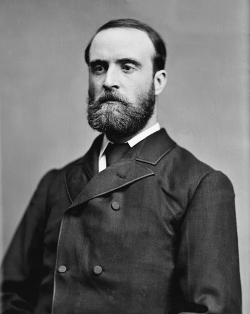
Charles Stewart Parnell’s Famous Speech at Ennis

Charles Stewart Parnell delivers his famous speech at Ennis, County Clare, on September 19, 1880, in which he introduces the term for non-violent protest – boycotting.

Parnell is elected president of Michael Davitt‘s newly founded Irish National Land League in Dublin on October 21, 1879, signing a militant Land League address campaigning for land reform. During the summer of 1880, the Land League, goes into decline but its fortunes are transformed when the House of Lords rejects a moderate measure of land reform. The movement is transformed into a national movement as it spreads into Munster and Leinster. As the movement spreads, crime increases especially in the West. Parnell, who had been elected leader of the Irish Parliamentary Party in May, is very worried about this violence and hopes that the Land League can deflect tenants away from the traditional violence associated with land agitation. He advocates a policy of “moral force” where tenants are to deny all social or commercial contact with anyone who is believed to oppose the aims of the League.

During his speech at Ennis, Parnell asks his audience, “What are you to do with a tenant who bids for a farm from which another has been evicted?” Several voices reply “Shoot him!” and “Kill him!” Parnell responds, “I wish to point out to you a very much better way, a more Christian and charitable way, which will give the lost man an opportunity of repenting. When a man takes a farm from which another has been evicted, you must shun him on the roadside when you meet him, you must shun him in the streets of the town, you must shun him in the shop, you must shun him on the fair green and in the market place, and even in the place of worship, by leaving him alone, by putting him in moral Coventry, by isolating him from the rest of the country, as if he were the leper of old – you must show him your detestation of the crime he committed.”

This type of “moral Coventry” is used in the cast of Captain Charles Cunningham Boycott, a County Mayo land agent, who is isolated by the local people until his nerve breaks. This leads to a new word entering into the English language – boycotting.


Leave a comment

The Norman Invasion of Ireland

Cambro-Norman mercenaries land in Ireland on May 1, 1169 at the request of Diarmait Mac Murchada (Dermot MacMurragh), the ousted King of Leinster, who has sought their help in regaining his kingdom. The Norman invasion of Ireland takes place in stages during the late 12th century, at a time when Gaelic Ireland is made up of several kingdoms, with a High King claiming lordship over all.

Diarmait and the Normans seize Leinster within weeks and launch raids into neighbouring kingdoms. This military intervention has the backing of King Henry II of England and is authorized by Pope Adrian IV.

And there and then the high king stood strong and lay down too led by Richard de Clare, 2nd Earl of Pembroke, more commonly known as Strongbow. By May 1171, Strongbow has assumed control of Leinster and seized the Norse-Irishcity kingdoms of Dublin, Waterford, and Wexford. That summer, High King Ruaidrí Ua Conchobair (Rory O’Connor) leads an Irish counteroffensive against the Normans, but they manage to hold most of their conquered territory. In October 1171, King Henry lands a large Anglo-Norman army in Ireland to establish control over both the Cambro-Normans and the Irish. The Norman lords hand their conquered territory to Henry. He lets Strongbow hold Leinster in fief and declares the cities to be crown land. Many Irish kings also submit to him, likely in the hope that he will curb Norman expansion. Henry, however, grants the unconquered Kingdom of Meath to Hugh de Lacy. After Henry’s departure in 1172, Norman expansion and Irish counteroffensives continue.

The 1175 Treaty of Windsor acknowledges Henry as overlord of the conquered territory and Ruaidrí as overlord of the rest of Ireland, with Ruaidrí also swearing fealty to Henry. However, the Treaty soon falls apart. The Anglo-Norman lords continue to invade Irish kingdoms and they in turn launch counter-attacks. In 1177, Henry adopts a new policy. He declares his son John to be “Lord of Ireland” (i.e. of the whole country) and authorizes the Norman lords to conquer more land. The territory they hold becomes the Lordship of Ireland and forms part of the Angevin Empire. The largely successful nature of the invasion has been attributed to a number of factors. These include the Normans’ military superiority and programme of castle-building, the lack of a unified opposition from the Irish, and the Church’s support for Henry’s intervention.

The Norman invasion is a watershed in the history of Ireland, marking the beginning of more than 700 years of direct English and, later, British involvement in Ireland.


Leave a comment

Founding of the Irish Rugby Football Union

irfu

The Irish Rugby Football Union (IRFU), the body managing rugby union in the island of Ireland, both Republic of Ireland and Northern Ireland, is founded in Dublin on February 5, 1879. The IRFU has its head office at 10/12 Lansdowne Road and home ground at Aviva Stadium, where adult men’s Irish rugby union international matches are played. In addition, the Union also owns Kingspan Stadium in Belfast, Thomond Park in Limerick and a number of grounds in provincial areas that have been rented to clubs.

Initially, there are two unions, both founded in 1874. The Irish Football Union has jurisdiction over clubs in Leinster, Munster, and parts of Ulster. The Northern Football Union of Ireland controls the Belfast area. The IRFU is formed in 1879 as an amalgamation of these two organisations and branches of the new IRFU are formed in Leinster, Munster, and Ulster. The Connacht Branch is formed in 1900.

The IRFU is a founding member of the International Rugby Football Board, now known as World Rugby, in 1886 with Scotland and Wales. England refuses to join until 1890.

Following the political partition of Ireland into separate national states, Ireland, originally the Irish Free State then Éire, and Northern Ireland, a political division of the United Kingdom, the then Committee of the Irish Rugby Football Union decides that it will continue to administer its affairs on the basis of the full 32 Irish counties and the traditional four provinces of Ireland – Leinster (12 counties), Ulster (9 counties), Munster (6 counties), and Connacht (5 counties).

This leads to the unusual, but not unique, situation among international rugby union teams, where the Irish representative teams are drawn from players from two separate political, national territories. To maintain the unity of Irish rugby union and the linkages between North and South, the IRFU purchase a new ground in 1923 in the Ravenhill district of Belfast at a cost of £2,300. The last full International at Ravenhill involving Ireland for more than a half-century takes place in 1953–54 against Scotland who are victorious by 2 tries (6 points) to nil. Australia plays Romania in the 1999 World Cup at the ground. The next full International played at Ravenhill is the Rugby World Cup warm-up match against Italy in August 2007 due to the temporary closure of Lansdowne Road for reconstruction.

The four provincial branches of the IRFU first run cup competitions during the 1880s. Although these tournaments still take place every year, their significance has been diminished by the advent of an All-Ireland League of 48 Senior Clubs in 1990.

The four provincial teams have played an Interprovincial Championship since the 1920s and continue to be the focal point for players aspiring to the international level. These are Munster, Leinster, Ulster, and Connacht . All four provinces play at the senior level as members of the Guinness Pro12.

There are currently approximately 95,000 rugby players in total in Ireland. There are 56 clubs affiliated to the Ulster Branch, 71 to the Leinster Branch, 59 to the Munster Branch, and 19 to the Connacht Branch. In addition, there are 246 schools playing rugby: Ulster (107), Leinster (75), Munster (41) and Connacht (23).

The IRFU also has an Exiles Branch tasked with developing “Ireland-qualified” players (i.e., eligible to play internationally for Ireland through ancestry) living in England, Scotland, and Wales. Volunteers provide coaching, administration and development under the supervision of a paid development manager.


Leave a comment

Construction Begins on the Royal Canal

royal-canal-old-mill-dublin

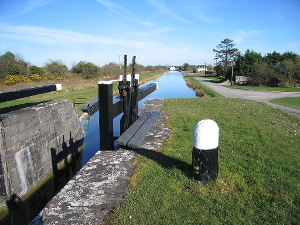
Construction begins on the Royal Canal on October 24, 1789. The canal is originally built for freight and passenger transportation from the River Liffey in Dublin to Longford.

In 1755, Thomas Williams and John Cooley make a survey to find a suitable route for a man-made waterway across north Leinster from Dublin to the River Shannon. They originally plan to use a series of rivers and lakes, including the Boyne, Blackwater, Deel, Yellow, Camlin, and Inny and Lough Derravaragh.

Work commences in 1789 and lasts 27 years before finally reaching the River Shannon in 1817, at a total cost of £1,421,954. Construction is unexpectedly expensive, and the project is riven with problems. In 1794 the Royal Canal Company is declared bankrupt. The Duke of Leinster, a board member, insists that the new waterway take in his local town of Maynooth. The builders have to deviate from the planned route and necessitate the construction of a ‘deep sinking’ between Blanchardstown and Clonsilla. The diversion also calls for the building of the Ryewater Aqueduct, at Leixlip.

royal-canal-kinnegad

The canal passes through Maynooth, Kilcock, Enfield, Mullingar and Ballymahon has a spur to Longford. The total length of the main navigation is 145 kilometres (90 miles), and the system has 46 locks. There is one main feeder, from Lough Owel, which enters the canal at Mullingar.

In 200 years, it has been maintained by eight successive agencies – the Royal Canal Company, the Commissioners of Inland Navigation, the New Royal Canal Company, Midland Great Western Railway Company, Great Southern Railways, CIÉ, and the Office of Public Works.

The canal falls into disrepair in the late 20th century, but much of the canal has since been restored for navigation. The length of the canal to the River Shannon is reopened on October 1, 2010, but the final spur branch of the canal to Longford Town remains closed.

(Pictured: Royal Canal as it enters Dublin city centre (left) and Royal Canal in rural County Westmeath north of Kinnegad (right)


Leave a comment

Henry II Lands at Waterford

henry-ii-at-waterford

Henry II, fearful that Richard de Clare, 2nd Earl of Pembroke, also known as Strongbow, will grow too powerful in Ireland, lands with an army at Waterford on October 17, 1171. The Normans, Norse, and Irish all submit to him, except for the most remote Irish kings.

Henry is worried about the growing power of the Cambro-Norman knights, in particular Strongbow, who has in the previous two years carved out what is a substantial new territory, as well as a delicately located new territory with regard to Henry’s own holdings in what is termed the Angevin Empire.

Henry’s presence changes the game for the Norman lords. Either they agree to do as he asks, submit to his sovereignty and accept the land they have grasp through force of arms as his gift, or branded as rebels they face their King with an army of 1,000 knights.

The Lords see the way of things and agree to the demand. Many of the Gaelic Irish, seeing Henry as a potential ally against the power of the Norman Lords, swear allegiance as well.

Henry receives recognition and hostages from the Ostmen of Wexford, who have captured Robert FitzStephen, as well as from many other kings in Ireland including Diarmait MacCarthaigh, king of Cork, Domnall Mór Ua Briain, king of Limerick, Murchadh O Cearbhaill, king of Airgialla, Tighearnán Mór Ua Ruairc, king of Breifne, and Donn Sléibe mac Con Ulad Mac Duinn Sléibe, king of Ulaid.

Henry formally grants Leinster to Strongbow in return for homage, fealty, and the service of 100 knights, reserving to himself the city and kingdom of Dublin and all seaports and fortresses. He also grants the kingdom of Meath, from the River Shannon to the sea, to his own follower Hugh de Lacy.

Henry II’s arrival at Waterford puts to rest the idea of an independent Irish kingdom that any Norman lord might imagine and determines a course for Ireland for some 750 years.


Leave a comment

The Battle of Knockdoe

battle-of-knockdoe

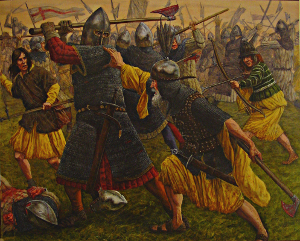
The Battle of Knockdoe, a battle between the forces of two Anglo-Irish lords — Gerald FitzGerald, Earl of Kildare, the Lord Deputy of Ireland, and Ulick Fionn Burke, lord of Clanricarde, takes place on August 19, 1504, at Knockdoe, County Galway.

Gerald FitzGerald becomes concerned that Ulick Burke’s attempt to gain supremacy in Connacht could simultaneously threaten the Crown’s interests in that province and his claim to be the paramount magnate in Ireland. He tries to persuade Ulick to acknowledge his authority by giving him his daughter Estacia in marriage. Ulick Burke, however, resists all attempts to have his power subordinated by the Earl of Kildare, forming an alliance with O’Brien of Thomond and the magnates of Munster. The Burkes of Mayo, on the other hand, join forces with Kildare with the aim of suppressing their dangerous neighbour.

In 1503, Ulick Burke attacks and destroys the castles of O’Kelly, Lord of Hymany, at Monivea, Garbally, and Castleblakeney. O’Kelly complains of this to the Lord Deputy.

For political and possibly for personal reasons, the Lord Deputy is eager to help O’Kelly weaken the prestige of Clanrickarde. Both sides gather a large contingent of lesser magnates and their armies. The Lord Deputy’s forces include contingents from Leinster, Ulster, and Connacht, among which are the armies of Red Hugh O’Donnell and Art Óg Ó Néill, the McDermotts and Morrisroes of Connacht, and a contingent provided by O’Kelly. Facing them are the forces of Burke and his allies – the O’Briens of Thomond, the McNamaras, the O’Kennedys, and the O’Carrolls.

The armies meet on the slopes of Knockdoe, almost a mile to the north of Lackagh Parish Church, with heavily armed Gallowglass playing a large part on both sides. It is said that firearms are employed in the course of the battle, an early instance of their use in Ireland. The battle apparently lasts all day, with the heaviest fighting taking place along the River Clare in the townland of Ballybrone. The precise number of casualties is unknown, though contemporary observers are impressed by the extent of the slaughter. Around the summit of Knockdoe are many cairns where the dead are said to have been buried, with one in particular being pointed out as the resting place of the two sons of O’Brien of Thomond.

The Lord Deputy, though victorious, has many among the slain. His army remains the night on the field as a token of victory, then marches to Galway, looting Claregalway castle en route and taking as prisoners the two sons and daughter of Ulick Burke. They remain in Galway for a few days and then travel to Athenry.

The Clanrickarde Burkes fade into obscurity for some decades, with their rivals, the Mayo Burkes, gaining influence as a consequence.


2 Comments

Viking Settlement That Becomes Dublin is Founded

founding-of-dublin

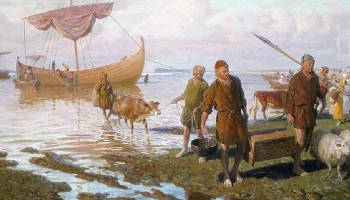
A Viking settlement that would later become the city of Dublin is founded on the banks of the River Liffey on July 10, 988.

The first documented history of Dublin begins with the Viking raids in the 8th and 9th century. These lead to the establishment of a settlement on the south side of the mouth of the Liffey, named Dubh Linn (Black Pool) after the dark tidal pool where the River Poddle enters the Liffey which is where the Danes first moor their boats.

The Vikings, or Ostmen as they call themselves, rule Dublin for almost three centuries, although they are expelled in 902 only to return in 917 and notwithstanding their defeat by the Irish High King Brian Boru at the Battle of Clontarf in 1014. From that date, the Norse are a minor political force in Ireland, firmly opting for a commercial life. Viking rule of Dublin ends completely in 1171 when the city is captured by King Dermot MacMurrough of Leinster, with the aid of Anglo-Norman mercenaries. An attempt is made by the last Norse King of Dublin, Ascall mac Ragnaill, to recapture the city with an army he raises among his relations in the Scottish Highlands, where he is forced to flee after the city is taken, but the attempted reconquest fails and Ascall is killed.

Dublin becomes the centre of English power in Ireland after the Norman invasion of the southern half of Ireland (Munster and Leinster) in 1169-1171, replacing Tara in Meath, seat of the Gaelic High Kings of Ireland, as the focal point of Ireland’s polity. On May 15, 1192, Dublin’s first written Charter of Liberties is granted by John, Lord of Ireland, and is addressed to all his “French, English, Irish and Welsh subjects and friends.” On June 15, 1229, his son Henry grants the citizens the right to elect a mayor who is to be assisted by two provosts. By 1400, however, many of the Anglo-Norman conquerors are absorbed into the Gaelic culture, adopting the Irish language and customs, leaving only a small area of Leinster around Dublin, known as the Pale, under direct English control.


Leave a comment

Death of Brendan the Navigator

brendan-the-navigator

Saint Brendan of Clonfert, called “the Navigator” and one of the early Irish monastic saints, dies on May 16, 577, in Annaghdown, County Galway.

In 484, Brendan is born in Tralee, County Kerry, in the province of Munster. He is born among the Altraige, a tribe originally centred around Tralee Bay, to parents called Finnlug and Cara. He is baptised at Tubrid, near Ardfert by Saint Erc, and is originally to be called “Mobhí” but signs and portents attending his birth and baptism lead to him being christened “Broen-finn” or “fair-drop.” For five years he is educated under Saint Ita, “the Brigid of Munster.” When he is six, he is sent to Saint Jarlath‘s monastery school at Tuam to further his education. Brendan is one of the “Twelve Apostles of Ireland,” one of those said to have been tutored by the great teacher, Finnian of Clonard.

At the age of twenty-six, Brendan is ordained a priest by Saint Erc. Afterwards, he founds a number of monasteries. Brendan’s first voyage takes him to the Aran Islands, where he founds a monastery. He also visits Hinba, an island off Scotland where he is said to meet Columcille. On the same voyage he travels to Wales, and finally to Brittany, on the northern coast of France. Between the years 512 and 530 Brendan builds monastic cells at Ardfert and, at the foot of Mount Brandon, Shanakeel— Seana Cill, usually translated as “the old church.” From here he supposedly sets out on his famous seven-year voyage for Paradise.

St. Brendan is chiefly renowned for his legendary journey to the Isle of the Blessed as described in the ninth century Voyage of St. Brendan the Navigator. Many versions exist that tell of how he sets out onto the Atlantic Ocean with sixteen pilgrims searching for the Garden of Eden. One of these companions is said to be Saint Malo, the namesake of Saint-Malo. This occurs sometime between 512 and 530 AD, before his travel to the island of Great Britain. On the trip, Brendan supposedly sees Saint Brendan’s Island, a blessed island covered with vegetation. He also encounters a sea monster, an adventure he shares with his contemporary, Saint Columba. The most commonly illustrated adventure is his landing on an island which turns out to be a giant sea monster called Jasconius or Jascon. This too, has its parallels in other stories, not only in Irish mythology but in other traditions, from Sinbad the Sailor to Pinocchio.

Brendan travels to Wales and the holy island of Iona, off the west coast of Scotland. Returning to Ireland, he founds a monastery at Annaghdown, where he spends the rest of his days. He also founds a convent at Annaghdown for his sister Briga. Having established the bishopric of Ardfert, St. Brendan proceeds to Thomond and founds a monastery at Inis-da-druim, in the present parish of Killadysert, County Clare, about the year 550. He then journeys to Wales and studies under Saint Gildas at Llancarfan, and then to Iona, for it is said that he leaves traces of his apostolic zeal at Kil-brandon and Kil-brennan Sound. After a three years’ mission in Britain, he returns to Ireland, and does more proselytising in various parts of Leinster, especially at Dysart, Killiney, and Brandon Hill. He establishes churches at Inchiquin, County Clare and at Inishglora, County Mayo, and founds Clonfert in County Galway around 557 AD.

Brendan dies on May 16, 577 at Annaghdown, while visiting his sister Briga. Fearing that after his death his devotees might take his remains as relics, Brendan arranges before his death to have his body secretly carried back to the monastery he founded at Clonfert concealed in a luggage cart. He is buried in Clonfert Cathedral.