seamus dubhghaill

Promoting Irish Culture and History from Little Rock, Arkansas, USA


Leave a comment

The Corporals Killings

British Army corporals Derek Wood and David Howes are killed by the Provisional Irish Republican Army (IRA) on March 19, 1988, in Belfast, Northern Ireland, in what becomes known as the corporals killings. The soldiers, wearing civilian clothes, both armed with Browning Hi-Power pistols and in a silver Volkswagen Passat hatchback, drive into the funeral procession for IRA member Kevin Brady.

The Brady funeral is making its way along the Andersonstown Road toward Milltown Cemetery when the corporals’ car appears from the opposite direction. The car drives straight towards the front of the funeral, which is headed by several black taxis. It drives past a Sinn Féin steward who signals it to turn. Mourners at the funeral say they believed they were under attack from Ulster loyalists, as three days earlier, loyalist Michael Stone had attacked an IRA funeral and killed three people. The car then mounts a pavement, scattering mourners, and turns into a small side road. When this road is blocked, it then reverses at speed, ending up within the funeral procession. Corporal Wood attempts to drive the car out of the procession but his exit route is blocked by a black taxi.

An angry crowd surrounds the car, smashes the windows and attempts to drag the soldiers out. Wood produces a Browning Hi-Power 9mm handgun. He climbs partly out of a window and fires a shot in the air, which briefly scatters the crowd. The crowd then surges back, with some of them attacking the car with a wheel-brace and a stepladder snatched from a photographer. The corporals are eventually pulled from the car and punched and kicked to the ground.

The attack is witnessed by the media and passersby. Journalist Mary Holland recalls seeing one of the men being dragged past a group of journalists. “He didn’t cry out; just looked at us with terrified eyes, as though we were all enemies in a foreign country who wouldn’t have understood what language he was speaking if he called out for help.”

The men are taken to nearby Casement Park sports ground, just opposite. Here they are beaten, stripped to their underpants and socks, and searched by a small group of men. The BBC and The Independent write that the men were “tortured.” A search reveals that the men are British soldiers. Their captors find a military ID on Howes which is marked “Herford,” the site of a British military base in Germany, but it is believed they misread it as “Hereford,” the headquarters of the Special Air Service (SAS).

Redemptorist priest Father Alec Reid, who plays a significant part in the peace process leading to the 1998 Good Friday Agreement, intervenes and attempts to save the soldiers, and asks people to call an ambulance. “I got down between the two of them and I had my arm around this one and I was holding this one up by the shoulder….They were so disciplined, they just lay there totally still and I decided to myself they were soldiers. There was a helicopter circling overhead and I don’t know why they didn’t do something, radio to the police or soldiers to come up, because there were these two of their own soldiers.”

One of the captors warns Father Reid not to interfere and orders two men to take him away.

The two soldiers are placed in a taxi and driven fewer than 200 yards to a waste ground near Penny Lane (South Link), just off the main Andersonstown Road. There they are taken out of the vehicle and shot dead. Wood is shot six times and Howes is shot five times. Each also has multiple injuries to other parts of their bodies. The perpetrators quickly leave the scene. Father Reid hears the shots and rushes to the waste ground. He believes one of the soldiers is still breathing and attempts to give him mouth-to-mouth resuscitation. Upon realizing that the soldiers are dead, he gives them the last rites. According to photographer David Cairns, although photographers have their films taken by the IRA, he is able to keep his by quickly leaving the area after taking a photograph of Reid kneeling beside the almost naked body of Howes, administering the last rites. Cairns’ photograph is later named one of the best pictures of the past 50 years by Life magazine.

The whole incident is filmed by a British Army helicopter hovering overhead. An unnamed soldier of the Royal Scots says his eight-man patrol is nearby and sees the attack on the corporals’ car but are told not to intervene. Soldiers and police arrive on the scene three minutes after the corporals had been shot. A British Army spokesman says the army did not respond immediately because they needed time to assess the situation and were wary of being ambushed by the IRA. The large funeral procession also prevents them getting to the scene quickly.

Shortly after, the IRA releases a statement:

“The Belfast Brigade, IRA, claims responsibility for the execution of two SAS members who launched an attack on the funeral cortege of our comrade volunteer Kevin Brady. The SAS unit was initially apprehended by the people lining the route in the belief that armed loyalists were attacking them and they were removed from the immediate vicinity. Our volunteers forcibly removed the two men from the crowd and, after clearly ascertaining their identities from equipment and documentation, we executed them.”

Two men, Alex Murphy and Harry Maguire, are sentenced to life imprisonment for murder, but are released in 1998 under the terms of the Good Friday Agreement. Several other men receive lesser sentences for their part in the corporals killings.

(Pictured: Catholic priest Father Alec Reid administers the last rights to Corporal David Howes, one of two British soldiers brutally beaten and murdered in Belfast)

6 Comments

The 1973 Old Bailey Bombing

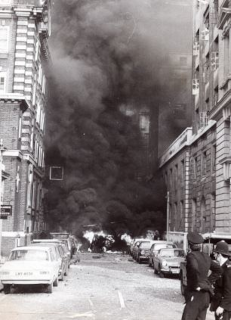
The 1973 Old Bailey bombing, a car bomb attack carried out by the Provisional Irish Republican Army (IRA) and dubbed as Bloody Thursday by newspapers in Britain, takes place outside the Central Criminal Court of England and Wales, commonly referred to as the Old Bailey, in London on March 8, 1973. This is the Provisional IRA’s first major attack in England since the Troubles began in the late 1960s. The unit also explodes a second bomb outside the Ministry of Agriculture building near Whitehall at around the same time the bomb at the Old Bailey explodes.

The Troubles had been ongoing in Northern Ireland and to a lesser extent in the Republic of Ireland since the late 1960s. Rioting, protests, gun battles, sniper attacks, bombings and punishment beatings became part of everyday life in many places in Northern Ireland, especially in the poorer working-class areas of Belfast and Derry. These events and others help to heighten sectarianism and boost recruitment into Irish republican and Ulster loyalist paramilitary groups and the security forces, mainly the newly created Ulster Defence Regiment (UDR).

England had been relatively untouched by the violence up until the beginning of 1973, but the IRA Army Council draws up plans for a bombing campaign to take place in England some time early in 1973. In the late 1960s and early 1970s, loyalist paramilitaries had bombed Dublin and other parts of the Republic of Ireland a number of times before the IRA began its bombing campaign in England. Following the Dublin bombings in late 1972 and in January 1973 carried out by Loyalists which killed three people and injured over 150, the media attention these bombings received helped the IRA decide to take its campaign to Britain in return. The arrest of top IRA personnel in both the Republic and Northern Ireland like Máire Drumm, Seán Mac Stíofáin, Ruairí Ó Brádaigh and Martin McGuinness in late 1972 help to convince the IRA to bomb England to take the heat off of the IRA in Ireland.

The IRA selects the volunteers who constitute the Active Service Unit (ASU) for the England bombing operation, which is scheduled to take place on March 8, 1973, the same day that a border poll, boycotted by Nationalists and Roman Catholics, is being held in Belfast. Volunteers from all three of the IRA’s Belfast Brigade Battalions are selected for the bombing mission. The team includes Gerry Kelly (19), Robert “Roy” Walsh (24), an expert bomb maker from Belfast, Hugh Feeney, a Belfast-born IRA volunteer and explosives expert, and two sisters, Marian (19) and Dolours Price (22) from Belfast and are from a staunchly Republican family, along with five other lesser-known volunteers from Belfast: Martin Brady (22), William Armstrong (29), Paul Holmes (19), William McLarnon (19), and Roisin McNearney (18).

Several days before the bombing, the leaders of the IRA ASU, which includes sisters Marian and Dolours Price, go to London and pick out four targets: the Old Bailey, the Ministry of Agriculture, an army recruitment office near Whitehall and New Scotland Yard. They then report back to their Officer Commanding (OC) in Belfast, and the IRA Army Council gives the go ahead. The bombs are made in Ireland and transported to London via ferry, according to Marian Price.

The Royal Ulster Constabulary (RUC) warns the British that the ASU is traveling to England, but are unable to provide specifics as to the target.

The drivers and the volunteers who are to prime the bombs wake up at 6:00 a.m. and drive the car bombs to their various targets. Gerry Kelly and Roy Walsh drive their car bomb to the Old Bailey. It is planned that by the time the bombs go off around 3:00 p.m., the ASU will be back in Ireland. The bomb at New Scotland Yard is found at 8:30 a.m. by a policeman who notices a discrepancy in the licence plate. The bomb team starts lifting out 5-pound (2.3 kg) bags of explosives and separates them, so that if the bomb does go off, the force of the explosion will be greatly reduced. The bomb squad eventually finds the detonating cord leads, which run under the front passenger seat of the car. Peter Gurney, a senior member of New Scotland Yard, cuts the detonator cord leads, defusing the bomb.

However, at the Old Bailey the bomb explodes, injuring many and causing extensive damage. Scotland Yard states it had warned the City of London police at 2:01 p.m. to search near the Old Bailey for a green Ford Cortina. The car is not located until 2:35 p.m. and explodes at 2:49 p.m. while police are evacuating the area. Several more people are injured by the car bomb near the Ministry of Agriculture, which brings the total number injured to over two hundred. A British man, Frederick Milton (60), dies of a heart attack. Dolours Price writes in her memoir, “There were warnings phoned in but people had stood about, curious to see… If people ignored the warnings and stood around gawking, they were stupid. The numbers of injured came about through curiosity and stupidity.” The ASU is caught trying to leave the country at Heathrow Airport prior to the explosions, as the police had been forewarned about the bombings and are checking all passengers to Belfast and Dublin. All ten give false names that do not match their documents and they are detained. The IRA Volunteer who gave a warning about the bombs an hour before they exploded is the only one not captured.

The IRA volunteers have to be tried at Winchester Crown court in Winchester Castle as the Old Bailey is wrecked by the car bomb. The trial takes ten weeks and is set amid extremely strict security. William McLarnon pleads guilty to all charges on the first day of the trial. On November 14, 1973, a jury convicts six men and two women of the bombings. The jury acquits Roisin McNearney in exchange for information and she is given a new identity. As her verdict is handed down, the other defendants begin to hum the “Dead March” from Saul, and one throws a coin at her, shouting, “Take your blood money with you” as she leaves the dock in tears. Six of the nine people convicted admit to Provisional IRA membership.

The judge sentences the eight to life imprisonment for the bombings and 20 years for conspiracy, while William McLarnon, whose family was forced out of their home in August 1969, is sentenced to 15 years. When his sentence is read he shouts, “Up The Provisional IRA.” As the eight are led to the cells below the court, several give raised fist salutes to relatives and friends in the public gallery. The Price sisters immediately go on hunger strike, soon followed by Feeney and Kelly, for the right not to do prison work and to be repatriated to a jail in Ireland. The bombers on hunger strike are eventually moved to jails in Ireland as part of the 1975 IRA truce agreed with the British. In 1983, Kelly escapes from Maze Prison and becomes part of an IRA ASU in the Netherlands. He is recaptured three years later by the Dutch authorities and extradited.

The Old Bailey bomb is the beginning of a sustained bombing campaign in England. The next major bombing by the IRA in England is the King’s Cross station and Euston station bombings which injured 13 people and do widespread damage. Another significant attack that year is the 1973 Westminster bombing which injures 60 people. Two more people die in England from IRA bombings in 1973, bringing the total to three for the year in that part of United Kingdom. The next year, 1974, is the bloodiest year of the Troubles outside of Northern Ireland with over 70 people being killed in the Republic of Ireland and England combined. Thirty-four are killed in the Dublin and Monaghan bombings, 21 from the Birmingham pub bombings, 12 from the M62 coach bombing, and several people are killed by the IRA’s Balcombe Street Gang.

One of the Old Bailey bombers, Marian Price, explains the IRA’s reasoning for bombing England. “It doesn’t seem to matter if it’s Irish people dying.” So if the armed struggle was to succeed then it was necessary to “bring it to the heart of the British Establishment.” Hence symbolic targets such as the Old Bailey “were carefully chosen.”


Leave a comment

The Shankill Butchers Sentenced to Life Imprisonment

The Shankill Butchers, a gang of eleven Ulster loyalists, are sentenced to life imprisonment on February 20, 1979, for 112 offences including nineteen murders. Many of the gang are members of the Ulster Volunteer Force (UVF) that is active between 1975 and 1982 in Belfast, Northern Ireland. The gang is based in the Shankill area and is responsible for the deaths of at least 23 people, most of whom are killed in sectarian attacks. The gang is notorious for kidnapping, torturing and murdering random or suspected Catholic civilians. Each is beaten ferociously and has their throat hacked with a butcher’s knife. Some are also tortured and attacked with a hatchet. The gang also kills six Ulster Protestants over personal disputes, and two other Protestants mistaken for Catholics.

Most of the Butchers are eventually captured and eleven of them come to trial during 1978 and early 1979. On February 20, 1979, the eleven men are convicted of a total of nineteen murders, and the 42 life sentences handed out are the longest combined prison sentences in United Kingdom legal history.

William Moore pleads guilty to eleven counts of murder and Bobby “Basher” Bates pleads guilty to ten counts. The trial judge, Lord Justice Turlough O’Donnell, says that he does not wish to be cast as “public avenger” but feels obliged to sentence the two to life imprisonment with no chance of release. Gang leader Lenny Murphy and his two chief “lieutenants,” however, escape prosecution.

In summing-up, Lord Justice O’Donnell states that their crimes, “a catalogue of horror”, are “a lasting monument to blind sectarian bigotry.” After the trial, Detective Chief Inspector Jimmy Nesbitt, head of the Criminal Investigation Department (CID) Murder Squad in Tennent Street Royal Ulster Constabulary (RUC) base and the man charged with tracking down the Butchers, comments, “The big fish got away,” a reference to Murphy (referred to in court as “Mr. X” or the “Master Butcher”) and to Messrs “A” and “B.”

Lenny Murphy is assassinated by a Provisional Irish Republican Army hit squad early in the evening of November 16, 1982, outside the back of his girlfriend’s house in the Glencairn estate. The IRA is likely acting with loyalist paramilitaries who perceive him as a threat.

The first of the Butchers to be released from prison is John Townsley, who had been only fourteen when he became involved with the gang and sixteen when arrested. Bobby Bates is released in October 1996, two years after the paramilitary ceasefires of 1994. He reportedly “found religion” behind bars. He is shot and killed in the upper Shankill area on June 11, 1997, by the son of the Ulster Defence Association (UDA) man he had killed in the Windsor Bar. “Mr. B”, John Murphy, dies in a car accident in Belfast in August 1998. William Moore is the final member of the gang to be released from prison in August 1998, in accordance with the Good Friday Agreement, after over twenty-one years behind bars. He dies on May 17, 2009, from a suspected heart attack at his home.

The investigations by Martin Dillon, author of The Shankill Butchers: A Case Study of Mass Murder (1989 and 1998), suggests that a number of other individuals (whom he is unable to name for legal reasons) escape prosecution for participation in the crimes of the Butchers and that the gang are responsible for a total of at least thirty murders.

The Butchers brought a new level of paramilitary violence to a country already hardened by death and destruction.


3 Comments

Birth of Paul “Dingus” Magee, Volunteer in the Provisional Irish Republican Army

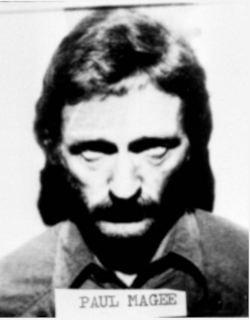
Paul “Dingus” Magee, a former volunteer in the Belfast Brigade of the Provisional Irish Republican Army (IRA), is born in the Ballymurphy area of Belfast, Northern Ireland, on January 30, 1948.

Magee joins the Belfast Brigade of the IRA and receives a five-year sentence in 1971 for possession of firearms. He is imprisoned in Long Kesh, where he holds the position of camp adjutant. In the late 1970s and early 1980s he is part of a four-man active service unit, along with Joe Doherty and Angelo Fusco, nicknamed the “M60 gang” due to their use of an M60 general-purpose machine gun. On April 9, 1980, the unit lures the Royal Ulster Constabulary (RUC) into an ambush on Stewartstown Road, killing Constable Stephen Magill and wounding two others. On May 2 the unit is planning another attack and has taken over a house on Antrim Road, when an eight-man patrol from the British Army‘s Special Air Service (SAS) arrives in plain clothes, after being alerted by the RUC. A car carrying three SAS members goes to the rear of the house, and another car carrying five SAS members arrives at the front of the house. As the SAS members at the front of the house exit the car the IRA unit opens fire with the M60 machine gun from an upstairs window, hitting Captain Herbert Westmacott in the head and shoulder. Westmacott is killed instantly and is the highest-ranking member of the SAS killed in Northern Ireland. The remaining SAS members at the front of the house, armed with Colt Commando automatic rifles, submachine guns and Browning pistols, return fire but are forced to withdraw. Magee is apprehended by the SAS members at the rear of the house while attempting to prepare the IRA unit’s escape in a transit van, while the other three IRA members remain inside the house. More members of the security forces are deployed to the scene, and after a brief siege the remaining members of the IRA unit surrender.

The trial of Magee and the other members of the M60 gang begins in early May 1981, with them facing charges including three counts of murder. On June 10 Magee and seven other prisoners, including Joe Doherty, Angelo Fusco and the other member of the IRA unit, take a prison officer hostage at gunpoint in Crumlin Road Jail. After locking the officer in a cell, the eight take other officers and visiting solicitors hostage, also locking them in cells after taking their clothing. Two of the eight wear officer’s uniforms while a third wears clothing taken from a solicitor, and the group moves toward the first of three gates separating them from the outside world. They take the officer on duty at the gate hostage at gunpoint and force him to open the inner gate. An officer at the second gate recognises one of the prisoners and runs into an office and presses an alarm button, and the prisoners run through the second gate towards the outer gate. An officer at the outer gate tries to prevent the escape but is attacked by the prisoners, who escape onto Crumlin Road. As the prisoners are moving toward the car park where two cars are waiting, an unmarked RUC car pulls up across the street outside Crumlin Road Courthouse. The RUC officers open fire, and the prisoners return fire before escaping in the waiting cars. Two days after the escape, Magee is convicted in absentia and sentenced to life imprisonment with a minimum recommended term of thirty years.

Magee escapes across the border into the Republic of Ireland. Eleven days after the escape he appears in public at the Wolfe Tone commemoration in Bodenstown Graveyard, County Kildare, where troops from the Irish Army and the Garda‘s Special Branch attempt to arrest him but fail after the crowd throws missiles and lay down in the road blocking access. He is arrested in January 1982 along with Angelo Fusco and sentenced to ten years imprisonment for the escape under extra-jurisdictional legislation. Shortly before his release from prison in 1989, he is served with an extradition warrant, and he starts a legal battle to avoid being returned to Northern Ireland. In October 1991, the Supreme Court of Ireland in Dublin orders his return to Northern Ireland to serve his sentence for the murder of Captain Westmacott, but Magee jumps bail, and a warrant is issued for his arrest.

Magee flees to England, where he is part of an IRA active service unit. On June 7, 1992, Magee and another IRA member, Michael O’Brien, are traveling in a car on the A64 road between York and Tadcaster, when they are stopped by the police. Magee and O’Brien are questioned by the unarmed police officers, who become suspicious and call for back-up. Magee shoots Special Constable Glenn Goodman, who dies later in hospital, and then shoots the other officer, PC Kelly, four times. Kelly escapes death when a fifth bullet ricochets off the radio he is holding to his ear, and the IRA members drive away. Another police car begins to follow the pair and comes under fire near Burton Salmon. The lives of the officers in the car are in danger, but Magee and O’Brien flee the scene after a member of the public arrives. A manhunt is launched, and hundreds of police officers, many of them armed, search woods and farmland. Magee and O’Brien evade capture for four days by hiding in a culvert, before they are both arrested in separate police operations in the town of Pontefract.

On March 31, 1993, Magee is found guilty of the murder of Special Constable Goodman and the attempted murder of three other police officers and sentenced to life imprisonment. O’Brien is found guilty of attempted murder and receives an eighteen-year sentence. On September 9, 1994, Magee and five other prisoners, including Danny McNamee, escape from HM Prison Whitemoor. The prisoners, in possession of two guns that had been smuggled into the prison, scale the prison walls using knotted sheets. A guard is shot and wounded during the escape, and the prisoners are captured after being chased across fields by guards and the police. In 1996 Magee stages a dirty protest in HM Prison Belmarsh, in protest at glass screens separating prisoners from their relatives during visits. He has refused to accept visits from his wife and five children for two years, prompting Sinn Féin to accuse the British government of maintaining “a worsening regime that is damaging physically and psychologically.”

In January 1997, Magee and the other five escapees from Whitemoor are on trial on charges relating to the escape for a second time, as four months earlier the first trial had been stopped because of prejudicial publicity. Lawyers for the defendants successfully argued that an article in the Evening Standard prejudiced the trial as it contained photographs of Magee and two other defendants and described them as “terrorists,” as an order had been made at the start of the trial preventing any reference to the background and previous convictions of the defendants. Despite the judge saying the evidence against the defendants was “very strong”, he dismisses the case stating, “What I have done is the only thing I can do in the circumstances. The law for these defendants is the same law for everyone else. They are entitled to that, whatever they have done.”

On May 5, 1998, Magee is repatriated to the Republic of Ireland to serve the remainder of his sentence in Portlaoise Prison, along with Liam Quinn and the members of the Balcombe Street Gang. He is released from prison in late 1999 under the terms of the Good Friday Agreement and returns to live with his family in Tralee, County Kerry. On March 8, 2000, he is arrested on the outstanding Supreme Court extradition warrant from 1991 and remanded to Mountjoy Prison. The following day he is granted bail at the High Court in Dublin, after launching a legal challenge to his extradition. In November 2000 the Irish government informs the High Court that it is no longer seeking to return him to Northern Ireland. This follows a statement from Secretary of State for Northern Ireland Peter Mandelson saying that “it is clearly anomalous to pursue the extradition of people who appear to qualify for early release under the Good Friday Agreement scheme, and who would, on making a successful application to the Sentence Review Commissioners, have little if any of their original prison sentence to serve.” In December 2000 Magee and three other IRA members, including two other members of the M60 gang, are granted a Royal Prerogative of Mercy which allows them to return to Northern Ireland without fear of prosecution.


Leave a comment

Blair & Ahern Meet in Aftermath of the Omagh Bombing

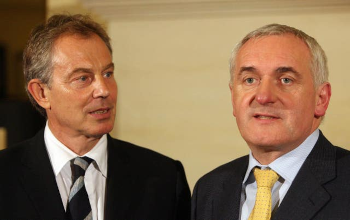
British Prime Minister Tony Blair meets with Taoiseach Bertie Ahern in Ashford Castle, County Mayo on August 26, 1998. They join forces to fight terrorism and discuss laws which will be introduced in the aftermath of the Omagh bombing, which took place eleven day earlier on August 15 in Omagh, County Tyrone, 110 kilometres west of Belfast, and resulted in 28 deaths.

Leading the way in a return to the past is Ahern’s Dublin government, which has introduced the toughest anti-terrorist legislation in the history of the Irish Republic. He concedes that the measures are draconian but says that his government is determined to do everything in its power, “working closely with the British government to defeat and suppress this murderous conspiracy against the people of Ireland.”

Prime Minister Blair promises that he too plans to introduce extreme measures. “We will bring in similar measures to those proposed by the Irish government, so we will then have the toughest anti-terrorist measures for the whole of Ireland, the Republic and Northern Ireland, that we have ever seen.”

With no plans to recall the British parliament, it is thought that existing legislation will be applied, since it already includes measures similar to those announced by the Irish government.

Oppressive British legislation has sustained British rule in Ireland for decades. This includes internment without trial, non-jury courts, entry and search of homes without a warrant, seven-day detention with unrecorded and unsupervised interrogation, denial of access to lawyers, exclusion orders and more. Most of these are still in use in 1998.

The Ahern package includes withdrawal of a suspect’s right to silence — refusal to answer questions can be used as evidence that a suspect is a member of an illegal organisation, the seizure of property that has been used for storing weapons or making bombs, and the creation of a new offence of directing an unlawful organisation. This is expected to carry the penalty of life imprisonment.

Omagh is 75% nationalist, with good cross-community relations, and has largely escaped the worst of the conflict. Although Republican dissidents have carried out a spate of similar bombings in the previous year, the towns targeted are mainly Unionist and further east.

In the wake of the Good Friday Agreement, Republican splinter groups remain on a military footing. These groups — the Irish National Liberation Army (INLA), the Continuity IRA and the Real IRA — have announced their determination to fight on.

The group that claims responsibility for the Omagh bombing is the Real IRA, which was formed in protest at the IRA’s 1997 cease-fire. Irish police have insisted that the Real IRA is the military wing of the recently formed 32 County Sovereignty Movement (32CSM), although this is denied by that organisation.

Although both the INLA and the Real IRA have declared a unilateral cease-fire since the Omagh bombing, media focus has settled on Bernadette Sands McKevitt, sister of the 1980s IRA hunger striker Bobby Sands, who is a leading figure in the 32 County Sovereignty Movement. Sands-McKevitt has condemned the Omagh bombing, but her home in Blackrock, County Louth, has since been targeted by local townspeople who have staged protests against her and her family. She has also been denied a visa to enter the United States on a speaking tour.

The Omagh bombing could not have come at a better time for Britain. With the war formally over and Sinn Féin penned, the bombing delivers an opportunity to smash the Republican left once and for all and wrench it from any semblance of ongoing support in Ireland.

All nationalist opponents of the Good Friday Agreement must now cope with being stained by the blood of Omagh. With the massive referendum vote in favour of peace to back them up, the British and Irish governments can be satisfied that the Good Friday Agreement now looks more in place than at any other time. As one nationalist describes the situation, “If the Good Friday Agreement was a defeat for the cause of Irish nationalism, the Omagh bombing has turned it into a rout.”

(From: “Blair, Ahern make the most of Omagh bomb” by Dave Riley, Green Left (www.greenleft.org), August 26, 1998)


Leave a comment

The Droppin’ Well Bombing

The Droppin’ Well bombing or Ballykelly bombing occurs on December 6, 1982, when the Irish National Liberation Army (INLA) explodes a time bomb at a disco in Ballykelly, County Londonderry, Northern Ireland. The disco, known as the Droppin’ Well, is targeted because it is frequented by British Army soldiers from nearby Shackleton Barracks. The bomb kills eleven soldiers and six civilians and 30 people are injured, making it the most deadly attack during the INLA’s paramilitary campaign and the most deadly attack during The Troubles carried out in County Londonderry.

The bomb is manufactured by the INLA in nearby Derry. One of those involved later reveals that the INLA unit had carried out reconnaissance missions to the Droppin’ Well to see if there were enough soldiers to justify the likelihood of civilian casualties.

On the evening of December 6, 1982, an INLA member leaves a bomb inside the pub. There are about 150 people inside. The Royal Ulster Constabulary (RUC) believe that the bomb, estimated to be 5 to 10 pounds of commercial (Frangex) explosives, is small enough to fit into a handbag. It has, however, been left beside a support pillar and, when it explodes at about 11:15 PM, the blast brings down the roof. Many of those killed and injured are crushed by fallen masonry.

Following the blast, it takes a few hours to pull survivors from the rubble. The last survivor is freed at 4:00 AM, but it is not until 10:30 AM that the last of the bodies is recovered. Ultimately, 17 people die and 30 are injured, some seriously. Five of the civilians are young women and three (Alan Callaghan, Valerie McIntyre and Angela Maria Hoole) are teenagers. Angela Hoole is celebrating her engagement to one of the soldiers who survives the incident. Of the eleven soldiers who die, eight are from the 1st Battalion Cheshire Regiment, two from the Army Catering Corps and one from The Light Infantry. One of those on the scene is Bob Stewart, then a company commander in the Cheshire Regiment. He loses six soldiers from his company and is deeply affected as he tends to the dead and injured.

Suspicion immediately falls upon the Provisional Irish Republican Army (IRA), who denies involvement. By December 8, the British Army is blaming the INLA on grounds that the IRA, in a mixed village, would have made greater efforts not to risk killing civilians. Shortly afterwards, the INLA issues a statement of responsibility.

The INLA describes the civilians killed as “consorts.” The attack is criticised by many on both sides of the conflict in Northern Ireland due to the high loss of civilian lives. Soon after the INLA had issued its statement, the government of the Republic of Ireland bans the INLA, making membership punishable by seven years imprisonment.

In an interview after the bombing, INLA leader Dominic McGlinchey says that the Droppin’ Well’s owner had been warned six times to stop offering entertainment to British soldiers. He adds that the owner, and those who socialise with the soldiers, “knew full well that the warnings had been given and that the place was going to be bombed at some stage.” It later emerges that the INLA may also have targeted Ballykelly because it believed that the military base was part of NATO‘s radar and communications network.

Six days after the bombing, RUC officers shoot dead INLA members Seamus Grew and Roddie Carroll near a vehicle checkpoint in Armagh. The officers say they believed that the two men were ferrying McGlinchey into Northern Ireland. Neither was armed, nor was McGlinchey in their car.

In June 1986, four INLA members, sisters Anna Moore and Helena Semple, Eamon Moore (no blood relation) and Patrick Shotter, receive life sentences for the attack. Anna Moore later marries loyalist Bobby Corry while both are in prison. Anna’s daughter, Jacqueline Moore, is given ten years for manslaughter as the court believes she had been coerced into involvement. She is pregnant during her arrest and later gives birth in jail. All of those convicted are from Derry.

(Pictured: The Droppin’ Well bar and disco in Ballykelly destroyed by a Irish National Liberation Army bomb in 1982. Credit: PA Wire)


Leave a comment

The Greysteel Massacre

The Greysteel massacre is a mass shooting that takes place on the evening of October 30, 1993 in Greysteel, County Londonderry, Northern Ireland.

On October 23, 1993, an Irish Republican Army (IRA) bomb prematurely explodes as the bombers carry it into a fishmongers on the Shankill Road in Belfast. The IRA’s intended target is a meeting of Ulster Defence Association (UDA) leaders, including brigadier Johnny Adair, which is to take place in a room above the shop. Unknown to the IRA, the meeting had been rescheduled. Eight Protestant civilians, a UDA member and one of the IRA bombers are killed in the blast. This became known as the Shankill Road bombing.

The UDA launches a number of “revenge attacks” for the bombing. Later that day, it fatally shoots a Catholic delivery driver after luring him to a bogus call at Vernon Court, Belfast. On October 26, the UDA shoots dead another two Catholic civilians and wounds five in an attack at the Council Depot at Kennedy Way, Belfast.

The massacre is carefully planned. The order for the attack comes from the UDA leadership and it is believed Greysteel is chosen partly because it is well away from Belfast, where security force activity is intense after the Shankill bombing. Those involved in planning and organising it include Billy McFarland, ‘Brigadier’ of the UDA’s North Antrim & Londonderry Brigade. Stephen Irwin, Geoffrey Deeney and Torrens Knight, all members of the brigade, are to carry out the shooting. The gunmen are first briefed on the plans for the massacre on October 27 in an office owned by the Ulster Democratic Party at Bond’s Place, Londonderry. Before the massacre, the gunmen go to the pub to familiarise themselves with the layout and choose the best positions to shoot from.

On Saturday, October 30, the gunmen drive to the pub in an Opel Kadett, with UDA member Brian McNeill driving a ‘scout car’ in front. Just before 10:00 PM the three gunmen, wearing blue boilersuits and balaclavas, enter the “Rising Sun Bar” in Greysteel. There are at least 70 people inside attending a Halloween party and at first some believe the men are playing a Halloween prank. Stephen Irwin yells “trick or treat” as he opens fire with a vz. 58 assault rifle on the packed crowd in the lounge. He keeps shooting until the magazine empties, quickly reloads and continues shooting. Geoffrey Deeney opens fire with a 9mm handgun at a fleeing woman, but it jams after one shot. Torrens Knight, armed with a shotgun, guards the entrance while the shooting is taking place. There is panic and screaming as people scramble for cover and women plead for mercy. The scene in the Rising Sun is described as “hell-like”; bodies lay everywhere and the lounge and dancefloor are covered with blood and broken glass. The gunmen, laughing, then make their escape in the Opel Kadett driven by Knight. While driving away from Greysteel, the getaway car’s wing mirror is hit by a police car speeding towards the scene. The gunmen drive the Kadett to a pick-up point near Eglinton, where they meet McNeill and burn the car.

Seven people are killed outright and nineteen are wounded, with another later dying of his wounds. The dead are Karen Thompson (19), Steven Mullan (20), Moira Duddy (59), Joseph McDermott (60), James Moore (81), John Moyne (50), John Burns (54) and Victor Montgomery (76). Six of those killed are Catholic civilians and two are Protestant civilians.

The following day, the UDA claims responsibility for the attack using the cover name “Ulster Freedom Fighters” (UFF). Its statement says that the “Greysteel raid” is “the continuation of our threats against the nationalist electorate that they would pay a heavy price for last Saturday’s slaughter of nine Protestants.” A UDA West Belfast Brigade member claims that his organisation “had information that senior IRA men drank in the Rising Sun… Unfortunately they were not there on Halloween but our boys acted on the briefing they had been given.” Afterwards, the gunmen are said to have boasted about the killings.

The UDA members involved are arrested shortly after the massacre. During their first court appearance, Knight is filmed laughing, taunting and shouting abuse at the victims’ relatives as he is led from the building. In February 1995, Irwin, Deeney, Knight and McNeill are sentenced to life imprisonment for their involvement in the attack. Knight is also convicted for the Castlerock killings. In 2000, they are released early, along with other paramilitary prisoners, under the terms of the Good Friday Agreement.

The pub is still open in Greysteel. There is a memorial to the victims outside the building that says: “May their sacrifice be our path to peace.”


Leave a comment

The Balcombe Street Siege Ends

balcombe-street-siege

The six-day Balcombe Street siege in London ends peacefully on December 12, 1975, after four Provisional Irish Republican Army (IRA) gunmen free their two hostages and give themselves up to the Metropolitan Police Service (MPS).

In 1974 and 1975, London is subjected to a 14-month campaign of gun and bomb attacks by the Provisional IRA. Some 40 bombs explode in London, killing 35 people and injuring many more. The four members of what becomes known as the “Balcombe Street gang,” Joe O’Connell, Edward Butler, Harry Duggan and Hugh Doherty, are part of a six-man IRA Active Service Unit (ASU) that also includes Brendan Dowd and Liam Quinn.

The Balcombe Street siege starts after a chase through London, as the MPS pursues Doherty, O’Connell, Butler and Duggan through the streets after they had fired gunshots through the window of Scott’s restaurant in Mount Street, Mayfair. The four IRA men ultimately run into a block of council flats in Balcombe Street, adjacent to Marylebone station, triggering the six-day standoff.

The four men go to 22b Balcombe Street in Marylebone, taking its two residents, middle-aged married couple John and Sheila Matthews, hostage in their front room. The men declare that they are members of the IRA and demand a plane to fly both them and their hostages to Ireland. Scotland Yard refuses, creating a six-day standoff between the men and the police. Peter Imbert, later Commissioner of the Metropolitan Police Service, is the chief police negotiator.

The men surrender after several days of intense negotiations between Metropolitan Police Bomb squad officers, Detective Superintendent Peter Imbert and Detective Chief Superintendent Jim Nevill, and the unit’s leader Joe O’Connell, who goes by the name of “Tom.” The other members of the gang are named “Mick” and “Paddy,” thereby avoiding revealing to the negotiators precisely how many of them are in the living room of the flat. The resolution of the siege is a result of the combined psychological pressure exerted on the gang by Imbert and the deprivation tactics used on the four men. The officers also use carefully crafted misinformation, through the BBC Radio news to further destabilise the gang into surrender. A news broadcast states that the British Special Air Service are going to be sent in to storm the building and release the hostages. This seems to deter the gang and they eventually give themselves up to the police.

The four are found guilty at their Old Bailey trial in 1977 of seven murders, conspiring to cause explosions, and falsely imprisoning John and Sheila Matthews during the siege. O’Connell, Butler and Duggan each receive 12 life sentences, and Doherty receives 11. Each of the men is later given a whole life tariff, the only IRA prisoners to receive this tariff. During the trial they instruct their lawyers to “draw attention to the fact that four totally innocent people were serving massive sentences” for three bombings in Woolwich and Guildford. Despite telling the police that they are responsible, they are never charged with these offences and the Guildford Four and Maguire Seven remain in prison for 15 more years, until it is ruled that their convictions are unsafe.

After serving 23 years in English prisons, the four men are transferred to the high security wing of Portlaoise Prison, County Laois, in early 1998. They are presented by Gerry Adams to the 1998 Sinn Féin Ardfheis as “our Nelson Mandelas,” and are released together with Brendan Dowd and Liam Quinn in 1999 as part of the Good Friday Agreement.


Leave a comment

Death of the Quinn Brothers in Ballymoney

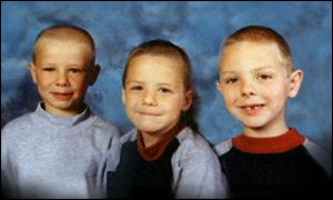
Three brothers, Jason, Richard and Mark Quinn, are killed by the Ulster Volunteer Force (UVF) in a firebomb attack on their home in Ballymoney, County Antrim, Northern Ireland on July 12, 1998. The crime is committed towards the end of the three-decade period known as “The Troubles.”

The Quinn family, consisting of mother Chrissie and sons Richard, Mark and Jason, live in the Carnany estate in the predominantly Protestant town of Ballymoney. The family is of a mixed religious background. Mother Chrissie is Roman Catholic from a mixed background and the boys’ father Jim Dillon is Catholic. After separating from her estranged husband, Chrissie rears the boys as Protestant “to avoid the hassle.” Chrissie lives with her Protestant partner Raymond Craig in Carnany which is predominately Protestant, reflecting the religious make-up of Ballymoney itself. The boys, aged 9, 10 and 11, attend a local state school and on the evening before their deaths had been helping to build the estate’s Eleventh Night loyalist bonfire. A fourth brother, Lee, is staying with his grandmother in Rasharkin at the time of the attack.

The killings take place at the height of the stand-off over the Orange Order march at Drumcree, which creates a tense atmosphere in various towns across Northern Ireland. In the weeks leading up to the fatal attack, the children’s mother expresses fear that she is not welcome in the area and that there is a possibility the family home might be attacked by loyalists. The Ballymoney Times reports a story the week of the deaths, stating that a resident of the Carnany estate had called in and was concerned about tension in the area adding something serious might happen “unless Catholic residents were left alone.”

The attack occurs at approximately 4:30 in the morning as the inhabitants of the house sleep. A car containing members of the Ulster Volunteer Force (UVF), a loyalist paramilitary organisation, arrive at the house and throw a petrol bomb through a window at the rear of the house. The petrol bomb is made from a whiskey bottle. The sounds of the boys’ shouting awake their mother, who finds her bedroom full of smoke. Chrissie Quinn, Raymond Craig and family friend Christina Archibald escape the resulting fire with minor injuries. Chrissie believes the boys have escaped the fire as she is unable to locate them in the dense smoke before she jumps to safety from a first-floor window. Two of the brother’s bodies are found in their mother’s bedroom and the other in another bedroom. Chrissie is taken to the hospital and released the next day after receiving minor injuries and shock in the attack.

One man, Garfield Gilmour, is found guilty of murdering the three brothers fifteen months later and is sentenced to life imprisonment after admitting that he had driven three other men to the house to commit the fatal petrol-bombing. Although Gilmour names the three alleged killers, they are never charged due to a lack of concrete evidence. Gilmour’s conviction for murder is reduced to manslaughter on appeal on June 5, 2000, and he is released six years later. Nine days after his release, his life sentence is replaced by a fixed prison sentence of 14 years.

(Pictured: The Quinn brothers. Left to right: Jason, Mark, Richard)