seamus dubhghaill

Promoting Irish Culture and History from Little Rock, Arkansas, USA


Leave a comment

Birth of Irish Novelist Maeve Binchy

maeve-binchy

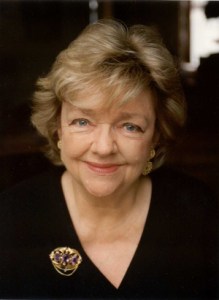
Maeve Binchy Snell, known as Maeve Binchy, Irish novelist, playwright, short story writer, columnist, and speaker best known for her sympathetic and often humorous portrayal of small-town life in Ireland, is born on May 28, 1939, in Dalkey, County Dublin.

Binchy is the oldest of four children born to William and Maureen (née Blackmore) Binchy. Educated at St. Anne’s, Dún Laoghaire, and later at Holy Child Convent, Killiney, she goes on to study at University College Dublin, where she earns a bachelor’s degree in history. She works as a teacher of French, Latin, and history at various girls’ schools.

A 1963 trip to Israel profoundly affects both her career and her faith. One Sunday, attempting to find the location of the Last Supper, she climbs a mountainside to a cavern guarded by an Israeli soldier. She weeps with despair and the soldier asks, “What’ya expect ma’am – a Renaissance table set for 13?” She replies, “Yes! That’s just what I did expect.” This experience causes her to renounce her Catholic faith and eventually turn to atheism.

In 1968, Binchy joins the staff at The Irish Times, and works there as a writer, columnist, the first Women’s Page editor, and the London editor reporting for the paper from London before returning to Ireland.

Binchy, tall and rather stout, never considers herself to be attractive. She ultimately encounters the love of her life, children’s author Gordon Snell, while recording a piece for Woman’s Hour in London. Their friendship blossoms into a cross-border romance, with her in Ireland and him in London, until she eventually secures a job in London through The Irish Times. They are married in 1977 and eventually return to live in Dalkey, not far from where she had grown up.

In all, Binchy publishes 16 novels, four short-story collections, a play, and a novella. A 17th novel, A Week in Winter, is published posthumously. Her literary career begins with two books of short stories, Central Line (1978) and Victoria Line (1980). She publishes her debut novel Light a Penny Candle in 1982.

Most of Binchy’s stories are set in Ireland, dealing with the tensions between urban and rural life, the contrasts between England and Ireland, and the dramatic changes in Ireland between World War II and the present day. Her books have been translated into 37 languages.

In 2002, Binchy suffers a health crisis related to a heart condition, which inspires her to write Heart and Soul. The book about a heart failure clinic in Dublin and the people involved with it, reflects many of her own experiences and observations in the hospital.

Binchy dies on July 30, 2012, at the age of 73, in a Dublin hospital with her husband at her side. She had suffered from various maladies, including painful osteoarthritis, which results in a hip operation. A month before her death she suffers a severe spinal infection and finally succumbs to a heart attack. Just ahead of that evening’s Tonight with Vincent Browne and TV3‘s late evening news, Vincent Browne and then Alan Cantwell, who respectively anchor these shows, announce to Irish television viewers that Binchy has died earlier in the evening.

Despite being an atheist, Binchy is given a traditional Requiem Mass which takes place at the Church of the Assumption, in her hometown of Dalkey. She is later cremated at Mount Jerome Cemetery and Crematorium.


Leave a comment

Publication of Bram Stoker’s “Dracula”

dracula-1st-edition

The Gothic horror novel Dracula, written by Bram Stoker of Dublin, is first published on May 26, 1897. The novel tells the story of Dracula’s attempt to move from Transylvania to England so that he may find new blood and spread the undead curse, and of the battle between Dracula and a small group of men and women led by Professor Abraham Van Helsing.

Between 1879 and 1898, Stoker is a business manager for the world-famous Lyceum Theatre in London, where he supplements his income by writing a large number of sensational novels, including the vampire tale Dracula. Parts of the novel are set around the town of Whitby, where he spends summer holidays.

Throughout the 1880s and 1890s, authors such as H. Rider Haggard, Rudyard Kipling, Robert Louis Stevenson, Arthur Conan Doyle, and H. G. Wells write many tales in which fantastic creatures threaten the British Empire. Invasion literature is at a peak, and Stoker’s formula of an invasion of England by continental European influences is very familiar by 1897 to readers of fantastic adventure stories. Victorian readers enjoy Dracula as a good adventure story like many others, but it does not reach its iconic legendary status until later in the 20th century when film versions begin to appear.

Before writing Dracula, Stoker spends seven years researching European folklore and stories of vampires, being most influenced by Emily Gerard‘s 1885 essay Transylvania Superstitions. Later he also claims that he has a nightmare, caused by eating too much crab meat covered with mayonnaise sauce, about a “vampire king” rising from his grave.

Despite being the most widely known vampire novel, Dracula is not the first. It is preceded and partly inspired by Sheridan Le Fanu‘s 1871 Carmilla, about a lesbian vampire who preys on a lonely young woman, and by Varney the Vampire, a lengthy penny dreadful serial from the mid-Victorian period by James Malcolm Rymer. John Polidori creates the image of a vampire portrayed as an aristocratic man, like the character of Dracula, in his tale The Vampyre in 1819.

The Lyceum Theatre where Stoker works between 1878 and 1898 is headed by actor-manager Henry Irving, who is Stoker’s real-life inspiration for Dracula’s mannerisms and who Stoker hopes would play Dracula in a stage version. Irving never does agree to do a stage version, but Dracula’s dramatic sweeping gestures and gentlemanly mannerisms draw their living embodiment from Irving.

The Dead Un-Dead is one of Stoker’s original titles for Dracula, and the manuscript is entitled simply The Un-Dead up until a few weeks before publication. Stoker’s notes for Dracula show that the name of the count is originally “Count Wampyr”, but Stoker becomes intrigued by the name “Dracula” while doing research, after reading William Wilkinson‘s book An Account of the Principalities of Wallachia and Moldavia with Political Observations Relative to Them (London 1820), which he finds in the Whitby Library and consults a number of times during visits to Whitby in the 1890s. The name Dracula is the patronym of the descendants of Vlad II of Wallachia, who takes the name “Dracul” after being invested in the Order of the Dragon in 1431. In the Romanian language, the word dracul can mean either “the dragon” or, especially in the present day, “the devil.”

Dracula is copyrighted in the United States in 1899 with the publication by Doubleday & McClure of New York. However, when Universal Studios purchases the rights, it comes to light that Bram Stoker has not complied with a portion of U.S. copyright law, placing the novel into the public domain. In the United Kingdom and other countries following the Berne Convention on copyrights, the novel is under copyright until April 1962, fifty years after Stoker’s death.

F. W. Murnau‘s unauthorized film adaptation Nosferatu is released in 1922, and the popularity of the novel increases considerably, owing to the controversy caused when Stoker’s widow tries to have the film removed from public circulation. Florence Stoker sues the film company and wins; however, the company is bankrupt, and Stoker only recovers her legal fees and an order by the court for all copies of the film to be destroyed. Some copies survive and find their way into theatres. Eventually, Florence Stoker simply gives up the fight against public displays of the film.

Dracula has been assigned to many literary genres including vampire literature, horror fiction, gothic fiction, and invasion literature. Stoker does not invent the vampire, but he defines its modern form, and the novel has spawned numerous theatrical, film, and television interpretations.


Leave a comment

Birth of Sir Arthur Conan Doyle, Creator of Sherlock Holmes

Sir Arthur Ignatius Conan Doyle, British writer and physician, most noted for creating the fictional detective Sherlock Holmes and writing stories about him which are generally considered milestones in the field of crime fiction, is born at 11 Picardy Place, EdinburghScotland, on May 22, 1859.

Doyle’s father, Charles Altamont Doyle, is an Englishman of Irish Catholic descent and his mother, Mary (née Foley), is Irish Catholic. Charles dies in 1893, in the Crichton Royal HospitalDumfries, after many years of psychiatric illness. Supported by wealthy uncles, Doyle is sent to the Jesuit preparatory school Hodder PlaceStonyhurst, at the age of nine. He then goes on to Stonyhurst College until 1875. From 1875 to 1876, he is educated at the Jesuit school Stella Matutina in FeldkirchAustria. Doyle later rejects the Catholic faith and becomes an agnostic. He also later becomes a spiritualist mystic.

From 1876 to 1881 Doyle studies medicine at the University of Edinburgh Medical School. While studying, he begins writing short stories. His first published piece, The Mystery of Sasassa Valley, is printed in Chambers’s Edinburgh Journal on September 6, 1879. After stints as a ship’s doctor and a failed medical practice with former classmate George Turnavine Budd, Doyle arrives in Portsmouth in June 1882 and sets up a medical practice at 1 Bush Villas in Elm Grove, Southsea. The practice is slow to develop and while waiting for patients, Doyle again begins writing fiction. In 1890, Doyle studies ophthalmology in Vienna and moves to London.

Doyle’s first work featuring Sherlock Holmes and Dr. Watson, A Study in Scarlet, is published by Ward Lock & Co. in November 1886. The piece appears one year later in the Beeton’s Christmas Annual and receives good reviews in The Scotsman and the Glasgow Herald.

A sequel to A Study in Scarlet is commissioned and The Sign of the Four appears in Lippincott’s Magazine in February 1890, the last under agreement with the Ward Lock company. Short stories featuring Sherlock Holmes are published in The Strand Magazine.

In December 1893, wanting to dedicate more time to historical novels, Doyle has Holmes and Professor Moriarty plunge to their deaths together down the Reichenbach Falls in the The Final Problem. Public outcry, however, leads him to feature Holmes in 1901 in the novel The Hound of the Baskervilles. Holmes is ultimately featured in a total of 56 short stories, the last published in 1927, and four novels by Doyle.

Between 1888 and 1906, Doyle writes seven historical novels, which many critics regard as his best work. He also authors nine other novels and, later in his career between 1912 and 1929, five stories, two of novella length, featuring the irascible scientist Professor Challenger.

He twice stands for Parliament as a Liberal Unionist, in 1900 in Edinburgh Central and in 1906 in the Hawick Burghs, but he is not elected. In May 1903, he is appointed a Knight of Grace of the Order of the Hospital of Saint John of Jerusalem.

Doyle is a supporter of the campaign for the reform of the Congo Free State, led by the journalist E. D. Morel and diplomat Roger Casement. He becomes acquainted with Morel and Casement and, together with Bertram Fletcher Robinson, they inspire several characters in the 1912 novel The Lost World. When Casement is found guilty of treason against the Crown during the 1916 Easter Rising, Doyle tries unsuccessfully to save him from facing the death penalty, arguing that Casement has been driven mad and cannot be held responsible for his actions.

Found clutching his chest in the hall of Windlesham Manor, his house in CrowboroughEast Sussex, on July 7, 1930, Doyle dies of a heart attack at the age of 71. At the time of his death there is some controversy concerning his burial place, as he is avowedly not a Christian, but rather considers himself a Spiritualist. He is first buried on July 11, 1930, in Windlesham rose garden. He is later reinterred together with his wife in Minstead churchyard in the New ForestHampshire.


Leave a comment

Birth of Joe Gilmore, Head Barman

joe-gilmore

Joe Gilmore, one of the longest running Head Barmen at the Savoy Hotel‘s American Bar, is born in Belfast on May 19, 1922.

The Gilmores own a popular tobacconist shop at the top of the Limestone Road, which remains in business through the Troubles until the mid-1990s. But Gilmore has plans to go places so, at the age of sixteen, he sets out with a friend for London.

His first job is packing rolls of wallpaper at a Sanderson’s factory before moving to a Lyons Corner House as a dish washer with the prospect of getting some decent dinners. He begins training as a barman at London’s La Coquille and The Olde Bell at Hurley, where a chance encounter serving a stylish couple sets the scene for the remarkable life that follows.

At the age of eighteen, Gilmore starts as a trainee barman at The American Bar in 1940 and is appointed Head Barman in 1955, a position he holds until he retires in 1976. Over his years as Head Barman, Gilmore invents numerous cocktails to mark special events and important guests, a longstanding tradition at the American Bar.

Gilmore has invented cocktails in honor of a number of royalty, politicians, and celebrities including the Prince of Wales, Prince William, Princess Anne, Queen Elizabeth The Queen Mother, Prince Andrew, Sir Winston Churchill, and American Presidents Harry S. Truman and Richard Nixon. He also invents cocktails to commemorate the first walk on the moon in 1969 by Neil Armstrong, and the American and Russian link-up in space in 1975.

In addition to serving five generations of royals at private receptions and parties, Gilmore has also served Errol Flynn, Laurel and Hardy, Charlie Chaplin, Dwight D. Eisenhower, Grace Kelly, George Bernard Shaw, Ernest Hemingway, Noël Coward, Agatha Christie, Alice Faye, Ingrid Bergman, Julie Andrews, Laurence Olivier, Joan Crawford, Judy Garland, Liza Minnelli, Bing Crosby, and Frank Sinatra.

Gilmore never forgets his Irish roots or family, and never loses his soft Belfast accent. Joe Gilmore dies at the age of 93 on December 18, 2015. His funeral is arranged by A. France & Son, undertakers to Admiral Nelson and near-neighbours in Lamb Conduit Street for more than 50 years. The Savoy sends their senior management and bar staff in their smart white uniforms.


Leave a comment

Death of Daniel O’Connell in Genoa, Italy

daniel-oconnell

Daniel O’Connell, lawyer who becomes the first great 19th-century Irish nationalist leader and is known as “The Liberator,” dies in Genoa, Italy on May 15, 1847. Throughout his life, he campaigns for Catholic emancipation, including the right for Catholics to sit in the Westminster Parliament and the repeal of the Act of Union which combines Great Britain and Ireland.

Compelled to leave the Roman Catholic college at Douai, France, when the French Revolution breaks out, O’Connell goes to London to study law, and in 1798 he is called to the Irish bar. His forensic skill enables him to use the courts as nationalist forums. Although he has joined the Society of United Irishmen, a revolutionary society, as early as 1797, he refuses to participate in the Irish Rebellion of the following year. When the Act of Union takes effect on January 1, 1801, and abolishes the Irish Parliament, he insists that the British Parliament repeal the anti-Catholic laws in order to justify its claim to represent the people of Ireland. From 1813 he opposes various Catholic relief proposals because the government, with the acquiescence of the papacy, has the right to veto nominations to Catholic bishoprics in Great Britain and Ireland. Although permanent political organizations of Catholics are illegal, O’Connell sets up a nationwide series of mass meetings to petition for Catholic emancipation.

On May 12, 1823, O’Connell and Richard Lalor Sheil found the Catholic Association, which quickly attracts the support of the Irish priesthood and of lawyers and other educated Catholic laymen and which eventually comprises so many members that the government cannot suppress it. In 1826, when it is reorganized as the New Catholic Association, it causes the defeat of several parliamentary candidates sponsored by large landowners. In County Clare in July 1828, O’Connell himself, although as a Catholic ineligible to sit in the House of Commons, defeats a man who tries to support both the British government and Catholic emancipation. This result impresses on the British prime minister, Arthur Wellesley, 1st Duke of Wellington, the need for making a major concession to the Irish Catholics. Following the passage of the Catholic Emancipation Act of 1829, O’Connell, after going through the formality of an uncontested reelection, takes his seat at Westminster.

In April 1835, he helps to overthrow Sir Robert Peel’s Conservative ministry. In the same year, he enters into the “Lichfield House compact,” whereby he promises the Whig Party leaders a period of “perfect calm” in Ireland while the government enacts reform measures. O’Connell and his Irish adherents, known collectively as “O’Connell’s tail,” then aid in keeping the weak Whig administration of William Lamb, 2nd Viscount Melbourne, in office from 1835 to 1841. By 1839, however, O’Connell realizes that the Whigs will do little more than the Conservatives for Ireland, and in 1840 he founds the Repeal Association to dissolve the Anglo-Irish legislative union. A series of mass meetings in all parts of Ireland culminate in O’Connell’s arrest for seditious conspiracy, but he is released on appeal in September 1844 after three months’ imprisonment. Afterward his health fails rapidly, and the nationalist leadership falls to the radical Young Ireland group.

O’Connell dies at the age of 71 of cerebral softening in 1847 in Genoa, Italy, while on a pilgrimage to Rome. His time in prison has seriously weakened him, and the appallingly cold weather he has to endure on his journey is probably the final blow. According to his dying wish, his heart is buried at Sant’Agata dei Goti, then the chapel of the Irish College, in Rome and the remainder of his body in Glasnevin Cemetery in Dublin, beneath a round tower.


Leave a comment

Birth of Anna Catherine Parnell

anna-catherine-parnell

Anna Catherine Parnell, Irish nationalist and younger sister of Irish Nationalist leader Charles Stewart Parnell, is born at Avondale House, near Rathdrum, County Wicklow on May 13, 1852.

Parnell receives her early education at home, later attending the Royal Dublin Society Art School and the South Kensington School of Design.

Following her father’s death in 1859, the family leaves Avondale, living in Dublin, Paris, and London. While studying in London, Parnell attends parliamentary sittings and writes accounts of them for an Irish-American journal. She helps to organize an American fund for the relief of famine in Ireland in 1879–1880.

When it becomes apparent that the men of the Irish National Land League are likely to be arrested, it is suggested that a women’s league in Ireland can take over the work in their absence. Public opinion at the time is against women in politics, but Anna and her sister, Fanny Parnell, establish the Central Land League of the Ladies of Ireland (LLL), of which she becomes organizing secretary and effective leader in January 1881.

When Charles Stewart Parnell and other leaders are imprisoned in 1881, as predicted, the Ladies’ Land League takes over their work. Offices are given to the ladies but they receive very little assistance. The women hold public meetings and encourage country women to be active in withholding rent, in boycotting, and in resisting evictions. They raise funds for the League and for the support of prisoners and their families. They distribute Land League wooden huts for shelter to evicted tenant families and by the beginning of 1882 they have five hundred branches, thousands of women members, and considerable publicity. Fanny Parnell dies in 1882 at the age of thirty three.

After his release from prison, Charles Stewart Parnell dissolves the Ladies’ Land League in August 1882. Anna, whose nationalist fervor exceeds that of her brother, parts with him on bad terms over politics. She lives the rest of her life in the south of England under an assumed name. She writes an angry account of her Land League experiences in Tale of a Great Sham, which is not published until 1986.

Anna Parnell never marries. She drowns at Ilfracombe, Devon, England on September 20, 1911.


Leave a comment

Birth of Sculptor John Edward Jones

john-edward-jones-busts

John Edward Jones, noted Irish civil engineer and sculptor in Dublin and London, is born in Dublin on May 2, 1806.

Jones is the son of miniature painter Edward Jones. Under the identity of “J. Jones,” architect, 7 Amiens Street, North Strand, Dublin, he exhibits several watercolors at the Royal Hibernian Academy in 1828 and 1829, including his View of the Town of Youghall, showing the proposed Chain Bridge (1828) and Design for a Viaduct (1829). He studies engineering under Alexander Nimmo and works for him on major engineering projects in Ireland including the building of the bridge at Waterford from 1829-1832, which he directs. He is listed as a civil engineer in Wilson’s Dublin Directory for the years 1833-35 with an office address at the Commercial Buildings, Dame Street. In 1839, he is awarded a Telford Medal in silver and 20 guineas for his paper and drawings on the sewage in Westminster.

In 1840, Jones ceases his engineering practice to become a sculptor in London, with considerable success, particularly in portrait busts of notables. Among his sitters are Queen Victoria, Albert, Prince Consort, Louis-Philippe, Napoleon III, the Duke of Cambridge, the Duke of Wellington, Lord Brougham, the Earl of Clarendon, Lord Palmerston, Daniel O’Connell, and Lord Gough. Among his few full-length statues is one of Sir R. Ferguson at Londonderry. He exhibits at the Royal Academy of Arts from 1854-1862.

Jones dies on July 25, 1862, while visiting Finglas, near Dublin, and is buried in Mount Jerome Cemetery.


Leave a comment

“Riverdance” Performed for the First Time

riverdance-1994

Riverdance, a theatrical show consisting of traditional Irish music and dance and featuring Irish dancing champions Jean Butler and Michael Flatley and a score composed by Limerick native Bill Whelan, is performed for the first time on April 30, 1994, as an interval performance act during the 1994 Eurovision Song Contest at the Point Theatre in Dublin.

Riverdance is rooted in a three-part suite of baroque-influenced traditional music called Timedance composed, recorded, and performed for the 1981 Eurovision Song Contest, which is hosted by Ireland. At the time, Bill Whelan and Dónal Lunny compose the music, augmenting the Irish folk band Planxty with a rock rhythm section of electric bass and drums and a four-piece horn section. The piece is performed, with accompanying ballet dancers, during the interval of the contest, and later released as a Planxty single. Whelan has previously produced EastWind, an album by Planxty member Andy Irvine with Davy Spillane who’s cross between Irish and Southeastern European folk music proves an influence on Riverdance. Thirteen years later, Bill Whelan is invited to do the intermission piece for another Eurovision Song Contest in Dublin and composes Riverdance. In the book The Humours of Planxty by Leagues O’Toole, Whelan says, “It was no mistake of mine to call it Riverdance because it connected absolutely to Timedance.”

The 1994 performance earns a standing ovation from the packed theatre of 3,000 people. As a result of this success, Riverdance is invited to perform at the prestigious Royal Variety Performance at Dominion Theatre, London, in the presence of Prince Charles on November 28, 1994.

At Congratulations: 50 Years of the Eurovision Song Contest and Eurovision Song Contest’s Greatest Hits events, the seven-minute performance is named as one of the most popular interval acts in the history of the contest.

An audio recording of Riverdance enters the Irish Singles Chart at number one on May 5, 1994, and remains there throughout the summer, eventually totalling a record eighteen weeks at #1. In response to the Rwandan genocide of May/June 1994, a video of the Eurovision interval performance is released by the Irish broadcaster Raidió Teilifís Éireann under the title Riverdance for Rwanda with all proceeds going to the Rwanda Appeal Disasters Joint Appeal Committee.

The success of the Eurovision performance leads husband and wife production team John McColgan and Moya Doherty to consider how to develop the piece. They decide to produce and direct a stage show, expanding the Eurovision piece and Bill Whelan’s composition. In November 1994, tickets are sold in Dublin for the first full-length performance of Riverdance, which opens at the Point Theatre on February 9, 1995. The show runs for five weeks and is a sell out with over 120,000 tickets sold. It stars the original lead dancers from the Eurovision performance as well as many from the dance troupe featured in the Eurovision performance.

Riverdance continues to be performed all over the world, in a diminished format and in smaller venues. Current productions are geared towards smaller theatres, whereas past productions have been performed in large theatres and arenas. Sets have been simplified, and some numbers contain fewer performers than in past productions.


Leave a comment

Postponement of the Easter Rising

general-post-office

On Saturday, April 22, 1916, the Easter Rising, originally planned for the following day, Easter Sunday, is postponed for one day.

At dawn a messenger from the Kerry Volunteers arrives in Dublin and informs James Connolly, Commandant of the Dublin Brigade, that Roger Casement had been arrested in County Kerry the previous day during a failed attempt to smuggle arms into Ireland on board the German ship Aud. A meeting of the Military Council is hastily organised, and the decision is made not to inform Chief-of-Staff of the Irish Volunteers, Eoin MacNeill, about Casement’s arrest.

Later in the morning, after attempting to escape the area, Karl Spindler, captain of the Aud, makes the decision to scuttle his ship after it is intercepted by the Royal Navy. Although Spindler and the crew are rescued, the armaments on board the Aud are lost. By early afternoon the Military Council is made aware of the loss of their arms shipment.

At 6:00 PM, Sean Fitzgibbon, Colm O’Loughlin, and Michael Joseph O’Rahilly arrive at Woodtown Park and inform MacNeill of the arrests and the loss of the Aud. After confronting Patrick Pearse at St. Enda’s School, a bilingual school for boys founded by Pearse, MacNeill and others, including O’Rahilly and Bulmer Hobson, gather at the house of Seumas O’Kelly on Rathgar Road and a decision is made to issue countermanding orders cancelling the Rising planned for Easter Sunday. To make sure that the countermanding order is received and understood, James Ryan is sent overnight to Cork, Colm O’Loughlin to Dundalk and Coalisland, Sean Fitzgibbon to Waterford, and Min Ryan to Wexford. O’Rahilly travels to Limerick, Kerry, Cork, and Tipperary. This succeeds in delaying the rising for only one day, although it greatly reduces the number of Volunteers who turn out.

During the evening, Major-General Sir Lovick Friend, General Officer Commanding of British forces in Ireland, travels to London on leave in wake of the capture of the Aud believing that any potential insurgency has been stopped. Chief Secretary Augustine Birrell is also in London having attended a Cabinet meeting. Both men remain in London through Easter, leaving Under Secretary Matthew Nathan as the most senior British official remaining in Dublin. Lord Lieutenant of Ireland, Ivor Churchill Guest, 1st Viscount Wimborne, urges Nathan to order the arrest of a large number of rebel leaders however he is unwilling to do so without the authorisation of Chief Secretary Birrell.


Leave a comment

First Performance of Handel’s Messiah

george-friedrich-handel

George Friedrich Handel’s Messiah is performed for the first time at Mr. Neale’s Great Musick Hall on Fishamble Street in Dublin on April 13, 1742. It receives its London premiere nearly a year later. After an initially modest public reception, the oratorio gains in popularity, eventually becoming one of the best known and most frequently performed choral works in Western music.

Handel decides to give a season of concerts in Dublin in the winter of 1741–42 arising from an invitation from the Duke of Devonshire, then serving as Lord Lieutenant of Ireland. After arriving in Dublin on November 18, 1741, Handel arranges a subscription series of six concerts, to be held between December 1741 and February 1742 at the Great Musick Hall on Fishamble Street. These concerts are so popular that a second series is quickly arranged. Messiah figures in neither series.

In early March, Handel begins discussions with the appropriate committees for a charity concert, to be given in April, at which he intends to present Messiah. He seeks and is given permission from St. Patrick’s Cathedral and Christ Church Cathedral to use their choirs for this occasion. The women soloists are Christina Maria Avoglio, who sang the main soprano roles in the two-subscription series, and Susannah Cibber, an established stage actress and contralto who sang in the second series. The performance, also in the Fishamble Street hall, is originally announced for April 12, but is deferred for one day “at the request of persons of Distinction.” The orchestra in Dublin, the exact size of which is unknown, is comprised of strings, two trumpets, and timpani. Handel has his own organ shipped to Ireland for the performances.

The three charities benefit from the performance – the prisoners’ debt relief, the Mercer’s Hospital, and the Charitable Infirmary. In its report on a public rehearsal, the Dublin News-Letter describes the oratorio as “… far surpassing anything of that Nature which has been performed in this or any other Kingdom.” Seven hundred people attend the premiere on April 13. In order to accommodate the largest possible audience, gentlemen are requested to remove their swords and ladies are asked not to wear hoops in their dresses. The performance earns unanimous praise from the assembled press: “Words are wanting to express the exquisite delight it afforded to the admiring and crowded Audience.” A Dublin clergyman, Rev. Delaney, is so overcome by Susanna Cibber’s rendering of “He was despised” that he reportedly leaps to his feet and cries, “Woman, for this be all thy sins forgiven thee!” The takings amount to around £400, providing about £127 to each of the three nominated charities and securing the release of 142 indebted prisoners.

Handel remains in Dublin for four months after the premiere. He organises a second performance of Messiah on June 3, which is announced as “the last Performance of Mr. Handel’s during his Stay in this Kingdom.” In this second Messiah, which is for Handel’s private financial benefit, Cibber reprises her role from the first performance, although details of other performers are not recorded.