seamus dubhghaill

Promoting Irish Culture and History from Little Rock, Arkansas, USA


Leave a comment

Death of Jane Francesca Agnes, Lady Wilde

jane-wilde

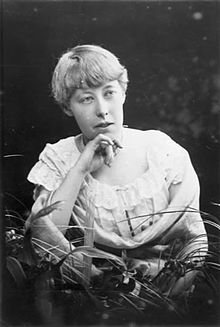
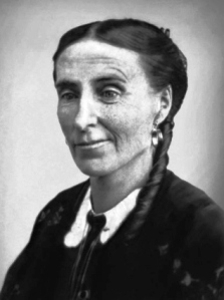
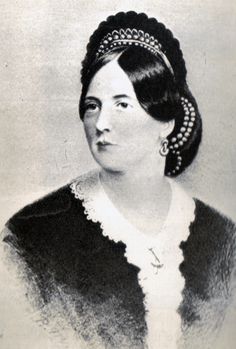
Jane Francesca Agnes, Lady Wilde, Irish poet who writes under the pen name “Speranza” and supporter of the nationalist movement, dies at her home, 146 Oakley Street, Chelsea, London, of bronchitis on February 3, 1896.

Jane is the last of the four children of Charles Elgee, a Wexford solicitor, and his wife Sarah. Her great-grandfather is an Italian who had come to Wexford in the 18th century. She has a special interest in Irish folktales, which she helps to gather. She marries Sir William Wilde on November 12, 1851, and they have three children, William Charles Kingsbury Wilde (1852–1899), Oscar Fingal O’Flahertie Wills Wilde (1854–1900), and Isola Francesca Emily Wilde (1857–1867).

Jane, who is the niece of Charles Maturin, writes for the Young Ireland movement of the 1840s, publishing poems in The Nation under the pseudonym of “Speranza.” Her works include pro-Irish independence and anti-British writing. She is sometimes known as “Speranza of the Nation.” Charles Gavan Duffy is the editor when “Speranza” writes commentary calling for armed revolution in Ireland. The authorities at Dublin Castle shut down the paper and bring the editor to court. Duffy refuses to name who has written the offending article. “Speranza” reputedly stands up in court and claims responsibility for the article. The confession is ignored by the authorities. But in any event the newspaper is permanently shut down by the authorities.

She is an early advocate of women’s rights, and campaigns for better education for women. She invites the suffragist Millicent Fawcett to her home to speak on female liberty. She praises the passing of the Married Women’s Property Act of 1883, preventing women from having to enter marriage “as a bond slave, disenfranchised of all rights over her fortune.”

William Wilde is knighted in January 1864, but the family celebrations are short-lived, for in the same year Sir William and Lady Wilde are at the centre of a sensational Dublin court case regarding a young woman called Mary Travers, the daughter of a colleague of Sir William’s, who claims that he had seduced her and who then brings an action against Lady Wilde for libel. Mary Travers wins the case and costs of £2,000 are awarded against Lady Wilde. Then, in 1867, their daughter Isola dies of fever at the age of nine. In 1871 the two illegitimate daughters of Sir William are burned to death and in 1876 Sir William himself dies. The family discovers that he is virtually bankrupt.

Lady Wilde leaves Dublin for London in 1879, where she joins her two sons, Willie, a journalist, and Oscar, who is making a name for himself in literary circles. She lives with her older son in poverty, supplementing their meagre income by writing for fashionable magazines and producing books based on the researches of her late husband into Irish folklore.

Lady Wilde contracts bronchitis in January 1896 and, dying, asks for permission to see Oscar, who is in prison. Her request is refused. It is claimed that her “fetch” appears in Oscar’s prison cell as she dies at her home, 146 Oakley Street, Chelsea, on February 3, 1896. Willie Wilde, her older son, is penniless, so Oscar pays for her funeral, which is held on February 5, at Kensal Green Cemetery in London. A headstone proved too expensive and she is buried anonymously in common ground. A monument to her, in the form of a Celtic cross, is erected at Kensal Green Cemetery by the Oscar Wilde Society in 1999.


Leave a comment

Birth of Theatrical Producer Hilton Edwards

hilton-edwards

Hilton Edwards, an English-born Irish actor, lighting designer, and theatrical producer, is born in London on February 2, 1903.

Edwards begins his career acting with the Charles Doran Shakespeare Company in 1920 in Windsor and then joins The Old Vic in London, playing in all but two of Shakespeare‘s plays before leaving the company a few years later. Trained in music, he also sings baritone roles with the Old Vic Opera company.

After touring with various companies in Britain and South Africa, Edwards goes to Ireland in 1927 for a season with Anew McMaster’s company and meets McMaster’s brother-in-law, Micheál Mac Liammóir. As he tells an interviewer once, both men want a theater of their own. Mac Liammóir wants it to be in Ireland and Edwards does not care. “I don’t care about nationalism, I care about the theater,” he says.

Edwards and Mac Liammóir co-found the Gate Theatre in Dublin in 1928. The two men’s talents are complementary. Mac Liammóir is an actor, designer, and writer. Edwards is a director, actor, producer, and lighting designer. Edwards produces and directs more than 300 plays at the Gate, ranging from the works of Aeschylus and Sophocles, Johann Wolfgang von Goethe and Henrik Ibsen to the comedies of George Bernard Shaw and Richard Brinsley Sheridan and new Irish plays, by such authors as W.B. Yeats, Brian Friel, and Mac Liammóir.

In New York City in 1948 Edwards plays in and directs John Bull’s Other Island and directs The Old Lady Says No and Where Stars Walk. In 1961 Edwards takes a two-year leave from the Gate to become the first Head of Drama at Telefís Éireann. A year later, he wins a Jacob’s Award for his television series Self Portrait.

Edwards appears in 15 films, including Captain Lightfoot (1955), David and Goliath (1960), Victim (1961), and Half a Sixpence (1967). He also writes and directs Orson Welles‘s Return to Glennascaul (1951). However, he is primarily known for his theatre work. He is nominated for a Tony Award in 1966 for Best Director of a Drama for Philadelphia, Here I Come!

Hilton Edwards dies in a Dublin hospital on November 18, 1982. Edwards and Mac Liammóir are the subject of a biography, titled The Boys by Christophor Fitz-Simon.


Leave a comment

Death of William Butler Yeats

william-butler-yeats

William Butler Yeats, Irish poet and one of the foremost figures of 20th century literature, dies on January 28, 1939, at the Hôtel Idéal Séjour, in Menton, France.

Yeats is born in Sandymount, County Dublin, on June 13, 1865, the oldest child of John Butler Yeats and Susan Mary Pollexfen. Although John trains as a lawyer, he abandons the law for art soon after his first son is born. Yeats spends much of his early years in London, where his father is studying art, but frequently returns to Ireland as well.

In the mid-1880s, Yeats pursues his own interest in art as a student at the Metropolitan School of Art in Dublin. Following the publication of his poems in the Dublin University Review in 1885, he soon abandoned art school for other pursuits.

After returning to London in the late 1880s, Yeats meets writers Oscar Wilde, Lionel Johnson, and George Bernard Shaw. He also becomes acquainted with Maud Gonne, a supporter of Irish independence. This revolutionary woman serves as a muse for Yeats for years. He even proposes marriage to her several times, but she turns him down. He dedicates his 1892 drama The Countess Kathleen to her.

Around this time, Yeats founds the Rhymers’ Club poetry group with Ernest Rhys. He also joins the Order of the Golden Dawn, an organization that explores topics related to the occult and mysticism. While he is fascinated with otherworldly elements, Yeats’s interest in Ireland, especially its folktales, fuels much of his output. The title work of The Wanderings of Oisin and Other Poems (1889) draws from the story of a mythic Irish hero.

In addition to his poetry, Yeats devotes significant energy to writing plays. He teams with Lady Gregory to develop works for the Irish stage, the two collaborating for the 1902 production of Cathleen Ni Houlihan. Around that time, Yeats helps found the Irish National Theatre Society with Lady Gregory and John Millington Synge, serving as its president and co-director. More works soon follow, including On Baile’s Strand, Deirdre, and At the Hawk’s Well.

Following his marriage to Georgie Hyde-Lees in 1917, Yeats begins a new creative period through experiments with automatic writing. The newlyweds sit together for writing sessions they believe to be guided by forces from the spirit world, through which Yeats formulates intricate theories of human nature and history. They soon have two children, daughter Anne and son Michael.

Yeats then becomes a political figure in the new Irish Free State, serving as a senator for six years beginning in 1922. The following year, he receives an important accolade for his writing as the recipient of the Nobel Prize in Literature. According to the official Nobel Prize website, Yeats is selected “for his always inspired poetry, which in a highly artistic form gives expression to the spirit of a whole nation.”

Yeats continues to write until his death. Some of his important later works include The Wild Swans at Coole (1917), A Vision (1925), The Tower (1928) and Words for Music Perhaps and Other Poems (1932). Yeats passes away on January 28, 1939, at the Hôtel Idéal Beauséjour near Menton, France. He is buried after a discreet and private funeral at Roquebrune-Cap-Martin. The publication of Last Poems and Plays and Two Plays shortly after his death further cements his legacy as a leading poet and playwright.

In September 1948, Yeats’ body is moved to the churchyard of St. Columba’s Church, Drumcliff, County Sligo, on the Irish Naval Service corvette Macha.


Leave a comment

Birth of Painter Daniel Maclise

daniel-maclise

Daniel Maclise, Irish history, literary and portrait painter, and illustrator, is born in Cork, County Cork, on January 25, 1806. He works in London, England for most of his life.

His early education is of the plainest kind, but he is eager for culture, fond of reading, and anxious to become an artist. He later studies at the Cork School of Art.

Maclise exhibits for the first time at the Royal Academy of Arts in 1829. Gradually he begins to confine himself more exclusively to subject and historical pictures, varied occasionally by portraits – such as those of Lord Campbell, novelist Letitia Landon, Charles Dickens, and other of his literary friends. In 1833, he exhibits two pictures which greatly increase his reputation and, in 1835, the Chivalric Vow of the Ladies and the Peacock procure his election as associate of the Academy, of which he becomes full member in 1840. The years that follow are occupied with a long series of figure pictures, deriving their subjects from history and tradition and from the works of William Shakespeare, Oliver Goldsmith, and Alain-René Lesage.

Maclise also designs illustrations for several of Dickens’s Christmas books and other works. Between the years 1830 and 1836 he contributes to Fraser’s Magazine, under the pseudonym of Alfred Croquis, a remarkable series of portraits of the literary and other celebrities of the time – character studies, etched or lithographed in outline, and touched more or less with the emphasis of the caricaturist, which are afterwards published as the Maclise Portrait Gallery (1871). During the rebuilding of the Houses of Parliament in London in 1834–1850 by Charles Barry, Maclise is commissioned in 1846 to paint murals in the House of Lords on such subjects as Justice and Chivalry.

In 1858, Maclise commences one of the two great monumental works of his life, The Meeting of Wellington and Blücher, on the walls of the Palace of Westminster. It is begun in fresco, a process which proves unmanageable. The artist wishes to resign the task, but, encouraged by Prince Albert, he studies in Berlin the new method of water-glass painting, and carries out the subject and its companion, The Death of Nelson, in that medium, completing the latter painting in 1864.

marriageaoifestrongbow

Maclise’s vast painting of The Marriage of Strongbow and Aoife (1854) hangs in the National Gallery of Ireland, Dublin. It portrays the marriage of the main Norman conqueror of Ireland “Strongbow” to the daughter of his Gaelic ally. By the grand staircase of Halifax Town Hall, which is completed in 1863, there is a wall painting by Maclise.

The intense application which he gives to these great historic works, and various circumstances connected with the commission, has a serious effect on Maclise’s health. He begins to shun the company in which he formerly delighted, his old buoyancy of spirits is gone, and in 1865, when the presidency of the Royal Academy is offered to him he declines the honour. He dies of acute pneumonia on April 25, 1870 at his home 4 Cheyne Walk, Chelsea, London.

(Pictured lower right: The Marriage of Strongbow and Aoife)


Leave a comment

Birth of Katharine Tynan, Novelist & Poet

katharine-tynan

Katharine Tynan, Irish writer, known mainly for her novels and poetry, is born into a large farming family in Clondalkin, County Dublin, on January 23, 1859.

Tynan is educated at St. Catherine’s, a convent school in Drogheda. Her poetry is first published in 1878. She meets and becomes friendly with the poet Gerard Manley Hopkins in 1886. She goes on to play a major part in Dublin literary circles. In 1898 she marries English writer and barrister Henry Albert Hinkson, and they move to England. After her marriage she usually writes under the name Katharine Tynan Hinkson, or variations thereof. Later she lives at Claremorris, County Mayo, when her husband is a magistrate from 1914 until 1919. Of their three children, Pamela Hinkson (1900–1982) was also known as a writer.

For a while, Tynan is a close associate of William Butler Yeats (who may have proposed marriage and been rejected, around 1885), and later a correspondent of Francis Ledwidge. Involved in the Irish Literary Revival, Tynan expresses concern for feminist causes, the poor, and the effects of World War I in her work. She also meditates on her Catholic faith. A prolific writer, she wrote more than one hundred novels, twelve collections of short stories, reminiscences, plays, and more than a dozen books of poetry.

Katharine Tynan Hinkson dies on April 2, 1931, in Wimbledon, London, at the age of 72.


Leave a comment

Birth of Singer/Songwriter Eleanor McEvoy

eleanor-mcevoy

Eleanor McEvoy, one of Ireland’s most accomplished contemporary singer/songwriters, is born in Dublin on January 22, 1967. McEvoy composes the song “Only A Woman’s Heart,” the title track of A Woman’s Heart, the best-selling Irish album in Irish history.

McEvoy’s life as a musician begins at the age of four when she begins playing piano. At the age of eight she takes up violin and, as a teen, she joins the Junior Irish Youth Orchestra. Upon finishing school, she attends Trinity College, Dublin where she studies music by day and works in pit orchestras and music clubs by night.

McEvoy graduates from Trinity with an Honors Degree in music and spends four months busking in New York City. In 1988, she is accepted into the RTÉ National Symphony Orchestra where she spends four years before leaving to concentrate on songwriting.

During a solo date in July 1992, she performs a little-known, self-penned song, “Only a Woman’s Heart.” Mary Black, of whose band McEvoy is a member, is in the audience and invites her to add the track to an album of Irish female artists. The album is subsequently titled A Woman’s Heart and the track is released as the lead single. The album goes on to sell over three-quarters of a million copies in Ireland alone and remains the biggest selling Irish album of all time. The record’s success makes McEvoy a superstar virtually overnight.

Eleanor McEvoy, the self-titled debut offering, recorded in Windmill Lane Studios, is released in February 1993, and tours in the United States, Asia, and Europe follow. Back on Irish soil, McEvoy is awarded Best New Artist, Best New Performer, and Best Songwriter Awards by the Irish entertainment and music industries.

McEvoy signs a contract with Columbia Records and begins working on a new, edgier second album, which is eventually entitled What’s Following Me? The album is released in 1996 and the sound is louder and grungier than her debut.

McEvoy releases her third album Snapshots in 1999. Her primary goal is to make Snapshots her most song-oriented album to date. Toward that goal, she hooks up with legendary producer Rupert Hine, who has worked with Stevie Nicks, Tina Turner, Suzanne Vega, and Duncan Sheik, and records the album at Rupert’s “Chateau de la Tour de Moulin” and then in Metropolis Studios in London.

As the century closes, McEvoy has had enough of major-label involvement, making the decision to take the fourth album and head down the independent road. Yola was a turning point in McEvoy’s musical direction. Released in 2001, it reflects the acoustic, jazz-influenced style she had developed on stage with Brian Connor.

March 2004 sees the release of Early Hours, produced by McEvoy and Brian Connor. The style differs from McEvoy’s previous work, taking on a jazz/blues feel for many of the songs. She continues to tour with Brian Connor until April 2005. She then begins performing solo, accompanying herself on bass guitar, electric guitar, mandolin, and violin.

McEvoy continues to release new albums almost on a yearly basis with Out There (2006), Love Must Be Tough (2008), Singled Out (2009), I’d Rather Go Blonde (2010), Alone (2011), If You Leave… (2013), and Stuff (2014).

Naked Music (2016) is McEvoy’s twelfth studio album. It is recorded at the Grange Studio in Norfolk, UK. McEvoy records the tracks by “studio-performing,” in other words, playing the songs as she would in a live performance. The album features exclusive artwork by famed painter Chris Gollon.


Leave a comment

Death of Marie Dolores Eliza Rosanna Gilbert, Dancer & Actress

lola-montez

Marie Dolores Eliza Rosanna Gilbert, Countess of Landsfeld, Irish dancer and actress better known by the stage name Lola Montez, dies in Brooklyn, New York, on January 17, 1861. She becomes famous as a “Spanish dancer,” courtesan, and mistress of King Ludwig I of Bavaria, who makes her Countess of Landsfeld. She uses her influence to institute liberal reforms. At the start of the German revolutions of 1848-1849, she is forced to flee. She proceeds to the United States via Switzerland, France, and London, returning to her work as an entertainer and lecturer.

Gilbert is born in Grange, County Sligo, on February 17, 1821. Her family makes their residence at King House in Boyle, County Roscommon, until early 1823, when they journey to Liverpool, thence departing for India on March 14. Gilbert spends much of her childhood in India but is educated in Scotland and England. At age 19 she elopes with Lieutenant Thomas James. The couple separates five years later, and, in 1843, Gilbert launches a career as a dancer. Her London debut in June 1843 as “Lola Montez, the Spanish dancer” is disrupted when she is recognized as Mrs. James. The fiasco would probably have ended the career of anyone less beautiful and determined, but Gilbert receives additional dancing engagements throughout Europe. During her travels she reputedly forms liaisons with Franz Liszt and Alexandre Dumas, among many others.

Late in 1846, Gilbert dances in Munich and Ludwig I of Bavaria is so struck by her beauty that he offers her a castle. She accepts, becomes Baroness Rosenthal and Countess of Lansfeld, and remains as his mistress. Under Gilbert’s influence, Louis inaugurates liberal and anti-Jesuit governmental policies, but his infatuation with her helps to bring about the collapse of his regime in the revolution of 1848. In March of that year Ludwig abdicates in favour of his son. Gilbert flees to London, where in 1849 she marries Lieutenant George Heald, although she has never been divorced from James. Heald later leaves her.

From 1851 to 1853 Gilbert performs in the United States. Her third marriage, to Patrick P. Hull of San Francisco in 1853, ends in divorce soon after she moves to Grass Valley, California. There, among other amusements, she coaches young Lotta Crabtree in singing and dancing. She settles in New York City after an unsuccessful tour of Australia in 1855–1856 and gathers a following as a lecturer on such topics as fashion, gallantry, and beautiful women. An apparently genuine religious conversion leads her to take up various personal philanthropies.

Gilbert publishes Anecdotes of Love; Being a True Account of the Most Remarkable Events Connected with the History of Love; in All Ages and among All Nations (1858), The Arts of Beauty, or, Secrets of a Lady’s Toilet with Hints to Gentlemen on the Art of Fascination (1858), and Lectures of Lola Montez, Including Her Autobiography (1858). The international notoriety of her heyday persists long after her death and inspires numerous literary and balletic allusions.

Gilbert spends her last days in rescue work among women. By November 1859 she is showing the tertiary effects of syphilis, and her body begins to waste away. She dies at the age of 39 on January 17, 1861. She is buried in Green-Wood Cemetery in Brooklyn, New York.


2 Comments

Birth of Frances Browne, Poet & Novelist

frances-browne

Frances Browne, Irish poet and novelist, best remembered for Granny’s Wonderful Chair, her collection of short stories for children, is born on January 16, 1816, at Stranorlar, County Donegal, the seventh child in a family of twelve children.

Browne is blind from infancy as a consequence of an attack of smallpox when she is only 18 months old. In her writings, she recounts how she learned by heart the lessons which her brothers and sisters said aloud every evening, and how she bribed them to read to her by doing their chores. She then worked hard at memorising all that she had heard. She writes her first poem, a version of “The Lord’s Prayer,” when she is seven years old.

In 1841, her first poems are published in the Irish Penny Journal and in the London Athenauem. One of those included in the Irish Penny Journal is the beautiful lyric “Songs of Our Land” which can be found in many anthologies of Irish patriotic verse. She publishes a complete volume of poems in 1844, and a second volume in 1847. The provincial newspapers, especially the Belfast-based Northern Whig reprint many of her poems and she becomes widely known as “The Blind Poetess of Ulster.”

In 1845 she makes her first contribution to the popular magazine Chambers’s Journal and she writes for this journal for the next 25 years. The first short story that she has published in the Journal is entitled, “The Lost New Year’s Gift,” appearing in March 1845. She also contributes many short stories to magazines that have a largely female readership.

In 1847, she leaves Donegal for Edinburgh with one of her sisters as her reader and amanuensis. She quickly establishes herself in literary circles, and writes essays, reviews, stories, and poems, in spite of health problems. In 1852, she moves to London, where she writes her first novel, My Share of the World (1861). Her best-known work, Granny’s Wonderful Chair, is published in 1856. It remains in print to this day and has been translated into several languages. It is a richly imaginative collection of fairy stories. It is also in 1856 that Pictures and Songs of Home appears, her third volume of poetry. This is directed at very young children and contains beautiful illustrations. The poems focus on her childhood experiences in County Donegal and provide evocative of its countryside.

After her move to London she writes for the Religious Tract Society, making many contributions to their periodicals The Leisure Hour and The Sunday at Home. One of these is “1776: a tale of the American War of Independence” which is printed in The Leisure Hour on the centenary of that event in 1876. As well as describing some of the revolutionary events, it is also a touching love story and is beautifully illustrated. Her last piece of writing is a poem called “The Children’s Day” which appears in The Sunday at Home in 1879.

Frances Brown dies from apoplexy on August 21, 1879, at 19 St. John’s Grove in Richmond-upon-Thames. She is buried on August 25, 1879, in plot 40 in the cemetery at St. Mary Magdalene Church in Richmond, London. Frances dies unmarried and leaves all her belongings, valued at less than 100 pounds, to Eliza Hickman who had been her faithful companion and secretary for many years.

(Pictured:  Frances Brown from the family photo collection of Selwyn Glynn, Brisbane, Australia)


Leave a comment

Birth of Thomas Arthur, comte de Lally, baron de Tollendal

thomas-arthur-lally

Thomas Arthur, comte de Lally, baron de Tollendal, French General of Irish Jacobite ancestry, is born on January 13, 1702. Lally commands French forces in India during the Seven Years’ War, including two battalions of his own red-coated Regiment of Lally of the Irish Brigade.

Lally is born at Romans-sur-Isère, Dauphiné, the son of Sir Gerald Lally, one of the original “Wild Geese” of 1691 and an Irish Jacobite from Tuam, County Galway, who married a French lady of noble family. His title is derived from the Lally’s ancestral home, Castel Tullendally in County Galway where the Lally’s, originally called O’Mullallys, are prominent members of the Gaelic Aristocracy who can trace their ancestry back to the second century High King of Ireland, Conn of the Hundred Battles.

Entering the French army in 1721 he serves in the war of 1734 against Austria. He is present at the Battle of Dettingen in 1743 and commands the regiment de Lally in the famous Irish brigade in the Battle of Fontenoy in May 1745. He is made a brigadier on the field by Louis XV of France.

Lally is a staunch Jacobite and in 1745 accompanies Charles Edward Stuart to Scotland, serving as aide-de-camp at the Battle of Falkirk Muir in January 1746. Escaping to France, he serves with Marshal Maurice de Saxe in the Low Countries. At the Siege of Maastricht in 1748 he is made a maréchal de camp.

When war breaks out with Britain in 1756 Lally is appointed governor-general of French India and commands a French expedition to India, made up of four battalions, two of whom are from his own Regiment of Lally of the Irish Brigade. He reaches Pondicherry in April 1758, and within six weeks has pushed the British back from the coast to Madras, the headquarters of the British East India Company.

He is a man of courage and a capable general, but his pride and ferocity make him unpopular with his officers and men. He is unsuccessful in an attack on Tanjore, and as he lacks French naval support he has to retire from the Siege of Madras in 1758, owing to the timely arrival of the British fleet. He is defeated by Sir Eyre Coote at the Battle of Wandiwash in 1760, and besieged in Pondicherry, where he is forced to capitulate in 1761.

Lally is sent to England as a prisoner of war. Public opinion in France is very hostile, blaming him for the defeat by the British, and there are widespread calls for Lally to be put on trial. While in London, he hears that he is accused of treason in France, and insists, against advice, on returning on parole to stand trial. He is kept prisoner for nearly two years before the trial begins in 1764. When the Advocate General of the Paris Parlement Joseph Omer Joly de Fleury begins the prosecution, Lally has not received any documentation of the charges and is not allowed a defence lawyer. Throughout the trial, which lasts for two years, Lally fights against Joly de Fleury’s charges but on May 6, 1766, he is convicted and sentenced to death.

Lally makes an unsuccessful attempt at suicide in prison after his sentencing. On May 9, 1766, three days after his conviction, he is gagged to prevent him from protesting his innocence further and is transported in a garbage cart to the Place de Grève to be beheaded. The executioner’s first blow only slices open his skull, and it takes a second blow to kill him.


Leave a comment

Birth of Edmund Burke, Political Writer & Orator

edmund-burke

Edmund Burke, one of the greatest political writers and orators in history, is born in Arran Quay, Dublin, on January 12, 1729. British statesman, parliamentary orator, and political thinker, he plays a prominent part in all major political issues for about thirty years after 1765 and remains an important figure in the history of political theory.

Burke is the son of a mixed marriage – his father, a solicitor, is Protestant, his mother is Roman Catholic. He enters Trinity College, Dublin in 1744, and studies law at Middle Temple in London in 1750. He fails to secure a call to the bar and instead begins a literary career. He writes several books and is editor of the The Annual Register before entering politics. Burke’s A Vindication of Natural Society is published in 1756 and in 1757 A Philosophical Inquiry into the Origin of Our Ideas of the Sublime and Beautiful appears. Also on March 12, 1757, Burke marries Jane Nugent, the daughter of Christopher Nugent, an Irish Catholic doctor.

His political career begins in 1765 when he becomes the private secretary of one of the Whig leaders in the Parliament of Great Britain, Charles Watson-Wentworth, 2nd Marquess of Rockingham. Burke soon proves to be one of the main characters in the constitutional controversy in Britain under George III, who at the time is trying to establish more actual power for the crown. Although the crown has lost some influence under the first two Georges, one of the major political problems in 18th century Britain is the fact that both the king and Parliament have considerable control over the executive. Burke responds to these affairs in his pamphlet Thoughts on the Cause of the Present Discontents (1770), in which he argues that although George’s actions are legal in the sense that they are not against the letter of the constitution, they are all the more against it in spirit. In the pamphlet Burke elaborates on his famous and new justification of a party, defined as “a body of men united on public principle, which could act as a constitutional link between king and parliament, providing consistency and strength in administration, or principled criticism in opposition.”

Concerning the imperial controversy at the time, Burke argues that the British government has acted in a both unwise and inconsistent manner. Again, Burke claims that Britain’s way of dealing with the colony question is strictly legal and he urges that also “claims of circumstance, utility, and moral principle should be considered, as well as precedent.” In other words, if the British, persistently clinging to their narrow legalism, are not to clash with the ideas and opinions of the colonists on these matters, they will have to offer more respect and regard for the colonies’ cause. Burke calls for “legislative reason” in two of his parliamentary speeches on the subject, On American Taxation (1774) and On Moving His Resolutions for Conciliation with America (1775). However, British imperial policy in the controversy continues to ignore these questions.

Burke’s view of the revolution in France is a much different story. He publishes Reflections on the Revolution in France in 1790, attacking the revolution’s motives and principles. Many writers oppose his views, the most famous being Thomas Paine in his Rights of Man. Burke is a consistent advocate of Catholic emancipation, which politically damages him, but he is never an advocate of self-rule for the Irish.

Edmund Burke dies in London on July 9, 1797. Many quotes from his writings and orations have come down through the years, perhaps one is most applicable to the situation in Ireland today: “All government, indeed every human benefit and enjoyment, every virtue, and every prudent act, is founded on compromise and barter.”