European Movement Ireland (EM Ireland) (Irish: Gluaiseacht na hEorpa in Éirinn) is founded in Dublin on January 11, 1954. EM Ireland is an independent not-for-profit organisation that campaigns for every Irish person to get involved in the European Union (EU) and by doing so, help shape it. It is the oldest Irish organisation dealing with the EU, pre-dating Ireland’s membership of the European Economic Community (EEC) in 1973 by almost twenty years. The organisation is headed by Chief Executive Officer (CEO), Noelle Connell. Julie Sinnamon acts as Chair of the EM Ireland Board.
These seven signatories lay the first stone paving Ireland’s way to full membership of the EU. The aim of the Irish Council is to inform Irish individuals and organisations about the EU. One of its primary objectives is for Ireland to gain membership of the European Communities (EC) (principally the European Economic Community (EEC), as the EU is then known). Former TaoisighGarret FitzGerald and Jack Lynch, and former PresidentMary Robinson back the initiative. After a referendum is held on the Third Amendment of the Irish Constitution, which is overwhelmingly approved by voters in May 1972, Ireland joins the European Communities as a full member state on January 1, 1973.
The Irish Council later becomes European Movement Ireland. Today the organisation claims to act as source of information for Irish citizens regarding the work of the EU and its stated aim is to promote reasoned robust and fair debate about EU in Ireland.
EM Ireland is part of a pan-European network. European Movement International is a lobbying association that coordinates the efforts of associations and national councils with the goal of promoting European integration, and disseminating information about it. It seeks to encourage and facilitate the active participation of citizens and civil society organisations in the European Union as it develops. The European Movement network is represented in over 41 countries and has over 20 international organisations as members. The current President of European Movement is the former MEP from Belgium, Guy Verhofstadt. For a full list of all European Movement offices, and an outline of the history of the international network visit the EM International website at http://www.europeanmovement.eu/
Colleran, and her twin Noreen, are born in Ballinrobe, County Mayo, on October 12, 1945, to John and Josie Colleran. One of a family of five children, her father is a school principal and her mother, also a primary school teacher, dies when she is just 11 years old. She completes her secondary education at St. Louis secondary school in Kiltimagh. She spends a lot of time outdoors as a child, particularly fishing, which sparks her interest in the environment.
On entering higher education, Colleran has a grant from the Department of Education, which requires that she do her studies through the Irish language. Her first choice, Medicine, is not available in Irish so she chooses Science. She graduates with a first-class primary degree in Science at University College Galway (now National University of Ireland, Galway) in 1967.
Colleran lectures in biology at Athlone Regional Technical College (now Athlone Institute of Technology) and Galway Regional Technical College (now Galway-Mayo Institute of Technology) before her appointment as a lecturer in microbiology at NUI Galway in 1976. She is appointed Associate Professor of Microbiology by the Senate of the National University of Ireland in 1990. She is a member of the university’s governing authority for a number of years, but steps down in May 2000 in connection with the selection procedure for the new university president. In October of that year, she is appointed professor of microbiology and chair of the department at NUI Galway.
Colleran is the first director of the Environment Change Institute at NUI Galway set up under the Higher Education Authority‘s Programme for Research in Third Level Institutions in 2000. In 2010, the Environmental Change Institute and the Martin Ryan Marine Research Institute are merged to form the current day Ryan Institute at NUI Galway.
In 1973, Colleran is elected to the committee of the Galway Association of An Taisce, part of a national voluntary organisation the aims of which are conservation in Ireland through education, publicity and positive action. She serves as membership secretary and then treasurer to the Galway branch before becoming chairman. In 1981, as chairman of the Galway branch, she hits back at claims from Galway County Council that An Taisce are “an anonymous group, wielding power unfairly.” She is involved in the compilation of a controversial planning report, published by An Taisce in 1983, which highlights abuse of planning laws by city and county councillors across Ireland, and in particular in counties Galway, Mayo, Donegal, Kerry and Louth.
Colleran serves as Environmental Officer for An Taisce before being elected National Chairman in 1987, the first time a chairman has come from one of the western county associations. She continues to use her position to campaign against misuse of planning laws, for a clamp down on pollution of rivers and lakes, and against a move to scrap An Foras Forbartha, a body that provides independent monitoring of pollution. During her three years as chairman, until May 1990, she is particularly involved in debates over local environmental and planning issues, in particular over gold mining in the west of Ireland, a proposed airport for Clifden, and the planned sewage treatment plant at Mutton Island, County Galway.
In 1991 plans are announced for a new visitor centre, to be located at Mullaghmore in The Burren. Colleran is among those who are part of an appeal, saying that while the plan for the national park is welcomed by An Taisce, they want the visitor centre to be located three or four miles from Mullaghmore.
President Mary Robinson appoints seven new members to her Council of State in February 1991, including Colleran. Other new members appointed at the time are Monica Barnes, Patricia O’Donovan, Quintan Oliver, Rosemarie Smith, Dónal Toolan and D. Kenneth Whitaker. The new Council of State represents a wide spectrum of Irish life and is widely welcomed, although Fine Gael is disappointed that its leader John Bruton is not included.
In 1991, Colleran is one of 15 people appointed to TaoiseachCharles Haughey‘s Green 2000 Advisory Group, to determine which problems will face the environment in the next century. The group is led by Dr. David Cabot, special advisor on environmental affairs.
In 2003, Colleran is elected as a member of the Royal Irish Academy.
Colleran is recognised at the annual NUI Galway Alumni Awards in 2004 when she receives the award for Natural Science, sponsored by Seavite Bodycare Ltd., which acknowledges a graduate who has made an outstanding contribution in the field of natural science.
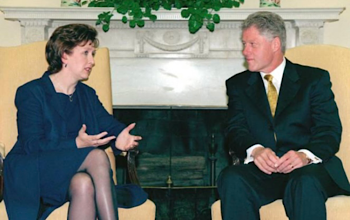
As this is not a state visit, there is no formal welcome for President McAleese or official functions at the White House as there was for President Mary Robinson‘s state visit two years earlier. McAleese arrives the previous day by government jet, accompanied by her husband, Dr. Martin McAleese, and the Minister for Foreign Affairs, David Andrews, and his wife. The McAleese’s son, thirteen-year-old Justin McAleese, travels to the United States separately and joined his parents in Washington, D.C..
Within hours of her arrival, McAleese attends a reception in the Four Seasons Hotel mainly for the Irish American community and hosted by the Irish ambassador, Sean O Huiginn, and his wife. In her remarks to the several hundred guests, President McAleese praises the role of President Clinton in the Northern Ireland peace process and of former Senator George Mitchell. She says Clinton’s contribution has been “remarkable.” She says, “He was prepared to take risks for peace: without his courage and leadership we could not have made the progress we have.”
McAleese says many of those present “have descended from some of the first settlers of the early colonies – some of whom, like myself, come from the northern part of the island of Ireland. I am deeply honoured that all of you have retained such a close bond and pride in your Irish heritage and that you demonstrated your affection by the strength of the many vibrant organisations in this area.”
McAleese says when our forebears crossed the Atlantic Ocean they retained a yearning that someday the Ireland they left would be a better place. “Regrettably, they did not live to see a new Ireland but it is now a reality in the economic, cultural and social progress of the last number of years.” Arranging the meeting at the White House is a problem for U.S. and Irish officials because of Clinton’s extremely busy schedule, as he prepares for his China visit. But the fact that he makes time for it is an indication of the importance he attaches to U.S.-Irish relations.
In the evening, McAleese attends a dinner in her honour at the Irish Embassy residence, to which leading political and administration figures are invited. On June 24, following a press conference at the National Press Club and a lunch on Capitol Hill with members of Congress, she flies to New York. There she pays a courtesy visit on the UN Secretary-General, Kofi Annan, and later attends a trade show organised by the Irish Business Organisation. In the evening she attends the “Dreamer of Dreams” awards ceremony organised by the Irish Voice newspaper.
On Thursday, June 25, McAleese has more engagements and prior to her return to Ireland on Friday, June 26.
(From: “McAleese for courtesy call on Clinton today” by Joe Carroll, The IrishTimes, http://www.irishtimes.com, July 23, 1998)
Alan Martin Dukes, former Fine Gaelpolitician, is born in Drimnagh, Dublin, on April 20, 1945. He holds several senior government positions and serves as a Teachta Dála (TD) from 1981 to 2002. He is one of the few TDs to be appointed a minister on their first day in the Dáil.
The Dukes family originally comes from the north of England. His grandfather serves with the Royal Engineers in World War I and settles in County Cork and then County Kerry afterward where he works with the Post Office creating Ireland’s telephone network.
Dukes is educated by the Christian Brothers at Coláiste Mhuire, Dublin, and is offered several scholarships for third level on graduation, including one for the Irish language. His interest in the Irish language continues to this day, and he regularly appears on Irish-language television programmes.
On leaving school he attends University College Dublin (UCD), where he captains the fencing team to its first-ever Intervarsity title.
In the 1979 European Parliament election, Dukes stands as a Fine Gael candidate in the Munster constituency. He has strong support among the farming community, but the entry of T. J. Maher, a former president of the IFA, as an independent candidate hurts his chances of election. Maher tops the poll.
This minority Fine Gael–Labour Partycoalition government collapses in February 1982 on the budget but returns to power with a working majority in December 1982. Dukes is again appointed to cabinet, becoming Minister for Finance less than two years into his Dáil career.
He faces a difficult task as finance minister. Ireland is heavily in debt while unemployment and emigration are high. Many of Fine Gael’s plans are deferred while the Fine Gael–Labour Party coalition disagrees on how to solve the economic crisis. The challenge of addressing the national finances is made difficult by electoral arithmetic and a lack of support from the opposition Fianna Fáil party led by Charles Haughey. He remains in the Department of Finance until a reshuffle in February 1986 when he is appointed Minister for Justice.
This is a difficult time for the country. Haughey’s Fianna Fáil runs on promises to increase spending and government services, and attacking the cutbacks favoured by Fine Gael. However, on taking office, the new Taoiseach and his finance minister Ray MacSharry immediately draw up a set of cutbacks including a spate of ward and hospital closures. This presents a political opportunity for the opposition to attack the government.
However, while addressing a meeting of the TallaghtChamber of Commerce, Dukes announces, in what becomes known as the Tallaght Strategy that: “When the government is moving in the right direction, I will not oppose the central thrust of its policy. If it is going in the right direction, I do not believe that it should be deviated from its course, or tripped up on macro-economic issues.”
This represents a major departure in Irish politics whereby Fine Gael will vote with the minority Fianna Fáil Government if it adopts Fine Gael’s economic policies for revitalising the economy. The consequences of this statement are huge. The Haughey government is able to take severe corrective steps to restructure the economy and lay the foundations for the economic boom of the nineties. However, at a snap election in 1989, Dukes does not receive electoral credit for this approach, and the party only makes minor gains, gaining four seats. The outcome is the first-ever coalition government for Fianna Fáil, whose junior partner is the Progressive Democrats led by former Fianna Fáil TD Desmond O’Malley.
Initially, Fianna Fáil’s Brian Lenihan Snr is the favourite to win. However, after several controversies arise, relating to the brief Fianna Fáil administration of 1982, and Lenihan’s dismissal as Minister for Defence midway through the campaign, the Labour Party’s Mary Robinson emerges victorious. To many in Fine Gael, the humiliation of finishing third is too much to bear and a campaign is launched against Dukes’ leadership. He is subsequently replaced as party leader by John Bruton.
Bruton brings Dukes back to the front bench in September 1992, shortly before the November 1992 Irish general election. In February 1994, Dukes becomes involved in a failed attempt to oust Bruton as leader and subsequently resigns from the front bench. Bruton becomes Taoiseach in December 1994 and Dukes is not appointed to cabinet at the formation of the government.
In 2001, Dukes backs Michael Noonan in his successful bid to become leader of Fine Gael.
After 21 years, Dukes loses his Dáil seat at the 2002 Irish general election. This contest sees many high-profile casualties for Fine Gael, including Deputy LeaderJim Mitchell, former deputy leader Nora Owen and others. Many local commentators feel that Dukes’ loss is due to a lack of attention to local issues, as he is highly involved in European projects and has always enjoyed a national profile.
He retires from frontline politics in 2002 and is subsequently appointed Director General of the Institute of International and European Affairs. He remains active within Fine Gael and serves several terms as the party’s vice-president. From 2001 to 2011, he is President of the Alliance française in Dublin, and in June 2004, the French Government appoints him an Officer of the Legion of Honour. In April 2004, he is awarded the Commander’s Cross of the Order of Merit of the Republic of Poland.
In December 2008, Dukes is appointed by Finance Minister Brian Lenihan Jnr as a public interest director on the board of Anglo Irish Bank. The bank is subsequently nationalised, and he serves on the board until the Irish Bank Resolution Corporation (IBRC) is liquidated in 2013.
Dukes has lived in Kildare since first being elected to represent the Kildare constituency in 1981. His wife Fionnuala (née Corcoran) is a former local politician and serves as a member of Kildare County Council from 1999 until her retirement in 2009. She serves as Cathaoirleach of the council from 2006 to 2007, becoming only the second woman to hold the position in the body’s one-hundred-year history. They have two daughters.
Mary Irvine, Irish judge who is the President of the Irish High Court between 2020 and 2022, is born on December 10, 1956, in Clontarf, Dublin. She first practiced as a barrister. She is a judge of the High Court between 2007 and 2014, a judge of the Court of Appeal from 2014 to 2019 and serves as a judge of the Supreme Court of Ireland from May 2019 until becoming President of the High Court on June 18, 2020. In addition to being the first woman to hold that position, she is the first judge to have held four judicial offices. She is an ex officio member of the Supreme Court and the Court of Appeal.
Irvine is born to John and Cecily Irvine, her father once being deputy director of RTÉ. She is educated at Mount Anville Secondary School, University College Dublin (UCD) and the King’s Inns. She is an international golf player, winning the Irish Girls Close Championship in 1975.
Irvine’s practice also extends to constitutional law. As a junior counsel, she represents the plaintiff in Cahill v. Sutton in 1980 in the Supreme Court with seniors Niall McCarthy and James O’Driscoll. The case establishes the modern Irish law of standing for applicants to challenge the constitutional validity of statutes. She appears with Peter Kelly to argue on behalf the right of the unborn in a reference made by President of IrelandMary Robinson under Article 26 of the Constitution to the Supreme Court in 1995 regarding the Information (Termination of Pregnancies) Bill 1995.
Irvine is appointed as a Judge of the High Court in June 2007. She is in charge of the High Court Personal Injuries list from 2009 to 2014 and subsequently becomes the second Chair of the Working Group on Medical Negligence and Periodic Payments, established by the President of the High Court.
Irvine is appointed to Court of Appeal on its establishment in October 2014. Some of her judgments on the Court of Appeal reduce awards given by lower courts for personal injuries compensation. She writes “most of the key” Court of Appeal judgments between 2015 and 2017 which have the effect of reducing awards arising from subsequent actions in the High Court.
Irvine is appointed to chair a statutory tribunal to conduct hearings and deal with cases related to the CervicalCheck cancer scandal in 2019. However, following her appointment as President of the High Court in 2020, she is unable to continue with the position.
On April 4, 2019, Irvine is nominated by the Government of Ireland as a Judge of the Supreme Court. She is appointed by the President of Ireland, Michael D. Higgins, on May 13, 2019. She writes decisions for the court in appeals involving planning law, the law of tort, intellectual property law, judicial review, and chancery law.
Irvine is appointed by Chief Justice Frank Clarke in 2019 to chair the Personal Injuries Guidelines Committee of the Judicial Council. The purpose of the committee is to review the levels of compensation issues in court cases arising out of personal injuries. Minister of State at the Department of FinanceMichael W. D’Arcy writes a letter to congratulate her on her appointment and outlines his views that personal injuries awards in Ireland should be “recalibrated.” She responds to the letter by saying it is the not the committee’s duty to tailor its findings “in a manner favourable to any particular interest group.”
Following a cabinet meeting on June 12, 2020, it is announced that Irvine will be nominated to succeed Peter Kelly as President of the High Court. A three-person panel consisting of the Chief Justice Frank Clarke (later substituted by George Birmingham), the Attorney GeneralSéamus Woulfe and a management consultant, Jane Williams, reviews applications for the position, before making recommendations to cabinet. The President of the Law Society of Ireland welcomes her appointment, describing her as an “outstandingly able judge.” She is the first woman to hold the role. As she is previously an ordinary judge of three courts, her appointment as President of the High Court makes her the first person to have held four judicial offices. She is appointed on June 18, 2020, and makes her judicial declaration on June 19.
Irvine takes over as president in the midst of the COVID-19 pandemic in the Republic of Ireland. She issues guidelines for lawyers to negotiate personal injuries cases outside of court due to the backlog formed by delays in hearings. She issues a practice direction in July 2020 that face coverings are to be worn at High Court hearings. She criticises barristers and solicitors in October 2020 for not wearing masks in the Four Courts.
In Irvine’s first week as president, she presides over a three-judge division of the High Court in a case taken by a number of members of Seanad Éireann. The plaintiffs seek a declaration that the Seanad should sit even though the nominated members of Seanad Éireann have not been appointed. The court refuses the relief and finds for the State. In 2021, she also presides over a three-judge division on a Seanad Éireann voting rights case, where the plaintiff argues for the extension of voting rights to graduates of all third-level educational institutions and the wider population. The court finds against the plaintiff.
Irvine continues to sit in the Supreme Court following her appointment.
In April 2022, Irvine announces her intention to retire in July 2022. She retires on July 13, 2022, and is succeeded by David Barniville.
Irvine is formerly married to retired judge Michael Moriarty, with whom she has three children. Her only known son, Mark Moriarty, dies suddenly on August 19,2022.
(Pictured: Justice Mary Irvine with the President of Ireland, Michael D. Higgins, on her appointment on the Supreme Court in 2019)
Best known as a centre half-forward, Purcell plays in most outfield positions during his career. In 2009, he is named in the Sunday Tribune‘s list of the “125 Most Influential People in GAA History.”
Purcell’s footballing career spans three decades, from the 1940s to the 1960s. He forms a successful on-field partnership with Frank Stockwell at Galway, culminating in the team winning their fourth All-Ireland championship in 1956 and leading to their nickname as the “Terrible Twins.”
Further successes in which Purcell is involved include winning the National Football League title in 1957, three Railway Cups, one of which he captains, the 1950 Sigerson Cup, appearances with the Combined Universities side and ten county titles with the Tuam Stars, including seven in a row from 1954 to 1960.
Purcell’s involvement in the GAA continues long after his playing days as he serves in a number of positions as team mentor and administrator in Galway.
Purcell dies on August 27, 2005, at the age of 76, following a short illness at the Blackrock Clinic, County Dublin. He is buried in the Athenry Road graveyard at Tuam.
Purcell marries Rita Shannon in 1961. They have four daughters and two sons before the marriage ends. His son, Robert Purcell, marries Tessa Robinson, daughter of former Irish PresidentMary Robinson, in 2005. His grandson, Simon Carr, is a professional tennis player. Another grandson, Sam McCartan, has played Gaelic football at senior level for Westmeath. His teenage grandson, Rory Purcell, dies in 2022.
Hogan is called to the Bar in July 1984 and becomes a Senior Counsel in 1997. He appears domestically in cases in the High Court and the Supreme Court and internationally at the European Court of Human Rights and the European Court of Justice.
Hogan is noted in particular for his experience in constitutional law. He acts for the Attorney General of Ireland in references made by President Mary Robinson under Article 26 of the Constitution of Ireland to the Supreme Court regarding the Information (Termination of Pregnancies) Bill 1995 and the Employment Equality Bill of 1997. He appears again for the Attorney General (with Dermot Gleeson and Paul Gallagher) in another reference made by President Mary McAleese regarding the Health (Amendment) (No. 2) Bill 2004.
Hogan is a law lecturer and fellow at Trinity College Dublin from 1982 to 2007. He lectures on constitutional law, competition law and the law of tort. He is regarded as “one of the foremost constitutional and administrative lawyers in Ireland.” He is the co-author of Administrative Law in Ireland and JM Kelly: The Irish Constitution, the core Irish legal texts in Irish administrative and constitutional law respectively. He also writes a text on political violence and a book chronicling the origins of the Constitution of Ireland.
Hogan appears for Katherine Zappone and Ann Louise Gilligan in Zappone v. Revenue Commissioners in the High Court and Miss D in her case related to the rights to travel abroad for an abortion. He represents the State in the High Court and the Supreme Court in litigation that emerges following a court finding that an offence of unlawful carnal knowledge is unconstitutional. In 2008, he acts for Colm Murphy and Seamus Daly in the Supreme Court who are contesting an action taken by families of victims of the Omagh bombing when they are refused access to books of evidence.
Hogan is the first barrister to appear in an Irish court without a wig, following the enactment of the Courts and Court Officers Act 1995.
Throughout his career, Hogan has been a member of committees and boards in areas requiring legal expertise. He chairs the Department of Justice‘s Balance in Criminal Law Review Group and is a member of three other review groups: the Constitution Review Group, the Competition and Mergers Review Group and the Offences Against the State Acts Review Group. He is also a member of the Competition Authority‘s Advisory Panel and the Committee on Court Practice and Procedure.
Hogan is appointed a Judge of the High Court in 2010. Soon after his appointment, he holds an emergency hearing in his home regarding a blood transfusion for a sick baby. He is one of three judges who hears a case taken by Marie Fleming, seeking a right to die in 2012. His reference to the European Court of Justice in 2014 regarding the International Safe Harbor Privacy Principles, results in a declaration by the Grand Chamber that the Safe Harbour Decision is invalid. He subsequently becomes a Judge of the Court of Appeal upon its establishment in October 2014.
In May 2018, Hogan is nominated by the Government of Ireland for appointment as the Advocate General to the European Court of Justice. His term begins in October 2018 and was scheduled to expire in October 2024. Anthony Collins is appointed in 2021 to complete his term following his appointment to the Supreme Court. He concludes his term on October 7, 2021.
In one of his first opinions, on a reference from the French Conseil d’État, Hogan finds that Regulation (EU) No 1169/2011 of the European Parliament and of the Council of October 25, 2011, requires that products originating from Israeli-occupied territories should indicate if these products come from such a territory. His opinion is followed by the Court of Justice.
In April 2021, the Irish government nominates Hogan to the Supreme Court of Ireland. He is appointed in October 2021.
Valerie Place, Irish nurse and overseas aid worker, is killed on February 22, 1993, while serving in Somalia. She is the second western aid worker to be killed there during the conflict and famine in the early 1990s.
Place is born at 20 St. Brendan’s Crescent, Walkinstown, Dublin, on March 24, 1969. She is the third child of Patrick Place, coachbuilder, and his wife Margaret (née Byrne). She has three brothers and two sisters. She attends St. Paul’s secondary school, Greenhills, Dublin, and is trained as a nurse at St. James’s Hospital, Dublin, from 1987 to 1990. She works for a period with Caring and Sharing Association (CASA).
Place goes to Somalia in September 1992 as a volunteer worker on a two-year contract with Concern Worldwide, Ireland’s largest aid and humanitarian agency. Concern has been part of the international emergency response in Somalia since May 1992. She is one of seventy Irish aid workers based in seventeen locations across Somalia. She is the supervisor of a feeding station for 2,500 children and an adjoining school in Mogadishu. The aid workers work with local guards, and later the Unified Task Force (UNITAF) of 30,000 troops to secure the areas for the distribution of humanitarian relief. The task force struggles to protect the aid convoys from attacks from armed groups.
Place is traveling in a party, which includes Rev. Aengus Finucane, on February 22, 1993, to attend the opening of a school in Wanlewein for 1,200 when the party is ambushed. She is fatally wounded when her car, the last in the convoy, is ambushed at Afgooye. She is airlifted to a military hospital in Mogadishu by a United States Air Forcehelicopter but dies within minutes of her arrival there. Her funeral at the Church of the Holy Spirit, Greenhills, Dublin, is attended by 2,000 people, including Irish PresidentMary Robinson, who had met Place during her visit to Somalia in October 1992.
At the time of her death, Place is the second western aid worker killed in Somalia, after the death of Sean Devereux in January 1993. Her death causes demands that the task force do more to protect aid workers and to disarm the Somali factions, as well as prompting fresh criticism of the United Nations mandate in its failure to support military intervention with political initiatives. As the situation worsens, American troops withdraw in March 1994, and the United Nations disengages in March 1995.
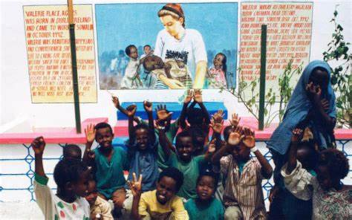
The Irish Department of Foreign Affairs founds the Valerie Place commemorative scholarship in March 1993, which brings Somali teachers and nurses to train in Ireland. In June 1997, St. James’s Hospital school of nursing unveils a portrait and a classroom dedicated to her memory. There is also a mural to Place in Mogadishu (pictured above).
The 23rd Government of Ireland is formed on January 12, 1993, following the 1992 Irish general election to the 27th Dáil held on November 25, 1992. It is a coalition of Fianna Fáil, with leader Albert Reynolds as Taoiseach, and the Labour Party, with leader Dick Spring as Tánaiste. It is the first time that these two parties are in government together. On each previous occasion Labour was in government, it was a junior coalition party with Fine Gael. The government lasts for 675 days from its appointment until its resignation on November 17, 1994, and continues to carry out its duties for an additional 28 days until the appointment of its successor, giving a total of 703 days.
The 27th Dáil lasts until 1997, but the first government falls in 1994 following the breakdown of relations between the two parties. It is succeeded in December 1994 by the 24th Government, a coalition of Fine Gael, with leader John Bruton as Taoiseach, Labour, with Dick Spring serving again as Tánaiste, and Democratic Left, led by Proinsias De Rossa. This is the only time a government with a new coalition of parties is formed within a single Dáil term.
The 27th Dáil first meets on December 14, 1992. In the debate on the nomination of Taoiseach, Fianna Fáil leader and outgoing Taoiseach Albert Reynolds, Fine Gael leader John Bruton and Labour Party leader Dick Spring are each proposed. None of these proposals are passed by the Dáil: Reynolds receives 68 votes in favour with 94 against, Bruton receives 55 in favour to 107 against, and Spring receives 39 in favour to 122 against. Reynolds resigns as Taoiseach and continues in a caretaker capacity.
On January 12, 1993, Albert Reynolds and John Bruton are again proposed for the nomination of the Dáil for the position of Taoiseach, and on this occasion, the nomination of Reynolds is successful by 102 votes to 60. Reynolds is then appointed as Taoiseach by PresidentMary Robinson.
After his appointment as Taoiseach by the president, Reynolds proposes the members of the government, and they are approved by the Dáil. They are appointed by the president on the same day.
Harry WhelehanSC is appointed by the president as Attorney General on the nomination of the Taoiseach. He resigns as Attorney General on November 11, 1994, on his nomination as President of the High Court, a position he serves in for only two days. Following Whelehan’s resignation, Eoghan Fitzsimons SC is appointed by the president as Attorney General on the nomination of the Taoiseach.
After the sum of European Structural and Investment Funds allocated to Ireland is lower than previously announced, a motion of no confidence is proposed in the government. This is then debated on October 28, 1993, as a motion of confidence in the government, proposed by the Taoiseach. It is approved by a vote of 94 to 55.
In November 1994, following the resignation of Attorney General Harry Whelehan, it emerges that he had failed to expedite the extradition of Fr. Brendan Smyth to Northern Ireland for sexual offences committed against children. The appointment of Whelehan to the court despite this leads to a motion of no confidence in the government. Reynolds responds on November 16 by proposing a motion reaffirming the confidence of the Dáil in the Taoiseach and the Government.
On the following day, November 17, Labour withdraws from the government and Reynolds resigns as Taoiseach. The motion of confidence in the government is withdrawn. Reynolds and the Fianna Fáil ministers continue to carry on their duties until their successors are appointed on December 15.
O’Brien is the youngest child of “a strict, religious family.” From 1941 to 1946 she is educated by the Sisters of Mercy, a circumstance that contributes to a “suffocating” childhood. “I rebelled against the coercive and stifling religion into which I was born and bred. It was very frightening and all pervasive. I’m glad it has gone.” She is fond of a nun as she deeply misses her mum and tries to identify the nun with her mother.
In 1950, O’Brien is awarded a licence as a pharmacist. In Ireland, she reads such writers as Leo Tolstoy, William Makepeace Thackeray, and F. Scott Fitzgerald. In 1954, she marries, against her parents’ wishes, the Irish writer Ernest Gébler and the couple moves to London. They have two sons, but the marriage is dissolved in 1964. Gébler dies in 1998.
In London, O’Brien purchases Introducing James Joyce, with an introduction written by T. S. Eliot. When she learns that James Joyce‘s A Portrait of the Artist as a Young Man is autobiographical, it makes her realise where she might turn, should she decide to write herself. In London she starts work as a reader for Hutchinson, where on the basis of her reports she is commissioned, for £50, to write a novel. Her first novel, The Country Girls (1960), is often credited with breaking silence on sexual matters and social issues during a repressive period in Ireland following World War II.
This novel is the first part of a trilogy of novels which includes The Lonely Girl (1962) and Girls in Their Married Bliss (1964). Shortly after their publication, these books are banned and, in some cases burned, in her native country due to their frank portrayals of the sex lives of their characters. Her novel A Pagan Place (1970) is about her repressive childhood. Her parents are vehemently against all things related to literature and her mother strongly disapproves of her daughter’s career as a writer.
O’Brien is a panel member for the first edition of the BBC‘s Question Time in 1979. In 2017, she becomes the sole surviving member.
Other works include a biography of James Joyce, published in 1999, and one of the poet Lord Byron, Byron in Love (2009). House of Splendid Isolation (1994), her novel about a terrorist who goes on the run, marks a new phase in her writing career. Down by the River (1996) concerns an under-age rape victim who seeks an abortion in England, the “Miss X case.” In the Forest (2002) deals with the real-life case of Brendan O’Donnell, who abducts and murders a woman, her three-year-old son, and a priest, in rural Ireland.






 seamus dubhghaill