seamus dubhghaill

Promoting Irish Culture and History from Little Rock, Arkansas, USA


Leave a comment

The Ballymurphy Massacre

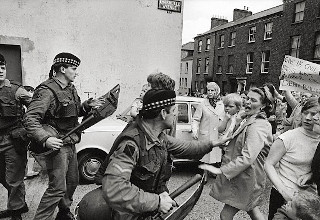
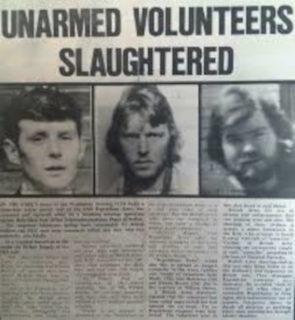
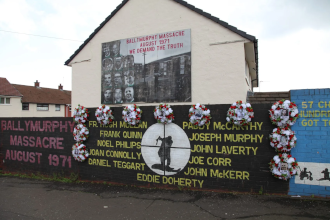
The Ballymurphy massacre is a series of incidents between August 9 and 11, 1971, in which the 1st Battalion, Parachute Regiment of the British Army kills ten civilians in Ballymurphy, Belfast, Northern Ireland, as part of Operation Demetrius. They are indirectly responsible for the death of an eleventh victim. The shootings are later referred to as Belfast’s Bloody Sunday, a reference to the killing of civilians by the same battalion in Derry a few months later. The 1972 inquests return an open verdict on all of the killings, but a 2021 coroner’s report finds that all those killed had been innocent and that the killings were “without justification.”

Belfast is particularly affected by political and sectarian violence during the early part of the Troubles. The British Army is deployed in Northern Ireland in 1969, as events become beyond the control of the Royal Ulster Constabulary (RUC).

On the morning of Monday, August 9, 1971, the security forces launch Operation Demetrius, the main focus of which is to arrest and intern suspected members of the Provisional Irish Republican Army (IRA). The Parachute Regiment is selected to carry out the operation. The operation is chaotic and informed by poor intelligence, resulting in a number of innocent people being interned. By focusing solely on republicans, it excludes violence carried out by loyalist paramilitaries. Some nationalist neighbourhoods attempt to disrupt the army with barricades, petrol bombs and gunfire. In the Catholic district of Ballymurphy, ten civilians are shot and killed between the evening of August 9 and the morning of August 11, while another dies of heart failure.

Members of the Parachute Regiment state that they were shot at by republicans as they entered the Ballymurphy area and returned fire. The press officer for the British Army stationed in Belfast, Mike Jackson, later to become head of the British Army, includes a disputed account of the shootings in his autobiography, stating that those killed in the shootings were republican gunmen. This claim is strongly denied by the families of those killed in the shootings, including in interviews conducted during the documentary film The Ballymurphy Precedent. The claim is found to be without basis by a later coroner’s inquest, which establishes that those killed were “entirely innocent.”

The six civilians killed on August 9 are Francis Quinn (19), shot while going to the aid of a wounded man, Father Hugh Mullan (38), a Catholic priest, shot while going to the aid of a wounded man, reputedly while waving a white cloth to indicate his intentions, Joan Connolly (44), shot by three soldiers as she stands opposite the army base, Daniel Teggart (44), shot fourteen times mostly in the back as he lay injured on the ground, Noel Phillips (20) and Joseph Murphy (41), shot as they stand opposite the army base. Murphy is subsequently taken into army custody and after his release, as he is dying in hospital, he claims that he had been beaten and shot again while in custody. When his body is exhumed in October 2015, a second bullet is discovered in his body, which activists say corroborates his claim.

Edward Doherty (28), is shot and killed on August 10 while walking along Whiterock Road.

Another three civilians are shot on 11 August: John Laverty (20) and Joseph Corr (43) are shot at separate points at the top of the Whiterock Road. Laverty is shot twice, once in the back and once in the back of the leg. Corr is shot several times and dies of his injuries on August 27. John McKerr (49), is shot in the head by an unknown sniper while standing outside a Catholic church and dies of his injuries on August 20. While a number of eyewitnesses state that soldiers were seen shooting toward the area, the 2021 inquest cannot establish who had killed him. The coroner notes that a more specific finding is not possible, in large part, due to an “abject failing by the authorities to properly inquire into the death of [McKerr at the time].”

Paddy McCarthy (44), an eleventh civilian, dies on August 11 following an altercation with a group of soldiers. His family allege that an empty gun is put in his mouth and the trigger pulled, he suffers a heart attack and dies shortly after the alleged confrontation.

In February 2015, the conviction of Terry Laverty, younger brother of John Laverty, one of those killed, is quashed by the Criminal Cases Review Commission. He had been convicted of riotous behaviour and sentenced to six months on the eyewitness evidence of a private in the Parachute Regiment. The case is referred to court because the sole witness retracts his evidence.

In 2016, Sir Declan Morgan, the Lord Chief Justice of Northern Ireland, recommends an inquest into the killings as one of a series of “legacy inquests” covering 56 cases related to the Troubles. These inquests are delayed, as funding has not been approved by the Northern Ireland Executive. The Stormont first minister, Arlene Foster of the Democratic Unionist Party (DUP), defers a bid for extra funding for inquests into historic killings in Northern Ireland, a decision condemned by the human rights group Amnesty International. Foster confirms she has used her influence in the devolved power-sharing executive to hold back finance for a backlog of inquests connected to the conflict. The High Court says her decision to refuse to put a funding paper on the Executive basis is “unlawful and procedurally flawed.”

In January 2018, the coroner’s office announces that the inquest will begin in September 2018. On May 11, 2021, this coroner’s inquest finds that the ten civilians killed were innocent and that the use of lethal force by the British Army was “not justified.” The circumstances of the 11th death are not part of the inquest since Paddy McCarthy died from a heart attack, allegedly after being threatened by a soldier. Following the inquest verdict, Boris Johnson, the British prime minister, apologises for the deaths at Ballymurphy in a phone call to Foster and deputy First Minister Michelle O’Neill. The lack of public apology is criticised by some relatives of the victims and Northern Irish politicians.

In May 2021, families of those shot dead by British soldiers in Ballymurphy urge the Irish government to oppose any attempt to prevent the prosecution of British soldiers alleged to have committed crimes during the Troubles.

The killings are the subject of the August 2018 documentary The Ballymurphy Precedent, directed by Callum Macrae and made in association with Channel 4.

Leave a comment

The Holy Cross Dispute

The Holy Cross dispute begins on June 19, 2001, and continues into 2002 in the Ardoyne area of north Belfast. During the 30-year conflict known as the Troubles, Ardoyne becomes segregated – Ulster Protestants and Irish Catholics living in separate areas. This leaves Holy Cross, a Catholic primary school for girls, in the middle of a Protestant area. During the last week of school in June 2001 before the summer break, Protestant loyalists begin picketing the school, claiming that Catholics are regularly attacking their homes and denying them access to facilities.

On Tuesday, June 19, Royal Ulster Constabulary (RUC) officers have to protect children and parents entering the school after they are attacked by loyalist stone throwers. Police describe the attack as “vicious.” Following the incident, a blockade of the school develops, with loyalists standing across the road and RUC officers keeping the children and their parents away.

The following day, the school is forced to close when loyalists block the entrance. During the evening, up to 600 loyalists and nationalists clash with each other and with the police. Shots are also fired at the police and over 100 petrol bombs are thrown. During the riots the police fire a number of the new ‘L21 A1’ plastic baton rounds for the first time. Thirty-nine RUC officers are injured. Nine shots in total are fired – six from loyalists and three from republicans. The trouble comes after an explosion at the rear of Catholic homes next to a peace line. Both loyalist and nationalist politicians blame each other for the violence. This is the first of many large riots to take place in Belfast within more than a year.

The morning blockade continues on Thursday, June 21. About 60 of the school’s 230 pupils enter the school through the grounds of another school. Senior Sinn Féin member Gerry Kelly says, “It’s like something out of Alabama in the 1960s.” Three Protestant families leave their homes in Ardoyne Avenue, saying they are afraid of a nationalist attack. During the evening and night there are serious disturbances in the area around the school. Loyalists fire ten shots and throw six blast bombs and 46 petrol bombs at police lines. Two Catholic homes are attacked with pipe bombs, and a child is thrown against a wall by one of the blasts. Twenty-four RUC officers are hurt.

On Friday, June 22, a number of schoolchildren again have to enter the school through the grounds of another school. This is the last day of school before the summer break.

Talks between the protesters and the schoolchildren’s parents take place over the summer, but no agreement is reached. On August 20, a paint bomb is thrown at the home of a Protestant man in Hesketh Park, smashing a window and causing paint damage to furniture. The man had taken part in the loyalist protest.

The picket resumes on September 3, when the new school term begins. For weeks, hundreds of loyalist protesters try to stop the schoolchildren and their parents from walking to school through their area. Hundreds of riot police, backed up by the British Army, escort the children and parents through the protest each day. Some protesters shout sectarian abuse and throw stones, bricks, fireworks, blast bombs and urine-filled balloons at the schoolchildren, their parents and the police. Death threats are made against the parents and school staff by the Red Hand Defenders, a loyalist paramilitary group. The protest is condemned by both Catholics and Protestants, including politicians. Some likened the protest to child abuse and compare the protesters to North American white supremacists in the 1950s. During this time, the protest sparks bouts of fierce rioting between Catholics and Protestants in Ardoyne, and loyalist attacks on police. On November 23, the loyalists end the protest after being promised tighter security for their area and a redevelopment scheme. The security forces remain outside the school for several months.

In January 2002, a scuffle between a Protestant and a Catholic outside the school sparks a large-scale riot in the area and attacks on other schools in north Belfast. The picket is not resumed, and the situation remains mostly quiet. The following year, the BBC airs a documentary-drama about the protests.


Leave a comment

The Tricolour Riots

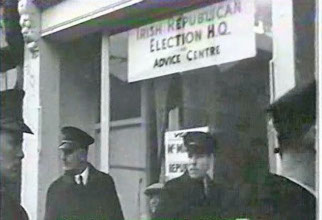
On the evening of the September 28, 1964, a detachment of the Royal Ulster Constabulary (RUC), acting on the direct instruction of Brian McConnell, the Minister of Home Affairs, attacks the Divis Street headquarters of the Republican Party (Sinn Féin had been outlawed earlier in the year) in West Belfast. Their perilous mission is to remove an Irish Tricolour.

This takes place during a general election for Westminster. Republicans have nominated Liam McMillan to contest in West Belfast. McConnell, under pressure from Ian Paisley and other unionists, holds a conference of his senior RUC officers on the morning of September 28 and orders that the tricolour flown at Liam McMillan’s headquarters be removed. Under the Flags and Emblems Display Act of 1954, it is an offence to display the tricolour anywhere in the six counties of Northern Ireland.

That evening, when it becomes known that the RUC are coming to seize the flag, more than 2,000 republican supporters block the roadway. Scores of RUC are rushed to the scene in armoured cars. The RUC, though heavily armed with sten guns, rifles, revolvers and riot batons, are made to look ridiculous by groups of children, who run about with miniature tricolour stickers which they stick on walls and police cars.

The RUC, using pickaxes, smashes down the doors of the Republican headquarters and takes the flag. They carry it away through a hail of stones and to the prolonged jeers of the people.

The following day the RUC clears Divis Street to make way for an armoured car. Their new perilous mission is to seize a new replacement tricolour. The armoured car stops outside the Republican headquarters, eight policemen emerge and begin another attack with crowbars and pickaxes. They fail to break down the door but one of them smashes the window, reaches in and pulls out the second tricolour.

By September 30, news of the events in Divis Street have spread throughout the media. Belfast begins attracting television reporters and newspaper men from all around the world. That night, thousands of republicans, armed with petrol bombs, sticks, stones and rotten vegetables, gather outside their headquarters to defend their identity and their flag. A battle begins at 11:00 PM when the RUC tries to disperse them. The television cameras are there to record all that happens. For the first time ever, people in many parts of the world are able to watch a sectarian police force in action.

When the republicans indicate that they will stand their ground, fifty RUC men, who had been held in reserve in the small streets between Falls Road and Shankill Road, are deployed but the republicans, in accordance with a pre-arranged strategy, drive them back. By midnight, the police have succeeded in sealing off Divis Street and dispersing the crowd but thirty people, including at least eighteen members of the RUC, have been injured.

One week later, on October 5, republicans carry the tricolour at the head of a parade of 5,000 people who march from Beechmount on Falls Road, through Divis Street, to an election rally near Smithfield. RUC men line the entire route but make no attempt to seize the flag.

(From: “The Tricolour Riots,” An Phoblacht (www.anphoblacht.com), September 23, 2004 edition)


Leave a comment

The Drumcree Conflict of 1998

orangemen-drumcree-march

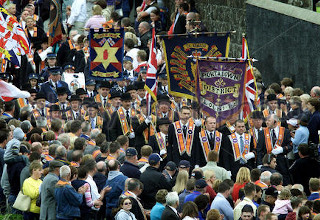
The Drumcree conflict or Drumcree standoff is a dispute over yearly Orange Order parades in the town of Portadown, County Armagh, Northern Ireland. The town is mainly Protestant and hosts numerous Protestant/loyalists marches each summer but has a significant Catholic minority. The Orange Order, a Protestant unionist organization, insists that it should be allowed to march its traditional route to and from Drumcree Church on the Sunday before The Twelfth. However, most of the route is through the mainly Catholic/Irish nationalist section of town. The residents, who see the march as sectarian, triumphalist and supremacist, seek to ban it from their area. The Orangemen see this as an attack on their traditions as they have marched the route since 1807, when the area was mostly farmland.

In 1995 and 1996, residents succeed in stopping the march. This leads to a standoff at Drumcree between the security forces and thousands of Orangemen/loyalists. Following a wave of loyalist violence, police allow the march through. In 1997, security forces lock down the Catholic area and let the march through, citing loyalist threats to kill Catholics if they are stopped. This sparks widespread protests and violence by Irish nationalists. From 1998 onward, the march is banned from Garvaghy Road and the army seals off the Catholic area with large steel, concrete and barbed wire barricades. Each year there is a major standoff at Drumcree and widespread loyalist violence. Since 2001 things have been relatively calm but moves to get the two sides into face-to-face talks have failed.

Early in 1998 the Public Processions (Northern Ireland) Act 1998 is passed, establishing the Parades Commission. The Commission is responsible for deciding what route contentious marches should take. On June 29, 1998, the Parades Commission decides to ban the march from Garvaghy Road.

On Friday, July 3, about 1,000 soldiers and 1,000 police are deployed in Portadown. The soldiers build large barricades made of steel, concrete and barbed wire across all roads leading into the nationalist area. In the fields between Drumcree Church and the nationalist area they dig a trench, fourteen feet wide, which is then lined with rows of barbed wire. Soldiers also occupy the Catholic Drumcree College, St. John the Baptist Primary School and some properties near the barricades.

On Sunday, July 5, the Orangemen march to Drumcree Church and state that they will remain there until they are allowed to proceed. About 10,000 Orangemen and loyalists arrive at Drumcree from across Northern Ireland. A loyalist group calling itself “Portadown Action Command” issues a statement which reads, “As from midnight on Friday 10 July 1998, any driver of any vehicle supplying any goods of any kind to the Gavaghy Road will be summarily executed.”

Over the next ten days, there are loyalist protests and violence across Northern Ireland in response to the ban. Loyalists block roads and attack the security forces as well as Catholic homes, businesses, schools and churches. On July 7, the mainly Catholic village of Dunloy is “besieged” by over 1,000 Orangemen. The County Antrim Grand Lodge says that its members have “taken up positions” and “held” the village. On July 8, eight blast bombs are thrown at Catholic homes in the Collingwood area of Lurgan. There are also sustained attacks on the security forces at Drumcree and attempts to break through the blockade. On July 9, the security forces at Drumcree are attacked with gunfire and blast bombs. They respond with plastic bullets. The police recorded 2,561 “public order incidents” throughout Northern Ireland.

On Sunday, July 12, brothers Jason (aged 8), Mark (aged 9) and Richard Quinn (aged 10) are burned to death when their home is petrol bombed by loyalists. The boys’ mother is a Catholic and their home is in a mainly-Protestant section of Ballymoney. Following the murders, William Bingham, County Grand Chaplain of Armagh and member of the Orange Order negotiating team, says that “walking down the Garvaghy Road would be a hollow victory, because it would be in the shadow of three coffins of little boys who wouldn’t even know what the Orange Order is about.” He says that the Order has lost control of the situation and that “no road is worth a life.” However, he later apologizes for implying that the Order is responsible for the deaths. The murders provoke widespread anger and calls for the Order to end its protest at Drumcree. Although the number of protesters at Drumcree drops considerably, the Portadown lodges vote unanimously to continue their standoff.

On Wednesday, July 15, the police begin a search operation in the fields at Drumcree. A number of loyalist weapons are found, including a homemade machine gun, spent and live ammunition, explosive devices, and two crossbows with more than a dozen homemade explosive arrows.


Leave a comment

Rioting Erupts In Belfast & Derry

belfast-rioting-1970

Intense riots between Protestants and Roman Catholics erupt in Derry and Belfast on June 27, 1970. During the evening, loyalist paramilitaries make incursions into republican areas of Belfast. This leads to a prolonged gun battle between republicans and loyalists. The rioting in both Belfast and Derry takes place despite the presence of more than 8,000 British soldiers, backed up by armored vehicles and helicopters.

The rioting follows the June 26 jailing of Bernadette Devlin, the 23‐year‐old Roman Catholic leader, who had recently been reelected to Parliament in London. She had been convicted of riotous behavior during violence in Derry in August 1969 and sentenced to six months in prison.

The rioting in Belfast begins after Catholic youths hurl stones and disrupt a parade by the militantly Protestant Orange Order. About 100 persons are injured badly enough to be treated in hospitals. A bakery and a butcher shop in a shopping center are set afire and a police station is wrecked with iron bars and clubs. The scene of the rioting is at the intersection of Mayo Street and Springfield Road in a mixed Protestant‐Catholic area.

Armed British soldiers, in visors and helmets and carrying riot shields, separate ugly, shouting mobs of Catholics and Protestants. The troops use tear gas in an effort to break up the crowd and at one point send 1,000 people, including women and children, fleeing with tears streaming down their faces.

There is civilian sniping and firing by British troops in two riot areas — the Springfield Road area and the Crumlin Road area – where rival crowds from segregated slum streets clash later in the afternoon.

At night British soldiers seal off the riot areas to all but military vehicles. Armored cars with machine guns ready stand in the streets, which are littered with glass and stones. Hundreds of soldiers in full battle dress stand against the seedy red‐brick shops and houses.

However, the crowds continue to gather. Buses are set afire, and late at night the army uses tear gas again to drive the mobs away. As rioting erupts in other parts of Belfast, 4,000 British soldiers are said to have been sent into the riot areas. The police are harassed by a half dozen fires around the city. Some of the fires are started with battery devices according to the police.

In Derry, Catholic youths attack soldiers and policemen with stones, bottles and gasoline bombs. The youths begin re‐erecting the barricades that had shielded the Catholic Bogside slum area during rioting the previous year. Ninety-two soldiers are injured and a paint shop near Bogside is set ablaze after looting by children who appear to be no more that 11 or 12 years old.

The wave of agitation begins in October 1968, when a largely Catholic civil rights movement takes to the streets to demand an end to anti‐Catholic discrimination in voting rights, jobs and housing. The Unionist Government in Belfast, which considers itself aligned with the Conservative Party in London, responds reluctantly to the street violence. However, under intense prodding by the Labor Government, it enacts many of the demanded reforms.

However, a Protestant backlash ensues, encouraged by the fiery evangelical preacher, the Rev. Ian Paisley. Paisley fans the latent fear that Northern Ireland‘s Catholics seek to unite Ireland into a Catholic state under Dublin. In the view of many observers, the Protestants have never shared power nor prestige with the Catholic minority, while the Catholics have taken an ambiguous view on whether they wanted to be British or Irish.

(From: “New Rioting Flares in Northern Ireland; 4 Dead and 100 Hurt” by John M. Lee, The New York Times, June 28, 1970)


Leave a comment

2012 North Belfast Riots

belfast-violence-july-2012

The first incident of the 2012 North Belfast Riots occurs on July 12, 2012, during “The TwelfthLoyalist celebrations. The sectarian disorder and rioting between loyalists and republicans take place when rival parades, authorised by the Parades Commission, take place.

Catholic rioting has been common in recent years when the parades are forced through the mostly Irish nationalist Ardoyne in north Belfast. The local Orangemen parade down the predominantly Ulster loyalist Crumlin Road towards the loyalist Woodvale area. Before turning into the Woodvale, they are met by Irish republican protesters and a nearby counter-parade organised by the Greater Ardoyne Residents Association (GARC). Nationalists then attack the Police Service of Northern Ireland (PSNI) and the parade with bricks, bottles and petrol bombs.

There is also violence in the Bogside area of Derry, where petrol bombs are thrown at police and a car is set afire. In south and east Belfast there are five arrests for a variety of offences including disorderly behaviour.

Prolonged attacks on the PSNI by Catholics follow the parades with missiles being thrown at police lines. Three cars are hijacked and pushed at police lines with at least one of them being set on fire, and at night ten shots are fired at police by a nationalist gunman who intends to kill police officers. On July 18, 2012, a 47-year-old man is charged with attempted murder of the police officers. The PSNI blames the violence on “thugs” and makes a further 26 arrests across Northern Ireland relating to the trouble.

In another incident during a different parade, a Shankill Road-based loyalist band “The Young Conway Volunteers” is filmed by a Sinn Féin activist playing The Famine Song outside St. Patrick’s Catholic Church in Ardoyne. The activist filming the incident is attacked by band members who try to snatch the phone from him. The incident brings condemnation, with Sinn Féin declaring it “provocative.” Protestant church leaders also condemn the incident as “blatantly sectarian.” It is this incident that is believed to ignite tensions in the area which continue over the next few months.

In the days that follow strong loyalist criticism is levelled at the Parades Commission blaming them for the violence. Nigel Dodds of the Democratic Unionist Party (DUP) accuses the Parades Commission of making a “bizarre, crazy, and mad decision” to allow the nationalist parade to coincide with the Orange parade while Sinn Féin’s Gerry Kelly blames the Orangemen for violating regulations set out by the Parades Commission. The Parades Commission denies responsibility, explaining “We have to balance the rights of everybody concerned in parades, not just the rights of paraders, but the rights of people who live in the areas and the rights of police officers.”


Leave a comment

The Ballysillan Postal Depot Shootings

ballysillan-road-shooting

The British Army shoot dead three Provisional Irish Republican Army (PIRA) volunteers and a passing Ulster Volunteer Force (UVF) volunteer at a postal depot on Ballysillan Road, Belfast on June 21, 1978. It is claimed that the PIRA volunteers are about to launch a bomb attack.

William Hanna is walking home with friend David Graham shortly after midnight. He is killed instantly when shooting breaks out between the British army and IRA gunmen. The three other men who die, William Mailey, Dennis Brown and James Mulvenna, are all members of the Provisional IRA.

It is believed the IRA men are challenged as they walk into a trap set up following recent bomb attacks at post office depots. Four petrol bombs are found by the army after the shootings. Three of the bombs are defused while the other is safely detonated.

Local residents, who say more and more soldiers have been seen around the premises in recent weeks, are moved out during the hour-long shooting in which more than 200 rounds are fired.

The Provisional IRA claims its men were not armed. The army does not find any weapons at the scene, but reports suggest accomplices carrying guns may have escaped.

Graham, who is not hurt, describes how shooting broke out when he and Hanna are halfway down the lane by the depot, “We hit the ground. The two of us rolled into the bushes and lay there.”

Roadblocks are immediately set up and a man is shot in the arm when he fails to stop. Police ultimately determine he is not connected with the post office attack.


Leave a comment

The Falls Curfew

falls-curfew

The Falls Curfew, also called the Battle of the Falls, a British Army operation in the Falls Road district of Belfast, Northern Ireland takes place on July 3-5, 1970.

The Northern Ireland riots of August 1969 mark the beginning of the Troubles. In Belfast, Catholic Irish nationalists clash with Protestant Ulster loyalists and the mainly-Protestant Royal Ulster Constabulary (RUC), Northern Ireland’s police force. Hundreds of Catholic homes and businesses are burned and more than 1,000 families, mostly Catholics, are forced to flee. The rioting ends with Operation Banner, the deployment of British troops.

A week before the Falls Curfew, on Saturday, June 27, 1970, there is severe rioting in Belfast following marches by the Protestant/unionist Orange Order. At the Short Strand, a Catholic enclave in a Protestant part of the city, the Provisional Irish Republican Army (IRA) fights a five-hour gun battle with loyalists. Three people are killed, and the loyalists withdraw. The Provisional IRA presents itself as having successfully defended a vulnerable Catholic enclave from armed loyalist mobs.

Meanwhile, the Official IRA arranges for a large number of weapons to be brought into the mainly nationalist and Catholic Lower Falls area for distribution. The area is a stronghold of the Official IRA.

The operation begins at about 4:30 PM on Friday, July 3, as a search for weapons in the staunchly Irish nationalist district. As the search ends, local youths attack the British soldiers with stones and petrol bombs and the soldiers respond with CS gas. This quickly develops into gun battles between British soldiers and the Irish Republican Army (IRA). After four hours of continuous clashes, the British commander seals off the area, which comprises 3,000 homes, and imposes a curfew which lasts 36 hours. Thousands of British troops move into the curfew zone and carry out house-to-house searches for weapons, while coming under intermittent attack from the IRA and rioters. The searches cause much destruction, and a large amount of CS gas is fired into the area. Many residents complain of suffering abuse at the hands of the soldiers. On July 5, the curfew is brought to an end when thousands of women and children from Andersonstown march into the curfew zone with food and groceries for the locals.

During the operation, four civilians are killed by the British Army, at least 78 people are wounded and 337 are arrested. Eighteen soldiers are also wounded. Large quantities of weapons and ammunition are captured. The British Army admits afterwards that some of its soldiers had been involved in looting.

The Falls Curfew is a turning point in the Troubles. It is seen as having turned many Catholics/Irish nationalists against the British Army and having boosted support for the IRA.

(Pictured: British soldiers on the Falls Road during the 1970 curfew)