seamus dubhghaill

Promoting Irish Culture and History from Little Rock, Arkansas, USA


Leave a comment

Death of Irish Writer Denis Johnston

Irish writer (William) Denis Johnston dies on August 8, 1984, at Ballybrack, County Dublin. He writes mostly plays, but also works of literary criticism, a book-length biographical essay of Jonathan Swift, a memoir and an eccentric work on cosmology and philosophy. He also works as a war correspondent and as both a radio and television producer for the BBC.

Johnston is born in Dublin on June 18, 1901, the only child of William John Johnston from Magherafelt, a barrister and later an Irish Supreme Court judge, and his wife Kathleen (née King), a teacher and singer from Belfast. They are Presbyterians and liberal home rulers. He sees the family home in Dublin occupied by rebels during the 1916 Easter Rising.

Johnston is educated at St. Andrew’s College, Dublin (1908–15, 1917–19), and Merchiston Castle School, Edinburgh (1915–16). In 1918, he attempts to join Sinn Féin, offering to supply the party with weapons taken from his Officers’ Training Corps. In 1922, while reading history and law at Christ’s College, Cambridge (1919–23) he tries to enlist in the civil war Free State army. He goes on to study at the Harvard Law School (1923–24) and enters King’s Inns in Dublin and the Inner Temple in London.

In London, developing his interest in the theatre, Johnston abandons plans for a legal and political career.

Johnston is a protégé of W. B. Yeats and George Bernard Shaw, and has a stormy friendship with Seán O’Casey. He is a pioneer of television and war reporting. He works as a lawyer in the 1920s and 1930s before joining the BBC as a writer and producer, first in radio and then in the fledgling television service. His broadcast dramatic work includes both original plays and adaptation of the work of many different writers.

Johnston’s first play, The Old Lady Says “No!”, helps establish the worldwide reputation of Dublin’s Gate Theatre. His second play, The Moon in the Yellow River, has been performed around the globe in numerous productions featuring such storied names as James Mason, Jack Hawkins, Claude Rains, Barry Fitzgerald, James Coco and Errol Flynn. Later plays deal with the life of Jonathan Swift, the 1916 Rebellion, the pursuit of justice, and the fear of death. He writes two opera libretti and a pageant.

“Passionate in his radical skepticism and loathing of what he saw as the pernicious influence of the Roman Catholic Church,” at the end of 1933, Johnston joins the trade unionist John Swift, the Dublin novelist Mary Manning, and fellow northerner, the libertarian socialist Jack White, in forming The Secular Society of Ireland. “Convinced that clerical domination in the community is harmful to advance,” the society seeks “to establish in this country complete freedom of thought, speech and publication, liberty for mind, in the widest toleration compatible with orderly progress and rational conduct.” Among other things it aims to terminate the clerically-dictated ban on divorce, the Censorship of Publications Act and the system of clerical management, and consequent sectarian teaching, in schools.

This is at a time of heightened clerical militancy and as soon the meeting place of the Society (from which it distributed the British journal The Freethinker) is exposed, it has to shift to private houses outside of Dublin. In 1936, Johnston and the other members disband the society and donate the proceeds to the government of the beleaguered Spanish Republic. He has become a recognised man of the left. In 1930 he joins the Irish Friends of Soviet Russia, and though never a party member, until as late as the 1950s he professes faith in a communist future.

During World War II he serves as a BBC war correspondent, reporting from El Alamein, through the Italian campaign, to Buchenwald and Adolf Hitler‘s Berghof. For this he is awarded an OBE, a mention in dispatches, and the Yugoslav Partisans Medal. He then becomes Director of Programmes for the television service.

Johnston later moves to the United States and teaches at Mount Holyoke College, Smith College and other universities. He keeps extensive diaries throughout his life, now deposited in the Library of Trinity College, Dublin, and these together with his many articles and essays give a distinctive picture of his times and the people he knew. Another archive of his work is held at the library of Ulster University at Coleraine. He receives honorary degrees from Ulster University and Mount Holyoke College and is a member of Aosdána.

Johnston and actress Shelah Richards are the parents of Jennifer Johnston, a respected novelist and playwright, and a son, Micheal. His second wife is the actress Betty Chancellor, with whom he has two sons, Jeremy and Rory.

Johnston dies on August 8, 1984, at Ballybrack, County Dublin, and is buried in St. Patrick’s Cathedral close. His epitaph is a quotation from The Old Lady Says “No!” – Emmet’s lines praising Dublin “the strumpet city.”

Johnston’s war memoir, Nine Rivers from Jordan, reaches The New York Times‘ Best Seller list and is cited in the World Book Encyclopedia‘s 1950s article on World War II under “Books to Read,” along with Winston Churchill, Dwight D. Eisenhower, et al. Joseph Ronsley cites an unnamed former CBS Vietnam War correspondent who called the book the “Bible,” carrying it with him constantly, “reading it over and over in the field during his tour of duty.” In a profile in The New Yorker in 1938, Clifford Odets is quoted as saying that the only playwrights he admires are John Howard Lawson, Sean O’Casey, and Denis Johnston.

The Denis Johnston Playwriting Prize is awarded annually by Smith College Department of Theatre for the best play, screenplay or musical written by an undergraduate at Smith College, Mount Holyoke College, Amherst College, Hampshire College and the University of Massachusetts Amherst. The prize is endowed by his former student at Smith, Carol Sobieski.

Leave a comment

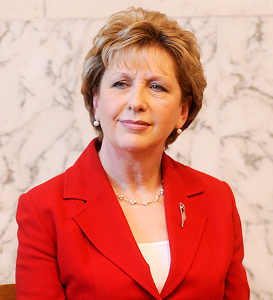
Birth of Mary McAleese, 8th President of Ireland

Mary Patricia McAleese, Irish Independent politician who serves as the 8th President of Ireland from November 1997 to November 2011, is born in Belfast, Northern Ireland on June 27, 1951. She is the second female president and is first elected in 1997 succeeding Mary Robinson, making McAleese the world’s first woman to succeed another as president. She is re-elected unopposed for a second term in office in 2004 and is the first President of Ireland to have come from either Northern Ireland or Ulster.

Born Mary Patricia Leneghan, McAleese is the eldest of nine children in a Roman Catholic family. Her family is forced to leave the area by loyalists when The Troubles break out. Educated at St. Dominic’s High School, she also spends some time when younger with the Poor Clares, Queen’s University Belfast, from which she graduates in 1973, and Trinity College, Dublin. She is called to the Bar of Northern Ireland in 1974 and remains a member of the Bar Council of Ireland. She opposes abortion and divorce.

In 1975, McAleese is appointed Professor of Criminal Law, Criminology and Penology at Trinity College, Dublin and in 1987, she returns to her Alma Mater, Queen’s, to become Director of the Institute of Professional Legal Studies. In 1994, she becomes the first female Pro-Vice-Chancellor of Queen’s University. She works as a barrister and also works as a journalist with RTÉ.

McAleese uses her time in office to address issues concerning justice, social equality, social inclusion, anti-sectarianism and reconciliation. She describes the theme of her Presidency as “Building Bridges.” This bridge-building materialises in her attempts to reach out to the unionist community in Northern Ireland. These steps include celebrating The Twelfth at Áras an Uachtaráin and she even incurs criticism from some of the Irish Catholic hierarchy by taking communion in a Church of Ireland cathedral in Dublin. Despite being a practising Roman Catholic, she holds liberal views regarding homosexuality and women priests. She is a member of the Council of Women World Leaders and is ranked the 64th most powerful woman in the world by Forbes. In spite of some minor controversies, McAleese remains popular, and her Presidency is regarded as successful.

McAleese receives awards and honorary doctorates throughout her career. On May 3, 2007, she is awarded The American Ireland Fund Humanitarian Award. On October 31, 2007, she is awarded an honorary Doctor of Laws from the University of Otago, New Zealand. On May 19, 2009, she becomes the third living person to be awarded the freedom of Kilkenny, succeeding Brian Cody and Séamus Pattison. The ceremony, at which she is presented with two hurleys, takes place at Kilkenny Castle. On May 24, 2009, she is awarded an honorary Doctor of Laws from Mount Holyoke College in South Hadley, Massachusetts. On May 22, 2010, she is awarded an honorary Doctor of Law from Fordham University, in the Bronx, New York City, where she delivers the commencement speech to the class of 2010. On November 8, she is awarded an honorary doctorate at University of Massachusetts Lowell in Lowell, Massachusetts.

On June 8, 2013, a ceremony is held to rename a bridge on the M1 motorway near Drogheda as the Mary McAleese Boyne Valley Bridge to honour McAleese’s contribution to the Northern Ireland peace process.


Leave a comment

Birth of Denis Johnston, Writer & Playwright

Irish writer William Denis Johnston is born in Ballsbridge, Dublin on June 18, 1901. He primarily writes plays, but also works of literary criticism, a book-length biographical essay of Jonathan Swift, a memoir and an eccentric work on cosmology and philosophy.

Johnston is a protégé of William Butler Yeats and George Bernard Shaw, and has a stormy friendship with Seán O’Casey. He is a pioneer of television and war reporting. He works as a lawyer in the 1920s and 1930s before joining the BBC as a writer and producer, first in radio and then in the fledgling television service. His broadcast dramatic work include both original plays and adaptation of the work of many different writers.

Johnston’s first play, The Old Lady Says “No!”, helps establish the worldwide reputation of the Dublin Gate Theatre. His second, The Moon in the Yellow River, has been performed around the globe in numerous productions featuring such actors as Jack Hawkins, Claude Rains and Errol Flynn, although not all in the same production. He plays a role in the 1935 film version of John Millington Synge‘s Riders to the Sea.

During World War II Johnston serves as a BBC war correspondent, reporting from El Alamein to Buchenwald. For this he is awarded an OBE, a Mentioned in Despatches and the Yugoslav Partisans Medal. He then becomes Director of Programmes for the television service.

Johnston later moves to the United States and teaches at Mount Holyoke College, Smith College and other universities. He keeps extensive diaries throughout his life, now deposited in the Library of Trinity College, Dublin. These, together with his many articles and essays, give a distinctive picture of his times and the people he knows. Another archive of his work is held at the library of Ulster University at Coleraine. He receives honorary degrees from the Ulster University and Mount Holyoke College and is a member of Aosdána.

The Denis Johnston Playwriting Prize is awarded annually by Smith College Department of Theatre for the best play, screen play, or musical written by an undergraduate at Smith, Mount Holyoke, Amherst College, Hampshire College and the University of Massachusetts Amherst.

Johnston’s war memoir Nine Rivers from Jordan reaches The New York Times Bestseller List and is cited in the World Book Encyclopedia‘s 1950s article on World War II under “Books to Read”, along with Churchill, Eisenhower et al. Joseph Ronsley cites an unnamed former CBS Vietnam correspondent who calls the book the “Bible”, carrying it with him constantly, “reading it over and over in the field during his tour of duty.”

Denis Johnston dies on August 8, 1984, in Ballybrack, Dublin. His daughter Jennifer Johnston is a respected novelist and playwright.