seamus dubhghaill

Promoting Irish Culture and History from Little Rock, Arkansas, USA


Leave a comment

Death of Andrew O’Connor, American Irish Sculptor

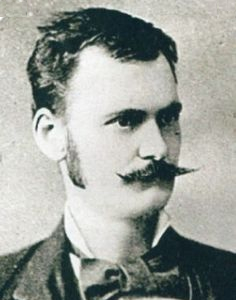
Andrew O’Connor, American Irish sculptor whose work is represented in museums in the United States, Ireland, Britain and France, dies in Dublin on June 9, 1941.

O’Connor is born on June 7, 1874, at Worcester, Massachusetts, the eldest of three sons and two daughters of Andrew O’Connor, a stonecutter from Lanarkshire, Scotland, who becomes a professional sculptor, and Marie Anne O’Connor (née McFadden), of County Antrim. Educated in Worcester public schools, at the age of 14 he becomes apprenticed to his father, helping him to design monuments for cemeteries. He is employed in the early 1890s on sculptural work for the World’s Columbian Exposition (Chicago World’s Fair), being active in the studio of William Ordway Partridge, and assisting Daniel Chester French on his colossal Statue of the Republic, a landmark of the 1893 Columbian exposition.

Moving to London (1894–98), O’Connor works on bas-reliefs in the studio of the painter John Singer Sargent, who uses him as a model for his mural Frieze of Prophets for the Boston Public Library. His first independent work, Sea Dreams, a relief of a head, is exhibited at the Royal Academy of Arts in 1896. Returning to the United States (1898–1903), he becomes a studio assistant of French, through whom he receives his first public commission, for the Vanderbilt Memorial Doors for St. Bartholomew’s Episcopal Church, Manhattan, New York, a project completed in 1902 to wide critical acclaim. He also executes the tympanum and lateral friezes.

Around 1900, O’Connor marries an artist’s model named Nora, by whom he has a daughter. In 1902, he hires as studio model Jessie Phoebe Brown from New Jersey and of County Down parentage. The following year he elopes with her to Paris, where they marry and have four sons, the youngest of whom, Patrick O’Connor, becomes an artist and gallery curator. Jessie continues for many years as his primary model, sitting for the heads of both female and male figures, O’Connor coarsening the features for the latter.

During his years in Paris (1903–14), O’Connor is influenced by the work of Auguste Rodin, whom he befriends. Among his pupils in Paris is the American sculptor and heiress Gloria Vanderbilt Whitney. He continues to fulfil numerous commissions for funerary and public monuments in the United States, an example of the former being the Recuillement in Sleepy Hollow Cemetery, near Tarrytown, New York. From 1906 he exhibits annually at the Salon in Paris, where he is the first foreigner to win a second-class medal, for his bronze statue of Gen. Henry Lawton. Included in his only exhibition at the Royal Hibernian Academy (1907) is a bronze relief of the prophet Nehemiah adapted from a panel of the Vanderbilt doors. The relief is subsequently included in his one-man show at the Galerie Hébrard, Paris in 1909.

In 1909, O’Connor wins a competition open to sculptors of Irish descent to execute a monument to Commodore John Barry, the County Wexford-born “father of the American navy,” for Washington, D.C. His design includes a frieze depicting events in Irish history, flanked by a group of three nude Irish emigrants entitled Exile from Ireland, and another group representing the Genius of Ireland, which includes a female figure of the “Motherland.” Probably owing to opposition from the Barry family to the depiction of their ancestor as a rough-and-ready sailor, the commission is not completed. His marble statue of Gen. Lew Wallace (author of Ben-Hur: A Tale of the Christ), a plaster of which is exhibited at the Salon in Paris in 1909, is placed by the state of Indiana in the National Statuary Hall in the United States Capitol, Washington, D.C. Another marble, Peace by Justice, is commissioned as a gift from the United States to the Peace Palace in The Hague in 1913.

O’Connor returns with his family to the United States on the outbreak of World War I, and sets up a studio in Paxton, Massachusetts. In 1918, his standing statue of the youthful Abraham Lincoln is placed outside the Illinois State Capitol at Springfield, Illinois. He later presents a marble head of Lincoln to the American ambassador’s residence, Phoenix Park, Dublin. His memorial in Chicago to President Theodore Roosevelt (1919) is commissioned as a tribute to Roosevelt’s associations with the Boy Scouts of America. The design of four standing scouts, modelled on O’Connor’s sons, is exhibited at the Philadelphia Art Alliance in 1920. He becomes an associate of the National Academy of Design, New York in 1919. In the early 1920s he executes an equestrian statue of the Marquis de Lafayette for South Park, at Mount Vernon, Baltimore, Maryland.

Returning to Paris in the mid-1920s, O’Connor becomes the first foreigner to win a gold medal at the Salon des Artistes in 1928, for the marble sculpture Tristan and Iseult, now held in the Brooklyn Museum, New York. The French government makes him a Chevalier of the National Order of the Legion of Honour in 1929. In 1926 he had exhibited a plaster group, Monument aux morts de la Grande Guerre, at the Salon in Paris. The sculpture is requested in 1932 by the people of Dún Laoghaire, County Dublin, as a memorial to Christ the King, O’Connor obligingly altering the interpretation of his iconography. Imposed on a “Tree of life” are three figures of Christ, representing in turn “Desolation,” “Consolation” and “Triumph.” Cast in bronze, throughout World War II the statue remains hidden in Paris to avoid its being melted down for the valuable metal. Transported to Dún Laoghaire in 1949, due to clerical opposition to its unconventional iconography, it is not at first erected, but for years lay on its side in a garden in Rochestown Avenue until its eventual unveiling in 1978 as Triple Cross in Haigh Terrace, where it stands in Moran Park. His other chief work in Ireland is a bronze statue of Daniel O’Connell in the Bank of Ireland, College Green, Dublin. Inspired by Rodin’s famous Monument to Balzac, the work is executed at his studio in a converted stable at Leixlip Castle, County Kildare in 1931–32.

During the 1930s, O’Connor lives and works in London and Ireland, where he has residences at Glencullen House, County Wicklow, and 77 Merrion Square, Dublin. He dies at the latter address on June 9, 1941, and is buried in Glasnevin Cemetery. His own bronze relief, Le feu sacré, marks the grave. A portrait painting, executed by his son Patrick in 1940, is in Dublin City Gallery The Hugh Lane, which also holds twenty-six sculptures presented by O’Connor late in his life, and posthumously by his family. The collection includes a marble self-portrait bust of 1940, a bronze of the Lafayette cast by the gallery in 1984 from a reduced plaster model presented by the artist, and a bronze group entitled The Victim, on view in Merrion Square Park, from an uncommissioned and uncompleted war memorial conceived by O’Connor under the general title Le Débarquement. The National Gallery of Ireland has the Desolation maquette for the Triple Cross. A centenary exhibition of his work is held at Trinity College Dublin in 1974. His widow dies in Dublin in 1974.

(From: “O’Connor, Andrew” by Lawrence William White and Carmel Doyle, Dictionary of Irish Biography, http://www.dib.ie, October 2009)
Leave a comment

Birth of Sculptor Augustus Saint-Gaudens

augustus-saint-gaudens

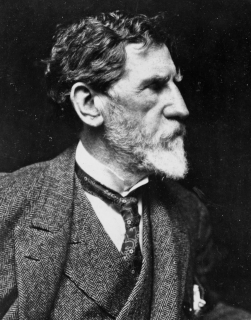
Augustus Saint-Gaudens, sculptor of the statue for the Charles Stewart Parnell monument which is installed at the North end of Dublin‘s O’Connell Street in 1911, is born in Dublin on March 1, 1848. He is generally acknowledged to be the foremost American sculptor of the late 19th century, noted for his evocative memorial statues and for the subtle modeling of his low reliefs.

Saint-Gaudens is born to a French father and an Irish mother. His family moves to New York City when he is an infant and at age 13, he is apprenticed to a cameo cutter. He earns his living at this craft, while studying at night at Cooper Union (1861–65) and the National Academy of Design (1865–66) in New York. In 1867 he travels to Paris and is admitted to the École des Beaux-Arts. Along with Olin Levi Warner and Howard Roberts, he is one of the first Americans to study sculpture in Paris. Late in 1870 he sets out for Rome, where, still supporting himself by cameo cutting, he works for two years copying famous antique statues on commission. He also starts to create his first imaginative compositions during this period.

After 1875 Saint-Gaudens settles in New York, where he befriends and collaborates with a circle of men who form the nucleus of an American artistic renaissance. The group includes the architects Henry Hobson Richardson, Stanford White, and Charles Follen McKim and the painter John La Farge. The most important work of Saint-Gaudens’s early career is the monument to Admiral David Farragut (1880, Madison Square Garden, New York), the base of which is designed by White.

From 1880 to 1897 Saint-Gaudens executes most of the well-known works that gain him his great reputation and many honours. Working with La Farge, in 1881 he creates two caryatids for a fireplace in Cornelius Vanderbilt’s residence. In 1887 he begins the Amor Caritas, which, with variations, preoccupies him from about 1880 to 1898, and also a statue of a standing Abraham Lincoln (Lincoln Park, Chicago). The memorial to Marian Hooper Adams (1891) in Rock Creek Cemetery, Washington, D.C., is considered by many to be his greatest work. In 1897 he completes a monument in Boston depicting Robert Gould Shaw, colonel of an African American regiment in the American Civil War. The statue is remarkable for its expression of movement. Shortly thereafter, he leaves for Paris, where, over the next three years, he prepares his final major public sculpture, the Sherman Monument (1903), which is eventually erected in Grand Army Plaza in New York.

Saint-Gaudens also makes many medallions, originally as a diversion from more serious tasks. These works show the influence of Renaissance medals as well as his early cameos. Among them are designs for U.S. coins and a considerable number of portraits. His autobiography, The Reminiscences of Augustus Saint-Gaudens, is published in 1913.

Diagnosed with cancer in 1900, Saint-Gaudens dies at the age of 59 on August 3, 1907, in Cornish, New Hampshire.


Leave a comment

Birth of Irish American Painter William Harnett

william-michael-harnett

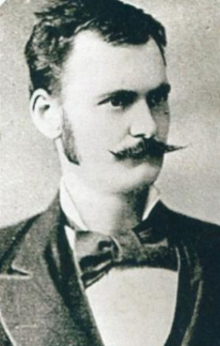
William Michael Harnett, Irish American painter known for his trompe-l’œil still lifes of ordinary objects, is born in Clonakilty, County Cork on August 10, 1848, during the time of the Great Famine.

Shortly after his birth Harnett’s family emigrates to the United States, settling in Philadelphia. Becoming a United States citizen in 1868, he makes a living as a young man by engraving designs on table silver, while also taking night classes at the Pennsylvania Academy of the Fine Arts and later, in New York City, at Cooper Union and at the National Academy of Design. His first known oil painting, a still life, dates from 1874.

The style of trompe-l’œil painting that Harnett develops is distinctive and inspired many imitators, but it is not without precedent. A number of Dutch Golden Age painters, Pieter Claesz for instance, had specialized in tabletop still life of astonishing verisimilitude. Raphaelle Peale, working in Philadelphia in the early 19th century, pioneers the form in America. What sets Harnett’s work apart, besides his enormous skill, is his interest in depicting objects not usually made the subject of a painting.

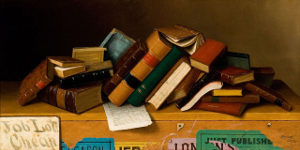
Harnett paints musical instruments, hanging game, and tankards, but also paints the unconventional Golden Horseshoe (1886), a single rusted horseshoe shown nailed to a board. He paints a casual jumble of second-hand books set on top of a crate, Job Lot, Cheap (1878), as well as firearms and even paper currency. His works sell well, but they are more likely to be found hanging in a tavern or a business office than in a museum, as they did not conform to contemporary notions of high art.

still-life-violin-and-music

Harnett spent the years 1880–1886 in Europe, staying in Munich from 1881 until early 1885. His best-known paintings, the four versions of After the Hunt, are painted between 1883 and 1885. Each is an imposing composition of hunting equipment and dead game, hanging on a door with ornate hinges at the right and keyhole plate at the left. These paintings, like the horseshoe or currency depictions mentioned earlier, are especially effective as trompe-l’œil because the objects occupy a shallow space, meaning that the illusion is not spoiled by parallax shift if the viewer moves.

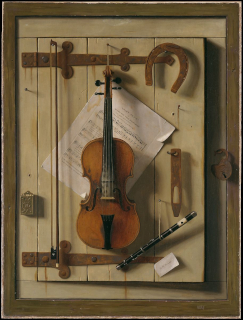
Overall, Harnett’s work is most comparable to that of the slightly younger John F. Peto. The two artists know each other, and a comparison can be made between two paintings featuring violins. Harnett’s Music and Good Luck from 1888 shows the violin hanging upright on a door with ornate hinges and with a slightly torn piece of sheet music behind it. The elements are arranged in a stable, deliberate manner. Peto’s 1890 painting shows the violin hanging askew, as well as chipped and worn, with one broken string. The sheet music is dog-eared and torn around the edges and placed haphazardly behind the instrument. The hinges are less ornate, and one is broken. Harnett’s objects show signs of use but are well preserved, while Peto’s more humble objects are nearly used up.

Crippling rheumatism plagues Harnett in his last years, reducing the number but not the quality of his paintings. He dies in New York City on October 29, 1892. Other artists who paint similar compositions in Harnett’s wake include his contemporary John Haberle and successors such as Otis Kaye and Jefferson David Chalfant.

Harnett’s work is in collections in the Albright-Knox Art Gallery (Buffalo, New York), the Amon Carter Museum of American Art (Fort Worth, Texas), the Dallas Museum of Art, the Art Institute of Chicago, the Brooklyn Museum, the Carnegie Museum of Art (Pittsburgh, Pennsylvania), the Cincinnati Art Museum, the Cleveland Museum of Art, the Detroit Institute of Arts, the Fine Arts Museums of San Francisco, Harvard Art Museums, the High Museum of Art (Atlanta, Georgia), the Honolulu Museum of Art, the Joslyn Art Museum (Omaha, Nebraska), the Los Angeles County Museum of Art, the Metropolitan Museum of Art (New York, New York), the National Gallery of Art (Washington D.C.), the National Gallery of Canada (Ottawa, Ontario), the Philadelphia Museum of Art, the San Diego Museum of Art, Thyssen-Bornemisza Museum (Madrid, Spain), the Toledo Museum of Art (Toledo, Ohio), the Wadsworth Atheneum (Hartford, Connecticut), and the Wichita Art Museum (Wichita, Kansas) among others.

(Pictured: Music and Good Luck, oil on canvas by William Michael Harnett, 1888, Metropolitan Museum of Art)


Leave a comment

Death of Irish American Painter William Harnett

william-harnett

William Michael Harnett, Irish American painter known for his trompe-l’œil still lifes of ordinary objects, dies at New York Hospital on October 29, 1892.

Harnett is born in Clonakilty, County Cork, on August 10, 1848, during the time of the Great Famine. Shortly after his birth his family emigrates to America, settling in Philadelphia. Becoming a United States citizen in 1868, he makes a living as a young man by engraving designs on table silver, while also taking night classes at the Pennsylvania Academy of the Fine Arts and later, in New York City, at Cooper Union and at the National Academy of Design. His first known oil painting, a still life, dates from 1874.

The style of trompe-l’œil painting that Harnett develops is distinctive and inspired many imitators, but it is not without precedent. A number of 17th century Dutch painters, Pieter Claesz for instance, specialize in tabletop still life of astonishing verisimilitude. Raphaelle Peale, working in Philadelphia in the early 19th century, pioneers the form in America. What sets Harnett’s work apart, besides his enormous skill, is his interest in depicting objects not usually made the subject of a painting.

Harnett paints musical instruments, hanging game, and tankards, but also painted the unconventional Golden Horseshoe (1886), a single rusted horseshoe shown nailed to a board. He paints a casual jumble of second-hand books set on top of a crate, Job Lot, Cheap (1878), as well as firearms and even paper currency. His works sell well, but they are more likely to be found hanging in a tavern or a business office than in a museum, as they did not conform to contemporary notions of high art.

Harnett spent the years 1880–1886 in Europe, staying in Munich from 1881 until early 1885. Harnett’s best-known paintings, the four versions of After the Hunt, are painted between 1883 and 1885. Each is an imposing composition of hunting equipment and dead game, hanging on a door with ornate hinges at the right and keyhole plate at the left. These paintings, like the horseshoe or currency depictions mentioned earlier, are especially effective as trompe-l’œil because the objects occupy a shallow space, meaning that the illusion is not spoiled by parallax shift if the viewer moves.

job-lot-cheap

Overall, Harnett’s work is most comparable to that of the slightly younger John F. Peto. The two artists know each other, and a comparison can be made between two paintings featuring violins. Harnett’s Music and Good Luck from 1888 shows the violin hanging upright on a door with ornate hinges and with a slightly torn piece of sheet music behind it. The elements are arranged in a stable, deliberate manner. Peto’s 1890 painting shows the violin hanging askew, as well as chipped and worn, with one string broken. The sheet music is dog-eared and torn around the edges and placed haphazardly behind the instrument. The hinges are less ornate, and one is broken. Harnett’s objects show signs of use but are well preserved, while Peto’s more humble objects are nearly used up.

Crippling rheumatism plagues Harnett in his last years, reducing the number but not the quality of his paintings. He seeks relief in the waters at Karlsbad and Wiesbaden, Germany and later at Hot Springs, Arkansas. But he continues to worsen and is hospitalized several times. He dies in New York City in 1892.