FitzMaurice is born in Wales in about 1150, the second-eldest son of Maurice FitzGerald, Lord of Llanstephan, by his wife, Alice (daughter of Arnulf de Montgomery). He has one sister, Nesta, who is named after their celebrated grandmother, Princess Nest ferch Rhys, and five brothers, including the eldest, William FitzMaurice, 1st Baron of Naas.
FitzMaurice’s father is the leader of the first landing of Normans who arrive in Ireland in 1169 to assist the exiled Irish king of Leinster Diarmait Mac Murchada regain his kingdom. Accompanying his father from Wales to Ireland, he and his brother Alexander show great valour in the battle against Ruaidrí Ua Conchobair outside the walls of Dublin in 1171. Upon the death of their father on September 1, 1176, his elder brother William grants him half the cantred of Ophelan with centres at Maynooth and Rathmore. He is confirmed in them by Prince John in 1185.
William FitzAldelm deprives FitzMaurice and his brothers of their stronghold of Wicklow, though, after a time, is compelled to give them Ferns in exchange. FitzMaurice has already received, from Strongbow, Naas and other districts in what becomes County Kildare, and has erected Maynooth Castle.
In 1199, though receiving King John’s letters of protection, FitzMaurice is ordered to “do right” to Maurice Fitzphilip for the lands of “Gessil and Lega,” that he had taken from Fitzphilip. Between 1185 and 1204, FitzGerald has established a settlement at Geashill. Originally of motte-and-bailey design, it is a timber castle on an earthen mound, nearby are located the church and tenant dwellings. On his death, FitzMaurice is still in possession of those estates. In the 15th century the wooded fortress at Geashill is replaced by a stone tower house. Today, only the west wall of the castle remains.
FitzMaurice is often described as “Baron Offaly,” the middle cantred of which had been among his father’s possessions. He dies on January 15, 1204.
FitzMaurice is described by his cousin, Gerald of Wales, as small in stature, but distinguished for prudence and honesty. He is the patrilineal ancestor of the earls of Kildare.
Sometime around 1193, FitzMaurice marries as her first husband, Eve de Bermingham, daughter of Sir Robert de Bermingham. In marriage, he receives the barony of Offaly, becoming the first FitzGerald Lord of Offaly. Together he and Eve have one son:
Following FitMaurice’s death in 1204, Eve goes on to marry two more times. Her second husband is Geoffrey FitzRobert, and her third, whom she marries sometime after 1211, is Geoffrey de Marisco, Justiciar of Ireland. She dies between June 1223 and December 1226.
FitzGerald is born in 1238 in Wexford, the second son of Maurice FitzGerald, 2nd Lord of Offaly, and Juliana de Grenville. He has three brothers, Gerald FitzMaurice II, Thomas FitzMaurice and David FitzMaurice. He is known by the nickname of Maurice Mael (from an old word meaning “devotee” in Irish). He is granted his father’s lands in Connacht in exchange for quitclaiming the barony of Offaly sometime before May 20, 1257, when his father, Maurice FitzGerald II, dies at Youghal Monastery.
Before his father’s death, FitzGerald is custos of Offaly, but after the 2nd Lord of Offaly dies, the countess of Lincoln, Margaret de Quincy, sues him for custody of Offaly.
Terrible feuds rage in his time between the Geraldines and the De Burghs. FitzGerald and his nephew John, son of his brother Thomas, capture the justiciar, Richard de la Rochelle, Theobald Butler IV, and John de Cogan I (whose son is married to Maurice FitzGerald III’s sister, Juliana). The capture of the three magnates leads to a private war in Ireland, with the Geraldines on one side and Walter de Burgh and Geoffrey de Geneville on the other. However, the Second Barons’ War in England forces them to come to a temporary peace while they battle Montfortians in the English Midlands in 1266.
In May 1265, FitzGerald is among the chief magnates in Ireland summoned to inform King Henry III of England and his son Prince Edward about conditions in the country, and again in June 1265. These are the result of the private war between the Geraldines and Walter de Burgh, lord of Connacht (who is later made the 1st Earl of Ulster). He is appointed Justiciar of Ireland on June 23, 1272, following the accidental death of his predecessor, James de Audley, on June 11 of that year. His father had served in the same capacity from 1232 to 1245. He holds the post until September 1273, when he is succeeded by Sir Geoffrey de Geneville, Seigneur de Vaucouleurs.
In 1276, FitzGerald leads a force of men from Connacht against the Irish of County Wicklow. His contingent joins the main army of English settlers jointly commanded by his son-in-law, Thomas de Clare, Lord of Inchiquin and Youghal, who had been made Lord of Thomond earlier that same year, and Sir Geoffrey de Geneville, Maurice’s successor as Justiciar of Ireland. The English under Thomas de Clare and Geoffrey de Geneville attack the Irish at Glenmalure, but are defeated and suffer heavy losses.
Shortly before October 28, 1259, FitzGerald married his first wife, Maud de Prendergast, daughter of Sir Gerald de Prendergast of Beauvoir and Matilda de Burgh, daughter of Richard Mór de Burgh. Together they have two daughters:
FitzGerald is Maud’s third husband. She dies on an unknown date. In 1273, he marries his second wife, Emmeline Longespee (1252–1291), daughter of Stephen Longespée and Emmeline de Ridelsford. He and Emeline have no issue.
FitzGerald dies September 2, 1277, at Ross, County Wexford. Emmeline Longespée then fights until her death to claim her dower against her daughter, Juliana, her stepdaughter, Amabilia, and John FitzGerald, who is created 1st Earl of Kildare on May 14, 1316. John is the son of his brother, Thomas by Rohesia de St. Michael. John sues or physically takes lands from the bailiffs of Emmeline, Juliana, and Amabilia.
There is some confusion as to whether Gerald Fitzmaurice FitzGerald is the first or second son of Maurice FitzGerald, 2nd Lord of Offaly. Most, like M. Hickson, of the Royal Society of Antiquaries of Ireland (RSAI) say he is the eldest. Lord Walter FitzGerald says he is the second. In any event, he predeceases his father in 1243. His son, Maurice FitzGerald, drowns in the Irish Channel in July 1268. His son is Gerald FitzMaurice III, born in 1263. Gerald’s marriage is sold to Geoffrey de Geneville, who matches Gerald with his own daughter, Joan, but he dies childless on August 29, 1287.
Maurice FitzMaurice FitzGerald 3rd Earl of Offaly, is succeeded by his nephew John, son of his younger brother Thomas FitzMaurice FitzGerald.
Brian O’Neill (Irish: Brian Chatha an Dúna Ó Néill), the High King of Ireland from 1258 to 1260, is defeated and killed by the forces of Roger des Auters at the Battle of Down on May 14, 1260.
O’Neill is the son of Niall Roe O’Neill, and grandson of Áed in Macáem Tóinlesc. His wife is Nuala O’Connor (Ní Conchobair), a daughter of Rory O’Connor (Irish: Ruaidrí Ua Conchobair), the last High King of Ireland before the Norman invasion. Therefore, through his mother, he is descended from Brian Boru (Irish: Brian Bóramha).
In 1230, Hugh O’Neill (Irish: Aedh Ó Néill), king of Tyrone, dies and is succeeded by Donnell MacLaughlin. MacLaughlin, however, is removed in 1238 by the Justiciar of Ireland, Maurice FitzGerald, 2nd Lord of Offaly, and Hugh de Lacy, 1st Earl of Ulster, who install “the son of O’Neill”, presumed to have been Brian, and take the hostages of the Cenel Owen and Cenel Connell. However, it may have been Brian’s cousin Donnell, who afterwards is killed by MacLaughlin. After this, O’Neill claims the kingship of the O’Neill dynasty as well as Tyrone, possibly with the aid of Hugh de Lacy, 1st Earl of Ulster.
In revenge, O’Neill with the aid of Melaghlin O’Donnell, king of Tyrconnell, defeat MacLoughlin and ten of his closest kinsmen at the Battle of Camergi, somewhere within Tyrone north of Omagh, in 1241. This ends the long rivalry between the MacLoughlin’s and O’Neill’s, with the MacLoughlin’s afterwards excluded from the kingship of Tyrone and Ailech.
In 1244, Henry III of England sends letters to various Gaelic Irish lords, including O’Neill, requesting their aid in a military campaign against the Kingdom of Scotland. In the end the issue is sorted out diplomatically. Copies of the letter are also distributed to O’Neill’s sub-chiefs including his tánaiste, Hugh Boy O’Neill.
A consequence of this infighting between the rival factions of the Cenél Eoghain allows the Normans to advance deeper into Gaelic Ulster, however, in 1243 de Lacy dies. Thus the Earldom of Ulster reverts to the English Crown and is taken over by royal administrators. John FitzGeoffrey, the king’s chief governor in Ireland, erects a bridge across the River Bann and builds castles at Coleraine and Ballyroney in Iveagh. From here FitzGeoffrey is able to penetrate deeper into Tyrone.
Despite ending MacLoughlin aspirations to the kingship, O’Neill forms a marriage alliance with them, however, this results in a war with the O’Donnells of Tyrconnell. Subsequently in 1248 O’Neill backs the king of Tyrconnell, Rory O’Cannon (Irish: Ruaidri Ua Canannáin), against the claims of O’Donnell. O’Cannon had been set up in the kingship by FitzGerald, however, rather than backing him, enters Tyrconnell and removes him in favour of Gofraid O’Donnell.
O’Cannon, who had been expelled to Tyrone, and O’Neill once again lead their forces into Tyrconnell to confront O’Donnell, however they are defeated and O’Cannon is killed.
That same year, John FitzGeoffrey, who replaced FitzGerald as Justiciar in 1246, enters Tyrone and takes the submission and hostages of O’Neill. A resolution had been adopted at a meeting of the Cenel Owen that “since the power of the Foreigners was over the Gaeidhel of Erinn, to give hostages to the Foreigners, and to make peace with them, for the sake of their country.”
In 1249, the king of Connacht, Felim O’Connor, is given refuge from the Normans by O’Neill. In 1252, O’Neill and his brother give their submissions to the Justiciar of Ireland, who had marched to Armagh with a large force. A Rory O’Neill is given as hostage.
In 1253, as a sign of defiance against his vassal status with the Earldom of Ulster, O’Neill withholds his tribute to it and raids Iveagh, destroying the castle at Ballyroney. He also launches an offensive against the Normans in Leinster. That same year, the son of Maurice FitzGerald leads his forces into Tyrone to attack O’Neill, however he fails to take his submission or hostages and after battle suffers a heavy defeat at the hands of O’Neill.
In 1255, O’Neill makes a pact with Felim O’Connor’s son Hugh, whereby allowing Hugh free rein in the Kingdom of Breifne, he would aid O’Neill against the Normans of the earldom who are eroding his territory.
In 1257, the king of Tyrconnell, Gofraid O’Donnell, is mortally wounded in battle against the FitzGeralds and O’Neill uses this opportunity to try to exact Tyrconnell’s submission. As the Cenel Connell discuss what to do, Gofraid’s youngest brother, Donnell Óg, returns from fosterage and is conferred the chieftainship of Tyrconnell. He refuses to submit O’Neill stating the Scottish proverb “Every man should have his own world.”
FitzGerald in 1252 had built a castle at Caoluisce, on the banks of Lough Erne, near modern day Belleek, County Fermanagh, Northern Ireland, however, in 1258 it is the site where O’Neill, in the presence of his ally O’Connor, is inaugurated as “King of the Gael of Erin.” While he receives hostages from O’Connor and from O’Brien of Thomond, along with several other minor Kings from Meath and Munster, his claim is not recognised by those of the Irish closest to him including the other O’Neill factions, the O’Donnell’s of Tyrconnell, the MacMahon’s of Airgíalla, and the O’Rourkes of Breifne. The following year O’Donnell leads an attack into Tyrone.
In 1260, O’Neill, along with his O’Connor allies, launch an attack on the Normans of the Earldom of Ulster at Drumderg, near its capital at Downpatrick in modern County Down, Northern Ireland. The Normans levy the town, and with the aid of forces brought by Sir Roger des Auters, O’Neill and his allies are decisively defeated at the subsequent Battle of Down. The Annals of Inisfallen state that the forces recruited by the Normans consist mostly of native Irish and that the Normans play only a minor role.
In the battle, O’Neill is killed along with many other Irish nobles including over a dozen members of the O’Cahans. O’Neill’s head is cut off by the Normans and sent to King Henry III of England, a sign of how dangerous his coalition is believed to be.
After this battle, O’Neill becomes known in Irish as Brian Chatha an Dúna, meaning “Brian of the Battle of Down.”
After O’Neill’s death, the kingship of the Cenel Owen, and with it Tyrone, is taken by his cousin’s son, Hugh Boy O’Neill, ancestor of the Clandeboye O’Neill’s, who also has the support of the earldom of Ulster. Upon Hugh’s death in 1283 O’Neill’s son Donnell seizes the kingship, which until 1295 is highly contested between him and his second-cousin Niall Culanach O’Neill and Hugh Boy’s son Brian, until he wins outright control by killing his opponents.
Under the Treaty, O’Connor recognizes King Henry II as his overlord and agrees to collect tribute for him from all parts of Ireland. Henry agrees that O’Connor can be king of the areas not conquered by the Normans. But O’Connor cannot control the territories of which he is nominally king. Henry and his barons annex further land without consulting O’Connor.
Overall, the agreement leaves O’Connor with a kingdom consisting of Ireland outside the provincial kingdom of Leinster (as it was then), Dublin and a territory from WaterfordDungarvan, as long as he paid tribute to Henry II, and owed fealty to him. All of Ireland is also subject to the new religious provisions of the papal bullLaudabiliter and the Synod of Cashel (1172).
O’Connor is obliged to pay one treated cow hide for every ten cattle. The other “kings and people” of Ireland are to enjoy their lands and liberties so long as they remain faithful to the kings of England and are obliged to pay their tribute in hides through O’Connor.
The Annals of Tigernach record that: “Cadla Ua Dubthaig came from England from the Son of the Empress, having with him the peace of Ireland, and the kingship thereof, both Foreigner and Gael, to Ruaidhrí Ó Conchobhair, and to every provincial king his province from the king of Ireland, and their tributes to Ruaidhrí.” The Annals also list the ongoing violence in Ireland at the time. The text reveals a misunderstanding of the scope of the treaty and the matters agreed by the two kings that soon prove fatal to the peace of Ireland. Henry sees O’Connor as his subordinate within the feudal system, paying him an annual rent on behalf of all his sub-kings. O’Connor sees himself as the restored High King of Ireland, subject only to a very affordable annual tribute to Henry.
The treaty breaks down very quickly, as O’Connor is unable to prevent Norman knights from carving out new territories on a freelance basis, starting with assaults on Munster and Ulaid in 1177. For his part Henry is by now too distant to suppress them and is preoccupied with events in France. In 1177 he replaces William FitzAldelm with his 10-year-old son Prince John and names him as Lord of Ireland.
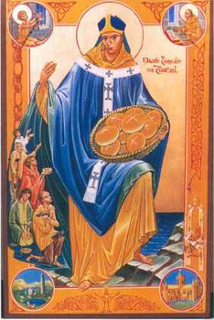
O’Toole is born in Castledermot in what is now County Kildare in 1128. His father is Maurice O’Toole, King of Hy Murray. It is common practice in the day for princes of one clan to be given as hostages to another clan, as a guarantee of peace. When he is ten years old O’Toole is given as hostage to Dermot McMurrough, King of Leinster, who treats him very badly. He is sent in chains to a remote place, where he gets very little to eat and does not have enough clothes to keep him warm in the winter. For two years, even though he is a king’s son, he learns what it is like to be poor and to be oppressed.
After two years, it is agreed that O’Toole is to be released. He is sent to a monastery at Glendalough, and the monks make him welcome. It is agreed that his father is to come and collect him there. But he soon comes to love Glendalough and likes joining the monks in prayer. After his two years as a hostage, he realises that wealth and power are not important. He feels very close to God in Glendalough. He asks his father’s permission to stay there and become a monk, to which his father agrees. At the age of only 25 years old, he is elected Abbot of the monastery. As the leader of the community, he encourages the monks in their learning. There is always a welcome in the monastery for the poor. When there is a famine in the area, he sells some of the treasures of Glendalough to provide food for those who are hungry.
In 1162 O’Toole becomes the first Irish-born Archbishop of the Danish city of Dublin. In those days, many of the people of Dublin do not take their Christian religion very seriously. He encourages them to become real Christians. He brings monks to Dublin from France, and they live at Christ Church Cathedral. They help many people to come back to Mass and the Sacraments. O’Toole himself never forgets his own days of poverty. He continues to care for the poor, especially homeless children. He makes room for them in his own house, and they share the food at his table.
The Normans land in Ireland in 1169. The following year they besiege Dublin under their leader, Strongbow. O’Toole meets Strongbow to arrange peace but the Normans attack while the talks are going on. They seize the city and begin killing the citizens and looting their houses. O’Toole saves the lives of many people.
As Archbishop of Dublin, O’Toole participates in the Third Council of the Lateran in Rome in 1179, with some of the other Irish bishops. Pope Alexander III knows that Ireland has been going through a bad time. He knows that many people, including priests, are no longer taking their religion seriously. He entrusts to O’Toole the task of reforming the Church in Ireland.
A new dispute breaks out between the King of England and the Irish Kings. In the spring of 1180, O’Toole leaves Ireland to see if he can help settle the dispute. The English King, Henry II, does not have much time for bishops. He has already arranged to have the Archbishop of Canterbury, Thomas Becket, murdered. He does not welcome O’Toole. He sees a chance to get rid of O’Toole as Archbishop of Dublin and does not let him return to Ireland. Henry has control of Normandy as well as England. O’Toole follows him there. As long as there is a chance of peace, he would not give up trying.
In 1180, O’Toole becomes seriously ill. The monks at Eu in Normandy look after him in their monastery but on November 14, 1180, at the age of 52, he dies. His tomb is in the crypt under the Collegial Church at Eu. Many people still go there to pray. Laurence O’Toole is canonized in 1225 by Pope Honorius III.
(From “St. Laurence O’Toole: a spiritual leader for difficult times,” CatholicIreland.net, November 30, 1999)
Millmount has been fortified in historical times since the early 12th century when invading Normans built a mote and bailey on what was probably originally a neolithic passage grave similar to Newgrange. In Irish cosmology, it is often assumed to be the burial place of Amergin Glúingel, whose name indicates that in ancient Irish mythology he was regarded as the originator of the arts of song, poetry and music.
Hugh de Lacy, one of the Normans who comes to Ireland after Strongbow, builds the original fort circa 1172, having been granted the Kingdom of Meath by Henry II of England. Later a stone castle is built on the site. This castle forms part of the defences of the town during the Siege of Drogheda during the Cromwellian conquest of Ireland in 1649. The fort’s English defenders attempt to surrender to Parliamentarian troops under Oliver Cromwell but are massacred when they give themselves up on September 11, 1649. The complex is later called Richmond Barracks. Some of the present buildings, in the courtyard, are built circa 1714. After the unrest and rebellions of the 1790s and the Acts of Union 1800 the complex is re-fortified, and the Martello tower is built.
The fort suffers considerable damage during the Irish Civil War. It is occupied by Anti-Treaty forces and on July 4, 1922, it becomes the target of shelling by the army of the Irish Free State. The Free State Forces under Michael Collins have been given extensive support by the British Army at the express wish of Winston Churchill who insists that the Republican Forces be crushed. Using the same British Army 18-pounder artillery piece which had shelled the Republican H.Q. in the Four Courts in Dublin some days earlier the Free State Forces bombard Millmount fort for several hours before the Republican garrison retreats. The famous Martello tower is all but destroyed during the shelling.
Today, after being restored in 2000, the complex houses the Millmount Museum which houses a wide variety of artifacts of local and national importance. The complex is Drogheda’s most dominant feature, clearly visible from all parts of the town. The Martello tower is affectionately known as “The Cup and Saucer” by locals. The whole fort is a national monument and has been designated as Drogheda’s Cultural Quarter.
Ua Conchobair is born in 1153 and serves as King of Connacht from 1189 to 1199, and is re-inaugurated on the stone at Clonalis about 1201, reigning until 1224. He first succeeds his elder half brother Ruaidri‘s son Conchobar Máenmaige Ua Conchobair as ruler of Connacht. Conchobar Máenmaige’s son Cathal Carrach Ua Conchobair then rules from 1199 to 1202, with Cathal Crobhdearg back in power from then.
From his base west of the River Shannon he is forced to deal with the Norman invaders. He is a competent leader despite problems, avoiding major conflicts and winning minor skirmishes. Ua Conchobair attempts to make the best of the new situation with Ireland divided between Norman and Gaelic rulers. His long reign is perhaps a sign of relative success. He is the subject, as Cáhal Mór of the Wine Red Hand, of the poem A Vision of Connaught in the Thirteenth Century by the 19th-century Irish nationalist James Clarence Mangan.
In 1224 Ua Conchobair writes to Henry III as Lord of Ireland, asking that his son and heir Od (Aedh) be granted all of Connacht, in particular those parts, Kingdom of Breifne, owned by William Gorm de Lacy.
An account of Ua Conchobair’s inauguration has been preserved, written down by Donogh Bacach Ó Maolconaire, the son of O’Connor’s very inaugurator Tanaide Ó Maolconaire, who is also his historian.
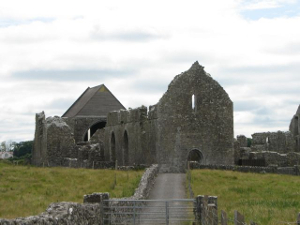
(Pictured: Ruins of the 12th century Cistercian Knockmoy Abbey which contains the burial site of King Cathal Crobhdearg Ua Conchobair)
Henry II, fearful that Richard de Clare, 2nd Earl of Pembroke, also known as Strongbow, will grow too powerful in Ireland, lands with an army at Waterford on October 17, 1171. The Normans, Norse, and Irish all submit to him, except for the most remote Irish kings.
Henry is worried about the growing power of the Cambro-Norman knights, in particular Strongbow, who has in the previous two years carved out what is a substantial new territory, as well as a delicately located new territory with regard to Henry’s own holdings in what is termed the Angevin Empire.
Henry’s presence changes the game for the Norman lords. Either they agree to do as he asks, submit to his sovereignty and accept the land they have grasp through force of arms as his gift, or branded as rebels they face their King with an army of 1,000 knights.
The Lords see the way of things and agree to the demand. Many of the Gaelic Irish, seeing Henry as a potential ally against the power of the Norman Lords, swear allegiance as well.
Henry receives recognition and hostages from the Ostmen of Wexford, who have captured Robert FitzStephen, as well as from many other kings in Ireland including Diarmait MacCarthaigh, king of Cork, Domnall Mór Ua Briain, king of Limerick, Murchadh O Cearbhaill, king of Airgialla, Tighearnán Mór Ua Ruairc, king of Breifne, and Donn Sléibe mac Con Ulad Mac Duinn Sléibe, king of Ulaid.
Henry formally grants Leinster to Strongbow in return for homage, fealty, and the service of 100 knights, reserving to himself the city and kingdom of Dublin and all seaports and fortresses. He also grants the kingdom of Meath, from the River Shannon to the sea, to his own follower Hugh de Lacy.
Henry II’s arrival at Waterford puts to rest the idea of an independent Irish kingdom that any Norman lord might imagine and determines a course for Ireland for some 750 years.
The Parliament of Ireland meets at Castledermot in County Kildare on June 18, 1264, the first definitively known meeting of this Irish legislature. There is some evidence to suggest that the word “parliament” may have been in use as early as 1234.
There is nothing new about parliamentary assemblies in Ireland. The Normans, who begin to settle in Ireland in 1169, are the first to give Ireland a centralised administration. The Irish legal system and courts of law are, in large measure, inherited from them. So too is the Irish legislature which is directly descended from the parliament which develops in medieval Ireland.
The Parliament of Ireland is formally founded in 1297 by the Justiciar, Sir John Wogan, to represent the Irish and Anglo-Norman population of the Lordship of Ireland. It exists in Dublin from 1297 until 1800 and is comprised of two chambers – the House of Commons and the House of Lords. The House of Lords consists of members of the Irish peerage and the bishops (after the Reformation, Church of Ireland bishops), while the Commons is directly elected, albeit on a very restricted franchise.
The main purpose of parliament is to approve taxes that are then levied by and for the Lordship of Ireland. Those who pay the bulk of taxation, the clergy, merchants, and landowners, naturally comprise the members. In 1541 the parliament votes to create the Kingdom of Ireland.
Over the centuries, the Irish parliament meets in a number of locations both inside and outside Dublin. The first meeting at Castledermot in June 1264 takes place some months earlier than the first English Parliament containing representatives of towns and cities. However, this Irish Parliament is a meeting of Irish nobles and bishops, not representatives of Irish people. Later, in the 15th century, Irish parliaments began to invite representatives of the people.
Diarmait Mac Murchada, Irish King of Leinster whose appeal to the English for help in settling an internal dispute leads to the Anglo-Norman invasion and conquest of Ireland by England, dies on May 1, 1171, of “an insufferable and unknown disease.”
Mac Murchada is born around 1110, the son of Donnchad mac Murchada, King of Leinster and Dublin. His father is killed in battle in 1115 by his cousin Sigtrygg Silkbeard, king of the Dublin Vikings, and is buried by them in Dublin along with the body of a dog which is considered to be a huge insult.
After the death of Énna Mac Murchada, his older brother, Mac Murchada unexpectedly becomes King of Leinster. This is opposed by the High King of Ireland, Toirdelbach Ua Conchobair, who fears that Mac Murchada will become a rival. Toirdelbach sends one of his allied Kings, the belligerent Tigernán Ua Ruairc, to conquer Leinster and oust the young Mac Murchada. Ua Ruairc goes on a brutal campaign slaughtering the livestock of Leinster and thereby trying to starve the province’s residents. Mac Murchada is ousted from his throne but is able to regain it with the help of Leinster clans in 1132. Two decades of an uneasy peace followed between Ua Conchobair and Mac Murchada. In 1152 he even assists the High King in a raid of the land of Ua Ruairc who has become a renegade.
As King of Leinster, between 1140–70, Mac Murchada commissions Irish Romanesque churches and abbeys at Baltinglass, Glendalough, Ferns, and Killeshin. He sponsors convents at Dublin, two at Aghade, County Carlow, and at Kilculliheen near Waterford city. He also sponsors the successful career of churchman St. Lorcán Ua Tuathail and presides at the synod of Clane in 1161 when Ua Tuathail is installed as archbishop of Dublin.
In 1166, Ireland’s new High King and Mac Murchada’s only ally, Muirchertach Ua Lochlainn, has fallen and a large coalition led by Mac Murchada’s arch enemy, Tigernán Ua Ruairc, marches on Leinster. The High King deposes Mac Murchada from the throne of Leinster, and he flees to Wales and from there to England and France seeking the support of Henry II of England in the recruitment of soldiers to reclaim his kingship. Henry authorises Mac Murchada to seek help from the soldiers and mercenaries in his kingdom. Those who agreed to help include Richard de Clare (Strongbow) and half-brothers Robert FitzStephen and Maurice FitzGerald.
In Mac Murchada’s absence, Ruaidrí Ua Conchobair, son of Mac Murchada’s former enemy, the High King Toirdelbach Ua Conchobair, has become the new High King of Ireland.
Mac Murchada brings an advance party of adventurers back to Ireland in 1167, recaptures Wexford, and waits for Strongbow to arrive. From his base in Wales, Strongbow launches an offensive in 1170, capturing Waterford and Dublin, taking control of the East coast, much to the dismay of the Gaelic Chieftains and Ua Conchobair. To cement the alliance, Mac Murchada marries his daughter, Aoife, to Strongbow, in Christ Church Cathedral in Dublin 1170.
The Irish Chieftains do not allow the invaders to settle, however, and they are continually attacked and harassed. It begins to appear likely that they will be driven from Ireland. However, they receive support from Henry II, who has become concerned about the amount of power and influence that Strongbow is amassing in Ireland. The subsequent domination of South Wales by the Normans is a result of the need to keep supply lines into Eastern Ireland open.
Mac Murchada dies on May 1, 1171, leaving Strongbow to declare himself King of Leinster. Mac Murchada is buried in the Cathedral graveyard of Ferns village.






 seamus dubhghaill