seamus dubhghaill

Promoting Irish Culture and History from Little Rock, Arkansas, USA


Leave a comment

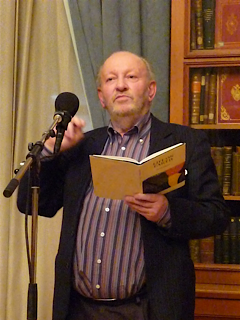
Birth of Derek Mahon, Northern Irish Poet

Norman Derek Mahon, Irish poet, is born in Belfast, Northern Ireland, on November 23, 1941, but lives in a number of cities around the world. At his death it is noted that his “influence in the Irish poetry community, literary world and society at large, and his legacy, is immense.” President of Ireland Michael D. Higgins says of Mahon, “he shared with his northern peers the capacity to link the classical and the contemporary but he brought also an edge that was unsparing of cruelty and wickedness.”

Mahon is the only child of Ulster Protestant working class parents. His father and grandfather work at Harland and Wolff while his mother works at a local flax mill. During his childhood, he claims he is something of a solitary dreamer, comfortable with his own company yet aware of the world around him. Interested in literature from an early age, he attends Skegoneill Primary School and then the Royal Belfast Academical Institution, known locally as Inst.

At Inst Mahon encounters fellow students who share his interest in literature and poetry. The school produces a magazine in which he produces some of his early poems. According to the critic Hugh Haughton, his early poems are highly fluent and extraordinary for a person so young. His parents cannot see the point of poetry, but he sets out to prove them wrong after he wins his school’s Forrest Reid Memorial Prize for the poem ”The power that gives the water breath.”

Mahon pursues third level studies at Trinity College Dublin (TCD) in French, English, and Philosophy and where he edits Icarus, and forms many friendships with writers such as Michael LongleyEavan Boland and Brendan Kennelly. He starts to mature as a poet. He leaves TCD in 1965 to take up studies at the Sorbonne in Paris.

After leaving the Sorbonne in 1966, Mahon works his way through Canada and the United States. In 1968, while spending a year teaching English at Belfast High School, he publishes his first collection of poems, Night Crossing (1968, Oxford University Press). He later teaches in a school in Dublin and works in London as a freelance journalist. He lives in Kinsale, County Cork. On March 23, 2007, he is awarded the David Cohen Prize for Literature. He wins the Poetry Now Award in 2006 for his collection, Harbour Lights, and again in 2009 for his Life on Earth collection.

At times expressing anti-establishment values, Mahon describes himself as an “aesthete” with a penchant “for left-wingery […] to which, perhaps naively, I adhere.”

In March 2020, at the beginning of the COVID-19 pandemicRTÉ News ends its evening broadcast with Mahon reading his poem Everything Is Going to Be All Right.

Mahon dies in Cork, County Cork, on October 1, 2020, after a short illness, aged 78. He is survived by his partner, Sarah Iremonger, and his three children, Rory, Katy, and Maisie. His papers are held at Emory University.

Mahon features on the Irish Leaving Certificate course with ten of his poems (Grandfather, Day Trip to Donegal, Ecclesiastes, After the Titanic, As It Should Be, A Disused Shed in Co. Wexford, Rathlin, The Chinese Restaurant in Portrush, Kinsale and Antarctica)


Leave a comment

Birth of Goddard Henry Orpen, Lawyer & Historian

Goddard Henry Orpen, lawyer and historian, is born in Dublin on May 8, 1852, the fourth son of the five sons and three daughters of John Herbert Orpen, barrister, of Dublin, and Ellen Susanna Gertrude Richards, youngest daughter of Rev. John Richards of Grange, County Wexford.

For most of his childhood Orpen’s family lives at 58 St. Stephen’s Green. He is educated at Abbey CBS, a Christian Brothers secondary school in Tipperary, County Tipperary, and in 1869 enters Trinity College Dublin (TCD), where he displays early academic aptitude, obtaining exhibitions and scholarships and being elected a foundation scholar. He graduates BA with first-class honours in 1873 and four years later is called to the English bar at the Inner Temple, London.

On August 18, 1880, in St. Peter’s Church, Aungier Street, Dublin, Orpen marries Adela Elizabeth Richards, the daughter and heiress of Edward Moore Richards, engineer and the landlord of Grange, County Wexford. Adela is his first cousin once removed, her great-grandfather and his grandfather being the Rev. John Richards. They live for two decades after their marriage at Bedford Park, Chiswick, London, with their daughter Lilian Iris (b. 1883) and son Edward Richards (b. 1884). Soon after their marriage, he begins taking lessons in the Irish language in line with his passionate interest in Irish historical and antiquarian research, which gradually supplants his languishing legal career. He translates and edits a French rhymed chronicle about the Anglo-Norman conquest of Ireland, entitled The Song of Dermot and the Earl (1892), the title which he gives it and by which it has since generally been known in English. He also translates Émile de Laveleye‘s Le Socialisme Contemporain (The Socialism of Today, 1884), to which he adds a chapter on English socialism.

After Adela’s father transfers ownership of his estate to her in 1900, now renamed Monksgrange, the Orpens reluctantly leave London to live there, enabling Orpen to devote his time fully to research and writing. His major work is Ireland Under the Normans (Vols. 1–2, 1911; Vols. 3–4, 1920), which argue that the Norman invasion benefited the Irish, leading to advances in agriculture and trade.

Both before and after his death Orpen’s work is the subject of hostile criticism from those with more nationalist inclinations, starting with Eoin MacNeill in a series of lectures delivered in 1917. Despite his own eminence as a scholar of medieval Ireland, MacNeill resorts to unfair polemic in his attack on Orpen, caricaturing his account of pre-Norman Irish society and disregarding the more subtle nuances in his views of the English Irish relationship. In this he has been followed by generations of other scholars and readers, overlooking the depth of Orpen’s research, the perceptiveness of his interpretations, and the extent of his fieldwork on the archaeological evidence from the medieval period. Orpen takes the study of Anglo-Norman Ireland out of the realm of vague antiquarianism and professionalises it. His standards are not those of “the gentleman-amateur” as might be expected from his background, but of the twentieth century “scientific” historian, and he is therefore now widely regarded as the founder of the professional study of Anglo-Norman Ireland. Perhaps the most striking evidence of the continued validity and relevance of his work is that his four-volume Ireland Under the Normans has been twice republished in more recent years, in 1968 by Oxford University Press and in 2002 in a one-volume version by Four Courts Press.

Orpen is elected a member of the Royal Society of Antiquaries of Ireland (RSAI), serving as president in 1930–32), and the Royal Irish Academy (RIA) (1911), and contributes historical articles to their journals as well as to periodicals such as The American Historical Review (1913–14) and The Cambridge Medieval History (1932, 1936). A lecture to the New Ross Literary Society is later published as New Ross in the Thirteenth Century (1911). He also contributes a major chapter on the medieval church to the second volume of Walter Alison Phillips‘s History of the Church of Ireland (1934). Though his literary work is recognised by an honorary doctorate from TCD in 1921, he feels increasingly isolated as Monksgrange is targeted during the Irish Civil War and raided on several occasions. On religion he lists himself as an agnostic in the 1911 census.

Orpen’s final work is The Orpen Family, a personal family history printed for private circulation in 1930. A portrait of Orpen (above) by Seán O’Sullivan hangs in Monksgrange.

Orpen dies on May 15, 1932, at Monksgrange, and is buried alongside his wife Adela in St. Anne’s Churchyard, Killanne, County Wexford. His very extensive papers, including correspondence, manuscripts and drawings, as well as records and papers of the Orpen family, are held at Monksgrange. Included there is a very large collection of his photographs, a skill in which he notably distinguishes himself. A small collection of his correspondence is also held in the National Library of Ireland (NLI).

(From: “Orpen, Goddard Henry” by Philip Bull, Dictionary of Irish Biography, http://www.dib.ie, October 2009, revised March 2021 | Pictured: Portrait of Goddard Henry Orpen by Seán O’Sullivan)


Leave a comment

Birth of E. R. Dodds, Irish Classical Scholar

Eric Robertson Dodds, Irish classical scholar, is born in Banbridge, County Down, on July 26, 1893. He is Regius Professor of Greek at the University of Oxford from 1936 to 1960.

Dodds is the son of schoolteachers. His father Robert is from a Presbyterian family and dies of alcoholism when Dodds is seven years old. His mother Anne is of Anglo-Irish ancestry. When he is ten, he moves with his mother to Dublin, and he is educated at St. Andrew’s College, where his mother teaches, and at Campbell College in Belfast. He is expelled from the latter for “gross, studied, and sustained insolence.”

In 1912, Dodds wins a scholarship at University College, Oxford, to read classics, or Literae Humaniores, a two-part, four-year degree program consisting of five terms of study of Latin and Greek texts followed by seven terms of study of ancient history and ancient philosophy. His friends at Oxford include Aldous Huxley and T. S. Eliot. In 1916, he is asked to leave Oxford due to his support for the Easter Rising, but he returns the following year to take his final examinations in Literae Humaniores, and is awarded a first-class degree to match the first-class awarded him in 1914 in Honour Moderations, the preliminary stage of his degree. His first tutor at Oxford is Arthur Blackburne Poynton.

After graduation, Dodds returns to Dublin and meets W. B. Yeats and George William Russell. He teaches briefly at Kilkenny College and in 1919 is appointed as a lecturer in classics at the University of Reading, where in 1923 he marries a lecturer in English, Annie Edwards Powell. They have no children.

In 1924, Dodds is appointed Professor of Greek at the University of Birmingham, and comes to know W. H. Auden, whose father George, Professor of Public Medicine and an amateur classicist, is a colleague. He is also responsible for Louis MacNeice‘s appointment as a lecturer at Birmingham in 1930. He assists MacNeice with his translation of Aeschylus, Agamemnon (1936), and later becomes the poet’s literary executor. He publishes one volume of his own poems, Thirty-Two Poems, with a Note on Unprofessional Poetry (1929).

In 1936, Dodds becomes Regius Professor of Greek at the University of Oxford, succeeding Gilbert Murray. Murray decisively recommends him to British Prime Minister Stanley Baldwin and it is not a popular appointment. He is chosen over two prominent Oxford dons, Maurice Bowra of Wadham College and John Dewar Denniston of Hertford College. His lack of service in World War I and his support for Irish republicanism and socialism in addition to his scholarship on the non-standard field of Neoplatonism, also does not make him initially popular with colleagues. He is treated particularly harshly by Denys Page at whose college, Christ Church, the Regius Chair of Greek is based.

Dodds has a lifelong interest in mysticism and psychic research, being a member of the council of the Society for Psychical Research from 1927 and its president from 1961 to 1963.

On his retirement in 1960, Dodds is made an Honorary Fellow of University College, Oxford, until his death on April 8, 1979. He dies in the village of Old Marston, northeast of Oxford.

Among Dodds’s works are The Greeks and the Irrational (1951), which charts the influence of irrational forces in Greek culture up to the time of Plato, and Pagan and Christian in an Age of Anxiety, a study of religious life in the period between Marcus Aurelius and Constantine I. He is also editor of three major classical texts for the Clarendon Press, Proclus: Elements of Theology, EuripidesThe Bacchae and Plato’s Gorgias, all published with extensive commentaries, and a translation in the case of the first. His autobiography, Missing Persons, is published in 1977. He edits Louis MacNeice’s unfinished autobiography The Strings are False (1965) and MacNeice’s Collected Poems (1966).