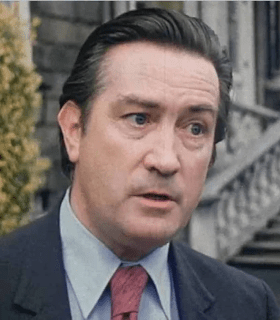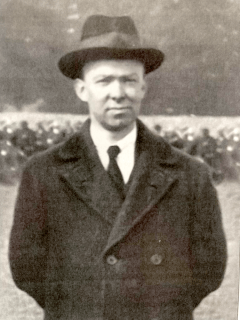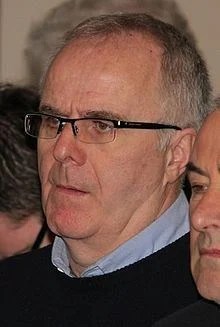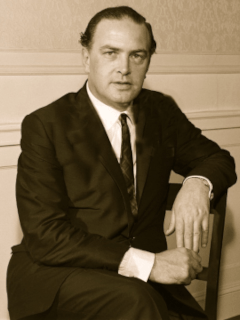
Blaney is first elected to Dáil Éireann for the Donegal East constituency in a by-election in December 1948, following the death of his father from cancer. He also becomes a member of the Donegal County Council. He remains on the backbenches for a number of years before he is one of a group of young party members handpicked by Seán Lemass to begin a re-organisation drive for the party following the defeat at the 1954 Irish general election. Within the party he gains fame by running the party’s by-election campaigns throughout the 1950s and 1960s. His dedicated bands of supporters earn the sobriquet “the Donegal Mafia,” and succeed in getting Desmond O’Malley and Gerry Collins elected to the Dáil.
Following Fianna Fáil’s victory at the 1957 Irish general election, Éamon de Valera, as Taoiseach, brings new blood into the Cabinet in the shape of Blaney, Jack Lynch, Kevin Boland and Mícheál Ó Móráin. Blaney is appointed Minister for Posts and Telegraphs however he moves to the position of Minister for Local Government at the end of 1957 following the death of Seán Moylan. He retains the post when Lemass succeeds de Valera as Taoiseach in 1959. During his tenure it becomes possible to pay rates by installment and he also introduces legislation which entitles non-nationals to vote in local elections.
In 1966 Lemass resigns as Taoiseach and Fianna Fáil leader. The subsequent leadership election sees Cork politician Jack Lynch become party leader and Taoiseach. In the subsequent cabinet reshuffle Blaney is appointed Minister for Agriculture and Fisheries.
In 1969, when conflict breaks out in Northern Ireland, Blaney is one of the first to express strong Irish republican views, views which contradict the policy of the Irish Government, in support of Northern nationalists. From around late 1968 onwards, he forms and presides over an unofficial Nationalist group in Leinster House popularly known as “the Letterkenny Table.” The group is dominated by Blaney up until his death.
There is general surprise when, in an incident known as the Arms Crisis, Blaney, along with Charles Haughey, is sacked from Lynch’s cabinet amid allegations of the use of the funds to import arms for use by the IRA. Lynch asks for their resignations but both men refuse, saying they did nothing illegal. Lynch then advises President de Valera to sack Haughey and Blaney from the government. Haughey and Blaney are subsequently tried in court but are acquitted. However, many of their critics refuse to recognise the verdict of the courts. Although Blaney is cleared of wrongdoing, his ministerial career is brought to an end.
Lynch subsequently moves against Blaney so as to isolate him in the party. When Blaney and his supporters try to organise the party’s national collection independently, Lynch acts and in 1972 Blaney is expelled from Fianna Fáil for “conduct unbecoming.”
Following his expulsion from Fianna Fáil, Kevin Boland tries to persuade Blaney to join the Aontacht Éireann party he is creating but Blaney declines. Instead, he contests all subsequent elections for Independent Fianna Fáil – The Republican Party, an organisation that he built up. Throughout the 1970s there are frequent calls for his re-admittance to Fianna Fáil but the most vocal opponents of this move are Fianna Fáil delegates from County Donegal.
During her term at Stormont, Cochrane sits on the Finance and Personnel Committee and is a member of the Assembly Commission. She founds the All Party Group on Small and Medium Sized Enterprises (SMEs) and is a member of the All Party Group on Cancer, the All Party Group on Tourism, and the All Party Group on Rugby, which she co-founds and serves as vice chair.
Cochrane is married to Jonny Cochrane with whom she has two children. The family resides in East Belfast and actively attends Bloomfield Presbyterian Church.
In the Fine Gael–Labour Partycoalition government which takes office after the 1973 Irish general election, Donegan is appointed as Minister for Defence. In October 1976, he makes a speech on an official visit to the opening of new kitchen facilities in an army barracks at Mullingar, County Westmeath in which he describes as a “thundering disgrace” PresidentCearbhall Ó Dálaigh‘s refusal to sign the Emergency Powers Bill 1976. Ó Dálaigh had instead exercised his powers under Article 26 of the Constitution of Ireland to refer it to the Supreme Court. The Taoiseach, Liam Cosgrave, refuses Donegan’s resignation. On October 21, Fianna Fáil proposes a motion in the Dáil calling on the minister to resign, which is defeated. Ó Dálaigh views the refusal to remove the minister as an affront to his office by the government and resigns on October 22, 1976.
In December 1976, Donegan is appointed as Minister for Lands. In February 1977, this office is restructured as the Minister for Fisheries. He serves in cabinet until the government loses office after the 1977 Irish general election.
Donegan retires from politics at the 1981 Irish general election. He dies at his home in County Louth on November 26,2000, following a long illness. Tributes in the Dáil are led by John Bruton as Fine Gael leader. He is buried in his hometown of Monasterboice, County Louth.
Sullivan, the second of six sons of Daniel Sullivan, house painter, and his wife, Catherine (née Baylor), a teacher, is born on May 15, 1829, in Bantry, County Cork. A popular date for Sullivan’s birth appears in many histories as 1830, but his gravestone reads 1829. He is educated in the local national school. One of his brothers is Timothy Daniel Sullivan, the Lord Mayor of Dublin from 1886 to 1888.
During the Great Famine of 1845 to 1847, Sullivan is employed as a clerk in connection with the relief works started by the government. Deeply influenced by the distress he witnesses, he afterward joins the Confederate Club formed in Bantry in support of the revolutionary movement of the Young Irelanders and is the organiser of the enthusiastic reception given by the town to William Smith O’Brien in July 1848 during the insurgent leader’s tour of the southern counties. Early in 1853, he goes to Dublin to seek employment as an artist. An exhibition of the arts and industries of Ireland is held in Dublin that year, and he is engaged to supply pencil sketches to the Dublin Expositor, a journal issued in connection with the exhibition. Subsequently, he obtains a post as a draughtsman in the Irish valuation office, and afterward as a reporter on the Liverpool Daily Post.
In 1855, Sullivan becomes assistant editor of The Nation, and subsequently editor and proprietor. From 1861 to 1884, in conjunction with his elder brother, T. D. Sullivan, he makes The Nation one of the most potent factors in the Irish Nationalist cause and also issues the Weekly News and Zozimus. Called to the Irish bar in 1876, he is a “special call” of the Inner Temple in 1877 and is made QC in 1881. He mainly practices at the English bar, though he acts in some political cases in Ireland.
As a member of the Dublin Corporation, Sullivan secures a magnificent site for the Grattan Monument, toward which he donates £400, the amount of a subscription by his admirers while he is undergoing imprisonment for a political offence in 1868. The monument is formally unveiled in January 1876. Between 1878 and 1882 he is engaged in many notable trials. His last great case is on November 30, 1883, when he is a colleague of Lord Russell in the defence of Patrick O’Donnell for the murder of James Carey, an informer.
Sullivan suffers another heart attack while on holiday in Bantry in September 1884 and spends his last days with William Martin Murphy at Dartry, County Dublin. Murphy regards him as a father figure, attributing his success to Sullivan’s early advice and journalistic training. Sullivan dies on October 17, 1884, at Dartry Lodge, Rathmines, Dublin. He is buried at Glasnevin Cemetery. With his wife, Frances Genevieve Donovan, whom he marries on April 27, 1861, and who outlives him by nearly forty years, he has a family of three sons and five daughters. His second son and namesake, Alexander Martin Sullivan, is the last to hold the rank of Serjeant-at-law (Ireland).
In addition to his labours, Sullivan is a great temperance reformer. He also writes two notable books, The Story of Ireland and New Ireland and contributes many sketches (including some verse) to Irish Penny Readings (1879–85). Some of his correspondence is located in the Isaac Butt papers in the National Library of Ireland.
Smith is born at 174 South Street, New York City, on December 30, 1873, and raised in the Fourth Ward on the Lower East Side of Manhattan. He resides there for his entire life. His mother, Catherine (née Mulvihill), is the daughter of Maria Marsh and Thomas Mulvihill, who are immigrants from County Westmeath, Ireland. His father, baptised Joseph Alfred Smith in 1839, is a Civil War–veteran and the son of Emanuel Smith, an Italian marinaro.
Although Smith remains personally untarnished by corruption, he — like many other New York Democrats — is linked to the notorious Tammany Hallpolitical machine that controls New York City politics during his era. He serves in the New York State Assembly from 1904 to 1915 and holds the position of Speaker of the Assembly in 1913. He also serves as sheriff of New York County from 1916 to 1917. He is first elected governor of New York in 1918, loses his 1920 bid for re-election, and is elected governor again in 1922, 1924, and 1926. He is the foremost urban leader of the efficiency movement in the United States and is noted for achieving a wide range of reforms as the New York governor in the 1920s.
Smith is the first Roman Catholic to be nominated for president of the United States by a major party. His 1928 presidential candidacy mobilizes both Catholic and anti-Catholic voters. Many Protestants, including German AmericanLutherans and Southern Baptists, fear his candidacy, believing that the Pope in Rome would dictate his policies. He is also a committed “wet” (i.e., an opponent of Prohibition in the United States) and as New York governor, he repeals the state’s prohibition law. As a “wet,” he attracts voters who want beer, wine and liquor without having to deal with criminal bootleggers, along with voters who are outraged that new criminal gangs have taken over the streets in most large and medium-sized cities. Incumbent RepublicanSecretary of CommerceHerbert Hoover is aided by national prosperity, the absence of American involvement in war and anti-Catholic bigotry, and he defeats Smith in a landslide in 1928.
Smith then enters business in New York City and becomes involved in the construction and promotion of the Empire State Building. He seeks the 1932 Democratic presidential nomination but is defeated by Franklin D. Roosevelt, his former ally and successor as governor of New York. During the Roosevelt presidency, he becomes an increasingly vocal opponent of Roosevelt’s New Deal.
Smith is an early and vocal critic of the Nazi regime in Germany. He supports the Anti-Nazi boycott of 1933 and addresses a mass-meeting at Madison Square Garden against Nazism in March 1933. His speech is included in the 1934 anthology Nazism: An Assault on Civilization. In 1938, he takes to the airwaves to denounce Nazi brutality in the wake of Kristallnacht. His words are published in The New York Times article “Text of the Catholic Protest Broadcast” of November 17, 1938.
Like most New York City businessmen, Smith enthusiastically supports American military involvement in World War II. Although he is not asked by Roosevelt to play any role in the war effort, he is an active and vocal proponent of FDR’s attempts to amend the Neutrality Act in order to allow “Cash and Carry” sales of war equipment to be made to the British. He speaks on behalf of the policy in October 1939, to which FDR responds directly: “Very many thanks. You were grand.”
Smith is memorialized by The Alfred E. Smith Foundation, founded by CardinalFrancis Spellman. Today it is a significant fund raiser for charity. Each election year, presidential candidates are expected to attend, make witty remarks, and profound commentary about Smith. In 2008, then candidate Barack Obama speaks eloquently of “a man who fought for many years to give Americans nothing more than fair shake and a chance to succeed. He touched the lives of millions as a result.”
(Pictured: Official Gubernatorial portrait of Alfred E. “Al” Smith by Douglas Volk)
Lee is married to Mary Lee (née Kitson) and they have two children, Alison and Harry, and live in Cabinteely. He famously travels to work at RTÉ using a Segway, once giving it a test ride live on Tubridy Tonight.
Lee joins the civil service as an executive officer in the Central Statistics Office (CSO). Two years later he enters University College Dublin where he studies economics under academics such as Brendan Walsh and Peter Neary.
Prior to his move into broadcasting, Lee lectures at NUI Galway and then works as a journalist with The Sunday Business Post. He is also a Senior Economist at Riada Stockbrokers. He also works as Treasury Economist with FTI and as a research economist with the Central Bank of Ireland.
From 1992 to 2009 Lee worked at RTÉ, the public broadcasting service of Ireland. He is appointed Economics Editor with RTÉ in 1996. He is named Irish Journalist of the Year, along with Charlie Bird, in 1998 after they uncover a major tax evasion and overcharging scandal at National Irish Bank. He has devised, researched and presented several television series, including Moneybox, More to Do, Winds of Change, and Beyond the Berlin Wall. He is thought of as an “economics guru.” He leaves RTÉ in the late 1990s to work for BCP Stockbrokers. He leaves the job and returns to his RTÉ post the next day.
Before embarking on his political career, Lee films a four-part series based on the fall of the Berlin Wall in 2008. It is aired on RTÉ One in November 2009.
Lee is parodied in the 1990s comedy Bull Island, where he is seen “menacingly staring down the lens of a camera,” and is also featured on RTÉ 2fm‘s Nob Nation.
On May 5, 2009, on RTÉ News at One on RTÉ Radio 1, Lee announces that he is resigning as Economic Editor with RTÉ and announces his intention to seek the Fine Gael nomination for the Dublin Southby-election in 2009. He takes a year’s unpaid leave from RTÉ in May 2009. On May 6, 2009, he is chosen as the Fine Gael candidate for the by-election. He is the only candidate for the nomination.
Lee is elected on the first count to represent Dublin South on June 6, 2009. He receives over 53% of the 1st preference vote. In total he receives 27,768 1st preference votes. When elected, he is referred to as a “Celebrity TD.” His RTÉ position is filled by Europe editor Sean Whelan, but only as correspondent. Instead, David Murphy is promoted to Business Editor.
Lee highlights the failure of EMPG, the holding company for U.S. publisher Houghton Mifflin Harcourt, and the potential impact on the Irish taxpayers of the loans given by Anglo Irish Bank to the investors in EMPG on January 13, 2010. He sees this as another example for the urgent need of an investigation into the Irish banking crisis.
On February 8, 2010, Lee announces his resignation from Fine Gael and from Dáil Éireann, due to having “virtually no influence or input” into shaping Fine Gael’s economic policies at a time of economic upheaval. It emerges that on February 2, he met with the Fine Gael leader Enda Kenny and told him of his intention to resign. Kenny then offered Lee the frontbench position as spokesman on economic planning. Speaking to reporters outside Leinster House soon after his announcement, Lee says it would have been dishonest of him to accept the position. “I had absolutely no input for nine months. I think I had to be honest with myself and honest with the electorate about that and not pretend.” Asked if his resignation is a vote of no confidence in Kenny, he says there are “certainly lots of large mutterings at the moment in relation to the leader’s position.” He says he had “minimal involvement” with Fine Gael finance spokesman Richard Bruton.
Kenny notes Lee had been appointed chair of the party’s committee on economic policy and also its forum. “I had anticipated a very important role for [George Lee] in the coming period with Fine Gael.” Kenny’s spokesman later dismisses the proposition that the resignation had implications for his leadership. He cited the public endorsement of Kenny by 20 Dáil deputies over the course of the weekend. Former Fine Gael leader Michael Noonan says he is surprised at the decision. “I thought that George Lee was fitting in well,” adding that he believes he would have been a cabinet member in a Fine Gael-led government.
Lee is criticised after his resignation by Senator Eoghan Harris, who is speaking on the Lunchtime programme of Newstalk Radio. Harris suggests financial considerations and long working hours of politicians are the reasons for Lee’s resignation. Fine Gael TDBrian Hayes, who is Lee’s campaign manager in the Dublin South by-election, says that in discussions with Lee, the latter had complained about “a major reduction in his income” since leaving RTÉ to become a Dáil backbencher. Lee denies that financial considerations had anything to do with his decision to quit politics.
RTÉ receives a letter from Lee confirming his intentions to return after his leave of absence. The Sunday Tribune says on February 14, 2010, that he will have to wait for three months before returning to RTÉ. Exactly a year after leaving RTÉ, he returns to the broadcaster on May 5, 2010. He works as an advisor on the RTÉ business desk. He presents Mind Your Business on RTÉ Radio 1 on Saturday Mornings as a summer replacement for The Business.
When John Murray moves to present his own programme, Lee takes over The Business slot on September 4, 2010, on Saturday mornings on RTÉ Radio 1. In addition to the radio edition, he has presented a televised version on RTÉ One, also titled The Business.
Lee has been Environment Correspondent for RTÉ since June 27, 2019.
Spence, the sixth of seven children, is born and raised in the Shankill Road area of West Belfast in Northern Ireland, the son of William Edward Spence, a member of the Ulster Volunteers who fought in World War I, and Isabella “Bella” Hayes. The family home is 66 Joseph Street in an area of the lower Shankill known colloquially as “the Hammer.” He is educated at the Riddel School on Malvern Street and the Hemsworth Square school, finishing his education at the age of fourteen. He is also a member of the Church Lads’ Brigade, a Church of Ireland group, and the Junior Orange Order. His family has a long tradition of Orange Order membership.
Spence takes various manual jobs in the area until joining the British Army in 1957 as a member of the Royal Ulster Rifles. He rises to the rank of Provost Sergeant (battalion police). He is stationed in Cyprus and sees action fighting against the forces of Colonel Georgios Grivas. He serves until 1961 when ill-health forces him to leave. He then finds employment at the Harland & Wolff shipyard in Belfast, where he works as a stager (builder of the scaffolding in which the ships are constructed), a skilled job that commands respect among working class Protestants and ensures for him a higher status within the Shankill.
From an early age Spence is a member of the Prince Albert Temperance Loyal Orange Lodge, where fellow members include John McQuade. He is also a member of the Royal Black Institution and the Apprentice Boys of Derry. Due to his later involvement in a murder, he is expelled from the Orange Order and the Royal Black Institution. The Reverend Martin Smyth is influential in his being thrown out of the Orange Order.
Spence’s older brother Billy is a founding member of Ulster Protestant Action (UPA) in 1956, and he is also a member of the group. He is frequently involved in street fights with republicans and garners a reputation as a “hard man.” He is also associated loosely with prominent loyalists such as Ian Paisley and Desmond Boal and is advised by both men in 1959 when he launches a protest against Gerry Fitt at Belfast City Hall after Fitt had described Spence’s regiment as “murderers” over allegations that they had killed civilians in Cyprus. He, along with other Shankill Road loyalists, break from Paisley in 1965 when they side with James Kilfedder in a row that follows the latter’s campaigns in Belfast West. Paisley intimates that Kilfedder, a rival for the leadership of dissident unionism, is close to Fine Gael after learning that he had attended party meetings while a student at Trinity College Dublin (TCD). The Shankill loyalists support Kilfedder and following his election as MP send a letter to Paisley accusing him of treachery during the entire affair.
Spence claims that he is approached in 1965 by two men, one of whom was an Ulster Unionist Party MP, who tells him that the Ulster Volunteer Force is to be re-established and that he is to have responsibility for the Shankill. He is sworn in soon afterward in a ceremony held in secret near Pomeroy, County Tyrone. Because of his military experience, he is chosen as the military commander and public face of the UVF when the group is established. However, RUC Special Branch believes that his brother Billy, who keeps a much lower public profile, is the real leader of the group. Whatever the truth of this intelligence, Spence’s Shankill UVF team is made up of only around 12 men on its formation. Their base of operations is the Standard Bar, a pub on the Shankill Road frequented by Spence and his allies.
On May 7, 1966, a group of UVF men led by Spence petrol bomb a Catholic-owned pub on the Shankill Road. Fire also engulfs the house next door, killing the elderly Protestant widow, Matilda Gould (77), who lives there. On May 27, he orders four UVF men to kill an Irish Republican Army (IRA) member, Leo Martin, who lives on the Falls Road. Unable to find their target, the men drive around in search of any Catholic instead. They shoot dead John Scullion (28), a Catholic civilian, as he walks home. Spence later writes “at the time, the attitude was that if you couldn’t get an IRA man you should shoot a Taig, he’s your last resort.” On June 26, the same gang shoots dead Catholic civilian Peter Ward (18) and wounds two others as they leave a pub on Malvern Street in the lower Shankill. Two days later, the government of Northern Ireland uses the Special Powers Act to declare the UVF illegal. Shortly after, Spence and three others are arrested.
In October 1966, Spence is sentenced to life imprisonment for the murder of Ward, although he has always claimed his innocence. He is sent to Crumlin Road Prison. During its July 12, 1967, march, the Orange lodge to which he belongs stops outside the prison in tribute to him. This occurs despite him having been officially expelled from the Orange Order following his conviction. His involvement in the killings gives him legendary status among many young loyalists and he is claimed as an inspiration by the likes of Michael Stone. Tim Pat Coogan describes Spence as a “loyalist folk hero.” The murder of Ward is, however, repudiated by Paisley and condemned in his Protestant Telegraph, sealing the split between the two.
Spence appeals against his conviction and is the subject of a release petition organised by the Ulster Constitution Defence Committee, although nothing comes of either initiative. Despite the fact that control of the UVF lay with his closest ally, Samuel “Bo” McClelland, from prison he is often at odds with the group’s leadership, in particular with regards to the 1971 McGurk’s Bar bombing. Spence now argues that UVF members are soldiers and soldiers should not kill civilians, as had been the case at McGurk’s Bar. He respects some Irish republican paramilitaries, who he feels also live as soldiers, and to this end he writes a sympathetic letter to the widow of Official IRA leader Joe McCann after he is killed in 1972.
Spence is granted two days leave in early July 1972 to attend the wedding of his daughter Elizabeth to Winston Churchill “Winkie” Rea. The latter had formally asked Spence for his daughter’s hand in marriage during a prison visit. Met by two members of the Red Hand Commando upon his release, Spence is informed of the need for a restructuring within the UVF and told not to return to prison. He initially refuses and goes on to attend his daughter’s wedding. Afterward a plot is concocted where Jim Curry, a Red Hand Commando member, will drive Spence back to prison but the car is to be stopped and Spence “kidnapped.” As arranged, the car in which he is a passenger is stopped in Springmartin and he is taken away by UVF members. He remains at large for four months and during that time gives an interview to ITV‘s World in Action in which he calls for the UVF to take an increased role in the Northern Ireland conflict against the Provisional IRA. At the same time, he distances himself from any policy of random murders of Catholics. He also takes on responsibility for the restructuring, returning the UVF to the same command structure and organisational base that Edward Carson had utilised for the original UVF, with brigades, battalions, companies, platoons and sections. He also directs a significant restocking of the group’s arsenal, with guns mostly taken from the security forces. He gives his permission for UVF brigadier Billy Hanna to establish the UVF’s Mid-Ulster Brigade in Lurgan. His fugitive status earns him the short-lived nickname the “Orange Pimpernel.” He is arrested along with around thirty other men at a UVF drinking club in Brennan Street, but after giving a false name, he is released.
Spence’s time on the outside comes to an end on November 4 when he is captured by Colonel Derek Wilford of the Parachute Regiment, who identifies him by tattoos on his hands. He is sent directly to Long Kesh Detention Centre soon afterward, where he shares a cell with William “Plum” Smith, one of the Red Hand Commandos whom he had met upon his initial release and who had since been jailed for attempted murder.
Spence soon becomes the UVF commander within the Long Kesh Detention Centre. He runs his part of Long Kesh along military lines, drilling inmates and training them in weapons use while also expecting a maintenance of discipline. As the loyalist Long Kesh commander, he initially also has jurisdiction over the imprisoned members of the Ulster Defence Association (UDA), although this comes to an end in 1973 when, following a deterioration in relations between the two groups outside the prison walls, James Craig becomes the UDA’s Maze commander. By this time Spence polarises opinion within the UVF, with some members fiercely loyal to a man they see as a folk hero and others resenting his draconian leadership and increasing emphasis on politics, with one anonymous member even labelling him “a cunt in a cravat.”
Spence begins to move toward a position of using political means to advance one’s aims, and he persuades the UVF leadership to declare a temporary ceasefire in 1973. Following Merlyn Rees‘ decision to legalise the UVF in 1974, Spence encourages them to enter politics and support the establishment of the Volunteer Political Party (VPP). However, his ideas are abandoned as the UVF ceasefire falls apart that same year following the Ulster Workers’ Council strike and the Dublin and Monaghan bombings. The carnage of the latter shocks and horrifies Spence. Furthermore, the VPP suffers a heavy defeat in West Belfast in the October 1974 United Kingdom general election, when the DUP candidate, John McQuade, captures six times as many votes as the VPP’s Ken Gibson.
Spence is increasingly disillusioned with the UVF, and he imparts these views to fellow inmates at Long Kesh. According to Billy Mitchell, Spence quizzes him and others sent to Long Kesh about why they are there, seeking an ideological answer to his question. When the prisoner is unable to provide one, Spence then seeks to convince them of the wisdom of his more politicised path, something that he accomplishes with Mitchell. David Ervine and Billy Hutchinson are among the other UVF men imprisoned in the mid-1970s to become disciples of Spence. In 1977, he publicly condemns the use of violence for political gain, on the grounds that it is counterproductive. In 1978, he leaves the UVF altogether. His brother Bobby, also a UVF member, dies in October 1980 inside the Maze, a few months after the death of their brother Billy.
Released from prison in 1984, Spence soon becomes a leading member of the UVF-linked Progressive Unionist Party (PUP) and a central figure in the Northern Ireland peace process. He initially works solely for the PUP but eventually also sets up the Shankill Activity Centre, a government-supported scheme to provide training and leisure opportunities for unemployed youths.
Spence is entrusted by the Combined Loyalist Military Command (CLMC) to read out their October 13, 1994, statement that announces the loyalist ceasefire. Flanked by his PUP colleagues Jim McDonald and William Plum Smith, as well as Ulster Democratic Party (UDP) members Gary McMichael, John White and David Adams, he reads the statement from Fernhill, a former Cunningham family home on their former Glencairn estate in Belfast’s Glencairn area. This building had been an important training centre for members of Edward Carson’s original UVF. A few days after the announcement, he makes a trip to the United States along with the PUP’s David Ervine and Billy Hutchinson and the UDP’s McMichael, Adams and Joe English. Among their engagements is one as guests of honour of the National Committee on American Foreign Policy. He goes on to become a leading advocate for the Good Friday Agreement.
In August 2000, Spence is caught up in moves by Johnny Adair‘s “C” Company of the UDA to take control of the Shankill by forcing out the UVF and other opponents. Due to his involvement in the peace process and the eventual Good Friday Agreement, the authorities insist against his wishes to install additional security measures to the doors and windows. As a result, when Adair’s men try to force their way into Spence’s Shankill home, they only manage to push a long stick through a partially open window of the bungalow and dislodge a few of his military frames off the opposite wall. There is no other damage and other than that small disruption no one is able to gain any physical entry into the property. When Spence’s wife dies three years later, he says that C Company is responsible for her death, as the events had taken on her health.
On May 3, 2007, Spence reads out the statement by the UVF announcing that it will keep its weapons but put them beyond the reach of ordinary members. The statement also includes a warning that activities could “provoke another generation of loyalists toward armed resistance.” He does not specify what activities or what is being resisted.
Spence marries Louie Donaldson, a native of the city’s Grosvenor Road, on June 20, 1953, at Wellwood Street Mission, Sandy Row. The couple has three daughters, Elizabeth (born 1954), Sandra (1956) and Catherine (1960). Louie dies in 2003. Spence, a talented footballer in his youth with Old Lodge F.C., is a lifelong supporter of Linfield F.C.
Spence dies in a Belfast hospital at the age of 78 on September 25, 2011. He had been suffering from a long-term illness and was admitted to hospital 12 days prior to his death. He is praised by, among others, PUP leader Brian Ervine, who states that “his contribution to the peace is incalculable.” Sinn Féin‘s Gerry Kelly claims that while Spence had been central to the development of loyalist paramilitarism, “he will also be remembered as a major influence in drawing loyalism away from sectarian strife.”
However, a granddaughter of Matilda Gould, a 74-year-old Protestant widow who had died from burns sustained in the UVF’s attempted bombing of a Catholic bar next door to her home, objects to Spence being called a “peacemaker” and describes him as a “bad evil man.” The unnamed woman states, “When you go out and throw a petrol bomb through a widow’s window, you’re no peacemaker.”
Spence’s funeral service is held in St. Michael’s Church of Ireland on the Shankill Road. Notable mourners include Unionist politicians Dawn Purvis, Mike Nesbitt, Michael McGimpsey, Hugh Smyth and Brian Ervine, UVF chief John “Bunter” Graham and UDA South Belfast brigadier Jackie McDonald. In accordance with his wishes, there are no paramilitary trappings at the funeral or reference to his time in the UVF. Instead, his coffin is adorned with the beret and regimental flag of the Royal Ulster Rifles, his former regiment. He is buried in Bangor, County Down.
Sinclair’s parents are Thomas (1811–1867), merchant and ship-owner, and Sarah Sinclair (née Archer) (1800–1849). His father goes into business with his brother John (1808–1856), setting up a provisions and general merchant store at 5–11 Tomb Street, Belfast. John marries Eliza Pirrie, a relative of the prominent ship builder William Pirrie, 1st Viscount Pirrie. After the death of his father in 1867, Sinclair inherits £35,000 as his mother, brother and sister are all deceased.
In 1876, Sinclair marries Mary Duffin of Strandtown Lodge, Belfast. They have a daughter, Frances Elizabeth Crichton, and a son. She dies in 1879. He marries Elizabeth Richardson in 1882. She is the niece of John Grubb Richardson and the widow of Sinclair’s cousin, John M. Sinclair. They have three sons and two daughters.
Sinclair attends Royal Belfast Academical Institution and Queen’s College Belfast, graduating with a BA with gold medal for mathematics in 1856, and an MA with gold medals in logic, political economy, and English literature in 1859. After his father’s death, he takes over running the family business. He expands and grows it by merging it with another large provisions business with American branches, Kingan & Co. He is related to the Kingans through his cousin Sarah, who is married to the owner, Samuel Kingan.
Despite numerous requests, Sinclair never stands for parliament, instead serving as deputy lieutenant, justice of the peace, president of the Ulsterchamber of commerce in 1876 and 1902, and privy councilor in 1896. Having been a supporter of William Ewart Gladstone, he joins the Ulster Liberal Party in 1868, supporting the land acts of 1870 and 1881. Following the home rule bill of 1886, he convenes a meeting in the Ulster Hall of liberals on April 30, 1886, which passes a resolution in condemnation of the bill. Forming the Ulster Liberal Unionist Association, of which he is chair, he organises the Ulster Convention in Belfast. Held on June 17, 1892, it sees 11,879 Ulster unionists meet to protest home rule. Nine months after the convention, he is appointed to the executive committee of the new unionist clubs, which are founded to protect the union. The defeat of the British Liberal Party in 1895 significantly decreases the threat of home rule, leading to the unionists’ clubs being suspended, and Sinclair returning to his activities in liberal reform. He is the leading Ulster member of the recess committee from 1895, which is founded by Horace Plunkett. He supports Plunkett’s backing of T. P. Gill as secretary of the Irish Agricultural Organisation Society (IAOS) in 1899, in the face of strong protest by conservative unionists.
Despite his unionist politics, Sinclair is nonsectarian, and during his time as chairman of the convocation of the Queen’s University he defends the core non-sectarian principles of the institution and refuses to allow any form of denominational teaching. Through his work with the recess committee, he ensures that the new Department of Agriculture’s vocational and technical education will remain secular.
By 1904 and the devolution crisis, Sinclair sides with conservative unionists, being of the 30 members of the standing committee of the Ulster Unionist Council on its foundation in December 1904. He proposes that all suspended unionist clubs be reestablished in January 1911, with the purpose of increasing their membership and responsibilities. This results in the clubs taking up arms, with over 80 groups drilling by April 1911, which goes on to form the core of the Ulster Volunteers. On September 25, 1911, he is appointed to a five-man commission tasked with writing a constitution for a provisional government of Ulster. He is one of the contributors to the 1912 collection of essays from the unionist party, Against home rule. He identifies the six county Ulster, proffering the idea of a two-nation island, warning that Ulster will never form part of an independent Ireland. Later in 1912, he is tasked with drafting Ulster’s Solemn League and Covenant, a pledge for signatories to oppose and defeat home rule and never recognise an Irish parliament.
Sinclair dies from kidney failure on February 14, 1914, at his home, Hopefield House, Belfast. His funeral procession on February 18 is headed by 200 UVF officers. The Ulster Museum holds a portrait of Sinclair by Frank McKelvey, and QUB holds one by Henrietta Rae (pictured above). A memorial window at Church House, the headquarters of the Presbyterian Church, is unveiled in his memory on June 8, 1915, and there is a Sinclair Memorial Hall opened in his honour on September 10, 1915. A blue plaque is erected to him on the Duncairn Centre for Arts & Culture.
The Sinclair Ward in the Royal Victoria Hospital, Belfast, is originally funded by Sinclair’s father, in honour of his wife Sarah under the Sinclair Memorial Fund. The surgeon and politician Thomas Sinclair is also a relative.
Following his exit from politics in 1957, having lost his Dáil seat, Finlay resumes practicing as a barrister. He successfully defends Captain James Kelly in the infamous 1970 arms trial.
In 1971, Finlay is tasked by the Fianna Fáil government with representing Ireland before the European Commission of Human Rights, when, in response to the ill treatment of detainees by security forces in Northern Ireland, they charge the British government with torture. Despite the notional recourse such prisoners would have within the British legal system, the Commission rules the complaint admissible.
During this period Finlay presides over a number of landmark cases, including Attorney General v X in 1992, when he overturns a High Court injunction preventing a pregnant teenage rape victim travelling to the UK for an abortion.
When, in the same year, Judge Liam Hamilton of the High Court, chair of the Beef Tribunal, seeks disclosure of the cabinet’s minutes for a particular meeting, Chief Justice Finlay along with the majority of the Supreme Court deny the request ruling that the concept of collective government responsibility in the Constitution takes precedence.
Finlay announces his resignation as Chief Justice of Ireland and retirement as a judge in 1994.
After his retirement, Finlay presides over a number of public inquiries.
In 1996, Finlay oversees the inquiry into the violence by English fans at the aborted 1995 friendly soccer match versus the Republic of Ireland at Lansdowne Road. His report to Bernard Allen, Minister for Sport, is critical of security arrangements on the night and recommends improvements to ticketing, seat-allocation, fan-vetting and policing arrangements. The Irish Government shares his report with the British Home Office.
After the collapse of The Irish Press group in 1995, the Minister for Enterprise and Employment, John Bruton, receives a damming report from the Competition Authority that Independent Newspapers has abused its dominant position and acted in an anti-competitive manner by purchasing a shareholding in The Irish Press. In September 1995, Bruton announces the Commission on the Newspaper Industry with an extremely wide remit to examine diversity and ownership, competitiveness, editorial freedom and standards of coverage in Irish newspapers as well as the impact of the sales of the British press in Ireland. Minister Bruton appoints 21 people to the commission and appoints Finlay chair. Due to the wide remit and huge number of submissions, the commission’s report is delayed but is eventually published at the end of July recommending widespread reforms.
Following the discovery of the BTSB anti-D scandal, in 1996, Finlay is appointed the chair and singular member of the Tribunal of Inquiry into the Blood Transfusion Service Board. The speed and efficiency with which his BTSB Tribunal conducts its business, restores confidence in the Tribunal as a mechanism of resolving great controversies in the public interest.
Finlay also sits on an Irish Rugby Football Union (IRFU) panel to adjudicate on the cases of Rugby players accused of using banned performance-enhancing substances.
Finlay is married to Alice Blayney, who predeceases him in 2012. They have five children, two of whom follow in his family’s legal tradition: his son John being a Senior Counsel and his daughter Mary Finlay Geoghegan a former judge of the High Court, Court of Appeal and Supreme Court. Whenever his work schedule allows, he escapes to County Mayo where he indulges his passion for fishing.
Thomas Finlay dies at the age of 95 in Irishtown, Dublin, on December 3, 2017.
Talbot is born likely in 1630, probably in Dublin. He is one of sixteen children, the youngest of eight sons of William Talbot and his wife Alison Netterville. His father is a lawyer and the 1st Baronet Talbot of Carton, County Kildare. His mother is a daughter of John Netterville of Castletown, Kildare. The Talbots are descended from a Norman family that had settled in Leinster in the 12th century. They adhere to the Catholic faith, despite the founding of the Reformed Church of Ireland under Henry VIII. Little is recorded of Talbot’s upbringing. As an adult he grows to be unusually tall and strong by standards of the time.
Talbot marries Katherine Baynton in 1669, and they have two daughters, Katherine and Charlotte. Katherine dies in 1679. In 1681, he marries Frances Jennings, sister of Sarah Jennings, the future Sarah Churchill, Duchess of Marlborough.
Talbot’s early career is spent as a cavalryman in the Irish Confederate Wars. Following a period on the European continent, he joins the court of James, Duke of York, then in exile following the English Civil War, becoming a close and trusted associate. After the 1660 restoration of James’s older brother, Charles, to the thrones of England, Ireland and Scotland, he begins acting as agent or representative for Irish Catholics attempting to recover estates confiscated after the Cromwellian conquest, a role that defines the remainder of his career. James converts to Catholicism in the late 1660s, strengthening his association with Talbot.
When James takes the throne in 1685, Talbot’s influence increases. He oversees a major purge of Protestants from the Irish Army, which had previously barred most Catholics. James creates him Earl of Tyrconnell and later makes him Viceroy, or Lord Deputy of Ireland. He immediately begins building a Catholic establishment by admitting Catholics to many administrative, political and judicial posts.
Talbot’s efforts are interrupted by James’s 1688 deposition by his Protestant son-in-law William of Orange. He continues as a Jacobite supporter of James during the subsequent Williamite War in Ireland, but also considers a peace settlement with William that would preserve Catholic rights. Increasingly incapacitated by illness, he dies of a stroke on August 14, 1691, shortly before the Jacobite defeat. He is thought to have been buried in St. Mary’s Cathedral, Limerick. By depriving the Jacobites of their most experienced negotiator, his death possibly has a substantial impact on the terms of the Treaty of Limerick that ends the war.
Talbot’s widow, Frances, and his daughter, Charlotte, remain in France, where Charlotte marries her kinsman, Richard Talbot, son of William Talbot of Haggardstown. Their son is Richard Francis Talbot. Talbot’s other daughter, Katherine, becomes a nun. An illegitimate son, Mark Talbot, serves as an officer in France before his death in the Battle of Luzzara in 1702. Talbot’s estate in nearby Carton, renamed Talbotstown, is uncompleted at the time of his death. Tyrconnell Tower on the site is originally intended by him as a family mausoleum to replace the existing vault at Old Carton graveyard but is also left unfinished.
Talbot is controversial in his own lifetime. His own Chief Secretary, Thomas Sheridan, later describes him as a “cunning dissembling courtier […] turning with every wind to bring about his ambitious ends and purposes.” Many 19th and early 20th century historians repeat this view. Recent assessments have suggested a more complex individual whose career was defined by personal loyalty to his patron James and above all by an effort to improve the status of the Irish Catholic gentry, particularly the “Old English” community to which he belonged.
(Pictured: Watercolour portrait of Richard Talbot by John Bulfinch (d.1728) after painting by Sir Godfrey Kneller)