seamus dubhghaill

Promoting Irish Culture and History from Little Rock, Arkansas, USA


Leave a comment

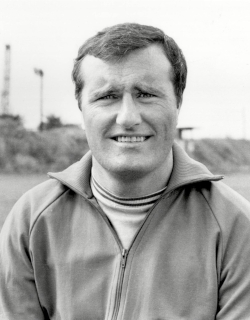
Birth of Noel Cantwell, Irish Footballer & Cricketer

Noel Euchuria Cornelius Cantwell, Irish football player and sometime cricketer, is born at 2 Illen Villas, Mardyke Walk, Cork, County Cork, on February 28, 1932.

Cantwell is one of five sons and a daughter of Michael Cantwell, a master tailor, and his wife Hannah (née Daly). He is educated at St. Joseph’s national school and the Presentation Brothers College in Cork. He plays as a full-back for Western Rovers, Cork Athletic, West Ham United and Manchester United.

While at West Ham, Cantwell features in the London XI side that competes in the 1955–58 Inter-Cities Fairs Cup final on May 1, 1958. He captains the Hammers to winning the Division Two championship in the 1957–58 season thereby leading the club into the topflight for the first time since 1932.

In November 1960, Cantwell joins Manchester United for £29,500 which at the time is a record for a full-back. He helps the club win the 1965 and 1967 league titles and captains United when winning the 1963 FA Cup Final – just as his fellow countryman Johnny Carey had done in United’s previous FA Cup win fifteen years earlier.

Cantwell also serves as Chairman of the Professional Footballers’ Association.

During his International career (1953-67), Cantwell wins 36 full International caps for the Republic of Ireland, typically playing at left full-back and on several occasions at centre-forward. He makes his debut against Luxembourg in October 1953, with his final appearance coming away to Turkey in February 1967. He scores fourteen goals including five from penalties and also captains the Republic on several occasions including a match against England at Wembley Stadium.

In his first managerial role at Coventry City, Cantwell has the onerous task of following Jimmy Hill who had taken the club into the First Division for the first time in their history. He narrowly keeps the Sky Blues in the top in his first two seasons before taking them to a sixth-place finish in 1969–70, earning them qualification for the Inter-Cities Fairs Cup (a year before it is replaced by the UEFA Cup).

Cantwell departs Highfield Road on March 12, 1972, but within seven months is back in English football as manager of Peterborough United. He helps Peterborough win the Fourth Division title in his first full season as manager, before leaving on May 10, 1977, to manage the New England Tea Men.

Cantwell returns to Peterborough on November 19, 1986, for a second stint as manager, remaining in this role until he becomes general manager on July 12, 1988. He is general manager at London Road for a year until he quits football to become licensee of the New Inn at Peterborough, where he remains for ten years until he retires in 1999. He also is landlord of the Bull and Swan in Stamford, Lincolnshire.

Cantwell also plays cricket for Cork Bohemians Cricket Club and Ireland as a left-handed batsman and a right-arm medium bowler. He plays five times for Ireland, making his debut in what is his sole first-class match versus Scotland at Edinburgh in 1956, scoring 31 and 17. His last match for Ireland is against Lancashire in July 1959.

Cantwell dies from cancer at Addenbrooke’s Hospital, Cambridge, not far from his home in Peterborough, on September 8, 2005. He is survived by his wife Maggie, a native of Belfast, and two daughters, Liz and Kate. A 22-year-old son, John Robert, is killed in a car crash thirteen years earlier.

Cantwell’s former teams each hold a moment of silence for him before their next matches.

2 Comments

Death of Seán Ó Faoláin, Short Story Writer

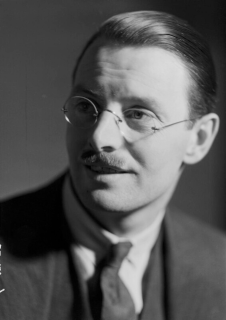
Seán Proinsias Ó Faoláin, short story writer of international repute and one of the most influential figures in 20th-century Irish culture, dies in Dublin on April 20, 1991. He is also a leading commentator and critic.

Ó Faoláin is born John Francis Whelan in Cork, County Cork, on February 27, 1900. He is educated at the Presentation Brothers College secondary school in Cork. He comes under the influence of Daniel Corkery, joining the Cork Dramatic Society, and increasing his knowledge of the Irish language, which he had begun in school. Shortly after entering University College Cork (UCC), he joins the Irish Volunteers and fights in the Irish War of Independence. During the Irish Civil War, he serves as censor for The Cork Examiner and as publicity director for the Irish Republican Army (IRA). After the Republican loss, he receives MA degrees from the National University of Ireland (NUI) and from Harvard University where he studies for three years. He is a Commonwealth Fellow from 1926 to 1928 and is a Harvard Fellow from 1928 to 1929.

Ó Faoláin writes his first stories in the 1920s, eventually completing ninety stories over a period of sixty years. From 1929 to 1933 he lectures at the Catholic college, St. Mary’s College, at Strawberry Hill, London, during which period he writes his first two books. His first book, Midsummer Night Madness, is published in 1932. It is a collection of stories partly based on his Civil War experiences. He afterward returns to Ireland. He publishes four novels, seven additional volumes of short stories, six biographies, three travel books, a play, a memoir, a history book, translations and literary criticism, including one of the rare full-length studies of the short story, The Short Story (1948). He also writes a cultural history, The Irish, in 1947. His last short story volume, Foreign Affairs, is published in 1976. His Collected Stories is published in 1983.

Ó Faoláin produces critical studies of the novel and the short-story form, introduces texts of historical and literary merit, and contributes scores of articles, reviews, and uncollected stories to periodicals in Ireland, Britain, and the United States.

Ó Faoláin is a founder member and editor of the Irish literary periodical The Bell from 1940 to 1946. Under his editorship, The Bell participates in many key debates of the day. It also provides a crucial outlet for established and emerging writers during the lean war years. The list of contributors to The Bell include many of Ireland’s foremost writers, among them Patrick Kavanagh, Patrick Swift, Flann O’Brien, Frank O’Connor and Brendan Behan.

A recurring thread in Ó Faoláin’s work is the idea that national identities are historically produced and culturally hybrid; an additional thesis is that Irish history should be conceived in international terms, and that it should be read, in particular, in the context of social and intellectual developments across Europe.

Ó Faoláin serves as director of the Arts Council of Ireland from 1956 to 1959.

Ó Faoláin marries Eileen Gould, a children’s book writer who publishes several books of Irish folk tales, in 1929. They have two children: Julia (1932–2020), who becomes a Booker-nominated novelist and short story writer, and Stephen (b. 1938).

Ó Faoláin dies in Dublin at the age of 91 on April 20, 1991.

Ó Faoláin is a controversial figure in his own lifetime and two of his books are banned for “indecency” in Ireland — his debut collection of short stories and his second novel, Bird Alone (1936). His legacy has proven divisive. If some consider him a social liberal cosmopolitan who challenges “proscriptive” definitions of Irish culture, others see him as a chauvinistic snob who paradoxically restricts the development of Irish writing. Proto-revisionist or nascent postcolonial, O’Faoláin has been considered both, sometimes within the same critical survey. Either way, his work is central to the evolution of a post–Literary Revival aesthetic, and his voice is one of the most prominent, and eloquent, in the fight against censorship in Ireland.

(Pictured: Portrait of Seán Ó Faoláin by Howard Coster, 1930s, National Portrait Gallery)


Leave a comment

Birth of William Wall, Novelist, Poet & Short Story Writer

William “Bill” Wall, Irish novelist, poet and short story writer, is born in Cork, County Cork, on July 6, 1955.

Wall is raised in the coastal village of Whitegate, County Cork. He receives his secondary education at the Midleton CBS Secondary School in Midleton. He progresses to University College Cork where he graduates in Philosophy and English. He teaches English and drama at Presentation Brothers College, Cork, where he inspires Cillian Murphy to enter acting.

In 1997, Wall wins the Patrick Kavanagh Poetry Award. He publishes his first collection of poetry that same year. His first novel, Alice Falling, a dark study of power and abuse in modern-day Ireland, appears in 2000. He is the author of four novels, two collections of poetry and one of short stories.

In 2005, This Is The Country appears. A broad attack on politics in “Celtic Tiger” Ireland, as well as a rite of passage novel, it is longlisted for the Man Booker Prize, and shortlisted for the Irish Book Awards. It can be read as a satirical allegory on corruption, the link between capitalism and liberal democracy exemplified in the ‘entrepreneurial’ activities of minor drug dealers and gangsters, and reflected in the architecture of business-parks and sink estates. This political writing takes the form of “an insightful and robust social conscience”, in the words of academic John Kenny. Kenny also focuses on what he sees as Wall’s “baneful take on the Irish family, his fundamentally anti-idyllic mood” which has “not entirely endeared Wall to the more misty-eyed among his readers at home or abroad.” The political is also in evidence in his second collection of poetry Fahrenheit Says Nothing To Me. He is not a member of Aosdána, the Irish organisation for writers and artists. In 2006, his first collection of short fiction, No Paradiso, appears. In 2017, he becomes the first European to win the Drue Heinz Literature Prize.

His provocative political blog, The Ice Moon, has increasingly featured harsh criticism of the Irish government over their handling of the economy, as well as reviews of mainly left-wing books and movies. Many of his posts are satirical. He occasionally writes for literary journals, writes for Irish Left Review, and reviews for The Irish Times. His work has been translated into several languages. He has also appeared on the Irish-language channel TG4, such as in the programme Cogar.

He is one of the Irish delegates at the European Writers Conference in Istanbul in 2010.

Described by writer Kate Atkinson as “lyrical and cruel and bold and with metaphors to die for,” critics have focused on Wall’s mastery of language, his gift for “linguistic compression,” his “poet’s gift for apposite, wry observation, dialogue and character,” his “unflinching frankness” and his “laser-like … dissection of human frailties,” which is counterbalanced by “the depth of feeling that Wall invests in his work.” A review of his first novel in The New Yorker declares “Wall, who is also a poet, writes prose so charged—at once lyrical and syncopated—that it’s as if Cavafy had decided to write about a violent Irish household.” In a recent review, his long poem “Job in Heathrow,” anthologised in The Forward Book of Poetry 2010 but originally published in The SHOp, is described as “a chilling airport dystopia.” Poet Fred Johnston suggests that Wall’s poetry sets out to “list the shelves of disillusion under which a thinking man can be buried.” For Philip Coleman, “Ghost Estate is a deeply political book, but it also articulates a profound interest in and engagement with questions of aesthetics and poetics.”

Wall is a longtime sufferer of adult-onset Still’s disease (AOSD) and describes his efforts to circumvent the disabling effects of the disease using speech-to-text applications as “a battle between me and the software.”


Leave a comment

Birth of Charles McCarthy, Trade Unionist & Academic

Charles McCarthy, trade unionist and academic, is born on January 25, 1924, at 12 Annmount, Friars Walk, Cork, County Cork.

McCarthy is the second child of John George McCarthy of Cork, plumber, and Agnes Abina McCarthy (née O’Donoghue). He is educated at Presentation Brothers College, Cork, University College Dublin (UCD), and King’s Inns, where he enrolls in 1948. He is called to the bar in 1956.

On June 7, 1951, McCarthy marries Muriel, daughter of Liam Breslin. She becomes (1989) keeper of Marsh’s Library, Dublin, receives an honorary LL.D from National University of Ireland (NUI), and is also made an honorary lay canon of St. Patrick’s Cathedral, Armagh. They live at 367 Howth Road, Raheny, Dublin, and have one son and two daughters.

After graduating from UCD McCarthy briefly works as a clerk on a building site and as an insurance agent before becoming an actor with the Radio Éireann Repertory in 1947. During his time with Radio Éireann he also writes four plays, one of which, entitled Jericho’s trumpets, is based on his experiences in the insurance industry. He is later employed as a speech and drama teacher by Cork vocational educational committee. At the same time, he develops an interest in industrial relations as treasurer of the actors’ trade union Equity and then as secretary of the Civil Service Alliance. In 1956 he becomes full-time general secretary of the Vocational Teacher’s Association, which later becomes the Teachers’ Union of Ireland (TUI). Through this post he eventually becomes president (1963–64) of the Irish Congress of Trade Unions (ICTU) and sits on the executive committee for ten years. As secretary to the International Committee of Technical Teachers he organises conferences around the world and develops countless international contacts.

In 1968 McCarthy publishes his first book, The distasteful challenge. A damning indictment of the static nature of Irish society at the time, it stresses the need to face up to change, particularly in the areas of education, the civil service, and local government. This is followed in 1971 by Industrial democracy. The following year he takes a leave of absence from the TUI to become a research fellow at Trinity College Dublin (TCD). In 1973 his dedication to the arts is rewarded with a seat (1973–76) on the RTÉ Authority and in the same year he publishes Decade of upheaval, which documents the experiences of the trade union movement during the turbulent era of the 1960s. In 1977 he becomes a lecturer in industrial relations at TCD and his 670-page magnum opus, Trade unions in Ireland, 1894–1960, is published to critical acclaim. In 1979 he is appointed to the chair in industrial relations at TCD and becomes head of the school of business and administrative studies. He is later appointed dean of the faculty of economic and social studies and made a fellow of TCD.

McCarthy is a firm believer in resolving industrial relations problems through negotiation. Both unions and management alike respect his views and abilities and he is frequently called on by the private and public sectors, as well as governments, to use his expertise to bring an end to protracted disputes. He sits on numerous public bodies including the National Industrial & Economic Council and the Irish National Productivity Committee. In 1985 his ability to bridge the divide between management and unions is recognised with his election to the council of the Irish Management Institute. Despite his career in industrial relations he maintains his interest in drama and is an original shareholder in the new Abbey Theatre. In 1973 he is appointed to the board of the theatre, serving as chairman from 1982–85. He is also a member of the board of governors and guardians of Dr. Steevens’ Hospital, Dublin.

McCarthy dies on September 8, 1986 in Dublin of atherosclerosis of the coronary arteries.

(From: “McCarthy, Charles” contributed by Shaun Boylan, Dictionary of Irish Biography, http://www.dib.ie)


Leave a comment

Death of Noel Cantwell, Soccer Player & Cricketer

noel-cantwell

Noel Euchuria Cornelius Cantwell, soccer player and sometime cricketer, dies of cancer on September 8, 2005. Born in Cork, County Cork on February 28, 1932, he is educated at the Roman Catholic Presentation Brothers College there.

Cantwell plays as a full-back for Western Rovers, Cork Athletic F.C., West Ham United F.C. and Manchester United F.C. While at West Ham, he features in the London XI side that competes in the 1955–58 Inter-Cities Fairs Cup final on May 1, 1958. He captains the Hammers to winning the Division Two championship in the 1957–58 season and thereby leads the club into the topflight for the first time since 1932.

In November 1960, Cantwell joins Manchester United for £29,500 which at the time is a record for a full-back. He helps the club win the 1965 and 1967 league titles and captains United when winning the 1963 FA Cup Final, just as his fellow countryman Johnny Carey had done in United’s previous FA Cup win 15 years earlier. He also serves as Chairman of the Professional Footballers’ Association.

Cantwell wins 36 full International caps for the Republic of Ireland national football team, typically playing at left full-back and on several occasions at centre-forward. He makes his debut against Luxembourg in October 1953 with his final appearance coming away to Turkey in February 1967. He scores 14 goals including 5 from penalties and also captains the Republic on several occasions including a match against England at Wembley Stadium.

In his first managerial role at Coventry City F.C. he has the onerous task of following Jimmy Hill who had taken the club into the Football League First Division for the first time in their history. He narrowly keeps the Sky Blues in the top in his first two seasons before taking them to a sixth-place finish in 1969–70, earning them qualification for the Inter-Cities Fairs Cup, a year before it was replaced by the UEFA Cup.

Cantwell departs from Highfield Road on March 12, 1972, to take charge of the New England Tea Men in the United States, but within seven months is back in English football as manager of Peterborough United F.C. He helps Peterborough win the Football League Fourth Division title in his first full season as manager, before leaving on May 10, 1977, for a second spell with the Tea Men. This time he spends a year in the United States.

Cantwell returns to Peterborough on November 19, 1986, for a second spell as manager, remaining in this role until he becomes general manager on July 12, 1988. He is general manager at London Road for a year until he quits football to become licensee of the New Inn at Peterborough, where he remains for 10 years until he retires in 1999. He also is landlord of the Bull and Swan in Stamford, Lincolnshire.

Cantwell also plays cricket for Cork Bohemians Cricket Club and Ireland as a left-handed batsman and a right-arm medium bowler. He plays five times for Ireland making his debut in what is his sole first-class match versus Scotland at Edinburgh in 1956, scoring 31 and 17. His last match for Ireland is against Lancashire in July 1959.

Cantwell dies on September 8, 2005, from cancer at the age of 73, leaving a widow and two children. His former teams each hold a minute of silence for him before their next matches.

Leave a comment

Birth of Short Story Writer Seán Ó Faoláin

sean-ofaolain

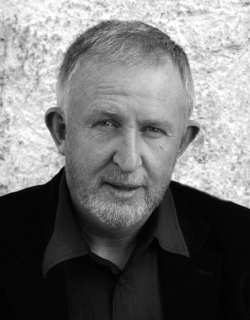
Seán Proinsias Ó Faoláin, Irish short story writer, is born as John Francis Whelan on February 22, 1900, in Cork, County Cork.

Ó Faoláin is educated at the Presentation Brothers Secondary School in Cork. He comes under the influence of Daniel Corkery, joining the Cork Dramatic Society and increasing his knowledge of the Irish language, which he had begun in school. Shortly after entering University College Cork, he joins the Irish Volunteers and fights in the Irish War of Independence. During the Irish Civil War, he serves as Censor for The Cork Examiner and as publicity director for the Irish Republican Army (IRA). After the Republican loss, he receives M.A. degrees from the National University of Ireland and from Harvard University where he studies for three years. He is a Commonwealth Fellow from 1926 to 1928 and is a Harvard Fellow from 1928 to 1929.

Ó Faoláin writes his first stories in the 1920s, eventually completing 90 stories over a period of 60 years. From 1929 to 1933 he lectures at the Catholic college, St. Mary’s College, at Strawberry Hill in Twickenham, England, during which period he writes his first two books. His first book, Midsummer Night Madness, is published in 1932. It is a collection of stories partly based on his Civil War experiences. He afterwards returns to his native Ireland. He publishes novels, short stories, biographies, travel books, translations, and literary criticism – including one of the rare full-length studies of the short story, The Short Story (1948). He also writes a cultural history, The Irish, in 1947.

Ó Faoláin serves as director of the Arts Council of Ireland from 1956 to 1959, and from 1940 to 1990 is a founder member and editor of the Irish literary periodical The Bell. The list of contributors to The Bell include many of Ireland’s foremost writers, among them Patrick Kavanagh, Patrick Swift, Flann O’Brien, Frank O’Connor and Brendan Behan. His Collected Stories are published in 1983. He is elected Saoi of Aosdána in 1986.

Seán Proinsias Ó Faoláin dies after a short illness on April 20, 1991, in the Dublin nursing home where he had lived for two years.