seamus dubhghaill

Promoting Irish Culture and History from Little Rock, Arkansas, USA


Leave a comment

President McAleese & Queen Elizabeth II Meet in Belfast

mcaleese-and-queen-elizabeth

President of Ireland Mary McAleese and Queen Elizabeth II shake hands on Northern Ireland soil for the first time on December 9, 2005 — a symbolic milestone following years of peacemaking in this long-disputed British territory.

The British monarch and the Republic of Ireland‘s head of state chat and pose together at Hillsborough Castle, outside Belfast, for an occasion that would have provoked hostility within Northern Ireland’s Protestant majority just a few years earlier. But their trouble-free meeting becomes inevitable once Ireland dropped its territorial claim to Northern Ireland as part of the landmark Good Friday Agreement peace accord of 1998. The visit also fuels speculation the queen could soon make her first official visit to the neighboring Republic of Ireland, where the Irish Republican Army assassinated Lord Louis Mountbatten, the uncle of her husband, Prince Philip, Duke of Edinburgh.

No British monarch has visited the territory of the modern-day Republic of Ireland since George V visited Dublin in 1911, a decade before the island’s partition into a mostly Protestant north that remains within the United Kingdom, and a predominantly Catholic rest of Ireland that gradually gains full independence from Britain.

Camera crews are allowed to film the moment, but not record the sound, when McAleese shakes the queen’s hand at the start of a 20-minute meeting, their fourth since 1998. Previous meetings occurred at Buckingham Palace and on a World War I battlefield site. McAleese later calls it “a very special day for Anglo-Irish relationships” that brings forward the day when the queen will visit the Irish Republic.

McAleese, a Belfast-born Catholic, had made scores of visits to Northern Ireland since being elected to the Irish Republic’s largely symbolic presidency in 1997. As part of her presidential theme of “building bridges,” she regularly invites Protestant groups to her official Dublin mansion and has built impressive diplomatic contacts with northern Protestants.

Before McAleese’s arrival, visits north by an Irish president were rare events that drew public protests from Protestants, who demanded that Ireland remove its territorial claim from its 1937 constitution. The republic’s voters overwhelmingly supported this in a May 1998 referendum, an action completed in December 1999.

The queen has avoided traveling to the Irish Republic, in part, because of security fears following the IRA assassination of Mountbatten in August 1979. He, his daughter-in-law and two teenage boys are killed when the IRA blows up his private boat near his castle in County Sligo. However, Prince Philip and their son, Prince Charles, make several visits to the Irish Republic in the decade following the IRA’s 1994 cease-fire.


Leave a comment

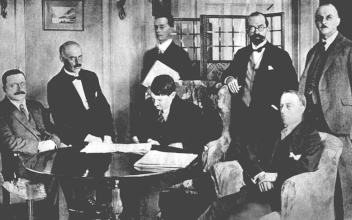
Signing of the Anglo-Irish Treaty

anglo-irish-treatyThe Anglo-Irish Treaty, commonly known as The Treaty and officially the Articles of Agreement for a Treaty Between Great Britain and Ireland, is signed in the early morning hours of December 6, 1921 by representatives of the Irish government appointed by President Éamon de Valera and those negotiating for the government of the United Kingdom of Great Britain and Ireland, ending the Irish War of Independence against Great Britain. It is then, and remains, one of the most debated moments in Irish history.

The Treaty provides for the establishment of the Irish Free State within a year as a self-governing dominion within the “community of nations known as the British Empire“, a status “the same as that of the Dominion of Canada.” It also provides Northern Ireland, which had been created by the Government of Ireland Act 1920, an option to opt out of the Irish Free State, which it exercises.

The agreement is signed in London by representatives of the British government, which includes Winston Churchill and Prime Minister David Lloyd George, who are old masters at the game of politics, and by representatives of the Irish Republic including Michael Collins and Arthur Griffith, who have nowhere near the political acumen of the British delegation. De Valera, a shrewd, experienced politician, may have been the only man in all of Ireland who might have matched them, but he refuses to join the negotiations.

The Irish representatives have plenipotentiary status acting on behalf of the Irish Republic, though the British government declines to recognise that status. As required by its terms, the Treaty is approved by “a meeting” of the members elected to sit in the House of Commons of Southern Ireland and separately by the British Parliament. In reality, Dáil Éireann, the legislative assembly for the de facto Irish Republic, first debates then approves the treaty. Members then proceed with the “meeting.” Though the Treaty is narrowly approved, the split leads to the Irish Civil War, which is won by the pro-treaty side.

The Irish Free State as contemplated by the Treaty comes into existence when its constitution becomes law on December 6, 1922 by a royal proclamation.

(Pictured: Michael Collins signs the Anglo-Irish Treaty on December 6, 1921)


Leave a comment

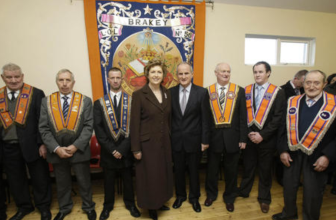
President McAleese Visits Brakey Orange Hall

mcaleese-at-brakey-orange-hallPresident Mary McAleese makes the first official visit by an Irish head of state to an Orange Order hall when she visits Brakey Orange Hall, just outside Bailieborough, County Cavan on November 28, 2008.

Brakey Orange Hall had been destroyed in an arson attack on July 13, 2000, but had since been rebuilt and reopened in 2004. Further extensions and improvements have been made since, with the latest recently completed in time for the occasion.

Approximately 50 local people, many of the men in their orange lapels and other regalia, pack the little hall to honour their guest. Placing the visit in a wider context, McAleese says the “journey of peace-building and peace-making” since the signing of the Belfast Agreement ten years earlier must continue, and calls for a new culture of tolerance and acceptance in both parts of Ireland.

McAleese is welcomed by Cavan County Grand Master Henry Latimer, who praises the financial support for Orange halls in Border counties provided by the Government. He outlines to the President and her husband, Dr. Martin McAleese, the close bond between local communities and Orange halls and the facilities provided for meetings, classes and social events. “Given the widespread nature of such activity, it demonstrates why when halls are damaged, attacked, destroyed or [placed] beyond use for periods of time, the community activity of its related hinterland suffers and is curtailed,” he adds.

McAleese hails the occasion as an example of fresh understanding in relationships between different traditions. “We have taken the first important steps towards ending the bitter culture of ‘either-or,’ of them versus us,” she says. She calls on Irish people everywhere “to build a new culture . . . each accepting that there are different perspectives and practices.”

McAleese praises Latimer as a good Cavan man, a good Irishman and a good Orangeman. The burning of Orange halls, she says, are “intemperate acts of vandalism” which are “a throw-back to another time.”

Appealing for an end to attacks on Orange halls and GAA clubs by arsonists McAleese adds, “I invite them all to stop and think how wonderfully transformed all our lives would be if we were all made as welcome in each other’s homes as I have been made welcome here.”

McAleese receives a bouquet of flowers and a piece of Cavan crystal to mark her visit. She later attends other engagements throughout Cavan.

(From: “President makes first official visit by Irish head of state to an Orange hall” by Dan Keenan, The Irish Times, November 28, 2008)


Leave a comment

Mary Robinson Elected Chancellor of the University of Dublin

File written by Adobe Photoshop? 4.0

United Nations High Commissioner for Human Rights, Mary Robinson, is elected Chancellor of the University of Dublin by the Trinity College Dublin senate on November 19, 1998. The University is the degree awarding body for Trinity College.

Robinson becomes the first woman in the university’s 406-year history to be elected to the position, making her the titular head of the University of Dublin of which Trinity College is the sole constituent, and represents it on ceremonial occasions. She is installed as Chancellor on December 17, 1998, replacing Dr. Francis Joseph Charles O’Reilly.

Born Mary Bourke in Ballina, County Mayo in 1944, the daughter of two physicians, she is educated at the University of Dublin (Trinity College), King’s Inns in Dublin and Harvard Law School to which she wins a fellowship in 1967. She graduates with a first class TCD law degree in 1967. She is Reid Professor of Constitutional and Criminal Law from 1969 to 1975, and lectures in European law from 1972 to 1990. She represents the university in Seanad Éireann from 1969 to 1989. She serves as the seventh (and first female) President of Ireland from 1990 to 1997.

The recipient of numerous honours and awards throughout the world including the Presidential Medal of Freedom from United States President Barack Obama, Robinson is a member of The Elders, former Chair of the Council of Women World Leaders and a member of the Club of Madrid. She is chair of the GAVI Alliance Board and President of the International Commission of Jurists.

She serves on several boards including the United Nations Global Compact, the Mo Ibrahim Foundation, is a member of the Royal Irish Academy and the American Philosophical Society and serves as President of the Mary Robinson Foundation – Climate Justice.


Leave a comment

Inauguration of Mary McAleese as 8th President of Ireland

CREATOR: gd-jpeg v1.0 (using IJG JPEG v62), quality = 100

Mary Patricia McAleese (née Leneghan) is inaugurated as the eighth President of Ireland on November 11, 1997. She succeeds Mary Robinson, making her the second female president of Ireland and the first woman in the world to succeed another woman as president. She is the first president to come from Northern Ireland.

Leneghan is born into a Roman Catholic family on June 27, 1951, in Ardoyne, north Belfast. The eldest of nine children, she grows up in Northern Ireland through the violent times that have come to be known as “The Troubles.” She is educated at St. Dominic’s High School, Queen’s University Belfast, from which she graduates in 1973, and Trinity College Dublin. She is called to the Bar of Northern Ireland in 1974 and remains a member of the Bar Council of Ireland. In 1975, she is appointed Reid Professor of Criminal Law, Criminology and Penology at Trinity College Dublin.

Leneghan marries Martin McAleese, an accountant and dentist in 1976. They have three children, Emma, born 1982, and twins Justin and SaraMai, born in 1985.

In 1987, McAleese returns to her Alma Mater, Queen’s University Belfast, to become Director of the Institute of Professional Legal Studies. In 1994, she becomes the first female Pro-Vice-Chancellor of the university.

McAleese defeats former Taoiseach Albert Reynolds in an internal party election in 1997, held to determine the Fianna Fáil nomination for the Irish presidency. Her opponents in the 1997 presidential election are Mary Banotti of Fine Gael, Adi Roche of the Labour Party and two Independents, Dana Rosemary Scallon and Derek Nally.

McAleese wins the presidency with 45.2% of first preference votes. In the second and final count against Banotti, McAleese wins 55.6% of preferences. Within weeks of her November 1997 inauguration, she makes her first official overseas trip to Lebanon.

McAleese describes the theme of her presidency as “building bridges.” The first individual born in Northern Ireland to become President of Ireland, McAleese is a regular visitor to Northern Ireland throughout her presidency, where she is on the whole warmly welcomed by both communities, confounding critics who had believed she would be a divisive figure. While on an official visit to the United States in 1998, Archbishop of Boston Cardinal Bernard Francis Law tells her he is “sorry for Catholic Ireland to have you as President.” She tells the cardinal that she is the “President of Ireland and not just of Catholic Ireland.”

McAleese’s initial seven-year term of office ends in November 2004, but she stands for a second term in the 2004 presidential election. She is re-elected on October 1, 2004, being the only validly nominated candidate.

McAleese is an experienced broadcaster, having worked as a current affairs journalist and presenter in radio and television with Radio Telefís Éireann. She has a longstanding interest in many issues concerned with justice, equality, social inclusion, anti-sectarianism and reconciliation.


Leave a comment

Death of Margaret Mary Pearse

margaret-mary-pearse

Margaret Mary Pearse, Fianna Fáil politician and teacher, dies at Linden Convalescent Home in Dublin on November 7, 1968. She is a sister of Patrick Pearse, one of the leaders of the 1916 Easter Rising, and Willie Pearse, both of whom are executed for their part in the Rising.

Pearse is born on August 24, 1878, at 27 Great Brunswick Street (now Pearse Street) in Dublin, the eldest child of James Pearse and Margaret Pearse (née Brady), who serves as a Teachta Dála (TD) in the 1920s. She is educated at the Holy Faith Convent in Glasnevin. After leaving school, she trains as a teacher. She helps to found St. Enda’s School with her brothers Patrick and Willie. Following the executions of her brothers in the aftermath of the Easter Rising, she continues to run St. Enda’s, along with Fergus De Búrca, until 1933.

Following in her mother’s footsteps, Pearse is first elected to Dáil Éireann as a Fianna Fáil TD for the Dublin County constituency at the 1933 general election. She is defeated at the 1937 general election on the 7th count of votes but is elected to the Administrative Panel of the 2nd Seanad. She serves in the Seanad until her death in 1968, however, she and her mother are never considered to be more than figureheads for the party. She is a founding member of the teaching staff of Ardscoil Éanna in Crumlin, Dublin, upon its establishment in 1939.

Illness forces Pearse into the Linden Convalescent Home in Blackrock, County Dublin when she is in her 80s. In 1967, when she is 89 years old, her condition is described to be deteriorating. However, in 1968 during the months leading up to her 90th birthday, she leaves the Linden Convalescent Home for a short while in order to spend her birthday at St. Endas in Rathfarnham. The president of Ireland at the time, Éamon de Valera, visits her at St. Endas to congratulate her on her upcoming 90th birthday.

Margaret Pearse dies, unmarried, at the Linden Convalescent Home in Blackrock, County Dublin, on November 7, 1968, and is given a state funeral. President de Valera, the church and the state all pay tribute to her at the funeral. She is buried beside her parents and sister at Glasnevin Cemetery. The Taoiseach, Jack Lynch, says that Margaret Mary Pearse is the last remaining member of the noble Pearse family. He says her life, like her patriotic brothers, was dedicated to Ireland.

As per her mother’s wishes, Pearse bequeaths St. Enda’s to the people of Ireland as a memorial to her brother’s sacrifice. The school is now home to the Pearse Museum.


Leave a comment

Death of Jack Lynch, Politician & Taoiseach of Ireland

jack-lynch

Jack Lynch, Irish politician and Taoiseach of Ireland from 1966 to 1973 and from 1977 to 1979, dies in the Royal Hospital, Donnybrook in Dublin on October 20, 1999.

Lynch is born on August 15, 1917, in Blackpool, on the north side of Cork, County Cork. He is educated at St. Vincent’s Convent on Peacock Lane, and later at the North Monastery Christian Brothers School. He sits his Leaving Certificate in 1936, after which he moves to Dublin and works with the Dublin District Milk Board, before returning to Cork to take up a position in the Circuit Court Office.

Lynch eventually decides on a legal career, is called to the bar (1945), resigns from the civil service, and practices on the Cork circuit. He already enjoys a national reputation as a sports hero having won five All-Ireland medals as a Cork hurler and another as a footballer. He joins Fianna Fáil and wins a seat in Dáil Éireann, the lower house of the Oireachtas, in 1948. He works closely with Éamon de Valera in opposition (1948–51), and de Valera appoints him a parliamentary secretary in 1951–54, minister for the Gaeltacht in 1957, and Minister for Education in 1957–59. When Seán Lemass succeeds de Valera as Taoiseach in 1959, he makes Lynch Minister for Industry and Commerce and in 1965–66 Minister for Finance.

Lemass’s retirement in 1966 causes an internal party conflict over the succession that leads to Lynch’s selection as a compromise candidate, a position he reluctantly accepts. In November of that year, he becomes leader of Fianna Fáil and Taoiseach. In June 1969 he becomes the only Fianna Fáil leader other than de Valera to win an overall majority in a general election. In 1969–1973 Lynch plays an important role when civil unrest leads to the collapse of the government of Northern Ireland and poses a threat to the stability of the Irish state. He fires two cabinet ministers who are suspected of involvement in smuggling arms to the Provisional Irish Republican Army (IRA). He also creates a consensus in Irish party politics on a policy of conciliation and cooperation with the British government in seeking a solution to the Northern Ireland problem based on establishing power-sharing between the unionist majority and the Roman Catholic minority.

In 1972 Lynch wins an 83 percent majority in a referendum on Ireland’s entry into the European Economic Community. On January 1, 1973, Ireland becomes a member. Although he is defeated in the 1973 elections, he again demonstrates his remarkable popularity at the polls in 1977 when Fianna Fáil wins their largest and their last overall majority. In December 1979, however, discouraged by challenges to his authority from party colleagues, he resigns his leadership and soon after retires from politics. He serves on a number of corporate boards after his retirement.

In 1992 Lynch suffers a severe health setback, and in 1993 suffers a stroke in which he nearly loses his sight. Following this he withdraws from public life, preferring to remain at his home with his wife Máirín where he continues to be dogged by ill-health.

Lynch dies in the Royal Hospital, Donnybrook, Dublin on October 20, 1999, at the age of 82. He is honoured with a state funeral which is attended by the President of Ireland Mary McAleese, Taoiseach Bertie Ahern, former Taoisigh John Bruton, Albert Reynolds and Charles Haughey, and various political persons from all parties. The coffin is then flown from Dublin to Cork where a procession through the streets of the city draws some of the biggest crowds in the city’s history. After the Requiem Mass celebrated in his home parish of the Cathedral of St. Mary and St. Anne, Lynch’s friend and political ally, Desmond O’Malley, delivers the graveside oration, paying tribute to Lynch’s sense of decency. He is buried in St. Finbarr’s Cemetery in Cork.


Leave a comment

State Funeral for Thomas Kent

thomas-kent-funeral

A state funeral for Thomas Kent takes place on September 18, 2015, 99 years after his execution following the 1916 Easter Rising. Thousands of people line the route from Collins Barracks in Cork to the Church of Saint Nicholas, Castlelyons, County Cork for the funeral mass.

Kent is executed after a gun battle with members of the Royal Irish Constabulary (RIC) who come to arrest him and his brothers on May 2, 1916, during the aftermath of the Easter Rising. During the ensuing fight, head constable William Rowe is killed, and Kent’s brother Richard later dies of his wounds. He is executed by firing squad on May 9, 1916, in the Military Detention Barracks, Cork and is buried in an unmarked grave on the grounds.

Apart from Roger Casement, Kent is the only one of the sixteen men executed after the Easter Rising to be executed outside Dublin. In June 2015, his remains are exhumed, and DNA testing confirms their identity.

A ripple of applause breaks through the crowd when the funeral cortege arrives at the church near where Kent was born and raised. The church is unable to accommodate all the visitors, so a marquee is set up on the grounds of the church.

President Michael D. Higgins is in attendance along with Taoiseach Enda Kenny, Tánaiste Joan Burton, Fianna Fáil leader Michéal Martin and Sinn Féin President Gerry Adams. The diplomatic corps is represented by British ambassador Dominick Chilcott, U.S. ambassador Kevin O’Malley and the Papal Nuncio Archbishop Charles Brown. The extended Kent family is represented mostly by the relatives of Edmund and William Kent, Thomas Kent’s brothers.

Kent’s funeral “writes the final chapter in a long ordeal for the Kent family,” the Bishop of Cloyne William Crean tells the congregation. Delivering the funeral eulogy, Cmdt. Gerry White says Thomas Kent was once known only for being the man who gave his name to Kent Station in Cork. “Today, however, all that is changed. Today, because of the recent discovery of his remains, Thomas Kent has once again become someone who is very much in the present. Today, members of Óglaigh na hÉireann, the Irish Defence Forces, will render the military honours that were denied him 99 years ago. Today, he will no longer be the ‘Forgotten Volunteer.’ Today, after 99 years, Thomas Kent is finally coming home.”

Thomas Kent’s life is represented by a picture of the family home, rosary beads, a pioneer pin and a leabhair gaeilge representing his interests in life. He is buried in the graveyard at Castlelyons. Taoiseach Enda Kenny gives the funeral oration.

(From: “State funeral for executed 1916 rebel Thomas Kent” by Ronan McGreevy and Éanna Ó Caollaí, The Irish Times, September 18, 2015 | Pictured: The remains of Thomas Kent as they are carried into St. Nicholas’ Church, Castlelyons, County Cork, photograph by Alan Betson)


Leave a comment

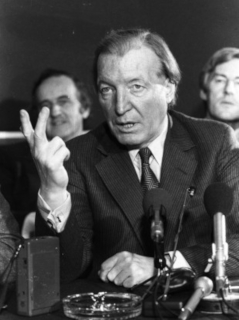
Birth of Charles Haughey, Taoiseach of Ireland

CREATOR: gd-jpeg v1.0 (using IJG JPEG v62), quality = 90

Charles James Haughey, Fianna Fáil leader and Taoiseach of Ireland, is born in Castlebar, County Mayo on September 16, 1925.

Haughey is the third of seven children of Seán Haughey, an officer in the original Irish Republican Army (IRA), and Sarah McWilliams, both natives of Swatragh, County Londonderry. He attends University College Dublin, studying law and accounting. While making a fortune, apparently in real estate, he marries Maureen Lemass, the daughter of future Taoiseach Seán Lemass on September 18, 1951. After several attempts he enters Dáil Éireann (the lower house of the Oireachtas, the Irish parliament) in 1957 as a member of the Fianna Fáil party for the Dublin North-East constituency. He becomes Minister for Justice in 1961 and later Minister for Agriculture and Minister for Finance.

In 1970 Haughey is twice tried for conspiracy to use government funds to procure arms for the outlawed IRA. The first trial is aborted, and he wins acquittal in the second. Dismissed from the government, he remains in the Dáil and gains strong support among his party’s grass roots. When Fianna Fáil is returned to office in 1977, he is made Minister for Health and Minister for Social Welfare. On the resignation of party leader Jack Lynch in 1979, he is elected party leader and becomes Taoiseach. In June 1981 his government falls, but he returns to power briefly in 1982. He becomes Taoiseach again after elections in February 1987, though his government lacks a majority in the Dáil. When Fianna Fáil forms a government with the Progressive Democrats in July 1989, thereby eschewing the party’s traditional rejection of coalition rule, he is made Taoiseach for a fourth time.

Haughey’s first two terms in office are marked by deteriorating relations with Great Britain, a declining economy, and deep divisions within Fianna Fáil. Despite the controversies that plague his government, the charismatic Haughey remains party leader after losing office for a second time in late 1982. During his later terms, he successfully mounts a fiscal austerity program to address Ireland’s financial crisis. In 1992 he resigns and retires after being implicated in a phone tapping scandal of two journalists. He denies the allegations. He remains out of public life until 1997, when an official tribunal of inquiry determines that he had received large sums of money from a prominent businessman while Taoiseach. The Dáil then establishes another tribunal to investigate his financial affairs, and many other irregularities are uncovered. He eventually agrees to pay €6.5 million in back taxes and penalties.

Haughey dies at the age of 80 from prostate cancer, from which he had suffered for a decade, on June 13, 2006, at his home in Kinsealy, County Dublin. He receives a state funeral on June 16. He is buried in St. Fintan’s Cemetery, Sutton, Dublin, following mass at Donnycarney. The then Taoiseach Bertie Ahern delivers the graveside oration. The funeral rites are screened live on RTÉ One and watched by a quarter of a million people. The funeral is attended by President Mary McAleese, the Taoiseach, Bertie Ahern, members of the Oireachtas, many from the world of politics, industry and business. The chief celebrant is Haughey’s brother, Father Eoghan Haughey.


Leave a comment

Irish National Day of Mourning

BERTIE AHERN IRISH RESPONSE TO TERRORIST ATTACK ON UNITED STATES OF AMERICA

The Irish government declares a National Day of Mourning on September 14, 2001. Schools, businesses, and shops are shut down in an unprecedented gesture of sympathy following the attack on the World Trade Center in New York City three days earlier.

Thousands of people queue for hours in front of the United States Embassy in Ballsbridge, Dublin, waiting patiently to sign one of the many books of condolences to be presented to the U.S. government in the aftermath of the attack. At John F. Kennedy’s ancestral home in Dunganstown, County Wexford, the U.S. flag flies at half-mast and the house is closed to visitors.

As it was on the day that Kennedy was assassinated, everyone remembers where they were on September 11. But on September 14 in Ireland, the churches are full and the offices, shops and pubs dark and silent as the country mourns with its American relatives, colleagues and friends.

Bouquets of flowers, teddy bears, candles and messages are left at the Embassy, as thousands stand with heads bowed. The building’s facade is turned into a shrine to those who died in New York, Washington, D.C. and Pennsylvania. There are both tears and applause when 250 firefighters from all over Ireland parade past the Embassy as a mark of respect to the hundreds of firefighters lost in New York. People weep openly as they hear of the casualties and more details emerge of that terrible morning.

The nation prays as industrial and commercial life comes to a halt and offices, government departments and all places of entertainment close for mourning. In every parish and diocese religious services are held, with the biggest, an ecumenical service in Dublin, attended by Taoiseach Bertie Ahern, President Mary McAleese and many other cabinet members. At least 2,000 people attempt to squeeze into St. Mary’s Pro-Cathedral, which holds only 1,500. Outside, a group of U.S. students break into the American national anthem and the crowd falls silent.

The bells of Christ Church Cathedral ring muffled for 90 minutes to mark the occasion, and at 11:00 AM towns and villages fall silent as the people join in a European-wide three minutes of silence. At noon, all trains stop for five minutes, and special services are held in practically every town in the country. In Bray, County Wicklow, so many people show up that the church runs out of communion. A number of people approaching the altar are given a blessing instead.

In Dublin’s universities in the months following the attacks, Irish students who were present in New York at the time are offered free counseling to help them deal with the “nightmares and flashbacks.”

A fund for the families of the victims started by Independent News and Media, which donates the money from the sales of all its newspapers on September 14, reaches more than 120,000 punts. It is given to The American Ireland Fund in the presence of U.S. Ambassador to Ireland, Richard Egan. Money is collected throughout the country for many months.

(From: “Ireland’s National Day of Mourning” by Irish America staff, http://www.irishamerica.com, December/January 2002 | Pictured: Taoisearch Bernie Ahern and Tanaiste Mary Harney with members of the Irish Cabinet sign the book of condolences in the U.S. Embassy in Dublin three days after the terrorist attacks)