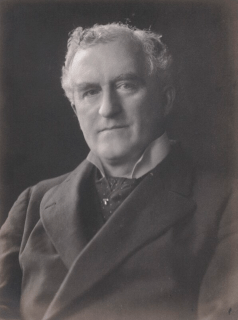
Henry’s legal career flourishes. He becomes Queen’s Counsel in 1896, a Bencher of the King’s Inns in 1898 and ultimately Father of the North-West Circuit – but his interest in politics does not diminish. In March 1905, he is a delegate at the inaugural meeting of the Ulster Unionist Council and in the 1907 North Tyrone by-election he is the Unionist candidate, losing by a mere seven votes.
On May 23, 1916, Henry is elected as an MP in the South Londonderry by-election, the first by-election to be held in Ireland after the Easter Rising, which occurred a month earlier. The rebellion has had no discernible impact on the contest.
Henry marries Violet Holmes, daughter of Hugh Holmes, a judge of the Court of Appeal in Ireland, and Olivia Moule. They have five children, including James Holmes Henry, who succeeds as second baronet. It is a mixed marriage as Violet is and remains a staunch member of the Church of Ireland. Despite their religious differences, the marriage is said to be happy.
Henry dies in Belfast on October 1, 1925, aged 61, and is buried near his native Draperstown.
(Pictured: Sir Denis Stanislaus Henry, 1st Baronet, bromide print by Walter Stoneman, 1920, National Portrait Gallery, London)
As the eldest living son, he is the heir apparent and is styled with the corresponding courtesy title, which at first is Viscount Thurles but changed to Earl of Ossory when his father becomes marquess in 1642. His early years are spent in Ireland until 1647 when he accompanies his father to England. In 1648 his father renews his support for the royalist cause and he and his son have to flee to France, arriving in Caen in February 1648. Lady Ormond also moves to Caen, where she arrives on June 23, 1648, with his siblings.
Butler is an accomplished athlete and a good scholar. Having come to London in 1652 he is rightly suspected of sympathising with the exiled royalists, and in 1655 is jailed by Oliver Cromwell. After his release about a year later he goes into exile to the Netherlands where Charles II has his exile court at the time.
In 1662 Butler is called to the Irish House of Lords under a writ of acceleration as the Earl of Ossory. His father holds the title “5th Earl of Ossory” as one of his subsidiary titles. The acceleration makes Thomas Butler the 6th Earl of Ossory. This is the only substantive title he ever holds, as he predeceases his father and therefore never succeeds to his father’s titles.
Butler holds several military appointments including lieutenant-general of the army in Ireland, created an English peer as Lord Butler in 1666, and Lord of the Bedchamber to Charles II (appointed in 1660 and held until his death).
In 1665 a fortunate accident allows Butler to take part in the Battle of Lowestoft against the Dutch, and in May 1672, being now in command of a ship, he fights against the same enemies in the Battle of Solebay, serving with great distinction on both occasions. While visiting France in 1672 he rejects the liberal offers made by Louis XIV to induce him to enter the service of France and returning to England he adds to his high reputation by his conduct during the Battle of Texel in August 1673. From 1677 until 1679, he serves alongside his father as a Lord of the Admiralty.
Butler is intimate with William II, Prince of Orange, and in 1677 he joins the allied army in the Netherlands, commanding the British contingent and winning great fame at the siege of Mons in 1678. He acts as deputy for his father, who is Lord Lieutenant of Ireland. In 1680 he is appointed governor of English Tangier, but his death prevents him from taking up his new duties.
Butler dies on July 30, 1680, at Arlington House in London. He is buried provisionally in Westminster Abbey on July 31, 1680. The ceremony of burial is performed belatedly on November 13, 1680. Some say his body is later taken to Ireland and reburied in the family vault in St. Canice’s Cathedral, Kilkenny. James, his eldest son, succeeds him as the 7th Earl of Ossory and becomes the 2nd Duke of Ormond in 1688.
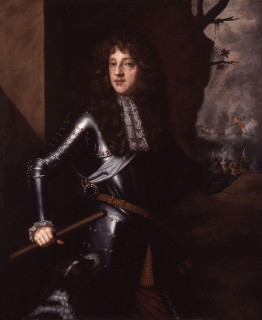
(Pictured: “Thomas Butler, Earl of Ossory,” painting by Peter Lely, circa 1678, Source: National Portrait Gallery)
Scott is the third son of Thomas Scott of Scottsborough, County Tipperary, and his wife Rachel, daughter of Mark Prim of Johnswell, County Kilkenny. His parents are cousins, being two of the grandchildren of Nicholas Purcell, 13th Baron of Loughmoe. His elder brother is the uncle of Bernard Phelan, who establishes Château Phélan Ségur, and Dean John Scott, who first plants the gardens open to the public at Ballyin, County Waterford and marries a niece of Scott’s political ally, Henry Grattan.
While at Kilkenny College, Scott stands up to the tormentor of a boy named Hugh Carleton, who grows up to be Viscount Carleton of Clare. They become firm friends, and Carleton’s father, then known as the “King of Cork,” due to his wealth and influence, invites him to their home and becomes his patron. In 1756, Carleton sends both the young men off, with equal allowances, to study at Trinity College, Dublin and then the Middle Temple in London. On being called to the Irish bar in 1765, Scott’s eloquence secures him a position that enables him to pay £300 a year to his patron, Francis Carleton, who through a series of disappointments has been declared bankrupt. He continues to gratefully support his patron until Hugh Carleton is financially able to insist that he take up the payments to his father. Scott in later life turns against Carleton, describing him in his diary as a “worthless wretch.”
Admitted to King’s Inns in 1765, Scott is entitled to practice as a barrister. In 1769 he is elected as the Member of Parliament for Mullingar, a seat he holds until 1783. The following year he is made a King’s Counsel (KC). In 1772 he is Counsel to the Board of Revenue and in 1774 is appointed Solicitor-General for Ireland (1774–1777). Three years later, he is elected a Privy Councillor and Attorney-General for Ireland (1774–1783). He is dismissed from the latter position in 1782 for refusing to acknowledge the right of England to legislate for Ireland. In 1775, he is awarded an honorary degree of Doctor of Law (LL.D.) by Trinity College, Dublin. He holds the office of Prime Serjeant-at-Law of Ireland between 1777 and 1782. He is Clerk of the Pleas of the Court of the Exchequer in 1783 and is elected Member of Parliament for Portarlington between 1783 and 1784.
In 1784, Scott is created 1st Baron Earlsfort of Lisson-Earl, County Tipperary, following his appointment to Lord Chief Justice of the King’s Bench. In 1789 he is created 1st Viscount Clonmel, of Clonmel, County Tipperary and in 1793 is created 1st Earl of Clonmel. By the 1790s he has an annual income of £20,000. Due to heavy drinking and overeating he becomes seriously overweight, and this no doubt contributes to his early death, although his diary shows that he makes frequent efforts to live a more temperate life. Drinking also produces the red face which earns him the nickname “Copper-faced Jack.”
In 1768, Scott marries the widowed Catherine Anna Maria Roe, daughter of Thomas Mathew, of Earl Landaff and sister of Francis Mathew, 1st Earl Landaff. She dies in 1771. In 1779, he marries Margaret Lawless, daughter and eventual heiress of banker Patrick Lawless of Dublin. He leaves a son and heir and a daughter by his second marriage.
Scott lives at Clonmell House, 17 Harcourt Street, Dublin. He also keeps a country residence, Temple Hill House, in County Dublin. Clonmell Street in Dublin is named in his honour, as is Earlsfort Terrace, also in Dublin. He also gains a reputation of being an experienced duelist.
In 1797, in the last conversation he would have with his wife’s cousin, Valentine Lawless, 2nd Baron Cloncurry, he exclaims, “My dear Val, I have been a fortunate man in life. I am a Chief Justice and an Earl; but, believe me, I would rather be beginning the world as a young (chimney) sweep.” He dies at the age of 58 the following year on May 23, 1798.
(Pictured: John Scott, 1st Earl of Clonmell, oil on canvas by Gilbert Charles Stuart)
Gore is the second son of George Gore, judge of the Court of Common Pleas (Ireland), who in turn is the son of Sir Arthur Gore, 1st Baronet. His mother is Bridget Sankey, younger daughter of John Sankey. His mother brings his father a fortune and the manor of Tenelick in County Longford, which comes to John on the death of his brother Arthur in 1758.
Gore is a popular, witty and unassuming man, and a keen sportsman. In politics he is considered a strong reactionary, arguing that the Crown has the right to keep Parliament sitting indefinitely, and he is opposed to any extension of the powers of the Irish Parliament. In his later years he is inclined to denounce the Irish people as “idle and licentious.” Irish author and legal historian F. Elrington Ball notes however that Henry Grattan likes and admires Gore despite their strongly opposed political views. His judicial qualities are viciously attacked in an anonymous satire: “Without judgement, a judge makes justice unjust.” Ball on the other hand argues that his judgements and speeches in the House of Commons show that he does not lack ability.
In 1747, Gore marries Frances Wingfield, second daughter of Richard Wingfield, 1st Viscount Powerscourt of the third creation. Their marriage is childless. He dies on April 3, 1784 at St. Stephen’s Green in Dublin and is buried in the family vault in the church of Taghshinny in County Longford. With his death the barony becomes extinct, but is revived for his brother Henry, first and last Baron Annaly of the second creation. Lady Annaly dies in 1794 and is buried at St. Marylebone Parish Church, London.
In 1863, Stephens tells friends he is to start a newspaper. With funds through John O’Mahony, founder of the Fenian Brotherhood in the United States, he sets up an office at 12 Parliament Street. John O’Leary becomes the editor, with Thomas Luby, Charles Kickham, and Denis Mulcahy as editorial staff and Luby as a proprietor. Jeremiah O’Donovan Rossa is the business manager and James O’Connor his assistant and bookkeeper. The newspaper is printed by John Haltigan. Most of the articles are written by O’Leary and Kickham. The first issue comes out on Saturday, November 28, 1863. Its sympathies are clear. A front-page advertisement offers to ship old copies of the United Irishman and The Irish Felon to any address in the UK and editorial content is critical of the political status quo. Superintendent Daniel Ryan of G Division of the Dublin Metropolitan Police, which is largely concerned with Fenianism, notes the new publication’s birth and comments on its low circulation.
Plans for a rising in Ireland, hatched in the United States, are found at Kingstown station in July 1865 in an envelope containing a £500 New York bankers’ draft payable to Stephens’ brother-in-law. This is handed over to Dublin Castle and the link proves to be decisive for what follows. Later, a letter to the Tipperary IRB calling for a nationalist uprising is found by Pierce Nagle, a police informer working for The Irish People. Nagle had visited British officials while in New York in 1864 and offers his services after being upset by Stephens’ manner. After Nagle provides the information, the offices of The Irish People are raided on September 15. The last issue comes out the following day.
The paper is suppressed by the Lord Lieutenant of Ireland, John Wodehouse. Luby, O’Leary, O’Donovan Rossa and O’Connor are arrested and held at Richmond Bridewell prison. Stephens and Kickham join them a month later. Stephens escapes from prison on November 24. A Special Commission is opened on November 27 and forty-one people are charged are ultimately charged. Luby, O’Leary, O’Connor, O’Donovan Rossa and Kickham are charged with the most serious crime of treason felony, first used against the republicans of 1848. Evidence used for the prosecution includes the letter found by Nagel and his testimony about Fenian connections, articles from The Irish People as far back as the first issue, in which Irish Catholic judges including one of the presiding judges, the current Attorney-General for Ireland and Privy CouncillorWilliam Keogh, had been strongly criticised, and a devastating secret document from 1864 written by Stephens and entrusted to Luby granting Luby, O’Leary and Kickham executive powers over the IRB. Kickham is unaware of the document. The conflicts of interest, also with the other judge, John David FitzGerald, who is involved in the defendants’ arrest, are highlighted by the defending counsel, former ToryMPIsaac Butt. Also noted is the striking, if not unusual, jury packing, an act where in a mostly Catholic land, some of the juries involved are entirely Protestant.
Luby, O’Leary and O’Connor receive sentences of twenty years. O’Donovan Rossa is sentenced to life imprisonment because of his previous convictions. The frail Kickham, lifelong near blind and deaf, gets twelve years. Judge Keogh praises his intellect and expresses sympathy with his plight, despite having refused his request for a writ of corpus to bring Luby and Charles Underwood O’Connell to his trial concerning his ignorance of the “executive document,” as Luby had already begun his sentence in Pentonville Prison.
Beresford employs Lewis Nockalls Cottingham, one of the most skilled architects at that time, to restore St. Patrick’s Cathedral, Armagh. Cottingham removes the old, stunted spire and shores up the belfry stages while he rebuilds the piers and arches under it. The arcade walls which had fallen away as much as 21 inches from the perpendicular on the south side and 7 inches on the north side, are straightened by means of heated irons, and the clerestory windows which had long been concealed, are opened out and filled with tracery.
Beresford dies on July 18, 1862, at Woburn, Bedfordshire, England, the home of his niece, in the parish of Donaghadee and is buried in the cathedral. There is a memorial to him in the south aisle at St. Patrick’s Cathedral, Armagh.
Moore is born in 1701, the second son of Charles Moore, Lord Moore, son of Henry Hamilton-Moore, 3rd Earl of Drogheda, and Jane Loftus, daughter of Lord Loftus. He serves in the Irish House of Commons as the Member of Parliament for Dunleer between 1725 and 1727 when he succeeds to his elder brother’s titles and takes his seat in the Irish House of Lords. In 1748 he is invested as a member of the Privy Council of Ireland and made a Governor of Meath.
Moore marries, firstly, Lady Sarah Ponsonby, daughter of Brabazon Ponsonby, 1st Earl of Bessborough, and Sarah Margetson, in 1727, with whom he has six sons and two daughters. Following her death on January 19, 1736, he married, secondly, Bridget Southwell, daughter of William Southwell and Lucy Bowen, on October 13, 1737.
Moore and his son Edward are lost in a storm at sea while travelling between Holyhead and Dublin on October 28, 1758. He is succeeded by his eldest son, Charles, who is created Marquess of Drogheda in 1791.
(Pictured: Stamp of Edward Moore, 5th Earl of Drogheda)
In 1793 Agar is elected to the House of Commons of the United Kingdom as one of two representatives for Heytesbury. He succeeds his great-uncle Lord Mendip as second Baron Mendip in 1802 according to a special remainder in the letters patent. This is an English peerage and forces him to resign from the House of Commons and enter the House of Lords. Two years later he assumes by Royal licence the surname of Ellis in lieu of Agar.
Lord Clifden marries Lady Caroline , daughter of George Spencer, 4th Duke of Marlborough, in 1792. His only son, George, becomes a successful politician and is created Baron Dover in his father’s lifetime, but predeceases his father. Lady Clifden dies at the age of 50 at Blenheim Palace in November 1813. Lord Clifden remains a widower until his death at the age of 75 at Hanover Square, Mayfair, London, on July 13, 1836. He is succeeded in his titles by his grandson Henry, the eldest son of Lord Dover.
Butler is the son of Richard and Ellen Butler. The great famine of 1847 and scenes of suffering and eviction are amongst his earliest recollections. He is educated chiefly by the Jesuits at Tullabeg College.
On June 11, 1877, Butler marries Elizabeth Thompson, an accomplished painter of battle scenes, notably The Roll Call (1874), Quatre Bras (1875), Rorke’s Drift (1881), The Camel Corps (1891), and The Dawn of Waterloo (1895). They have six children. His daughter, Elizabeth Butler, marries Lt.-Col. Randolph Albert Fitzhardinge Kingscote (1867-1940) on July 24, 1903.
In 1898 Butler succeeds General William Howley Goodenough as commander-in-chief in South Africa, with the local rank of lieutenant general. For a short period (December 1898 – February 1899), during the absence of Sir Alfred Milner in England, he acts as high commissioner, and as such, and subsequently in his military capacity, he expresses views on the subject of the probabilities of war which are not approved by the home government. He is consequently ordered home to command the Western District and holds this post until 1905. He also holds the Aldershot Command for a brief period from 1900 to 1901. He is promoted to lieutenant general in 1900 and continues to serve, finally leaving the King‘s service in 1905.
In October 1905, having reached the age limit of sixty-seven, Butler is placed on the retired list. The few years of life which remain to him he spends at Bansha Castle in Ireland, devoted chiefly to the cause of education. He is a frequent lecturer both in Dublin and the provinces on historical, social, and economic questions. He is known as a Home Ruler and an admirer of Charles Stewart Parnell. He is a member of the Senate of the National University of Ireland, and a commissioner of the Board of National Education. In June 1906, he is appointed Knight of the Grand Cross of the Order of the Bath, and in 1909 he is made a member of the Privy Council of Ireland.
William Butler dies at Bansha Castle in Bansha, County Tipperary, on June 10, 1910, and is buried at the cemetery of Killaldriffe, a few miles distant and not far from his ancestral home.
Butler had long been known as a descriptive writer, since his publication of The Great Lone Land (1872) and other works and he was the biographer (1899) of Sir George Pomeroy Colley. He had started work on his autobiography a few years before his death but died before it was completed. His youngest daughter, Eileen, Viscountess Gormanston, completes the work and has it published in 1911.
(Pictured: William Francis Butler, Source: Archives of Manitoba, Personalities – Butler, W. F. 1, N10492)
Broderick sits in the Irish House of Commons for Midleton from 1692 to 1693, for County Cork from 1695 to 1699 and again from 1703 to 1713, and for Midleton again from 1715 to 1727. He is appointed to the Privy Council of Ireland on May 10, 1695. He is removed on July 17, 1711, but reappointed on September 30, 1714.