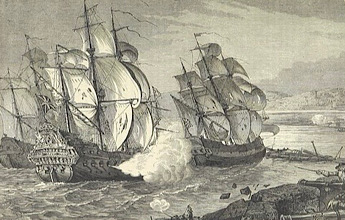
On July 28, 1689, two armed merchant ships, Mountjoy and Phoenix, sail toward the heavily defended defensive boom (floating barrier) across the River Foyle at Culmore, protected by the frigate HMS Dartmouth under Captain John Leake. Mountjoy rams and breaches the boom at Culmore fort and the ships move in, unloading many tons of food to relieve the Siege of Derry.
The Siege of Derry in 1689 is the first major event in the Williamite War in Ireland. The siege is preceded by an attempt against the town by Jacobite forces on December 7, 1688, that is foiled when thirteen apprentices shut the gates. This is an act of rebellion against James II.
The second attempt begins on April 18, 1689, when James himself appears before the Derry city walls with an Irish army led by Jacobite and French officers. The town is summoned to surrender but refuses. The siege begins. The besiegers try to storm the walls, but fail. They then resort to starving Derry. They raise the siege and do not leave until supply ships break through to the town.
Frederick Schomberg, having been appointed commander-in-chief by William III, orders Major-GeneralPercy Kirke to attack the boom. Thereupon, on July 28, Kirke sends four ships to the mouth of the River Foyle to try to bring food into Derry. These are HMS Dartmouth and three merchant ships: Mountjoy from Derry, Phoenix from Coleraine, and Jerusalem. Dartmouth, under Captain John Leake, engages the shore batteries, while Mountjoy, commanded by her Master Michael Browning, rams and breaches the boom, whereupon Mountjoy and Phoenix sail up to Derry, unloading many tons of food. Seeing that he can no longer starve out Derry and not having enough troops to storm the town, Conrad von Rosen, the commander of the Jacobite troops, decides to raise the siege. On August 1, the besieged discover that the enemy is gone. On August 3, Kirke reports the raising of the siege to London. On July 31, another Jacobite army is defeated at Newtownbutler by the armed citizens of Enniskillen.
The city endures 105 days of siege, from April 18 to August 1, 1689. Some 4,000 of its garrison of 8,000 are said to have died during this siege. The siege is commemorated annually by the Protestant community.
(Pictured: HMS Dartmouth fires at shore batteries while Mountjoy rams through the boom, from the 1873 book British Battles on Land and Sea, Volume 1)
The agreement on January 28, 1610, between the Crown and the Irish Society of London to carry out the plantation of Derry, Coleraine, and part of Tyrone refers to a significant historical event known as the Plantation of Ulster. This event takes place in the early 17th century and is part of the broader policy of the English and later British colonization of Ireland.
The Plantation of Ulster is a process initiated by the English Crown, primarily under King James I, to colonize the province of Ulster in the north of Ireland with English and ScottishProtestant settlers to defend against a future attack from within or without. This follows the Flight of the Earls in 1607, when several Gaelic Irish lords leave Ireland, leading to the confiscation of their lands by the Crown.
In his survey, James I finds that the town of Derry (renamed Londonderry) can become either a great asset as a control over the River Foyle and Lough Swilly, or it can become an inviting back door if the people of the area are against him. He pressures the guilds of the City of London to fund the resettlement of the area, including the building of a new walled city.
The Irish Society is formed by the City of London in response to James I’s royal request to participate in the plantation. The Society is a consortium of Londonlivery companies, which are trade associations and guilds.
The Crown grants the Irish Society lands in Ulster, particularly in modern-day County Londonderry (then including what is now County Tyrone), to establish new settlements. The key areas are the city of Derry and the town of Coleraine.
The primary objective is to settle Ulster with loyal Protestant subjects, thus consolidating English influence in Ireland. The plantation aims to bring about economic development and to establish control over what is considered a rebellious and unruly region.
The livery companies of London undertake the establishment of new towns, fortifications, and the settlement of the land with tenants. However, the implementation faces various challenges, including resistance from the native Irish population, logistical difficulties, and issues of mismanagement.
The Plantation of Ulster has profound and lasting demographic, social, and political impacts. It leads to significant changes in land ownership and contributes to the religious and cultural diversification of the region. The plantation is also a root cause of the sectarian divide in Northern Ireland, contributing to centuries of conflict between the Protestant and Catholic communities.
The agreement between the Crown and the Irish Society of London to carry out the Plantation of Ulster is a pivotal event in Irish history. It plays a crucial role in shaping the historical trajectory of Ireland, particularly Northern Ireland, and its effects are still felt in the region’s complex socio-political landscape.
The Plantation of Ulster remains a subject of historical analysis and debate, reflecting the complex interplay of colonization, cultural identity, and conflict in Irish history.
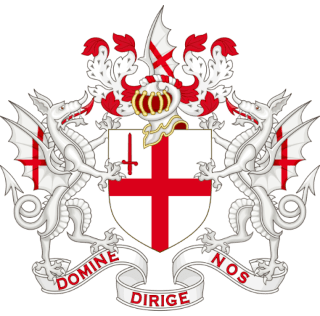
(From: “The Crown and the Irish Society of London, Agree to Carry Out the Plantation of Derry, Coleraine and Part of Tyrone,” McManus Family History, http://www.mcmanusfamilyhistory.com | Pictured: The crest of the Irish Society of London)
A rally of twelve to fifteen thousand Peace People from both north and south takes place at the new bridge over the River Boyne at Drogheda, County Louth, on December 5, 1976. In general, the Peace People’s goals are the dissolution of the Irish Republican Army (IRA) and an end to violence in Northern Ireland. The implicit goals of the Peace People rallies are delegitimization of violence, increasing solidarity, and gaining momentum for peace.
In the 1960s, Northern Ireland begins a period of ethno-political conflict called the Troubles. Through a series of social and political injustices, Northern Ireland has become a religiously divided society between historically mainland Protestants and Irish Catholics. Furthermore, the Irish people have become a fragmented body over a range of issues, identities, circumstances and loyalties. The conflict between Protestants and Catholics spills over into violence, marked by riots and targeted killings between the groups beginning in 1968. In addition, paramilitary groups, including the prominent IRA, launch attacks to advance their political agendas.
The violence continues to escalate. On August 10, 1976, Anne Maguire and her children are walking along Finaghy Road North in Belfast. Suddenly, a Ford Cortina slams into them. The car is being driven by Danny Lennon, who moments before had been shot dead by pursuing soldiers. The mother is the only survivor. The collision kills three of her four children, Joanne (8), John (2), and Andrew (6 months). Joanne and Andrew die instantly while John is injured critically.
The next day, immediately following John’s death, fifty women from the Republican neighborhoods of Andersonstown and Stewartstown protest Republican violence by marching with baby carriages. That evening, Mairead Corrigan, Anne Maguire’s sister, appears on television pleading for an end to the violence. She becomes the first leader of the Peace People to speak publicly.
However, she was not the only one to initiate action. As soon as she hears Mairead speak on the television, Betty Williams begins petitioning door-to-door for an end to sectarian violence. She garners 6,000 signatures of support within a few days. This support leads directly into the first unofficial action of the Peace People. On 14 August, only four days after the incident, 10,000 women, both Protestant and Catholic, march with banners along Finaghy Road North, the place of the children’s death, to Milltown Cemetery, their burial site. This march mostly includes women along with a few public figures and men. The marchers proceed in almost utter silence, only broken by short bouts of singing from the nuns in the crowd and verbal and physical attacks by Republican opposition.
The following day, the three who become leaders of the Peace People – Mairead Corrigan, Betty Williams, and journalist Ciaran McKeown – come together for their first official meeting. During these initial meetings they establish the ideological basis of nonviolence and goals for the campaign. The essential goals for the movement are the dissolution of the IRA and an end to the violence in Northern Ireland. The goals of the campaign implicit in their declaration are awareness, solidarity, and momentum. Peace People’s declaration:
“We have a simple message to the world from this movement for Peace. We want to live and love and build a just and peaceful society. We want for our children, as we want for ourselves, our lives at home, at work, and at play to be lives of joy and peace. We recognise that to build such a society demands dedication, hard work, and courage. We recognise that there are many problems in our society which are a source of conflict and violence. We recognise that every bullet fired, and every exploding bomb make that work more difficult. We reject the use of the bomb and the bullet and all the techniques of violence. We dedicate ourselves to working with our neighbours, near and far, day in and day out, to build that peaceful society in which the tragedies we have known are a bad memory and a continuing warning.”
During the four-month campaign, Peace People and partners organize and participate in 26 marches in Northern Ireland, Britain, and the Republic of Ireland. In order to organize these marches effectively they establish their main headquarters in Belfast.
After the initial Finaghy Road March, the Peace People, both Protestants and Catholics, rally in Ormeau Park on August 21. The official Declaration of the Peace People is first read at this rally, the largest rally of the entire campaign. The group numbers over 50,000. The rally even includes some activists from the Republic of Ireland, most notably Judy Hayes from the Glencree Centre of Reconciliation near Dublin. After the rally, she and her colleagues return to the south to organize solidarity demonstrations.
In the few days before the next march, the organization “Women Together” request Peace People to call off the march, disapproving of Catholics and Protestants participating in a joint march. The Peace People are not dissuaded. The next Saturday, 27,000 people march along Shankill Road, the loyalist/Protestant neighborhood.
In the next three months, Peace People organize and participate in a rally every Saturday; some weeks even have two. Some of the most notable marches include the Derry/Londonderry double-march, the Falls march, the London march, and the Boyne march.
The Saturday following the Shankill march marks the Derry/Londonderry double-march. At this march, Catholics march on one side of the River Foyle and Protestants on the other. The groups meet on the Craigavon Bridge. Simultaneously, 50,000 people march in solidarity in Dublin.
On October 23, marchers meet in the Falls, Belfast, in the pouring rain on the same Northumberland street corner where the Shankill March had started. The Falls Road rally is memorable for the fear and violence that ensues. During this rally Sinn Féin supporters throw stones and bottles at the marchers. The attackers escalate the violence as the marchers near Falls Park. The marchers are informed by others that more attackers await them at the entrance to the park, inciting fear within the body of the rally. The leaders decide that this is an important moment of conflict in the rally and that they must push on. They continue verbally encouraging the marchers through the cloud of bottles, bricks, and stones.
The leaders plan to escalate the campaign momentum for the last two major symbolic rallies in London and Boyne, Drogheda. A week before the rallies, on November 20-21, they plan a membership drive. Over 105,000 people sign within two days.
The symbolic week of the culminating rallies begins on November 27 at the glamorous London Rally. They begin to march at Hyde Park, cut through Westminster Abbey, and end at Trafalgar Square. Some groups sing “Troops Out,” and others resound with civil rights songs.
On December 5, Peace People holds its final march of the campaign, along the River Boyne. The Northern and Southern Ireland contingents met at the Peace Bridge. This is an important point in the legacy of the Peace People movement. Now that the enthusiastic rallies are over, the people are responsible for the tedious local work and continuing the momentum and solidarity that the rallies have inspired. The shape of the Peace People is changing.
After the planned marches are over, the rally portion of the campaign fades and the Peace People take a new shape. Corrigan, Williams, and McKeown stop planning marches, but continue to be involved in action that takes the form of conferences and traveling overseas. However, the leaders begin doing more separated work. Ciaran McKeown increases his focus on radical political restructuring.
In 1977, Betty Williams and Mairead Corrigan receive the Nobel Peace Prize. Issues regarding the use of the monetary award impact the two leaders’ relationships in an irreconcilable manner.
Due to the fact that many people, unlike McKeown, are less interested in the political side of the equation, the People continue actions along the lines of rallies and social work. Actions continue through the People’s initiative in the form of Peace Committees that each does separate work in local areas.
The Peace People makes a substantial impact. They help to de-legitimize violence, increase solidarity across sectarian lines, and develop momentum for peace. Although the violence does not fully subside until 1998 with the negotiation of political change, Ireland sees in 1976 one of its most dramatic decreases in political violence, accompanying the Peace People’s marches and rallies. The campaign dramatizes how tired the people are of bloodshed, their desperate desire for peace, and the clear possibility of alternatives.
(From: “Peace People march against violence in Northern Ireland, 1976” by Hannah Lehmann, Global Nonviolent Action Database, https://nvdatabase.swarthmore.edu/, 2011 | Pictured: The Peace People organisation rally in Drogheda, County Louth, December 5, 1976)
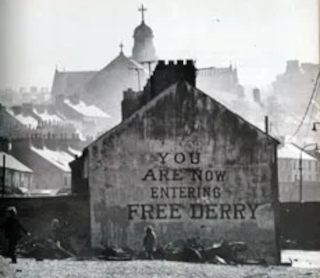
The “no-go” areas, known as Free Derry, are areas where both the Irish Republican Army and Provisional Irish Republican Army can openly patrol, train and open offices with widespread support and without involvement of security services. Bogside, Creggan and Brandywell make up the area Free Derry, and it is still known by that name despite the barricades no longer being present.
The 10,000 strong march sets off from Irish Street at 1500 GMT to call for an end to the “no-go” areas on the east bank side of the River Foyle.
The biggest security operation since the start of the Troubles is set up for the march with soldiers on every corner. The bridge is the centre of the trouble as it joins the Protestant side of the town to the “no-go” Roman Catholic areas of Bogside and Creggan.
Despite pleas from march organisers for the violence to stop it does not end until the Ulster Defence Association (UDA) steps in. They form a human barrier between the protesters and the Army. The confrontation lasts an hour and results in one man being injured but no arrests.
A spokesman for the Army says, “Naturally it is regretted that we have to fire rubber bullets but there we are. The only alternative is the Bogside would be invaded by the Protestant marchers.”
Despite the violence, William Craig, the leader of the Ulster Vanguard movement, who organised the march, says the marches will go on. “We are no longer protesting – we are demanding action,” he says.
Although slightly smaller than their opponents, Coote’s troops consist largely of veterans from the New Model Army and have three times the number of cavalry. After an hour of fighting, the Ulster army collapses and flees, losing most of its men, officers, weapons, and supplies. The battle secures the north of Ireland for the Commonwealth and clears the way to complete the Cromwellian conquest of Ireland.
In September 1643, Ormond agrees a truce, or ‘Cessation’, with the Confederation, freeing his troops for use in England against Parliament in the First English Civil War. Some Irish Protestants object, and switch sides, including Sir Charles Coote, who becomes Parliamentarian commander in Connacht. Charles surrenders in 1646, while a Covenanter/Royalist uprising is quickly suppressed in the 1648 Second English Civil War. On January 17, 1649, the Confederation allies with Ormond’s Royalists. Following the execution of Charles on January 30, they are joined by the Laggan Army and remaining Scots troops in Ulster.
There are various reasons for this. The Covenanter government, who provide support for Scottish settlers in Ulster, consider Oliver Cromwell and other leaders of the new Commonwealth of England dangerous political and religious radicals. As Scots, they object to the execution of their king by the English. As Presbyterians, they view monarchy as divinely ordained, making regicide also sacrilegious, and they transfer their allegiance to his son, Charles II of England.
However, this is offset by a split within the Confederation, between Catholic landowners who want to preserve the position prevailing in 1641, and those like Ó Néill, whose estates had been confiscated in 1607. As a result, he agrees a truce with Coote, and refuses to join the Alliance, depriving them of their most effective fighting force in the north. Despite this, by late July, Ormond’s combined Royalist/Confederate army control most of Ireland.
Ormond’s defeat at the Battle of Rathmines on August 2 allows Cromwell and an army of 12,000 to land in Dublin unopposed. After capturing Drogheda on September 11, his main force heads south towards Wexford. Colonel Robert Venables is sent north with three regiments, or around 2,500 men, to take control of Ulster. Munro’s garrisons surrender with minimal resistance, and by the end of September, Venables has occupied Dundalk, Carlingford, Newry, and Belfast. These are accompanied by the mass expulsion of Scots settlers, as punishment for their defection. When Coote captures Coleraine on September 15, he massacres the largely Scottish garrison.
Ó Néill’s death in November 1649 and Coote’s defeat of a combined Royalist/Covenanter force at Lisnagarvey in December leaves the Catholic Ulster army as the only remaining opposition to the Commonwealth in the north. At a meeting at Belturbet on March 18, 1650, Heber MacMahon, Catholic Bishop of Clogher, is appointed in his place. Although a leading figure in the Confederation, MacMahon has no military experience and opposes the alliance with Ormond’s Royalists. His election is essentially a compromise between supporters of Henry, Ó Néill’s son, and his cousin, Felim Ó Néill.
By May 20, MacMahon and his deputy Richard O’Farrell have assembled an army near Loughgall, with 5,000 infantry and 1,000 cavalry. They lack both arms and artillery but after Ormond promises to send these from Connacht, they march north, intending to divide Coote’s troops at Derry from those commanded by Venables at Carrickfergus in the east. To do this, MacMahon establishes a line of garrisons with its northern end at Ballycastle, then moves south, intending to cross the River Foyle just below Lifford and maintain contact with Ormond through Ballyshannon.
At this point, Coote has only 1,400 men and seems vulnerable. The Irish cross the river on June 2, beating off an attack by the Commonwealth cavalry and occupy Lifford, where they spend the next two weeks and Coote withdraws to Derry. However, the supplies promised by Ormond fail to arrive, leaving MacMahon short of provisions, while on June 18 Coote is joined by an additional 1,000 infantry under Colonel Roger Fenwick sent from Belfast. At the same time, detaching men for the new garrisons leave MacMahon with around 4,000 infantry and 400 cavalry.
MacMahon now relocates to the Doonglebe/Tullygay Hill overlooking the pass at Scariffhollis, a strong defensive position two miles west of Letterkenny on the River Swilly. When Myles MacSweeney takes his regiment off to recapture his ancestral home at Doe Castle, it leaves the two armies roughly equal in number. However, Coote’s men are well equipped veterans, and he has three times the number of cavalry. When he appears at Scariffhollis on June 21, MacMahon’s subordinates advise him not to risk battle. They argue Coote will soon be forced to retreat due to lack of provisions, allowing the Irish to withdraw into Connaught in good order.
For reasons that are still debated, MacMahon ignores this advice and on the morning of June 21, 1650, orders his troops down from their mountain camp to give battle. Coote later reports that although the ground is still “excessive bad,” it allows him to use his cavalry, although the initial fighting is conducted by the opposing infantry.
The Irish army is drawn up in a large mass formation with 200–300 musketeers in front, which may have been due to their shortage of ammunition. The battle begins when Colonel Fenwick leads a detachment of 150 men against the advance guard. After an exchange of fire, during which Fenwick is mortally wounded, it turns into a hand-to-hand struggle. As Coote feeds in reinforcements, the Irish musketeers fall back on their main force, which has no room to manoeuvre and is now subjected to devastating volleys at close range. After an hour of bitter conflict, the Irish are out of ammunition and at this point the Parliamentarian cavalry charges their flank. Thrown into disarray, the Irish break and run.
In most battles, flight is the point at which the defeated suffer the heaviest casualties, exacerbated by the lack of Irish cavalry and the brutal nature of the war. Most of the infantry dies on the battlefield or in the pursuit that follows, including Henry Ó Néill and many officers, some of whom are killed after surrendering. Estimates of the Irish dead range from 2,000 – 3,000, while Coote loses around 100 killed or wounded.
MacMahon escapes with 200 horse but is captured a week later and executed. Phelim Ó Néill and O’Farrell make it to Charlemont, which is besieged by Coote and surrenders on August 14. With the exception of a few scattered garrisons, this ends fighting in the north. Limerick is taken by Hardress Waller in October 1651, and the war ends when Galway surrenders to Coote in May 1652.
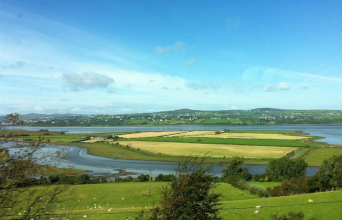
(Pictured: A view of the mouth of River Swilly at Lough Swilly, Letterkenny, County Donegal)
The Glorious Revolution of 1688 is a relatively bloodless revolution in which James II, King of England, Ireland and Scotland and a Roman Catholic convert, is ousted from power by the Parliament of England. The English throne is then offered to his Protestant daughter Mary and her husband William III of England, also known as William of Orange. In Scotland, the privy council asks William III to assume responsibility for the government in January 1689, and he and Mary are formally offered the Scottish throne in March. The situation is different in Ireland where most of the population are Catholics. Irish Catholics are hoping that James will re-grant them lands, which had been seized from them after the Cromwellian conquest of Ireland (1649–53). James thus looks to Ireland to muster support in regaining his kingdoms just as his father, Charles I, had done in the English Civil War of the 1640s.
On December 10, James flees London. He is caught but flees a second time on December 23 and makes his way to France. On March 12, James I lands in Kinsale with 6,000 French soldiers. He takes Dublin and marches north with an army of Irish and French Catholics.
In April 1689 reinforcements from England arrive under the command of Colonel John Cunningham, who is a native of the city. He is under instructions to take his orders from the Derry City Governor, Lieutenant Colonel Robert Lundy. Lundy advises Colonel Cunningham to leave as arrangements have been made for the city to be surrendered. Lundy calls a meeting with several of his most loyal supporters to discuss surrender. News of the meeting spread, angering many of the citizens. That night, Lundy and many others leave the city aboard a ship to Scotland. The city’s defence is overseen by Major Henry Baker, Colonel Adam Murray, and Major George Walker, also an Anglican priest. Their slogan is “No Surrender.”
As the Jacobite army nears, all the buildings outside the city walls are set alight by the defenders to prevent them being used as cover by the besiegers.
The Jacobite army reaches Derry on April 18. James and his retinue ride to within 300 yards of Bishop’s Gate and demand the surrender of the city. He is rebuffed with shouts of “No surrender!” and some of the city’s defenders fire at him. James asks for surrender three more times but is refused each time. This marks the beginning of the siege. Cannon and mortar fire are exchanged, and disease takes hold within the city. James returns to Dublin and leaves his forces under the command of Richard Hamilton.
Royal Navy warships under Admiral George Rooke arrive in Lough Foyle on June 11 but initially decline to ram through the heavily defended defensive boom across the River Foyle at Culmore.
On July 28, two armed merchant ships, Mountjoy and Phoenix, sail toward the boom, protected by the frigate HMS Dartmouth under Captain John Leake. Mountjoy rams and breaches the boom, and the ships move in, unloading many tons of food to relieve the siege. The city had endured 105 days of siege during which some 4,000 Protestants of a population of 8,000 are said to have died.
The siege is commemorated yearly by the Protestant Apprentice Boys of Derry who stage the week-long Maiden City Festival culminating in a parade around the walls of the city by local members, followed by a parade of the city by the full Association. Although violence has attended these parades in the past, those in recent years have been largely peaceful.
The song “Derry’s Walls” is written to commemorate the siege.



 seamus dubhghaill