seamus dubhghaill

Promoting Irish Culture and History from Little Rock, Arkansas, USA


Leave a comment

Death of Sir James Ware, Anglo-Irish Historian

Sir James Ware, historian, collector of manuscripts, and civil servant, dies at his home in Castle Street, Dublin, on December 1, 1666.

Ware is born on November 16, 1594, in Castle Street, Dublin, eldest surviving son among ten children of Sir James Ware, auditor general, and his wife Mary Bryden, sister of Sir Ambrose Briden of Maidstone, Kent, England, whose house provides Ware’s base in England. His father, a Yorkshireman, comes to Ireland in the train of Lord Deputy of Ireland Sir William FitzWilliam in 1588 and builds up a substantial landed estate. He enters Trinity College Dublin (TCD), where his father is the college auditor, as a fellow commoner in 1605 and is presented a silver standing bowl in 1609. His association with the college continues, as he particularly remembers the philosophy lectures of Anthony Martin, who becomes a fellow in 1611. He takes his MA on January 8, 1628, but by then he has already launched on his future course. His father procures him the reversion of his office in 1613, and by 1620 he already owns the Annals of Ulster and is taking notes from the Black Book of Christ Church. In 1621, he marries Elizabeth Newman, daughter of Jacob Newman, one of the six clerks in chancery. Newman becomes clerk of the rolls in 1629, which apparently facilitates Ware’s assiduous research in the Irish public records.

From Ware’s numerous surviving notebooks, it is possible to follow his scholarly tracks over the rest of his life. He is particularly concerned to trace the succession of the Irish bishops. The first fruits appear in print in 1626, Archiepiscoporum Cassiliensium et Tuamensium . . . adjicitur historia coenobiorum Cisterciensium Hiberniae, followed in 1628 by De presulibus Lageniae . . ., the whole to be rounded off in 1665 with De presulibus Hiberniae. . . . However, he has wide interests in Irish history and in 1633 edits Edmund Spenser‘s A View of the Present State of Irelande and the Irish histories of Edmund Campion, Meredith Hanmer, and Henry of Marlborough. The first Irish biographical dictionary follows in 1639, De scriptoribus Hiberniae. Both publications are dedicated to the viceroy, Thomas Wentworth. In public life he is a supporter, first of Wentworth, later of James Butler, 1st Duke of Ormond, rather than a leader, and always a stout royalist. He is knighted in 1630 and following his father’s death in 1632 he succeeds as auditor general. He is elected member of parliament for Dublin University in 1634, 1640, and 1661, but is not admitted to the Privy Council of Ireland until 1640.

Shortly after the outbreak of rebellion in October 1641, Ware is in England, and in London at the time of the passing of the Adventurers’ Act 1640, presumably on the council’s business. During Ormond’s prolonged negotiations with the confederates, he is sent to advise the king at Oxford in November 1645. While there he works in the Bodleian Library and is incorporated into the university as a Doctor of Civil Law. On his way back to Ireland in January 1646, he is captured at sea by a parliament ship and held prisoner in the Tower of London until October 1646.

When Ormond is arranging the surrender of Dublin to the parliament in the summer of 1647, Ware is sent to London as one of the hostages for his performance of the terms. Back in Dublin he has been replaced as auditor general but is able to carry on his work on the public records. In 1648 he publishes the catalogue of his manuscript library. As a leading royalist he is unwelcome to those governing the city for the parliament and is sent into exile in France on April 7, 1649, with his eldest son, also James, who already holds the reversion of the auditor generalship and eventually succeeds his father. He is allowed to live in London from October 1650, and from 1653, when hostilities end in Ireland, he is allowed brief visits there, perhaps taking up residence again in 1658.

Ware’s years in London are spent in the library of Archbishop of Armagh James Ussher, then in Lincoln’s Inn, and in the Royal, Cotton, Carew, and Dodsworth libraries. He publishes his De Hibernia et antiquitatibus ejus disquisitiones in 1654, lamenting the inaccessibility of his notes, then in Dublin. The second edition, published in 1658, also includes the annals of Henry VII. His Opuscula Sancto Patricio . . . adscripta . . . appears in 1656. In it he remarks that his knowledge of the Irish language is not expert enough for an edition of the ‘Lorica’. According to Roderick O’Flaherty, Ware can read and understand but not speak Irish. For the older language he employs Irish scholars, Dubhaltach Mac Fhirbhisigh being the last and most learned. The 1660 Stuart Restoration sees him back as auditor general and one of the commissioners for the Irish land settlement. He publishes annals of Henry VIII in 1662, and in 1664 annals for 1485–1558.

Ware dies in his house in Castle Street on December 1, 1666, and is buried in the family vault in St. Werburgh’s Church, Dublin. He has numerous friends among the scholars of the day, including Irish Franciscans, across the sectarian divide. While clergy lists are still partly dependent on his work, his notebooks and manuscripts remain of first importance for the study of medieval Ireland. Of his ten children, two boys and two girls survive him. His wife dies on June 9, 1651. The engraving by George Vertue prefixed to Harris’ edition of Ware’s Works is claimed to be based on a portrait in the possession of the family.

(From: “Ware, Sir James” by William O’Sullivan, Dictionary of Irish Biography, http://www.dib.ie, October 2009)


Leave a comment

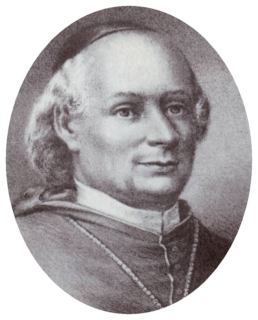
Giovanni Battista Rinuccini, Nuncio to Ireland, Returns to Rome

Giovanni Battista Rinuccini, an Italian Roman Catholic archbishop in the mid-seventeenth century, returns to Rome on February 23, 1649, after spending just over three years in Ireland supporting Catholics with arms, money, and diplomacy.

Rinuccini is born in Rome on September 15, 1592. He is educated by the Jesuits in Rome and studies law at the Universities of Bologna and Perugia. In due course, he is ordained a priest, having at the age of twenty-two obtained his doctor’s degree from the University of Pisa. He is named a camariere (chamberlain) by Pope Gregory XV and in 1625 becomes Archbishop of Fermo. In 1631 he carefully refuses an offer to be made Archbishop of Florence.

On September 15, 1644, a new pope, Pope Innocent X, is elected. He decides to step up the help for the Irish Catholic Confederates. He sends Rinuccini as nuncio to Ireland to replace the envoy Friar Pierfrancesco Scarampi, who had been sent to Ireland by his predecessor, Pope Urban VIII, in 1643.

Rinuccini departs France from Saint-Martin-de-Ré near La Rochelle on October 18, 1645, on the frigate San Pietro and arrives in Kenmare, County Kerry, on October 21, 1645, with a retinue of twenty-six Italians, several Irish officers, and the Confederation’s secretary, Richard Bellings. He proceeds to Kilkenny, the Confederate capital, where Richard Butler, 3rd Viscount Mountgarret, the president of the Confederation, receives him at the castle. He speaks Latin to Montgarret, but all the official business of the Confederates is done in English. He asserts in his discourse that the object of his mission is to sustain the King, but above all to help the Catholic people of Ireland in securing the free and public exercise of their religion, and the restoration of the churches and church property to the Catholic Church.

Rinuccini had sent ahead arms and ammunition: 1,000 braces of pistols, 4,000 cartridge belts, 2,000 swords, 500 muskets and 20,000 pounds of gunpowder. He arrives twelve days later with a further two thousand muskets and cartridge-belts, four thousand swords, four hundred braces of pistols, two thousand pike-heads, and twenty thousand pounds of gunpowder, fully equipped soldiers and sailors and 150,658 livres tournois to finance the Irish Catholic war effort. These supplies give him a huge input into the Confederate’s internal politics because he doles out the money and arms for specific military projects, rather than handing them over to the Confederate government, or Supreme Council.

Rinuccini hopes that by doing so he can influence the Confederates’ strategic policy away from making a deal with Charles I and the Royalists in the English Civil War and towards the foundation of an independent Catholic-ruled Ireland. In particular, he wants to ensure that churches and lands taken in the rebellion would remain in Catholic hands. This is consistent with what happened in Catholic-controlled areas during the Thirty Years’ War in Germany. His mission can be seen as part of the Counter-Reformation in Europe. He also has unrealistic hopes of using Ireland as a base to re-establish Catholicism in England. However, apart from some military successes such as the Battle of Benburb on June 5, 1646, the main result of his efforts is to aggravate the infighting between factions within the Confederates.

The Confederates’ Supreme Council is dominated by wealthy landed magnates, predominantly of “Old English” origin, who are anxious to come to a deal with the Stuart monarchy that will guarantee them their land ownership, full civil rights for Catholics, and toleration of Catholicism. They form the moderate faction, which is opposed by those within the Confederation, who want better terms, including self-government for Ireland, a reversal of the land confiscations of the plantations of Ireland and establishment of Catholicism as the state religion. A particularly sore point in the negotiations with the English Royalists is the insistence of some Irish Catholics on keeping in Catholic hands the churches taken in the war. Rinuccini accepts the assurances of the Supreme Council that such concerns will be addressed in the peace treaty negotiated with James Butler, 1st Duke of Ormond, negotiated in 1646, now known as the First Ormond Peace.

However, when the terms are published, they grant only the private practice of Catholicism. Alleging that he had been deliberately deceived, Rinuccini publicly backs the militant faction, which includes most of the Catholic clergy and some Irish military commanders such as Owen Roe O’Neill. On the other side there are the Franciscans Pierre Marchant, and later Raymond Caron. In 1646, when the Supreme Council tries to get the Ormond Peace ratified, Rinuccini excommunicates them and helps to get the Treaty voted down in the Confederate General Assembly. The Assembly has the members of the Supreme Council arrested for treason and elects a new Supreme Council.

However, the following year, the Confederates’ attempts to drive the remaining English (mainly Parliamentarian) armies from Ireland meets with disaster at the battles of Dungan’s Hill on August 8, 1647 and Knocknanuss on November 13, 1647. As a result, the chastened Confederates hastily conclude a new deal with the English Royalists to try to prevent a Parliamentarian conquest of Ireland in 1648. Although the terms of this second deal are better than those of the first one, Rinuccini again tries to overturn the treaty. However, on this occasion, the Catholic clergy are split on whether to accept the deal, as are the Confederate military commanders and the General Assembly. Ultimately, the treaty is accepted by the Confederacy, which then dissolves itself and joins a Royalist coalition. Rinuccini backs Owen Roe O’Neill, who used his Ulster army to fight against his former comrades who had accepted the deal. He tries in vain to repeat his success of 1646 by excommunicating those who support the peace. However, the Irish bishops are split on the issue and so his authority is diluted. Militarily, Owen Roe O’Neill is unable to reverse the political balance.

Despairing of the Catholic cause in Ireland, Rinnuccini leaves the country on February 23, 1649, embarking at Galway on the ship that had brought him to Ireland, the frigate San Pietro. In the same year, Oliver Cromwell leads a Parliamentarian re-conquest of the country, after which Catholicism is thoroughly repressed. Roman Catholic worship is banned, Irish Catholic-owned land is widely confiscated east of the River Shannon, and captured Catholic clergy are executed.

Rinuccini returns to Rome, where he writes an extensive account of his time in Ireland, the Commentarius Rinuccinanus. His account blames personal vainglory and tribal divisions for the Catholic disunity in Ireland. In particular, he blames the Old English for the eventual Catholic defeat. The Gaelic Irish, he writes, despite being less civilised, are more sincere Catholics.

Rinuccini returns to his diocese in Fermo in June 1650 and dies there on December 13, 1653.


Leave a comment

Death of Thomas Butler, Viscount Thurles

Thomas Butler, Viscount Thurles, drowns on December 15, 1619, off the coast of The Skerries, Isle of Anglesey. He is the son and heir apparent of Walter Butler, 11th Earl of Ormond (1559–1633), whom he predeceases. He resides at Thurles Castle, Thurles, County Tipperary. He is the father of the Irish statesman and Royalist commander James Butler, 1st Duke of Ormond.

Butler is born the eldest son of Walter Butler and his wife Helen Butler. His father is the 11th Earl of Ormond. His mother is the eldest daughter of Edmund Butler, 2nd Viscount Mountgarret and his wife Grizel FitzPatrick. His father and mother are cousins. Their common great-grandfather is Piers Butler, 8th Earl of Ormond. Their family, the Butler dynasty, is Old English and descends from Theobald Walter, who had been appointed Chief Butler of Ireland by King Henry II of England in 1177.

Some time before 1610, Butler marries Elizabeth Poyntz against his father’s wishes. She is the daughter of Sir John Pointz (died 1633) of Iron Acton in Gloucestershire and his wife Elizabeth Sydenham. He and Elizabeth had seven children, three sons and four daughters:

In 1619 after the beginning of his father’s long imprisonment in the Fleet Prison, Butler is summoned to England to answer charges of treason, specifically, of having garrisoned Kilkenny. However, on December 15 the ship conveying him is wrecked off the coast of The Skerries, Isle of Anglesey and he drowns. Like his father, he is a prominent Catholic and it seems likely that his refusal to conform to the established Anglican religion had angered King James I and may have been the true motive for his summons.

Butler predeceases his father who dies in 1634. His eldest son James, the future 1st Duke of Ormond, succeeds him as heir apparent and bearer of the courtesy title Viscount Thurles until he succeeds his grandfather as the 12th Earl of Ormond.


Leave a comment

The Battle of Dungan’s Hill

battle-of-dungans-hill

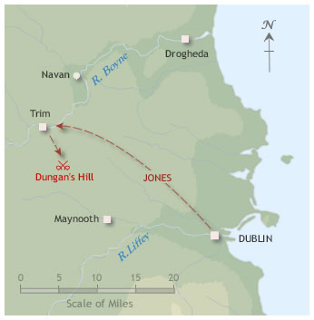
The Battle of Dungan’s Hill takes place in County Meath on August 8, 1647. It is fought between the armies of Confederate Ireland and the Parliament of England during the Wars of the Three Kingdoms. The battle takes place near the modern village of Summerhill and along the present main road between Trim and Kilcock.

By 1647, The Irish Catholic Confederation controls all of Ireland except for Parliamentarian enclaves around Dublin and Cork and a Scottish outpost in Ulster. The previous year they had rejected a treaty with the English Royalists in favour of eliminating the remaining British forces in Ireland.

In August 1647, the Confederate Leinster army under Thomas Preston is attempting to take Dublin from the English Parliamentarian garrison under Michael Jones, when it is intercepted by the Roundheads and forced to give battle. Jones had marched to Trim to relieve the Parliamentarian outpost there at Trim Castle. Preston, who had been shadowing Jones’ movements, attempts to march on Dublin before Jones’ army returns there, but covers only 12 of the 40 miles before being caught at Dungan’s Hill, where the Confederate forces have to form up for battle.

From a Parliamentarian point of view, victory in this battle is presented to them by the incompetence of the Irish commander. Preston is a veteran of the Thirty Years’ War, where he had been a commander of the Spanish garrison at Leuven, but has no experience in open warfare or handling cavalry. Jones, by contrast, had been a cavalry officer in the English Civil War. As a result, Preston tries to move his cavalry along a narrow covered lane where they are trapped and subjected to enemy fire without being able to respond. Even worse, Preston has placed a large number of his troops in wheat fields over seven feet tall. As a result these troops are unable to see the Parliamentarians until it is too late. With the Confederate army spread out and in confusion, Jones’ troops fall in amongst them causing the demoralised Irish cavalry to flee the field, leaving the remainder of Preston’s infantry unsupported.

The Confederate army’s infantry are primarily equipped with pikes and heavy muskets and trained to stand in tercios in the Spanish manner. This means they are difficult to break, but also highly immobile, without cavalry to cover their cumbersome formation when it moves. What is worse, Preston has positioned them in a large walled field, so that when their cavalry has run away, the Parliamentarians can surround and trap them. Some of the Irish infantry, Scottish Highlanders brought to Ireland by Alasdair Mac Colla, manage to charge and break through Jones’ men and escape into a nearby bog, where the English cavalry could not follow. Preston and 2,000 to 3,000 of his regular infantry manage to follow the Highlanders to safety, but the remainder are trapped.

What happens next is disputed. The Irish infantry manages to hold off several assaults on their position, before trying to follow their comrades into the safety of the bog. This makes them lose their formation and the Parliamentarians get in amongst them and then surround them in the bogland. Parliamentarian accounts simply say that the Irish force is then destroyed. Irish accounts, however, claim that the Confederate troops surrender and are then massacred. One account, by a Catholic friar named O Meallain, says that the corpses of the Irish foot soldiers are found with their hands tied. A recent study suggests that the Irishmen probably tried to surrender, but that, according to the conventions of 17th century warfare, this had to be accepted before it entitled them to safety. In this case, it was not accepted and the infantrymen were butchered.

Around 3,000 Confederate troops and a small number of Parliamentarians die at Dungan’s Hill. One of the English regimental commanders, Colonel Anthony Hungerford, is shot in the mouth, a wound that invalids him out of the English Army. Most of the dead are Irish infantrymen killed in the last stage of the battle. Those prisoners who are taken are mainly officers, whom the Parliamentarians can either ransom or exchange for prisoners of their own. Richard Talbot, a junior cavalry officer but later Earl of Tyrconnell and Lord Deputy of Ireland, is among the Confederate prisoners.

In the immediate aftermath of the battle, Owen Roe O’Neill‘s Ulster Army marches through the pass of Portlester Mill to mount an effective rearguard action, routing Jones’ advanced brigade and enabling the survivors of the Leinster army to escape. Jones, fearing O’Neills army, does not continue the pursuit and returns to Dublin. O’Neill and his Ulstermen return four months later to bury the dead Confederates.


1 Comment

The Battle of Kilrush

james-butler-earl-of-ormonde

The Battle of Kilrush, a battle at the start of the Irish Confederate Wars in Ireland, takes place on April 15, 1642, soon after the Irish Rebellion of 1641.

The battle is fought between a Royalist army under the James Butler, 12th Earl of Ormonde, and Richard Butler, 3rd Viscount Mountgarret, who leads Confederate Irish troops raised during the Irish Rebellion of 1641. Ormonde and Mountgarret are cousins, both being members of the Butler dynasty.

Ormonde’s troops leave Dublin on April 2 and march unopposed from Naas to Athy and on to Maryborough, now Portlaoise, arriving on April 8. There they resupply the royalist garrisons and send cavalry forces to support those at Carlow and Birr, before returning to Athy on April 13. Setting out at 6:00 AM on April 15, and having decided to avoid a battle on their return march to Dublin, the government troops are blocked by Mountgarret’s rebel militias at Kilrush, two miles south of Suncroft, between Kilcullen and Moone in southeastern County Kildare.

The land is remarkably flat, with the exception of two ridges that run nearly parallel northward from a castle, with a marsh lying between. The army of Ormonde, consisting of 2,500 foot soldiers and 500 horses, assembles on the high grounds of Ardscull, Fontstown, and Kilrush, while the rebel army under Mountgarret, consisting of 8,000 foot soldiers and 400 horses, proceeds in the same direction along the heights of Birtown, Ballyndrum, Glasshealy, and Narraghmore. Mountgarret, having the advantage in numbers, and anxious for battle, outmarches Ormonde’s forces, and posts himself on Bull Hill and Kilrush, completely intercepting Ormonde’s further progress to Dublin. A general engagement becomes unavoidable. The left wing of the Irish is broken by the first charge. The right wing, animated by their leaders, maintains the contest for some time, but eventually falls back to neighbouring Battlemount. Here they break, flee and are pursued with great slaughter across the grounds they had marched over the previous day. Ormonde’s army then marches on to Dublin, arriving on April 17.

Ormonde’s army suffers twenty fatalities and approximately forty wounded in the Battle of Kilrush. Mountgarret’s rebel army loses more than 700, among which are several colonels. The victory is considered of such consequence that Ormonde is presented with a jewel valued at £50 by the Irish Government.

(Pictured: Sir Peter Lely’s oil painting of James Butler, 12th Earl of Ormonde)


Leave a comment

The Battle of Rathmines

The Battle of Rathmines is fought in and around what is now the Dublin suburb of Rathmines on August 2, 1649, during the Irish Confederate Wars. It is fought between an English Parliamentarian army under Michael Jones which holds Dublin and an army composed of Irish Confederate and English Royalist troops under the command of the James Butler, 1st Duke of Ormond.

By 1649, Ireland has already been at war for eight years, since the outbreak of the Irish Rebellion of 1641. The English Parliament holds only two small enclaves, Dublin and Derry, in Ireland.

In July 1649, Ormond, marches his coalition forces of 11,000 men to the outskirts of Dublin with the intent of taking the city from its Parliamentary garrison, which had landed there in 1647. Ormond takes Rathfarnham Castle and camps at Palmerston Park in Rathgar, about 4 km south of the city. The area from Ormond’s camp to the city of Dublin is now a heavily urbanised area, but in 1649, it is open countryside. Ormond begins inching his forces closer to Dublin by taking the villages around its perimeter and to this end, sends a detachment of troops to occupy Baggotrath Castle, on the site of present-day Baggot Street bridge. For reasons which have never been clear, they take several hours to reach Baggotrath, a distance of about a mile, and they arrive to find that the Parliamentary troops have already occupied the castle.

However, Ormond is not expecting Michael Jones, the Parliamentary commander, to take the initiative and has not drawn up his troops for battle. Unfortunately for the Royalists, this is exactly what Jones does, launching a surprise attack on August 2 from the direction of Irishtown with 5,000 men and sending Ormond’s men at Baggotsrath reeling backwards towards their camp in confusion.

Too late, Ormond and his commanders realise what is going on and send units into action piecemeal to try to hold up the Parliamentarian advance, so that they can form their army into battle formation. However, Jones’ cavalry simply outflanks each force sent against them, sending them too fleeing back south through the townland of Rathmines. The battle becomes a rout as scores of fleeing Royalist and Confederate soldiers are cut down by the pursuing Roundheads. The fighting finally ends when the English Royalist troops under Murrough O’Brien, 1st Earl of Inchiquin, mounts a disciplined rearguard action, allowing the rest to get away. Ormond claims he has lost less than a thousand men. Jones claims to have killed around 4,000 Royalist or Confederate soldiers and taken 2,517 prisoners, while losing only a handful himself. Ormond certainly loses at least one leading officer, Christopher Plunkett, 2nd Earl of Fingall, who is fatally wounded and dies in Dublin Castle a few days later. Ormond also loses his entire artillery train and all his baggage and supplies.

In the aftermath of the battle, Ormond withdraws his remaining troops from around Dublin, allowing Oliver Cromwell to land in the city at Ringsend with 15,000 veteran troops on August 15. Cromwell calls the battle “an astonishing mercy,” taking it as a sign that God has approved of his conquest of Ireland. Over the next four years he completes the Cromwellian conquest of Ireland.

Without Jones’ victory at Rathmines, the New Model Army would have had no port to land at in Ireland and the Cromwellian conquest of Ireland would have been much more difficult. Ormond’s incompetent generalship at Rathmines disillusions many Irish Confederates with their alliance with the English Royalists and Ormond is ousted as commander of the Irish forces the following year.


Leave a comment

The Siege of Limerick

Henry IretonOliver Cromwell’s son-in-law, lays siege to Limerick city on June 4, 1651. During the Irish Confederate Wars, Limerick is one of the last fortified cities held by an alliance of Irish Confederate Catholics and English Royalists against the forces of the Parliament of England.

By 1650, the Irish Confederates and their English Royalist allies have been driven out of eastern Ireland by the Cromwellian conquest of Ireland. They occupy a defensive position behind the River Shannon, of which Limerick is the southern stronghold. Oliver Cromwell himself leaves Ireland in May 1650, delegating his command of the English Parliamentarian forces to Henry Ireton. Ireton moves his forces north from Munster to besiege Limerick in October of that year. However, the weather is increasingly wet and cold and Ireton is forced to abandon the siege before the onset of winter.

Ireton returns on June 4, 1651 with 8,000 men, 28 siege artillery pieces and 4 mortars. He summons Hugh Dubh O’Neill, the Irish commander of Limerick to surrender, but is refused. The siege is on.

Limerick in 1651 is split into two sections, English town and Irish town, which are separated by the Abbey River. English town, which contains the citadel of King John’s Castle, is encircled by water, the Abbey River on three sides and the River Shannon on the other, in what is known as King’s Island. Thomond bridge is only one bridge onto the island and is fortified with bastioned earthworks. Irish town is more vulnerable, but is also more heavily fortified. Its medieval walls have been buttressed by 20 feet of earth, making it difficult to knock a breach in them. In addition, Irish town has a series of bastions along its walls, mounted with cannon which cover its approaches. The biggest of these bastions are at St. John’s Gate and Mungret gate. The garrison of the city is 2,000 strong and composed mainly of veterans from the Confederate’s Ulster army, commanded by Hugh Dubh O’Neill, who had distinguished themselves at the siege of Clonmel the previous year.

Because Limerick is very well fortified, Ireton does not risk an assault on its walls. Instead he secures the approaches to the city, cuts off its supplies and builds artillery earthworks to bombard the defenders. His troops take the fort at Thomond bridge, but the Irish destroy the bridge itself, denying the Parliamentarians land access to English town. Ireton then tries an amphibious attack on the city, a storming party attacking the city in small boats. They are initially successful, but O’Neill’s men counterattack and beat them off.

After this attack fails, Ireton resolves to starve the city into submission and builds two forts known as Ireton’s fort and Cromwell’s fort on nearby Singland Hill. An Irish attempt to relieve the city from the south is routed at the battle of Knocknaclashy. O’Neill’s only hope is now to hold out until bad weather and hunger force Ireton to raise the siege. To this end, O’Neill tries to send the town’s old men, women and children out of the city so that his supplies will last a little longer. However, Ireton’s men kill forty of these civilians and send the rest back into Limerick.

O’Neill comes under pressure from the town’s mayor and civilian population to surrender. The town’s garrison and civilians suffer terribly from hunger and disease, especially an outbreak of plague. In addition, Ireton finds a weak point in the defences of Irish town, and knocks a breach in them, opening the prospect of an all out assault.

Eventually in October 1651, six months after the siege started, part of Limerick’s garrison mutinies and turns some cannon inwards, threatening to fire on O’Neill’s men unless they surrender. Hugh Dubh O’Neill surrenders Limerick on October 27. The inhabitants lives and property are respected, but they are warned that they could be evicted in the future. The garrison is allowed to march to Galway, which is still holding out, but has to leave their weapons behind.

The lives of the civilian and military leaders of Limerick are excepted from the terms of surrender. A Catholic Bishop Terence Albert O’Brien, an Alderman and the English Royalist officer Colonel Fennell are hanged. O’Neill is also sentenced to death, but is reprieved by the Parliamentarian commander Edmund Ludlow and imprisoned instead in London. Former mayor Dominic Fanning is drawn, quartered, and decapitated, with his head mounted over St. John’s Gate.

Over 2,000 English Parliamentary soldiers die at Limerick, mostly from disease. Among them is Henry Ireton, who dies a month after the fall of the city. About 700 of the Irish garrison and an estimated 5,000 citizens die.

(Pictured: The Treaty Stone on which the treaty of Limerick may have been signed in 1691)