seamus dubhghaill

Promoting Irish Culture and History from Little Rock, Arkansas, USA


Leave a comment

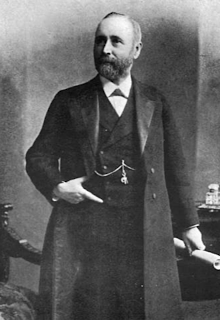
Birth of William Pirrie, 1st Viscount Pirrie

William James Pirrie, 1st Viscount PirrieKPPCPC (Ire), a leading British shipbuilder and businessman, is born on May 31, 1847, in Quebec City, Canada East, Province of Canada. He is chairman of Harland & Wolff, shipbuilders, between 1895 and 1924, and also serves as Lord Mayor of Belfast between 1896 and 1898.

Pirrie is taken back to Ireland when he is two years old and spends his childhood at Conlig House, also known as Little Clandeboye ConligCounty Down. Belonging to a prominent family, his nephews included J. M. Andrews, who later becomes Prime Minister of Northern IrelandThomas Andrews, builder of RMS Titanic, and Sir James Andrews, 1st Baronet, the Lord Chief Justice of Northern Ireland.

Pirrie is educated at the Royal Belfast Academical Institution before entering Harland & Wolff shipyard as a gentleman apprentice in 1862. Twelve years later he is made a partner in the firm, and on the death of Sir Edward Harland in 1895, he becomes its chairman, a position he holds until his death. As well as overseeing the world’s largest shipyard, he is elected Lord Mayor of Belfast in 1896, and is re-elected to the office as well as made an Irish Privy Counsellor the following year. He becomes Belfast’s first honorary freeman in 1898, and serves in the same year as High Sheriff of Antrim and subsequently of County Down. In February 1900, he is elected President of the UK Chamber of Shipping, where he had been vice-president the previous year. He helps finance the Liberals in Ulster in the 1906 United Kingdom general election, and that same year, at the height of Harland & Wolff’s success, he is raised to the peerage as Baron Pirrie, of the City of Belfast.

In 1907, Pirrie is appointed Comptroller of the Household to the Lord Lieutenant of Ireland, and in 1908 is appointed Knight of St Patrick (KP). Pro-Chancellor of Queen’s University of Belfast (QUB) from 1908 to 1914, he is also in the years before World War I a member of the Committee on Irish Finance as well as Lord Lieutenant of Belfast.

In February 1912, after chairing a famous meeting of the Ulster Liberal Association at which Winston Churchill defends the government’s policy of Home Rule for Ireland, Pirrie is jeered on the streets of Belfast, and assaulted as he boards a steamer in Larne: pelted with rotten eggs, herrings, and bags of flour. In 1910, the Ulster Liberal Association, an overwhelmingly Protestant body, with a weekly newspaper, and branch network throughout Ulster, adopts (in opposition to the Ulster Liberal Unionist Association) an explicitly pro-home rule position.

In the months leading up to the 1912 sinking of the RMS Titanic, Pirrie is questioned about the number of life boats aboard the Olympic-class ocean liners. He responds that the great ships are unsinkable and the rafts are to save others. This haunts him for the rest of his life. In April 1912, Pirrie is to travel aboard RMS Titanic, but illness prevents him.

During the war Pirrie is a member of the War Office Supply Board, and in 1918 becomes Comptroller-General of Merchant Shipbuilding, organising British production of merchant ships.

In 1921, Pirrie is elected to the Senate of Northern Ireland, and that same year is created Viscount Pirrie of the City of Belfast, in the honours for the opening of the Parliament of Northern Ireland in July 1921, for his war work and charity work. In Belfast he is, on other grounds, already a controversial figure: a Protestant employer associated as a leading Liberal with a policy of Home Rule for Ireland.

In March 1924, Pirrie, his wife, and her sister sail on a Royal Mail Steam Packet Company liner from Southampton on a business trip to South America. They travel overland from Buenos Aires to Chile, where they embark aboard the Pacific Steam Navigation Company‘s Ebro. Pirrie comes down with pneumonia in Antofagasta, and his condition worsens when the ship reaches Iquique. At Panama City two nurses embark to care for him. By then he is very weak, but insists on being brought on deck to see the canal. He admires how Ebro is handled through the locks.

Pirrie dies at sea off Cuba on June 7, 1924. His body is embalmed. On June 13, Ebro reaches Pier 42 on the North River in New York City, where Pirrie’s friend Andrew Weir, 1st Baron Inverforth and his wife meet Viscountess Pirrie and her sister. UK ships in the port of New York lower their flags to half-mast, and Pirrie’s body is transferred to Pier 59, where it is embarked on White Star Line‘s RMS Olympic, one of the largest ships Pirrie ever built, to be repatriated to the UK. He is buried in Belfast City Cemetery. The barony and viscountcy die with him. Lady Pirrie dies on June 19, 1935. A memorial to Pirrie in the grounds of Belfast City Hall is unveiled in 2006.

Leave a comment

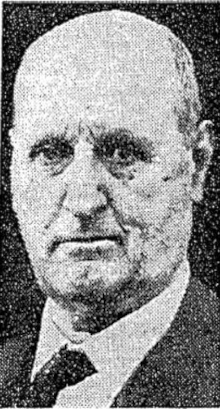
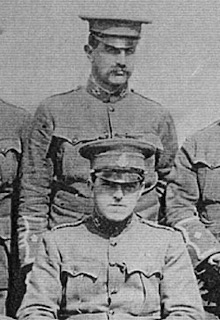
Death of Colonel Robert David Perceval-Maxwell

Colonel Robert David Perceval-Maxwell DSO JP DL PC (Ire), British soldier and Ulster Unionist Party politician, dies in Belfast, Northern Ireland, on May 24, 1932. He is a member of the Senate of Northern Ireland and Down County Council.

Perceval-Maxwell is born in 1870, the only son of John Perceval-Maxwell, eldest son of Robert Perceval-Maxwell DL (1813–1905), of Finnebrogue House, Downpatrick, County Down.

Perceval-Maxwell is educated at Eton College. He plays a significant part in the raising of the 36th (Ulster) Division on the outbreak of World War I. He is commissioned Major in the 13th (County Down) Battalion, Royal Irish Rifles, which he had raised, in September 1914, and is appointed second-in-command in December 1914. He is promoted to the temporary rank of Lieutenant-Colonel and commands a battalion from November 1916 and commands a battalion of the Royal Munster Fusiliers from May 1918. He is seriously wounded during the war. He resigns his commission in January 1919.

He is appointed to the Privy Council of Ireland in the honours for the opening of the Parliament of Northern Ireland in July 1921, entitling him to the style “The Right Honourable.” He serves in the Northern Ireland Senate from 1921 to 1925.

In 1895, Perceval-Maxwell marries Edith Grace Head. They have five sons: John Robert Perceval-Maxwell (born 1896), Richard Henry (born 1897, killed in action in 1916), Patrick Edward (born 1900), Brian Stephen (born 1908), and David (born 1911).

Perceval-Maxwell dies at the age of 62 on May 24, 1932, in a Belfast nursing home. He is buried in Inch Parish Churchyard, Downpatrick.


Leave a comment

Shooting of Protestant Senator John Barnhill

Gunmen shoot the hardline Protestant Senator John Barnhill at his home near Strabane, County Tyrone, Northern Ireland, on December 12, 1971, then wreck his country mansion with a bomb. His body is buried under tons of rubble.

Barnhill, a right‐wing member of the Protestant‐based Ulster Unionist Party (UUP), which rules the British province, is the first member of the Parliament of Northern Ireland to die in two years of violence that have resulted in 196 deaths up to this point.

Barnhill’s wife says that the senator had gone to answer the door at their home, close to the border with the Republic of Ireland. She says she heard two shots and found her husband lying near the door with a gunman kneeling at his side. Then, she says, a second man helps drag him into the main room, where the attackers plant a gelignite bomb beside his body.

Barnhill, 63 years old, has been a Senator for ten years. He often is outspoken in public denunciations of the outlawed Irish Republican Army (IRA) for its terrorist campaign to overthrow the provincial government. He is an officer in the Orange Order, the powerful Freemasonry of Northern Ireland Protestants, and a director of a Londonderry seed company.

The police say that Mrs. Barnhill ran for help from the ruins of her home and is admitted to a hospital under treatment for shock.

At least 28 people die in the violence of the previous nine days, fifteen of them in an explosion on December 4 that wrecks a bar in a Roman Catholic area.

The leadership of the Irish Republican Army disclaims responsibility for the bombs and charges that they were set off as acts of provocation by the British Army. The British dismiss the charge as ludicrous.

The IRA, fighting for the separation of predominantly Protestant Northern Ireland from Britain and its merger with the Republic of Ireland to the south, has threatened to destroy Belfast‘s center by Christmas. Mass arrests fail to halt the latest wave of violence.

On December 13, Cardinal William Conway, Primate of All Ireland, denounces bombers and gunmen who have participated in the violence as “monsters.”

Preaching in St. Patrick’s Cathedral, Armagh, Ireland’s ecclesiastical capital, the Belfast‐born Cardinal delivers his toughest attack yet on the latest incidents, which include the fatal shooting of a parttime soldier in his home in front of his five children, and the bombing the previous day of a Protestant‐owned Belfast furniture showroom, in which four people are killed and nineteen are injured.

A plaque commemorating Barnhill’s murder is unveiled at Stormont on the 30th anniversary of his death on December 12, 2001.

(From: “Rightist Ulster Senator Slain by Gunmen in Home,” The New York Times, http://www.nytimes.com, December 13, 1971)


Leave a comment

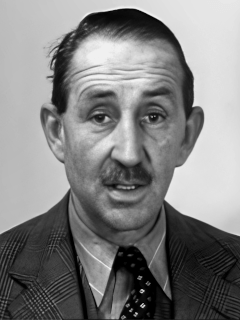
Death of Basil Stanlake Brooke, Third Prime Minister of Northern Ireland

Basil Stanlake Brooke, 1st Viscount Brookeborough, KG, CBE, MC, TD, PC (Ire), Ulster Unionist Party (UUP) politician who serves as the third Prime Minister of Northern Ireland from May 1943 until March 1963, dies on August 18, 1973, at Colebrooke Park, Brookeborough, County Fermanagh, Northern Ireland. He has been described as “perhaps the last Unionist leader to command respect, loyalty and affection across the social and political spectrum.” Equally well, he has also been described as one of the most hardline anti-Catholic leaders of the UUP, and his legacy involves founding his own paramilitary group, which feeds into the reactivation of the Ulster Volunteers.

Brooke is born on June 9, 1888, at Colebrooke Park, his family’s neo-Classical ancestral seat on what is then the several-thousand-acre Colebrooke Estate, just outside Brookeborough, a village near Lisnaskea in County Fermanagh. He is the eldest son of Sir Arthur Douglas Brooke, 4th Baronet, whom he succeeds as 5th Baronet when his father dies in 1907. His mother is Gertrude Isabella Batson. He is a nephew of Field Marshal Alan Brooke, 1st Viscount Alanbrooke, Chief of the Imperial General Staff (CIGS) during World War II, who is only five years his senior. His sister Sheelah marries Sir Henry Mulholland, Speaker of the Stormont House of Commons and son of Lord Dunleath. He is educated for five years at St. George’s School in Pau, France, and then at Winchester College (1901–05).

After graduating from the Royal Military College, Sandhurst, Brooke is commissioned into the Royal Fusiliers on September 26, 1908, as a second lieutenant. He transfers to the 10th Royal Hussars in 1911. He is awarded the Military Cross and Croix de guerre with palm for his service during World War I.

Brooke is a very active Ulster Unionist Party member and ally of Edward Carson. He founds his own paramilitary group, Brooke’s Fermanagh Vigilance, from men returning from the war front in 1918. Although the umbrella Ulster Volunteers had been quiescent during the war, it is not defunct. It re-emerges strongly in 1920, subsuming groups like Brooke’s.

In 1920, having reached the rank of captain, Brooke leaves the British Army to farm the Colebrooke Estate, the family estate in west Ulster, at which point he turns toward a career in politics.

Brooke has a very long political career. When he resigns the Premiership of Northern Ireland in March 1963, he is Northern Ireland’s longest-serving prime minister, having held office for two months short of 20 years. He also establishes a United Kingdom record by holding government office continuously for 33 years.

In 1921, Brooke is elected to the Senate of Northern Ireland, but he resigns the following year to become Commandant of the Ulster Special Constabulary (USC) in their fight against the Irish Republican Army (IRA). He is created a Commander of the Order of the British Empire in 1921.

In 1929 Brooke is elected to the House of Commons of Northern Ireland as Ulster Unionist Party MP for the Lisnaskea division of County Fermanagh. In the words of the Oxford Dictionary of National Biography, “his thin, wiry frame, with the inevitable cigarette in hand, and clipped, anglicised accent were to be a feature of Stormont for the next forty years.”

Brooke becomes Minister of Agriculture in 1933. By virtue of this appointment, he also acquires the rank of Privy Councilor of Northern Ireland. From 1941 to 1943 he is Minister of Commerce.

On May 2, 1943, Brooke succeeds John M. Andrews as Prime Minister of Northern Ireland. In 1952, while Prime Minister, was raised to the peerage as Viscount Brookeborough, the title taken from the village named after the Brookes. Although a peer, he retained his seat in the House of Commons at Stormont and remained Prime Minister for another decade.

As the Northern Ireland economy begins to de-industrialise in the mid-1950s, leading to high unemployment amongst the Protestant working classes, Brooke faces increasing disenchantment amongst UUP backbenchers for what is regarded as his indifferent and ineffectual approach to mounting economic problems. As this disenchantment grows, British civil servants and some members of the UUP combine to exert discreet and ultimately effective pressure on Brooke to resign to make way for Captain Terence O’Neill, who is Minister of Finance.

In 1963, his health having worsened, Brooke resigns as Prime Minister. However, he remains a member of the House of Commons of Northern Ireland until the 1969 Northern Ireland general election, becoming the Father of the House in 1965. During his last years in the Parliament of Northern Ireland he publicly opposes the liberal policies of his successor Terence O’Neill, who actively seeks to improve relationships with the Republic of Ireland, and who attempts to address some of the grievances of Catholics and grant many of the demands of the Northern Ireland Civil Rights Association (NICRA).

Brooke is noted for his casual style toward his ministerial duties. Terence O’Neill later writes of him, “he was good company and a good raconteur, and those who met him imagined that he was relaxing away from his desk. However, they did not realise that there was no desk.”

In his retirement Brooke develops commercial interests as chairman of Carreras (Northern Ireland), a director of Devenish Trade, and president of the Northern Ireland Institute of Directors. He is also made an honorary LL.D. of Queen’s University Belfast.

From 1970 to 1973, years in which the Stormont institution comes under its greatest strain and eventually crumbles, Brooke makes only occasional forays into political life. In 1972, he appears next to William Craig MP on the balcony of Parliament Buildings at Stormont, a diminutive figure beside the leader of the Vanguard Unionist Progressive Party (VUPP) who is rallying right-wing Unionists against the Government of Northern Ireland. He opposes the Westminster white paper on the future of Northern Ireland and causes some embarrassment to his son, Captain John Brooke, the UUP Chief Whip and an ally of Brian Faulkner, by speaking against the Faulkner ministry‘s proposals.

Brooke dies at his home, Colebrooke Park, on the Colebrooke Estate, on August 18, 1973. His remains are cremated at Roselawn Cemetery, East Belfast, three days later, and, in accordance with his wishes, his ashes are scattered on the demesne surrounding his beloved Colebrooke Park.


Leave a comment

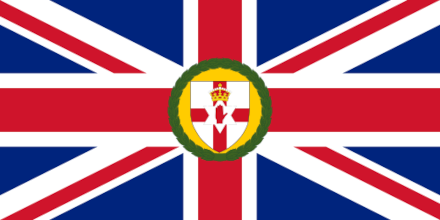
Office of Governor of Northern Ireland Abolished

The mainly ceremonial office of Governor of Northern Ireland is abolished on July 18, 1973 under Section 32 of the Northern Ireland Constitution Act 1973. The Secretary of State for Northern Ireland, a cabinet office created in 1972, takes over the functions of the Governor on December 20, 1973 under Letters Patent.

The office of the Governor of Northern Ireland is established on 9 December 9, 1922 under Letters Patent to “do and execute in due manner as respects Northern Ireland all things which by virtue of the [1920] Act and our said Letters Patent of 27 April 1921 or otherwise belonged to the office of Lord Lieutenant at the time of the passing of the Irish Free State Constitution Act 1922.”

The 1922 “Instructions” sent alongside the letters patent establishing the office require the Governor of Northern Ireland to get the monarch’s permission to leave Northern Ireland, and empowers the Governor in such cases to issue letters patent under the Great Seal of Northern Ireland appointing a “Deputy or Deputies, Justice or Justices” during his absence. This emulates the practice of appointing Lords Justices of Ireland when the Lord Lieutenant is absent from Ireland. Each new Governor upon taking office selects a slate of eligible deputies from among the Privy Council of Northern Ireland, and at each of his subsequent absences a subset of these are sworn in for its duration. Many are Lord Chief Justice or Lord Justice of Appeal, including Denis Henry, William Moore, James Andrews, Anthony Babington, John MacDermott, Baron MacDermott, and Samuel Clarke Porter. Others are Senators and/or county lieutenants, including Robert Sharman-Crawford, Robert David Perceval-Maxwell, Henry Armstrong, Sir Thomas Dixon, 2nd Baronet, Maurice McCausland, and Francis Needham, 4th Earl of Kilmorey.

The Governor has possession of the Great Seal of Northern Ireland and is the successor to the Lord Lieutenant of Ireland in Northern Ireland, itself established on May 3, 1921. The official residence of the Governor of Northern Ireland is Hillsborough Castle in County Down. Following refurbishment of the Castle, James Hamilton, 3rd Duke of Abercorn, takes up residence in 1925. It remained the official residence until the abolition of the office of governor in 1973. Henceforth it has been the official residence of the Secretary of State for Northern Ireland.


Leave a comment

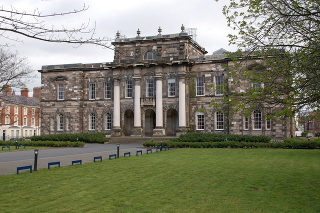
Opening of Assembly’s College, Belfast

assemblys-college-belfast

Assembly’s College, Belfast, opens for the training of Presbyterian clergy on December 5, 1853.

The Renaissance Revival style building with its grand Doric porch and Baroque attic is designed by Sir Charles Lanyon, the architect of the main building at Queen’s University Belfast and built with Scrabo stone at a cost of £5,000. Jean-Henri Merle d’Aubigné of Geneva participates in the opening ceremony alongside Henry Cooke, President of the Faculty. The five other professors in the new college are John Edgar, Robert Wilson, William Dool Killen, James G. Murphy and William Gibson.

There is a large influx of students in the wake of the 1859 Ulster revival and the south wing with its dining hall and student accommodations is added in 1869. Princeton Theological Seminary has an important influence in the shaping of the ethos of the College during this period as the Reverend Roberts Watts, who is appointed Professor of Systematic Theology in 1866, hopes to make “Belfast another Princeton.” The north wing with its wood-panelled chapel is designed by John Lanyon, son of original architect, and completed in 1881. The first degrees under the Royal Charter are conferred in 1883. However, the death of Watts in 1895 marks the beginning of the end of the Princetonian influence. A partial union takes place between the faculties in Belfast and Magee in 1922.

The newly formed Parliament of Northern Ireland meets in Assembly’s College from 1921 until 1932 while Stormont is being built with the House of Commons meeting in the Gamble Library and the Senate in the College chapel. During this period the College conducts classes in a house and provides library resources in a house on University Square. In 1926 the College becomes a Recognised College of Queen’s University. During this period the College comes under criticism for its embrace of theological liberalism. This culminates in a charge of heresy being brought against Professor James Ernest Davey in 1926-27. The College officially reopens in October 1932 and the inaugural lecture is delivered by the Scottish Historian Robert Rait.

Between 1941 and 1948 the Royal Ulster Constabulary, the city police, use the College as its own headquarters are bombed in the Belfast Blitz. In 1953, to mark the College’s centenary year, Prof. Davey is elected Moderator of the General Assembly.

In 1976 theological teaching at Magee College in Derry, County Londonderry, ceases and the two colleges amalgamate in 1978. The new college, constituted by an Act of Parliament, is named Union Theological College.

Today Union Theological College offers a full range of courses in Theology. The professors at the College constitute the Presbyterian Theological Faculty Ireland (PTFI) which was granted a Royal Charter in 1881 to confer academic degrees. The PTFI still awards degrees, diplomas and certificates. The majority of students are enrolled for degrees and diplomas, undergraduate and postgraduate, through the Institute of Theology of the Queen’s University of Belfast, in particular the BTh, BD, MTh and PhD.