seamus dubhghaill

Promoting Irish Culture and History from Little Rock, Arkansas, USA


Leave a comment

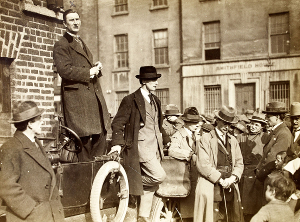
Oscar Traynor Leads Anti-Treaty IRA Occupation of O’Connell Street

On June 29, 1922, during the Irish Civil War, Oscar Traynor leads Anti-Treaty members of the Irish Republican Army‘s (IRA) 1st Dublin Brigade to occupy O’Connell Street in order to help the Four Courts garrison. His men also take up positions in York Street, South Circular Road, Capel Street, Parnell Square, and Dolphin’s Barn.

Traynor is an Irish politician and republican born into a strongly nationalist family in Dublin on March 21, 1886. He serves in a number of cabinet positions, most notably as the country’s longest-serving Minister for Defence. He is educated by the Christian Brothers in Dublin. In 1899 he is apprenticed to John Long, a famous woodcarver. As a young man he is a noted footballer and tours Europe as a goalkeeper with Belfast Celtic F.C. whom he plays with from 1910 to 1912.

Traynor joins the Irish Volunteers and takes part in the Easter Rising in 1916, following which he is interned in Wales. During the Irish War of Independence, he is brigadier of the Dublin Brigade of the Irish Republican Army. He leads the attack on The Custom House in 1921 and an ambush on the West Kent Regiment at Claude Road, Drumcondra on June 16, 1921, when the Thompson submachine gun is fired for the first time in action. When the Irish Civil War breaks out in June 1922, Traynor takes the republican side.

The Dublin Brigade is split however, with many of its members following Michael Collins in taking the pro-Treaty side. On June 29, 1922, Traynor and his supporters occupy O’Connell Street in an attempt to help the republicans who have occupied the Four Courts but are under attack by Free State forces. Traynor and his men hold out for a week of street fighting before making their escape. He organises guerilla activity in south Dublin and County Wicklow, before being captured by Free State troops in September. He is then imprisoned for the remainder of the war.

On March 11, 1925, Traynor is elected to Dáil Éireann in a by-election as a Sinn Féin Teachta Dála (TD) for the Dublin North constituency, though he does not take his seat due to the abstentionist policy of Sinn Féin. He is re-elected as one of eight members for Dublin North in the June 1927 Irish general election but just one of six Sinn Féin TDs. Once again, he does not take his seat. He does not contest the second general election called that year but declares his support for Fianna Fáil. He stands again in the 1932 general election and is elected as a Fianna Fáil TD for Dublin North.

In 1936 Traynor is first appointed to the Cabinet as Minister for Posts and Telegraphs. In September 1939 he is appointed Minister for Defence and holds the portfolio until February 1948. In 1948 he becomes President of the Football Association of Ireland, a position he holds until his death. He serves as Minister for Defence in several Fianna Fáil governments and as Minister for Justice, where he is undermined by his junior minister, and later Taoiseach, Charles Haughey, before he retires in 1961.

Oscar Traynor dies on December 15, 1963, in Dublin at the age of seventy-seven. He has a road named in his memory on the Coolock to Santry stretch in North Dublin.

(Pictured: Oscar Traynor in Dublin in July 1922)

Leave a comment

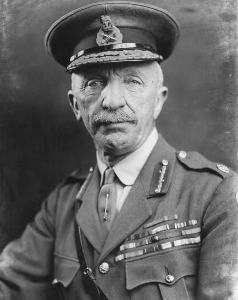
Assassination of Field Marshal Sir Henry Hughes Wilson

Field Marshal Sir Henry Hughes Wilson is shot and killed by two Irish Republican Army (IRA) men in London on June 22, 1922.

Wilson is born in County Longford and a long-time opponent of the Irish Home Rule movement. He joins the British army in 1884 and sees action during the Boer War. He is assigned to British army headquarters during the infamous Curragh incident and supports the near-mutiny of British officers who refuse to lead troops against Ulster opponents of home rule. He serves in France during the World War I and, when the war ends, continues his staunch support of the Unionist cause while serving as Chief of General Staff. He is a strong supporter of the coercion tactics of the British in Ireland during the Irish War of Independence, even suggesting that the leaders of Sinn Féin be executed. He leaves the army when David Lloyd George decides not to renew his term as chief of staff and is elected Member of Parliament (MP) for North Down as a Conservative in 1922. In Parliament, he urges even stronger coercion methods than those then being carried out by the Black and Tans.

On June 22, 1922, two London-based volunteers of the Irish Republican Army, Reginald Dunne and Joseph O’Sullivan, assassinate Wilson outside his house at 36 Eaton Place at approximately 2:20 PM. He is in full uniform as he is returning from unveiling the Great Eastern Railway War Memorial at Liverpool Street station at 1:00 PM. He has six wounds, two of them fatal wounds to the chest.

Stories later circulate that the first shot misses but rather than taking shelter in the house, he draws his sword and advances on his attackers, who are able to shoot and kill him. These stories often stress that he dies a martyr. His housemaid testifies that she found his drawn sword lying by his side. These details do not feature in the witness accounts by Reginald Dunne, which is smuggled out of prison, the inquest testimony of one of two road menders working nearby, and the taxi driver who had just dropped Wilson off. One of the road mender’s accounts, as published in the Daily Mail, mentions Wilson turning on his attackers with the words “you cowardly swine!” but this is believed to be a possible embellishment by the newspaper.

Two police officers and a chauffeur are also shot as the men attempt to avoid capture. They are then surrounded by a crowd and arrested by other policemen after a struggle. Dunne and O’Sullivan are convicted of murder and hanged on August 10, 1922. On the day Wilson’s killers were hanged, Currygrane, the family homesite in Ballinalee, County Longford is burned to the ground, possibly as a reprisal although possibly as an unrelated part of the unrest in that county.

Wilson’s widow blames the government for his death and is only persuaded to allow government representation at the funeral on the grounds that not to do so would be disrespectful to the King. Wilson’s funeral is a public affair attended by David Lloyd George and the cabinet, Ferdinand Foch, Robert Nivelle and Maxime Weygand from France as well as many of his former army colleagues including John French, Nevil Macready, Douglas Haig and William Robertson. He is buried in the crypt of St. Paul’s Cathedral in London.


Leave a comment

Ireland Approves Same-Sex Marriage by Popular Vote

Ireland becomes the first nation in the world to approve same-sex marriage by a popular vote on May 23, 2015, sweeping aside the opposition of the Roman Catholic Church in a resounding victory for the gay rights movement and placing the country at the vanguard of social change.

With the final ballots counted, the vote is 62.1% in favor of legalizing same-sex marriage, and 37.9% opposed. The turnout is large with more than 60% of the 3.2 million eligible voters casting ballots. Only one of the 43 districts, Roscommon-South Leitrim, votes the measure down.

With early vote counts suggesting a comfortable victory, crowds begin to fill the courtyard of Dublin Castle, a government complex that was once the center of British rule. By late morning, the leader of the opposition, David Quinn, director of the Iona Institute, concedes the outcome on Twitter: “Congratulations to the Yes side. Well done.”

Cheers break out among the crowd of supporters in the courtyard of Dublin Castle when Returning Officer Riona Ni Fhlanghaile announces in the evening that the ballot has passed.

In recent history a vote such as this would have been unthinkable. Ireland decriminalizes homosexuality only in 1993, the church dominates the education system, and abortion remains illegal except when a mother’s life is at risk. But the influence of the church has waned amid scandals in recent years, while attitudes, particularly among the young, have shifted.

“Today Ireland made history,” Taoiseach Enda Kenny says at a news conference, adding that “in the privacy of the ballot box, the people made a public statement.” He also adds, “This decision makes every citizen equal, and I believe it will strengthen the institution of marriage.”

Alex White, the government’s Minister for Communications, Climate Action and Environment, says, “This didn’t change Ireland — it confirmed the change. We can no longer be regarded as the authoritarian state we once might have been perceived to be. This marks the true separation of church and state.”

Gerry Adams, president of Sinn Féin, says, “There are two Irelands, the elite Ireland and the hidden Ireland. And today the hidden Ireland spoke.”

Nick O’Connell, who is from a rural area in County Kilkenny, cradles a celebratory drink in a Dublin pub. He says he had been too afraid to come out as gay until his mid-20s. “Today I’m thinking of all those young people over the years who were bullied and committed suicide because of their sexuality. This vote was for them, too.” He adds, “This is different from other countries because it was the people who gave it to us, not a legislature.”


Leave a comment

Prince Charles & Camilla Visit County Sligo

Charles, Prince of Wales, and his wife Camilla, Duchess of Cornwall, arrive at the Model Arts Centre in Sligo town on May 20, 2015, where the prince makes an address.

On arrival at the Model the couple delays for some time chatting to school children and local residents who line the street to greet them. The welcoming party also includes Minister for Foreign Affairs and Trade Charles Flanagan, and members of Sligo County Council including Sinn Féin’s Sean MacManus.

Charles speaks of his “deep anguish” following the killing of his “much loved grand uncle” Lord Louis Mountbatten by the Irish Republican Army (IRA) in Mullaghmore on August 27, 1979.

“At the time I could not imagine how we would come to terms with such anguish and such deep loss” he tells the gathering. “In August 1979, my much-loved great uncle, Lord Mountbatten, was killed alongside his young grandson and my godson, Nicholas, and his friend, Paul Maxwell, and Nicholas’s grandmother, the Dowager Lady Brabourne.”

“At the time I could not imagine how we would come to terms with the anguish of such a deep loss since, for me, Lord Mountbatten represented the grandfather I never had. So, it seemed as if the foundations of all that we held dear in life had been torn apart irreparably.”

But he stresses the tragedy helped him understand the widespread suffering.

“Through this dreadful experience, though, I now understand in a profound way the agonies borne by so many others in these islands, of whatever faith, denomination or political tradition. Despite the tragedy of August 1979, the memories that Lord Mountbatten’s family have of Classiebawn Castle and Mullaghmore, going right back to 1946, are of great happiness. I look forward to seeing, at last, the place that he and they so loved and to meeting its inhabitants. Many of them showed the most extraordinary outpouring of compassion and support to both Lord Mountbatten’s and Paul Maxwell’s families in the aftermath of the bombing. Their loving kindness has done much to aid the healing process.”

Charles says he is “only too deeply aware of the long history of suffering that Ireland has endured. A history that has caused much pain and much resentment in a world of imperfect human beings, where it’s always too easy to overgeneralise and attribute blame.” Referring to his mother’s speech at Dublin Castle he says, “with the benefit of historical hindsight we can all see things which we would wish had been done differently or not at all.”

Charles and Camilla then travel to Drumcliff church for a service of peace and reconciliation before proceeding to the village of Mullaghmore.


Leave a comment

Sinn Féin Votes to Accept the Good Friday Agreement

Members of Sinn Féin, the political wing of the republican Irish Republican Army (IRA), vote to accept the Good Friday Agreement on May 10, 1998, effectively acknowledging the north-south border. This marks a major shift in modern republicanism as, up until now, Sinn Féin has regarded participation in a Northern Ireland body as a tacit acceptance of partition.

The agreement comes at the party’s annual conference, which includes about thirty IRA prisoners granted special leave in order to vote.

The British and Irish governments welcome the decision to formally approve the peace agreement signed at Stormont in April to create the Northern Ireland Assembly and new cross-border institutions. Taoiseach Bertie Ahern says he now looks forward to an overwhelming “yes” vote in referendums on the deal later in the month. The British government praises Sinn Féin leader Gerry Adams saying the decision marks a final realisation that violence does not pay.

Secretary of State for Northern Ireland Mo Mowlam expresses her delight at the outcome, “I recognise how significant this decision is for republicans and pay tribute to the leadership of Gerry Adams in bringing his party to support the agreement, north and south of the border.” In what she describes as an “exceptional decision,” the IRA’s commanding officer, Patrick Wilson, who is confined in HM Prison Maze, is among the 30 republican inmates freed for the conference in an effort to bring about a “Yes” vote.

Sinn Féin also votes to amend its constitution to allow members to sit in a new Northern Ireland Assembly after Adams tells his members they have a real chance to influence the strategy of the party and the way towards a united Ireland.

Martin McGuinness, one of Sinn Féin’s UK Members of Parliament (MP), tells the BBC he is optimistic about achieving a “Yes” vote in the referendum due to be held on May 22. “I think there are concerns naturally among a small section of the Sinn Féin membership, but I have to say I think the mood all over the island is that moving into the assembly to further our republican objectives towards our ultimate goal of a united Ireland is at this moment in time the sensible thing to do,” he says.

(Pictured: Sinn Féin MP Martin McGuinness and Sinn Féin president Gerry Adams)


Leave a comment

Birth of Northern Ireland Politician Gerry Fitt

Gerard FittNorthern Ireland politician, is born in Belfast on April 9, 1926. He is a founder and the first leader of the Social Democratic and Labour Party (SDLP), a social democratic and Irish nationalist party.

Fitt is educated at a local Christian Brothers school in Belfast. He joins the Merchant Navy in 1941 and serves on convoy duty during World War II. His elder brother Geordie, an Irish Guardsman, is killed at the Battle of Normandy.

Living in the nationalist Beechmount neighbourhood of the Falls, he stands for the Falls as a candidate for the Dock Labour Party in a city council by-election in 1956, but loses to Paddy Devlin of the Irish Labour Party, who later becomes his close ally. In 1958, he is elected to Belfast City Council as a member of the Irish Labour Party.

In 1962, he wins a seat in the Parliament of Northern Ireland from the Ulster Unionist Party, becoming the only Irish Labour member. Two years later, he left Irish Labour and joined with Harry Diamond, the sole Socialist Republican Party Stormont MP, to form the Republican Labour Party. At the 1966 general election, Fitt won the Belfast West seat in the Westminster parliament.

Many sympathetic British Members of Parliament (MPs) are present at a civil rights march in Derry on October 5, 1968, when Fitt and others are beaten by the Royal Ulster Constabulary. Fitt also supports the 1969 candidacy of Bernadette Devlin in the Mid Ulster by-election who runs as an anti-abstentionist ‘Unity‘ candidate. Devlin’s success greatly increases the authority of Fitt in the eyes of many British commentators, particularly as it produces a second voice on the floor of the British House of Commons who challenge the Unionist viewpoint at a time when Harold Wilson and other British ministers are beginning to take notice.

In August 1970, Fitt becomes the first leader of a coalition of civil rights and nationalist leaders who create the Social Democratic and Labour Party (SDLP). By this time Northern Ireland is charging headlong towards near-civil war and the majority of unionists remain hostile.

After the collapse of Stormont in 1972 and the establishment of the Northern Ireland Assembly in 1973 Fitt becomes deputy chief executive of the short-lived Power-Sharing Executive created by the Sunningdale Agreement.

Fitt becomes increasingly detached from both his own party and also becomes more outspoken in his condemnation of the Provisional Irish Republican Army. He becomes a target for republican sympathisers in 1976 when they attack his home. He becomes disillusioned with the handling of Northern Ireland by the British government. In 1979, he abstains from a crucial vote in the House of Commons which brings down the Labour government, citing the way that the government had failed to help the nationalist population and tried to form a deal with the Ulster Unionist Party.

In 1979, Fitt is replaced by John Hume as leader of the SDLP and he leaves the party altogether after he agrees to constitutional talks with British Secretary of State Humphrey Atkins without any provision for an ‘Irish dimension’ and then sees his decision overturned by the SDLP party conference. Like Paddy Devlin before him, he claims the SDLP has ceased to be a socialist force.

In 1981, he opposes the hunger strikes in the Maze prison in Belfast. His seat in Westminster is targeted by Sinn Féin as well as by the SDLP. In June 1983, he loses his seat in Belfast West to Gerry Adams, in part due to competition from an SDLP candidate. The following month, on October 14, 1983, he is created a UK life peer as Baron Fitt, of Bell’s Hill in County Down. His Belfast home is firebombed a month later and he moves to London.

Gerry Fitt dies in London on August 26, 2005, at the age of 79, after a long history of heart disease.


Leave a comment

Birth of Irish Republican Tom Maguire

Tom MaguireIrish republican who serves as commandant-general in the Western Command of the Irish Republican Army (IRA) and leads the South Mayo flying column, is born on March 28, 1892.

On September 18, 1920, the Mayo Brigade of the IRA is reorganized and spilt up into four separate brigades. Tom Maguire is appointed commander of the South Mayo brigade.

Maguire leads an ambush on a Royal Irish Constabulary (RIC) patrol in ToormakeadyCounty Mayo, on May 3, 1921, killing four. Maguire’s flying column then heads for the Partry Mountains. According to one account, the column is surrounded by many soldiers and policemen guided by aeroplanes. Maguire is wounded and his adjutant is killed, but the column manages to escape with no further casualties. Maguire is involved in numerous other engagements including the Kilfall ambush.

At the 1921 Irish election to Dáil Éireann, Maguire is returned unopposed as Teachta Dála (TD) for Mayo South–Roscommon South as a Sinn Féin candidate. He opposes the Anglo-Irish Treaty, and apart from voting against the treaty when the vote is called, does not participate in any substantial way in the Dáil treaty debates. He is returned unopposed at the 1922 Irish general election. At the 1923 Irish general election, Maguire faces a contest and succeeds in securing the second of five seats in the Mayo South constituency.

Maguire is a member of the anti-Treaty IRA executive which commands rebel troops during the Irish Civil War. Maguire is captured by the National Army while in bed and is told that he would be executed, but his life is spared. While in prison his brother, Sean Maguire, aged 17, is executed by the government.

Maguire remains a TD until 1927. He initially indicates a willingness to contest the June 1927 Irish general election as a Sinn Féin candidate but withdraws after the IRA threatens to court-martial any member under IRA General Army Order 28, which forbids its members from standing in elections.

Maguire subsequently drifts out of the IRA. In 1932, a Mayo IRA officer reports that Maguire, now firmly aligned with Sinn Féin, refuses to call on men to join the IRA when speaking at republican commemorations. When challenged on this, Maguire claims that, as the IRA “were no longer the same as they used to be,” he disagrees with the organisation.

In December 1938, Maguire is one of a group of seven people, who had been elected to the Second Dáil in 1921, who meet with the IRA Army Council under Seán Russell. At this meeting, the seven sign over what they contend is the authority of the Government of Dáil Éireann to the Army Council. Henceforth, the IRA Army Council perceives itself to be the legitimate government of the Irish Republic and, on this basis, the IRA and Sinn Féin justify their rejection of the states of the Republic of Ireland and Northern Ireland and political abstentionism from their parliamentary institutions.

When the majority of IRA and Sinn Féin decide to abandon abstentionism in the 1969–1970 split, Ruairí Ó Brádaigh and Dáithí Ó Conaill seek and secure Maguire’s recognition of the Provisional IRA as the legitimate successor to the 1938 Army Council. Of the seven 1938 signatories, Maguire is the only one still alive at the time.

Likewise, in the aftermath of the 1986 split in the Republican Movement, both the Provisional IRA and the Continuity IRA seek Maguire’s support. Maguire signs a statement which is issued posthumously in 1996. In it, he confers legitimacy on the Army Council of the Continuity IRA. In The Irish TroublesJ. Bowyer Bell describes Maguire’s opinion in 1986, “abstentionism was a basic tenet of republicanism, a moral issue of principle. Abstentionism gave the movement legitimacy, the right to wage war, to speak for a Republic all but established in the hearts of the people.”

Tom Maguire dies on July 5, 1993, and is buried in Cross, County MayoRepublican Sinn Fein have held multiple commemorations by his graveside.


Leave a comment

Birth of Irish Politician Mary MacSwiney

Mary MacSwiney, Irish politician and educationalist, is born in London on March 27, 1872, to an Irish father and English mother. In 1927, she becomes leader of Sinn Féin when Éamon de Valera resigns from the presidency of the party.

MacSwiney returns to Ireland with her family at the age of six and is educated at St. Angela’s School in Cork. At the age of twenty, she obtains a teaching post at a private school in England and studies for a Teaching Diploma at the University of Cambridge, which is normally reserved for men.

Influenced by her younger brother Terence MacSwiney‘s staunch Irish republicanism, MacSwiney joins the Gaelic League and Inghinidhe na hÉireann. She is a founder member of Cumann na mBan when it is formed in 1914 in Cork and becomes a National Vice-President of the organisation. She leads the denunciation of British rule at the Convention of November 1914. In 1916, she is arrested and imprisoned following the Easter Rising and is also dismissed from her teaching position due to her republican activities. Several months later, upon her release from prison, she and her sister Annie re-found Scoil Íte, a sister school to Patrick Pearse‘s St. Enda’s School, and she remains involved with the school for the rest of her life.

MacSwiney supports the Irish War of Independence in 1919–21. After the death of her brother Terence in October 1920 on hunger strike during the height of the war, she is elected for Sinn Féin to the Cork Borough constituency in 1921. She gives evidence in Washington, D.C., before the American Commission on Conditions in Ireland. For nine months she and Terence’s widow, Muriel, tour the United States lecturing and giving interviews.

MacSwiney is active in her friendship with Harry Boland and de Valera, whom she cultivates assiduously. In October 1921, a second delegation is to be sent to London which for the first time includes Michael Collins. MacSwiney, who remains implacably opposed, pleads with de Valera to be allowed to go. She is refused as de Valera thinks her to be “too extreme.” She strongly opposes the Anglo-Irish Treaty, debating during December 1921 to January 1922 to resume the war. On December 21 she speaks for three hours, criticising the agreement from all angles.

MacSwiney is arrested at Nell Ryan’s home, a safe house, at 40 Herbert Park, Ballsbridge, on November 4, 1922, when it is raided by Free State soldiers. She is interned at Mountjoy Gaol and immediately goes on hunger strike. Cumann na mBan organizes vigils outside the prison in protest of Mary’s and the others internment. The Women’s Prisoner’s Defence League is formed in August 1922 to protect their rights. During the hunger strike she refuses doctor’s visits and is resigned to her death. Her condition is critical, and she is given the Last Rites by a Catholic priest. The Government is not prepared to allow strikers die, so she is released.

En route to Liam Lynch‘s funeral, MacSwiney is again arrested when the car in which she is riding is stopped and she is recognised. She is taken with Kate O’Callaghan to Kilmainham Gaol. Fearless of death, she begins another protest. They continued to be interned without charge, but it is explained she is distributing anti-government propaganda. After nineteen days of hunger strike, she is due to be released on April 30, 1923. The Governor allows O’Callaghan to go but stays a decision on MacSwiney. Most of the women on hunger strike are sent to the North Dublin Union.

MacSwiney retains her seat at the 1923 Irish general election and, along with other Sinn Féin members, refuses to enter the Dáil Éireann.

In March 1926 the party holds its Ardfheis. MacSwiney and Father Michael O’Flanagan lead the section from which Éamon de Valera and Fianna Fáil break away. De Valera has come to believe that abstentionism is not a workable tactic and now sees the need to become the elected government of the Dáil. The conference instructs a joint committee of representatives from the two sections to arrange a basis for co-operation. That day, it issues a statement declaring “the division within our ranks is a division of Republicans.” The next day, de Valera’s motion to accept the Free State Constitution, contingent upon the abolition of the Oath of Allegiance, narrowly fails by a vote of 223 to 218. However, de Valera takes the great majority of Sinn Féin support with him when he founds Fianna Fáil.

MacSwiney continues to maintain a republican position until her death. By then she is vice-president of Sinn Féin and Cumann na mBan but loses her seat at the June 1927 Irish general election. When lack of funds prevents Sinn Féin contesting the second election called that year, MacSwiney declares “no true Irish citizen can vote for any of the other parties.”

Mary MacSwiney dies at her home in Cork on March 8, 1942. Her stance, both before and after the Treaty, may be summed up by her statement, “A rebel is one who opposes lawfully constituted authority and that I have never done.”


Leave a comment

Dáil Éireann Declares War with Great Britain

first-dail

The President of the Dáil Éireann, Éamon de Valera, secures on March 11th, 1921, the chamber’s support for a formal declaration of war with Great Britain.

In January 1921, at his first Dáil meeting after his return to a country gripped by the War of Independence, de Valera introduces a motion calling on the Irish Republican Army (IRA) to desist from ambushes and other tactics that are allowing the British to successfully portray it as a terrorist group, and to take on the British forces with conventional military methods. This they strongly oppose, and de Valera relents, issuing a statement expressing support for the IRA, and claims it is fully under the control of the Dáil. He then, along with Cathal Brugha and Austin Stack, bring pressure to bear on Michael Collins to undertake a journey to the United States himself, on the pretext that only he can take up where de Valera had left off. Collins successfully resists this move and stays in Ireland.

The British government’s proposal of a Truce and negotiations over Ireland’s future is a result of both domestic and international factors. The British have been unable to defeat the Irish struggle for independence and there is a danger that the longer it continues the more radicalised it is becoming. In March 1921 Southern Unionist leader Lord Midleton also points to the strengthening of the independence movement, telling David Lloyd George and Hamar Greenwood that the resistance is now three times stronger than in July 1920. The following month Greenwood himself is talking of pacification taking years rather than months. British government policy in Ireland is also creating problems for it both internationally (especially in the United States) and in Britain itself. At the same time Britain is facing growing independence struggles in Egypt and India. It also faces an increasingly difficult financial situation. British foreign trade suffers a substantial collapse in 1921 as its exports fall by 48 percent over a twelve-month period, its imports drop by 44 percent, and unemployment rapidly increases. The Economist describes 1921 as one of the worst years of depression since the industrial revolution began.

There is a substantial debate in the British Cabinet about whether or not to proceed along these lines. An example of this is the May 12, 1921 Cabinet meeting. Greenwood appears to have revised his view about how long pacification will take. He is opposed to the Truce proposal at this stage, feeling that the republicans are being worn down. Health Minister Christopher Addison disagrees and favours a truce. Winston Churchill, who has been in favour of the substantial escalation of coercion, now supports a truce partly because things are getting “very unpleasant as regards the interests of this country all over the world; we are getting an odious reputation; poisoning our relations with the United States.” Herbert Fisher, who is a historian and head of the Board of Education as well as a politician, also worries, “the present situation is degrading to the moral life of the whole country; a truce would mean a clear moral and political gain” and that if the IRA accepts the truce it will be hard for them to start up again, it will also “create a big rift in Sinn Féin ranks, the moderate Sinn Féin would have to come out into the open.” This meeting rejects the idea of a truce. In June, however, a memorandum from Nevil Macready states that beating the republicans will require coercion being carried out to the maximum and if this is done the cabinet will have to stand by 100 executions a week. Such a policy is a political impossibility. In this situation, Lloyd George proposes an Anglo-Irish conference and negotiations.


Leave a comment

Ahern & Blair Conduct Talks at Hillsborough Castle

ahern-blair-hillsboroughTaoiseach Bertie Ahern and British Prime Minister Tony Blair conduct talks at Hillsborough Castle on March 3, 2003, in the latest bid to salvage the floundering Good Friday Agreement. The negotiations last eight hours.

This meeting is very important, as it is Tony Blair’s last chance at intensive negotiation before his attention is totally caught up in the Iraq War. Progress cannot afford to slip further as the Stormont Assembly election has to be formally declared by March 21 if it is to take place as scheduled on May 1.

David Trimble, representing the unionists, has said the Irish Republican Army (IRA) must “go out of business” before his party will re-enter a coalition government with Sinn Fein. In late 2002, he uses the word “disbandment” but he is now careful to avoid being overly prescriptive.

He wants visible, verifiable decommissioning to restore unionist confidence, severely damaged by the IRA spy ring allegations which led to the collapse of devolution in October 2002. Trimble is also urging sanctions to punish republican politicians if the Provisionals renege.

The key demands of the republicans are demilitarisation, guarantees that unionists cannot pull down the Stormont Assembly again, devolution of policing and criminal justice, further police reforms, and a dispensation for 30-40 fugitive IRA members to go back to Northern Ireland without prosecution.

Republicans insist discussions must not revolve around getting rid of the IRA. They prefer to interpret the prime minister’s talk of “acts of completion” as an admission of failure to implement his obligations under the Good Friday Agreement, shortcomings they outlined in a 57-page dossier handed in to Downing Street.

Tony Blair claims he does not want to get involved in a bartering game – but in fact the government is prepared make major moves in return for IRA concessions. The prime minister is offering a radical three-year plan to withdraw 5,000 of the 13,000 soldiers in Northern Ireland and tear down a large number of border watchtowers and military bases.

Sinn Fein wants written guarantees on troop withdrawal and police reform, criminal justice and on-the-run terrorists. But important details need ironing out.

Policing and the return of fugitive paramilitaries are extremely sensitive issues for both republicans and unionists. A balance must be struck so that on-the-runs, mostly republican, are freed on licence after some sort of judicial process but not given amnesty, unacceptable to unionists.

Government sources claim Sinn Fein is poised to join the policing board, endorsing the police service for the first time, but this too will require delicate handling to ensure unionists don’t walk away.

One British government source states, “Everybody knows what has to be done, the question is if the will is there to achieve it. One of the problems is no one is absolutely clear what the IRA is prepared to do.”