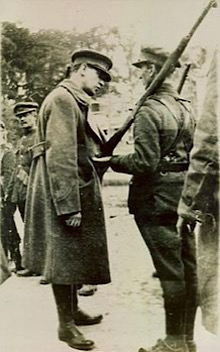
Nationalist forces enter Newcastle West, County Limerick, on Monday, August 7, 1922, after a twelve-hour battle, in which twelve anti-Treaty Irish Republican Army (IRA) members, sometimes referred to as Irregulars, are killed. The casualties of the Nationalists are less than those of the Irregulars.
Taking little respite after Sunday’s labors, the Nationals advance from Rathkele on Monday morning, and by midday are in sight of their fresh objective. Armored cars enter the town and machine gun fire is directed against a party of Irregulars, causing many casualties.
When the artillery goes into action against the headquarters of the Irregulars, the Irregulars flee precipitately along Cord road.
Owing to the slow progress in the operations in Southern Ireland, the meeting of Dáil Éireann, scheduled to open Saturday, is postponed again.
The official army bulletin announces that the Nationals captured Castle Island on Saturday, August 5. It says that the counties of Cork and Kerry with a part of South Tipperary and a small area in County Waterford are the only districts held by the Irregulars with any degree of security.
The streets of Dublin are lined with great crowds of people on Tuesday, August 8, for the military funeral of nine National Army soldiers who were killed in fighting the Republican Irregulars in County Kerry. Michael Collins, Chairman of the Provisional Government, and all the leading officers of the army in Dublin march beside the hearses. Each coffin is covered with the Republican tricolour. There are many clergymen and other civilians in the funeral procession.
Prominent Catholics of Dublin and Belfast are trying to effect a better understanding between the Ulster and Free State Governments, according to the Daily Mail. This newspaper further states that all efforts to this end, which have all been taken with the advice and approval of leading English Catholics, are without official character.
A message from Strabane, County Tyrone, received by the Exchange Telegraph Company on August 8 states that a settlement between the Ulster Government and the Free State authorities is imminent, the terms of agreement having been practically arranged in negotiations proceeding in London.
In Downing Street, however, all knowledge of any such Irish negotiations is disclaimed and a telegram from Belfast quotes Ulster Government officials as denying that a settlement with the Free State is imminent.
The Free State Government is also unaware of any negotiations for a settlement between the Ulster Government and the Free State authorities. It is further states that such negotiations are unlikely to take place.
(From: “Irish Irregulars Routed With Loss,” The New York Times, August 9, 1922 | Pictured: General Michael Collins inspects a soldier at Newcastle West, County Limerick, August 8, 1922)
MacDermott is born in Belfast on April 12, 1896, the third surviving son and sixth of seven children of the Reverend John MacDermott DD, a Presbyterian clergyman who is minister of Belmont and moderator of the Presbyterian Church in Ireland, and of his wife Lydia Allen MacDermott (née Wilson), the daughter of a Strabane solicitor. He is educated at Campbell College, Belfast, from where he wins a scholarship to read Law at the Queen’s University Belfast (QUB) in 1914.
Eight years later MacDermott is appointed to determine industrial assurance disputes in Northern Ireland, and in 1931 becomes a lecturer in Jurisprudence at Queen’s University Belfast, teaching for four years.
In 1940, MacDermott is appointed Minister of Public Security in the Government of Northern Ireland, and the following year becomes the Attorney General for Northern Ireland. He is succeeded in this post by William Lowry, whose son, Lord Lowry, would eventually succeed MacDermott as Lord Chief Justice. In 1944, he resigns his parliamentary seat on appointment as a High Court Judge for Northern Ireland, and three years later, on April 23, 1947, is made a Lord of Appeal in Ordinary, becoming a life peer as Baron MacDermott, of Belmont in the city of Belfast.
MacDermott returns from the House of Lords to take up his appointment as Lord Chief Justice of Northern Ireland. His successors to the latter office become Law Lords subsequently. Whilst Lord Chief Justice, he is affectionately known as “the Baron.”
In 1977, aged over eighty, MacDermott offers to redeliver a lecture at the Ulster College, which had been interrupted by a bomb meant for him and which had severely wounded him.
Having been made a Northern Ireland Privy Counsellor seven years earlier, MacDermott is sworn of the British Privy Council in 1947.
Four years later, in 1951, MacDermott is appointed Lord Chief Justice of Northern Ireland, a post he holds for twenty years. He is also Pro-Chancellor of his alma mater from 1951 to 1969. In 1958, he chairs the commission on the Isle of ManConstitution. He dies at his home in Belfast on July 13, 1979.
In 1926, MacDermott weds Louise Palmer Johnston, later Lady MacDermott. Their son, Sir John MacDermott, is also sworn into the British Privy Council in 1987, as a Lord Justice of Appeal in Northern Ireland. He later became a Surveillance Commissioner for Northern Ireland.
The Battle of Glentaisie is fought in the north of Ulster on May 2, 1565. The result is a victory for Shane O’Neill over the Clan MacDonald of Dunnyveg. The conflict is a part of the political and military struggle for control of the north of Ireland, involving the English and occasionally the Scots. Although the MacDonalds are a Scottish family, based principally on the island of Islay in the Hebrides, they have long been associated with the Gaelic polity rather than the Kingdom of Scotland.
O’Neill assembles his army for the attack on the MacDonnells at the tower house of Feadan, at Fathom Mountain, near Newry. Traditionally, he “kept Easter” at Feadan, and an assembly of his clan would be unremarked until its size draws notice.
The MacDonnells expect O’Neill’s sizeable army to take some weeks to reach their territory on the Antrim coast. They start gathering as many warriors in the Highlands and Islands as they can muster. However, O’Neill advances with unprecedented speed. Within a week his army arrives at Edenduffcarrick.
Sorley Boy MacDonnell gathers a small holding force at a forward base at Cloughdonaghy. He attempts to stop O’Neill’s advancing army at Knockboy, a wooded pass in the hills above Broughshane. O’Neill sweeps Sorley’s ambush away, takes Cloughdonaghy and sends a force of cavalry to seize James MacDonald of Dunnyveg’s recently constructed Red Bay Castle. With the landing beaches at Waterfoot and Cushendall now controlled by O’Neill’s army, the first several hundred of MacDonnell’s men are compelled to land farther north. They land at Ballycastle beach to await the locally raised MacDonnnell army. Their plan is to await the arrival of their brother Alexander, the MacDonnell seneschal of Cantyre, who is assembling a second army composed from late comers to James of Dunnyveg’s army.
O’Neill does not permit the MacDonnells any time for their reinforcement to arrive. His advance guard continues to press the retreating MacDonnell army, who fall back from the beach through Ballycastle. They are driven past the area of the modern Diamond and well away from the river Tow, denying them the necessary water supply for a sizeable army.
Both armies set up camp for the night. O’Neill’s army occupies land at the centre of modern Ballycastle, between the modern Diamond and the river Tow, giving them full access to water. The combined MacDonnell army of around five hundred men occupy the exposed higher ground at Ramon, the ridge at the head of modern Castle Street, Ballycastle, where the Presbyterian Church now stands, with only a small well for their needs.
At very first light, O’Neill attacks uphill with a sudden onslaught led by his heavy Gallowglassinfantry. By forgoing the customary exchange of spears, darts, and arrows by the light infantry kernagh and Scots archers that customarily precede the usually decisive deployment of the Gallowglass corrughadh, or battalions, O’Neill surprises the MacDonnell army. The MacDonnell leaders try to rally their men, but after a violent interlude of some confusion, they break and flee over Knocklayd mountain in the direction of Glenshesk, heading back toward the beach at Cushendun. James of Dunnyveg is seriously wounded in the early fighting and his brother Angus MacDonnell is killed.
The attempt to flee by the old mountain road between Greenan and Ballypatrick Forest in an attempt to reach a possible landing place for their birlinns at Cushendun beach is finally stopped at a hollow at Legacapple. Sorley Boy and James are both taken prisoner. James dies of his wounds two months later at Castle Crocke, near Strabane. Their brother Alistair Og MacDonnell had landed at Rathlin, with the final levies raised in the Highlands and Islands, reputed to be nine hundred men. However, in the immediate aftermath of O’Neill’s decisive victory, Alistair can achieve nothing without a base on the mainland. O’Neill marches on along the north coast to mop up the MacDonnell garrisons and deny Alistair any foothold from which to launch a MacDonnell recovery. Dunseverick and Dunluce fall within a few days, and Alistair returns to Scotland.
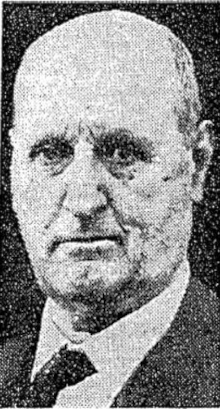
Barnhill, a right‐wing member of the Protestant‐based Ulster Unionist Party (UUP), which rules the British province, is the first member of the Parliament of Northern Ireland to die in two years of violence that have resulted in 196 deaths up to this point.
Barnhill’s wife says that the senator had gone to answer the door at their home, close to the border with the Republic of Ireland. She says she heard two shots and found her husband lying near the door with a gunman kneeling at his side. Then, she says, a second man helps drag him into the main room, where the attackers plant a gelignite bomb beside his body.
Barnhill, 63 years old, has been a Senator for ten years. He often is outspoken in public denunciations of the outlawed Irish Republican Army (IRA) for its terrorist campaign to overthrow the provincial government. He is an officer in the Orange Order, the powerful Freemasonry of Northern Ireland Protestants, and a director of a Londonderry seed company.
The police say that Mrs. Barnhill ran for help from the ruins of her home and is admitted to a hospital under treatment for shock.
At least 28 people die in the violence of the previous nine days, fifteen of them in an explosion on December 4 that wrecks a bar in a Roman Catholic area.
The leadership of the Irish Republican Army disclaims responsibility for the bombs and charges that they were set off as acts of provocation by the British Army. The British dismiss the charge as ludicrous.
The IRA, fighting for the separation of predominantly Protestant Northern Ireland from Britain and its merger with the Republic of Ireland to the south, has threatened to destroy Belfast‘s center by Christmas. Mass arrests fail to halt the latest wave of violence.
Preaching in St. Patrick’s Cathedral, Armagh, Ireland’s ecclesiastical capital, the Belfast‐born Cardinal delivers his toughest attack yet on the latest incidents, which include the fatal shooting of a parttime soldier in his home in front of his five children, and the bombing the previous day of a Protestant‐owned Belfast furniture showroom, in which four people are killed and nineteen are injured.
A plaque commemorating Barnhill’s murder is unveiled at Stormont on the 30th anniversary of his death on December 12, 2001.
(From: “Rightist Ulster Senator Slain by Gunmen in Home,” The New York Times, http://www.nytimes.com, December 13, 1971)
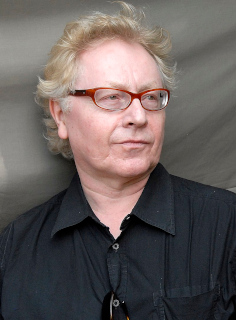
Paul Joseph Brady, Irish singer-songwriter and musician, is born in Belfast, Northern Ireland, on May 19, 1947. Interested in a wide variety of music from an early age, his work straddles folk and pop.
Brady begins learning piano around age six and by the age of eleven he has begun to play guitar, spending hours of his school holidays learning every song that the Shadows had recorded. He is also influenced by Chuck Berry.
In 1963, Brady begins performing as a piano player in a hotel in Bundoran, County Donegal. In October 1964, he attends University College Dublin and performs with a number of R&B groups, covering songs by the likes of Ray Charles and James Brown. The first of these is the Inmates (late 1964–about April 1965), which evolves into the Kult (about April–December 1965), featuring Brady, Jackie McAuley (ex-Them, and future Belfast Gypsies and Trader Horne), Brendan Bonass, and Dave Pennefather. He can be seen in the documentary film Charlie Is My Darling waiting outside Dublin‘s Adelphi Cinema for the Rolling Stones‘ concert of September 3, 1965. He next joins Rootzgroup (late 1965–May 1966) and Rockhouse (about May–December 1966).
During Brady’s time at college in Dublin, the country sees a huge rise in interest in traditional Irish music. He joins the popular Irish band The Johnstons when Michael Johnston leaves in May 1967. They move to London in 1969 and subsequently to New York City in 1972 to expand their audience. Despite some success, he returns to Ireland in 1974 to join the Irish group Planxty, the band that subsequently launches the solo careers of Andy Irvine, Liam O’Flynn, Dónal Lunny, and Christy Moore.
When Planxty disbands in late 1975, Brady forms a duo with Irvine from 1976 to 1978, a partnership that produces the successful album, Andy Irvine/Paul Brady. The next few years see him establish his popularity and reputation as one of Ireland’s best interpreters of traditional songs. His versions of ballads like “Arthur McBride” and “The Lakes of Pontchartrain” are considered definitive and are still popular at concerts today. In 1975 in New York, he records three albums for Shanachie Records as guitar accompanist to resident Irish fiddlers Andy McGann, Paddy Reynolds and John Vesey. He also records a 1976 album, The High Part of the Road, for the same label with Irish fiddler Tommy Peoples.
In 1978, Brady releases his first solo album, Welcome Here Kind Stranger, which wins him critical acclaim and is voted the “Folk Album of the Year” by Melody Maker magazine. However, it proves to be his last album covering traditional material. He decides to delve into pop and rock music and releases his first album of this genre in 1981, Hard Station.
Brady releases a number of successful solo albums throughout the 1980s: True for You (1983), Back to the Centre (1985), and Primitive Dance (1987). By the end of the decade, he is recognised and accepted as a respected performer and songwriter. His songs are being covered by a number of other artists, including Santana and Dave Edmunds.
Dylan is sufficiently impressed by Brady’s work to name-check him in the booklet of his 1985 box set, Biograph. The actual quote is “(…) people get too famous too fast these days and it destroys them. Some guys got it down – Leonard Cohen, Paul Brady, Lou Reed, secret heroes, John Prine, David Allen Coe, Tom Waits. I listen more to that kind of stuff than whatever is popular at the moment. They’re not just witchdoctoring up the planet, they don’t set up barriers (…)”.
In 1991, Brady reaches number 5 in the Irish Singles Chart with Nobody Knows.
Since his Hard Station album (1981), Brady is on various major labels until he creates his own label, PeeBee Music, in the late 1990s. He releases three albums in the 1990s: Trick or Treat, Songs & Crazy Dreams (a remixed compilation of earlier songs) and Spirits Colliding, which are met with critical acclaim. Trick or Treat is on Fontana/Mercury Records and receives a lot of promotion. As a result, some critics consider it his debut album and note that the record benefits from the expertise of experienced studio musicians, as well as producer Gary Katz, who works with the rock group Steely Dan. Rolling Stone, after praising his earlier but less-known solo records, calls Trick or Treat Brady’s “most compelling collection.”
Brady goes on to record several other albums, fifteen in total since going solo in 1978, and collaborates with a number of other established musicians including Bonnie Raitt and Richard Thompson. In 2006, he collaborates with Cara Dillon on the track “The Streets of Derry” from her album After the Morning. He also works with Fiachra Trench.
Brady’s fifteenth studio album, Hooba Dooba, is released in March 2010.
In 2017, a friendship is struck with Theo Katzman (Vulfpeck) and Brady tours Ireland in 2019 as half of this duo with Joe Dart, also of vulfpeck, Louis Cato and Lee Pardini. He continues to tour, record and collaborate with other artists. In 2019, Jimmy Buffett begins performing a cover of Brady’s hit, “The World is What you Make It.” In September 2019, Brady joins Buffett on his tour stops in both Dublin and London.
Brady releases the album Unfinished Business on his own label, PeeBee Music, licensed to Proper Music UK, in 2017.
While Brady and Andy Irvine’s planned tour of their 1976 album Andy Irvine/Paul Brady is impacted by the COVID-19 pandemic, they finish the tour in 2022. Musicians to join them on the tour include fiddle player Kevin Burke and multi-instrumentalist Dónal Lunny, both of whom had played on the original album.
In 2009, Brady receives an honorary degree of Doctor of Letters from the University of Ulster, in recognition of his services to traditional Irish music and songwriting.
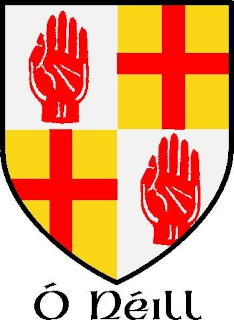
Shane O’Neill had, in the previous 20 years, eliminated his rivals within the O’Neills and asserted his authority over neighbouring clans (or “septs“) the MacDonnells of Antrim in battle and O’Donnells by kidnapping the O’Donnell leader Calvagh, in Donegal. In 1566, the English Lord Deputy of Ireland, Henry Sidney, gives support to the O’Donnells by ransoming the long tortured Calvagh O’Donnell, against O’Neill who is regarded as a destabilising and anti-English power in the north of Ireland. O’Neill forces out these English troops, but the new O’Donnell chieftain, Hugh O’Donnell, who takes over after the long tortured Calvagh dies, takes the opportunity to assert his independence and raids O’Neill’s lands at Strabane. In response, O’Neill musters his armed forces and marches into O’Donnell territory.
O’Neill crosses into Tir Connell (O’Donnell territory) the traditional way by crossing the River Swilly at an Fearsaid mhór (known as Porterfields today), about 3 km (2 miles) east of the modern town of Letterkenny. O’Donnell has advance warning of this impending incursion so has prepared for the forthcoming attack by dispatching messengers to all his people. Both sides are not equal in size. O’Neills army is estimated at 2,000 men and are composed of cavalry (Nobility), Gallowglass, kearn and a small body of English soldiers who have deserted to him to provide modern weapon skills to his host. O’Donnell’s initial force is only about 40-foot and 80 horse (his personal guard).
O’Donnell’s horsemen harass O’Neill’s men immediately after his fording of the river, leaving O’Donnell a short breathing space to locate his small force in a more defensible position, at Magherennan (near today’s entrance to the Letterkenny Rugby club). When their lord is in position the O’Donnell cavalry withdraws and there O’Donnell awaits his reinforcements. While his opponent waits, O’Neill sets up his camp in Cluain Aire beside the river to cover the ford. When O’Donnell’s troops finally arrive, they number 400 Gallowglass from all the MacSweeney septs. With this virtual parity in the usually decisive heavy infantry, the O’Donnell host proceeds to advance on O’Neill’s camp. When first perceiving their attack, Shane says, “It is very wonderful and amazing to me that those people should not find it easier to make full concessions to us, and submit to our awards, than thus come forward to us to be immediately slaughtered and destroyed.”
This statement, made just as the armies meet, is possibly a late attempt to put heart into his own surprised army. Significantly, the main O’Donnell war host has employed rising ground to successfully cover their advance until it is far too late for O’Neill to deploy his own Gallowglass spars into proper line of battle to hold the enemy while the O’Neill horse mount up. The O’Neill army are caught utterly unprepared, in much the same way as O’Neill himself had taken a MacDonnell host by surprise at Glentaisie in 1565. Despite the element of surprise and O’Neill’s lack of manoeuvre room, the resistance of the surprised O’Neill Gallowglass in this encounter battle is at first successful for the Four Masters state that the action lasted “for a long time.” Eventually, with their loose protective screen of Gallowglass cut down, a panicked rout of Shane’s force ensues. The O’Donnell pressure of attack continues so fiercely that the broken O’Neill host is forced back on the ford and attempts to recross the Swilly. As the tide is now coming in, many of them drown in the speeding rush of waters. O’Neill’s losses are estimated by their enemies at 1,400 men killed and no prisoners are mentioned, although the English sources note a more credible total of 680 dead. With many of his most senior commanders and advisors killed amid the chaos of the first onslaught, O’Neill himself escapes the final slaughter with the timely aid of a party of the Gallaghers. They guide him to Ath an Tairsi (Ford of protection), near Crieve Smith in Oldtown today, where they escort him to his own territory and relative safety.
Many of the Donnelleys, Shane’s foster family and the source of his strongest support, defend him to the last and are decimated at Farsetmore. Abandoned by his tanisté and all of his Urríthe, literally under-kings, and with the destruction of his army, the “most powerful force Gaelic Ireland had yet witnessed,” Shane begins looking for a mercenary force to sustain him until he can make good his losses. With all other options closed, he turns to a warband hired to fight against him the previous winter by William Piers from among the MacDonald’s of Dunnyveg. He arrives at their camp at Cushendun with a small retinue and during their negotiations an altercation occurs, in which Shane is killed. Despite being engineered by Piers, this assassination has gone down in history as retribution for Shane’s military action against the MacDonalds in 1565. Shane is buried in a place called CrossSkern Church at Ballyterrim townland in the hills above Cushendun. Later his remains are exhumed with his head then being sent to Dublin.
(Pictured: An artist’s impression of an O’Donnell gallowglass dispatching an O’Neill kern in the waters of the Swilly, with Glebe Hill in the background, May 8, 1567)
To seek to achieve unity among the Irish people on the issue of restoring national sovereignty and to promote the revolutionary ideals of republicanism and to this end involve itself in resisting all forms of colonialism and imperialism.
To seek the immediate and unconditional release of all Irish republican prisoners throughout the world.
The 32CSM does not contest elections but acts as a pressure group, with branches, or cumainn, organised throughout the traditional counties of Ireland. It has been described as the “political wing” of the now defunct Real Irish Republican Army (Real IRA or RIRA), but this is denied by both organisations. The group originates in a split from Sinn Féin over the Mitchell Principles.
The organisation is founded on December 7, 1997, at a meeting of like-minded Irish republicans in the Dublin suburb of Finglas. Those present are opposed to the direction taken by Sinn Féin and other mainstream republican groups in the Northern Ireland peace process, which eventually leads to the Good Friday Agreement, also known as the Belfast Agreement, the following year. The same division in the republican movement leads to the paramilitary group now known as the Real IRA breaking away from the Provisional Irish Republican Army at around the same time.
Most of the 32CSM’s founders had been members of Sinn Féin, with some having been expelled from the party for challenging the leadership’s direction, while others felt they had not been properly able to air their concerns within Sinn Féin at the direction its leadership had taken. Bernadette Sands McKevitt, wife of Michael McKevitt and a sister of hunger strikerBobby Sands, is a prominent member of the group until a split in the organisation.
The name refers to the 32 counties of Ireland which were created during the Lordship of Ireland and Kingdom of Ireland. With the partition of Ireland in 1920–22, twenty-six of these counties form the Irish Free State which is abolished in 1937 and is now known as Ireland since 1949. The remaining six counties of Northern Ireland remain part of the United Kingdom. Founder Bernadette Sands McKevitt says in a 1998 interview with The Mirror that people did not fight for “peace” – “they fought for independence” – and that the organisation reaffirms to the republican position in the 1919 Irish Declaration of Independence.
Before the referendums on the 1998 Good Friday Agreement, the 32CSM lodges a legal submission with the United Nations challenging British sovereignty in Ireland. The referendums are opposed by the 32CSM but are supported by 71% of voters in Northern Ireland and by 94% in the Republic of Ireland. It is reported in February 2000 that the group had established a “branch” in Kilburn, London.
In November 2005, the 32CSM launches a political initiative titled Irish Democracy, A Framework for Unity.
On May 24, 2014, Gary Donnelly, a member of the 32CSM, is elected to the Derry and Strabane super council. In July 2014, a delegation from the 32CSM travels to Canada to take part in a six-day speaking tour. On arrival the delegation is detained and refused entry into Canada.
In 2015, the 32CSM organises a demonstration in Dundee, Scotland, in solidarity with the men convicted of shooting Constable Stephen Carroll, the first police officer to be killed in Northern Ireland since the formation of the PSNI. The organisation says the “Craigavon Two” are innocent and are victims of a miscarriage of justice.
The 32CSM also operates outside of the island of Ireland to some extent. The Gaughan/Stagg Cumann covers England, Scotland and Wales, and has an active relationship of mutual promotion with a minority of British left-wing groups and anti-fascist organisations. The James Larkin Republican Flute Band in Liverpool and the West of Scotland Band Alliance, the largest section of which is the Glasgow-based Parkhead Republican Flute Band, are also supporters of the 32CSM. As of 2014, the 32CSM’s alleged paramilitary wing, the Real IRA, is reported to still be involved in attempts to perpetrate bombings in Britain as part of the dissident Irish republican campaign, which has been ongoing since 1998.
The 32CSM is currently considered a foreign terrorist organization (FTO) in the United States, because it is considered to be inseparable from the Real IRA, which is designated as an FTO. At a briefing in 2001, a spokesman for the U.S. Department of State states that “evidence provided by both the British and Irish governments and open-source materials demonstrate clearly that the individuals who created the Real IRA also established these two entities to serve as the public face of the Real IRA. These alias organizations engage in propaganda and fundraising on behalf of and in collaboration with the Real IRA.” The U.S. Department of State’s designation makes it illegal for Americans to provide material support to the Real IRA, requires U.S. financial institutions to block the group’s assets and denies alleged Real IRA members travel visas into the United States.
O’Nolan writes prodigiously during his years as a student at University College, Dublin (UCD), where he is an active, and controversial, member of the well-known Literary and Historical Society. He contributes to the student magazine Comhthrom Féinne (Fair Play) under various guises, in particular the pseudonym Brother Barnabas. Significantly, he composes a story during this same period titled “Scenes in a Novel (probably posthumous) by Brother Barnabas”, which anticipates many of the ideas and themes later to be found in his novel At Swim-Two-Birds.
In 1934 O’Nolan and his student friends found a short-lived magazine called Blather. The writing here, though clearly bearing the marks of youthful bravado, again somewhat anticipates O’Nolan’s later work, in this case his Cruiskeen Lawn column as Myles na gCopaleen. Having studied the German language in Dublin, he may have spent at least parts of 1933 and 1934 in Germany, namely in Cologne and Bonn, although details are uncertain and contested.
A key feature of O’Nolan’s personal situation is his status as an Irish government civil servant, who, as a result of his father’s relatively early death, is obliged to support ten siblings, including an elder brother who is an unsuccessful writer. Given the desperate poverty of Ireland in the 1930s to 1960s, a job as a civil servant is considered prestigious, being both secure and pensionable with a reliable cash income in a largely agrarian economy. The Irish civil service is fairly strictly apolitical, prohibiting Civil Servants above the level of clerical officer from publicly expressing political views. This fact alone contributes to his use of pseudonyms, though he had started to create character-authors even in his pre-civil service writings. He rises to be quite senior, serving as private secretary to Seán T. O’Kelly and Seán McEntee.
Although O’Nolan is a well-known character in Dublin during his lifetime, relatively little is known about his personal life. On December 2, 1948, he marries Evelyn McDonnell, a typist in the Department of Local Government. On his marriage he moves from his parental home in Blackrock to nearby Merrion Street, living at several further locations in South Dublin before his death. The couple has no children.
O’Nolan is an alcoholic for much of his life and suffers from ill health in his later years. He suffers from throat cancer and dies from a heart attack in Dublin on the morning of April 1, 1966. He is buried in Deans Grange Cemetery in Dublin.
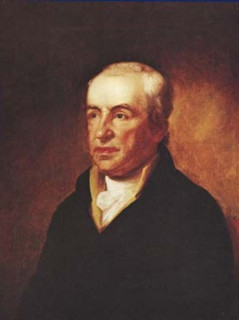
Dunlap is born in 1747 in Strabane, County Tyrone, in what is now Northern Ireland. When he is ten years old, he goes to work as an apprentice to his uncle, William Dunlap, a printer and bookseller in Philadelphia. In 1766, William Dunlap leaves the business in the care of his nephew, who eventually purchases the business. Initially he makes a living by printing sermons, broadsides and handbills. In November 1771, he begins the publication of the Pennsylvania Packet, or General Advertiser, a weekly newspaper. In 1773 he marries Elizabeth Hayes Ellison.
In 1776, Dunlap secures a lucrative printing contract for the Continental Congress. In July 1776, fighting between the American colonists and the British forces had been going on for over a year. On July 2, the Second Continental Congress votes on the Lee Resolution to secede. Two days later, they approve the final wording of a public declaration regarding their decision, which ultimately comes to be known as the Declaration of Independence. President of Congress John Hancock signs the fair copy with Secretary of Congress Charles Thomson attesting it. That evening Hancock orders Dunlap to print broadside copies of the declaration. He prints perhaps 200 broadsides, since known as the Dunlap broadsides, which are the first published versions of the Declaration.
Dunlap also prints items for Pennsylvania’s revolutionary government. In 1777 he takes over the printing of the Journals of the Continental Congress from Robert Aitken, but loses the contract in 1779 after printing in his newspaper a letter from Thomas Paine that leaks news of the secret French aid to the Americans.
In 1784, Dunlap’s paper becomes a daily with a new title: the North American and United States Gazette. It is not the first daily in the United States as the Pennsylvania Evening Post is the first in 1783, but it becomes the first successful daily.
Continuing to serve the changing needs of the government, Dunlap and his partner David Claypoole print the Constitution of the United States on September 19, 1787 for use by the Constitutional Convention, and later publish it for the first time in the Pennsylvania Packet.
Dunlap’s major financial success comes from real estate speculation. During the American Revolutionary War, he purchases property confiscated from Loyalists who refuse to take Pennsylvania’s new loyalty oath. After the war, he purchases land in Kentucky. By 1795, when he is forty-eight, he is able to retire with a sizable estate. Retirement does not agree with him, however. According to his friend, Dr. Benjamin Rush, he becomes a drunkard in his final years. He dies in Philadelphia on November 27, 1812.
O’Nolan writes prodigiously during his years as a student at University College, Dublin (UCD), where he is an active, and controversial, member of the well-known Literary and Historical Society. He contributes to the student magazine Comhthrom Féinne (Fair Play) under various guises, in particular the pseudonym Brother Barnabas. Significantly, he composes a story during this same period titled “Scenes in a Novel (probably posthumous) by Brother Barnabas”, which anticipates many of the ideas and themes later to be found in his novel At Swim-Two-Birds.
In 1934 O’Nolan and his student friends found a short-lived magazine called Blather. The writing here, though clearly bearing the marks of youthful bravado, again somewhat anticipates O’Nolan’s later work, in this case his Cruiskeen Lawn column as Myles na gCopaleen. Having studied the German language in Dublin, he may have spent at least parts of 1933 and 1934 in Germany, namely in Cologne and Bonn, although details are uncertain and contested.
A key feature of O’Nolan’s personal situation is his status as an Irish government civil servant, who, as a result of his father’s relatively early death, is obliged to support ten siblings, including an elder brother who is an unsuccessful writer. Given the desperate poverty of Ireland in the 1930s to 1960s, a job as a civil servant is considered prestigious, being both secure and pensionable with a reliable cash income in a largely agrarian economy. The Irish civil service is fairly strictly apolitical, prohibiting Civil Servants above the level of clerical officer from publicly expressing political views. This fact alone contributes to his use of pseudonyms, though he had started to create character-authors even in his pre-civil service writings. He rises to be quite senior, serving as private secretary to Seán T. O’Kelly and Seán McEntee.
Although O’Nolan is a well-known character in Dublin during his lifetime, relatively little is known about his personal life. On December 2, 1948, he marries Evelyn McDonnell, a typist in the Department of Local Government. On his marriage he moves from his parental home in Blackrock to nearby Merrion Street, living at several further locations in South Dublin before his death. The couple has no children.
O’Nolan is an alcoholic for much of his life and suffers from ill health in his later years. He suffers from throat cancer and dies from a heart attack in Dublin on the morning of April 1, 1966.





 seamus dubhghaill