seamus dubhghaill

Promoting Irish Culture and History from Little Rock, Arkansas, USA


Leave a comment

Birth of James FitzJames Butler, 2nd Duke of Ormonde

James FitzJames Butler, 2nd Duke of Ormonde, KG, Irish statesman and soldier, is born into a Protestant family on April 29, 1665, at Dublin Castle. He is the third of the Kilcash branch of the family to inherit the earldom of Ormond. He serves in the campaign to put down the Monmouth Rebellion, in the Williamite War in Ireland, in the Nine Years’ War and in the War of the Spanish Succession but is accused of treason and goes into exile after the Jacobite rising of 1715.

Butler is the second but eldest surviving son, and one of eleven children, of Thomas Butler by his wife Emilia van Nassau-Beverweerd. His father is known as Lord Ossory. His father is heir apparent of James Butler, 1st Duke of Ormond but predeceases him and so never becomes duke. His father’s family, the Butler dynasty, is Old English and descends from Theobald Walter, who had been appointed Chief Butler of Ireland by King Henry II in 1177. His mother is Dutch. She descends from a cadet branch of the House of Nassau.

Butler is educated in France and afterwards at Christ Church, Oxford. On the death of his father on July 30, 1680, he becomes Baron Butler in the peerage of England and the 7th Earl of Ossory in the peerage of Ireland.

Butler obtains command of a cavalry regiment in Ireland in 1683 and having received an appointment at court on the accession of James II, he serves against the Duke of Monmouth at the Battle of Sedgemoor in July 1685. Having succeeded his grandfather as 2nd Duke of Ormonde on July 21, 1688, he is appointed a Knight of the Order of the Garter on September 28, 1688. In 1688, he also becomes Chancellor of the University of Dublin and Chancellor of the University of Oxford.

In January and February 1689, Butler votes against the motion to put William of Orange and Mary on the throne and against the motion to declare that James II has abdicated it. Nevertheless, he subsequently joins the forces of William of Orange, by whom he is made colonel of the 2nd Troop of Horse Guards on April 20, 1689. He accompanies William in his Irish campaign, debarking with him in Carrickfergus on June 14, 1690, and commands this troop at the Battle of the Boyne in July 1690. In February 1691 he becomes Lord Lieutenant of Somerset.

Butler serves on the continent under William of Orange during the Nine Years’ War and, having been promoted to major general, he fights at the Battle of Steenkerque in August 1692 and the Battle of Landen in July 1693, where he is taken prisoner by the French and then exchanged for the Duke of Berwick, James II’s illegitimate son. He is promoted to lieutenant general in 1694.

After the accession of Queen Anne in March 1702, Butler becomes commander of the land forces co-operating with Sir George Rooke in Spain, where he fights in the Battle of Cádiz in August 1702 and the Battle of Vigo Bay in October 1702 during the War of the Spanish Succession (1701–1714). Having been made a Privy Councillor, he succeeds Lord Rochester as Lord Lieutenant of Ireland in 1703. In 1704, he leases and rebuilds a property that becomes known as Ormonde Lodge in Richmond outside London.

Following the dismissal of the Duke of Marlborough, Butler is appointed Commander-in-Chief of the Forces and colonel of the 1st Regiment of Foot Guards on January 4, 1712, and Captain General on February 26, 1712. In the Irish Parliament he and the majority of peers support the Tory interest.

Butler plays a dramatic role at the notorious meeting of the Privy Council on March 8, 1711, when Antoine de Guiscard, a French double agent who is being questioned about his treasonable activities, attempts to assassinate Robert Harley, 1st Earl of Oxford, against whom he has a personal grudge for drastically cutting his allowance, by stabbing him with a penknife. Harley is wounded, but not seriously, due largely to the fact that he is wearing a heavy gold brocade waistcoat in which the knife gets stuck. Several Councillors, including Butler, stab Guiscard in return. Guiscard implores Butler to finish the deed, but he replies that it is not for him to play the hangman. In any case, he has the sense to see that Guiscard must be kept alive at least long enough to be questioned, although as it turns out Guiscard’s wounds are fatal, and he dies a week later.

On April 23, 1712, Butler leaves Harwich for Rotterdam to lead the British troops taking part in the war. Once there he allows himself to be made the tool of the Tory ministry, whose policy is to carry on the war in the Netherlands while giving secret orders to him to take no active part in supporting their allies under Prince Eugene. In July 1712, he advises Prince Eugene that he can no longer support the siege of Le Quesnoy and that he is withdrawing the British troops from the action and instead intends to take possession of Dunkirk. The Dutch are so exasperated at the withdrawal of the British troops that they close the towns of Bouchain on Douai to British access, despite the fact that they have plenty of stores and medical facilities available. Butler takes possession of Ghent and Bruges as well as Dunkirk, in order to ensure his troops are adequately provided for. On April 15, 1713, he becomes Lord Lieutenant of Norfolk.

Ormonde’s position as Captain-General makes him a personage of much importance in the crisis brought about by the death of Queen Anne and, during the last years of Queen Anne, he almost certainly has Jacobite leanings and corresponds with the Jacobite Court including his cousin, Piers Butler, 3rd Viscount Galmoye, who keeps barrels of gunpowder at Kilkenny Castle. King George I, on his accession to the throne in August 1714, institutes extensive changes and excludes the Tories from royal favour. Butler is stripped of his posts as Captain-General, as colonel of the 1st Regiment of Foot Guards and as Commander in Chief of the Forces with the first two posts going to the Duke of Marlborough and the role of Commander-in-Chief going to John Dalrymple, 2nd Earl of Stair. On November 19, 1714, Butler is instead made a member of the reconstituted Privy Council of Ireland.

Accused of supporting the Jacobite rising of 1715, Butler is impeached for high treason by Lord Stanhope on June 21, 1715. He might avoid the impending storm of Parliamentary prosecution, if he remains in England and stands trial but instead, he chooses to flee to France in August 1715 and initially stays in Paris with Lord Bolingbroke. On August 20, 1715, he is attainted, his estate forfeited, and honours extinguished. The Earl Marshal is instructed to remove the names and armorial bearings of Butler and Bolingbroke from the list of peers and his banner as Knight of the Garter is taken down in St. George’s Chapel.

On June 20, 1716, the Parliament of Ireland passes an act extinguishing the regalities and liberties of the county palatine of Tipperary; for vesting Butler’s estate in the crown and for giving a reward of £10,000 for his apprehension, should he attempt to land in Ireland. But the same parliament passes an act on June 24, 1721, to enable his brother, Charles Butler, 1st Earl of Arran, to purchase his estate, which he does accordingly.

Butler subsequently moves to Spain where he holds discussions with Cardinal Giulio Alberoni. He later takes part in a Spanish and Jacobite plan to invade England and puts James Francis Edward Stuart on the British throne in 1719, but his fleet is disbanded by a storm in the Bay of Biscay. In 1732, he moves to Avignon, where he is seen in 1733 by the writer Lady Mary Wortley Montagu. He dies at Avignon in exile on November 16, 1745, but his body is returned to London and buried in Westminster Abbey on May 22, 1746.

On July 20, 1682, Butler, then called Lord Ossory, marries Lady Anne Hyde, daughter of Laurence Hyde, who is then Viscount Hyde of Kenilworth but becomes Earl of Rochester in November. The couple has a daughter, Mary, who dies young in 1688.

Following the death of his first wife in 1685, Butler plans to marry again in order to secure a male heir. He gains permission from the House of Lords for the arranging of a jointure for another marriage in May 1685, and in August of that year, he marries Lady Mary Somerset, daughter of the Duke of Beaufort and Mary Capel. The couple has a son, Thomas (1686–1689), and two daughters, Elizabeth (1689–1750) and Mary (1690–1713). His second wife is a Lady of the Bedchamber to Queen Anne. Their younger daughter, Mary, marries John Ashburnham, 1st Earl of Ashburnham.

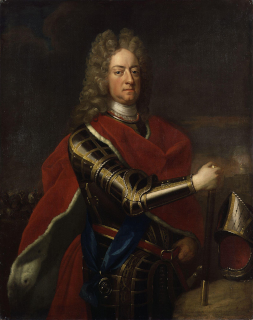
(Pictured: Portrait of James Butler, 2nd Duke of Ormonde, by Michael Dahl, National Portrait Gallery)

Leave a comment

Death of James Butler, 2nd Duke of Ormonde

James FitzJames Butler, 2nd Duke of Ormonde, KG, Irish statesman and soldier, dies in Avignon on November 16, 1745. He is the third of the Kilcash branch of the family to inherit the earldom of Ormond. He serves in the campaign to put down the Monmouth Rebellion, in the Williamite War in Ireland, in the Nine Years’ War and in the War of the Spanish Succession but is accused of treason and goes into exile after the Jacobite rising of 1715.

Butler is born into a Protestant family on April 29, 1665, at Dublin Castle. He is the second but eldest surviving son, and one of eleven children, of Thomas Butler by his wife Emilia van Nassau-Beverweerd. His father is known as Lord Ossory. His father is heir apparent of James Butler, 1st Duke of Ormond but predeceases him and so never becomes duke. His father’s family, the Butler dynasty, is Old English and descends from Theobald Walter, who had been appointed Chief Butler of Ireland by King Henry II in 1177. His mother is Dutch. She descends from a cadet branch of the House of Nassau.

Butler is educated in France and afterwards at Christ Church, Oxford. On the death of his father on July 30, 1680, he becomes Baron Butler in the peerage of England and the 7th Earl of Ossory in the peerage of Ireland.

Butler obtains command of a cavalry regiment in Ireland in 1683 and having received an appointment at court on the accession of James II, he serves against the Duke of Monmouth at the Battle of Sedgemoor in July 1685. Having succeeded his grandfather as 2nd Duke of Ormonde on July 21, 1688, he is appointed a Knight of the Order of the Garter on September 28, 1688. In 1688, he also becomes Chancellor of the University of Dublin and Chancellor of the University of Oxford.

In January and February 1689, Butler votes against the motion to put William of Orange and Mary on the throne and against the motion to declare that James II has abdicated it. Nevertheless, he subsequently joins the forces of William of Orange, by whom he is made colonel of the 2nd Troop of Horse Guards on April 20, 1689. He accompanies William in his Irish campaign, debarking with him in Carrickfergus on June 14, 1690, and commands this troop at the Battle of the Boyne in July 1690. In February 1691 he becomes Lord Lieutenant of Somerset.

Butler serves on the continent under William of Orange during the Nine Years’ War and, having been promoted to major general, he fights at the Battle of Steenkerque in August 1692 and the Battle of Landen in July 1693, where he is taken prisoner by the French and then exchanged for the Duke of Berwick, James II’s illegitimate son. He is promoted to lieutenant general in 1694.

After the accession of Queen Anne in March 1702, Butler becomes commander of the land forces co-operating with Sir George Rooke in Spain, where he fights in the Battle of Cádiz in August 1702 and the Battle of Vigo Bay in October 1702 during the War of the Spanish Succession (1701–1714). Having been made a Privy Councillor, he succeeds Lord Rochester as Lord Lieutenant of Ireland in 1703. In 1704, he leases and rebuilds a property that becomes known as Ormonde Lodge in Richmond outside London.

Following the dismissal of the Duke of Marlborough, Butler is appointed Commander-in-Chief of the Forces and colonel of the 1st Regiment of Foot Guards on January 4, 1712, and Captain General on February 26, 1712. In the Irish Parliament he and the majority of peers support the Tory interest.

Butler plays a dramatic role at the notorious meeting of the Privy Council on March 8, 1711, when Antoine de Guiscard, a French double agent who is being questioned about his treasonable activities, attempts to assassinate Robert Harley, 1st Earl of Oxford, against whom he has a personal grudge for drastically cutting his allowance, by stabbing him with a penknife. Harley is wounded, but not seriously, due largely to the fact that he is wearing a heavy gold brocade waistcoat in which the knife gets stuck. Several Councillors, including Butler, stab Guiscard in return. Guiscard implores Butler to finish the deed, but he replies that it is not for him to play the hangman. In any case, he has the sense to see that Guiscard must be kept alive at least long enough to be questioned, although as it turns out Guiscard’s wounds are fatal, and he dies a week later.

On April 23, 1712, Butler leaves Harwich for Rotterdam to lead the British troops taking part in the war. Once there he allows himself to be made the tool of the Tory ministry, whose policy is to carry on the war in the Netherlands while giving secret orders to him to take no active part in supporting their allies under Prince Eugene. In July 1712, he advises Prince Eugene that he can no longer support the siege of Le Quesnoy and that he is withdrawing the British troops from the action and instead intends to take possession of Dunkirk. The Dutch are so exasperated at the withdrawal of the British troops that they close the towns of Bouchain on Douai to British access, despite the fact that they have plenty of stores and medical facilities available. Butler takes possession of Ghent and Bruges as well as Dunkirk, in order to ensure his troops are adequately provided for. On April 15, 1713, he becomes Lord Lieutenant of Norfolk.

Ormonde’s position as Captain-General makes him a personage of much importance in the crisis brought about by the death of Queen Anne and, during the last years of Queen Anne, he almost certainly has Jacobite leanings and corresponds with the Jacobite Court including his cousin, Piers Butler, 3rd Viscount Galmoye, who keeps barrels of gunpowder at Kilkenny Castle. King George I, on his accession to the throne in August 1714, institutes extensive changes and excludes the Tories from royal favour. Butler is stripped of his posts as Captain-General, as colonel of the 1st Regiment of Foot Guards and as Commander in Chief of the Forces with the first two posts going to the Duke of Marlborough and the role of Commander-in-Chief going to John Dalrymple, 2nd Earl of Stair. On November 19, 1714, Butler is instead made a member of the reconstituted Privy Council of Ireland.

Accused of supporting the Jacobite rising of 1715, Butler is impeached for high treason by Lord Stanhope on June 21, 1715. He might avoid the impending storm of Parliamentary prosecution, if he remains in England and stands trial but instead, he chooses to flee to France in August 1715 and initially stays in Paris with Lord Bolingbroke. On August 20, 1715, he is attainted, his estate forfeited, and honours extinguished. The Earl Marshal is instructed to remove the names and armorial bearings of Butler and Bolingbroke from the list of peers and his banner as Knight of the Garter is taken down in St. George’s Chapel.

On June 20, 1716, the Parliament of Ireland passes an act extinguishing the regalities and liberties of the county palatine of Tipperary; for vesting Butler’s estate in the crown and for giving a reward of £10,000 for his apprehension, should he attempt to land in Ireland. But the same parliament passes an act on June 24, 1721, to enable his brother, Charles Butler, 1st Earl of Arran, to purchase his estate, which he does accordingly.

Butler subsequently moves to Spain where he holds discussions with Cardinal Giulio Alberoni. He later takes part in a Spanish and Jacobite plan to invade England and puts James Francis Edward Stuart on the British throne in 1719, but his fleet is disbanded by a storm in the Bay of Biscay. In 1732, he moves to Avignon, where he is seen in 1733 by the writer Lady Mary Wortley Montagu. He dies at Avignon in exile on November 16, 1745, but his body is returned to London and buried in Westminster Abbey on May 22, 1746.

On July 20, 1682, Butler, then called Lord Ossory, marries Lady Anne Hyde, daughter of Laurence Hyde, who is then Viscount Hyde of Kenilworth but becomes Earl of Rochester in November. The couple has a daughter, Mary, who dies young in 1688.

Following the death of his first wife in 1685, Butler plans to marry again in order to secure a male heir. He gains permission from the House of Lords for the arranging of a jointure for another marriage in May 1685, and in August of that year, he marries Lady Mary Somerset, daughter of the Duke of Beaufort and Mary Capel. The couple has a son, Thomas (1686–1689), and two daughters, Elizabeth (1689–1750) and Mary (1690–1713). His second wife is a Lady of the Bedchamber to Queen Anne. Their younger daughter, Mary, marries John Ashburnham, 1st Earl of Ashburnham.

(Pictured: Portrait of James Butler, 2nd Duke of Ormonde, by Michael Dahl, National Portrait Gallery)


Leave a comment

Murder of Nicholas Walsh, Church of Ireland Bishop of Ossory

Nicholas Walsh, (Irish: Nicolás Bhailis), Church of Ireland Bishop of Ossory and a pioneer of printing in Irish type, is murdered on December 14, 1585, by James Dullerde, against whom he had proceeded in his court for adultery.

Walsh is born in Waterford, County Waterford, in or before 1538. He is the son of Patrick Walsh, Bishop of Waterford and Lismore (d. 1578). The identity of his mother is unknown. She was Patrick’s concubine for many years and they apparently married only after 1558, meaning their son was born outside marriage. About 1551 Walsh leaves Ireland to study at the universities of Paris, Oxford, and Cambridge, eventually graduating BA at Cambridge in 1562 or 1563. He receives the MA from Cambridge in 1567. He is appointed chancellor of St. Patrick’s Cathedral, Dublin, in 1571.

As a fluent Irish speaker, Walsh is deeply committed to the propagation of the Protestant faith through the medium of the Irish language. In 1571 he helps to secure the publication in Dublin of a catechism written in Irish by John Kearney (Irish: Seán Ó Cearnaigh), whom he has known since his time at Cambridge. He then procures a government order for printing the Book of Common Prayer in Irish, and for the liturgy and a sermon to be communicated in Irish in a church in each large town. In practice this order has no effect. From about 1573 he and Kearney begin work on an Irish translation of the New Testament. This project is finally completed and published in 1602 or 1603. He also writes a collection of sermons in Latin.

In 1572 Walsh is offered the bishopric of Kilmacduagh in Connacht but declines as this diocese lay in a dangerous part of the country. In February 1578 he becomes Bishop of Ossory, upon which he resigns his chancellorship at St. Patrick’s Cathedral and presumably sets aside his translation of the New Testament. Through his family he has links with the area of his diocese, and he is assured of the protection of the dominant magnate, Thomas Butler, Earl of Ormond. However, Catholicism is very strong in Ossory, particularly in the diocesan capital of Kilkenny. His arrival at Kilkenny is ignored by the citizens, and he finds himself presiding over an empty St. Canice’s Cathedral during Sunday services. In November 1578 he writes for support to the Lord Justice of Ireland, Sir William Drury, who empowers Walsh to fine recusants. That month Drury comes to Kilkenny and heavily fines a number of prominent citizens of Kilkenny for recusancy. However, these punitive efforts have little long-term impact and only increased Walsh’s unpopularity.

Walsh is further hampered by a lack of revenues from his diocese, which leads him in April 1581 to seek additional benefices that he can hold in commendam. in July 1582 he seeks a licence to solicit charitable donations in England. He also initiates legal proceedings to recover church property. At a time when the Church of Ireland episcopate is characterised by venality, cynicism, and crypto-Catholicism, he stands head and shoulders above his colleagues owing to his dedication, ability, and evangelising zeal. At the installation of the Bishop of Meath in 1584 he criticises his fellow bishops for neglecting their spiritual duties for political concerns. He is married to an Englishwoman and has four children.

Walsh’s life comes to a violent end on December 14, 1585, when he is stabbed to death in his own house at Kilkenny by James Dullerde, whom he had cited for adultery in his consistory court. He is buried in a tomb in St. Canice’s Cathedral, Kilkenny. Dullerde is caught and beheaded by Domhnall Spanaigh Kavanagh MacMurrough and his brother Cahir Carroughe.

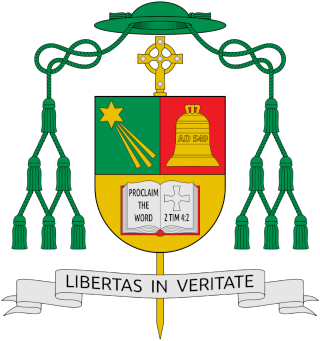
(From: “Walsh, Nicholas (Nicolás Bhailis)” by Anthony M. McCormack and Terry Clavin, Dictionary of Irish Biography, http://www.dib.ie, October 2009 | Pictured: Coat of arms of the Bishop of Ossory)


Leave a comment

Death of Richard Butler, Irish-born Officer in the Continental Army

Richard Butler, an Irish-born officer in the Continental Army during the American Revolutionary War, is killed on November 4, 1791, while fighting Native Americans in the United States in a battle that is known as St. Clair’s defeat.

Born on April 1, 1743, in St. Bridget’s Parish, Dublin, Butler is the oldest son of Thomas and Eleanor Butler (née Parker). His father is an Irish aristocrat who serves in the British Army. He is the brother of Colonel Thomas Butler and Captain Edward Butler. All three brothers serve in the American Revolution and in the Northwest Indian War against the Northwestern Confederacy of Native American tribes in the Northwest Territories. His two other brothers, William and Percival, serve in the Revolution but do not see later military service.

In 1748 Butler’s father opens a gun shop in Dublin, but that same year the family moves to Lancaster, Pennsylvania, where he learns to make the Pennsylvania long rifles used in the French and Indian War.

By 1760, the family moves to the frontier at Carlisle, Pennsylvania, where Thomas and his sons manufacture long rifles and become friends with Daniel Morgan. The Butler gun shop still stands in Carlisle.

By the 1770s, Butler and his brother William are important traders at Fort Pitt in Pennsylvania and in Ohio. Butler Street in Pittsburgh is named for them.

At the outset of the American Revolution, the Continental Congress names Butler a commissioner in 1775 to negotiate with the Indians. He visits representatives of the Delaware, Shawnee, and other tribes to secure their support, or at least neutrality, in the war with Britain.

On July 20, 1776, Butler is commissioned a major in the 8th Pennsylvania Regiment in the Continental Army, serving first as second in command to his friend Daniel Morgan. He is promoted to lieutenant colonel on March 12, 1777, retroactive to September 1776. On June 7, 1777, he is promoted to colonel and placed in command of 9th Pennsylvania Regiment.

During the war Butler sees action at the Battle of Saratoga (1777) and the Battle of Monmouth (1778). His four other brothers also serve and are noted for their bravery as the “fighting Butlers.” In January 1781 he is transferred to the 5th Pennsylvania Regiment and leads the Continental Army at the Battle of Spencer’s Ordinary.

At the conclusion of the Battle of Yorktown in October 1781, General George Washington confers on Butler the honor of receiving Cornwallis’ sword of surrender, an honor which he gives to his second in command, Ebenezer Denny. At the last moment, Baron von Steuben demands that he receive the sword. This almost precipitates a duel between Butler and Von Steuben.

At the victory dinner for his officers, George Washington raises his glass and toasts, “The Butlers and their five sons!”

Following Yorktown, Butler remains in the Continental Army and is transferred to the 3rd Pennsylvania Regiment following a consolidation of the Army on January 1, 1783. On September 30 of the same year, he is breveted as a brigadier general. He remains in active service with the Continental Army until it is finally disbanded on November 3, 1783.

In 1783 Butler and his brothers become original members of the Pennsylvania Society of the Cincinnati, a military society of officers who had served in the Continental Army.

After the war, the Confederation Congress puts Butler in charge of Indians of the Northwest Territory. He negotiates the Treaty of Fort Stanwix in 1784, in which the Iroquois surrender their lands. He is also called upon during later negotiations, such as the Treaty of Fort McIntosh in 1785.

Butler returns to Pennsylvania and is a judge in Allegheny County. He also serves in the state legislature. He marries Maria Smith, and they have four children, only one of whom lives to have children and continue the line. He also fathers a son, Captain Butler (or Tamanatha) with Shawnee chief Nonhelema. He and his Shawnee son fight in opposing armies in 1791.

In 1791, Butler is commissioned a major general in the levies (i.e. militiamen conscripted into Federal service) under Major General Arthur St. Clair to fight against the Western Confederacy of Native Americans in the Northwest Territories (modern day Ohio). He is killed in action on November 4, 1791, in St. Clair’s Defeat at what is now Fort Recovery, Ohio.

Reportedly Butler is first buried on the battlefield, which site is then lost until it is accidentally found years later. The remains are laid to rest with the remains of the other fallen at Fort Recovery.

Butler County, Ohio, where Fort Hamilton stood, is named for Richard Butler, as are Butler County, Kentucky, and Butler County, Pennsylvania. The city of Butler, Pennsylvania and the General Richard Butler Bridge, located in the city of Butler, are also named for him. A miniature portrait of Butler is painted by “The Painter of The Revolution,” Colonel John Trumbull, in 1790 and is in the collection of Yale University.

Butler is also honored in the name of General Richard Butler KYSAAR, Butler County, Kentucky recognized August 20, 2016. A chapter of the Sons of the American Revolution is named for him as as is the General Richard Butler Chapter of the Daughters of the American Revolution (DAR), founded in Butler, Pennsylvania.


Leave a comment

Death of James Butler, 1st Duke of Ormonde

James Butler, 12th Earl and 1st Duke of Ormond, dies on July 21, 1688, at the Kingston Lacy estate near Wimborne Minster, Dorset, England. An Anglo-Irish Protestant, he is the leading agent of English royal authority in Ireland during much of the period from the beginning of the English Civil War (1642–51) to the Glorious Revolution (1688–89).

Butler is born at Clerkenwell, London on October 19, 1610, into the prominent Butler family, the eldest child of Thomas Butler and his wife Elizabeth Poyntz. He grows up in England and succeeds to the earldom of Ormonde in 1633. That same year he begins his active career in Ireland by offering his services to Lord Deputy of Ireland Thomas Wentworth, later Earl of Strafford. Upon the outbreak of the Irish Rebellion of 1641 in Ireland, he is appointed a lieutenant general in the English army. He defeats the rebels of the Catholic Confederacy at Kilrush, Munster on April 15, 1642, and at New Ross, Leinster on March 18, 1643. Those triumphs, however, do not prevent the confederates from overrunning most of the country.

Butlers’s attempts to conclude a peace are blocked by a Catholic faction that advocates complete independence for Ireland. The situation deteriorates further, and in July 1647, he departs from Ireland, leaving the Protestant cause in the hands of the parliamentarians, who had defeated King Charles I in the First English Civil War (1642–46).

Returning to Ireland in September 1648, Butler concludes a peace with the confederacy in January 1649. He then rallies Protestant royalists and Catholic confederates in support of Charles II, son and successor of Charles I. For several months most of Ireland is under his control. But the parliamentarian general Oliver Cromwell lands at Dublin in August 1649 and swiftly conquers the country for Parliament. Butler flees to France and becomes one of Charles II’s closest advisers at his court-in-exile in Paris.

When Charles II returns to England in the Restoration of 1660, Butler, who had urged constitutional rather than military rule, is made commissioner for the treasury and the navy. Appointed Lord Lieutenant of Ireland in 1662, he makes vigorous attempts to encourage Irish commerce and industry. Nevertheless, his enemies at court persuade Charles to dismiss him in 1669. He is restored to royal favour in 1677 and is again appointed Lord Lieutenant of Ireland. Although he is created a duke in the English peerage in 1682, he is recalled from Ireland in 1684 as a result of new intrigues at Charles’s court and because of the determination of James, Duke of York, to strengthen his supporters in Ireland.

Butler dies on July 21, 1688, at the Kingston Lacy estate, Dorset. He is buried in Westminster Abbey on August 4, 1688. His eldest son, Thomas, 6th Earl of Ossory, predeceases him, but Ossory’s eldest son James succeeds as 2nd Duke of Ormonde (1665–1745).

(Pictured: “James Butler, 1st Duke of Ormond,” oil on canvas by William Wissing, National Portrait Gallery)


Leave a comment

Birth of Thomas Butler, 6th Earl of Ossory

Vice Admiral Thomas Butler, 6th Earl of Ossory, KG, PC, PC (Ire), Irish soldier and politician, is born on July 8, 1634, at Kilkenny Castle. He is the eldest son of James Butler, 1st Duke of Ormond, and Elizabeth Preston. He predeceases his father and therefore never becomes duke.

When Butler is born, his father is then the 12th Earl of Ormond but is raised to marquess and duke. His family, the Butler dynasty, is Old English and descends from Theobald Walter, who had been appointed Chief Butler of Ireland by King Henry II in 1177. His mother is a second cousin once removed of his father as she is a granddaughter of Black Tom, 10th Earl of Ormond. Her father, however, is Scottish, Richard Preston, 1st Earl of Desmond, a favourite of James I. Both parents are Protestants. They married on Christmas Day 1629.

Butler is one of ten siblings, eight brothers and two sisters, but five of the sons die in childhood. As the eldest living son, he is the heir apparent and is styled with the corresponding courtesy title, which at first is Viscount Thurles but changed to Earl of Ossory when his father becomes marquess in 1642. His early years are spent in Ireland until 1647 when he accompanies his father to England. In 1648 his father renews his support for the royalist cause and he and his son have to flee to France, arriving in Caen in February 1648. Lady Ormond also moves to Caen, where she arrives on June 23, 1648, with his siblings.

Butler is an accomplished athlete and a good scholar. Having come to London in 1652 he is rightly suspected of sympathising with the exiled royalists, and in 1655 is jailed by Oliver Cromwell. After his release about a year later he goes into exile to the Netherlands where Charles II has his exile court at the time.

On November 17, 1659, while in exile, Butler marries Emilia van Nassau, the second daughter of Louis of Nassau, Lord of De Lek and Beverweerd. They have eleven children, including two sons: James (1665–1745), who becomes the 2nd Duke of Ormonde in 1688; Charles (1671–1758), who becomes the de jure 3rd Duke of Ormonde following his elder brother’s attainder in 1715; Elizabeth (died 1717), who marries William Stanley, 9th Earl of Derby in 1673; Amelia (died 1760), who inherits the estates of her brother Charles and never marries; and Henrietta (died 1724), who marries Henry de Nassau d’Auverquerque, 1st Earl of Grantham.

Butler accompanies Charles II back to England in 1660. In 1661 he becomes a member of both the English and the Irish houses of commons, representing in the former Bristol and Dublin University in the latter.

In 1662 Butler is called to the Irish House of Lords under a writ of acceleration as the Earl of Ossory. His father holds the title “5th Earl of Ossory” as one of his subsidiary titles. The acceleration makes Thomas Butler the 6th Earl of Ossory. This is the only substantive title he ever holds, as he predeceases his father and therefore never succeeds to his father’s titles. His eldest son, however, would later become the 2nd Duke of Ormond and the 7th Earl of Ossory.

Butler holds several military appointments: lieutenant-general of the army in Ireland (appointed in 1665); created an English peer as Lord Butler (in 1666); Lord of the Bedchamber to Charles II (appointed in 1660), a post he holds until his death.

In 1665 a fortunate accident allows Butler to take part in the Battle of Lowestoft against the Dutch, and in May 1672, being now in command of a ship, he fights against the same enemies in the Battle of Solebay, serving with great distinction on both occasions. He is partly responsible for this latter struggle, as on March 12, 1672, before war is declared, he attacks the Dutch Smyrna fleet, an action which he greatly regrets later in life. While visiting France in 1672 he rejects the liberal offers made by Louis XIV to induce him to enter the service of France and returning to England he adds to his high reputation by his conduct during the Battle of Texel in August 1673. From 1677 until 1679, he serves alongside his father as a Lord of the Admiralty.

Butler is intimate with William, Prince of Orange, and in 1677 he joins the allied army in the Netherlands, commanding the British contingent and winning great fame at the siege of Mons in 1678. He acts as deputy for his father, who is Lord Lieutenant of Ireland, and in parliament he defends Ormond’s Irish administration with great vigour. In 1680 he is appointed governor of English Tangier, but his death prevents him from taking up his new duties.

Butler dies on July 30, 1680, at Arlington House in London. He is buried provisionally in Westminster Abbey on July 31, 1680. The ceremony of burial is performed belatedly on November 13, 1680. Some say Butler’s body is later taken to Ireland and reburied in the family vault in St. Canice’s Cathedral, Kilkenny. James, his eldest son, succeeds him as the 7th Earl of Ossory and in 1688 becomes the 2nd Duke of Ormond.

One of Butler’s most intimate friends is John Evelyn, who eulogises him in his Diary.

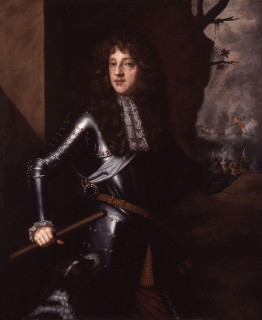
(Pictured: “Thomas Butler, Earl of Ossory” by Peter Lely, painting, circa 1678, National Portrait Gallery)


Leave a comment

Death of Thomas Butler, 6th Earl of Ossory

Vice Admiral Thomas Butler, 6th Earl of Ossory, KG, PC, PC (Ire), Irish soldier and politician, dies in London on July 30, 1680.

Thomas is born on July 8, 1634, at Kilkenny Castle, the eldest son and one of ten siblings of James Butler, 1st Duke of Ormond and his wife Elizabeth Preston. His father is then the 12th Earl of Ormond but would be raised to marquess and duke. His family, the Butler dynasty, is Old English and descends from Theobald Walter, who had been appointed Chief Butler of Ireland by Henry II of England in 1177. His mother is a second cousin once removed of his father as she is a granddaughter of Thomas Butler, 10th Earl of Ormond. Her father, however, is Scottish, Richard Preston, 1st Earl of Desmond, a favourite of James I. Both parents are Protestants.

As the eldest living son, he is the heir apparent and is styled with the corresponding courtesy title, which at first is Viscount Thurles but changed to Earl of Ossory when his father becomes marquess in 1642. His early years are spent in Ireland until 1647 when he accompanies his father to England. In 1648 his father renews his support for the royalist cause and he and his son have to flee to France, arriving in Caen in February 1648. Lady Ormond also moves to Caen, where she arrives on June 23, 1648, with his siblings.

Butler is an accomplished athlete and a good scholar. Having come to London in 1652 he is rightly suspected of sympathising with the exiled royalists, and in 1655 is jailed by Oliver Cromwell. After his release about a year later he goes into exile to the Netherlands where Charles II has his exile court at the time.

On November 17, 1659, while in exile, Butler marries Emilia van Nassau, the second daughter of Louis of Nassau, Lord of De Lek and Beverweerd. They have eleven children.

Butler accompanies Charles II back to England in 1660. In 1661 he becomes a member of both the English and the Irish houses of commons, representing in the former Bristol and Dublin University in the latter.

In 1662 Butler is called to the Irish House of Lords under a writ of acceleration as the Earl of Ossory. His father holds the title “5th Earl of Ossory” as one of his subsidiary titles. The acceleration makes Thomas Butler the 6th Earl of Ossory. This is the only substantive title he ever holds, as he predeceases his father and therefore never succeeds to his father’s titles.

Butler holds several military appointments including lieutenant-general of the army in Ireland, created an English peer as Lord Butler in 1666, and Lord of the Bedchamber to Charles II (appointed in 1660 and held until his death).

In 1665 a fortunate accident allows Butler to take part in the Battle of Lowestoft against the Dutch, and in May 1672, being now in command of a ship, he fights against the same enemies in the Battle of Solebay, serving with great distinction on both occasions. While visiting France in 1672 he rejects the liberal offers made by Louis XIV to induce him to enter the service of France and returning to England he adds to his high reputation by his conduct during the Battle of Texel in August 1673. From 1677 until 1679, he serves alongside his father as a Lord of the Admiralty.

Butler is intimate with William II, Prince of Orange, and in 1677 he joins the allied army in the Netherlands, commanding the British contingent and winning great fame at the siege of Mons in 1678. He acts as deputy for his father, who is Lord Lieutenant of Ireland. In 1680 he is appointed governor of English Tangier, but his death prevents him from taking up his new duties.

Butler dies on July 30, 1680, at Arlington House in London. He is buried provisionally in Westminster Abbey on July 31, 1680. The ceremony of burial is performed belatedly on November 13, 1680. Some say his body is later taken to Ireland and reburied in the family vault in St. Canice’s Cathedral, Kilkenny. James, his eldest son, succeeds him as the 7th Earl of Ossory and becomes the 2nd Duke of Ormond in 1688.

(Pictured: “Thomas Butler, Earl of Ossory,” painting by Peter Lely, circa 1678, Source: National Portrait Gallery)


Leave a comment

Birth of James Butler, 1st Duke of Ormond

James Butler, 12th Earl and 1st Duke of Ormond, is born at Clerkenwell, London on October 19, 1610. An Anglo-Irish Protestant, he is the leading agent of English royal authority in Ireland during much of the period from the beginning of the English Civil War (1642–1651) to the Glorious Revolution (1688–1689).

Butler is born into the prominent Butler family, the eldest child of Thomas Butler and his wife Elizabeth Poyntz. He grows up in England and succeeds to the earldom of Ormonde in 1633. That same year he begins his active career in Ireland by offering his services to Lord Deputy of Ireland Thomas Wentworth, later Earl of Strafford. Upon the outbreak of the Irish Rebellion of 1641 in Ireland, he is appointed a lieutenant general in the English army. He defeats the rebels of the Catholic confederacy at Kilrush, Munster on April 15, 1642, and at New Ross, Leinster on March 18, 1643. Those triumphs, however, do not prevent the confederates from overrunning most of the country.

Butlers’s attempts to conclude a peace are blocked by a Catholic faction that advocates complete independence for Ireland. The situation deteriorates further, and, in July 1647, he departs from Ireland, leaving the Protestant cause in the hands of the parliamentarians, who had defeated King Charles I in the first English Civil War (1642–1646).

Returning to Ireland in September 1648, Butler concludes a peace with the confederacy in January 1649. He then rallies Protestant royalists and Catholic confederates in support of Charles II, son and successor of Charles I. For several months most of Ireland is under his control. But the parliamentarian general Oliver Cromwell lands at Dublin in August 1649 and swiftly conquers the country for Parliament. Butler flees to France and becomes one of Charles II’s closest advisers at his court-in-exile in Paris.

When Charles II returns to England in the Restoration of 1660, Butler, who had urged constitutional rather than military rule, is made commissioner for the treasury and the navy. Appointed Lord Lieutenant of Ireland in 1662, he makes vigorous attempts to encourage Irish commerce and industry. Nevertheless, his enemies at court persuade Charles to dismiss him in 1669. He is restored to royal favour in 1677 and is again appointed Lord Lieutenant of Ireland. Although he is created a duke in the English peerage in 1682, he is recalled from Ireland in 1684 as a result of new intrigues at Charles’s court and because of the determination of James, Duke of York, to strengthen his supporters in Ireland.

Butler dies on July 21, 1688, at Kingston Lacy estate, Dorset. He is buried in Westminster Abbey on August 4, 1688. His eldest son, Thomas, 6th Earl of Ossory, predeceases him, but Ossory’s eldest son James succeeds as 2nd Duke of Ormonde (1665–1745).

(Pictured: “James Butler, 1st Duke of Ormond,” oil on canvas by William Wissing, National Portrait Gallery)