seamus dubhghaill

Promoting Irish Culture and History from Little Rock, Arkansas, USA


Leave a comment

The Lisburn Van Bombing

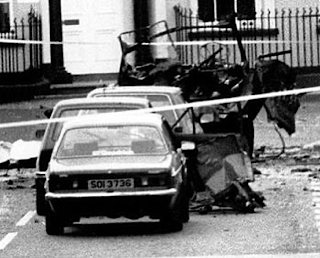
On June 15, 1988, an unmarked military van carrying six British Army soldiers is blown up by the Provisional Irish Republican Army (IRA) at Market Place in Lisburn, County AntrimNorthern Ireland. The explosion takes place at the end of a charity marathon run in which the soldiers had participated. All six soldiers are killed in the attack – four outright, one on his way to hospital and another later on in hospital.

Lisburn is the headquarters of the British Army in Northern Ireland. Four of the dead are from the Royal Corps of Signals while the other two are from the Green Howards and the Royal Army Ordnance Corps. A booby trap bomb is hidden under the Ford Transit van in which the soldiers are traveling, and is designed in such a way that the blast goes upward to cause maximum damage to the vehicle. Eleven civilian bystanders are injured, including a two-year-old child and 80-year-old man. The bombing is sometimes referred to as the Lisburn “Fun Run” bombing.

On Wednesday, June 15, 1988, at 8:50 p.m., an unmarked blue Ford Transit van carrying six off-duty British soldiers in civilian clothes drives off from a leisure centre carpark in Lisburn. The soldiers have just taken part in the “Lisburn Fun Run”, a 13-mile (21 km) charity half marathon held in the town. They leave the van unattended in the car park, which is the start and finish point for the run. It is there that an IRA active service unit (ASU), who has been following the van, hides a bomb underneath the vehicle. The half marathon and shorter “fun runs” are organised by Lisburn Borough Council, together with the YMCA, to raise funds for the disabled. There are 4,500 participants that day and at least 200 British Army personnel have been given leave to participate in the event.

Nine minutes later, the van stops at traffic lights at Market Place, in Lisburn’s town centre. As the van moves on, the seven-pound (3.2 kg) bomb detonates, turning the van into a massive fireball and instantly killing four of the soldiers as the vehicle disintegrates with the force of the blast. The Semtex device has been designed in a cone shape to channel the blast upward, thereby causing maximum damage to the vehicle and the soldiers inside. The area around Market Place is crowded with onlookers, including many teenagers and families with young children, although the biggest crowd is at the carpark. In all, about 10,000 onlookers have attended the charity run. There is pandemonium as frightened parents search for their children, while others rush to give aid to the dead and dying soldiers before fire engines and ambulances arrive.

Eleven civilian bystanders are injured in the attack, including a two-year-old child and an 80-year-old man. Another soldier dies on the way to hospital while a sixth soldier dies later that night after undergoing surgery for severe head injuries. The dead soldiers are stationed at Ebrington Barracks in Derry and are returning to base when the bomb goes off. Four of the men – Sergeant Michael Winkler (31), Signalman Mark Clavey (24), Lance Corporal Graham Lambie (22), and Corporal William Patterson (22) – are from the Royal Corps of Signals, while the other two – Corporal Ian Metcalf (36) and Lance Corporal Derek Green (20) – are from the Green Howards and Royal Army Ordnance Corps respectively.

Lisburn is a mainly Ulster Protestant town, 14 miles (23 km) southwest of Belfast. It serves as the garrison headquarters of the British Army in Northern Ireland. Six months before the van bombing, a booby trap bomb planted by the IRA kills Ulster Defence Association (UDA) leader John McMichael in the town.

The van bombing results in the greatest loss of life suffered by the British Army since eleven soldiers were killed in the Droppin Well Disco bombing on December 6, 1982.

In Belfast, on the same day as the Lisburn attack, the IRA shoots dead the Ulster Volunteer Force’s (UVF) East Belfast commander, Robert “Squeak” Seymour (33). This is retaliation for the UVF gun attack on an Irish nationalist pub in which three Catholics died.

On June 16, the Provisional IRA Belfast Brigade claims responsibility for the bombing, promising to wage “unceasing war” against the British security forces in Northern Ireland. Sinn Féin president Gerry Adams allegedly says that the IRA’s killing of the six soldiers is “vastly preferable” to killing members of the (locally recruited) Ulster Defence Regiment (UDR) or Royal Ulster Constabulary (RUC). The leisure centre is forced to remain shut for a time after the loyalist Protestant Action Force (a cover-name of the UVF) issues a warning that they regard Catholic staff working there as “legitimate targets,” inferring that they may have had a hand in the bombing. Lisburn mayor Councillor William Bleakes condemns the threats by the PAF.

That same day, Tom King, then Secretary of State for Northern Ireland, travels to Lisburn where he holds a meeting with Lieutenant General Sir John Waters, the British Army Commander in Northern Ireland, and senior RUC officers. They discuss the attack and proposals for heightened security. The soldiers had failed to follow proper security procedures, as they had left their vehicle unguarded for over two hours and had then driven off without having checked under it beforehand. After the Lisburn meeting, King flies to London where he reports directly to British Prime Minister Margaret Thatcher, who describes the attack as a “terrible atrocity.” However, she rejects demands from Conservative members of Parliament to bring back internment, regarding the proposal as “a very serious step.”

In his statement to the House of Commons, Tom King suggests that there would have been a much higher death toll had the bomb exploded in the carpark, where thousands of people had gathered after the run.

The Republic of Ireland‘s government also strongly condemns the killings and extends its sympathy to the families of the dead soldiers. The bombing is a topic of debate in the Seanad Éireann on June 16, 1988. Bishop Cahal Daly of the Roman Catholic Diocese of Down and Connor denounces the bombers and the killings in the “strongest possible terms.”

Questions are raised as to how the IRA knew the soldiers were attending the charity run in Lisburn, how they recognised their unmarked van, and how the unit was able to plant a bomb in the predominantly loyalist town without being spotted, despite the number of people in the carpark. The RUC believes that the bombers may have been wearing sports gear as they mingled with the crowd that evening. They appeal to onlookers who had attended the event to hand over any film they may have taken of the “fun run” in an attempt to identify the IRA bombers.

The following Saturday, between 1,000 and 2,000 people gather in Lisburn town centre to attend a remembrance service for the six soldiers. A book of condolences is also opened.

Leave a comment

The Ballygawley Bus Bombing

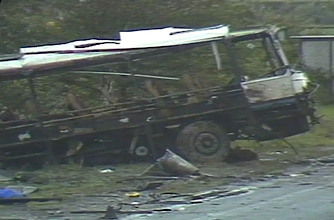
The Ballygawley bus bombing is a roadside bomb attack by the Provisional Irish Republican Army (IRA) on a bus carrying British soldiers in Northern Ireland. It occurs in the early hours of August 20, 1988, in the townland of Curr near Ballygawley, County Tyrone. The attack kills eight soldiers and wounds twenty-eight. In the wake of the bombing, the British Army begins ferrying its troops in and out of County Tyrone by helicopter.

The Irish Times reports that “This stretch of road has been a favourite ambush spot for successive generations of IRA men since the 1920s.” The Provisional IRA has been attacking British Army patrols and convoys with roadside bombs regularly since the beginning of the Troubles in the early 1970s. Most of these attacks take place in rural parts of Northern Ireland, especially eastern and southern County Tyrone (where the IRA’s Tyrone Brigade is active) and southern County Armagh (heartland of the South Armagh Brigade). In August 1979, the IRA ambushes a British Army convoy with two large roadside bombs near Warrenpoint, killing eighteen soldiers. This is the deadliest attack on the British Army in Northern Ireland during the Troubles. In December 1979, four more British soldiers are killed on Ballygawley Road in the Dungannon land mine attack. In May 1981, five British soldiers are killed when their Saracen APC is ripped apart by a roadside bomb at Altnaveigh, County Armagh. In July 1983, four Ulster Defence Regiment (UDR) soldiers are killed when their vehicle strikes an IRA land mine near Ballygawley, County Tyrone. In December 1985, the Tyrone IRA launches an assault on the police barracks in Ballygawley, shooting dead two officers and destroying the barracks with a bomb.

In June 1988, six off-duty British soldiers are killed when an IRA bomb explodes underneath their van in Lisburn. It had been attached to the van as the soldiers are taking part in a charity marathon.

On the night of August 19/20, 1988, an unmarked 52-seater bus is transporting 36 soldiers of The Light Infantry from Aldergrove Flying Station to a military base near Omagh. The soldiers, who came from England, have just finished 18 months of a two-year tour of duty in Northern Ireland and are returning to the base after a short holiday.

As it is driving along the main road from Ballygawley to Omagh, at about 12:30 a.m., IRA members remotely detonate a roadside bomb containing 200 pounds (91 kg) of Semtex. According to police, the bomb had been planted in a vehicle by the roadside and had been detonated by command wire from 330 yards (300 m) away. A statement by one of the survivors claims instead that the roadside bomb was made of “two fertilizer bags filled with Semtex.” The blast hurls the bus 30 metres down the road and throws the soldiers into neighbouring hedges and fields. It leaves a crater 6 feet deep and scatters body parts and twisted metal over a wide area. Witnesses describe finding dead, dying and wounded soldiers strewn on the road and caught in the wreckage of the bus. Others are walking around “stunned.” Some of the first to arrive on the scene and offer help are loyalist bandsmen of the Omagh Protestant Boy’s Band returning from a parade in Portadown, who have also been traveling in buses.

Eight of the soldiers are killed and the remaining 28 are wounded. The soldiers killed are: Jayson Burfitt (aged 19), Richard Greener (aged 21), Mark Norsworthy (aged 18), Stephen Wilkinson (aged 18), Jason Winter (aged 19), Blair Bishop (aged 19), Alexander Lewis (aged 18) and Peter Bullock (aged 21). This is the single biggest loss of life for the British Army from an IRA attack in Northern Ireland since the Warrenpoint ambush in 1979, although eleven off-duty British soldiers had been killed in the Droppin Well bombing in 1982, carried out by the Irish National Liberation Army (INLA). An account from one of the survivors is published in Ken Wharton‘s book A Long Long War: Voices from the British Army in Northern Ireland, 1969–98 (2008).

An inquest into the attack is told that the road is usually off-limits to military vehicles, due to the threat from the IRA. The driver of the bus, who is also a soldier, claims he had been directed on to the road by diversion signs. The inquest hears that signs had not been placed by the police or the roads service. The IRA denies placing any signs and says that military buses often use the road. The mother of one of those killed accuses the British military of negligence and claims it is “trying to conceal the truth.”

Shortly thereafter, the Provisional IRA issues a statement claiming responsibility. It says that the attack had been carried out by its Tyrone Brigade and adds: “We will not lay down our arms until the peace of a British disengagement from Ireland.” The security forces suspect that an informer may have told the IRA of the bus’s route and the time it would pass a specific spot. After the attack, the British military decides to start ferrying their troops to and from East Tyrone by helicopter to avoid any future attacks like this.

Tom King, then Secretary of State for Northern Ireland, says there is “some evidence” that the explosives used are part of a consignment from Libya. He also states that the possibility of reintroducing internment is “under review”. Libyan weaponry enables the IRA to mount some of its biggest operations during its campaign. The Ballygawley bus bombing is believed to be one of these attacks. One former IRA member later suggests that Semtex explosive was not crucial to the outcome of the attack, saying, “we were having plenty of success without Semtex… at Ballygawley we ‘only’ got eight, but it was a bus of about fifty-six. If we’d used a fertiliser bomb, the whole bus would have been destroyed.”

On August 30, 1988, three IRA members are ambushed and killed by the Special Air Service (SAS) at Drumnakilly, County Tyrone. According to author Nick Van der Bijl, the men—Gerard Harte, Martin Harte and Brian Mullin—are identified by British intelligence as the perpetrators of the bombing. Peter Taylor, instead, says that only Mullin is suspected, and that plans for the SAS operation were already underway at the time of the IRA attack.

Two months after the attack, the British Government introduces the broadcasting ban. It means that the voices of Sinn Féin and IRA members are not allowed to be broadcast on television or radio. The Ballygawley bus bombing is believed to have influenced the Government’s decision to introduce the ban.

According to state papers declassified in 2019, the attack sparks “panic” in the British Government, and tension between the Royal Ulster Constabulary (RUC) and the British Army over who is at fault for the security lapse. British Prime Minister Margaret Thatcher warns RUC chief, John Hermon, that she will no longer send British troops over “in waves to be killed.”


Leave a comment

The Downing Street Mortar Attack

The Downing Street mortar attack was carried out by the Provisional Irish Republican Army (IRA) on February 7, 1991. The IRA launches three homemade mortar shells at 10 Downing Street, London, the headquarters of the British government in an attempt to assassinate prime minister John Major and his war Cabinet, who were meeting to discuss the Gulf War.

During the Troubles, as part of its armed campaign against British rule in Northern Ireland, the Provisional Irish Republican Army repeatedly uses homemade mortars against targets in Northern Ireland. The IRA carries out many attacks in England, but none involve mortars. In December 1988, items used in mortar construction and technical details regarding the weapon’s trajectory are found during a raid in Battersea, South West London, by members of the Metropolitan Police Anti-Terrorist Branch. In the late 1980s, British Prime Minister Margaret Thatcher is top of the IRA’s list for assassination, following the failed attempt on her life in the Brighton hotel bombing.

Security around Downing Street is stepped up following increased IRA activity in England in 1988. Plans to leave a car bomb on a street near Downing Street and detonate it by remote control as Thatcher’s official car is driving by had been ruled out by the IRA Army Council owing to the likelihood of civilian casualties.

The Army Council instead sanctions a mortar attack on Downing Street and, in mid-1990, two IRA members travel to London to plan the attack. One is knowledgeable about the trajectory of mortars and the other, from the IRA’s Belfast Brigade, is familiar with their manufacture. An active service unit (ASU) purchases a Ford Transit van and rents a garage, and an IRA co-ordinator procures the explosives and materials needed to make the mortars. The IRA unit begins making the mortars and cutting a hole in the roof of the van for the mortars to be fired through. Once preparations are complete, the two IRA members return to Ireland, as the IRA leadership considers them valuable personnel and does not wish to risk them being arrested in any follow-up operation by the security services. In November 1990, Thatcher unexpectedly resigns from office, but the Army Council decides the planned attack should still go ahead, targeting her successor, John Major. The IRA plans to attack when Major and his ministers are likely to be meeting at Downing Street and wait until the date of a planned cabinet meeting is publicly known.

On the morning of February 7, 1991, the War Cabinet and senior government and military officials are meeting at Downing Street to discuss the ongoing Gulf War. As well as the Prime Minister, John Major, those present include politicians Douglas Hurd, Tom King, Norman Lamont, Peter Lilley, Patrick Mayhew, David Mellor and John Wakeham, civil servants Robin Butler, Percy Cradock, Gus O’Donnell and Charles Powell, and Chief of the Defence Staff David Craig. As the meeting begins, an IRA member is driving the van to the launch site at the junction of Horse Guards Avenue and Whitehall, about 200 yards from Downing Street.

On arrival, the driver parks the van and leaves the scene on a waiting motorcycle. Several minutes later, at 10:08 AM, as a policeman is walking towards the van to investigate it, three mortar shells are launched from a Mark 10 homemade mortar, followed by the explosion of a pre-set incendiary device. This device is designed to destroy any forensic evidence and set the van on fire. Each shell is four and a half feet long, weighs 140 pounds, and carries a 40-pound payload of the plastic explosive Semtex. Two shells land on Mountbatten Green, a grassed area near the Foreign and Commonwealth Office. One explodes and the other fails to detonate. The third shell explodes in the back garden of 10 Downing Street, 30 yards from the office where the cabinet is meeting. Had the shell struck 10 Downing Street itself, it is likely the entire cabinet would have been killed. On hearing the explosion, the cabinet ducks under the table for cover. Bomb-proof netting on the windows of the cabinet office muffle the force of the explosion, which scorches the back wall of the building, smashes windows and makes a crater several feet deep in the garden.

Once the sound of the explosion and aftershock has died down, the room is evacuated, and the meeting reconvenes less than ten minutes later in the Cabinet Office Briefing Rooms (COBR). No members of the cabinet are hurt, but four people receive minor injuries, including two police officers injured by flying debris. Immediately after the attack, hundreds of police officers seal off the government district, from the Houses of Parliament to Trafalgar Square. Until 6:00 PM, civilians are kept out of the area as forensic experts combed the streets and government employees are locked in behind security gates.

The IRA claims responsibility for the attack with a statement issued in Dublin, saying, “Let the British government understand that, while nationalist people in the six counties [Northern Ireland] are forced to live under British rule, then the British Cabinet will be forced to meet in bunkers.” John Major tells the House of Commons that “Our determination to beat terrorism cannot be beaten by terrorism. The IRA’s record is one of failure in every respect, and that failure was demonstrated yet again today. It’s about time they learned that democracies cannot be intimidated by terrorism, and we treat them with contempt.” Leader of the Opposition Neil Kinnock also condemns the attack, stating, “The attack in Whitehall today was both vicious and futile.” The head of the Metropolitan Police Anti-Terrorist Branch, Commander George Churchill-Coleman, describes the attack as “daring, well planned, but badly executed.”

A further statement from the IRA appears in An Phoblacht, with a spokesperson stating “Like any colonialists, the members of the British establishment do not want the result of their occupation landing at their front or back doorstep … Are the members of the British cabinet prepared to give their lives to hold on to a colony? They should understand the cost will be great while Britain remains in Ireland.” The attack is celebrated in Irish rebel culture when the band The Irish Brigade releases a song titled “Downing Street,” to the tune of “On the Street Where You Live,” which includes the lyrics “while you hold Ireland, it’s not safe down the street where you live.”


Leave a comment

The Remembrance Day Bombing

remembrance-day-bombing

The Remembrance Day bombing, also known as the Enniskillen bombing or Poppy Day massacre, takes place on November 8, 1987, in Enniskillen, County Fermanagh, Northern Ireland. A Provisional Irish Republican Army (IRA) bomb explodes near the town’s war memorial during a Remembrance Sunday ceremony, which is being held to commemorate British military war dead. Eleven people, many of them old age pensioners, are killed and 63 are injured.

The bomb explodes as a parade of Ulster Defence Regiment (UDR) soldiers is making its way to the memorial and as people wait for the ceremony to begin. It blows out the wall of the Reading Rooms, where many of the victims are standing, burying them under rubble and hurling masonry towards the gathered crowd. Bystanders rush to free those trapped in the rubble.

Eleven people, all Protestant, are killed by the Provisional IRA that day, including three married couples. The dead are Wesley and Bertha Armstrong, Kitchener and Jessie Johnston, William and Agnes Mullan, John Megaw, Georgina Quinton, Marie Wilson, Samuel Gault, and Edward Armstrong. Armstrong is a serving Royal Ulster Constabulary (RUC) officer and Gault has recently left the force. Gordon Wilson, whose daughter Marie dies in the blast and who is himself injured, goes on to become a peace campaigner and member of Seanad Éireann. The twelfth fatality, Ronnie Hill, dies after spending 13 years in a coma. Sixty-three people are injured, including thirteen children. Ulster Unionist politicians Sam Foster and Jim Dixon are among the crowd. Dixon receives extensive head injuries but recovers. A local businessman captures the immediate aftermath of the bombing on video camera. His footage, showing the effects of the bombing, is broadcast on international television.

A few hours after the blast, the IRA calls a radio station and says it has abandoned a 150-pound bomb in Tullyhommon, twenty miles away, after it failed to detonate. That morning, a Remembrance Sunday parade, which includes many members of the Boys’ and Girls’ Brigades, has unwittingly gathered near the Tullyhommon bomb. Soldiers and RUC officers were also there, and the IRA says it attempted to trigger the bomb when soldiers were standing beside it. The bomb is defused by security forces and is found to have a command wire leading to a “firing point” across the border.

The IRA apologises, saying it had made a mistake and that the target had been the UDR soldiers who were parading to the memorial. The bombing leads to an outcry among politicians in the Republic of Ireland and the United Kingdom. British Prime Minister Margaret Thatcher says, “It’s really desecrating the dead and a blot on mankind.” The Secretary of State for Northern Ireland, Tom King, denounces the “outrage” in the House of Commons, as does the Irish Minister for Foreign Affairs, Brian Lenihan, in Dáil Éireann. Seanad Éireann Senator Maurice Manning speaks of people’s “total revulsion.” It also facilitates the passing of the Extradition Act, which makes it easier to extradite IRA suspects from the Republic of Ireland to the United Kingdom.

The bombing is seen by many Northern Irish Protestants as an attack on them, and loyalist paramilitaries ″retaliate″ with attacks on Catholic civilians. The day after the bombing, five Catholic teenagers are wounded in a shooting in Belfast, and a Protestant teenager is killed by the Ulster Defence Association after being mistaken for a Catholic. In the week after the bombing, there are fourteen gun and bomb attacks on Catholics in Belfast.

The Remembrance Day bombing has been described as a turning point in the Troubles and an incident that shook the IRA “to its core.”