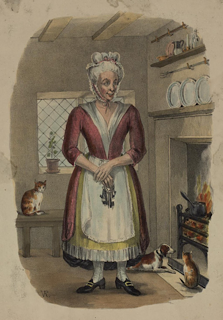
Mary Carryl, an Irish-born loyal servant and friend of the celebrated Ladies of Llangollen, dies on November 22, 1809. She serves them up to her death. When the Ladies die, they share the same grave.
Carryl is brought up in a poor family in Ross, County Wexford. Little is known about her until she is employed by Lady Elizabeth “Betty” and Sir William Fownes, 2nd Baronet, at the Woodstock Estate near Inistioge, County Kilkenny. He inherits the baronetcy from his father Sir William Fownes, 1st Baronet, the Lord Mayor of Dublin, and over 21,000 acres from his grandfather. When Fownes marries Elizabeth Ponsonby, he receives £4,000 as a dowry and the couple builds the six-bayed, three-story Woodstock House in County Kilkenny in 1745-47. In 1769, the Fownes have a thirteen-year-old guest to stay for some time named Sarah Ponsonby, who is Elizabeth’s cousin and the orphaned daughter of Chambré Brabazon Ponsonby. She attends school at Kilkenny.
Sarah develops a friendship with Eleanor Butler, which is not approved of by the Fownes nor by Eleanor’s family guardians. When the friendship begins, Sarah is an unhappy thirteen-year-old orphan. She is captivated by the well-educated Eleanor Butler, a 30-year-old spinster no longer considered marriageable. Sarah is also receiving unwanted attention from Sir William, her guardian.
When Eleanor Butler runs away from home, she is hidden in Sarah’s room and Carryl smuggles in food for her stowaway. Eventually Butler and Ponsonby agree that they can leave Ireland together. They go to Llangollen in Wales where they set up home in a cottage called Plas Newydd. Meanwhile Carryl, who is known as Mary the Bruiser, has been fired after throwing a candlestick that wounds another servant. Her prospects are saved when Eleanor and Sarah send for her to come to Llangollen.
In time Eleanor and Sarah become notorious as “The Ladies of Llangollen,” and Carryl becomes both their servant and the head of the household. She is loyal to her employers. She is said to have “masculine qualities” and Lady Eleanor’s diary records how she gives as good as she gets as she bargains loudly with the fishermen, the butchers and the inebriated.
Carryl dies at Plas Newydd on November 22, 1809, and is buried in the churchyard of St. Collen’s Church, Llangollen. She leaves a shilling to her brother and sister, but leaves the field she owns to Sarah. When in time the Ladies of Llangollen die, they are buried beside their faithful servant.
The memorial monument to Mary Carryl, Eleanor Butler and Sarah Ponsonby in the churchyard of St. Collen’s Church is erected in 1810. The inscription on Carryl’s part of the monument reads: “In Memory of / Mrs Mary Carryl / Deceased 22 November 1809 / This monument is erected by Eleanor Butler, / and Sarah Ponsonby, of Plasnewydd in this Parish. / Released from Earth and all its transient woes, / She whose remains beneath this stone repose, / Stedfast in Faith resigned her parting breath, / Looked up with Christian joy, and smiled in Death! / Patient, Industrious, Faithful, Generous, Kind, / Her Conduct left the proudest far behind, / Her Virtues dignified her humble birth, / And raised her mind above this sordid earth, / Attachment (Sacred bond of grateful breasts) / Extinguished but with life, this Tomb attests, / Reared by Two Friends who will her loss bemoan, / ‘Till with Her Ashes…Here shall rest, Their own.”
(Pictured: A portrait of Mary Carryl from the Welsh Portrait Collection at the National Library of Wales)
Hayes-McCoy is born to Thomas Hayes-McCoy and Mary Kathleen Hayes-McCoy (née Wallace). His grandfather, Thomas Hayes-McCoy, is a Dubliner who as a child came to Galway in 1834 and is later a well-known Parnellite. His maternal grandfather, Thomas Burke, is a Galway artist. He grows up on Eyre Square where his father runs a gentleman’s hairdressing business. His two older siblings are Ignatius and Marguerite. The latter receives a PhD-degree in History at University College Galway (UCG), and later teaches at the Galway Technical School.
Hayes-McCoy receives his early education from the Patrician Brothers, Galway. His earliest notebook of 1927 and a manuscript history of Poland of the same year, now at the National Library of Ireland (NLI), testify to an early interest in history and heritage. From 1928 to 1932 he is a student scholarship holder at University College Galway, graduating in 1932 with a Bachelor of Commerce, and a Bachelor of Arts, with first-class honours in both, and a specialisation in “History, Ethics, Politics” for the latter. Mary Donovan O’Sullivan is one of his professors of history, and Liam Ó Briain, professor of Romance languages, is a stimulating influence. At this time, Hayes-McCoy is a member of the Republican Club, a committee member of the Literary and Debating Society, and in 1931 he is one of the founding members of a new Irish Students’ Association.
Hayes-McCoy pursues his PhD at the University of Edinburgh, and then spends two years at the Institute of Historical Research, London, in the Tudor seminar of J. E. Neale, rewriting his PhD and eventually publishing it as Scots mercenary forces in Ireland, 1565–1603 (Dublin and London, 1937), with a foreword by Eoin MacNeill. This is characterised by meticulous archival research, and it anticipates by sixty years the much-vaunted New British History of the late twentieth century by tracing the interconnections between events in England, Ireland, and Scotland.
In the absence of an academic post, Hayes-McCoy becomes an assistant keeper in the Art and Industrial Division at the National Museum of Ireland (1939–1959), with a responsibility for the Military History, and the Irish War of Independence collections. One of his first tasks is to prepare a standing exhibition on Irish history before 1916. His research, long-standing personal interest in the military, and his curatorial experience, helps form an expert knowledge of historical Irish warfare. This leads to his role in co-founding The Military History Society of Ireland in 1949 whose journal, The Irish Sword, he edits. He describes the vagaries of setting up such a body, its reception, and the historiographical considerations attendant on it, in a paper published posthumously in The Irish Sword.
On August 19, 1941, Hayes-McCoy marries Mary Margaret “May” O’Connor, daughter of C.J. and M.B. O’Connor of New Ross/Enniscorthy. They have three daughters and two sons: Mary, Ann, Ian, Robert, Felicity. The family home is in Dublin.
Earning high reputation by continued research and by publishing leads to Hayes-McCoy’s receipt of the D.Litt. degree from the National University, and to his membership in the Royal Irish Academy in 1950. In his professional career, apart from the broad spectrum of press publications, he publishes prolifically. The works that are judged most influential, are his Scots mercenary forces in Ireland 1565–1603 (1937), the papers “The early history of guns in Ireland” (1938–1939), “Strategy and tactics in Irish warfare, 1593–1601” (1941), “The army of Ulster, 1593–1601” (1951), the controversial “Gaelic society in Ireland in the late sixteenth century” (1963), and the monographs “Irish battles” (London 1969), and “A history of Irish flags from earliest times” (Dublin 1979). A member of the Irish Manuscripts Commission, his most notable contribution is the publication “Ulster and other Irish maps, c.1600” (Dublin 1964).
In 1946, Hayes-McCoy is appointed to a committee of eight historians to advise on setting up the Bureau of Military History, a body established for the creation and compilation of material on the history of the Irish movements for independence, 1913–1921, specifically from witness statements. The committee is also to further offer guidance and oversee progress of the Bureau in coordination with the Ministry of Defence. It subsequently expresses concerns about the state’s role and methods in the collection of statements.
Having begun writing for the press at an early stage, Hayes-McCoy’s public position at the Museum encourages him to go further. He has broad involvement with local history groups to whom he presents papers, and also works for newspapers and for radio and television. To the national and Galway press he usually contributes articles on military aspects of Irish history, as well as book reviews, but he also uses them as a platform to engage with what he sees are flaws in the education of history in Ireland which during his lifetime is constrained by a certain degree of political and cultural state control.
During the 1940s and 1950s, Hayes-McCoy becomes involved in a number of paratheatrical events of national significance one of which – the “Pageant of St.Patrick” for which he writes the script (An Tóstal 1954) – is realised on an immense scale. He scripts these works to begin with and is later principally engaged as historical consultant. In that capacity, he collaborates in 1955 and 1956 with Micheál Mac Liammóir and Denis Johnston on their scripts for pageants on St. Patrick and on the Táin Bó Cuailgne, at times finding it difficult to square the historical liberties taken by these artists with his own role.
On Irish radio and television Hayes-McCoy is most active in the mid-1960s, editing and contributing to Thomas Davis lectures series, writing scripts for a series of thirty children’s programmes on all aspects of Irish history, and preparing/contributing on air to the television series “Irish battles” and “The long winter.” As well as writing for RTÉ, Ireland’s national broadcaster, he contributes scripts to BBC Northern Ireland‘s schools radio programmes.
In 1959, Hayes-McCoy succeeds to the chair of his former history professor at UCG with the full remit of lecturing, administering examinations to undergraduates, and supervising postgraduate theses. Among his students who continue in the field of history are Nicholas Canny, Martin Coen, Patrick Melvin, Peter Toner, Tony Claffey, and Breandán Ó Bric. After his appointment to UCG, the family home remains in Dublin, and he commutes to Galway weekly during term time.
In the early 1960s, Hayes-McCoy becomes a spokesperson for the movement rekindled by the Old Galway Society to preserve the landmark “Lion’s Tower” in the city. The ultimate failure of the campaign informs his regret, expressed a year later, that Ireland is forgetful about its past and that “we don’t bother to find out about it or to maintain our ancient heritage,” and, on a perceived spirit of conformity, “take my own city of Galway, it is now more prosperous than it was, but it is no longer distinctive. I do not believe that it is essential for progress that we should lose our heritage.”
While at one time member and secretary of the London Sinn Féin office and informed by a pride of country and place, Hayes-McCoy’s professional and private outlook are marked by a distrust of nationalism or of any antagonising national agendas compromising genuine scholarship. In a paper drafted on tendencies in modern historical studies, he criticises the two historiographical extremes, each to be avoided, each unfortunately characteristic of the moment – extreme de-bunking and extreme “adding for effect.” “A history is a record of fact; to add pseudo-facts is as grave a sin as to leave out real facts that may change the colour of the whole.”
Hayes-McCoy’s abiding pastime is drawing. Among his papers in the James Hardiman Library, NUI Galway are approximately 40 items with predominantly maritime subjects, and he has a special regard for the history of ships, and a romantic liking of the sea. He also has a lifelong interest in Robert Louis Stevenson, Sir Walter Scott, and their works, and in the Pre-Raphaelite movement.
Hayes-McCoy’s middle age is marked by intermittent ill health. He dies on November 27, 1975, in his room at the Great Southern Hotel, Eyre Square, Galway.
Hayes-McCoy’s papers are held at the James Hardiman Library, National University of Ireland, Galway.
Eleanor Charlotte Butler, recluse of Llangollen, is born in Cambrai, France, on May 11, 1739.
Butler is the youngest daughter of Walter Butler of Garryricken, County Tipperary, and his wife, Ellen (née Morres), of Latargh, County Tipperary. Her family are members of the old Catholic gentry, and her father is the sole lineal representative of James Butler, 2nd Duke of Ormonde. In 1740 her family returns to the Garryricken estate, where she spends part of her childhood. She is educated by the English Benedictine nuns of the convent of Our Lady of Consolation in Cambrai, where her Jacobite grand-aunt is a pensioner. Reared in the liberal and anti-clerical environment at Cambrai, she is open about her opposition to Irish Catholicism. She is also well read in literature.
By the time Butler returns to Ireland, her brother John had claimed the family titles and was recognised as 16th Earl of Ormond. Though he never uses the title, his sisters are recognised as the daughters of an earl. As the family is impoverished, and she is not disposed to marriage, a decade is passed in unhappiness. Then, in 1768, the thirteen-year-old Sarah Ponsonby arrives in Kilkenny to attend a local school. Following her visit to the Butler home at Kilkenny Castle, and despite the difference in age, the two form an immediate friendship and corresponded secretly, having discovered their mutual interest in the arts and Rousseau‘s ideal of pastoral retirement.
Ponsonby, upon finishing school, is sent to live with relatives at nearby Woodstock Estate, and there is subject to the uninvited attention of a middle-aged guardian. Butler is discontented with her life and the prospects of her family’s wish to send her back to Cambrai, so the two plan to leave their difficulties behind and settle in England. In their first attempt to flee in March 1778, they leave for Waterford disguised as men and wielding pistols, but their families manage to catch up with them. Butler is then sent to the home of her brother-in-law, Thomas ‘Monarch’ Kavanagh of Borris, County Carlow, but makes a second, successful attempt and runs away to find Ponsonby at Woodstock Estate. Her persistence wins out when both families finally capitulate and accepted their plans to live together.
Butler and Ponsonby set out for Wales in May 1778 and, after an extensive tour of Wales and Shropshire, eventually settle in Llangollen Vale, where they rent a cottage which is renamed Plas Newydd. They are accompanied by Mary Carryll, a former servant of the Woodstock household, who remains in their service until her death in 1809. Having made a deliberate decision to retire from the world, they spend the greater part of their days corresponding with friends, reading, building up a large library and making alterations to Plas Newydd, which takes on a fashionable Gothic look. Their garden, landscaped under their direction, becomes a popular attraction for visitors. Butler meticulously records their daily routine in a series of journals, some of which are now lost.
Their seclusion, eccentricities, semi-masculine dress and short-cropped powdered hair gain them notoriety, and it becomes fashionable to call on them. Their numerous and illustrious visitors include Hester Lynch Piozzi, Charles and Erasmus Darwin, Sir Walter Scott, Sir Arthur Wellesley, the Duke of Gloucester and Josiah Wedgwood. In 1792 they entertain Stéphanie Caroline Anne Syms, later that year to become the wife of Lord Edward FitzGerald, and her mother, Madame de Genlis. Following the arrest of Edward FitzGerald in 1798, Stéphanie and her suite flee to London and on May 27 pass through Llangollen, where the events in Dublin are already known. On hearing that she is staying in the local inn, Butler and Ponsonby invite her to call in. However, when she wishes to stay for the day, their apprehension of Jacobinism leads them to persuade her “principally for her own sake and a little for [our] own to proceed as fast and as incognito as possible for London.”
Both Anna Seward and William Wordsworth, who stay at Plas Newydd, write poems celebrating their friendship, and Lord Byron sends them a copy of The Corsair. Owing to her support of the Bourbons, Butler is sent the Croix St. Louis, which she wears about her neck. Though generally considered a hospitable couple, Seward, who is a good friend, admits that the “incessant homage” they received could make Butler “haughty and imperious,” while Lady Lonsdale thinks her “very clever, very odd.” Their celebrity does have its drawbacks: an article in the General Evening Post of July 24, 1790, entitled “Extraordinary female affection,” suggests indirectly that their relationship is unnatural. Butler is particularly angered by this publicity and appeals to Edmund Burke for legal advice. Their retirement is also continually dogged by financial difficulties. They live mainly off their respective allowances and Butler’s royal pension (granted through the influence of Lady Frances Douglas), but spend beyond their means and are often in debt. To add to their problems, Butler receives no mention in her father’s will. However, the Gothic eccentricities of their cottage, which they succeed over time in purchasing, and garden attract even the interest of Queen Charlotte.
Though it is claimed that neither woman spends a night away from Plas Newydd, in January 1786 they stay with their friends, the Barretts of Oswestry, and that September they visit Sir Henry Bridgeman of Weston Park, near Staffordshire. In June 1797 they take their only holiday, at the coastal resort of Barmouth. Despite their isolation they are well informed about international events and society gossip. The Irish serjeant-at-law Charles Kendal Bushe recalls how they gave him all the news of Dublin, London, Cheltenham, and Paris.
In later years Butler’s eyesight deteriorates, preventing her from keeping her journal. She is secretly painted as an old woman with Ponsonby by Lady Mary Leighton and sketched by Lady Henrietta Delamere. A distinctive, anonymous silhouette shows the two generously proportioned women in traditional riding habits (National Portrait Gallery, London). Butler dies on June 2, 1829, and is buried alongside Carryll at Llangollen church. Sarah Ponsonby is subsequently buried with them.
(From: “Butler, Lady (Charlotte) Eleanor” by Frances Clarke, Dictionary of Irish Biography, http://www.dib.ie)
Maturin’s first three works are Gothic novels published under the pseudonym Dennis Jasper Murphy and are critical and commercial failures. They do, however, catch the attention of Sir Walter Scott, who recommends Maturin’s work to Lord Byron. With their help, his play Bertram is staged in 1816 at the Theatre Royal, Drury Lane for 22 nights, with Edmund Kean starring in the lead role as Bertram. Financial success, however, eludes Maturin, as the play’s run coincides with his father’s unemployment and another relative’s bankruptcy, both of them assisted by the fledgling writer. To make matters worse, Samuel Taylor Coleridge publicly denounces the play as dull and loathsome, and “melancholy proof of the depravation of the public mind,” going nearly so far as to decry it as atheistic.
The Church of Ireland takes note of these and earlier criticisms and, having discovered the identity of Bertram‘s author after Maturin had shed his nom de plume to collect the profits from the play, subsequently bar his further clerical advancement. Forced to support his wife and four children by writing on his curate salary of £80-90 per annum, compared to the £1000 he made for Bertram, he switches back from playwright to novelist after a string of his plays meet with failure. He produces several novels in addition to Melmoth the Wanderer, including some on Irish subjects and The Albigenses, a historical novel which features werewolves. Various poems have also been ascribed to Maturin on dubious grounds and appear to be the work of others. The prize-winning “Lines on the Battle of Waterloo” is published in 1816 under the name of the university graduate John Shee. “The Universe” appears with Maturin’s name on the title page in 1821 but is now thought to be almost completely the work of James Wills.
The exaggerated effectiveness of Maturin’s preaching can be gauged from the two series of sermons that he publishes. On the occasion of the death of Princess Charlotte, he declares, “Life is full of death; the steps of the living cannot press the earth without disturbing the ashes of the dead – we walk upon our ancestors – the globe itself is one vast churchyard.” A contemporary account records that there had seldom been seen such crowds at St Peter’s. “Despite the severe weather, people of all persuasions flocked to the church and listened spellbound to this prince of preachers. In his obituary it is said that ‘did he leave no other monument whereon to rest his fame, these sermons alone would be sufficient.'”
Maturin dies in Dublin on October 30, 1824. A writer in the University Magazine later sums up his character as “eccentric almost to insanity and compounded of opposites – an insatiable reader of novels; an elegant preacher; an incessant dancer; a coxcomb in dress and manners.”
A sister of Maturin’s wife marries Charles Elgee, whose daughter, Jane Francesca, becomes the mother of Oscar Wilde. Thus, Charles Maturin is Oscar Wilde’s great-uncle by marriage. Wilde discards his own name and adopts the name of Maturin’s novel, Melmoth, during his exile in France.
Maturin’s eldest son, William Basil Kingsbury Maturin, follows him into the ministry, as do several of his grandsons. One of these, Basil W. Maturin, dies in the sinking of RMS Lusitania on May 7, 1915. The second son is Edward Maturin, who emigrates to the United States and becomes a novelist and poet there.
Butler is born in Cambrai, France, the youngest daughter of Walter Butler, 16th Earl of Ormonde, of Garryricken, County Tipperary, and his wife, Ellen (née Morres), of Latargh, County Tipperary. Her family are members of the old Catholic gentry, and her father is the sole lineal representative of James Butler, 2nd Duke of Ormonde. In 1740 her family returns to the Garryricken estate, where she spends part of her childhood. She is educated by the English Benedictine nuns of the convent of Our Lady of Consolation in Cambrai, where her Jacobite grand-aunt is a pensioner. Reared in the liberal and anti-clerical environment at Cambrai, she is open about her opposition to Irish Catholicism. She is also well read in literature.
By the time Butler returns to Ireland, her brother John has claimed the family titles and is recognised as 17th Earl of Ormonde. Though he never uses the title, his sisters are recognised as the daughters of an earl. As the family is impoverished, and she is not disposed to marriage, a decade is passed in unhappiness. Then in 1768 the thirteen-year-old Sarah Ponsonby arrives in Kilkenny to attend a local school. Following her visit to the Butler home at Kilkenny Castle, and despite the difference in age, the two form an immediate friendship and correspond secretly, having discovered their mutual interest in the arts and Jean-Jacques Rousseau‘s ideal of pastoral retirement.
Ponsonby, on finishing school, is sent to live with relatives at the nearby Woodstock Estate, and there is subject to the uninvited attention of a middle-aged guardian. Butler is discontented with her life and the prospects of her family’s wish to send her back to Cambrai, so the two plan to leave their difficulties behind and settle in England. In their first attempt to flee in March 1778, they leave for Waterford disguised as men and wielding pistols, but their families manage to catch up with them. Butler is then sent to the home of her brother-in-law Thomas ‘Monarch’ Kavanagh of Borris, County Carlow, but makes a second, successful attempt and runs away to find Ponsonby at the Woodstock Estate. Her persistence wins out when both families finally capitulate and accept their plans to live together.
The two set out for Wales in May 1778 and, after an extensive tour of Wales and Shropshire, eventually settle in Llangollen Vale, where they rent a cottage which is renamed Plas Newydd. They are accompanied by Mary Carryl, a former servant of the Woodstock household, who remains in their service until her death in 1809. Having made a deliberate decision to retire from the world, they spend the greater part of their days corresponding with friends, reading, building up a large library and making alterations to Plas Newydd, which takes on a fashionable Gothic look. Their garden, landscaped under their direction, becomes a popular attraction for visitors. Butler meticulously records their daily routine in a series of journals, some of which are now lost.
Their seclusion, eccentricities, semi-masculine dress and short-cropped powdered hair gain them notoriety, and it becomes fashionable to call on them. Their numerous and illustrious visitors include Hester Lynch Piozzi, Charles and Erasmus Darwin, Sir Walter Scott, Sir Arthur Wellesley, the Duke of Gloucester and Josiah Wedgwood. In 1792 they entertain Pamela Sims, later that year to become the wife of Lord Edward FitzGerald, and her mother Madame de Genlis. Following the arrest of Edward FitzGerald in 1798, Pamela and her suite flee to London and on May 27 pass through Llangollen, where the events in Dublin are already known. On hearing that Pamela FitzGerald is staying in the local inn, Butler and Ponsonby invite her to call in. However, when Pamela wishes to stay for the day, their apprehension of Jacobinism leads them to persuade her “principally for her own sake and a little for [our] own to proceed as fast and as incognito as possible for London.”
Both Anna Seward and William Wordsworth, who stay at Plas Newydd, write poems celebrating their friendship, and Lord Byron sends them a copy of The corsair. Owing to her support of the Bourbons, Butler is sent the Croix St. Louis, which she wears about her neck. Their celebrity does have its drawbacks: an article in the General Evening Post of July 24, 1790, entitled ‘Extraordinary female affection’, suggests indirectly that their relationship is unnatural. Butler is particularly angered by this publicity and appeals to Edmund Burke for legal advice. Their retirement is also continually dogged by financial difficulties. They live mainly off their respective allowances and Butler’s royal pension, granted through the influence of Lady Frances Douglas, but spend beyond their means and are often in debt. To add to their problems, Butler receives no mention in her father’s will. However, the Gothic eccentricities of their cottage, which they succeed over time in purchasing, and garden attract even the interest of Queen Charlotte.
Though it is claimed that neither woman spent a night away from Plas Newydd, in January 1786 they stay with their friends the Barretts of Oswestry, and that September they visit Sir Henry Bridgeman of Weston Park, near Staffordshire. In June 1797 they take their only holiday, at the coastal resort of Barmouth. Despite their isolation they are well informed about international events and society gossip. The Irish serjeant-at-law Charles Kendal Bushe recalls how they gave him all the news of Dublin, London, Cheltenham, and Paris. In later years Butler’s eyesight deteriorates, preventing her from keeping her journal. She is secretly painted as an old woman with Ponsonby by Lady Mary Leighton and sketched by Lady Henrietta Delamere. A distinctive, anonymous silhouette shows the two generously proportioned women in traditional riding habits (National Portrait Gallery, London).
Butler dies on June 2, 1829, and is buried alongside Mary Carryl at St. Collen’s Church in Llangollen. Sarah Ponsonby is subsequently buried with them.
(From: “Butler, Lady (Charlotte) Eleanor” by Frances Clarke, Dictionary of Irish Biography, http://www.dib.ie)
The son of a Roman Catholic wine merchant, Moore graduates from Trinity College, Dublin, in 1799 and then studies law in London. His major poetic work, Irish Melodies (1807–34), earns him an income of £500 annually for a quarter of a century. It contains such titles as “The Last Rose of Summer” and “Oft in the Stilly Night.” The Melodies, a group of 130 poems set to the music of Moore and of Sir John Stevenson and performed for London’s aristocracy, arouses sympathy and support for the Irish nationalists, among whom Moore is a popular hero.
Lalla-Rookh (1817), a narrative poem set in an atmosphere of Oriental splendour, gives Moore a reputation among his contemporaries rivaling that of Byron and Sir Walter Scott. It is perhaps the most translated poem of its time, and it earns what was until then the highest price paid by an English publisher for a poem (£3,000). His many satirical works, such as The Fudge Family in Paris (1818), portray the politics and manners of the Regency era.
In 1824 Moore becomes a participant in one of the most celebrated episodes of the Romantic era. He is the recipient of Byron’s memoirs, but he and the publisher John Murray burn them, presumably to protect Byron. He later brings out the Letters and Journals of Lord Byron (1830), in which he includes a life of the poet. His lifelong espousal of the Catholic cause leads him to produce such brilliant works as his parody of agrarian insurgency, The Memoirs of Captain Rock (1824), and his courageous biography of the revolutionary leader of the 1798 rebellion, The Life and Death of Lord Edward Fitzgerald (1831).
Moore’s personal life is dogged by tragedy including the deaths of all five of his children within his lifetime and a stroke in later life, which disables him from performances, the activity for which he is most renowned. Moore dies while being cared for by his wife, Elizabeth (nee Dyke), at Sloperton Cottage, Bromham, Wiltshire, England on February 26, 1852. His remains are in a vault at St. Nicholas churchyard, Bromham, within view of his cottage-home and beside his daughter Anastasia.
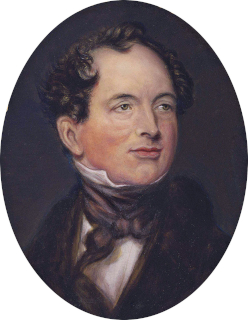
(Pictured: Thomas Moore, after a painting by Thomas Lawrence)
Edgeworth is born at Black Bourton, Oxfordshire, England on January 1, 1768. She is the second child of Richard Lovell Edgeworth and Anna Maria Edgeworth (née Elers). She spends her early years with her mother’s family in England, until her mother’s death when Maria is five. When her father marries his second wife Honora Sneyd in 1773, she goes with him to his estate, Edgeworthstown, in County Longford. There, she assists her father in managing his estate. In this way she acquires the knowledge of rural economy and of the Irish peasantry that is to become the backbone of her novels.
Domestic life at Edgeworthstown is busy and happy. Encouraged by her father, Edgeworth begins her writing in the common sitting room, where the 21 other children in the family provide material and audience for her stories. She publishes them in 1796 as The Parent’s Assistant. Even the intrusive moralizing, attributed to her father’s editing, does not wholly suppress their vitality, and the children who appear in them, especially the impetuous Rosamond, are the first real children in English literature since William Shakespeare.
Her first novel, Castle Rackrent (1800), written without her father’s interference, reveals her gift for social observation, character sketch, and authentic dialogue and is free from lengthy lecturing. It establishes the genre of the “regional novel,” and its influence is enormous. Sir Walter Scott acknowledges his debt to Edgeworth in writing Waverley. Her next work, Belinda (1801), a society novel unfortunately marred by her father’s insistence on a happy ending, is particularly admired by Jane Austen.
Edgeworth never marries. She has a wide acquaintance in literary and scientific circles. Between 1809 and 1812 she publishes her Tales of Fashionable Life in six volumes. They include one of her best novels, The Absentee, which focuses attention on a great contemporary abuse in Irish society: absentee English landowning.
Before her father’s death in 1817 she publishes three more novels, two of them, Patronage (1814) and Ormond (1817), of considerable power. After 1817 she writes less. She completes her father’s Memoirs (1820) and devotes herself to the estate. She enjoys a European reputation and exchanges cordial visits with Scott. Her last years are saddened by the Irish famine of 1846, during which she works for the relief of stricken peasants.
After a visit to see her relations in Trim, Maria, now in her eighties, begins to feel heart pains and dies suddenly of a heart attack in Edgeworthstown on May 22, 1849. She is laid to rest in a vault at Edgeworthstown Church.
The feminist movement of the 1960s leads to the reprinting of her Moral Tales for Young People, 5 vol. (1801) and Letters for Literary Ladies (1795) in the 1970s. Her novels continue to be regularly reprinted in the 21st century.
The son of a Roman Catholic wine merchant, Moore is born at 12 Aungier Street in Dublin on May 28, 1779. From a relatively early age he shows an interest in music and other performing arts. He attends several Dublin schools including Samuel Whyte’s English Grammar School in Grafton Street where he learns the English accent with which he speaks for the rest of his life. In 1795 he graduates from Trinity College, Dublin in an effort to fulfill his mother’s dream of his becoming a lawyer.
Upon graduation from Trinity, Moore studies law in London. His major poetic work, Irish Melodies (1807–34), earns him an income of £500 annually for a quarter of a century. It contains such titles as “The Last Rose of Summer” and “Oft in the Stilly Night.” The Melodies, a group of 130 poems set to the music of Moore and Sir John Andrew Stevenson and performed for London’s aristocracy, arouses sympathy and support for the Irish nationalists, among whom Moore is a popular hero.
Lalla-Rookh (1817), a narrative poem set in an atmosphere of Oriental splendour, gives Moore a reputation among his contemporaries rivaling that of Byron and Sir Walter Scott. It is perhaps the most translated poem of its time, and it earns what is up until then the highest price paid by an English publisher for a poem (£3,000). His many satirical works, such as The Fudge Family in Paris (1818), portray the politics and manners of the Regency era.
In 1824 Moore becomes a participant in one of the most celebrated episodes of the Romantic era. He is the recipient of Byron’s memoirs, but he and the publisher John Murray burn them, presumably to protect Byron. He later brings out the Letters and Journals of Lord Byron: With Notices of his Life (1830), in which he includes a life of the poet. His lifelong espousal of the Catholic cause leads him to produce such brilliant works as his parody of agrarian insurgency, The Memoirs of Captain Rock (1824), and his courageous biography of the revolutionary leader of the Irish Rebellion of 1798, The Life and Death of Lord Edward Fitzgerald (1831).
Moore finally settles in Sloperton Cottage at Bromham, Wiltshire, England, and becomes a novelist and biographer as well as a successful poet. Around the time of the Reform Act he is invited to stand for parliament, and considers it, but nothing comes of it. In 1829 he is painted by Thomas Lawrence, one of the last works completed by the artist before his death.
Moore’s personal life is dogged by tragedy including the deaths of all five of his children within his lifetime and a stroke in later life, which disables him from performances – the activity for which he is most renowned. He dies being cared for by his wife at Sloperton on February 25, 1852. His remains are in a vault at St. Nicholas churchyard, Bromham, within view of his cottage-home, beside his daughter Anastasia.
Lardner’s father was a solicitor in Dublin, who wishes his son to follow the same calling. After some years of uncongenial desk work, Lardner enters Trinity College, Dublin in 1812, obtains a B.A. in 1817 and an M.A. in 1819, winning many prizes. While in Dublin, Lardner begins to write and lecture on scientific and mathematical matters, and to contribute articles for publication by the Irish Academy.
In 1828, Lardner is elected professor of natural philosophy and astronomy at University College, London, a position he holds until he resigns his professorship in 1831. He is the author of numerous mathematical and physical treatises on such subjects as algebraic geometry, differential and integral calculus, and the steam engine. He also writes handbooks on various departments of natural philosophy, but it is as the editor of Lardner’sCabinet Cyclopædia that he is best remembered.
The Cabinet Cyclopædia eventually comprises 133 volumes with many of the ablest savants of the day contributing to it, including Sir Walter Scott, Thomas Moore, Connop Thirlwall, and Robert Southey. Lardner himself is the author of the treatises on arithmetic, geometry, heat, hydrostatics and pneumatics, mechanics, and electricity. The Cabinet Library and the Museum of Science and Art are his other chief undertakings.
In 1840, Lardner’s career receives a major setback as a result of his involvement with Mary Spicer Heaviside, the wife of Captain Richard Heaviside, of the Dragoon Guards. Lardner runs off to Paris with Mrs. Heaviside and is pursued by her husband. When he catches up with them, Heaviside subjects Lardner to a flogging but is unable to persuade his wife to return with him. Later that year Heaviside successfully sues Lardner for “criminal conversation” (adultery) and receives a judgment of £8,000. The Heavisides are divorced in 1845 and Lardner marries Mary Heaviside in 1846. The scandal effectively ends his career in England, so Lardner and his wife remained in Paris until shortly before his death in 1859. He is able to maintain his career by lecturing in the United States between 1841 and 1844, which proves financially rewarding.






 seamus dubhghaill